
Journal of Systems Engineering and Electronics ›› 2026, Vol. 37 ›› Issue (1): 75-83.doi: 10.23919/JSEE.2025.000182
• ELECTRONICS TECHNOLOGY • Previous Articles Next Articles
Liang LI1( ), Hongwei GAO2,*(), Binchao ZHANG3(), Cheng JIN2()
Received:2024-03-12
Accepted:2025-12-22
Online:2026-02-18
Published:2026-03-09
Contact:
Hongwei GAO
E-mail:liuqi@bit.edu.cn;gaohw@bit.edu.cn;binchao_zhang@163.com;jincheng@bit.edu.cn
About author:Supported by:Liang LI, Hongwei GAO, Binchao ZHANG, Cheng JIN. Radar cross section reduction in target airspace based on ultra-wide-angle artificial electromagnetic absorbing surface[J]. Journal of Systems Engineering and Electronics, 2026, 37(1): 75-83.
Add to citation manager EndNote|Reference Manager|ProCite|BibTeX|RefWorks
Fig 1
Schematic diagram of impedance matching of grounded uniaxial material illuminated at oblique incidence angle θ"
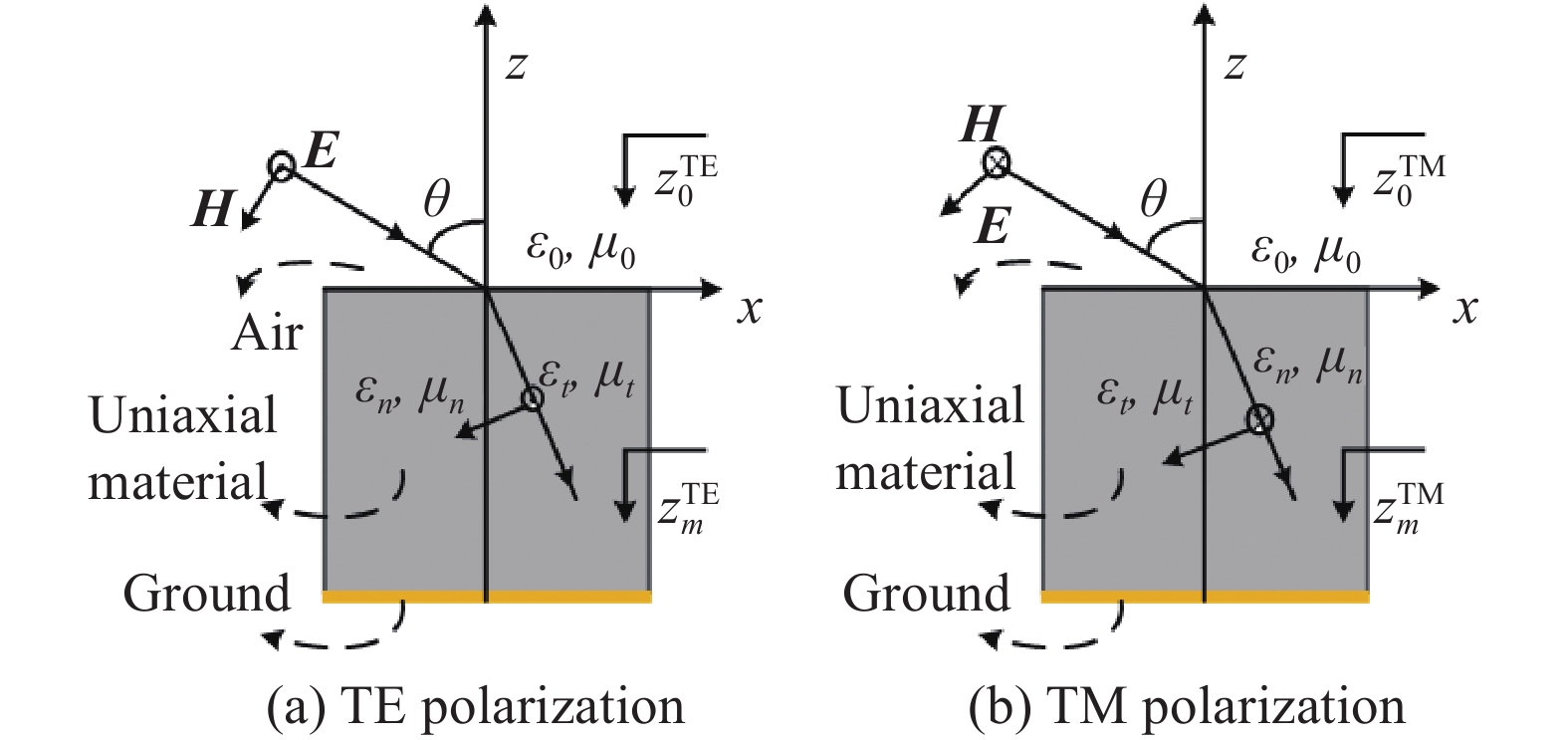

Table 1
Theoretical value of relative permittivity and permeability tensors for matching angles of θ=25°, θ=45°, θ=55°, θ=65° and θ=75°, and the parameters of corresponding five unit cells"
| Relative permittivity and permeability | Parameter of absorbing unit cell/mm | Range/(°) | |
| 25 | 0−30 | ||
| 45 | 30−50 | ||
| 55 | 50−60 | ||
| 65 | 60−70 | ||
| 75 | 70−80 |
Fig 2
Absorbing coefficient of five absorbing structures varing with the incidence angle"
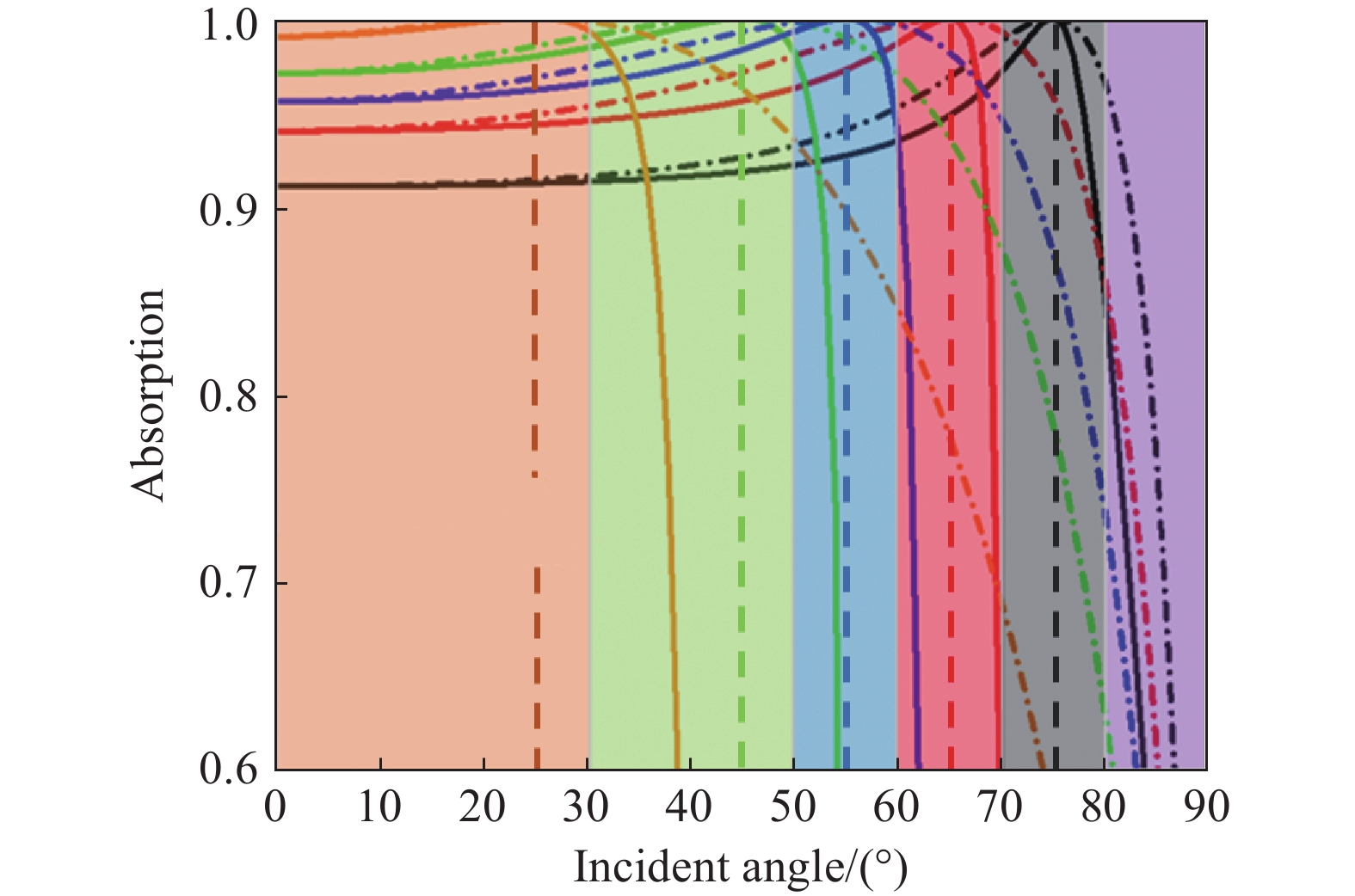
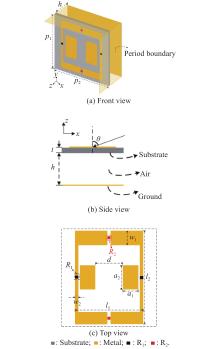
Fig 3
Configuration of the proposed broadband absorbing surface unit cell"
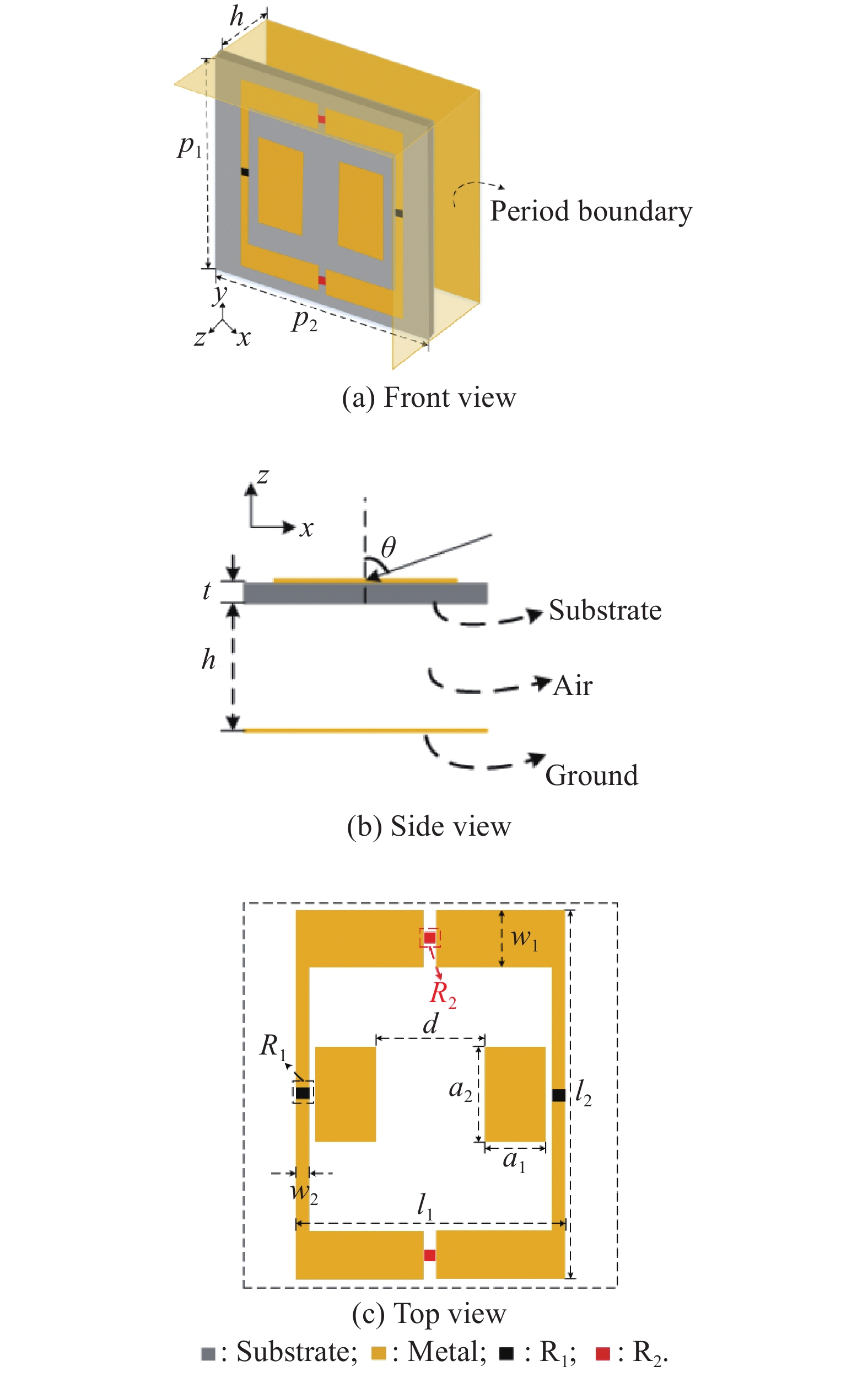
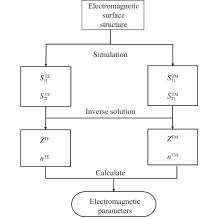
Fig 4
Configuration of the proposed broadband absorbing surface unit cell"
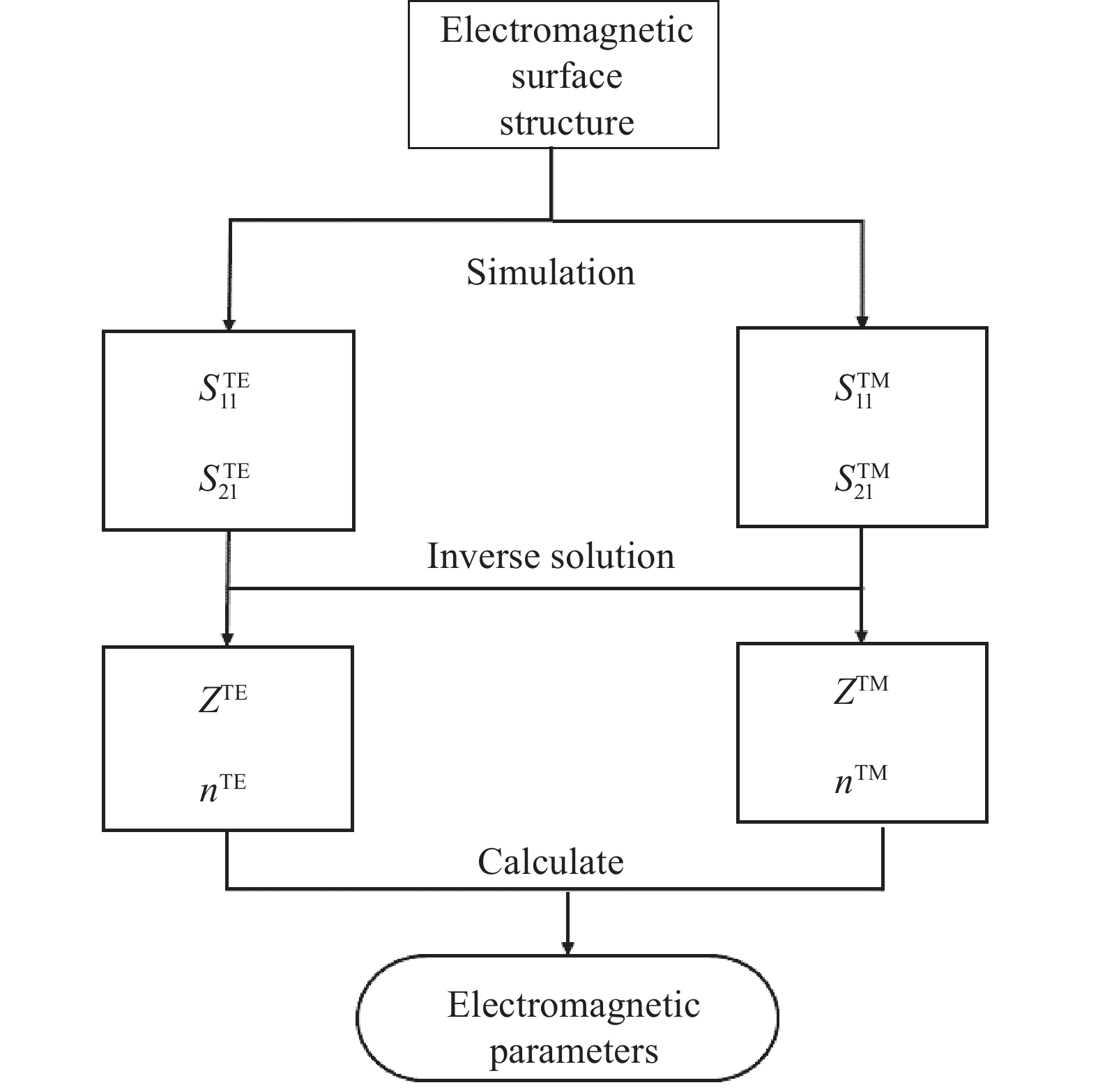
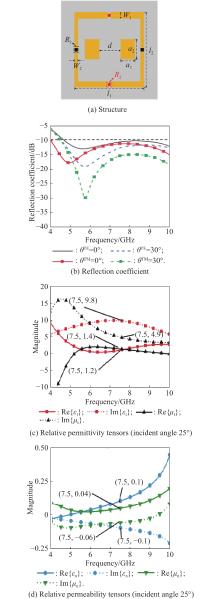
Fig 5
Absorbing surface unit cell I and simulated results"
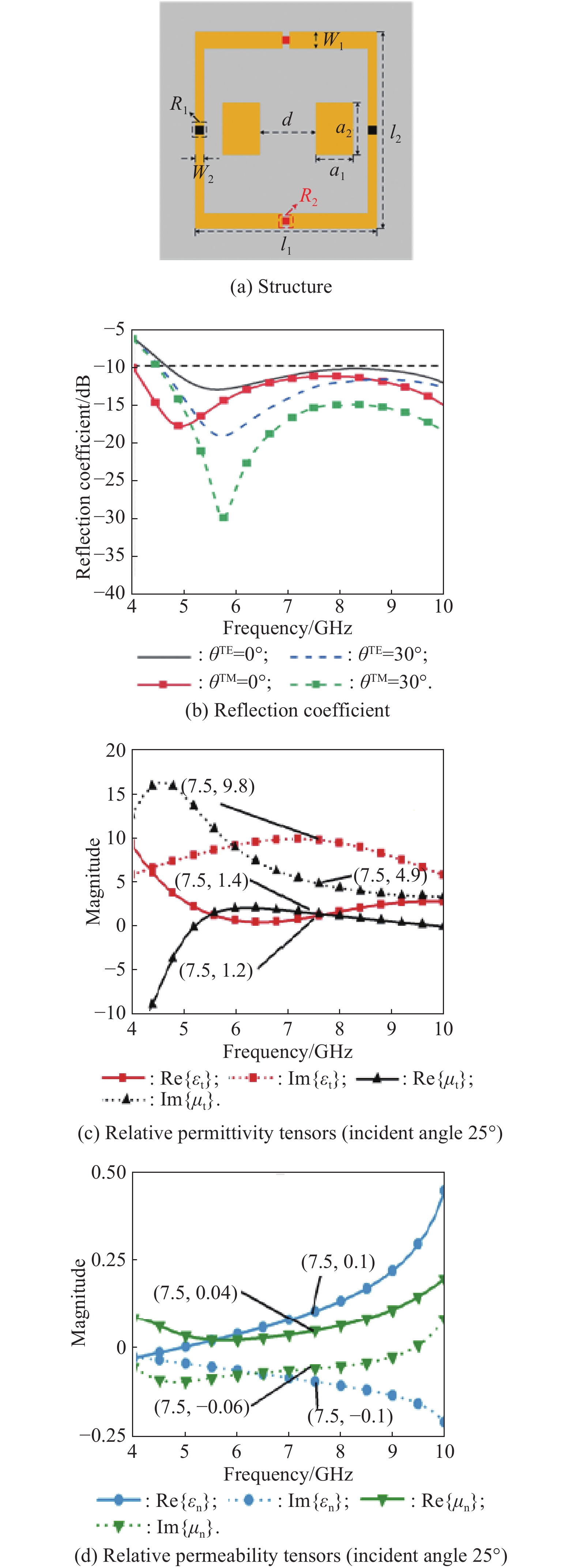
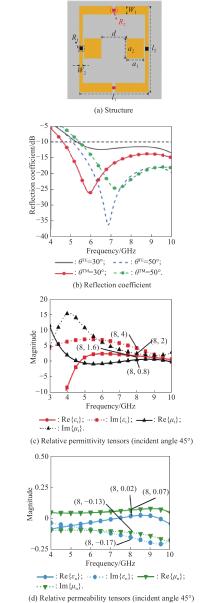
Fig 6
Absorbing surface unit cell II and simulated results"
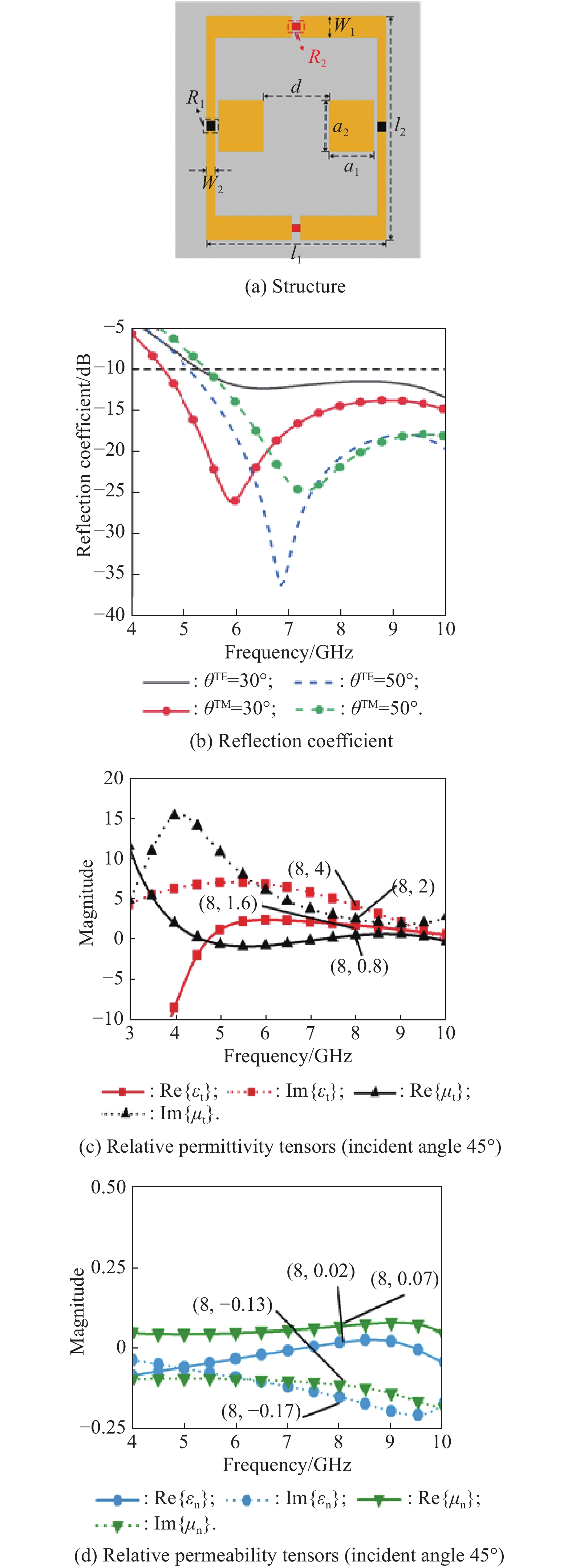
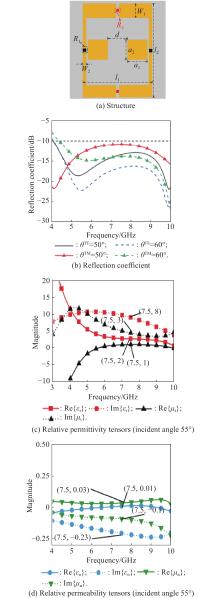
Fig 7
Absorbing surface unit cell III and simulated results"
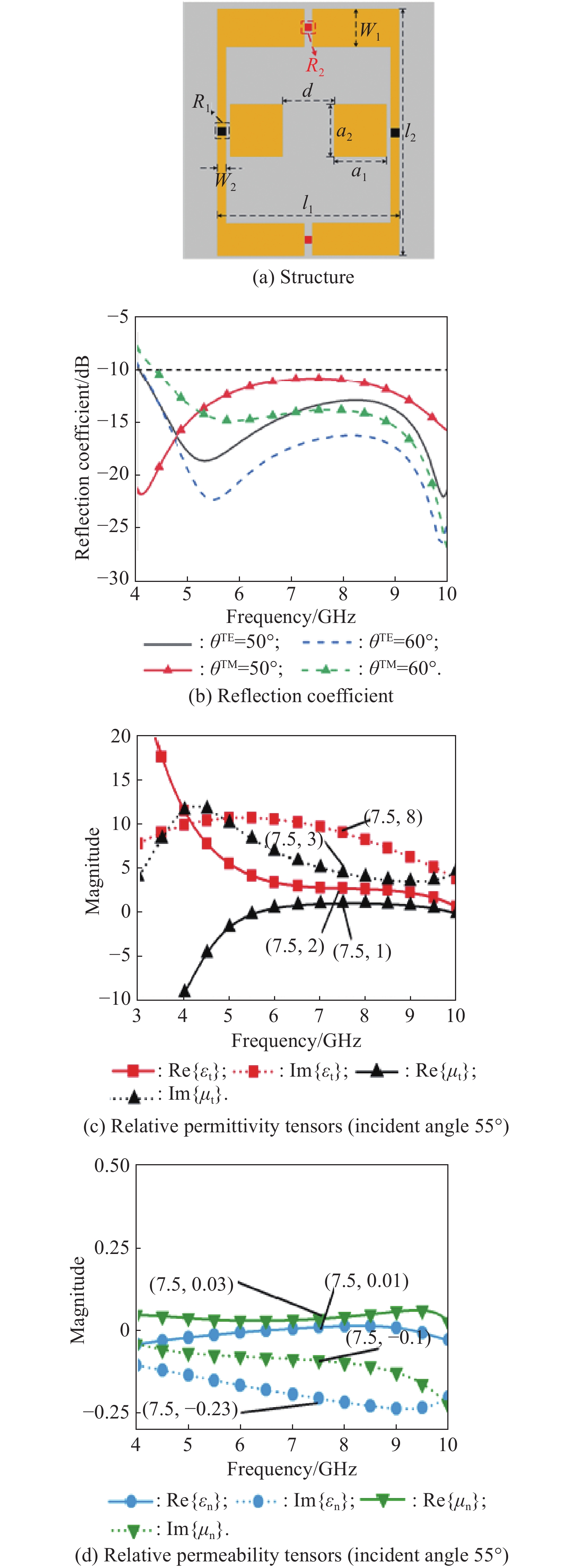
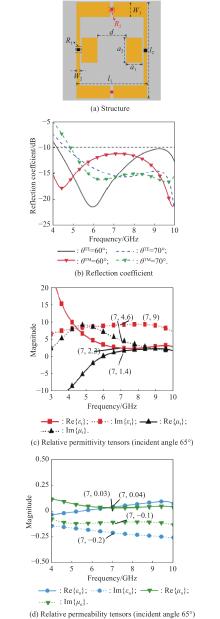
Fig 8
Absorbing surface unit cell IV and simulated results"
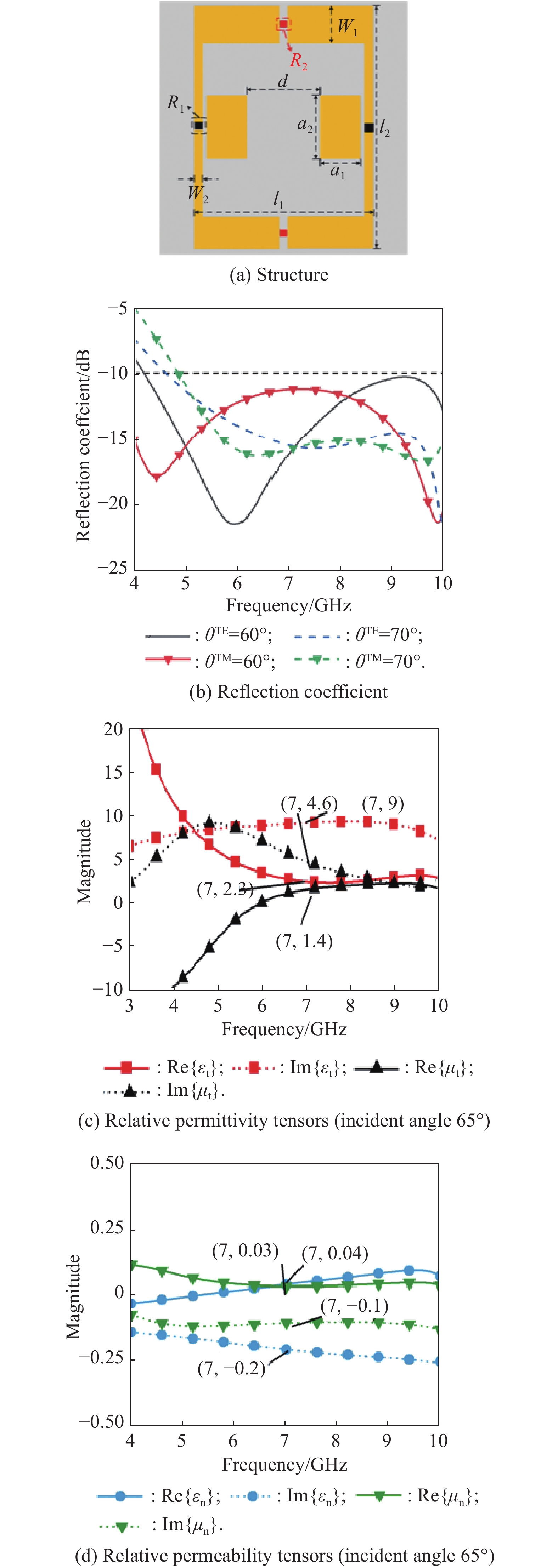
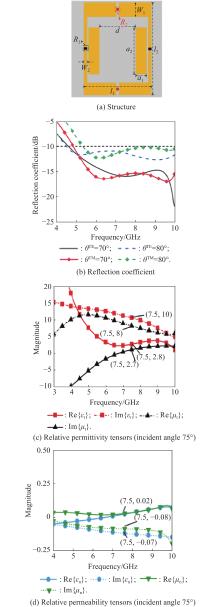
Fig 9
Proposed broadband absorbing surface unit cell and simulated result"
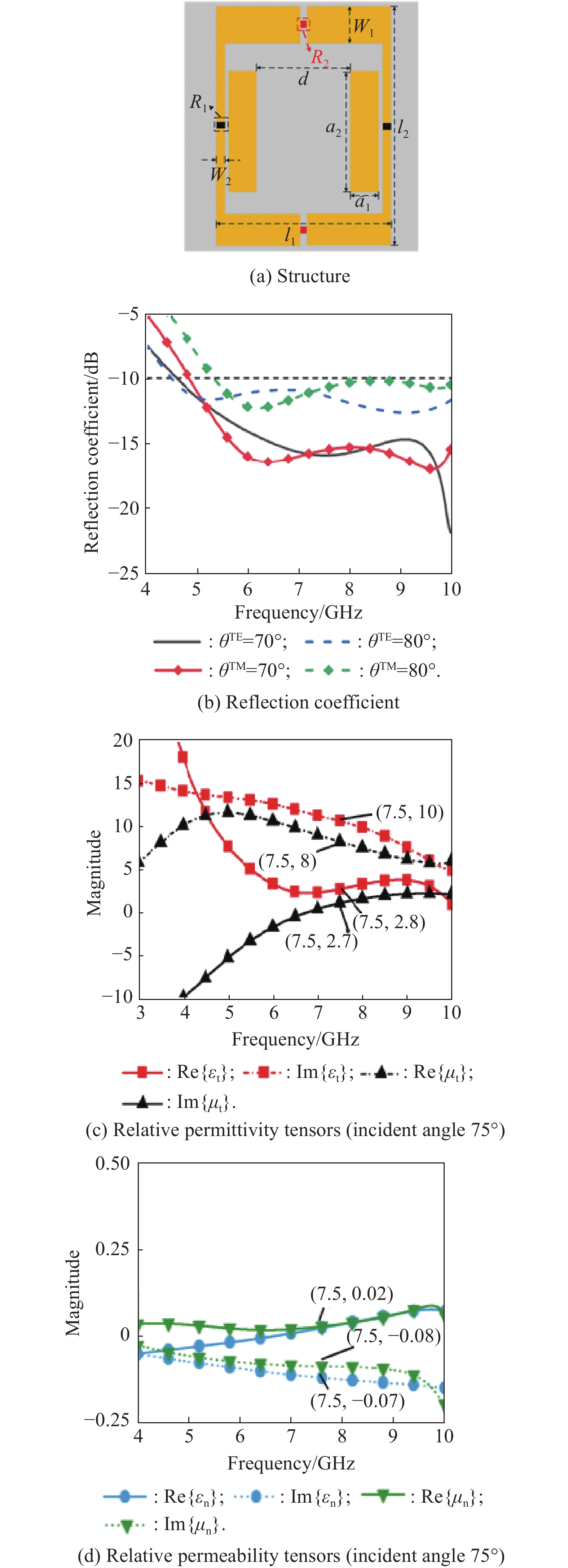
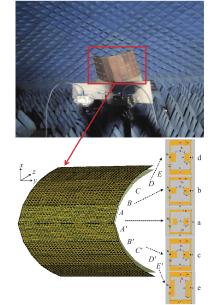
Fig 10
Entire leading edge of airfoil conformal structure and profile"
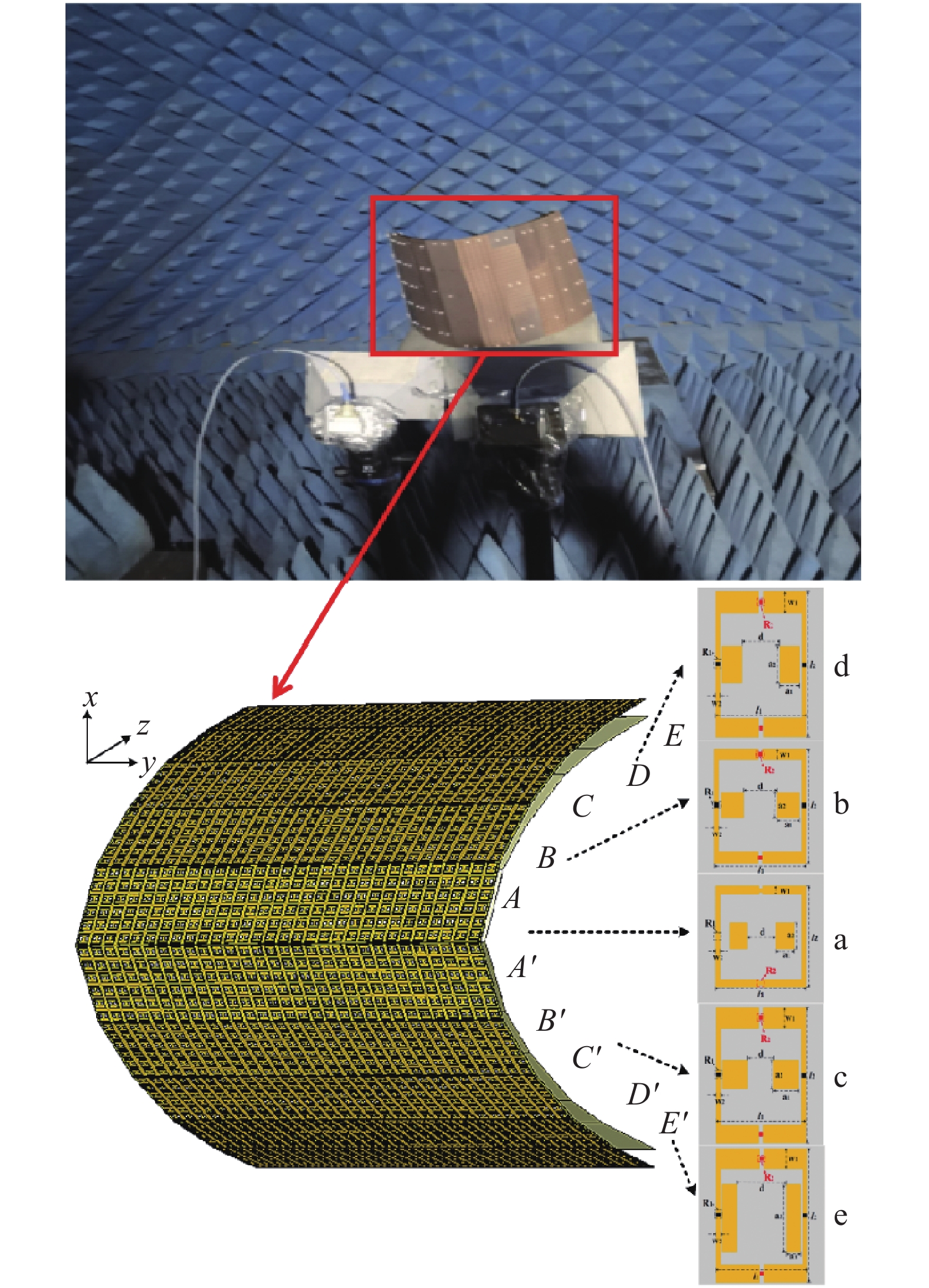
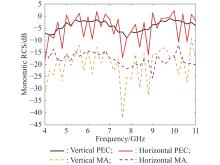
Fig 11
Monostatic RCS of metal plates and equal size MA"
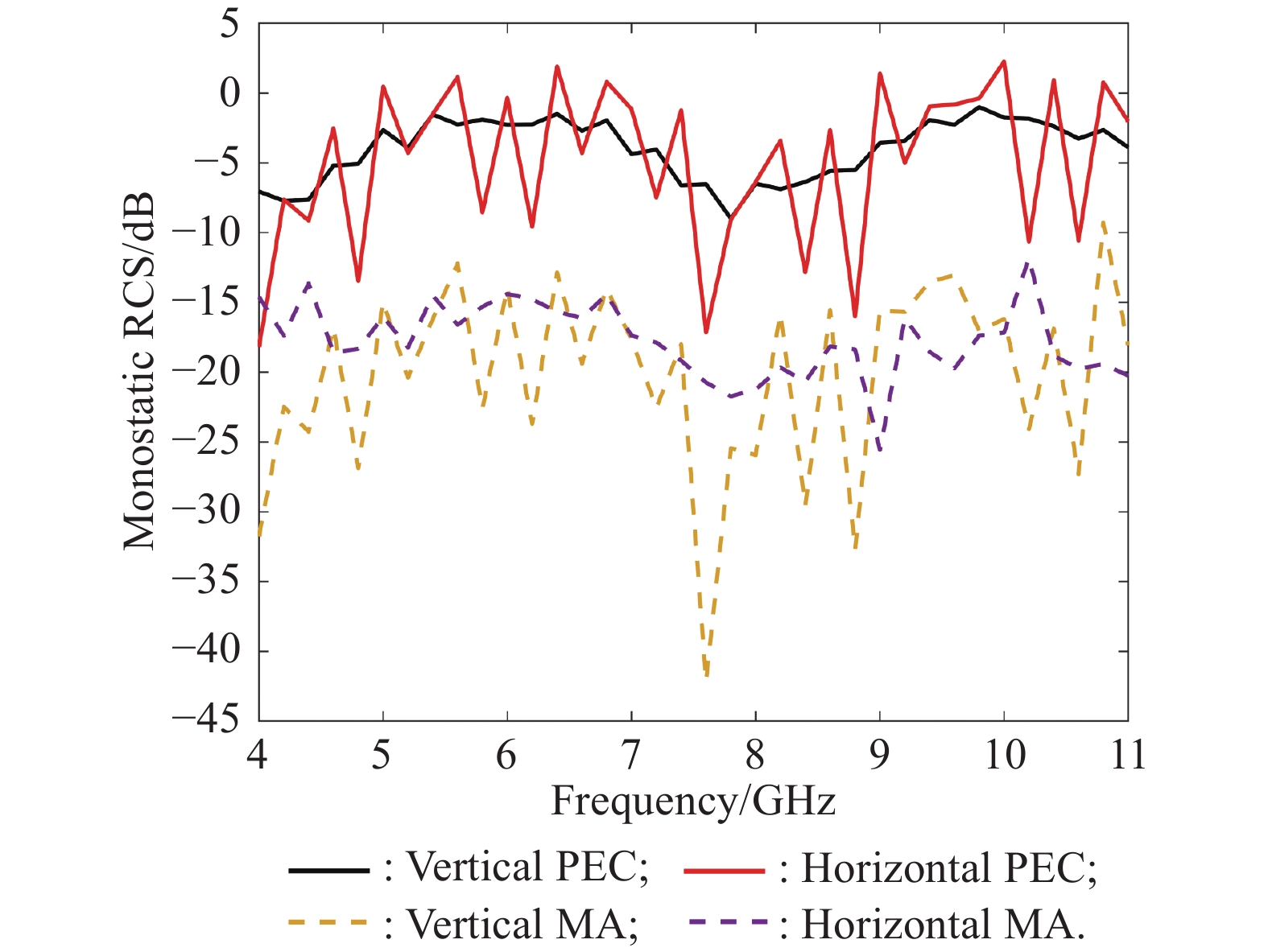
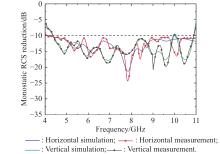
Fig 12
Monostatic RCS reduction results for the horizontal and vertical polarizations"
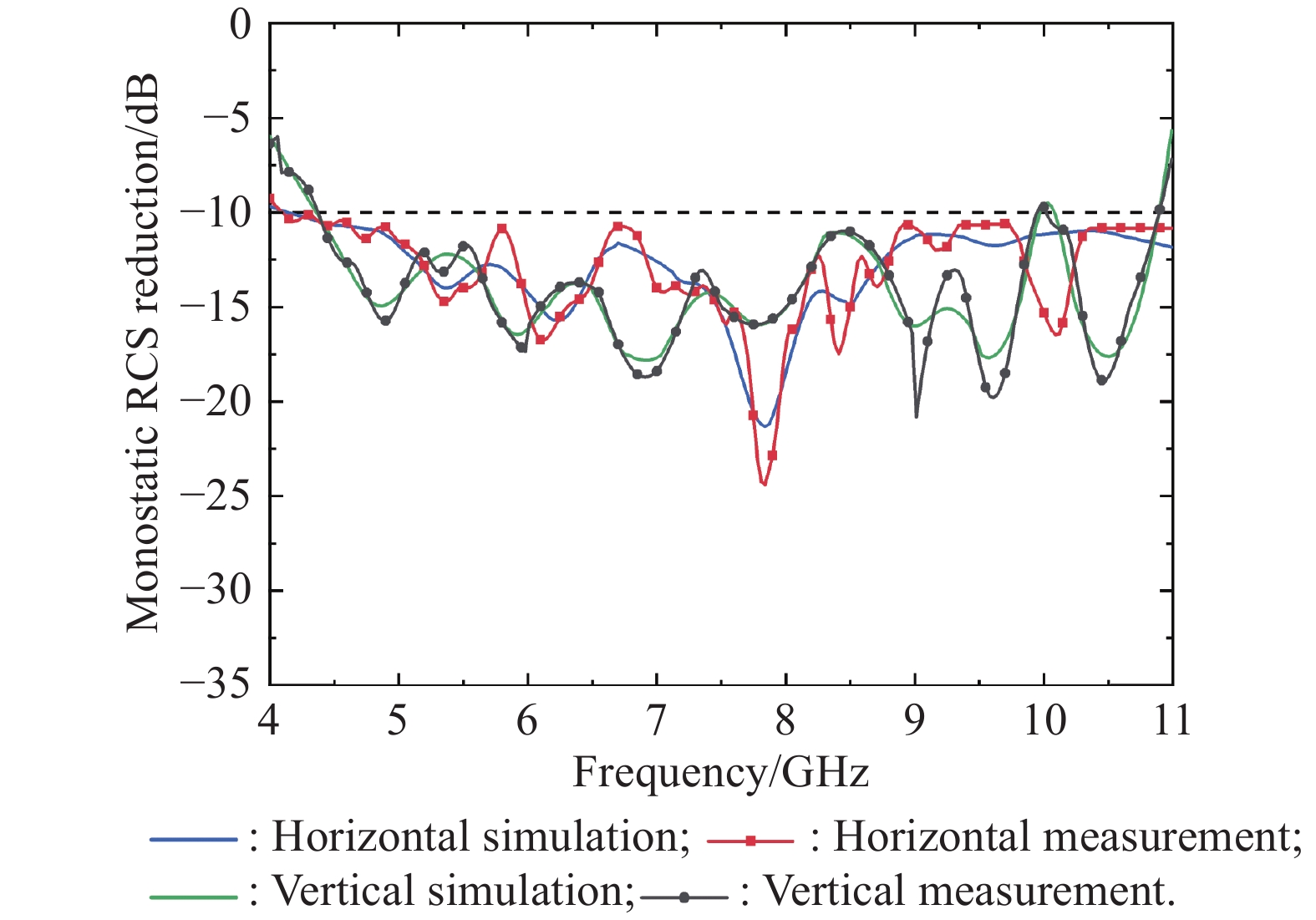
Table 2
Performance comparison of absorbers"
| Reference | Polarization | Oblique incidence/(°) | Bandwidth/GHz |
| [ | TE polarization | 0−65 | 99−117 |
| [ | TM polarization | 0−75 | 3.6−11.4 |
| [ | Dual polarization | 0−45 | 7.7−23.6 |
| [ | Dual polarization | 0−45 | 8.7−32.5 |
| [ | Dual polarization | 0−30 | 14.4−39.4 |
| [ | Dual polarization | 0−50 | 2.11−3.89 |
| This paper | Dual polarization | 0−80 | 5−10.9 |
| 1 |
LV Q H, JIN C, ZHANG B C, et al Wideband dual-polarized microwave absorber at extremely oblique incidence. IEEE Trans. on Antennas and Propagation, 2023, 71 (3): 2497- 2506.
doi: 10.1109/TAP.2022.3233480 |
| 2 |
STEINBERG B D, CARLSON D L, LEE W Experimental localized radar cross sections of aircraft. Proceedings of the IEEE, 1989, 77 (5): 663- 669.
doi: 10.1109/5.32057 |
| 3 | YAN Y B, GE D B, CUI D H, et al. Transient scattering analysis of an airfoil and its RCS reduction by partially RAM coating. Proc. of the IEEE 5th International Symposium on Antennas, Propagation, and EM Theory, 2000: 622−625. |
| 4 | WEI B, GE D B, ZHANG S Q. Wideband scattering of an airfoil with plasma coating. Proc. of the 6th International Symposium on Antennas, Propagation and EM Theory, 2003: 421−423. |
| 5 | CHOI W H, JANG H K, SHIN J H, et al. The effective design approach of radar absorbing leading edge structure of airfoil. Proc. of the International Symposium on Antennas and Propagation, 2012: 708−711. |
| 6 | VINH H, VAN DAM C P, DWYER H A. Airfoil shaping for reduced radar cross section. Journal of Aircraft, 1994: 787−793. |
| 7 |
DENG G Y, ZHANG Y H, GAO H T, et al A super diffuse broadband RCS reduction surface design based on rotated phase coding polarization conversion metasurfaces. IEEE Trans. on Antennas and Propagation, 2023, 71 (9): 7409- 7417.
doi: 10.1109/TAP.2023.3298136 |
| 8 |
WANG P F, JIA Y T, HU W Y, et al Circularly polarized polarization conversion metasurface-inspired antenna array with low RCS over a wide band. IEEE Trans. on Antennas and Propagation, 2023, 71 (7): 5626- 5636.
doi: 10.1109/TAP.2023.3269860 |
| 9 | SOLIMAN S A M, ELDESOUKI E M, EL-NADY S M, et al Broadband low RCS based on polarization-dependent artificial magnetic conductor metasurface. IEEE Access, 2023, 11, 53176- 53184. |
| 10 |
AL-NUAIMI M K T, WHITTOW W G, HUANG G L, et al Wideband radar cross section reduction using parabolic phased metasurfaces. IEEE Antennas and Wireless Propagation Letters, 2023, 22 (7): 1547- 1551.
doi: 10.1109/LAWP.2023.3250453 |
| 11 |
COSTA F, MONORCHIO A, MANARA G Analysis and design of ultra-thin electromagnetic absorbers comprising resistively loaded high impedance surface. IEEE Trans. on Antennas and Propagation, 2010, 58 (5): 1551- 1558.
doi: 10.1109/TAP.2010.2044329 |
| 12 |
ZHANG B C, JIN C, SHEN Z X Low-profile broadband absorber based on multimode resistor-embedded metallic strips. IEEE Trans. on Microwave Theory and Techniques, 2020, 68 (3): 835- 843.
doi: 10.1109/TMTT.2019.2956933 |
| 13 |
CHEN Q, SANG D, GUO M, et al Frequency-selective rasorber with inter absorption band transparent window and interdigital resonator. IEEE Trans. on Antennas and Propagation, 2018, 66 (8): 4105- 4114.
doi: 10.1109/TAP.2018.2835671 |
| 14 |
LV Q H, TANG Y, ZHANG B C, et al Dual-band diffusive metasurface-based reflector with low out-of-band backscattering. IEEE Access, 2020, 8, 217196- 217203.
doi: 10.1109/ACCESS.2020.3042600 |
| 15 |
LV Q H, JIN C, ZHANG B C, et al Wide-passband dual-polarized elliptic frequency selective surface. IEEE Access, 2019, 7, 55833- 55840.
doi: 10.1109/ACCESS.2019.2910394 |
| 16 |
SARABANDI K, BEHDAD N A frequency selective surface with miniaturized elements. IEEE Trans. on Antennas and Propagation, 2007, 55 (5): 1239- 1245.
doi: 10.1109/TAP.2007.895567 |
| 17 |
YU J, JIANG W, GONG S X Wideband angular stable absorber based on spoof surface plasmon polariton for RCS reduction. IEEE Antennas and Wireless Propagation Letters, 2020, 19 (7): 1058- 1062.
doi: 10.1109/LAWP.2020.2988089 |
| 18 | ZABRI N, CAHILL R, SCHUCHINSKY A Polarisation independent resistively loaded frequency selective surface absorber with optimum oblique incidence performance. IET Microwave Antennas Propagate, 2014, 8 (14): 1199- 1203. |
| 19 |
PINTO Y, SARRAZIN J, LEPAGE A C Resistive high-impedance surfaces (RHIS) as absorbers for oblique incidence electromagnetic waves. Applied Physics A, 2014, 117 (2): 693- 697.
doi: 10.1007/s00339-014-8724-5 |
| 20 |
SCHOENLINNER B, ABBASPOUR-TAMIJANI A, KEMPEL L C, et al Switchable low-loss RF MEMS Ka-band frequency-selective surface. IEEE Trans. on Microwave Theory and Techniques, 2004, 52 (11): 2474- 2481.
doi: 10.1109/TMTT.2004.837148 |
| 21 |
OMAR A A, SHEN Z X Double-sided parallel-strip line resonator for dual-polarized 3-D frequency-selective structure and absorber. IEEE Trans. on Microwave Theory and Techniques, 2017, 65 (10): 3744- 3752.
doi: 10.1109/TMTT.2017.2700301 |
| 22 |
LUO G Q, YU W L, YU Y F, et al A three-dimensional design of ultra-wideband microwave absorbers. IEEE Trans. on Microwave Theory and Techniques, 2020, 68 (10): 4206- 4215.
doi: 10.1109/TMTT.2020.3011437 |
| 23 |
LI B, SHEN Z X Wideband 3D frequency selective rasorber. IEEE Trans. on Antennas and Propagation, 2014, 62 (12): 6536- 6541.
doi: 10.1109/TAP.2014.2361892 |
| 24 |
LI B, SHEN Z X Three-dimensional dual-polarized frequency selective structure with wide out-of-band rejection. IEEE Trans. on Antennas and Propagation, 2014, 62 (1): 130- 137.
doi: 10.1109/TAP.2013.2287000 |
| 25 |
MIAS C 3D frequency selective surface for stable angle of incidence. Electronics Letters, 2014, 50 (6): 423- 424.
doi: 10.1049/el.2014.0053 |
| 26 |
ZHU D Z, GREGORY M Z, WERNER P L, et al Fabrication and characterization of multiband polarization independent 3-D-printed frequency selective structures with ultrawide fields of view. IEEE Trans. on Antennas and Propagation, 2018, 66 (11): 6096- 6105.
doi: 10.1109/TAP.2018.2866507 |
| 27 | TRETYAKOV S. Analytical modeling in applied electromagnetics. Norwood, MA: Artech House, 2003. |
| 28 |
PENDRY J B, HOLDEN A J, STEWART W J, et al Extremely low frequency plasmons in metallic mesostructures. Physical Review Letters, 1996, 76 (25): 4773.
doi: 10.1103/PhysRevLett.76.4773 |
| 29 |
LIN X, SHEN Y C, KAMINER I, et al Transverse-electric Brewster effect enabled by nonmagnetic two-dimensional materials. Physical Review A, 2016, 94 (2): 023836.
doi: 10.1103/PhysRevA.94.023836 |
| 30 |
SHEN Y, PANG Y, WANG J, et al Origami-inspired metamaterial absorbers for improving the larger-incident angle absorption. Journal of Physics D: Applied Physics, 2015, 48 (44): 445008.
doi: 10.1088/0022-3727/48/44/445008 |
| 31 |
XIE J W, QUADER S, XIAO F J, et al Truly all-dielectric ultrabroadband metamaterial absorber: water-based and ground-free. IEEE Antennas and Wireless Propagation Letters, 2019, 18 (3): 536- 540.
doi: 10.1109/LAWP.2019.2896166 |
| 32 |
XI Y, JIANG W, HONG T W, et al Wideband and wide-angle radar cross section reduction using a hybrid mechanism metasurface. Optics Express, 2021, 29 (14): 22427- 22441.
doi: 10.1364/OE.429972 |
| 33 |
GAO Z Q, FAN Q, TIAN X X, et al An optically transparent broadband metamaterial absorber for radar-infrared bi-stealth. Optical Materials, 2021, 112, 110793.
doi: 10.1016/j.optmat.2020.110793 |
| 34 | SHI T, JIN L, HAN L, et al Dispersion-engineered, broadband, wide-angle, polarization-independent microwave metamaterial absorber. IEEE Trans. on Antennas and Propagation, 2020, 69 (1): 229- 238. |
| [1] | Zhao Long & Zhang Ning. Adaptive cancellation of Es layer interference using auxiliary horizontal antennas [J]. Journal of Systems Engineering and Electronics, 2006, 17(2): 313-315. |
| Viewed | ||||||
|
Full text |
|
|||||
|
Abstract |
|
|||||
