
Journal of Systems Engineering and Electronics ›› 2026, Vol. 37 ›› Issue (2): 431-444.doi: 10.23919/JSEE.2025.000042
• DEFENCE ELECTRONICS TECHNOLOGY • Previous Articles
Gang WU1,2,3( ), Zhongping HUANG2(), Zhiyong LEI2,*()
Received:2024-08-19
Accepted:2025-03-10
Online:2026-04-18
Published:2026-04-30
Contact:
Zhiyong LEI
E-mail:wugang151@sohu.com;274545306@qq.com;zhylie@163.com
About author:Gang WU, Zhongping HUANG, Zhiyong LEI. High-dimensional robust nested parallel streaming adaptive processor[J]. Journal of Systems Engineering and Electronics, 2026, 37(2): 431-444.
Add to citation manager EndNote|Reference Manager|ProCite|BibTeX|RefWorks
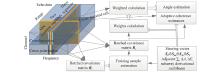
Fig 1
Adaptive processing frameworks"
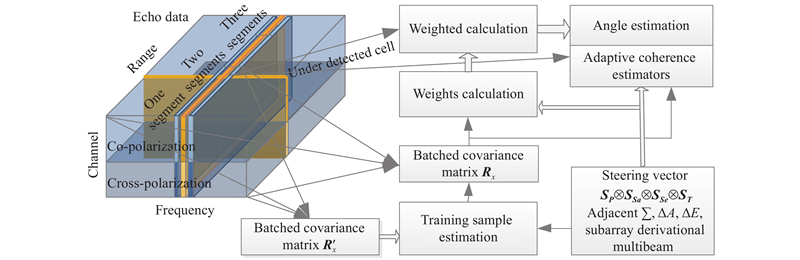
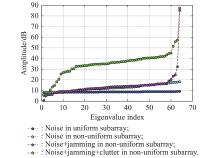
Fig 2
Distribution of covariance matrix’s eigenvalues at four states"
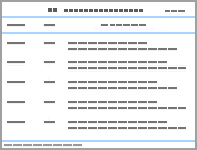
Table 1
Comparison of calculation methods"
| Criterion | Method | ||||
| Gauss-Jordan | QR | LU | LLT | LDLT-RMI | |
| Number of operator type | 3 | 4 | 3 | 4 | 3 |
| Addition | |||||
| Multiplication | |||||
| Division | |||||
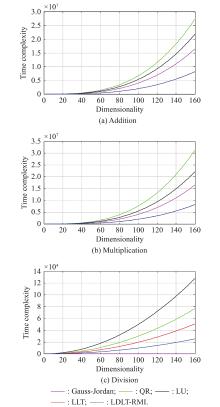
Fig 3
Matrix inversion time complexity comparison"
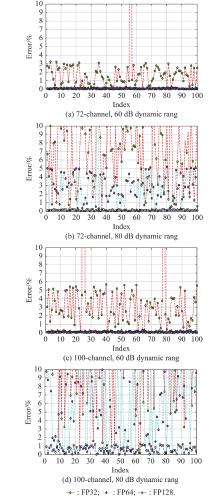
Fig 4
Error of covariance inverse matrix at different FP precisions"
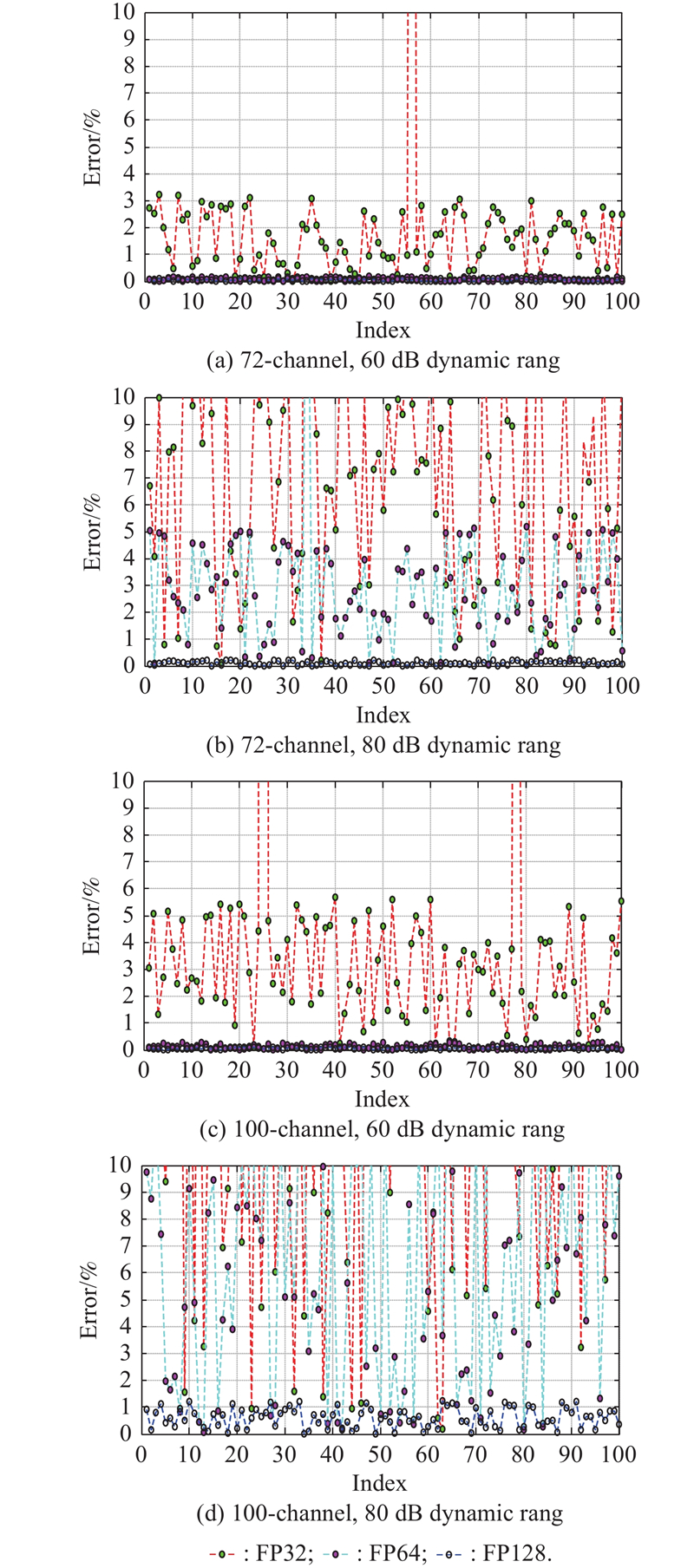
Fig 5
STAP effect with FP64, FP128 precision LDLT-RMI"
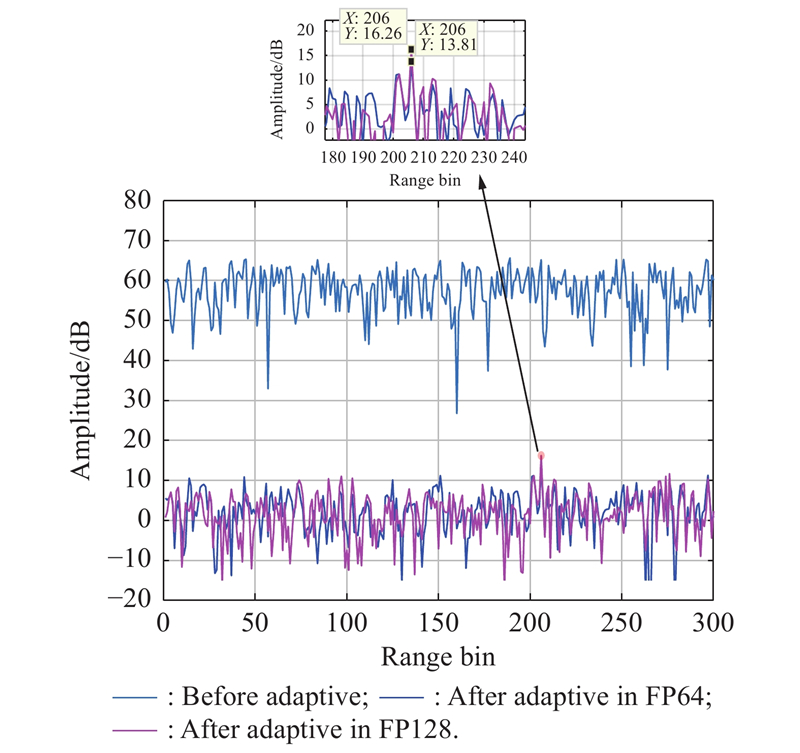
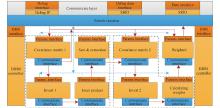
Fig 6
Fully interchangeable streaming adaptive architecture"
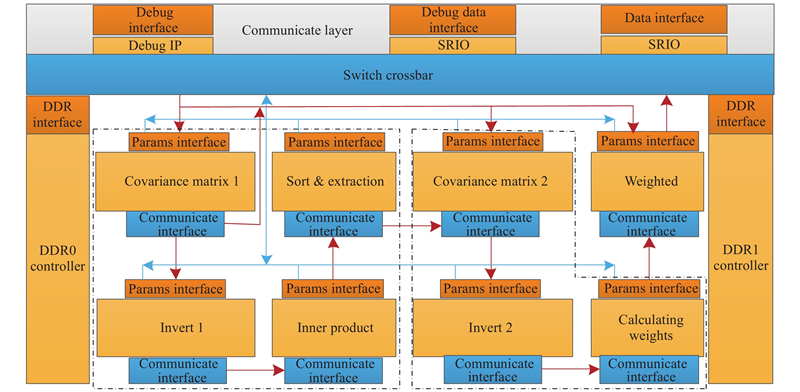
Fig 7
Nested parallel computing structure"
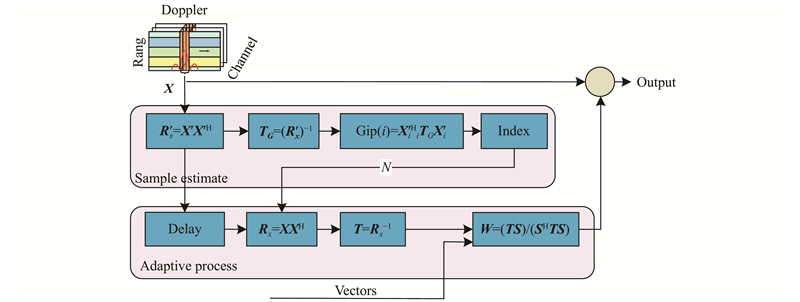
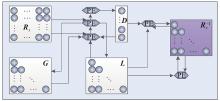
Fig 8
LDLT-RMI matrix inversion"
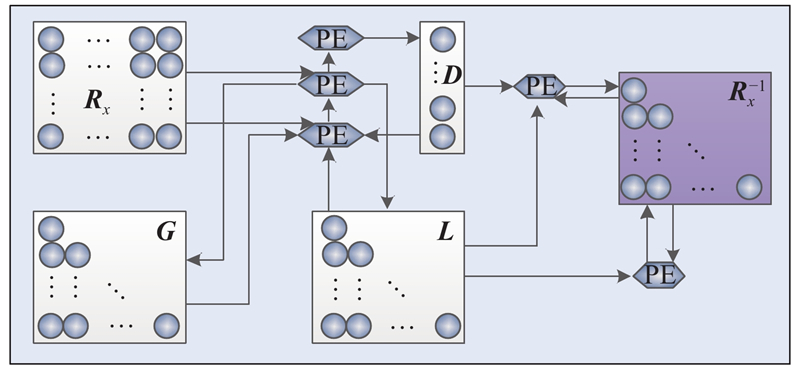
Fig 9
Covariance Matrix 1"
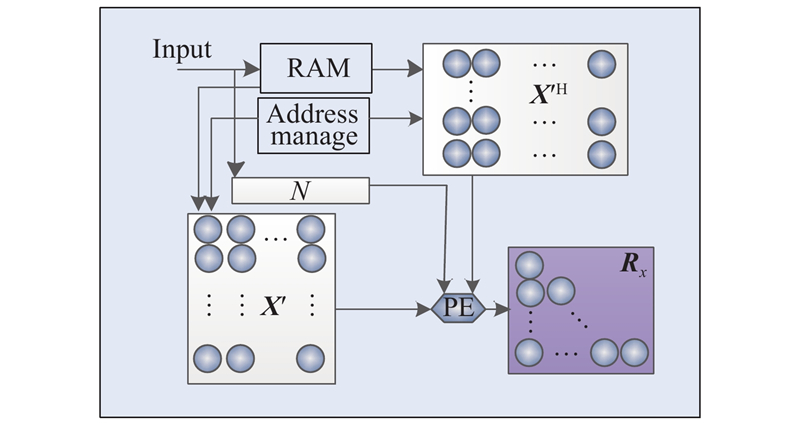
Fig 10
Covariance Matrix 2"
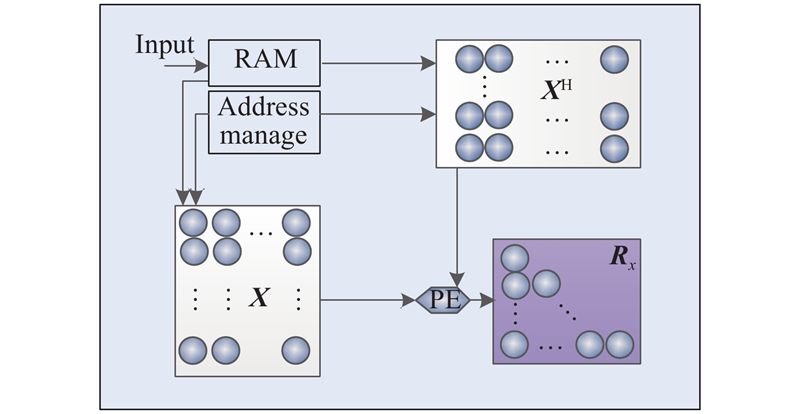
Fig 11
GIP"
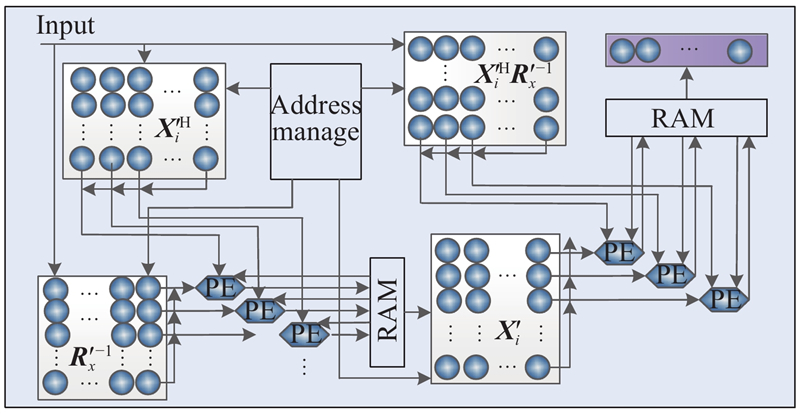
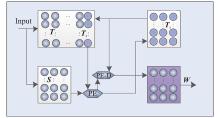
Fig 12
Calculating weights"
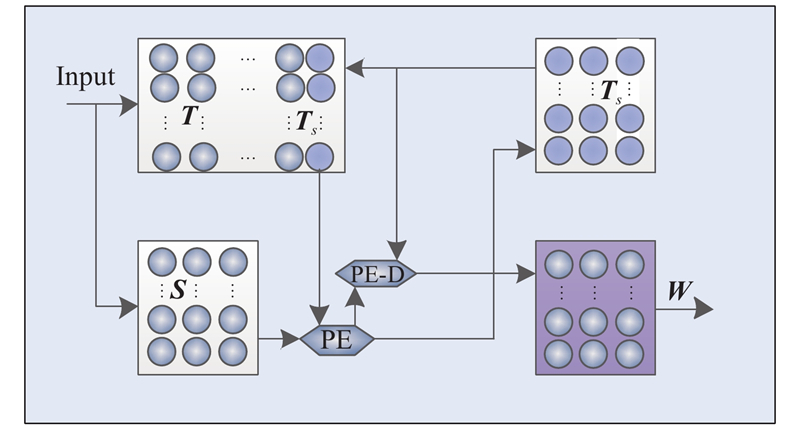
Fig 13
Multi-steering vector weighted"
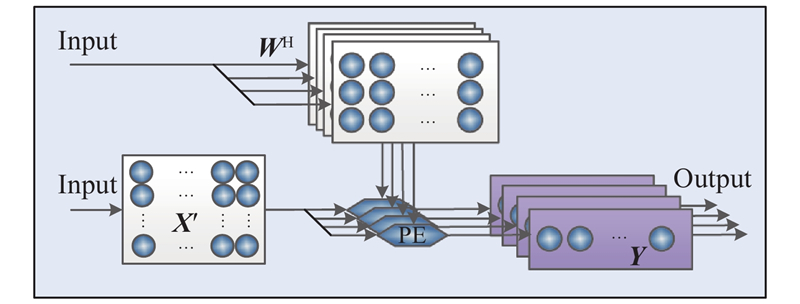
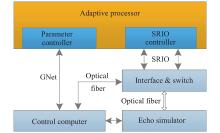
Fig 14
Experimental test process"
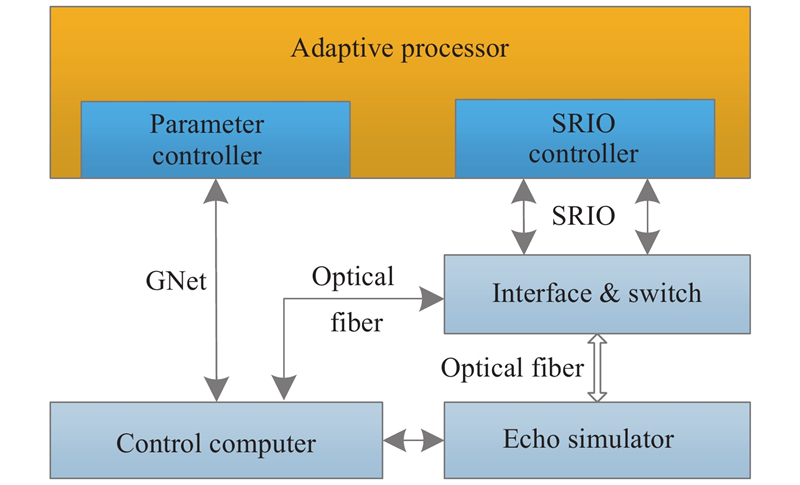
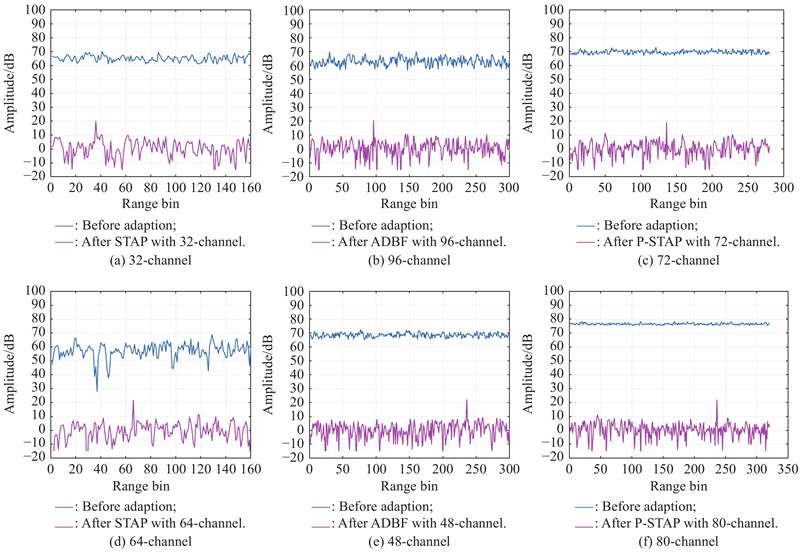
Fig 15
Adaptive processing power spectrum"
| 1 | SHIN H. The mitigation of multiple jammers using a sidelobe canceller designed with independently configured loops. Proc. of the IEEE Radar Conference, 2018: 969−974. |
| 2 | WANG R X, DENG Y K, WANG W, et al A novel adaptive digital beamforming method based on beam-space phase-center cross correlation. IEEE Trans. on Geoscience and Remote Sensing, 2023, 61, 5212213. |
| 3 | HUAN Z P, LEI Z Y, HE Z S, et al. Performance analysis on clutter suppression of polarization space time adaptive processing for airborne radar. Proc. of the 5th International Conference on Electronics and Communication Technologies, 2023: 59−64. |
| 4 |
ZHANG W, HE Z S, LI J, et al A method for finding best channels in beam-space post-Doppler reduced-dimension STAP. IEEE Trans. on Aerospace and Electronic Systems, 2014, 50 (1): 254- 264.
doi: 10.1109/TAES.2013.120145 |
| 5 | CUI N, DUAN K Q, YU Z J, et al Beam-space reduced-dimension 3D-STAP for nonside-looking airborne radar. IEEE Geoscience and Remote Sensing Letters, 2022, 19, 3506505. |
| 6 |
XU J W, WANG C H, LIAO G S, et al Sum-and-difference beamforming for angle-Doppler estimation with STAP-based radars. IEEE Trans. on Aerospace and Electronic Systems, 2016, 52 (6): 2825- 2837.
doi: 10.1109/TAES.2016.150728 |
| 7 | KLINTBERG J, MCKELVEY T, DAMMERT P. A parametric approach to space-time adaptive processing in bistatic radar systems. IEEE Trans. on Aerospace and Electronics Systems, 2022, 58(2): 1149−1160. |
| 8 | HUANG P H, ZOU Z H, XIA X G, et al A novel dimension-reduced space-time adaptive processing algorithm for spaceborne multichannel surveillance radar systems based on spatial-temporal 2-D sliding window. IEEE Trans. on Geoscience and Remote Sensing, 2022, 60, 5109721. |
| 9 |
ABDELFATTAH A, TOMOV S, DONGARRA J Matrix multiplication on batches of small matrices in half and half-complex precisions. Journal of Parallel and Distributed Computing, 2020, 145, 188- 201.
doi: 10.1016/j.jpdc.2020.07.001 |
| 10 |
MASLIAH I, ABDELFATTAH A, HAIDAR A, et al Algorithms and optimization techniques for high-performance matrix-matrix multiplications of very small matrices. Parallel Computing, 2019, 81, 1- 21.
doi: 10.1016/j.parco.2018.10.003 |
| 11 | LIU S F, ZHAO Y H, HUANG R F, et al Effective implementation of matrix inversion based on batched LU decomposition on GPU. Journal of Software, 2023, 34 (11): 4952- 4972. |
| 12 | HYUKYEON L, KYUNGMOOK O, MINJEONG C, et al Efficient low-latency implementation of CORDIC-based sorted QR decomposition for multi-gbps MIMO systems. IEEE Trans. on Circuits and Systems II: Express Briefs, 2018, 65 (10): 1375- 1379. |
| 13 |
PEDRAM A, GERSTLAUER A, GEIJN V D, et al Algorithm, architecture, and floating-point unit codesign of a matrix factorization accelerator. IEEE Trans. on Computers, 2014, 63 (8): 1854- 1862.
doi: 10.1109/TC.2014.2315627 |
| 14 |
JAISWAL M K, CHANDRACHOODAN N FPGA-based high-performance and scalable block LU decomposition architecture. IEEE Trans. on Computers, 2012, 61 (1): 60- 68.
doi: 10.1109/TC.2011.24 |
| 15 | LIU Q, QIN S, YU B, et al π-BA: bundle adjustment hardware accelerator based on distribution of 3D-point observations. IEEE Trans. on Computers, 2020, 69 (7): 1083- 1095. |
| 16 |
ZHAO D D, MAO W B, CHEN P, et al FPGA-based real-time synchronous parallel system for underwater acoustic positioning and navigation. IEEE Trans. on Industrial Electronics, 2024, 71 (3): 3199- 3207.
doi: 10.1109/TIE.2023.3266583 |
| 17 |
CHEN S, ZHAO Y B, HU Y L, et al Beamspace maximum likelihood algorithm based on sum and difference beams for elevation estimation. Journal of Systems Engineering and Electronics, 2024, 35 (3): 589- 598.
doi: 10.23919/JSEE.2024.000057 |
| 18 |
SONG D, CHEN S, LI H, et al Space-time adaptive processing via random matrix theory for finite training samples. IEEE Sensors Journal, 2023, 23 (7): 7334- 7344.
doi: 10.1109/JSEN.2023.3245581 |
| 19 | MOHAMMADZADEH S, NASCIMENTO V H, LAMARE R C D, et al Covariance matrix reconstruction based on power spectral estimation and uncertainty region for robust adaptive beamforming. IEEE Trans. on Aerospace and Electronic Systems, 2023, 59 (4): 3848- 3858. |
| 20 | WANG H, CHEN R, XIE W, et al. A reduced-dimensional STAP scheme for end-fire array airborne radar. Proc. of the IEEE International Radar Conference, 2023. DOI: 10.1109/RADAR54928.2023.10371133. |
| 21 | LONCOVA J, OCHODNICKY J. A modified STAP algorithm for ground-based radar. Proc. of the Communication and Information Technologies, 2023. DOI: 10.1109/KIT59097.2023.10297020. |
| 22 |
WANG Y K, XIA W, HE Z S, et al Polarimetric detection in compound Gaussian clutter with Kronecker structured covariance matrix. IEEE Trans. on Signal Processing, 2017, 65 (17): 4562- 4576.
doi: 10.1109/TSP.2017.2716912 |
| 23 | LOMBARDO P, PASTINA D, BUCCIARELLI T. Adaptive polarimetric target detection with coherent radar Part I: detection against Gaussian background. IEEE Trans. on Aerospace & Electronic Systems, 2001, 37(4), 1194−1206. |
| 24 | LOMBARDO P, PASTINA D, BUCCIARELLI T Adaptive polarimetric target detection with coherent radar, Part II: detection against non-Gaussian background. IEEE Trans. on Aerospace and Electronic Systems, 2001, 37 (4): 1207- 1220. |
| 25 |
BLUNT S D, GERLACH K Efficient robust AMF using the FRACTA algorithm. IEEE Trans. on Aerospace and Electronic Systems, 2005, 41 (2): 537- 548.
doi: 10.1109/TAES.2005.1468746 |
| 26 |
GERLACH K, BLUNT S D, PICCIOLO M L Robust adaptive matched filtering using the FRACTA algorithm. IEEE Trans. on Aerospace and Electronic Systems, 2004, 40 (3): 929- 945.
doi: 10.1109/TAES.2004.1337465 |
| 27 | SHEN M W, YU J, WU D, et al. Space-time adaptive monopulse for RD-STAP parameters estimation. Proc. of the IEEE China Summit and International Conference on Signal and Information Processing, 2015: 283−287. |
| 28 |
NICKEL U Overview of generalized monopulse estimation. IEEE Aerospace and Electronics Systems Magazine, 2006, 21 (6): 27- 56.
doi: 10.1109/MAES.2006.1662039 |
| 29 | ZHOU R, ZHANG C, ZHANG G. Generalized space-time adaptive monopulse angle estimation approach. Proc. of the International Conference on Control, Automation and Information Sciences, 2019. DOI: 10.1109/ICCAIS46528.2019.9074719. |
| 30 |
KRAUT S, SCHARF L L, MCWHORTER L T Adaptive subspace detectors. IEEE Trans. on Signal Processing, 2001, 49 (1): 1- 16.
doi: 10.1109/78.890324 |
| 31 | ZHANG W, HAN M H, HE Z A, et al. Data-dependent reduced-dimension STAP. IET Radar Sonar Navigation, 2019, 13(8): 1287−1294. |
| 32 | AHMED A A, LOANNIS P, BENOIT C. Covariance-free non-homogeneity STAP detector in compound Gaussian clutter based on robust statistics. IET Radar, Sonar & Navigation, 2019, 13(12), 2107−2119. |
| 33 |
GOODMAN N A, STILES M J On clutter rank observed by arbitrary arrays. IEEE Trans. on Signal Processing, 2007, 55 (1): 178- 186.
doi: 10.1109/TSP.2006.882071 |
| 34 |
SEN S Low-rank matrix decomposition and spatio-temporal sparse recovery for STAP radar. IEEE Journal of Selected Topics in Signal Processing, 2015, 9 (8): 1510- 1523.
doi: 10.1109/JSTSP.2015.2464187 |
| No related articles found! |
| Viewed | ||||||
|
Full text |
|
|||||
|
Abstract |
|
|||||
