
Journal of Systems Engineering and Electronics ›› 2026, Vol. 37 ›› Issue (1): 137-147.doi: 10.23919/JSEE.2025.000155
• DEFENCE ELECTRONICS TECHNOLOGY • Previous Articles Next Articles
Yongsheng DUAN( ), Junning ZHANG(), Lei XUE(), Ying XU()
Received:2025-05-15
Accepted:2025-09-11
Online:2026-02-18
Published:2026-03-09
Contact:
Junning ZHANG
E-mail:406810103@qq.com;zjn20101796@sina.cn;eeixuelei@163.com;eeixuying@163.com
About author:Supported by:Yongsheng DUAN, Junning ZHANG, Lei XUE, Ying XU. Embedded RF fingerprint interpretation: multi-channel complex residual networks with adaptive sphere space decision boundaries[J]. Journal of Systems Engineering and Electronics, 2026, 37(1): 137-147.
Add to citation manager EndNote|Reference Manager|ProCite|BibTeX|RefWorks
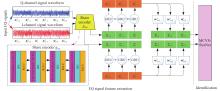
Fig 1
An I/Q signal feature extraction network based on multi-channel CPC"
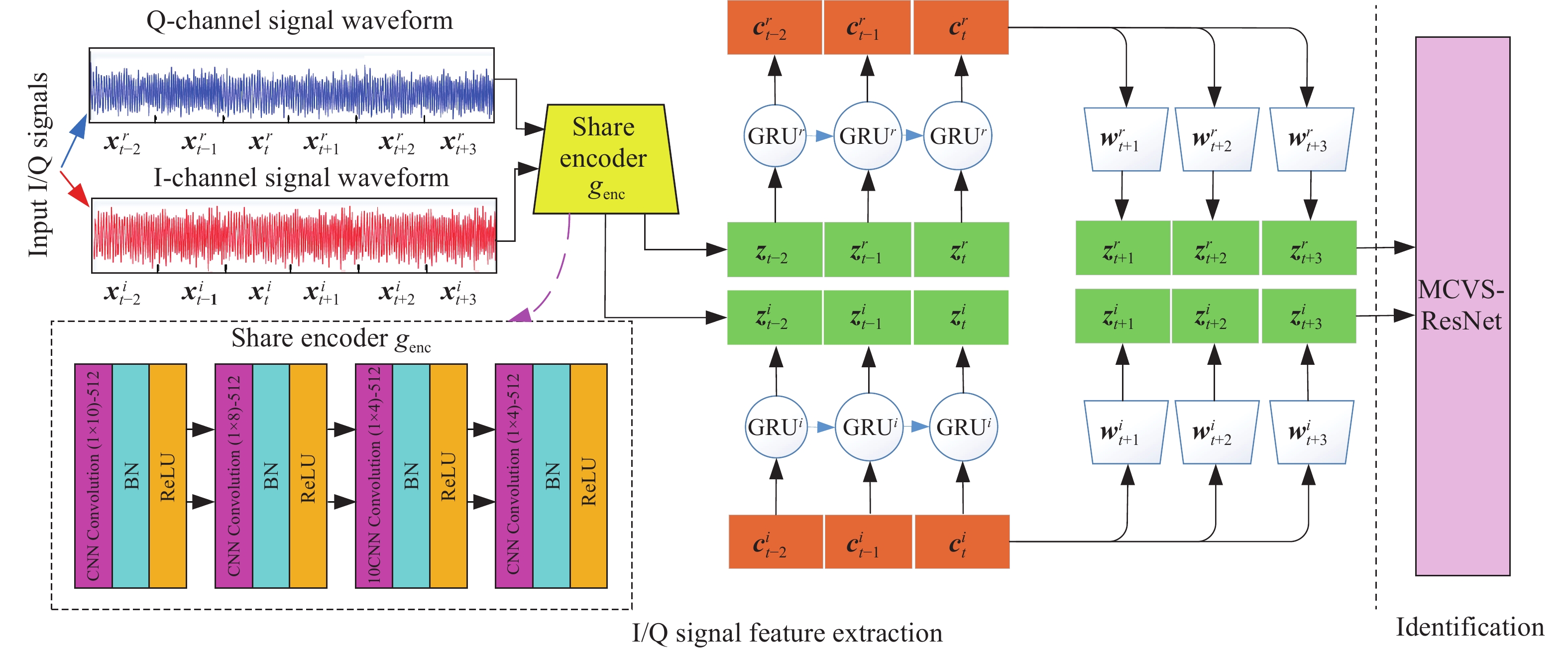
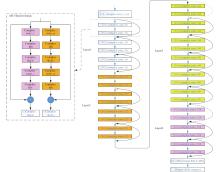
Fig 2
Schematic representation of the multi-channel complex-valued residual network architecture"
Fig 3
Optimization objective of SS-softmax"
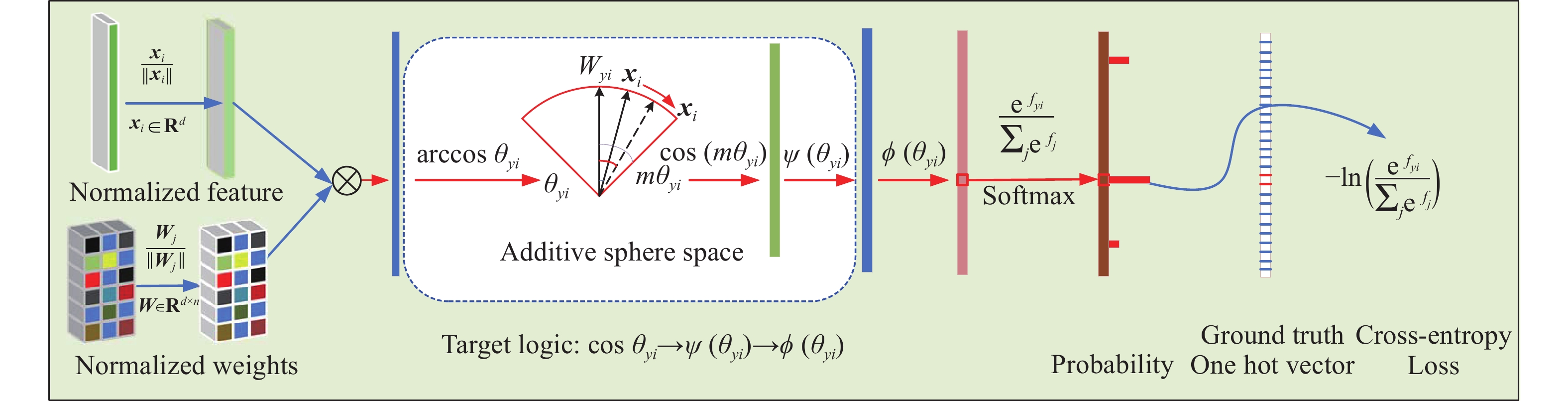
Fig 4
Schematic diagram of the angular margin-based decision boundary"
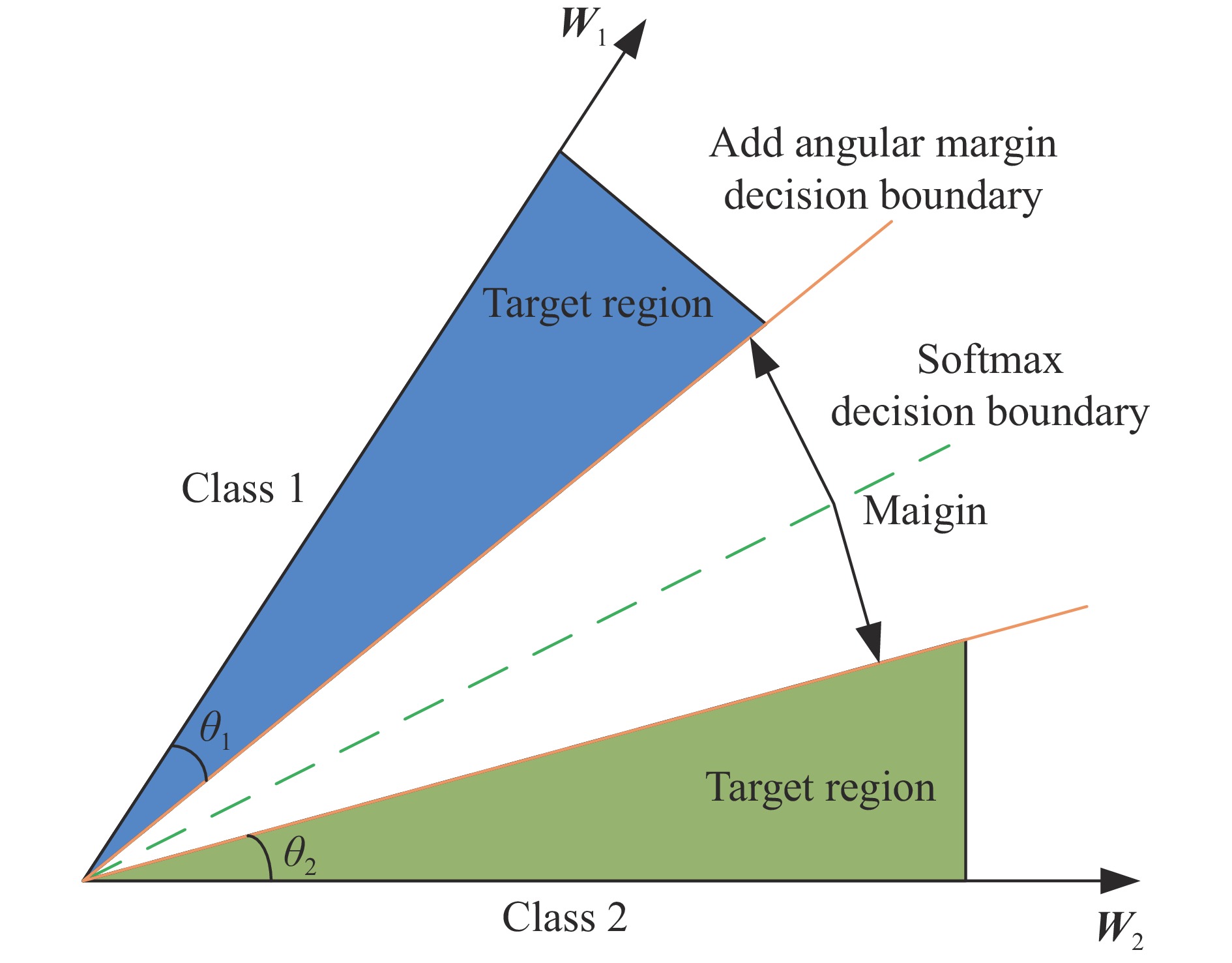
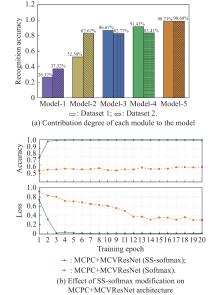
Fig 5
Algorithm ablation experiment"
Table 1
Performance comparison of various models on multiple datasets"
| Algorithm | Dataset 1 | Dataset 2 | Number of parameters | Single-epoch time/s | Number of training epoch | Total time/s | |||
| Training accuracy/% | Validation accuracy/% | Training accuracy/% | Validation accuracy/% | ||||||
| ResNet [ | 96.02 | 82.67 | 75.48 | 52.50 | 485 406 | 15.11 | 33 | 498.33 | |
| CVCNN- ResNet [ | 95.32 | 83.08 | 86.56 | 84.28 | 6 852 817 | 57.365 | 16 | 917.84 | |
| CPC-ResNet | 97.35 | 82.77 | 91.32 | 86.67 | 3 951 283 | 52.285 | 15 | 784.275 | |
| MCPC-ResNet [ | 97.64 | 83.41 | 93.21 | 91.43 | 9 087 283 | 70.588 | 6 | 453.528 | |
| The proposed method | 99.91 | 98.68 | 99.62 | 98.21 | 14 093 495 | 114.706 | 5 | 573.53 | |
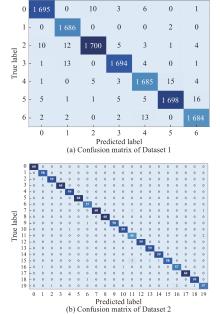
Fig 6
Confusion matrix of different datasets"
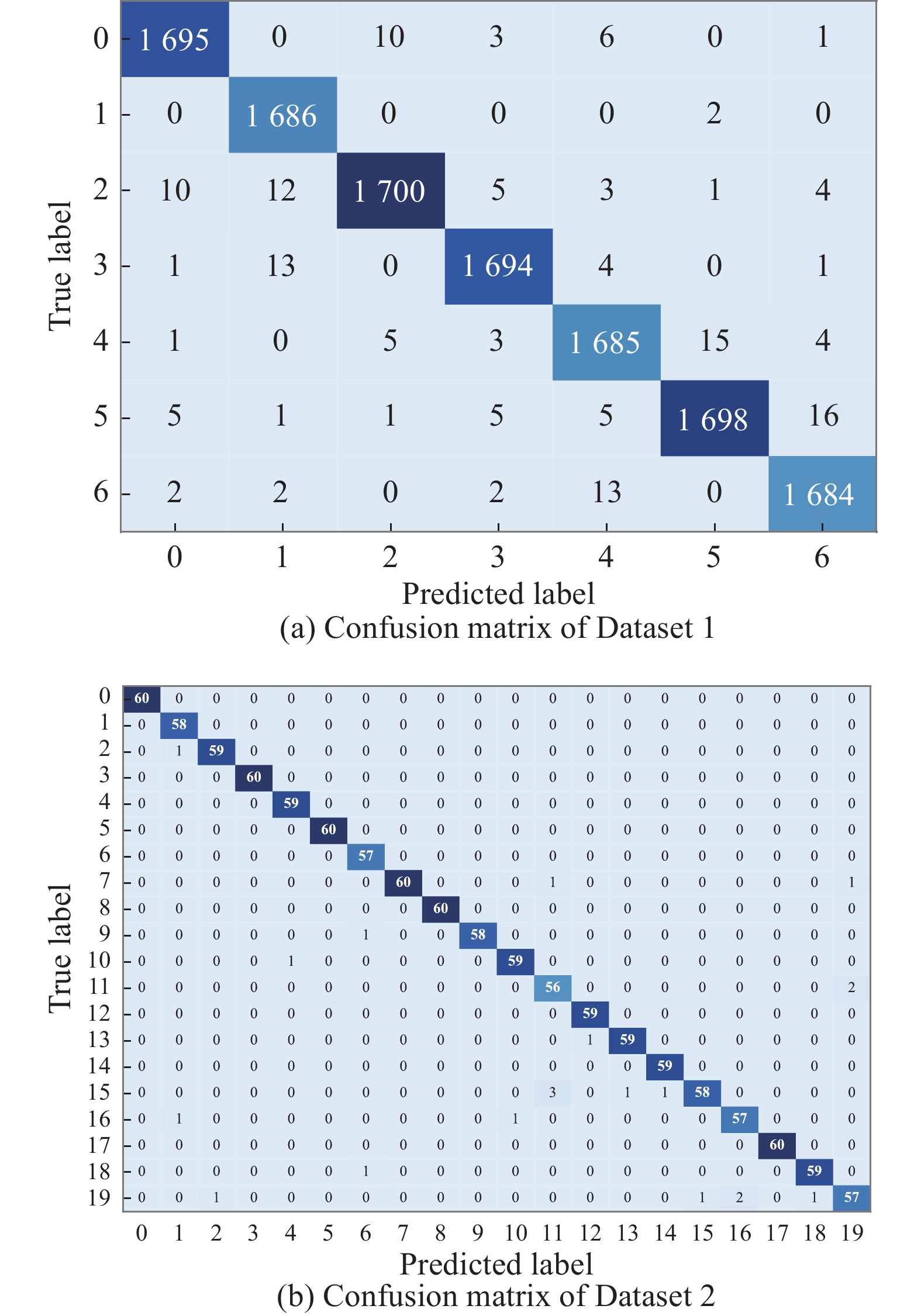
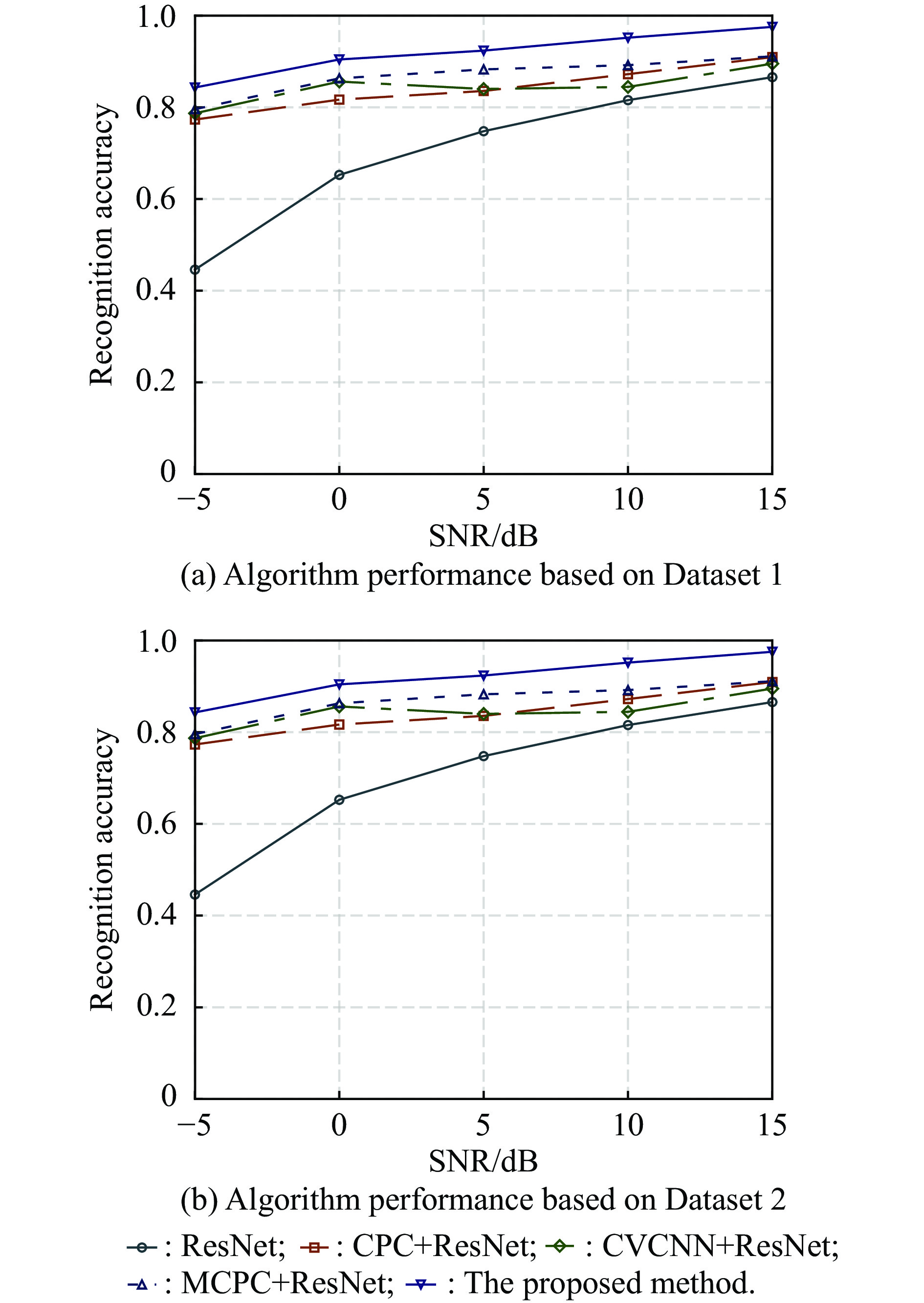
Fig 7
Anti-noise performance of the proposed algorithm and competitors"
| 1 |
ZHANG J N, LIU Y, DING G R, et al Adaptive decomposition and extraction network of individual fingerprint features for specific emitter identification. IEEE Trans. on Information Forensics and Security, 2024, 19, 8515- 8528.
doi: 10.1109/TIFS.2024.3427361 |
| 2 |
CHEN J, ZHOU R P, GUI W H A serial game distributed algorithm to ϵ-minimum vertex cover of networks. IEEE Trans. on Automation Science and Engineering, 2025, 22, 1534- 1542.
doi: 10.1109/TASE.2024.3367722 |
| 3 |
ZHAO Y R , WANG X , SUN L T, et al Specific emitter identification based on frequency and amplitude of the signal kurtosis. Journal of Systems Engineering and Electronics, 2025, 36 (2): 333- 343.
doi: 10.23919/JSEE.2023.000054 |
| 4 |
FAN R , SI C K , HAN Y, et al RFFsNet-SEI: a multidimensional balanced-RFFs deep neural network framework for specific emitter identification. Journal of Systems Engineering and Electronics, 2024, 35 (3): 558- 574.
doi: 10.23919/JSEE.2023.000069 |
| 5 |
FANG Y Y, WEI S, ZHAO Y, et al Radar-specific emitter identification with only envelope power based on multidimensional complex noncentral Chi-square classifier. IEEE Sensors Journal, 2023, 23 (17): 20223- 20235.
doi: 10.1109/JSEN.2023.3298352 |
| 6 |
CHEN Y C, LI P, YAN E X, et al A knowledge graph-driven CNN for radar emitter identification. Remote Sensing, 2023, 15 (13): 3289.
doi: 10.3390/rs15133289 |
| 7 | ZHENG C, WU H, HAO Y, et al Radar emitter identification based on deep learning of inter-pulse features. Journal of Signal Processing, 2020, 36 (8): 1187- 1195. |
| 8 | CHURCHILL F E, OGAR G W, THOMPSOM B J The correction of I and Q errors in a coherent processor. IEEE Trans. on Aerospace and Electronic Systems, 1981, 17 (1): 131- 137. |
| 9 |
BASSAM S A, BOUMAIZA S, GHANNOUCHI F M Block-wise estimation of and compensation for I/Q imbalance in direct-conversion transmitters. IEEE Trans. on Signal Processing, 2009, 57 (12): 4970- 4973.
doi: 10.1109/TSP.2009.2026598 |
| 10 |
WANG Y, GUI G, GACANIN H, et al An efficient specific emitter identification method based on complex-valued neural networks and network compression. IEEE Journal on Selected Areas in Communications, 2021, 39 (8): 2305- 2317.
doi: 10.1109/JSAC.2021.3087243 |
| 11 |
SINHA H, AWASTHI V, AJMERA P K Audio classification using braided convolutional neural networks. IET Signal Processing, 2020, 14 (7): 448- 454.
doi: 10.1049/iet-spr.2019.0381 |
| 12 |
KOBAL T, LI Y, WANG X, et al Digital predistortion of RF power amplifiers with phase-gated recurrent neural networks. IEEE Trans. on Microwave Theory and Techniques, 2022, 70 (6): 3291- 3299.
doi: 10.1109/TMTT.2022.3161024 |
| 13 | MOSSAD O S, ELNAINAY M, TORKI M. Deep convolutional neural network with multi-task learning scheme for modulations recognition. Proc. of the 15th International Wireless Communications & Mobile Computing Conference, 2019: 1644−1649. |
| 14 | HENNEKE L. Improving data-driven RF signal separation with SOI-matched autoencoders. Proc. of the IEEE International Conference on Acoustics, Speech, and Signal Processing Workshops, 2024. DOI: 10.1109/ICASSPW62465.2024.10626245. |
| 15 | YADAV H, SITARAM S, SHAH R R. Analysing the masked predictive coding training criterion for pre-training a speech representation model. Proc. of the IEEE International Conference on Acoustics, Speech and Signal Processing, 2023. DOI: 10.1109/ICASSP49357.2023.10096167. |
| 16 |
WEI P L, TONG M I Attention-DPU: dual-path UNet with an attention mechanism for ultrasound image segmentation. Journal of Physics: Conference Series, 2020, 1693 (1): 012155.
doi: 10.1088/1742-6596/1693/1/012155 |
| 17 | ZHANG J N, WEI Z, DING G, et al Multi-channel lightweight contrast prediction coding for feature extraction of radar emitter signals. Neural Processing Letters, 2024, 56 (6): 1- 13. |
| 18 |
YANG Y, GAO F, LI G Y, et al Deep learning-based downlink channel prediction for FDD massive MIMO system. IEEE Communications Letters, 2019, 23 (11): 1994- 1998.
doi: 10.1109/LCOMM.2019.2934851 |
| 19 |
TU Y, LIN Y, HOU C B, et al Complex-valued networks for automatic modulation classification. IEEE Trans. on Vehicular Technology, 2020, 69 (9): 10085- 10089.
doi: 10.1109/TVT.2020.3005707 |
| 20 | GOPALAKRISHNAN S, CEKIC M, MADHOW U. Robust wireless fingerprinting via complex-valued neural networks. Proc. of the IEEE Global Communications Conference, 2019. DOI:10.1109/GLOBECOM38437.2019.9013154. |
| 21 |
XIAO F, HUANG Y, ZUO Y Y, et al Over-the-air adversarial attacks on deep learning Wi-Fi fingerprinting. IEEE Internet of Things Journal, 2023, 10 (11): 9823- 9835.
doi: 10.1109/JIOT.2023.3236314 |
| 22 | DUARTE G J, PEREIRA T A, NASCIMENTO E J, et al. How do loss functions impact the performance of graph neural networks? Proc. of the Brazilian Congress of Computational Intelligence, 2021. DOI: 10.21528/cbic2021-161. |
| 23 | CHEN J F, ZHAO J C, HAN J, et al. Softmax clustering algorithm based on deep features representation. Journal of Nanjing University, 2020, 56(4): 533−540. (in Chinese) |
| 24 | WEN Y D, ZHANG K P, LI Z F, et al. A discriminative feature learning approach for deep face identification. Proc. of the European Conference on Computer Vision, 2016. DOI: 10.1007/978-3-319-46478-7_31. |
| 25 | WANG F, XIANG X, CHENG J, et al. Normface: L2 hypersphere embedding for face verification. Proc. of the 25th ACM International Conference on Multimedia, 2017. DOI: 10.48550/ARXIV.1704.06369. |
| 26 | WANG F, LIU W Y, LIU H J, et al. Additive margin softmax for face verification. IEEE Signal Processing Letters, 2018, 25(7): 926−930. |
| 27 | LIANG X Z, WANG X B, LEI Z, et al. Soft-margin softmax for deep classification. Proc. of the 24th International Conference on Neural Information Processing, 2017: 413–421. |
| 28 | HAN G J, CHEN C K, XU Z X, et al. Sphere margins softmax for face identification. Proc. of the 39th Chinese Control Conference, 2020. DOI: 10.23919/ccc50068.2020.9188526. |
| 29 |
DENG J K, GUO J, YANG J, et al ArcFace: additive angular margin loss for deep face recognition. IEEE Trans. on Pattern Analysis and Machine Intelligence, 2022, 44 (10): 5962- 5979.
doi: 10.1109/TPAMI.2021.3087709 |
| 30 |
CHENG X, XIE T S, WANG X M, et al Selective output smoothing regularization: regularize neural networks by softening output distributions. Applied Intelligence, 2025, 55, 721.
doi: 10.1007/s10489-025-06539-6 |
| 31 | LIU W Y, WEN Y D, YU Z D, et al. Sphereface: deep hypersphere embedding for face identification. Proc. of the IEEE Conference on Computer Vision and Pattern Identification, 2017. DOI: 10.1109/CVPR.2019.00482. |
| 32 |
TU Y, LIN Y, ZHA H R, et al Large scale real-world radio signal recognition with deep learning. Chinese Journal of Aeronautics, 2022, 35 (9): 35- 48.
doi: 10.1016/j.cja.2021.08.016 |
| 33 | HE K W, ZHANG X, REN S, et al. Deep residual learning for image identification. Proc. of the IEEE Conference on Computer Vision and Pattern Identification, 2016. DOI: 10.48550/arXiv.1512.03385. |
| 34 | YU W, GUI G, HARIS G, et al An efficient specific emitter identification method based on complex-valued neural networks and network compression. IEEE Journal on Selected Areas in Communications, 2021, 39, 2305- 2317. |
| [1] | Yurui ZHAO, Xiang WANG, Liting SUN, Zhitao HUANG. Specific emitter identification based on frequency and amplitude of the signal kurtosis [J]. Journal of Systems Engineering and Electronics, 2025, 36(2): 333-343. |
| [2] | Rong FAN, Chengke SI, Yi HAN, Qun WAN. RFFsNet-SEI: a multidimensional balanced-RFFs deep neural network framework for specific emitter identification [J]. Journal of Systems Engineering and Electronics, 2024, 35(3): 558-574. |
| Viewed | ||||||
|
Full text |
|
|||||
|
Abstract |
|
|||||
