
Journal of Systems Engineering and Electronics ›› 2026, Vol. 37 ›› Issue (4): 1297-1316.doi: 10.23919/JSEE.2026.000009
• SYSTEMS ENGINEERING • Previous Articles
Xin Cao1,2( ), He Luo1,2,*(), Guoqiang Wang1,2(), Yingying Ma1,2(), Jue Zhang3()
Received:2025-05-27
Online:2026-08-18
Published:2026-09-03
Contact:
He Luo
E-mail:caoxin@mail.hfut.edu.cn;luohe@hfut.edu.cn;gqwang2017@hfut.edu.cn;mayingying@mail.hfut.edu.cn;jue.zhang@griffith.edu.au
Supported by:Xin Cao, He Luo, Guoqiang Wang, Yingying Ma, Jue Zhang. Curriculum learning for adaptive multi-UAV swarm target search in obstacle environment[J]. Journal of Systems Engineering and Electronics, 2026, 37(4): 1297-1316.

Fig 1
UAVs searching a target in 3D environment"


Fig 2
Ground observation range at flight altitude $ {\boldsymbol{z}} $"


Fig 3
Basic framework for deep Q-learning with altitude matrix optimization module"


Fig 4
Illustration diagram of the flight altitude optimization"


Fig 5
Stage division of target search process"

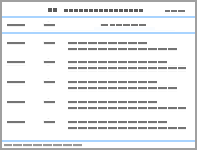
Table 1
Parameter setting of four search scenes"
| Scene | Proportion of obstacles/% | Height variance/m2 |
| I | 5 | 1 |
| II | 10 | 1.5 |
| III | 15 | 2 |
| IV | 20 | 3 |

Fig 6
3D representation of experimental scenes"

Table 2
Parameter setting of UAV and target"
| Parameter type | UAV | Target |
| Quantity | 4 | 1 |
| Velocity | 1 | 1 |
| Action-dim | 27 | 27 |
Table 3
Hyperparameters of algorithms"
| Method | Parameter | Value |
| DQN | Gamma | 0.99 |
| Learning rate | ||
| Batch size | 128 | |
| Epsilon | 0.01 | |
| MTS-ACO | Population size N | 8 |
| Evaporation rate | 0.5 | |
| Values of the pheromones | 1 | |
| Heuristic influence | 1 | |
| Ours-CL | Gamma | 0.99 |
| Learning rate | ||
| Batch size | 128 | |
| Epsilon | 0.01 | |
| DQN-AMO | Gamma | 0.99 |
| Learning rate | ||
| Batch size | 32 | |
| Epsilon | 0.05 |
Table 4
Evaluation metric"
| Metric | Description |
| ASS | The average search steps to search the target in all episodes (including failure episodes) |
| SSR | The percentage of successful episodes in all episodes |
| ACA | The proportion of grids that have been visited over all grids |
| DA | The accuracy of the agent’s observation of the ground target |

Fig 7
Simulated results of the target search tasks"

Table 5
Average search steps and search success rate between the proposed method and the baseline methods in four search scenes"
| Scene | Size | DQN | MTS-ACO | Ours-CL | The proposed method | Target | |||||||
| ASS | SSR/% | ASS | SSR/% | ASS | SSR/% | ASS | SSR/% | ||||||
| I | 10×10 | 6.68 | 100 | 6.41 | 100 | 6.22 | 100 | 6.09 | 100 | Target 1 | |||
| 20×20 | 9.99 | 98 | 8.65 | 100 | 9.08 | 100 | 8.04 | 100 | |||||
| 30×30 | 15.98 | 87 | 13.78 | 94 | 15.01 | 90 | 12.71 | 97 | |||||
| 40×40 | 29.46 | 72 | 25.31 | 82 | 27.22 | 77 | 23.88 | 89 | |||||
| 50×50 | 58.02 | 47 | 48.59 | 62 | 53.14 | 53 | 40.79 | 74 | |||||
| I | 10×10 | 8.01 | 99 | 7.03 | 100 | 7.36 | 100 | 6.71 | 100 | Target 2 | |||
| 20×20 | 13.65 | 90 | 10.78 | 96 | 12.23 | 94 | 10.18 | 98 | |||||
| 30×30 | 23.77 | 76 | 18.25 | 86 | 20.61 | 81 | 16.99 | 91 | |||||
| 40×40 | 43.22 | 61 | 31.46 | 74 | 36.52 | 68 | 28.25 | 83 | |||||
| 50×50 | 71.04 | 30 | 64.29 | 49 | 68.14 | 41 | 55.55 | 63 | |||||
| 10×10 | 8.99 | 98 | 7.99 | 100 | 8.39 | 99 | 7.48 | 100 | Target 3 | ||||
| 20×20 | 15.96 | 84 | 12.31 | 92 | 13.27 | 89 | 11.77 | 97 | |||||
| 30×30 | 32.93 | 67 | 24.71 | 80 | 27.97 | 75 | 21.06 | 86 | |||||
| 40×40 | 51.23 | 52 | 40.35 | 67 | 47.90 | 59 | 34.76 | 77 | |||||
| 50×50 | 84.64 | 17 | 71.65 | 37 | 77.27 | 29 | 65.33 | 54 | |||||
| II | 10×10 | 7.05 | 100 | 6.30 | 100 | 6.30 | 100 | 6.18 | 100 | Target 1 | |||
| 20×20 | 10.87 | 88 | 9.73 | 93 | 9.81 | 92 | 8.77 | 100 | |||||
| 30×30 | 21.98 | 76 | 16.31 | 87 | 17.80 | 85 | 14.67 | 95 | |||||
| 40×40 | 42.91 | 60 | 30.98 | 72 | 35.39 | 69 | 26.14 | 83 | |||||
| 50×50 | 73.10 | 28 | 62.06 | 47 | 69.57 | 32 | 52.65 | 66 | |||||
| 10×10 | 8.18 | 96 | 7.42 | 98 | 7.72 | 97 | 7.14 | 100 | Target 2 | ||||
| 20×20 | 15.10 | 77 | 12.81 | 86 | 14.39 | 86 | 11.97 | 96 | |||||
| 30×30 | 33.60 | 64 | 25.23 | 77 | 28.35 | 73 | 19.20 | 86 | |||||
| 40×40 | 53.00 | 49 | 37.21 | 64 | 46.25 | 58 | 32.12 | 76 | |||||
| 50×50 | 83.20 | 16 | 71.79 | 32 | 81.13 | 20 | 63.93 | 53 | |||||
| 10×10 | 9.71 | 94 | 8.43 | 98 | 8.81 | 96 | 8.15 | 98 | Target 3 | ||||
| 20×20 | 19.27 | 70 | 15.38 | 81 | 16.60 | 80 | 13.97 | 91 | |||||
| 30×30 | 41.27 | 55 | 31.34 | 70 | 35.56 | 65 | 25.78 | 80 | |||||
| 40×40 | 60.09 | 40 | 48.52 | 58 | 54.41 | 49 | 39.23 | 70 | |||||
| 50×50 | 91.12 | 9 | 80.78 | 24 | 87.76 | 11 | 70.81 | 41 | |||||
| III | 10×10 | 8.30 | 99 | 7.34 | 100 | 7.96 | 100 | 6.73 | 100 | Target 1 | |||
| 20×20 | 12.99 | 82 | 10.33 | 90 | 11.37 | 87 | 9.81 | 97 | |||||
| 30×30 | 26.96 | 74 | 21.01 | 84 | 23.44 | 79 | 16.36 | 91 | |||||
| 40×40 | 48.25 | 56 | 37.13 | 67 | 43.51 | 62 | 30.98 | 75 | |||||
| 50×50 | 89.07 | 13 | 75.33 | 28 | 79.48 | 22 | 67.13 | 40 | |||||
| 10×10 | 10.08 | 93 | 8.89 | 99 | 9.56 | 96 | 8.55 | 100 | Target 2 | ||||
| 20×20 | 22.05 | 71 | 15.99 | 81 | 19.26 | 78 | 13.14 | 90 | |||||
| 30×30 | 41.02 | 61 | 31.71 | 73 | 38.24 | 66 | 25.34 | 84 | |||||
| 40×40 | 61.96 | 44 | 46.33 | 59 | 49.66 | 55 | 39.27 | 64 | |||||
| 50×50 | 94.98 | 8 | 81.24 | 20 | 88.84 | 14 | 73.02 | 31 | |||||
| 10×10 | 11.97 | 87 | 10.61 | 93 | 10.87 | 90 | 9.79 | 96 | Target 3 | ||||
| 20×20 | 29.06 | 63 | 20.55 | 74 | 22.33 | 70 | 17.76 | 85 | |||||
| 30×30 | 49.79 | 50 | 35.22 | 67 | 43.26 | 57 | 31.80 | 77 | |||||
| 40×40 | 67.53 | 34 | 55.24 | 51 | 58.71 | 47 | 48.24 | 56 | |||||
| 50×50 | 98.04 | 5 | 89.30 | 14 | 92.80 | 10 | 77.62 | 25 | |||||
| IV | 10×10 | 9.37 | 92 | 8.57 | 100 | 8.91 | 98 | 7.99 | 100 | Target 1 | |||
| 20×20 | 16.02 | 70 | 12.95 | 84 | 13.90 | 81 | 11.19 | 92 | |||||
| 30×30 | 42.40 | 62 | 25.62 | 78 | 34.36 | 70 | 20.97 | 87 | |||||
| 40×40 | 60.13 | 46 | 50.34 | 56 | 58.33 | 50 | 39.82 | 66 | |||||
| 50×50 | 97.77 | 7 | 84.96 | 18 | 87.55 | 14 | 72.31 | 32 | |||||
| 10×10 | 11.33 | 86 | 9.99 | 92 | 10.62 | 92 | 8.61 | 95 | Target 2 | ||||
| 20×20 | 26.75 | 58 | 21.36 | 74 | 22.55 | 71 | 13.09 | 84 | |||||
| 30×30 | 50.34 | 47 | 39.19 | 65 | 42.74 | 57 | 29.80 | 76 | |||||
| 40×40 | 64.48 | 38 | 58.63 | 48 | 62.20 | 40 | 49.79 | 57 | |||||
| 50×50 | 99.02 | 2 | 87.61 | 14 | 96.82 | 6 | 80.55 | 22 | |||||
| IV | 10×10 | 14.67 | 78 | 11.76 | 89 | 12.28 | 85 | 9.34 | 91 | Target 3 | |||
| 20×20 | 33.56 | 49 | 24.98 | 66 | 27.23 | 58 | 20.79 | 78 | |||||
| 30×30 | 59.01 | 36 | 46.76 | 52 | 53.36 | 44 | 39.88 | 64 | |||||
| 40×40 | 77.73 | 24 | 74.17 | 26 | 70.80 | 32 | 56.55 | 50 | |||||
| 50×50 | 100.00 | 0 | 97.24 | 8 | 98.10 | 4 | 83.40 | 18 | |||||

Fig 8
Comparison of reward values and search success rates during the training process in different search tasks"


Fig 9
Comparison of the average search steps of the three types of RL algorithms in different search tasks"


Fig 10
Comparison of the average coverage area and detection accuracy of the four types of methods for searching the three types of targets in four scenes"

Table 6
Impact of using three different altitude modes on the search efficiency in a 50×50 scene"
| Target | Scene | Mode | ASS/% | SSR/% | ACA% | DA% |
| 1 | I | Fixed | 36.02 | 70 | 0.652 | 0.95 |
| Random | 34.46 | 68 | 0.684 | 0.94 | ||
| The proposed mode | 33.79 | 74 | 0.673 | 0.96 | ||
| II | Fixed | 56.59 | 61 | 0.725 | 0.93 | |
| Random | 58.73 | 58 | 0.741 | 0.92 | ||
| The proposed mode | 52.65 | 66 | 0.734 | 0.95 | ||
| III | Fixed | 71.69 | 34 | 0.782 | 0.93 | |
| Random | 72.24 | 32 | 0.793 | 0.91 | ||
| The proposed mode | 62.72 | 40 | 0.784 | 0.92 | ||
| IV | Fixed | 78.56 | 27 | 0.795 | 0.91 | |
| Random | 80.72 | 25 | 0.799 | 0.90 | ||
| The proposed mode | 72.31 | 32 | 0.801 | 0.91 | ||
| 2 | I | Fixed | 58.74 | 58 | 0.715 | 0.95 |
| Random | 60.69 | 56 | 0.749 | 0.94 | ||
| The proposed mode | 55.55 | 63 | 0.741 | 0.95 | ||
| II | Fixed | 65.60 | 45 | 0.743 | 0.93 | |
| Random | 68.48 | 41 | 0.773 | 0.92 | ||
| The proposed mode | 62.93 | 53 | 0.770 | 0.94 | ||
| III | Fixed | 78.30 | 24 | 0.773 | 0.93 | |
| Random | 80.80 | 21 | 0.792 | 0.91 | ||
| The proposed mode | 73.02 | 31 | 0.804 | 0.92 | ||
| IV | Fixed | 85.48 | 17 | 0.780 | 0.91 | |
| Random | 86.29 | 15 | 0.797 | 0.89 | ||
| The proposed mode | 80.55 | 22 | 0.799 | 0.91 | ||
| 3 | I | Fixed | 67.43 | 47 | 0.752 | 0.95 |
| Random | 68.21 | 45 | 0.767 | 0.93 | ||
| The proposed mode | 65.33 | 54 | 0.765 | 0.95 | ||
| II | Fixed | 73.96 | 33 | 0.761 | 0.92 | |
| Random | 76.30 | 29 | 0.772 | 0.91 | ||
| The proposed mode | 70.81 | 41 | 0.769 | 0.93 | ||
| III | Fixed | 87.29 | 17 | 0.783 | 0.93 | |
| Random | 89.71 | 14 | 0.799 | 0.90 | ||
| The proposed mode | 77.62 | 25 | 0.812 | 0.94 | ||
| IV | Fixed | 90.21 | 12 | 0.794 | 0.91 | |
| Random | 94.36 | 9 | 0.817 | 0.88 | ||
| The proposed mode | 83.40 | 18 | 0.806 | 0.91 |
| 1 |
Shakhatreh H, Sawalmeh A H, Al-Fuqaha A, et al Unmanned aerial vehicles (UAVs): a survey on civil applications and key research challenges. IEEE Access, 2019, 7, 48572.
doi: 10.1109/ACCESS.2019.2909530 |
| 2 |
Xu Y, Li X B, Meng X P, et al An iterated greedy heuristic for collaborative human-UAV search of missing tourists. Knowledge-Based Systems, 2024, 286, 111409.
doi: 10.1016/j.knosys.2024.111409 |
| 3 |
Liu D Q, Zhu X M, Bao W D, et al Smart: vision-based method of cooperative surveillance and tracking by multiple UAVs in the urban environment. IEEE Trans. on Intelligent Transportation Systems, 2022, 23, 24941.
doi: 10.1109/TITS.2022.3203411 |
| 4 |
Zhen Z Y, Xing D J, Gao C Cooperative search-attack mission planning for multi-UAV based on intelligent self-organized algorithm. Aerospace Science and Technology, 2018, 76, 402.
doi: 10.1016/j.ast.2018.01.035 |
| 5 |
Liu L X, Wang X, Yang X, et al Path planning techniques for mobile robots: review and prospect. Expert Systems with Applications, 2023, 227, 120254.
doi: 10.1016/j.eswa.2023.120254 |
| 6 |
Xue Y T, Chen W A UAV navigation approach based on deep reinforcement learning in large cluttered 3D environments. IEEE Trans. on Vehicular Technology, 2023, 72, 3001.
doi: 10.1109/TVT.2022.3218855 |
| 7 |
Otto A, Agatz N, Campbell J, et al Optimization approaches for civil applications of unmanned aerial vehicles (UAVs) or aerial drones: a survey. Networks, 2018, 72, 411.
doi: 10.1002/net.21818 |
| 8 |
Xiao Y G, Li Y H, Liu H, et al Adaptive large neighbor- hood search algorithm with reinforcement search strategy for solving extended cooperative multi task assignment problem of UAVs. Information Sciences, 2024, 679, 121068.
doi: 10.1016/j.ins.2024.121068 |
| 9 |
Zhao B C, Huo M Y, Li Z, et al Clustering-based hyper-heuristic algorithm for multi-region coverage path planning of heterogeneous UAVs. Neurocomputing, 2024, 610, 128528.
doi: 10.1016/j.neucom.2024.128528 |
| 10 |
Jia Z, Du X, Dong Q C, et al Distributed collaborative complete coverage path planning based on hybrid strategy. Journal of Systems Engineering and Electronics, 2024, 35 (2): 463.
doi: 10.23919/JSEE.2023.000118 |
| 11 |
Xu X J, Xie C Y, Luo Z F, et al A multi-objective evolu- tionary algorithm based on dimension exploration and discrepancy evolution for UAV path planning problem. Information Sciences, 2024, 657, 119977.
doi: 10.1016/j.ins.2023.119977 |
| 12 |
Al-Hourani A, Kandeepan S, Lardner S Optimal lap altitude for maximum coverage. IEEE Wireless Communication Letter, 2014, 3, 569.
doi: 10.1109/LWC.2014.2342736 |
| 13 |
Mnih V, Kavukcuoglu K, Silver D, et al Human-level control through deep reinforcement learning. Nature, 2015, 518, 529.
doi: 10.1038/nature14236 |
| 14 |
Soviany P, Ionescu R T, Rota P, et al Curriculum learning: a survey. International Journal of Computer Vision, 2022, 130, 1526.
doi: 10.1007/s11263-022-01611-x |
| 15 | Tang H W, Sun W, Yu H S, et al. A multirobot target searching method based on bat algorithm in unknown environments [J]. Expert Systems with Application, 2020, 141; 112945. |
| 16 |
Hu J Q, Wu H S, Zhan R J, et al Self-organized search-attack mission planning for UAV swarm based on wolf pack hunting behavior. Journal of Systems Engineering and Electronics, 2021, 32 (6): 1463.
doi: 10.23919/jsee.2021.000124 |
| 17 |
Sun L, Wang J S, Wang J, et al Efficient joint deployment of multi-UAVs for target tracking in traffic big data. IEEE Trans. on Intelligent Transportation Systems, 2024, 25 (7): 7780.
doi: 10.1109/TITS.2024.3370250 |
| 18 |
Stamatopoulos M N, Banerjee A, Niko-Lakopoulos G Conflict-free optimal motion planning for parallel aerial 3D printing using multiple UAVs. Expert systems with applications, 2024, 246, 123201.
doi: 10.1016/j.eswa.2024.123201 |
| 19 |
Li J X, Zhao Z S, Qin X H Adaptive sliding mode control using a novel fully feedback recurrent neural network for quad-rotor UAVs. Neurocomputing, 2024, 610, 128592.
doi: 10.1016/j.neucom.2024.128592 |
| 20 |
Li J, Xiong Y H, She J H UAV path planning for target coverage task in dynamic environment. IEEE Internet of Things Journal, 2023, 10 (20): 17734.
doi: 10.1109/JIOT.2023.3277850 |
| 21 |
Hentati A I, Fourati L C, Rezgui J Cooperative UAVs framework for mobile target search and tracking. Computers and Electrical Engineering, 2022, 101, 107992.
doi: 10.1016/j.compeleceng.2022.107992 |
| 22 |
Yang Y F, Zhang C S, Liu Y, et al Deep reinforcement learning assisted novelty search in voronoi regions for con- strained multi-objective optimization. Swarm and Evolution- ary Computation, 2024, 91, 101732.
doi: 10.1016/j.swevo.2024.101732 |
| 23 |
Huang C C, Du B, Chen M Multi-UAV cooperative online searching based on voronoi diagrams. IEEE Trans. on Aerospace and Electronic Systems, 2024, 60, 3038.
doi: 10.1109/TAES.2024.3362320 |
| 24 |
Ma T X, Wang Y H, Li X T Convex combination multi- ple populations competitive swarm optimization for moving target search using UAVs. Information Sciences, 2023, 641, 119104.
doi: 10.1016/j.ins.2023.119104 |
| 25 |
Guan W, Wang K Autonomous collision avoidance of unmanned surface vehicles based on improved a-star and dynamic window approach algorithms. IEEE Intelligent Transportation Systems Magazine, 2023, 15, 36.
doi: 10.1109/mits.2022.3229109 |
| 26 |
Pehlivanoglu Y V, Pehlivanoglu P An enhanced genetic algorithm for path planning of autonomous UAV in target coverage problems. Applied Soft Computing, 2021, 112, 107796.
doi: 10.1016/j.asoc.2021.107796 |
| 27 |
Phung M D, Ha Q P Motion-encoded particle swarm optimization for moving target search using UAVs. Applied Soft Computing, 2020, 97, 106705.
doi: 10.1016/j.asoc.2020.106705 |
| 28 |
Alfeo A L, Cimino M G, Vaglini G Enhancing bio- logically inspired swarm behavior: metaheuristics to foster the optimization of UAVs coordination in target search. Computers & Operation Research, 2019, 110, 34.
doi: 10.1016/j.cor.2019.05.021 |
| 29 | Hu G, Cheng M, Houssein E H, et al: A novel co-evolutionary multigroup particle swarm optimization for multi-mission UAVs path planning. Swarm and Evolutionary Computation, 2025, 63, 102923. |
| 30 |
Hu G, Huang F Y, Shu B, et al MAHACO: multi-algo- rithm hybrid ant colony optimizer for 3D path planning of a group of UAVs. Information Sciences, 2025, 694, 121714.
doi: 10.1016/j.ins.2024.121714 |
| 31 | Zheng Y J, Du Y C, Ling H F, et al Evolutionary collab- orative human-UAV search for escaped criminals. IEEE Trans. on Evolutionary Computation, 2019, 24, 217. |
| 32 |
Schmidhuber J Deep learning in neural networks: an overview. Neural Networks, 2015, 61, 85.
doi: 10.1016/j.neunet.2014.09.003 |
| 33 | Ellis B, Cook J, Moalla S, et al SMACV2: an improved benchmark for cooperative multi-agent reinforcement learning. Advances in Neural Information Processing Systems, 2023, 36, 37567. |
| 34 |
Vinyals O, Babuschkin I, Czarnecki W M, et al Grandmaster level in StarCraft II using multi-agent reinforce- ment learning. Nature, 2019, 575, 350.
doi: 10.1038/s41586-019-1724-z |
| 35 |
Salameh H B, Alhafnawi M, Masadeh A, et al Federated reinforcement learning approach for detecting uncertain deceptive target using autonomous dual UAV system. Information Processing & Management, 2023, 60, 103149.
doi: 10.1016/j.ipm.2022.103149 |
| 36 |
Zhang T, Zhou Q Y, Zheng Y, et al Improved proximal policy optimization for UAV tracking in complex environments. Knowledge-Based Systems, 2025, 30, 113627.
doi: 10.1016/j.knosys.2025.113627 |
| 37 |
Wei D X, Zhang L, Liu Q, et al UAV swarm coopera- tive dynamic target search: a MAPPO-based discrete optimal control method. Drones, 2024, 8 (6): 214.
doi: 10.3390/drones8060214 |
| 38 |
Xiao J, Yuan G H, Xue Y X, et al A deep reinforcement learning based distributed multi-UAV dynamic area coverage algorithm for complex environment. Neurocomputing, 2024, 595, 127904.
doi: 10.1016/j.neucom.2024.127904 |
| [1] | Xiaoxuan Hu, Yanhong Liu, and Guoqiang Wang. Optimal search for moving targets with sensing capabilities using multiple UAVs [J]. Systems Engineering and Electronics, 2017, 28(3): 526-535. |
| [2] | Yang Chunhui, Liu Junxian, Chen Honghui & Luo Xueshan. Adaptive optimization of agile organization of command and control resource [J]. Journal of Systems Engineering and Electronics, 2009, 20(3): 558-564. |
| Viewed | ||||||
|
Full text |
|
|||||
|
Abstract |
|
|||||
