
Journal of Systems Engineering and Electronics ›› 2026, Vol. 37 ›› Issue (5): 1574-1586.doi: 10.23919/JSEE.2026.000139
• SYSTEMS ENGINEERING • Previous Articles
Zhiwei Chen1,2,3, Yulu Zhang1,2,3( ), Weiwei Cui4,5,*(), Dongpao Hong5(), Hongyan Dui6()
Received:2025-01-07
Online:2026-10-18
Published:2026-11-09
Contact:
Weiwei Cui
E-mail:zhangyulu@mail.nwpu.edu.cn;buaacvv@126.com;hloving@163.com;duihongyan@zzu.edu.cn
Supported by:Zhiwei Chen, Yulu Zhang, Weiwei Cui, Dongpao Hong, Hongyan Dui. Mission-driven equipment supportability analysis and optimization[J]. Journal of Systems Engineering and Electronics, 2026, 37(5): 1574-1586.
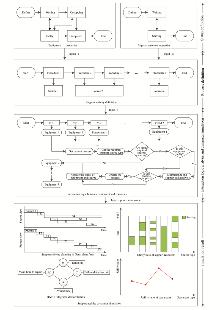
Fig 1
Algorithmic framework of supportability modeling and optimization"
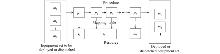
Fig 2
Schematic diagram of support activity"
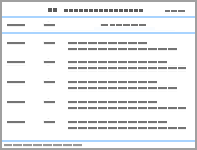
Table 1
Equipment properties"
| Property | Type |
| Identification | Positive integer |
| Current procedure | Positive integer |
| Procedure processing time | Positive integer |
| State | String, {waiting, occupying, completed} |
| Resource currently in service for this equipment | String |
| State vector | String vector |
Table 2
Resource properties"
| Property | Type |
| Type | String |
| Identification in this resource type | Positive integer |
| State | String, {waiting, serving} |
| Equipment identification served by this resource | Positive integer |
| State vector | String vector |
Table 3
Form of the state vector"
| Time | 1 | 2 | 3 | ··· | end T−1 | end T |
| State | Awaiting | Awaiting | Serving | ··· | Completed | Completed |
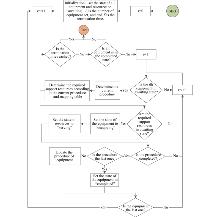
Fig 3
Flow chart of supportability modeling algorithm"
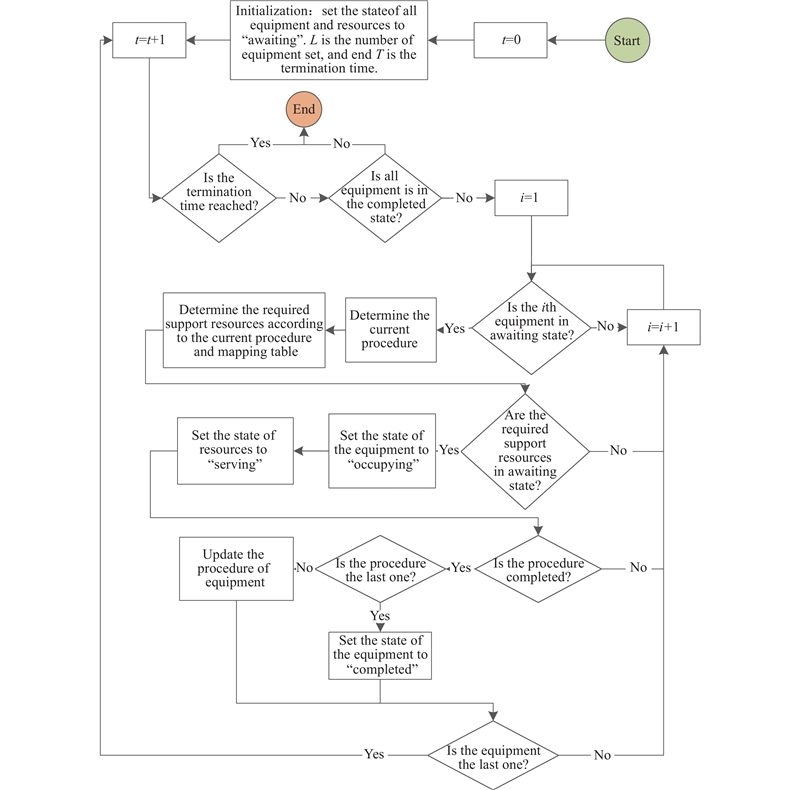
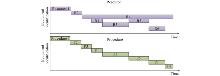
Fig 4
Gantt chart including support resource usage and process execution"
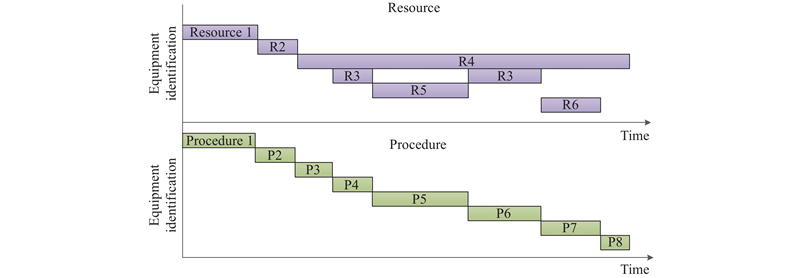
Fig 5
Schematic diagram of optimization process using GA"
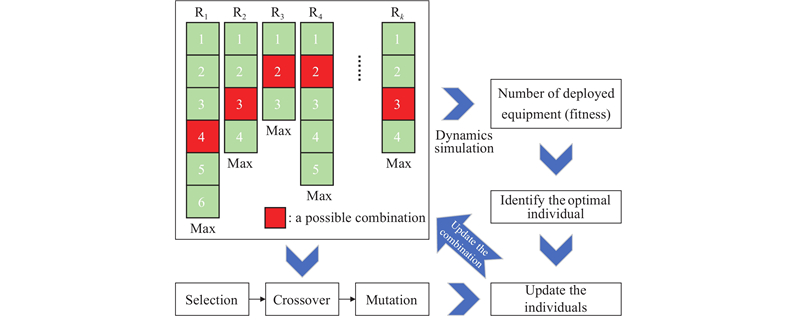
Fig 6
Relationship between RMST considering fault"
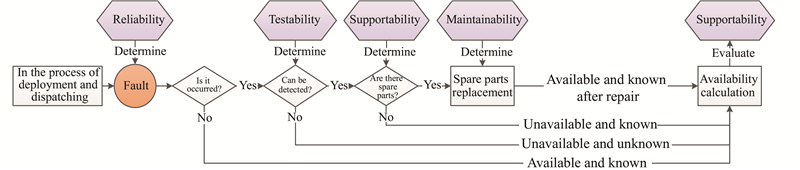
Fig 7
Flow chart of the supportability simulation algorithm considering fault"
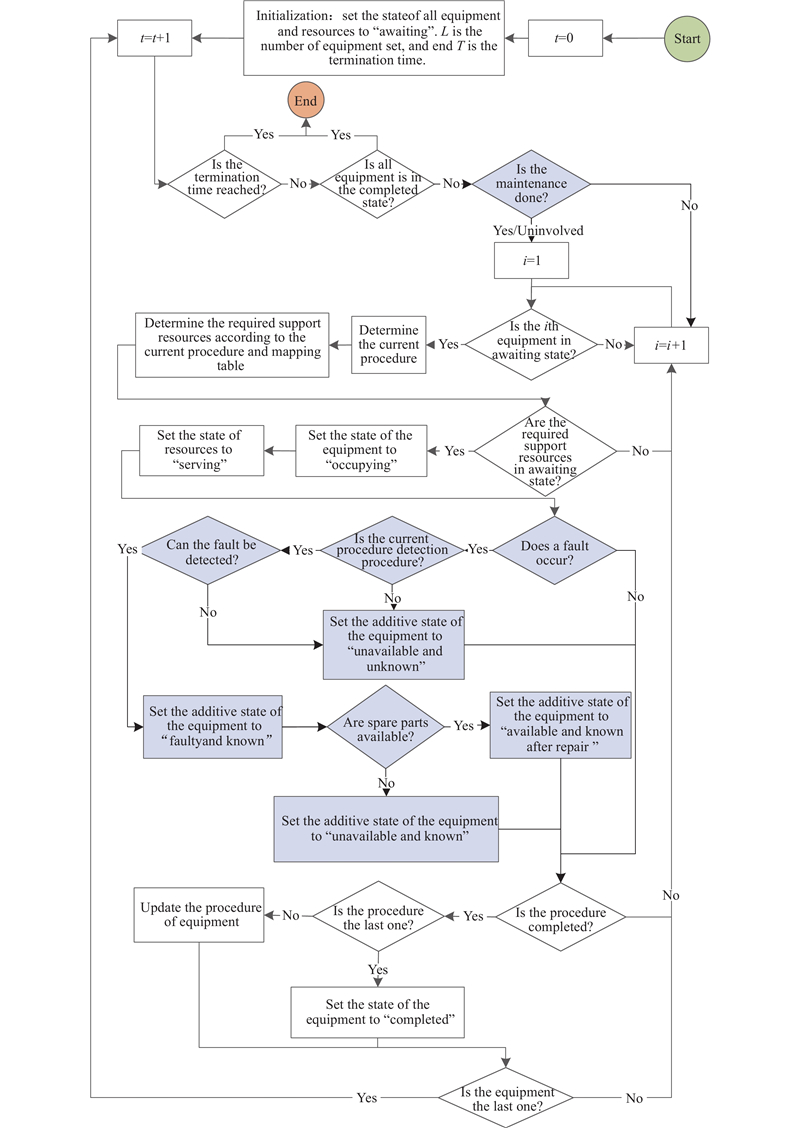
Table 4
Mapping table"
| Procedure | R1 | R2 | R3 | R4 | R5 | R6 |
| P1 | 1 | 0 | 0 | 0 | 0 | 0 |
| P2 | 0 | 1 | 0 | 0 | 0 | 0 |
| P3 | 0 | 0 | 1 | 0 | 0 | 0 |
| P4 | 0 | 0 | 1 | 1 | 0 | 0 |
| P5 | 0 | 0 | 1 | 0 | 1 | 0 |
| P6 | 0 | 0 | 1 | 1 | 0 | 0 |
| P7 | 0 | 0 | 1 | 0 | 0 | 1 |
| P8 | 0 | 0 | 1 | 0 | 0 | 0 |
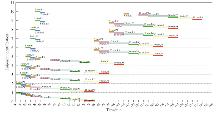
Fig 8
Planning result of support activity plan in procedure view"
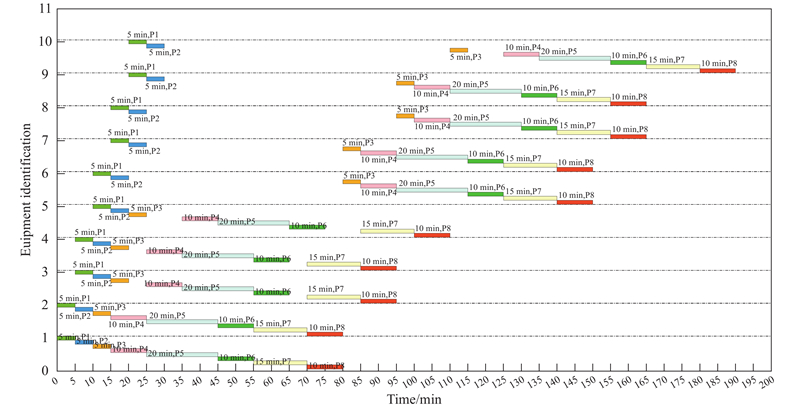
Fig 9
Planning result of support activity in resource view"
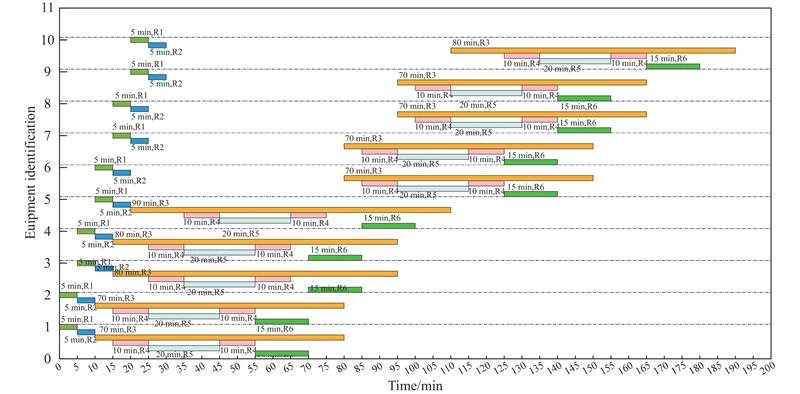
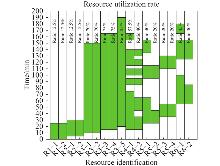
Fig 10
Utilization rate of support resources"
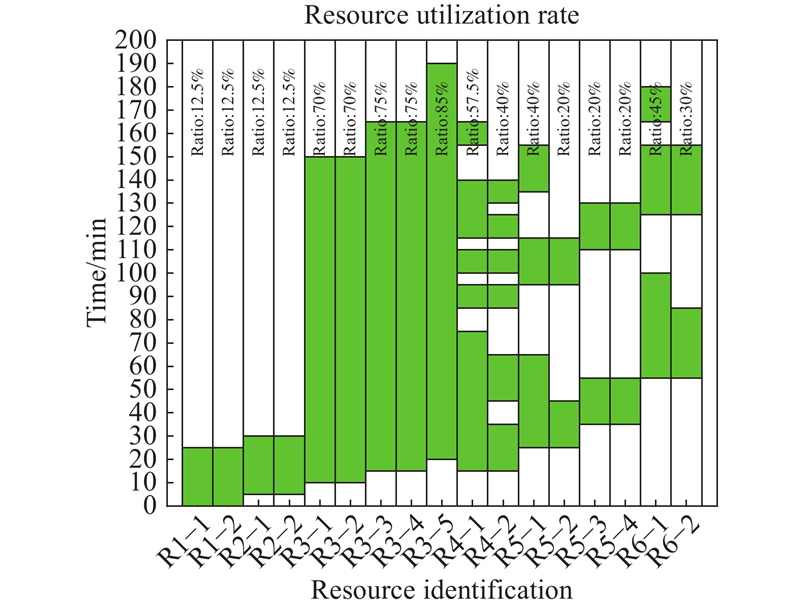
Fig 11
Optimization process using GA"
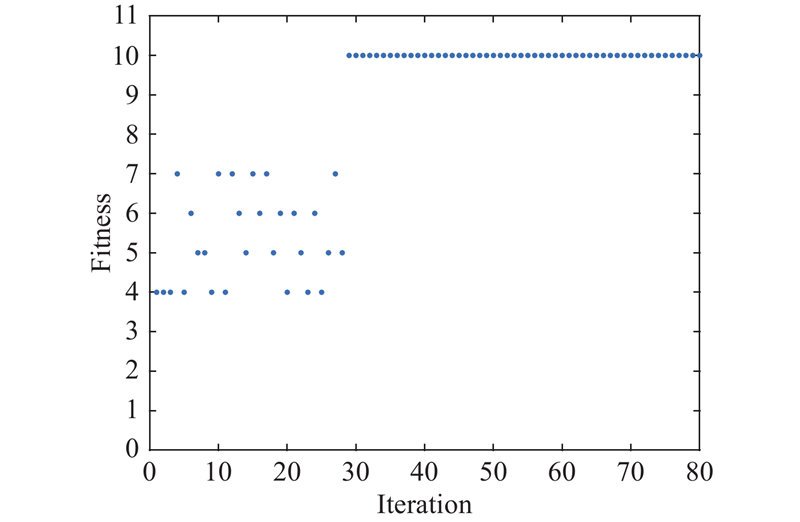
Table 5
Optimization result"
| Resource type | R1 | R2 | R3 | R4 | R5 | R6 |
| Number | 1 | 1 | 5 | 2 | 2 | 2 |
Fig 12
Planning result of support activity introducing fault in procedure view"
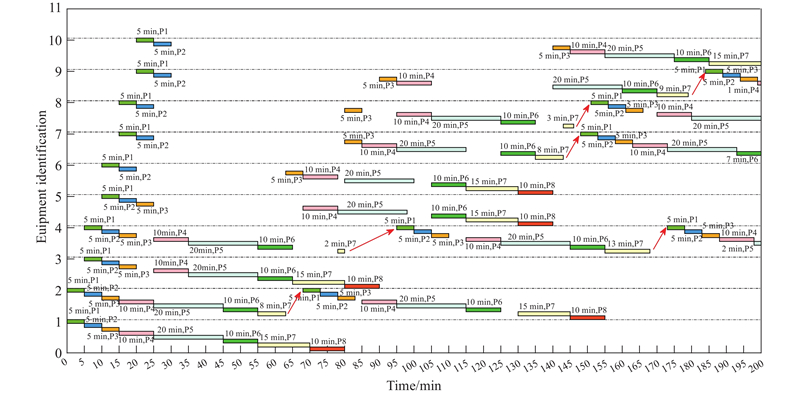
Fig 13
Planning result of support activity introducing a fault in the resource view"
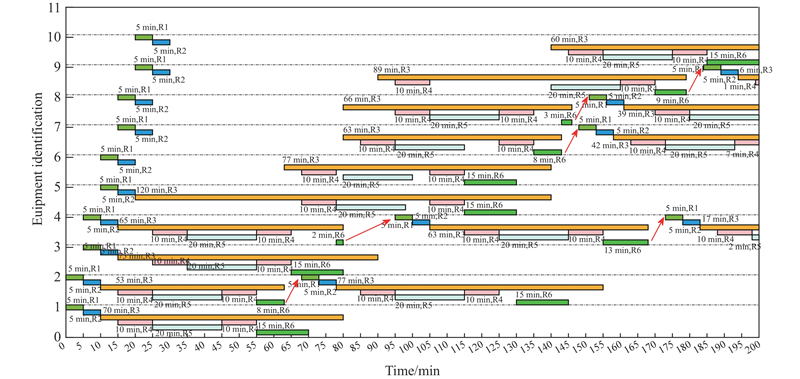
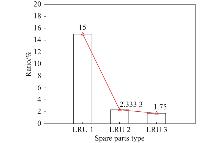
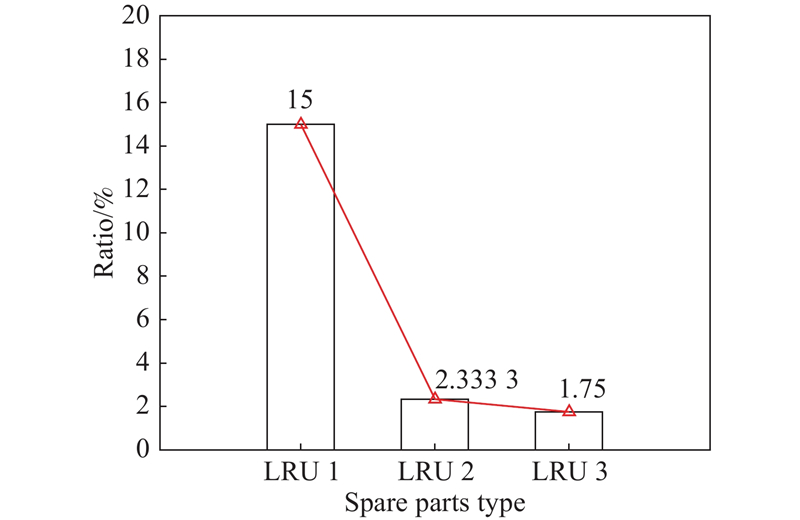
Fig 14
Spare parts utilization rate of each LRU"
| 1 |
Saranga H, Kumar U D Optimization of aircraft maintenance/support infrastructure using genetic algorithms—level of repair analysis. Annals of Operations Research, 2006, 143 (1): 91.
doi: 10.1007/s10479-006-7374-1 |
| 2 |
Chen Z W, Zhang H, Wang X Y, et al Reliability analysis and redundancy design of satellite communication system based on a novel Bayesian environmental importance. Reliability Engineering & System Safety, 2024, 243, 109813.
doi: 10.1016/j.ress.2023.109813 |
| 3 |
Dui H Y, Zhang Y L, Wu X M, et al Dynamic reliability assessment model for IoT-Enabled smart offshore wind farm. IEEE Trans. on Reliability, 2025, 74 (3): 3529.
doi: 10.1109/TR.2024.3428870 |
| 4 | Power W, Wylie M, Mellen P, et al. A hybrid between model-based systems engineering and agile methodologies for simulation of complex weapon systems of systems [C]//Proc. of the IEEE Aerospace Conference, 2021. DOI: 10.1109/AERO50100.2021.9438152. |
| 5 |
Ding G, Cui L J, Zhang F, et al Simulation evaluation and case study verification of equipment system of systems support effectiveness. Systems, 2025, 13 (2): 77.
doi: 10.3390/systems13020077 |
| 6 |
Cruyt A L M, Ghobbar A, Curran R A value-based assessment method of the supportability for a new aircraft entering into service. IEEE Trans. on Reliability, 2014, 63 (4): 817.
doi: 10.1109/TR.2014.2335972 |
| 7 |
Andersen A C, Pavlikov K, Toffolo T A M Weapon-target assignment problem: exact and approximate solution algorithms. Annals of Operations Research, 2022, 312 (2): 581.
doi: 10.1007/s10479-022-04525-6 |
| 8 |
Chen Z W, Zhang S R, Dui H Y Importance-based risk evaluation methodology in transportation cyber-physical systems. Frontiers of Engineering Management, 2025, 12 (2): 291.
doi: 10.1007/s42524-025-4026-1 |
| 9 |
Chen Z W, Zhang L G, Chu J Y, et al Computational resource configuration analysis and optimization methods for unmanned system considering intended functionality safety. Frontiers of Engineering Management, 2025, 12 (4): 1196.
doi: 10.1007/s42524-025-4173-4 |
| 10 |
Cao R M, Hao L N, Gao Q, et al Modeling and decision-making methods for a class of cyber-physical systems based on modified hybrid stochastic timed petri net. IEEE Systems Journal, 2020, 14 (4): 4684.
doi: 10.1109/JSYST.2020.2970748 |
| 11 |
Dui H Y, Wu X M, Wu S M, et al Importance measure-based maintenance strategy optimization: Fundamentals, applications and future directions in AI and IoT. Frontiers of Engineering Management, 2024, 11 (3): 542.
doi: 10.1007/s42524-024-4003-0 |
| 12 |
Dui H Y, Cui M, Tao J Y, et al Survivability analysis and data simulation of logistic networks under different attacks. Annals of Operations Research, 2025, 348 (1): 147.
doi: 10.1007/s10479-022-05083-7 |
| 13 |
Chen Z W, Zhou Z M, Zhang L G, et al Mission reliability modeling and evaluation for reconfigurable unmanned weapon system-of-systems based on effective operation loop. Journal of Systems Engineering and Electronics, 2023, 34 (3): 588.
doi: 10.23919/JSEE.2023.000082 |
| 14 |
Jin Y X, Geng J, Lv C, et al A methodology for equipment condition simulation and maintenance threshold optimization oriented to the influence of multiple events. Reliability Engineering & System Safety, 2023, 229, 108879.
doi: 10.1016/j.ress.2022.108879 |
| 15 | Woulee J, Andersson M. Product supportability through lifecycle modeling and simulation [C]//Proc. of the Winter Simulation Conference, 2020: 2049. |
| 16 |
Yin F P, Gao Q, Sun J K Research and application of the simulation method for product development process based on system dynamics. Systems, 2024, 12 (5): 172.
doi: 10.3390/systems12050172 |
| 17 |
Wei Z Q, Zhao Z B, Zhou Z, et al A deep reinforcement learning-driven multi-objective optimization and its applications on aero-engine maintenance strategy. Journal of Manufacturing Systems, 2024, 74, 316.
doi: 10.1016/j.jmsy.2024.04.003 |
| 18 |
Fang Z M, Li H, Chen D Z An integrated method for selecting architecture alternatives and reconfiguration options towards system-of-systems resilience. Systems, 2025, 13 (1): 9.
doi: 10.3390/systems13010009 |
| 19 |
Chen Z W, Yin S Y, Li L F, et al Resilience metric and dynamic assessment of unmanned system-of-systems considering cooperative reconfiguration strategies. IEEE Trans. on Reliability, 2025, 74 (2): 2942.
doi: 10.1109/TR.2024.3438810 |
| 20 |
Hao Y Q, Wang J T, Wang Z B, et al Equilibrium joining strategies in the m/m/1 queues with setup times under n-policy. Journal of Systems Science and Systems Engineering, 2019, 28 (2): 141.
doi: 10.1007/s11518-018-5398-0 |
| 21 |
Wang J T, Zhang X L, Huang P Strategic behavior and social optimization in a constant retrial queue with the N-policy. European Journal of Operational Research, 2017, 256 (3): 841.
doi: 10.1016/j.ejor.2016.06.034 |
| 22 |
Su Y, Zhou M C, Qi L, et al A reachability-decidable petri net modeling method for discrete event systems. IEEE Trans. on Systems, Man, and Cybernetics: Systems, 2025, 55 (1): 453.
doi: 10.1109/TSMC.2024.3473851 |
| 23 |
Chen Y F, Li Y T, Li Z W, et al On optimal supervisor design for discrete-event systems modeled with petri nets via constraint simplification. IEEE Trans. on Systems, Man, and Cybernetics: Systems, 2022, 52 (6): 3404.
doi: 10.1109/TSMC.2021.3069201 |
| 24 |
Abdullah, Alrabghi, Ashutosh, et al A novel approach for modelling complex maintenance systems using discrete event simulation. Reliability Engineering & System Safety, 2016, 154, 160.
doi: 10.1016/j.ress.2016.06.003 |
| 25 |
Guo X W, Liu S X, Zhou M C, et al Disassembly sequence optimization for large-scale products with multiresource constraints using scatter search and Petri nets. IEEE Trans. on Cybernetics, 2016, 46 (11): 2435.
doi: 10.1109/TCYB.2015.2478486 |
| 26 |
Golbasi O, Turan M O A discrete-event simulation algorithm for the optimization of multi-scenario maintenance policies. Computers & Industrial Engineering, 2020, 145, 106514.
doi: 10.1016/j.cie.2020.106514 |
| 27 |
Zhao J, Zhang F Agent-based simulation system for optimising resource allocation in production process. Iet Collaborative Intelligent Manufacturing, 2025, 7 (1): 70020.
doi: 10.1049/cim2.70020 |
| 28 |
Li K X, Liu Q S, Yang S F, et al Cooperative optimization of dual multiagent system for optimal resource allocation. IEEE Trans. on Systems, Man, and Cybernetics: Systems, 2020, 50 (11): 4676.
doi: 10.1109/TSMC.2018.2859364 |
| 29 |
Lee J, Mitici M An integrated assessment of safety and efficiency of aircraft maintenance strategies using agent-based modelling and stochastic Petri nets. Reliability Engineering & System Safety, 2020, 202, 107052.
doi: 10.1016/j.ress.2020.107052 |
| 30 |
Qian C, Bao J Y, Tang Y Study on rms integrated simulation modeling of multi-agent-warship propulsion system. Journal of Physics: Conference Series, 2021, 1774 (1): 012054.
doi: 10.1088/1742-6596/1774/1/012054 |
| 31 |
Nguyen L K N, Howick S, Megiddo I A framework for conceptualising hybrid system dynamics and agent-based simulation models. European Journal of Operational Research, 2024, 315 (3): 1153.
doi: 10.1016/j.ejor.2024.01.027 |
| 32 |
Qin J H, Ma Q C, Shi Y, et al Recent advances in consensus of multi-agent systems: A brief survey. IEEE Trans. on Industrial Electronics, 2017, 64 (6): 4972.
doi: 10.1109/TIE.2016.2636810 |
| 33 |
Hojjati S H, Ebrahimzadeh A, Najimi M, et al Sensor selection for cooperative spectrum sensing in multi-antenna sensor networks based on convex optimization and genetic algorithm. IEEE Sensors Journal, 2016, 16 (10): 3486.
doi: 10.1109/JSEN.2016.2535862 |
| 34 |
Zhang Q Y, Kang R, Wen M Belief reliability for uncertain random systems. IEEE Trans. on Fuzzy Systems, 2018, 26 (6): 3605.
doi: 10.1109/TFUZZ.2018.2838560 |
| 35 |
Wang Y, Guo L H, Wen M L, et al Belief availability for repairable systems based on uncertain alternating renewal process. IEEE Trans. on Reliability, 2021, 70 (3): 1242.
doi: 10.1109/TR.2020.3047599 |
| No related articles found! |
| Viewed | ||||||
|
Full text |
|
|||||
|
Abstract |
|
|||||
