
Journal of Systems Engineering and Electronics ›› 2026, Vol. 37 ›› Issue (1): 104-111.doi: 10.23919/JSEE.2025.000056
• ELECTRONICS TECHNOLOGY • Previous Articles Next Articles
Bin CHEN( ), Tongxin DANG(), Kaibin ZHAGN, Yiming LI()
Received:2024-05-14
Accepted:2024-05-14
Online:2026-02-18
Published:2026-03-09
Contact:
Bin CHEN
E-mail:chen_cem@126.com;yatsun@qq.com;lym94@foxmail.com
About author:Bin CHEN, Tongxin DANG, Kaibin ZHAGN, Yiming LI. Scattered field calculation and angular glint analysis in near-field region[J]. Journal of Systems Engineering and Electronics, 2026, 37(1): 104-111.
Add to citation manager EndNote|Reference Manager|ProCite|BibTeX|RefWorks
Fig 1
Monostatic NF co-polarized RCS of a cylinder"
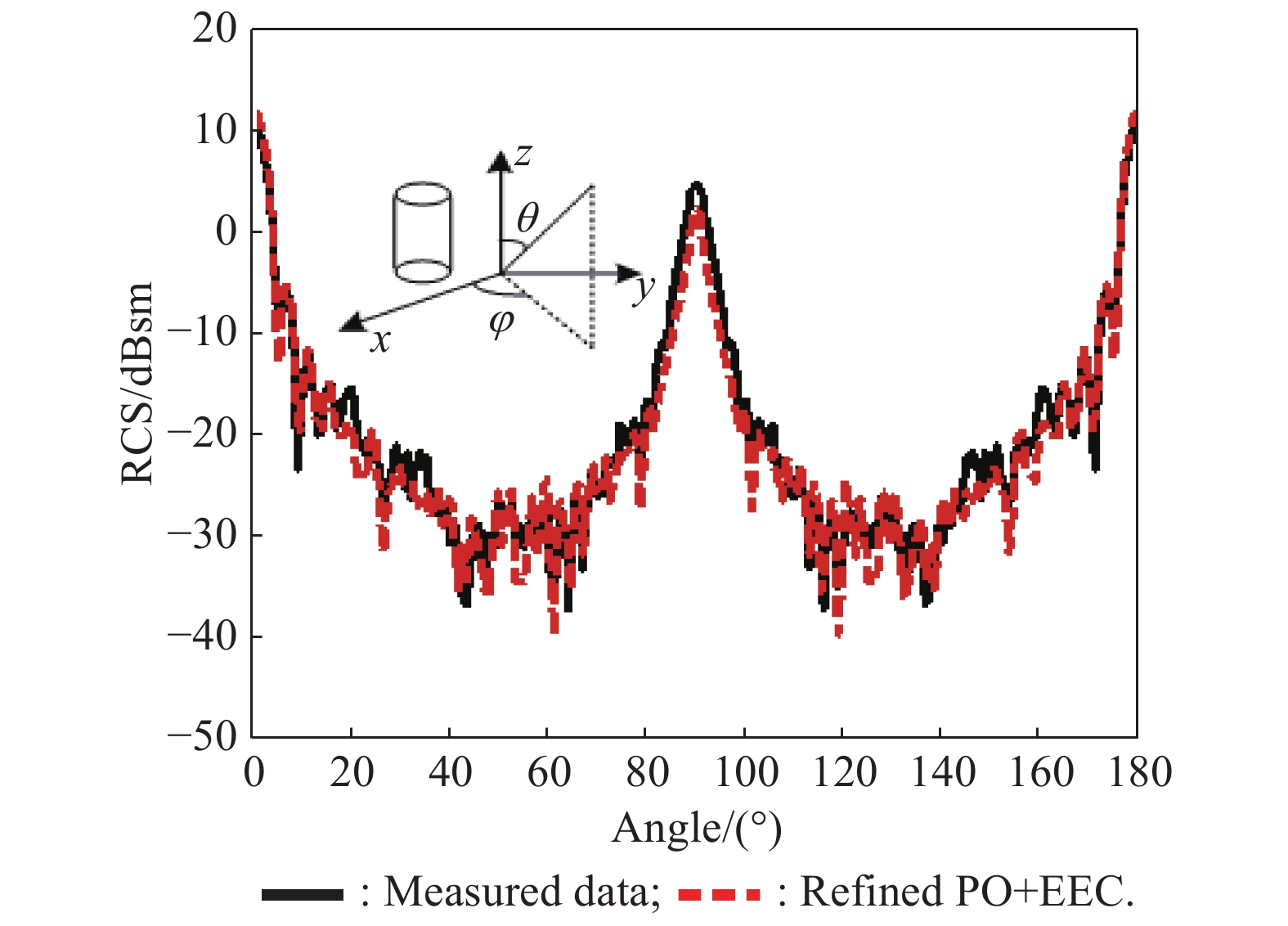
Fig 2
RCS of a quadrangular frustum of pyramid"
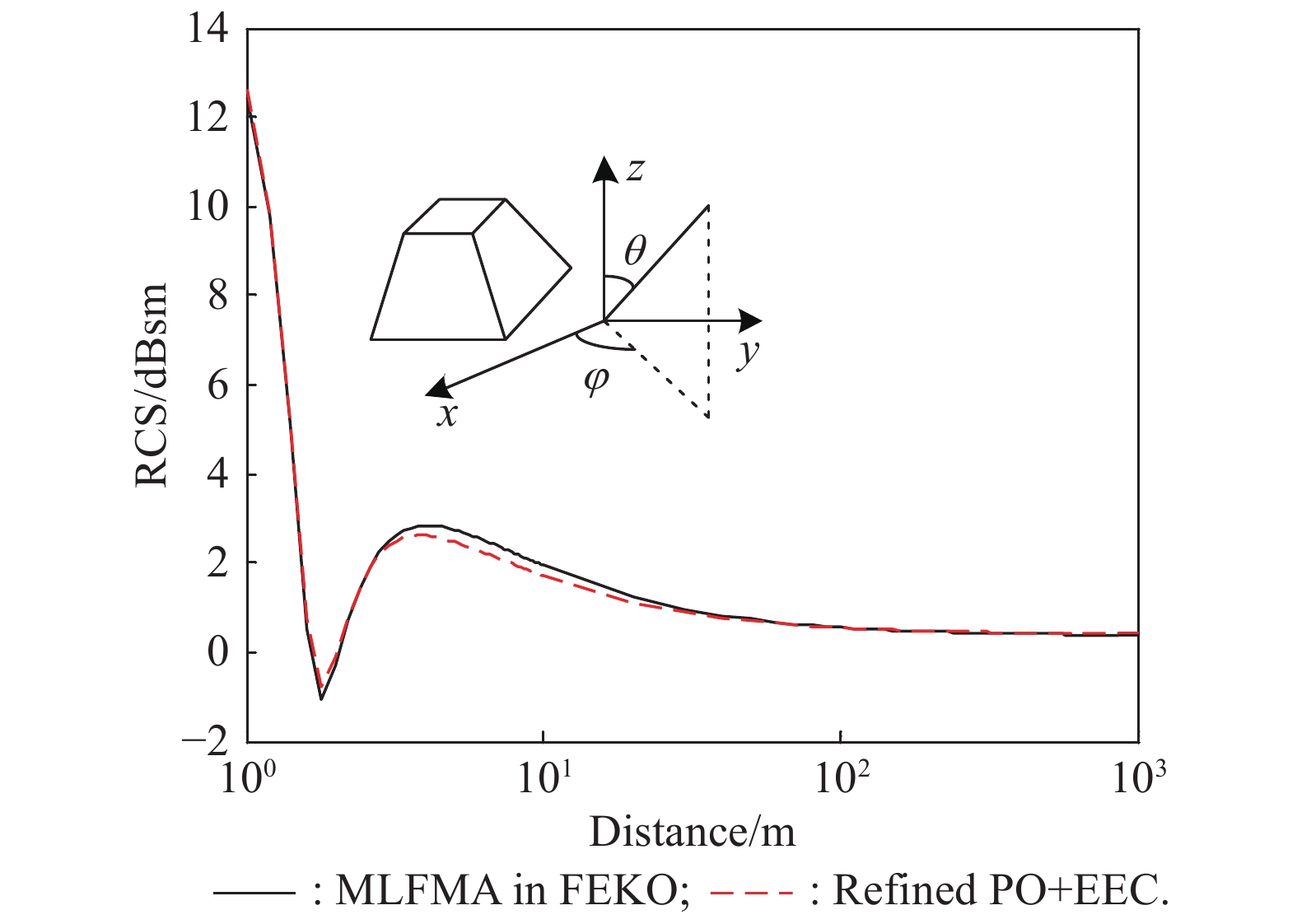
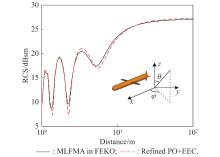
Fig 3
Monostatic RCS of a generic missile"
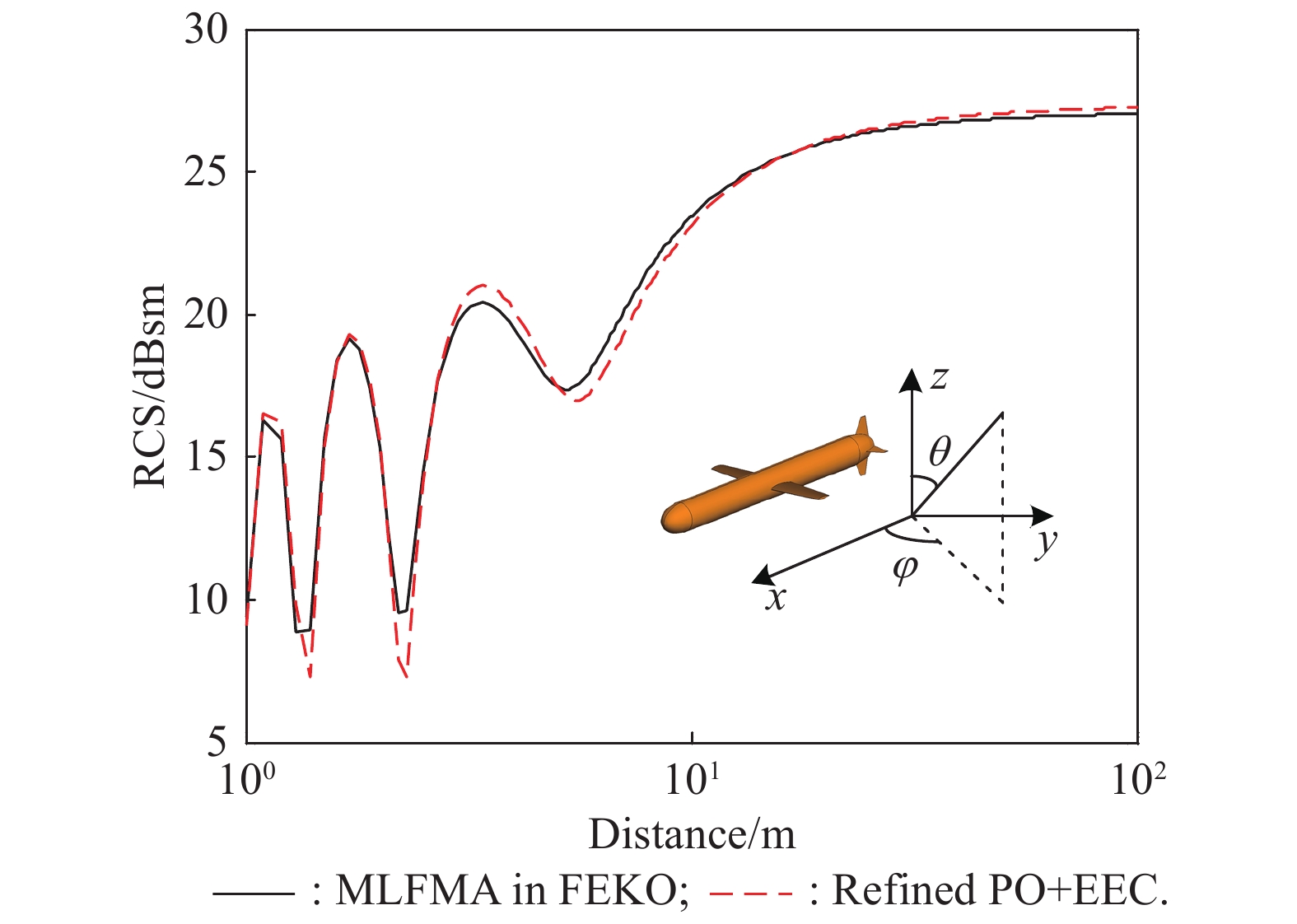
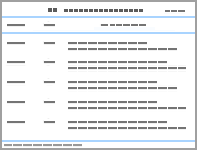
Table 1
Comparison of calculation time and memory"
| Solution | MLFMA in FEKO | Refined PO+EEC |
| Time/s | 12.91 | |
| Memory/MB | 3.28 |
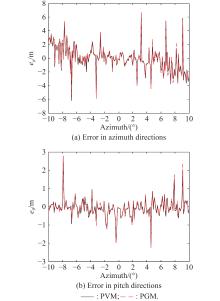
Fig 4
FF angular glint error of some aircraft"
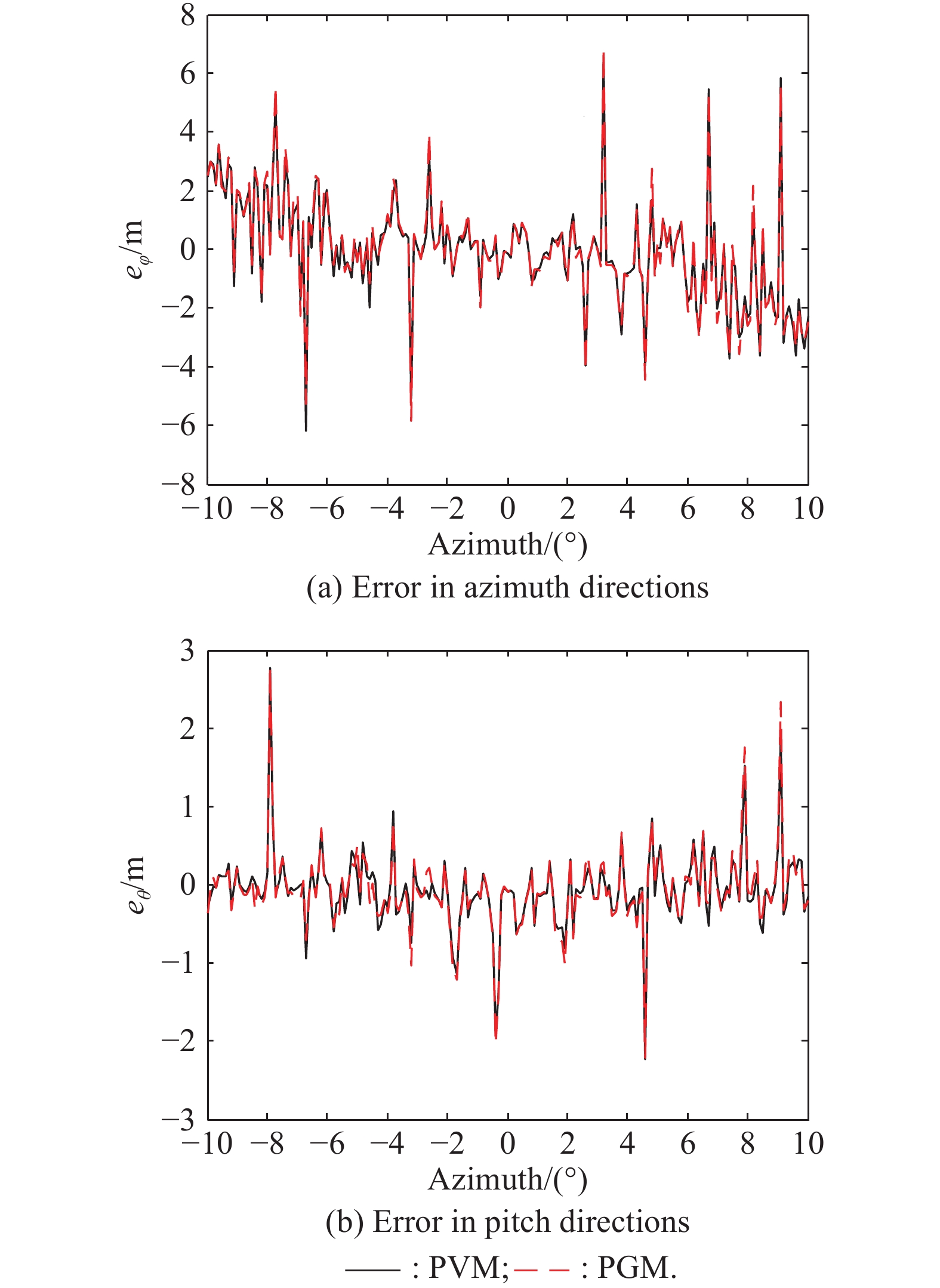
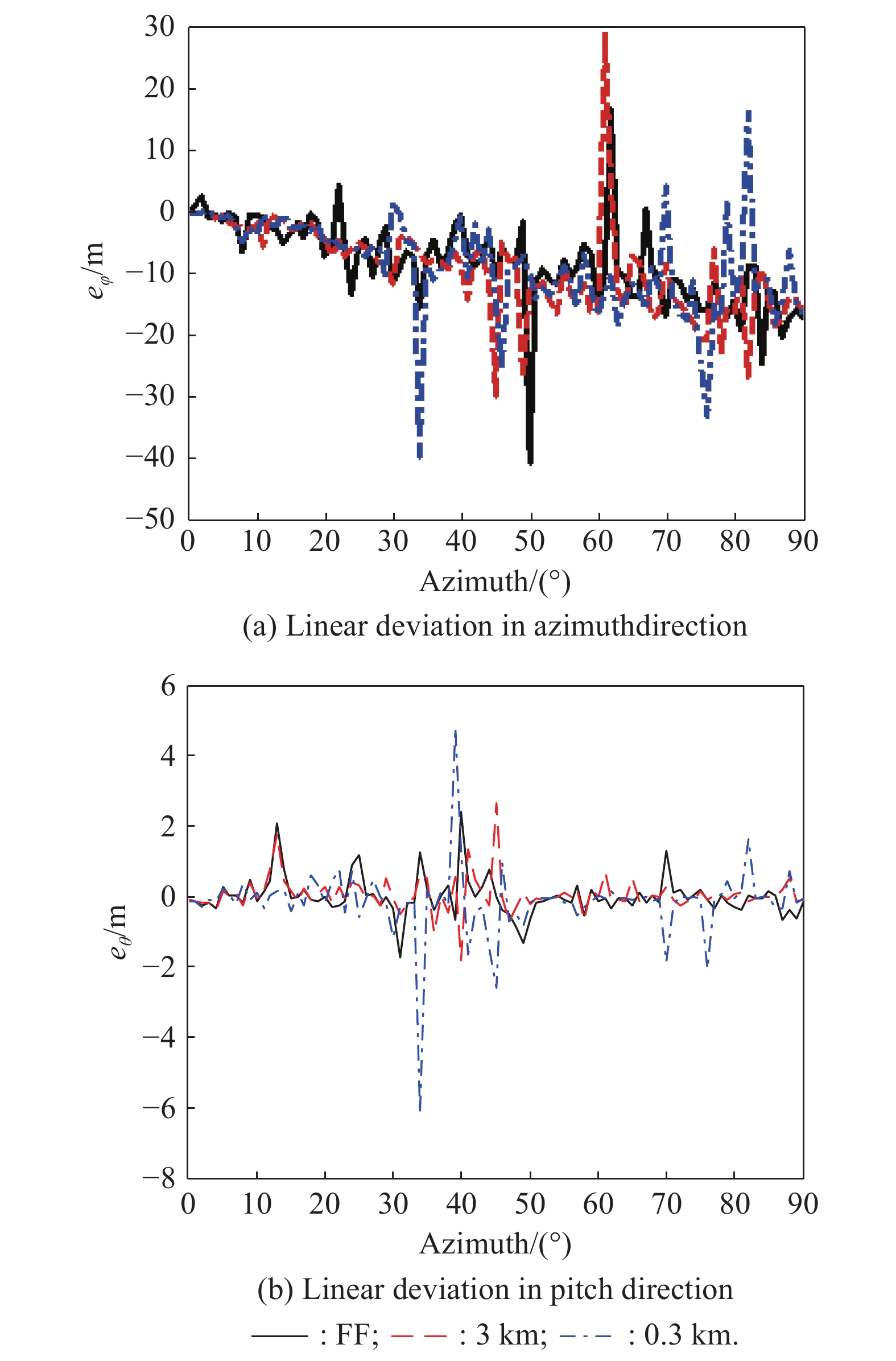
Fig 5
Angular glint error of a generic aircraft in different observation distance"
| 1 |
ZHU Y, WEI G, LI J Z A shooting and bouncing ray method for electrically large targets with non-uniform thickness anisotropic material. IEEE Trans. on Antennas and Propagation, 2024, 72 (7): 6156- 6161.
doi: 10.1109/TAP.2024.3407346 |
| 2 | HE Y M, LU D W, HE H F, et al The analysis of cross-polarization characteristic based on high-frequency electromagnetic theory. IEEE Trans. on Antennas and Propagation, 2024, 72 (7): 3778- 3782. |
| 3 |
NA H, HAN N, MEHMET M T, et al A multiple Huygens surface based ray tracing framework with GPU acceleration. IEEE Trans. on Antennas and Propagation, 2024, 72 (1): 183- 196.
doi: 10.1109/TAP.2023.3326942 |
| 4 |
DU X, KANG C H, TAKADA J I UTD-type solution of physical optics approximation for reconfigurable intelligent surface modeled by a continuous planar surface. IEEE Open Journal of Antennas and Propagation, 2023, 4, 1103- 1115.
doi: 10.1109/OJAP.2023.3329767 |
| 5 |
TAN Q, LIU T P, JIANG W Det al. Azimuth-dimensional RCS prediction method based on physical model priors. Journal of Systems Engineering and Electronics, 2025, 36 (1): 1- 14.
doi: 10.3390/s23177606 |
| 6 |
JENG S K Near-field scattering by physical theory of diffraction and shooting and bouncing rays. IEEE Trans. on Antennas and Propagation, 1998, 46 (4): 551- 558.
doi: 10.1109/8.664120 |
| 7 | NETO A ‘True’ physical optics for the accurate characterization of antenna radomes and lenses. Proc. of the IEEE Antennas and Propagation Society International Symposium, 2003, 4, 416- 419. |
| 8 |
CHEN M, ZHANG Y, LIANG C H Calculation of the field distribution near electrically large NURBS surfaces with physical-optics method. Journal of Electromagnetic Waves and Applications, 2005, 19 (11): 1511- 1524.
doi: 10.1163/156939305775701886 |
| 9 | LEGAULT S R. Refining physical optics for near-field computations. Electronics Letters, 2004, 40(1): 71−72. |
| 10 |
PAPKELIS E G, ANASTASSIU H T, FRANGOS P V A time-efficient near-field scattering method applied to radio-coverage simulation in urban microcellular environments. IEEE Trans. on Antennas and Propagation, 2008, 56 (10): 3359- 3363.
doi: 10.1109/TAP.2008.929516 |
| 11 |
SUI M, XU X J A novel procedure for high resolution radar signature prediction of near field targets. IEEE Trans. on Antennas and Propagation, 2010, 58, 2981- 2993.
doi: 10.1109/TAP.2010.2052552 |
| 12 | SUI M, XU X J. Near-field iterative physical optics based on distinct wave propagation vector. Proc. of the IEEE URSI/APS Symposium, 2010. DOI: 10.1109/APS.2010.5562315. |
| 13 |
CORUCCI L, GIUSTI E, MARTORELLA M, et al Near field physical optics modelling for concealed weapon detection. IEEE Trans. on Antennas and Propagation, 2012, 60 (12): 6052- 6057.
doi: 10.1109/TAP.2012.2210017 |
| 14 |
GENDELMAN A, BRICK Y, BOAG A Multilevel physical optics algorithm for near field scattering. IEEE Trans. on Antennas and Propagation, 2014, 62 (8): 4325- 4335.
doi: 10.1109/TAP.2014.2327648 |
| 15 |
ROUDSTEIN M, BRICK Y, BOAG A Multilevel physical optics algorithm for near-field double-bounce scattering. IEEE Trans. on Antennas and Propagation, 2015, 63 (11): 5015- 5025.
doi: 10.1109/TAP.2015.2481491 |
| 16 |
CHEN B, TONG C M Near-field scattering evaluation based on improved PO and EECs. Electronics Letters, 2019, 55 (4): 180- 182.
doi: 10.1049/el.2018.7884 |
| 17 | CHEN B, TONG C M Modified physical optics algorithm for near field scattering. Chinese Physics B, 2018, 27 (11): 476- 480. |
| 18 |
CHEN B, DANG T X, LI Y M, et al Near-field scattering prediction and analysis. Electromagnetics, 2024, 44 (5): 339- 348.
doi: 10.1080/02726343.2024.2383696 |
| 19 | ZHOU X, CUI T J A closed-form representation of time-domain far fields based on physical optics. IEEE Antennas and Wireless Propagation Letters, 2012, 11, 1965- 968. |
| 20 |
CHEN B, TONG C M Near-field scattering prediction based on refined time-domain high-frequency method. IEEE Antennas and Wireless Propagation Letters, 2019, 18, 1194- 1198.
doi: 10.1109/LAWP.2019.2911951 |
| 21 | GUO G B, GUO L X, WANG R, et al. Time-domain near-field scattering from composite target-ocean scene illuminated by far-field antenna sources. Proc. of the 13th International Symposium on Antennas, Propagation and EM Theory, 2021. DOI: 10.1109/ISAPE54070.2021. 9753056. |
| 22 | HOWARD D D. Radar target angular scintillation in tracking and guidance system based on echo signal phase distortion. Proc. of the National Electronics Conference, 1959: 840–849. |
| 23 |
DUNN J H, HOWARD D D Radar target amplitude, angle, and Doppler scintillation from analysis of the echo signal propagating in space. IEEE Trans. on Microwave Theory and Techniques, 1968, 16 (9): 715- 728.
doi: 10.1109/TMTT.1968.1126776 |
| 24 | LINDSAY J E. Angular glint and the moving, rotating, complex radar target. IEEE Trans. on Aerospace and Electronic Systems, 1968, 4(2): 164–173. |
| 25 |
KAJENSKI P J Comparison of two theories of angle glint: polarization consideration. IEEE Trans. Aerospace and Electronic Systems, 2006, 42 (1): 206- 210.
doi: 10.1109/TAES.2006.1603415 |
| 26 |
YIN H C Further comparison between two concepts of radar target angular glint. IEEE Trans. Aerospace and Electronic Systems, 2008, 44 (1): 372- 380.
doi: 10.1109/TAES.2008.4517012 |
| 27 |
YIN H C Inherent relations among the three representations of radar target angular glint. Journal of Radars, 2014, 3 (2): 119- 128.
doi: 10.3724/SP.J.1300.2014.14025 |
| 28 | GUO K Y. Angular glint error simulation using attributed scattering center models. IEEE Access, 2018, 6: 35194–35205. |
| 29 |
ALTINTAS A, RUSSER P Time-domain equivalent edge currents for transient scattering. IEEE Trans. on Antennas and Propagtion, 2001, 49 (4): 602- 606.
doi: 10.1109/8.923321 |
| 30 | CÔTÉ F. Simulation de section efficace radar sur unetrajectoire. Quebec City: Laval University, 2007. |
| [1] | Yuguang TIAN, Yixin LIU, Xuan CHEN, Penghui CHEN, Jun WANG, Junwen CHEN. Sparsity-based efficient simulation of cluster targets electromagnetic scattering [J]. Journal of Systems Engineering and Electronics, 2023, 34(2): 299-306. |
| [2] | Guangfu Zhang, Chao Wang, Liguo Liu, Yunqi Fu, and Naichang Yuan. Calculation of angular glint in near field utilizing graphical electromagnetic computing [J]. Journal of Systems Engineering and Electronics, 2013, 24(6): 906-911. |
| [3] | Xiaofei Li and Xiaojian Xu. Doppler spectral analysis for time-evolving sea surfaces using second-order small slope approximation [J]. Journal of Systems Engineering and Electronics, 2011, 22(5): 754-759. |
| [4] | Zhanhe Liu, Peilin Huang, ZheWu, and Xu Gao. Improvement and performance of parallel multilevel fast multipole algorithm [J]. Journal of Systems Engineering and Electronics, 2011, 22(1): 164-169. |
| [5] | Yongpin Chen, Zaiping Nie, and Jun Hu. Fast and accurate analysis of electromagnetic scattering from targets situated in dielectric half space [J]. Journal of Systems Engineering and Electronics, 2010, 21(1): 37-40. |
| [6] | Wang Chao, Yin Hongcheng & Huang Peikang. Comparison between two concepts of angular glint: general considerations [J]. Journal of Systems Engineering and Electronics, 2008, 19(4): 635-642. |
| Viewed | ||||||
|
Full text |
|
|||||
|
Abstract |
|
|||||
