
Journal of Systems Engineering and Electronics ›› 2026, Vol. 37 ›› Issue (2): 445-454.doi: 10.23919/JSEE.2025.000049
• DEFENCE ELECTRONICS TECHNOLOGY • Previous Articles
Xinyong ZHANG( ), Zhangming HE(), Xuanying ZHOU(), Huiyu CHEN(), Jiongqi WANG(), Haiyin ZHOU()
Received:2024-08-28
Accepted:2025-04-07
Online:2026-04-18
Published:2026-04-30
Contact:
Zhangming HE
E-mail:867428705@qq.com;hzmnudt@163.com;julia_chow07@163.com;1633110563@qq.com;wjq_gfkd@163.com;gfkd_zhy@sina.com
About author:Supported by:Xinyong ZHANG, Zhangming HE, Xuanying ZHOU, Huiyu CHEN, Jiongqi WANG, Haiyin ZHOU. Evaluation approaches for spatial targets localization precision based on observation matrix condition number[J]. Journal of Systems Engineering and Electronics, 2026, 37(2): 445-454.
Add to citation manager EndNote|Reference Manager|ProCite|BibTeX|RefWorks
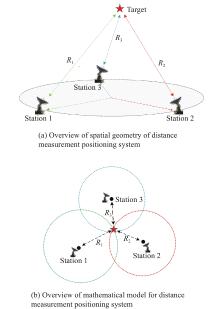
Fig 1
Overview of TOA technology based on distance measurement positioning system"
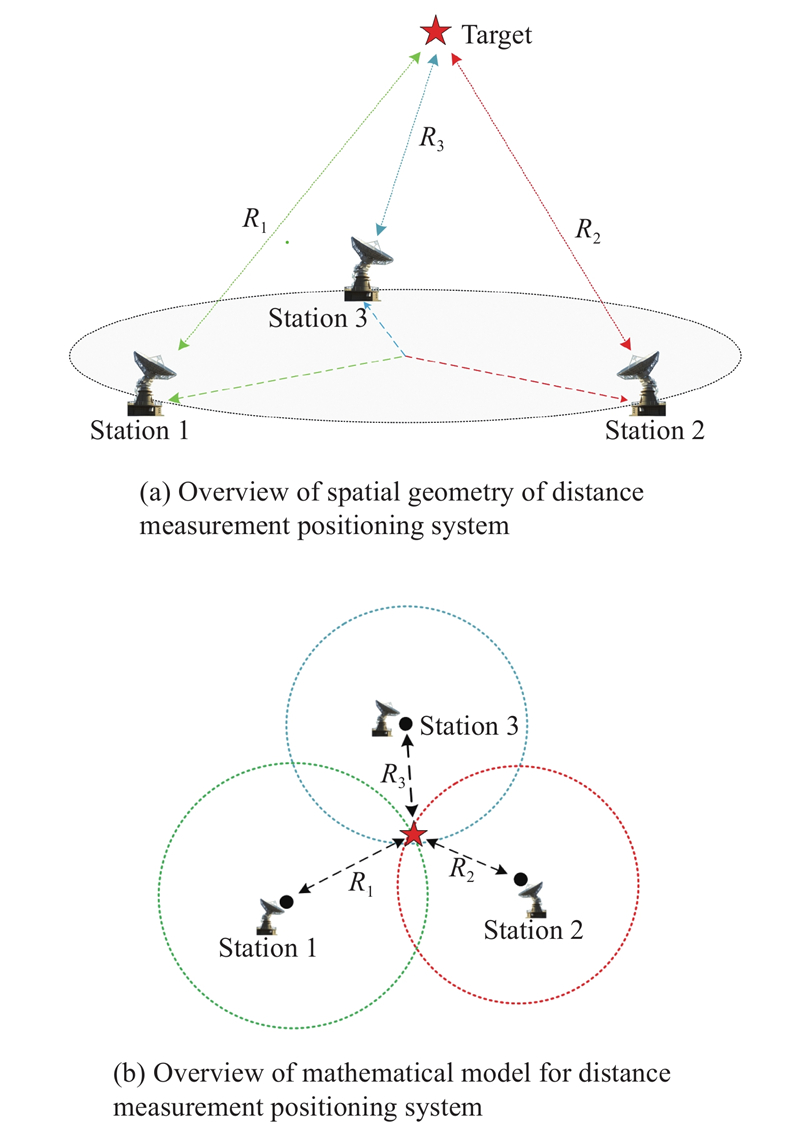
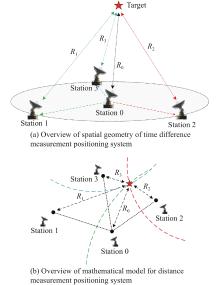
Fig 2
Overview of time difference measurement positioning based on TDOA technology"
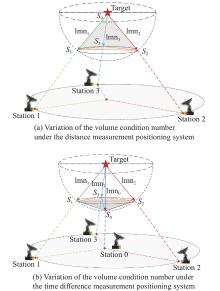
Fig 3
Variation of the volume condition number"
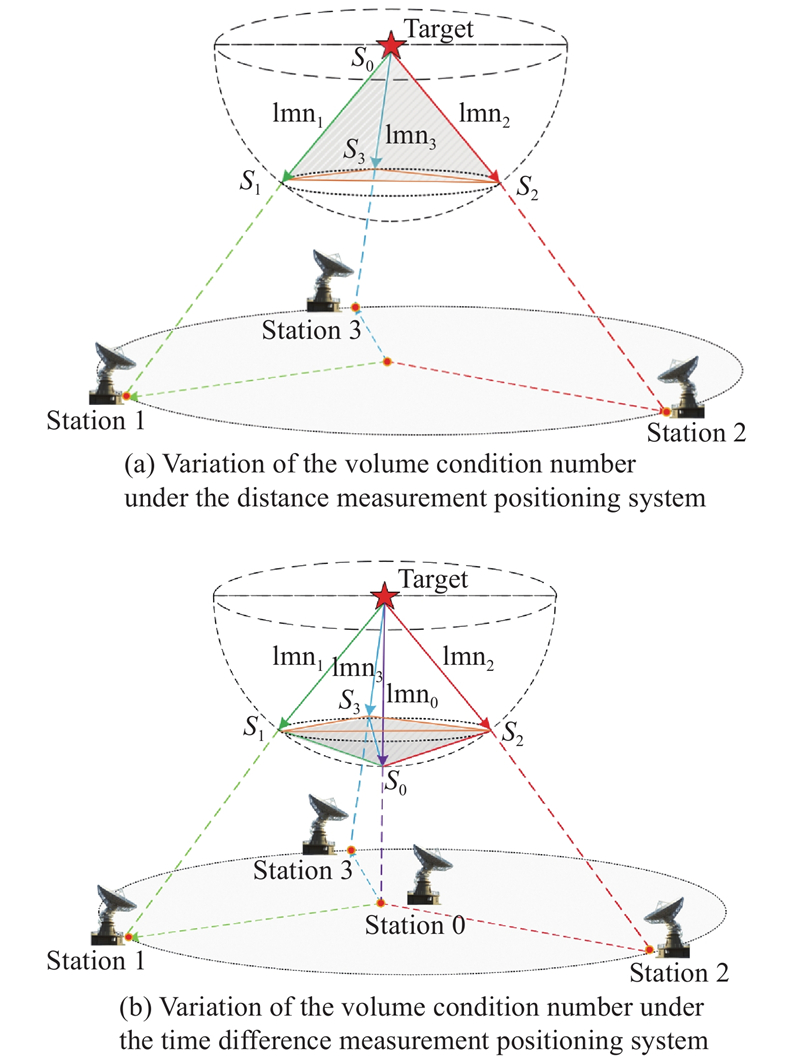
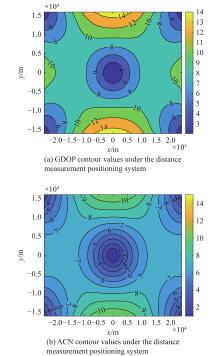
Fig 4
GDOP and ACN values under distance measurement positioning system"
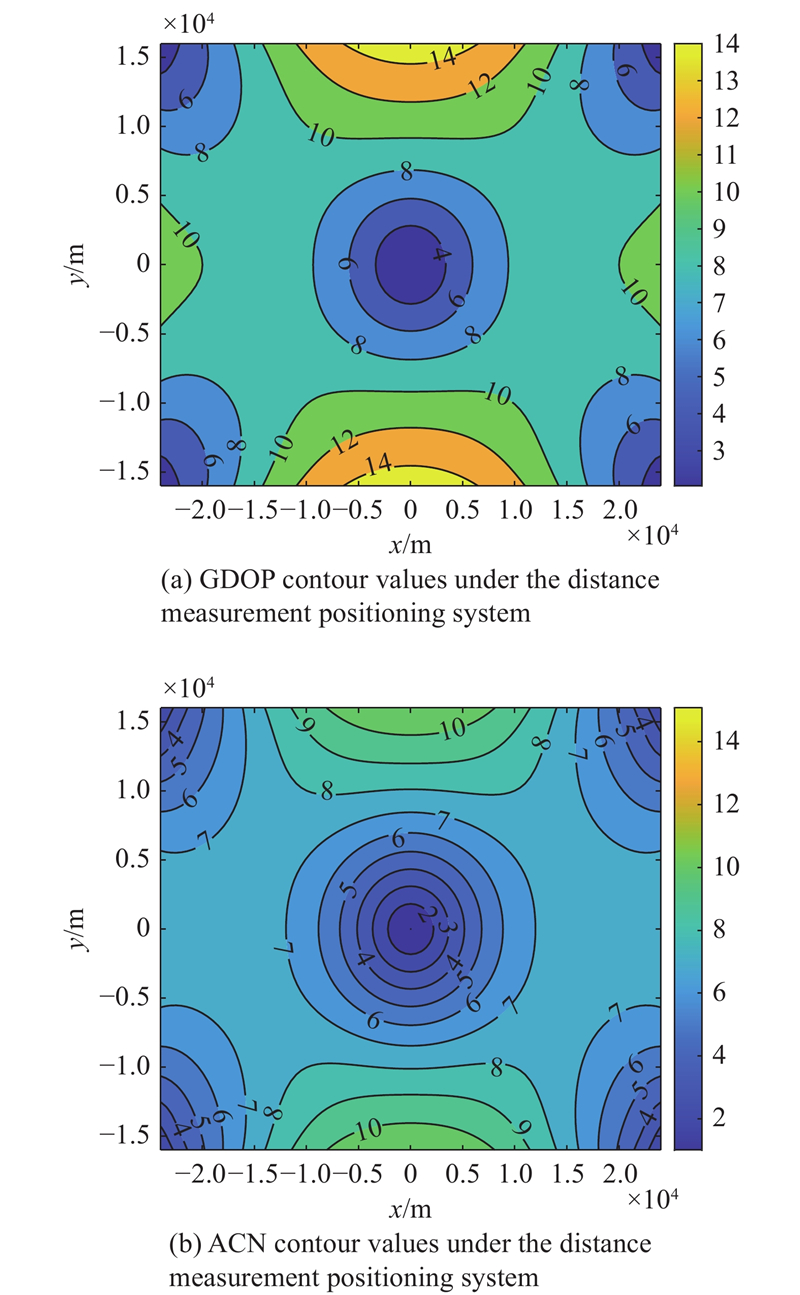
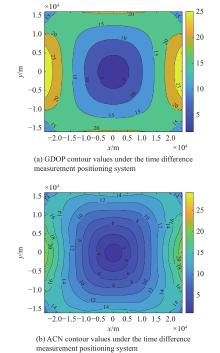
Fig 5
GDOP and ACN values under the time difference measurement positioning system"
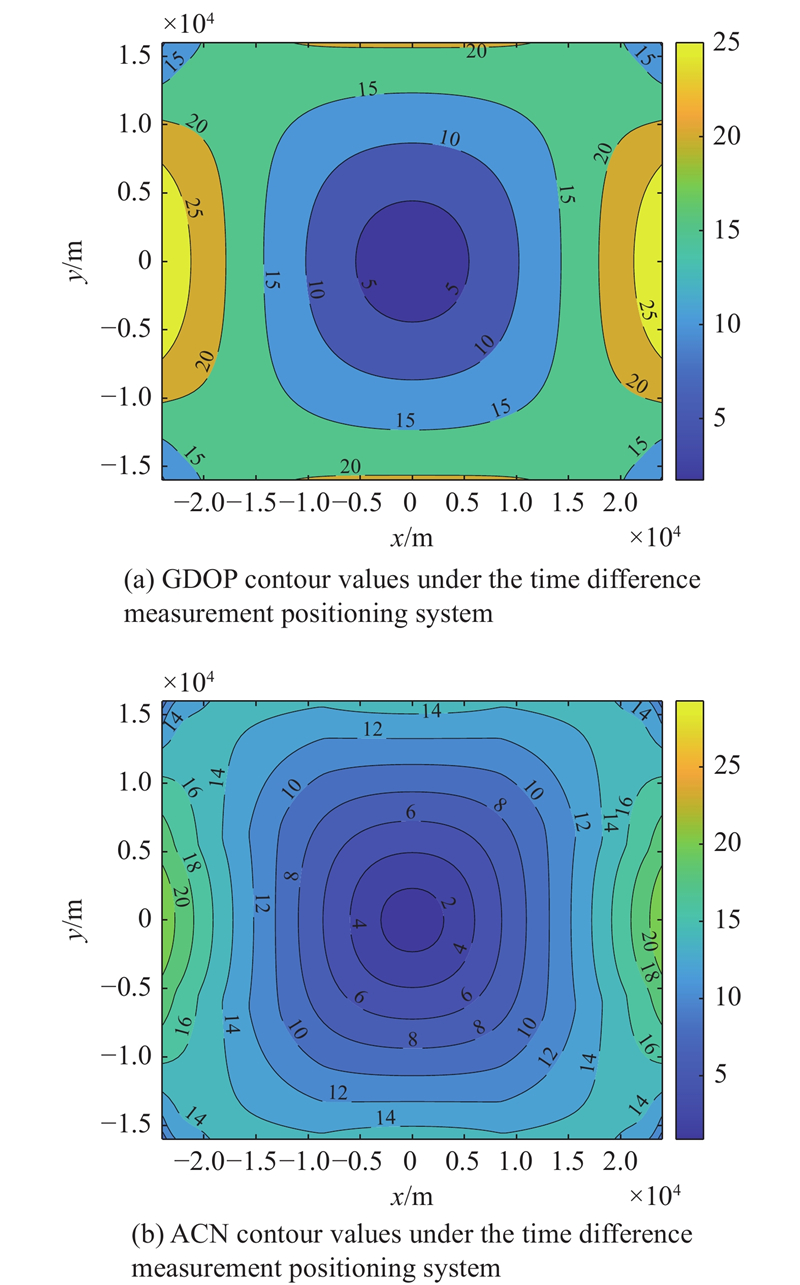
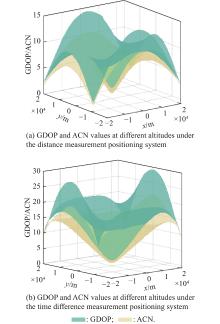
Fig 6
Relationship between GDOP and ACN during the measurement process"
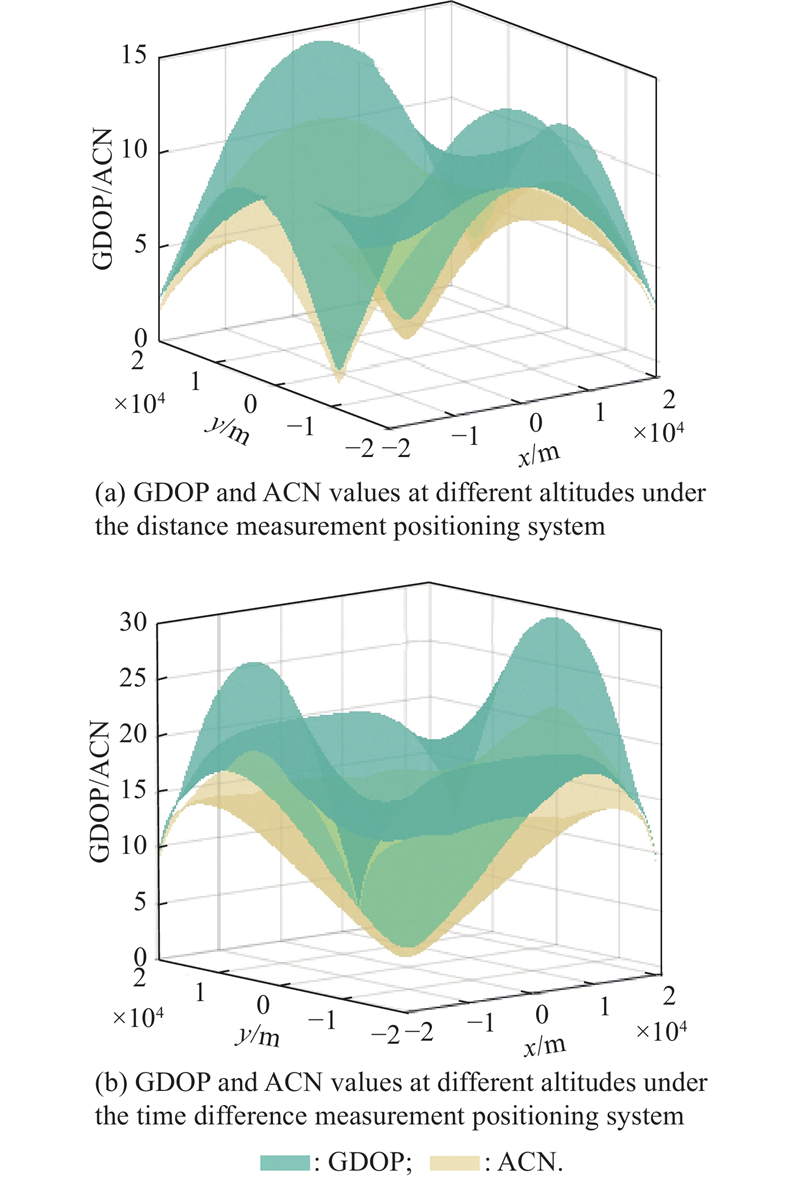
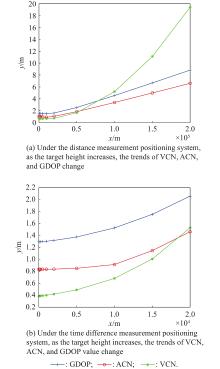
Fig 7
Trend graph of localization accuracy change during space target movement"
| 1 | TIAN X, WEI G L, WANG G N Overview of wireless sensor network localization. Information and Control, 2022, 51 (1): 69- 87. |
| 2 |
WU Y H, LIU Q W, LYU T Y, et al Pedestrian and vehicle area positioning with multiple UWB signals. IEEE Internet of Things Journal, 2024, 11 (19): 30875- 30886.
doi: 10.1109/JIOT.2024.3455069 |
| 3 |
CANO J, LE NY J Ranging-based localizability optimization for mobile robotic networks. IEEE Trans. Robot, 2023, 39 (4): 2842- 2860.
doi: 10.1109/TRO.2023.3263772 |
| 4 |
ZHAO S H, ZHANG X P, CUI X W, et al A new TOA localization and synchronization system with virtually synchronized periodic asymmetric ranging network. IEEE Internet of Tings Journal, 2021, 8 (11): 9030- 9044.
doi: 10.1109/JIOT.2021.3055677 |
| 5 |
CUI J F, LIANG H, WANG Z Spatial Distribution Characteristics of Positioning Accuracy for TOA Localization. IEEE Sensors Journal, 2025, 25 (3): 5003- 5012.
doi: 10.1109/JSEN.2024.3512613 |
| 6 | MULLER J G, VIBRANS A C, PINTO C T Impact of solar activity on the calculation of TOA reflectance values of multispectral images. IEEE Trans. on Geoscience and Remote Sensing, 2024, 62, 5402806. |
| 7 | YI L, LE Y, JI L. Robust UWB indoor position tracking using TDOA measurements. Proc. of IEEE 4th International Conference on Computer and Communications, 2018. DOI: 10.1109/CompComm.2018.8780881. |
| 8 |
NAVARATIL V, KRSKAR J, VEJRAZKA F Concurrent bidirectional TDOA positioning in UWB network with free-running clocks. IEEE Trans. on Aerospace and Electronic Systems, 2022, 58 (5): 4434.
doi: 10.1109/TAES.2022.3161895 |
| 9 | PHRUKSAHIRAN N Analysis of influence of sensor placement for source localization based on TDOA algorithm. Computers and Electrical Engineering, 2024, 116, 109147. |
| 10 | KILANI M, GAGNON G, GAGNON F Multistate radar placement optimization for cooperative radar-communication systems. IEEE Communication Letters, 2018, 22, 1576- 1579. |
| 11 |
BACH S H, KHOI P B, YI S Y, et al Global UWB system: a high-accuracy mobile robot localization system with tightly coupled integration. IEEE Internet of Things Journal, 2024, 11 (9): 16618- 16626.
doi: 10.1109/JIOT.2024.3354786 |
| 12 |
DING Y W, SHEN D, PHAM K, et al Optimal placements for minimum GDOP with consideration on the elevations of access nodes. IEEE Trans. on Instrumentation and Measurement, 2025, 74, 9501210.
doi: 10.1109/TIM.2024.3497055 |
| 13 |
YARLAGADDA R, ALI I, AL-DHAHIR N, et al GPS GDOP metric. IEE Proceedings of Radar, Sonar and Navigation, 2000, 147, 259- 264.
doi: 10.1049/ip-rsn:20000554 |
| 14 |
AZARBAD M, AZAMI H, SANEI S, et al New neural network-based approaches for GPS GDOP classification based on neuro-fuzzy inference system, radial basis function, and improved bee algorithm. Applied Soft Computing, 2014, 25, 285- 292.
doi: 10.1016/j.asoc.2014.09.022 |
| 15 | LANGLEY R B. Dilution of precision. GPS World, 1999, 10: 52–59. |
| 16 |
CHINMAY S, BANAVAR M Data-driven nonlinear TDOA for accurate source localization in complex signal dynamics. IEEE Sensors Journal, 2024, 24 (19): 31018- 31025.
doi: 10.1109/JSEN.2024.3464389 |
| 17 | FAN J N. Research on wireless localization algorithms based on TOA and TDOA. Shantou: Shantou University, 2023. (in Chinese) |
| 18 | LEI W Y, CHEN B X, YANG M L, et al Passive 3D target location method based on TOA and TDOA. Systems Engineering and Electronics, 2014, 36 (5): 816- 823. |
| 19 |
BEN K, M G Multistatic radar placement optimization for cooperative radar-communication systems. IEEE Communications Letters, 2018, 22 (8): 1576- 1579.
doi: 10.1109/LCOMM.2018.2837913 |
| 20 |
WANG Y, ZHOU T, YI W, et al A GDOP-based performance description of TOA localization with uncertain measurements. Remote Sensing, 2022, 14 (4): 910.
doi: 10.3390/rs14040910 |
| 21 | LIANG J L, HUAN M S, DENG M B, et al Optimal transmitter and receiver placement for localizing 2D interested-region target with constrained sensor regions. Signal Processing, 2021, 183, 108032. |
| 22 | WANG B, WANG S Y, ZHAO W L, et al. Matrix analysis. Beijing: Electronic Industry Press, 2021. (in Chinese) |
| 23 |
GUO Q, TIAN Y H, QI L G A SAR multiple RFI suppression method via Frobenius norm and iterative matrix decomposition. IEEE Journal of Selected Topics in Applied Earth Observations and Remote Sensing, 2024, 17, 3927- 3939.
doi: 10.1109/JSTARS.2024.3357131 |
| 24 |
SHARP I, YU K, GUO Y J GDOP analysis for positioning system design. IEEE Trans. on Vehicular Communications, 2009, 58 (7): 3371- 3382.
doi: 10.1109/TVT.2009.2017270 |
| 25 |
BACH S H, YI S Y Constrained least-squares trilateration for indoor positioning system under high GDOP condition. IEEE Trans. on Industrial Informatics, 2023, 20 (3): 4550- 4558.
doi: 10.1109/TII.2023.3326535 |
| 26 | LI H. Numerical analysis, 2nd Edition. Wuhan: Huazhong University of Science and Technology Press, 2010. (in Chinese) |
| 27 |
TURING A M Rounding off-errors in matrix processes. The Quarterly Journal of Mechanics and Applied Mathematics, 1948, 1 (1): 287- 308.
doi: 10.1093/qjmam/1.1.287 |
| 28 | ZHANG X D. Matrix analysis and applications. Beijing: Tsinghua University Press, 2004. (in Chinese) |
| 29 | SHORES T S. Applied linear algebra and matrix analysis. Cham: Springer, 2018. |
| 30 | HE Z M, ZENG K J, WEI C, et al. Real time and post-processing methods for remote measurement data. Beijing: Science Press, 2024. (in Chinese) |
| 31 |
MOSLEM Z, MILAN H Error bounds and a condition number for the absolute value equations. Mathematical Programming, 2023, 198 (1): 85- 113.
doi: 10.1007/s10107-021-01756-6 |
| 32 | HE Z K, ZHENG S J, SUN Z X The geometric significance of determinant and calculation of polyhedron volume. College Mathematics, 2021, 37 (3): 105- 109. |
| [1] | Jinhai Guo, Xinping Xiao, Jun Liu, and Shuhua Mao. Stability of GM(1,1) power model on vector transformation [J]. Journal of Systems Engineering and Electronics, 2015, 26(1): 103-. |
| [2] | Qian Weixing, Liu Jianye, Zhao Wei & Zhu Yanhua. Novel method of improving the alignment accuracy of SINS on revolving mounting base [J]. Journal of Systems Engineering and Electronics, 2009, 20(5): 1052-1057. |
| [3] | Xiao Hailin, Ouyang Shan, Nie Zaiping & Zhao Feng. Capacity analysis of high-rank line-of-sight MIMO channels [J]. Journal of Systems Engineering and Electronics, 2009, 20(4): 706-710. |
| [4] | Sheng Xinqing & Peng Zhen. Novel high-performance element in the electromagnetic finite-element method——node-edge element [J]. Journal of Systems Engineering and Electronics, 2008, 19(5): 878-881. |
| [5] | Xiao Hailin, Nie Zaiping, Li Xin & Ouyang Shan. Analysis for MIMO correlated frequency-selective channel in the presence of interference [J]. Journal of Systems Engineering and Electronics, 2008, 19(4): 679-682. |
| Viewed | ||||||
|
Full text |
|
|||||
|
Abstract |
|
|||||
