
Journal of Systems Engineering and Electronics ›› 2026, Vol. 37 ›› Issue (5): 1438-1448.doi: 10.23919/JSEE.2025.000148
• ELECTRONICS TECHNOLOGY • Previous Articles
Jie Wang1,2( ), Wei Xiao2,3,*(), Fangxuan Zou1(), Wenxiang Liu2,3(), Gang Ou2,3()
Received:2025-04-01
Accepted:2025-07-18
Online:2026-10-18
Published:2026-11-09
Contact:
Wei Xiao
E-mail:wangjiefjj@163.com;xiaowei12@nudt.edu.cn;zoufangxuan24@nudt.edu.cn;liuwenxiang8888@163.com;ougangcs@139.com
Jie Wang, Wei Xiao, Fangxuan Zou, Wenxiang Liu, Gang Ou. Adaptive covariance matrix taper for GNSS antenna array receivers through subspace leakage analysis[J]. Journal of Systems Engineering and Electronics, 2026, 37(5): 1438-1448.
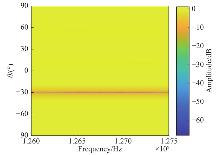
Fig 1
Angle-frequency pattern of STAP without a CMT (one interference)"
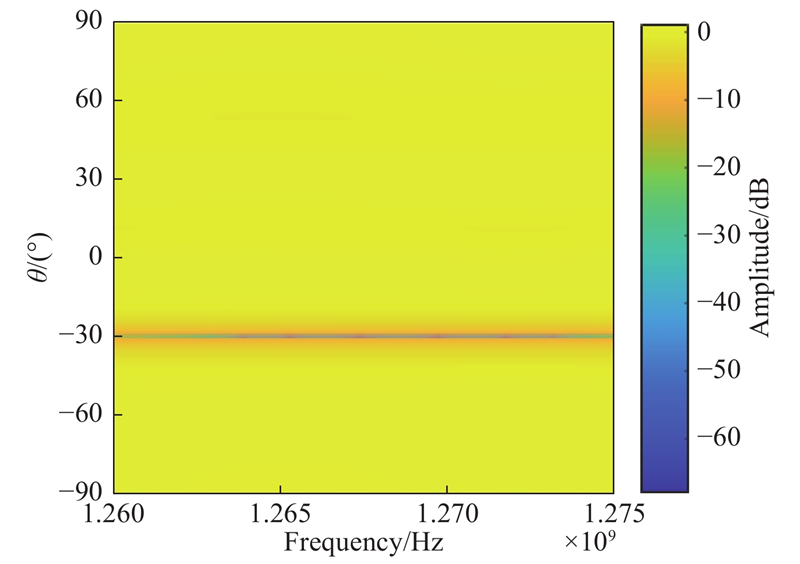
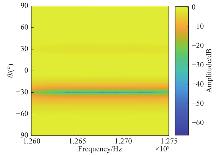
Fig 2
Angle-frequency pattern of STAP with a CMT (one interference)"
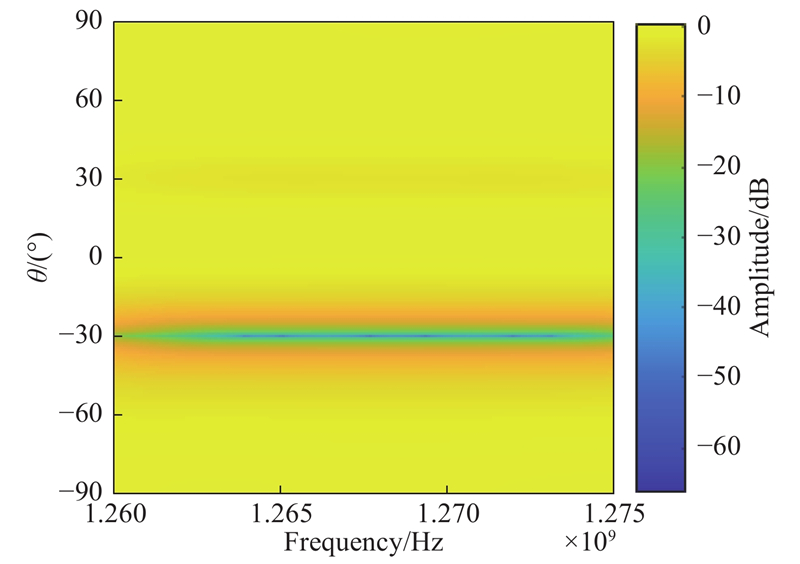
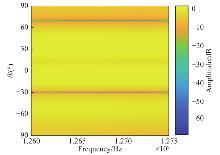
Fig 3
Angle-frequency pattern of STAP without a CMT (two interference)"
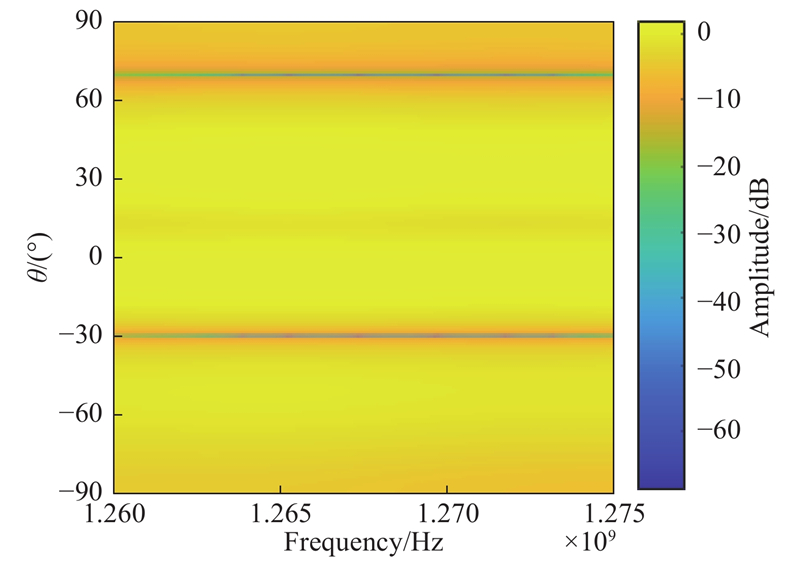
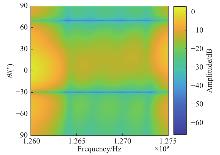
Fig 4
Angle-frequency pattern of STAP with a CMT (two interference)"
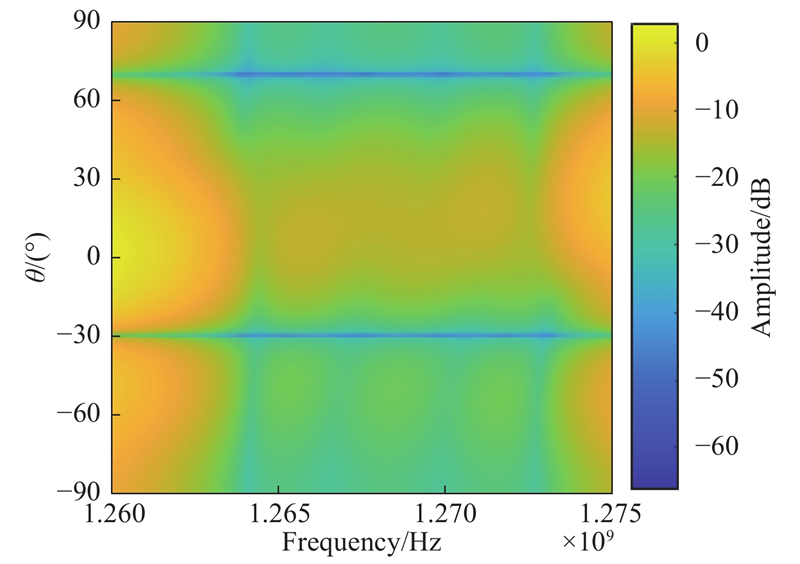
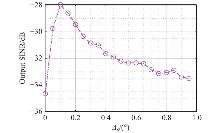
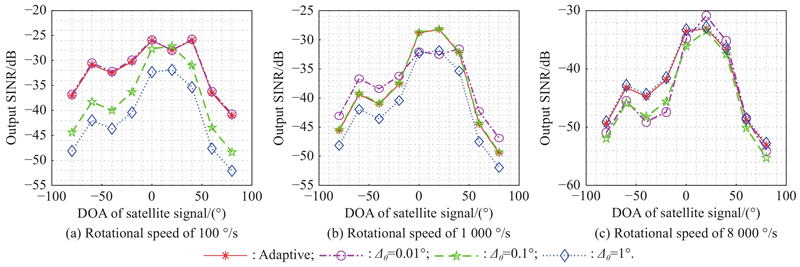
Fig 5
Output SINR with different ${\varDelta _\theta }$ of the CMT"
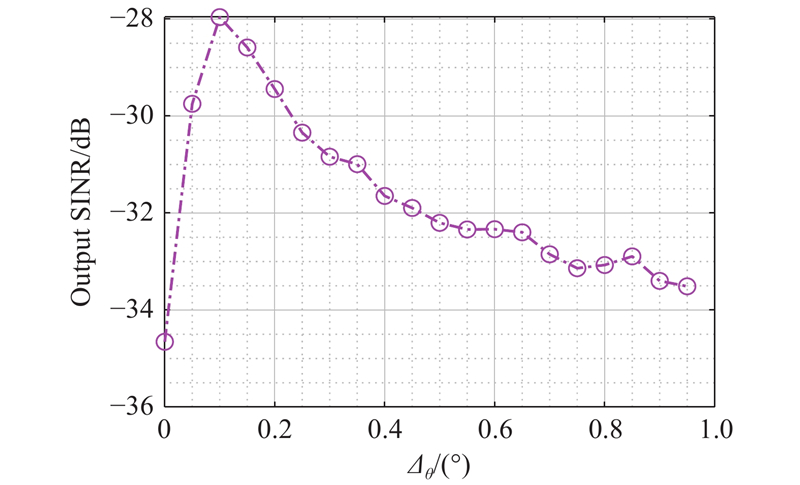
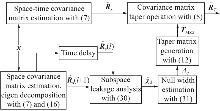
Fig 6
Schematic diagram of the adaptive CMT"
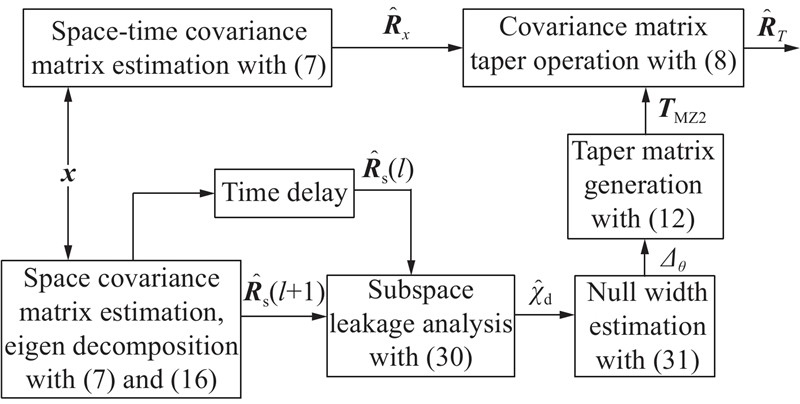
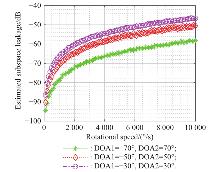
Fig 7
Dynamic subspace leakage is estimated by (18) with INR = 82 dB"
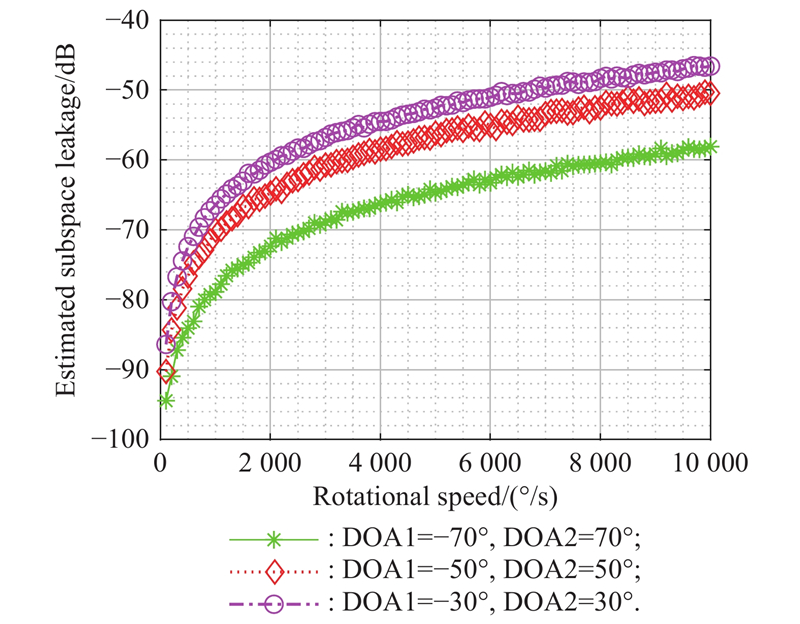
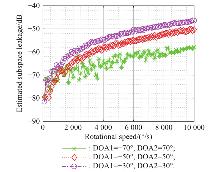
Fig 8
Dynamic subspace leakage estimated by (18) with INR = 62 dB"
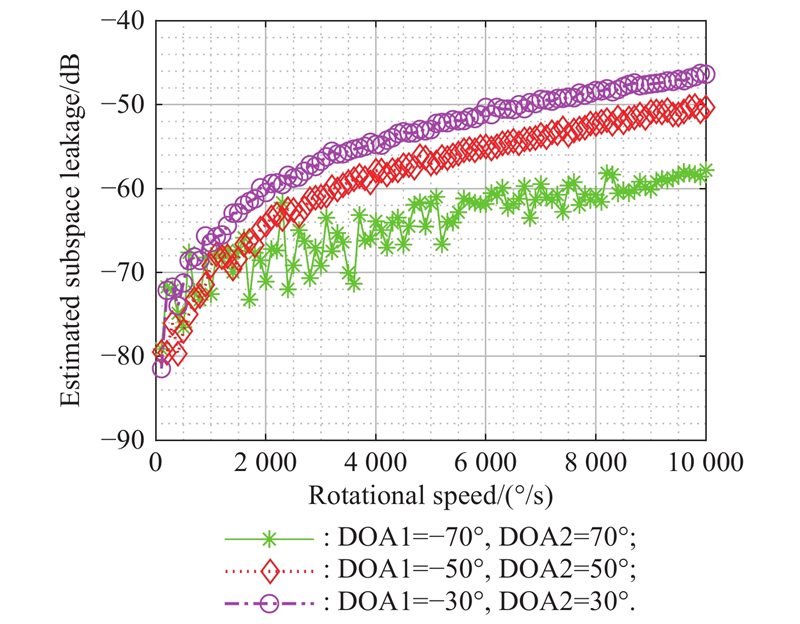
Fig 9
Dynamic subspace leakage estimated by (18) with INR = 32 dB"
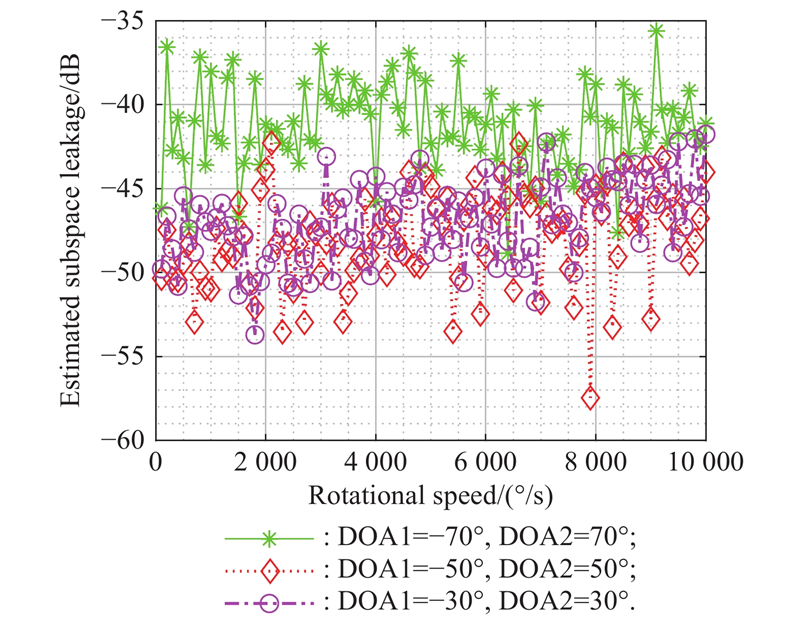
Fig 10
Dynamic subspace leakage estimated by (30)"
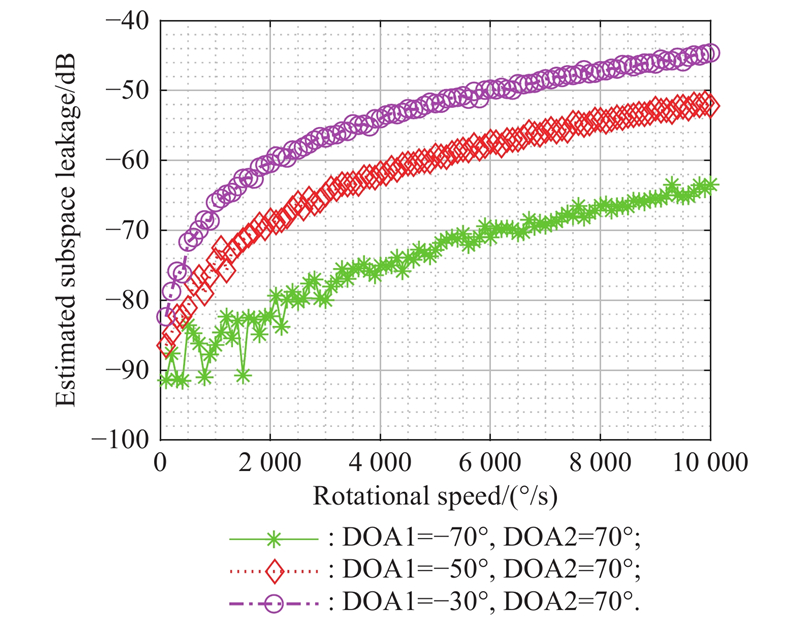
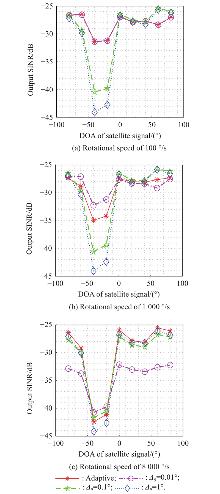
Fig 11
Output SINRs of Scenario 1"
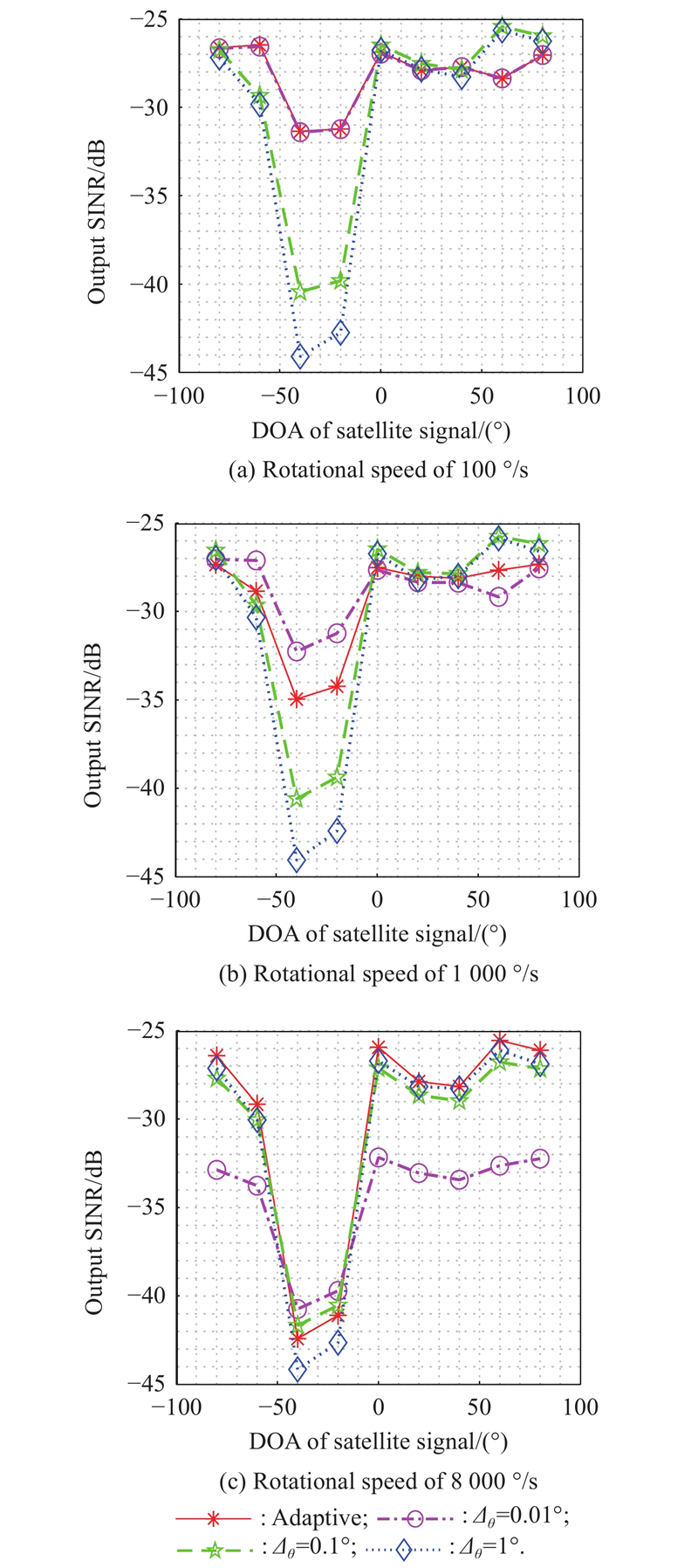
Fig 12
Output SINRs of Scenario 2"
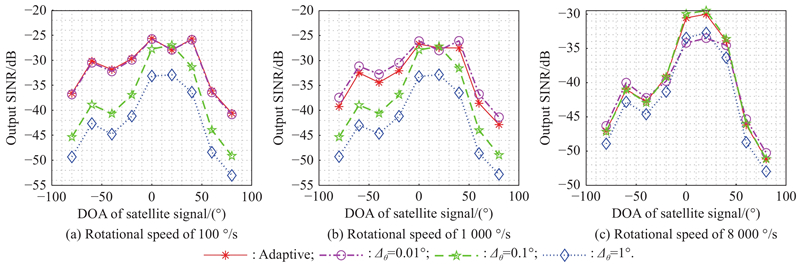
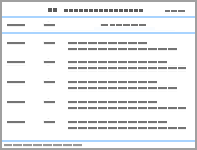
Table 1
Average output SINRs of satellite signal with different DOA"
| Scenario | Rotational speed/(°/s) | Average output SINR/dB | |||
| Adaptive | |||||
| Scenario 1 | 100 | −28.2 | −28.2 | −30.0 | −31.0 |
| −29.3 | −28.7 | −30.0 | −31.0 | ||
| −31.6 | −34.5 | −30.9 | −31.1 | ||
| Scenario 2 | 100 | −31.6 | −31.8 | −37.9 | −42.4 |
| −33.5 | −32.2 | −37.9 | −42.4 | ||
| −40.2 | −40.7 | −40.0 | −42.4 | ||
| Scenario 3 | 100 | −28.5 | −28.3 | −29.8 | −30.9 |
| −30.1 | −32.9 | −30.3 | −31.0 | ||
| −31.6 | −33.5 | −32.7 | −30.7 | ||
| Scenario 4 | 100 | −32.0 | −31.8 | −37.4 | −41.5 |
| −38.5 | −37.7 | −38.4 | −41.4 | ||
| −42.7 | −44.0 | −44.9 | −42.4 | ||
Fig 13
Output SINRs of Scenario 3"
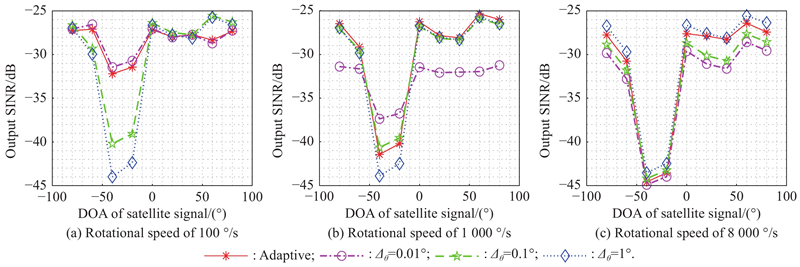
Fig 14
Output SINRs of Scenario 4"
| 1 |
An Y, Kang R L, Ban Y L, et al Beidou receiver based on anti-jamming antenna arrays with self-calibration for precise relative positioning. Journal of Systems Engineering and Electronics, 2024, 35 (5): 1132.
doi: 10.23919/JSEE.2024.000013 |
| 2 | Fante R L, Vaccaro J J Wideband cancellation of interference in a GPS receive array. IEEE Trans. on Aerospace and Electronic Systems, 2002, 36 (2): 549. |
| 3 |
Gupta I J, Moore T D Space-frequency adaptive processing (SFAP) for radio frequency interference mitigation in spread-spectrum receivers. IEEE Trans. on Antennas and Propagation, 2004, 52 (6): 1611.
doi: 10.1109/TAP.2004.829850 |
| 4 |
Gupta I J, Weiss I M, Morrison A W Desired features of adaptive antenna arrays for GNSS receivers. Proceedings of the IEEE, 2016, 104 (6): 1195.
doi: 10.1109/JPROC.2016.2524416 |
| 5 |
Chuang Y C, Gupta I J On-the-fly estimation of antenna induced biases in SFAP based GNSS antenna arrays. Navigation: Journal of The Institute of Navigation, 2014, 61 (4): 323.
doi: 10.1002/navi.73 |
| 6 | Vorobyov S A Adaptive and robust beamforming. Academic Press Library in Signal Processing, 2014, 3, 503. |
| 7 |
Mohammadzadeh S, Kukrer O Robust adaptive beamforming for fast moving interference based on the covariance matrix reconstruction. IET Signal Processing, 2019, 13 (4): 486.
doi: 10.1049/iet-spr.2018.5264 |
| 8 | Mao X J, Li W X, Li Y S, et al Robust adaptive beamforming against signal steering vector mismatch and jammer motion. International Journal of Antennas and Propagation, 2015, 1, 780296. |
| 9 |
Wang H Y, Yao Z C, Fan Z L, et al A robust STAP beamforming algorithm for GNSS receivers in high dynamic environment. Signal Processing, 2020, 172, 107532.
doi: 10.1016/j.sigpro.2020.107532 |
| 10 | Carlson B D Covariance matrix estimation errors and diagonal loading in adaptive arrays. IEEE Trans. on Aerospace and Electronic Systems, 2002, 24 (4): 397. |
| 11 | Gershman A B, Nickel U, Bohme J F Adaptive beamforming algorithms with robustness against jammer motion. IEEE Trans. on Signal Processing, 2002, 45 (7): 1878. |
| 12 |
Gershman A B, Serebryakov G V, Bohme J F Constrained Hung-Turner adaptive beam-forming algorithm with additional robustness to wideband and moving jammers. IEEE Trans. on Antennas and Propagation, 1996, 44 (3): 361.
doi: 10.1109/8.486305 |
| 13 |
Zatman M Production of adaptive array troughs by dispersion synthesis. Electronics Letters, 1995, 31 (25): 2141.
doi: 10.1049/el:19951486 |
| 14 |
Mailloux R J Covariance matrix augmentation to produce adaptive array pattern troughs. Electronics Letters, 1995, 31 (10): 771.
doi: 10.1049/el:19950537 |
| 15 | Ma Y X, Lu D, Wang W Y, et al. A high-dynamic null-widen GPS anti-jamming algorithm based on statistical model of the changing interference DOA[C]// China Satellite Navigation Conference: 695. |
| 16 | Lu D, Ge L, Wu R B, et al. High-dynamic wideband interference suppression in GNSS via reduced-rank STAP[C]// 28th International Technical Meeting of the Satellite Division of the Institute of Navigation: 3127. |
| 17 |
Guerci J R Theory and application of covariance matrix tapers for robust adaptive beamforming. IEEE Trans. on Signal Processing, 1999, 47 (4): 977.
doi: 10.1109/78.752596 |
| 18 | Li R F, Wang Y L, Wan S H Research on adapted pattern null widening techniques. Modern Radar, 2003, 25 (2): 42. |
| 19 | Cao Y H, Guo Y Q, Liu S, et al Adaptive null broadening algorithm based on sidelobes cancellation. Journal of Electronics & Information Technology, 2020, 42 (3): 597. |
| 20 |
Ji Y F, He T, Chen Y, et al A study of null broadening algorithms for navigation receivers in highly dynamic scenarios. Sensors, 2025, 25 (5): 1499.
doi: 10.3390/s25051499 |
| 21 |
Hao F, Wang W, Li R Robust wideband adaptive beamforming with adjustable nulls in high dynamic scene. IEEE Communications Letters, 2023, 27 (11): 3053.
doi: 10.1109/LCOMM.2023.3319602 |
| 22 |
Hao F, Wang W, Li Y W, et al Robust anti-interference strategy with null broadening in the UCA. IEEE Sensors Journal, 2024, 24 (11): 17974.
doi: 10.1109/JSEN.2024.3388428 |
| 23 |
Guerci J R, Bergin J S Principal components, covariance matrix tapers, and the subspace leakage problem. IEEE Trans. on Aerospace and Electronic Systems, 2002, 38 (1): 152.
doi: 10.1109/7.993236 |
| 24 |
Wang J, Liu W X, Chen F Q, et al GNSS array receiver faced with overloaded interferences: anti-jamming performance and the incident directions of interferences. Journal of Systems Engineering and Electronics, 2022, 34 (2): 335.
doi: 10.23919/jsee.2022.000072 |
| 25 |
Thombre S, Bhuiyan M Z H, Eliardsson P, et al GNSS threat monitoring and reporting: past, present, and a proposed future. The Journal of Navigation, 2018, 71 (3): 513.
doi: 10.1017/S0373463317000911 |
| 26 |
Wang J, Liu W X, Ou G, et al Channel scintillations of array global navigation satellite system receiver under distributed intermittent interferences. IET Radar, Sonar & Navigation, 2023, 17 (2): 227.
doi: 10.1049/rsn2.12335 |
| 27 | Li X J, Zhang K, Wang J, et al. A multi-polarization interference suppression strategy of GNSS antenna array based on polarization equalization[J]. IEEE Trans. on Aerospace and Electronic Systems, 2025. |
| 28 |
Liu Z W, Zhao S S, Zhang C, et al Flexible robust adaptive beamforming method with null widening. IEEE Sensors Journal, 2021, 21 (9): 10579.
doi: 10.1109/JSEN.2021.3060510 |
| 29 |
Xu Z Y Perturbation analysis for subspace decomposition with applications in subspace-based algorithms. IEEE Trans. on Signal Processing, 2002, 50 (11): 2820.
doi: 10.1109/TSP.2002.804084 |
| 30 |
Liu J, Liu X Q, Ma X L First-order perturbation analysis of singular vectors in singular value decomposition. IEEE Trans. on Signal Processing, 2008, 56 (7): 3044.
doi: 10.1109/TSP.2007.916137 |
| 31 | Shaghaghi M, Vorobyov S A. Subspace leakage analysis of sample data covariance matrix[C]// IEEE International Conference on Acoustics, Speech and Signal Processing, 2015: 3447. |
| [1] | Sushmitha KOTI, Rachamalla SANDHYA. Hybrid adaptive machine learning approach for detection and mitigation of GNSS spoofing through enhanced osprey optimization algorithm [J]. Journal of Systems Engineering and Electronics, 2026, 37(3): 1059-1080. |
| [2] | Maoyou LIAO, Xu LYU, Ziyang MENG, Zheng YOU. GNSS spoofing detection for single antenna receivers via CNR variation monitoring [J]. Journal of Systems Engineering and Electronics, 2024, 35(5): 1276-1286. |
| [3] | Yuqing ZHENG, Xiaofeng AI, Yong YANG, Feng ZHAO, Shunping XIAO. Detection method of forward-scatter signal based on Rényi entropy [J]. Journal of Systems Engineering and Electronics, 2024, 35(4): 865-873. |
| [4] | Hongcheng ZENG, Jiadong DENG, Pengbo WANG, Xinkai ZHOU, Wei YANG, Jie CHEN. A spawning particle filter for defocused moving target detection in GNSS-based passive radar [J]. Journal of Systems Engineering and Electronics, 2023, 34(5): 1085-1100. |
| [5] | YI PAN, Sheng ZHANG, Xiao WANG, Manhao LIU, Yiran LUO. A fine acquisition algorithm based on fast three-time FRFT for dynamic and weak GNSS signals [J]. Journal of Systems Engineering and Electronics, 2023, 34(2): 259-269. |
| [6] | Yue WANG, Fuping SUN, Jinming HAO, Lundong ZHANG, Xian WANG. Evaluation of global navigation satellite system spoofing efficacy [J]. Journal of Systems Engineering and Electronics, 2022, 33(6): 1238-1257. |
| [7] | Yangjun GAO, Guangyun LI, Zhiwei LYU, Lundong ZHANG, Zhongpan LI. Improved adaptively robust estimation algorithm for GNSS spoofer considering continuous observation error [J]. Journal of Systems Engineering and Electronics, 2022, 33(5): 1237-1248. |
| [8] | Xiaojiao PANG, Yongbo ZHAO, Chenghu CAO, Baoqing XU, Yili HU. STAP method based on atomic norm minimization with array amplitude-phase error calibration [J]. Journal of Systems Engineering and Electronics, 2021, 32(1): 21-30. |
| [9] | Qian WANG, Chuanding ZHANG, Deyong XIAN. Multi-channel signal parameters joint optimization for GNSS terminals [J]. Journal of Systems Engineering and Electronics, 2018, 29(1): 39-47. |
| [10] | Rongling Lang, Xinyue Li, Fei Gao, and Liang Yang. Re-scaling and adaptive stochastic resonance as a tool for weak GNSS signal acquisition [J]. Journal of Systems Engineering and Electronics, 2016, 27(2): 290-296. |
| [11] | Hongwei Zhao, Baowang Lian, and Juan Feng. Adaptive beamforming and phase bias compensation for GNSS receiver [J]. Journal of Systems Engineering and Electronics, 2015, 26(1): 10-. |
| [12] | Hong Zhou, Michail Antoniou, Zhangfan Zeng, Rui Zuo, et al.. Pre-processing for time domain image formation in SS-BSAR system [J]. Journal of Systems Engineering and Electronics, 2012, 23(6): 875-880. |
| [13] | Yan Zhang, Yunhua Zhang, and Xiang Gu. Improved STAP algorithm based on APES [J]. Journal of Systems Engineering and Electronics, 2011, 22(3): 387-392. |
| [14] | Zhiwei Yang, Guisheng Liao, Shun He, and Cao Zeng. Target location with signal fitting and sub-aperture tracking for airborne multi-channel radar [J]. Journal of Systems Engineering and Electronics, 2010, 21(5): 752-758. |
| [15] | Dong Shengbo, Zhang Wentao, Zhang Xiaofeng, Chang Xiaolan & Gu Xuemai. Digital implementation and analysis of a high dynamic frequency tracking loop [J]. Journal of Systems Engineering and Electronics, 2007, 18(3): 443-447. |
| Viewed | ||||||
|
Full text |
|
|||||
|
Abstract |
|
|||||
