
Journal of Systems Engineering and Electronics ›› 2026, Vol. 37 ›› Issue (5): 1642-1664.doi: 10.23919/JSEE.2026.000148
• SYSTEMS ENGINEERING • Previous Articles
Junfeng Chu1( ), Yanyan Su1(), Pan Shu1,*(), Yanyan Wang2(), Yingming Wang1()
Received:2025-01-08
Online:2026-10-18
Published:2026-11-09
Contact:
Pan Shu
E-mail:chujunfeng1987@163.com;suyanyan2019@163.com;shupan321@163.com;wangyanyan12116@163.com;msymwang@hotmail.com
Supported by:Junfeng Chu, Yanyan Su, Pan Shu, Yanyan Wang, Yingming Wang. Consensus-reaching method for social network large-scale group decision-making with linguistic distributed preference relations[J]. Journal of Systems Engineering and Electronics, 2026, 37(5): 1642-1664.

Table 1
The main symbols used in this paper"
| Symbol | Meaning of symbols |
| Adjacency matrix of the social network graph of decision experts | |
| Trust relationship matrix among decision experts | |
| LDPR of decision experts | |
| FRR of decision experts | |
| Set of decision experts | |
| Set of alternative solutions | |
| Weight information of experts in community | |
| Weight information of each community | |
| Weight information of edges between expert nodes |
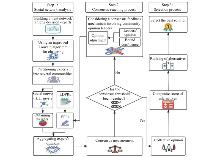
Fig 1
The framework of the method proposed in this paper"
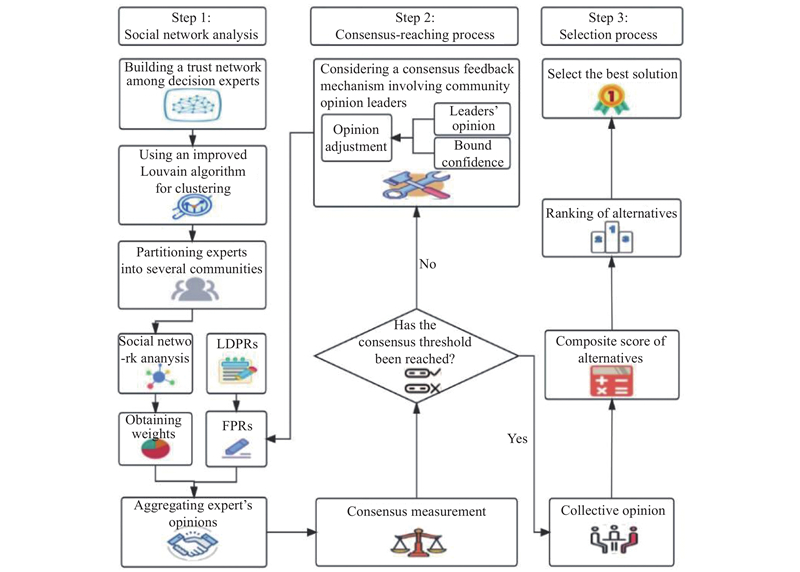
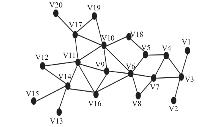
Fig 2
Trust network relationship graph of 20 experts"
Table 2
Personalized numeric scale of linguistic terms for each expert"
| e | |||||||
| 0 | 0.42 | 0.5 | 0.58 | 1 | |||
| 0 | 0.42 | 0.5 | 0.58 | 1 | |||
| 0 | 0.5 | 1 | |||||
| 0 | 0.42 | 0.5 | 0.58 | 1 | |||
| 0 | 0.5 | 0.58 | 1 | ||||
| 0 | 0.5 | 1 | |||||
| 0 | 0.42 | 0.5 | 0.58 | 1 | |||
| 0 | 0.42 | 0.5 | 0.58 | 1 | |||
| 0 | 0.42 | 0.5 | 0.58 | 1 | |||
| 0 | 0.22 | 0.42 | 0.5 | 0.58 | 0.78 | 1 | |
| 0 | 0.5 | 1 | |||||
| 0 | 0.42 | 0.5 | 0.58 | 1 | |||
| 0 | 0.42 | 0.5 | 0.8 | 1 | |||
| 0 | 0.5 | 1 | |||||
| 0 | 0.42 | 0.5 | 0.58 | 1 | |||
| 0 | 0.42 | 0.5 | 0.58 | 1 | |||
| 0 | 0.5 | 1 | |||||
| 0 | 0.5 | 1 | |||||
| 0 | 0.5 | 1 | |||||
| 0 | 0.5 | 1 |
Table 3
Similarity table of decision expert pairs"
| Expert pair | Similarity | Expert pair | Similarity | Expert pair | Similarity | Expert pair | Similarity | |||
Fig 3
Weighted social network relation graph of 20 experts"
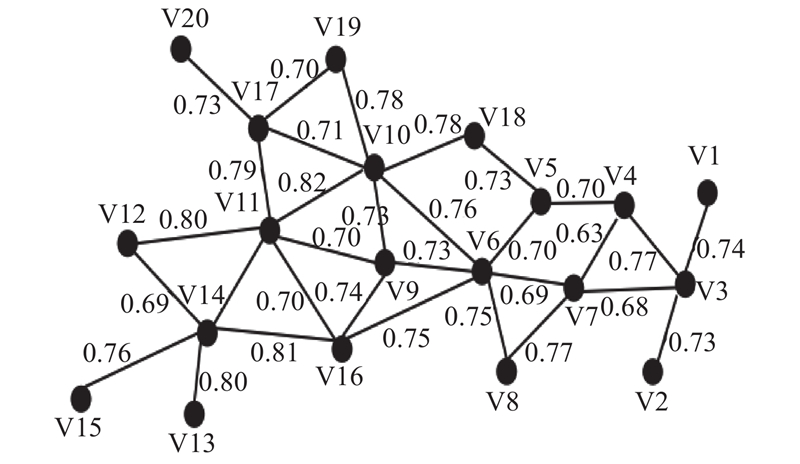
Fig 4
Community partitioning results of 20 decision experts"
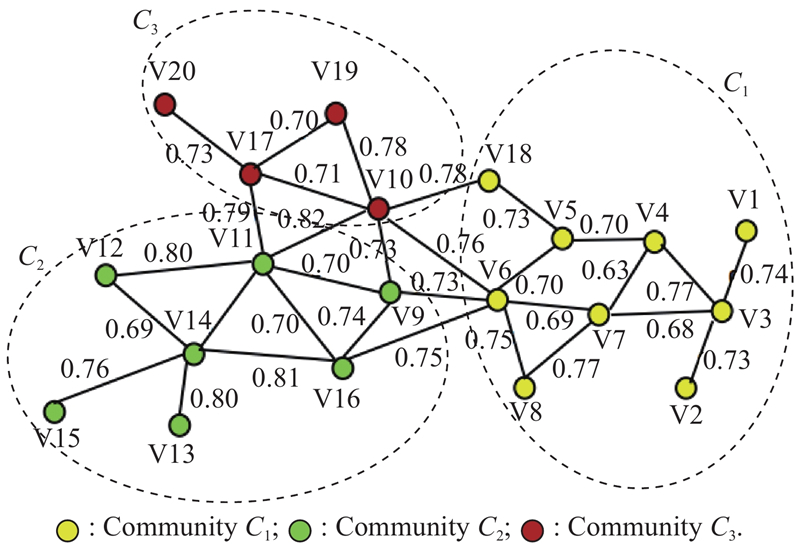
Table 4
Node weights of community 1"
| Community | Weight |
Table 5
Node weights of community 2"
| Community | Weight |
Table 6
Node weights of community 3"
| Community | Weight |
Table 7
Weights of each community"
| Community | Weight |
Table 8
Initial consensus levels of each community and the group"
| Community | Consensus level |
| 0.926 | |
| 0.940 | |
| 0.966 | |
| 0.936 |
Table 9
The first-round consensus levels of each community and the group"
| Community | Consensus level |
| 0.933 | |
| 0.943 | |
| 0.966 | |
| 0.940 |
Table 10
The second-round consensus levels of each community and the group"
| Community | Consensus level |
| 0.940 | |
| 0.945 | |
| 0.966 | |
| 0.945 |
Table 11
The third-round consensus levels of each community and the group"
| Community | Consensus level |
| 0.949 | |
| 0.947 | |
| 0.966 | |
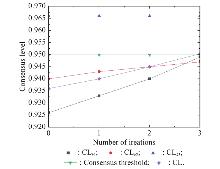
Fig 5
Graph of consensus level variation during iteration process"
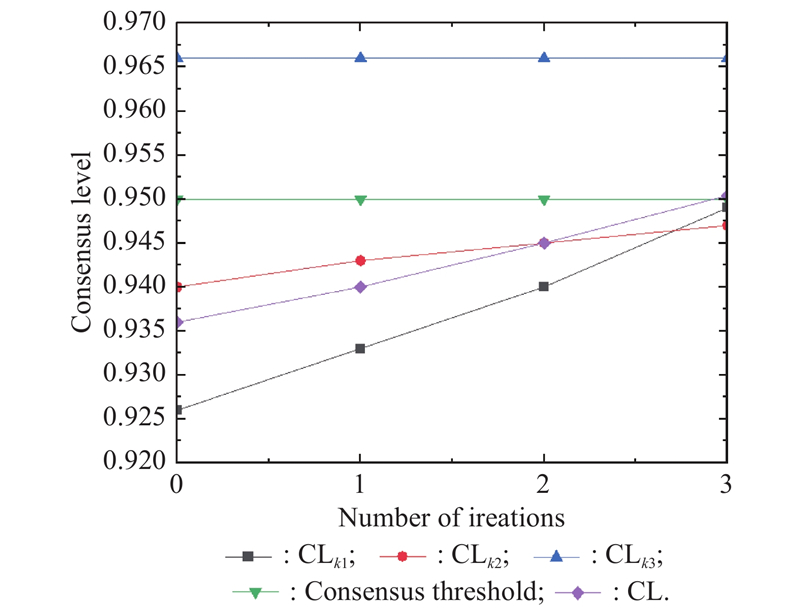
Table 12
Final results of clustering considering different edge weights"
| Weight | Result |
| Trust relationship | |
| Preference similarity | |
| Trust relationship & Preference similarity |
Table 13
Analysis of results from different clustering algorithms"
| Method | Result |
| Trust relationship | |
| Preference similarity | |
| Trust relationship & Preference similarity |
Table 14
Comparative analysis of different clustering methods"
| Method | Dunn | Calinski- Harabasz | Davies- Bouldin index | Silhouette coefficient |
| Proposed algorithm | 1.316 | |||
| K-means algorithm | 1.245 | 3.595 | 1.548 | |
| Traditional Louvain algorithm | 1.235 |
Table 15
Comparison of community weight determination methods in different literature"
| Method | Weight |
| Reference [ | |
| Reference [ | |
| Proposed method |
Table 16
Comparison of consensus levels among different community weights"
| Method | Initial consensus level | Final consensus level | Number of iterations |
| Proposed Method | 0.936 | 3 | |
| Reference [ | 0.942 | 0.951 | 4 |
| Reference [ | 0.939 | 3 |
Table 17
Comparison of GDM methods considering community leaders"
| Reference | Social network | Considering community leaders (or bounded confidence) | Processing method |
| [ | Yes | Community leaders | Identifying community leader based on the reachability matrix, the leader’s opinion represents the opinions of the community. |
| [ | Yes | Community leaders and bounded confidence | The two-stage consensus method uses the bounded confidence model in the first stage for community consensus, and in the second stage, community leaders’ opinions represent the community’s. |
| [ | No | Community leaders | The simple and fast algorithm for K-Medoids algorithm is used to select leaders for communities, and the opinions of these leaders represent the opinions of communities. |
| [ | Yes | Community leaders and bounded confidence | Leaders are determined based on the reachability matrix analysis, and the bounded confidence model is applied in the consensus feedback mechanism to adjust expert opinions. |
Table 18
Comparison of different feedback mechanisms"
| Method | Number of iterations | Consensus improvement range |
| Reference [ | 6 | 0.012 |
| Reference [ | 4 | 0.01 |
| Proposed method | 3 | 0.014 |
| 1 |
Dong Y C, Zha Q B, Zhang H J, et al Consensus reaching and strategic manipulation in group decision making with trust relationships. IEEE Trans. on Systems, Man, and Cybernetics: Systems, 2021, 51 (10): 6304.
doi: 10.1109/TSMC.2019.2961752 |
| 2 |
Chu J F, Wang Y M, Liu X W, et al Social network community analysis based large-scale group decision making approach with incomplete fuzzy preference relations. Information Fusion, 2020, 60, 98.
doi: 10.1016/j.inffus.2020.02.005 |
| 3 |
Du Z J, Luo H Y, Lin X D, et al A trust-similarity analysis-based clustering method for large-scale group decision-making under a social network. Information Fusion, 2020, 63, 13.
doi: 10.1016/j.inffus.2020.05.004 |
| 4 |
Jin F F, Yang Y, Liu J P, et al Social network analysis and consensus reaching process-driven group decision making method with distributed linguistic information. Complex & Intelligent Systems, 2023, 9 (1): 733.
doi: 10.1007/s40747-022-00817-3 |
| 5 |
Gai T T, Cao M S, Chiclana F, et al Consensus-trust driven bidirectional feedback mechanism for improving consensus in social network large-group decision making. Group Decision and Negotiation, 2023, 32 (1): 45.
doi: 10.1007/s10726-022-09798-7 |
| 6 |
Zhang H J, Wang F, Dong Y C, et al Social trust driven consensus reaching model with a minimum adjustment feedback mechanism considering assessments-modifications willingness. IEEE Trans. on Fuzzy Systems, 2022, 30 (6): 2019.
doi: 10.1109/TFUZZ.2021.3073251 |
| 7 |
Wan S P, Dong J Y, Zhang Z H Two-stage consensus reaching process in social network large group decision-making with application to battery supplier selection. Information Sciences, 2024, 668, 120526.
doi: 10.1016/j.ins.2024.120526 |
| 8 |
Shen Y F, Ma X L, Xu Z S, et al Opinion evolution and dynamic trust-driven consensus model in large-scale group decision-making under incomplete information. Information Sciences, 2024, 657, 119925.
doi: 10.1016/j.ins.2023.119925 |
| 9 |
Yuan Y X, Cheng D, Zhou Z L, et al A minimum adjustment cost consensus framework considering harmony degrees and trust propagation for social network group decision making. IEEE Trans. on Systems, Man, and Cybernetics: Systems, 2023, 53 (3): 1453.
doi: 10.1109/TSMC.2022.3200433 |
| 10 | Zhan J X, Cai M J. A cost-minimized two-stage three-way dynamic consensus mechanism for social network-large scale group decision-making: utilizing k-nearest neighbors for incomplete fuzzy preference relations[J]. Expert Systems with Applications, 2025, 263. |
| 11 | Li H Y, Ye G J, Liu W, et al Interval number ranking and its application based on different risk preferences and irrational behaviors of decision makers. Chinese Journal of Engineering Mathematics, 2025, 42 (1): 127. |
| 12 |
Wu Z B, Xu J P Managing consistency and consensus in group decision making with hesitant fuzzy linguistic preference relations. Omega, 2016, 65, 28.
doi: 10.1016/j.omega.2015.12.005 |
| 13 |
Li Z L, Zhang Z, Yu W Y Consensus reaching for ordinal classification-based group decision making with heterogeneous preference information. Journal of the Operational Research Society, 2024, 75 (2): 224.
doi: 10.1080/01605682.2023.2186806 |
| 14 | Yan J, Wan S P, Dong J Y. A hierarchical consensus reaching model based on trust and uncertain degree for heterogeneous large-scale group decision making and application to product design[J]. Journal of the Operational Research Society, 2024: 1. |
| 15 |
Wan S P, Zou W C, Dong J Y Dual strategies consensus reaching process for ranking consensus based probabilistic linguistic multi-criteria group decision-making method. Expert Systems with Applications, 2025, 262, 125342.
doi: 10.1016/j.eswa.2024.125342 |
| 16 |
Mata F, Martinez L, Herrera-Viedma E An adaptive consensus support model for group decision-making problems in a multigranular fuzzy linguistic context. IEEE Trans. on Fuzzy Systems, 2009, 17 (2): 279.
doi: 10.1109/TFUZZ.2009.2013457 |
| 17 |
Liao H C, Wu Z, Tang M, et al An interactive consensus reaching model with updated weights of clusters in large-scale group decision making. Engineering Applications of Artificial Intelligence, 2022, 107, 104532.
doi: 10.1016/j.engappai.2021.104532 |
| 18 |
Tang M, Liao H C, Xu J P, et al Adaptive consensus reaching process with hybrid strategies for large-scale group decision making. European Journal of Operational Research, 2020, 282 (3): 957.
doi: 10.1016/j.ejor.2019.10.006 |
| 19 |
Du Z J, Yu S M, Luo H Y, et al Consensus convergence in large-group social network environment: coordination between trust relationship and opinion similarity. Knowledge-Based Systems, 2021, 217, 106828.
doi: 10.1016/j.knosys.2021.106828 |
| 20 |
Liu B S, Zhou Q, Ding R X, et al Large-scale group decision making model based on social network analysis: trust relationship-based conflict detection and elimination. European Journal of Operational Research, 2019, 275 (2): 737.
doi: 10.1016/j.ejor.2018.11.075 |
| 21 | Wang Z Y, Liu H J, Ma R H. A probabilistic linguistic large-group emergency decision-making method based on the Louvain algorithm and group pressure model[J]. Mathematics, 2025, 13(4). |
| 22 |
Gao P Q, Huang J, Xu Y J A k-core decomposition-based opinion leaders identifying method and clustering-based consensus model for large-scale group decision making. Computers & Industrial Engineering, 2020, 150, 106842.
doi: 10.1016/j.cie.2020.106842 |
| 23 | Nian F Z, Zhang Z. The influence of opinion leaders on public opinion spread and control strategies in online social networks[J]. IEEE Trans. on Computational Social Systems, 2025: 1. |
| 24 |
Zhang C X, Zhao M, Zhao L C, et al A consensus model for large-scale group decision-making based on the trust relationship considering leadership behaviors and non-cooperative behaviors. Group Decision and Negotiation, 2021, 30 (3): 553.
doi: 10.1007/s10726-021-09723-4 |
| 25 |
Xu X H, Zhang Q H, Chen X H Consensus-based non-cooperative behaviors management in large-group emergency decision-making considering experts’ trust relations and preference risks. Knowledge-Based Systems, 2020, 190, 105108.
doi: 10.1016/j.knosys.2019.105108 |
| 26 |
Zhang Z, Gao Y, Li Z L, et al A consensus-reaching method for large-scale group decision-making based on integrated trust-opinion similarity relationships. Computers & Industrial Engineering, 2022, 173, 108667.
doi: 10.1016/j.cie.2022.108667 |
| 27 |
Wu J, Xiong R Y, Chiclana F Uninorm trust propagation and aggregation methods for group decision making in social network with four tuple information. Knowledge-Based Systems, 2016, 96, 29.
doi: 10.1016/j.knosys.2016.01.004 |
| 28 |
Herrera F, Martinez L A 2-tuple fuzzy linguistic representation model for computing with words. IEEE Trans. on Fuzzy Systems, 2000, 8, 746.
doi: 10.1109/91.890332 |
| 29 |
Dong Y C, Xu Y F, Yu S Computing the numerical scale of the linguistic term set for the 2-tuple fuzzy linguistic representation model. IEEE Trans. on Fuzzy Systems, 2009, 17 (6): 1366.
doi: 10.1109/TFUZZ.2009.2032172 |
| 30 |
Zhang H J, Xiao J, Palomares L, et al Linguistic distribution-based optimization approach for large-scale GDM with comparative linguistic information: an application on the selection of wastewater disinfection technology. IEEE Trans. on Fuzzy Systems, 2020, 28 (2): 376.
doi: 10.1109/TFUZZ.2019.2906856 |
| 31 |
Xiao J, Wang X L, Zhang H J Managing personalized individual semantics and consensus in linguistic distribution large-scale group decision making. Information Fusion, 2020, 53, 20.
doi: 10.1016/j.inffus.2019.06.003 |
| 32 |
Gao Y, Fan S, Hu Z N, et al Learning personalized individual semantics through the data of distributed linguistic preference relations: a two-stage method to support linguistic consensus reaching. Computers & Industrial Engineering, 2022, 172, 108581.
doi: 10.1016/j.cie.2022.108581 |
| 33 |
Li C C, Dong Y C, Herrera F A consensus model for large-scale linguistic group decision making with a feedback recommendation based on clustered personalized individual semantics and opposing consensus groups. IEEE Trans. on Fuzzy Systems, 2019, 27 (2): 221.
doi: 10.1109/TFUZZ.2018.2857720 |
| 34 |
Wu T, Liu X W, Qin J D, et al Balance dynamic clustering analysis and consensus reaching process with consensus evolution networks in large-scale group decision making. IEEE Trans. on Fuzzy Systems, 2021, 29 (2): 357.
doi: 10.1109/TFUZZ.2019.2953602 |
| 35 |
Qin J D, Li M X, Liang Y Y Minimum cost consensus model for CRP-driven preference optimization analysis in large-scale group decision making using Louvain algorithm. Information Fusion, 2022, 80, 121.
doi: 10.1016/j.inffus.2021.11.001 |
| 36 |
Liu X, Xu Y J, Herrera F Consensus model for large-scale group decision making based on fuzzy preference relation with self-confidence: Detecting and managing overconfidence behaviors. Information Fusion, 2019, 52, 245.
doi: 10.1016/j.inffus.2019.03.001 |
| 37 |
Gou X J, Xu Z S, Liao H C, et al Consensus model handling minority opinions and noncooperative behaviors in large-scale group decision-making under double hierarchy linguistic preference relations. IEEE Trans. on Cybernetics, 2021, 51 (1): 283.
doi: 10.1109/TCYB.2020.2985069 |
| 38 |
Yu S M, Du Z J, Zhang X Y, et al Trust cop-kmeans clustering analysis and minimum-cost consensus model considering voluntary trust loss in social network large-scale decision-making. IEEE Trans. on Fuzzy Systems, 2022, 30 (7): 2634.
doi: 10.1109/TFUZZ.2021.3089745 |
| 39 |
Tang X A, Peng Z L, Zhang Q, et al Consistency and consensus-driven models to personalize individual semantics of linguistic terms for supporting group decision making with distribution linguistic preference relations. Knowledge-Based Systems, 2020, 189, 105078.
doi: 10.1016/j.knosys.2019.105078 |
| 40 |
Wang S, Wu J, Chiclana F, et al Two-stage feedback mechanism with different power structures for consensus in large-scale group decision making. IEEE Trans. on Fuzzy Systems, 2022, 30 (10): 4177.
doi: 10.1109/TFUZZ.2022.3144536 |
| 41 |
Li S L, Rodriguez R M, Wei C P, et al A consensus model for large-scale group decision making with hesitant fuzzy linguistic information and hierarchical feedback mechanism. Computers & Industrial Engineering, 2022, 173, 108669.
doi: 10.1016/j.cie.2022.108669 |
| 42 | Yao S B, Gu M. An influence network-based consensus model for large-scale group decision making with linguistic information[J]. International Journal of Computational Intelligence Systems, 2022, 15(3). |
| 43 |
Li Y H, Kou G, Li G X, et al Multi-attribute group decision making with opinion dynamics based on social trust network. Information Fusion, 2021, 75, 102.
doi: 10.1016/j.inffus.2021.04.010 |
| 44 |
Liu J P, Shui T Q, Jin F F, et al Minimum deviation distribution ranking model and fairness concern-based consensus building for group decision-making. Information Sciences, 2025, 692, 121654.
doi: 10.1016/j.ins.2024.121654 |
| 45 |
Gou X J, Xu Z S, Herrera F Consensus reaching process for large-scale group decision making with double hierarchy hesitant fuzzy linguistic preference relations. Knowledge-Based Systems, 2018, 157, 20.
doi: 10.1016/j.knosys.2018.05.008 |
| 46 |
Zhang Z, Gao Y, Li Z L Consensus reaching for social network group decision making by considering leadership and bounded confidence. Knowledge-Based Systems, 2020, 204, 106240.
doi: 10.1016/j.knosys.2020.106240 |
| 47 |
Dong Y C, Ding Z G, Martinez L, et al Managing consensus based on leadership in opinion dynamics. Information Sciences, 2017, 397, 187.
doi: 10.1016/j.ins.2017.02.052 |
| 48 |
Tang M, Liao H C Multi-attribute large-scale group decision making with data mining and subgroup leaders: an application to the development of the circular economy. Technological Forecasting and Social Change, 2021, 167, 120719.
doi: 10.1016/j.techfore.2021.120719 |
| 49 |
Li S L, Rodriguez R M, Wei C P Two-stage consensus model based on opinion dynamics and evolution of social power in large-scale group decision making. Applied Soft Computing, 2021, 111, 107615.
doi: 10.1016/j.asoc.2021.107615 |
| [1] | Ya WANG, Mei CAI, Xinglian JIAN. Consensus model of social network group decision-making based on trust relationship among experts and expert reliability [J]. Journal of Systems Engineering and Electronics, 2023, 34(6): 1576-1588. |
| Viewed | ||||||
|
Full text |
|
|||||
|
Abstract |
|
|||||
