
Journal of Systems Engineering and Electronics ›› 2026, Vol. 37 ›› Issue (5): 1665-1690.doi: 10.23919/JSEE.2026.000144
• SYSTEMS ENGINEERING • Previous Articles
Xiuli Wu*( ), Yaqi Zhang
Received:2024-08-28
Accepted:2026-03-18
Online:2026-10-18
Published:2026-11-09
Contact:
Xiuli Wu
E-mail:wuxiuli@ustb.edu.cn
Supported by:Xiuli Wu, Yaqi Zhang. Reentrant flexible job-shop scheduling problem with assembly constraints in the context of wafer manufacturing: an improved MOEA/D with objective-oriented search[J]. Journal of Systems Engineering and Electronics, 2026, 37(5): 1665-1690.
Fig 1
An example of processing process of MEMS"
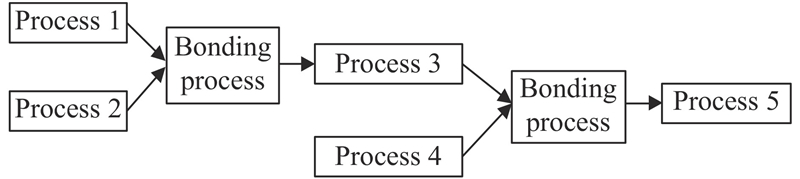
Fig 2
Processing operation tree of product A"
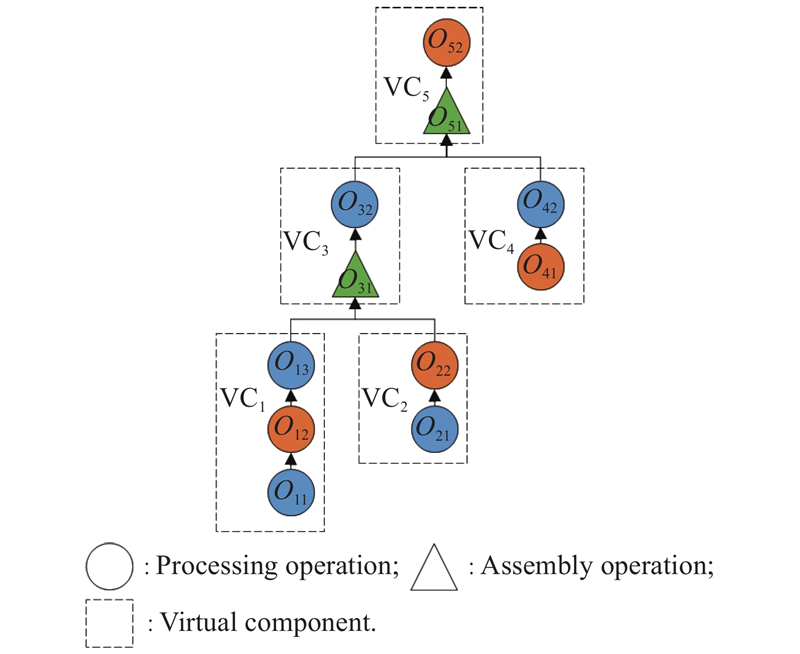

Table 1
Processing information for product A in Fig. 2"
| VCs | Operation | Workstation1 | Workstation2 | Workstation3 | |||
| M11 | M12 | M21 | M31 | ||||
| VC1 | O11 | 1, 5 | 1, 4 | − | − | ||
| O12 | − | − | 1, 5 | − | |||
| O13 | 1, 5 | 2, 3 | − | − | |||
| VC2 | O21 | 1, 4 | 1, 5 | − | − | ||
| O22 | − | − | 1, 4 | − | |||
| VC3 | O31 | − | − | − | 2, 3 | ||
| O32 | 1, 5 | 1, 6 | − | − | |||
| VC4 | O41 | − | − | 2, 2 | − | ||
| O42 | 1, 5 | 2, 3 | − | − | |||
| VC5 | O51 | − | − | − | 1, 3 | ||
| O52 | − | − | 1, 2 | − | |||
Table 2
Idle energy consumption per hour for product A in Fig. 2"
| Machine | Idle energy consumption/(kw/h) |
| M11 | 1 |
| M12 | 2 |
| M21 | 1 |
| M31 | 1 |
Fig 3
Processing process of product A"
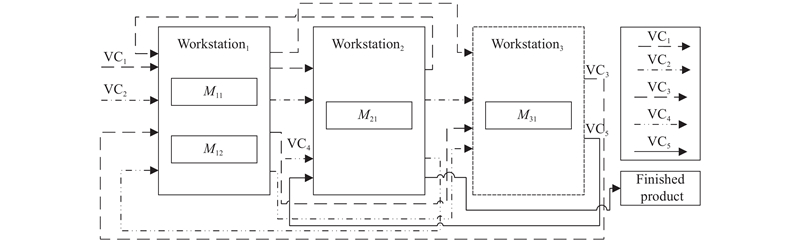
Table 3
Notations"
| Type of notations | Symbol | Definition |
| Index | i | Job index, i∈{1, 2, ···, I} |
| h, g | VC index, h, g∈{1, 2, 3, ···, H} | |
| l, v | Operation index in the VC, l, v∈{1, 2, ···, Lh} | |
| j | Workstation index, j∈{1, 2, ···, J} | |
| k | Machine index in the workstation, k∈{1, 2, ···, Kj} | |
| o | Position index on the machine, o∈{1, 2, ···, Q} | |
| Parameters | I | Number of the jobs |
| J | Number of the workstations | |
| H | Number of the VCs | |
| Q | Number of positions of all machines | |
| Kj | Number of machines in the jth workstation | |
| Lh | Number of the operations of the VCh | |
| Mjk | The kth machine in the jth workstation | |
| Ohl | The lth operation index of the VCh | |
| Dhl | Workstation index for handling the Ohl | |
| Phlk/h | Processing time of the lth operation of the kth machine of VCh | |
| Fjk/(kW/h) | Idle energy consumption per hour of the Mjk | |
| Ghlk/(kW/h) | Processing energy consumption per hour of the Ohl on the kth machine | |
| MM | A value of positive infinity | |
| Variable | Shl/h | Start time of the lth operation of VCh |
| Chl/h | End time of the lth operation of VCh | |
| Qjk | Number of operations processed on Mjk | |
| Vjko | VC index processed on the oth position on Mjk | |
| Wjko | Operation index processed on the oth position on Mjk | |
| MIhl | Index of processing machine of the lth operation of VCh | |
| KSjko/h | Start time of the oth operation on Mjk | |
| KEjko/h | End time of the oth operation on Mjk | |
| MSjk/h | Turn-on time of Mjk | |
| MEjk/h | Turn-off time of Mjk | |
| MPjk/h | Occupying time of Mjk | |
| Cmax | Makespan of a scheduling solution | |
| TEC/(kW/h) | Total energy consumption of a scheduling solution | |
| EI/(kW/h) | Total idle energy consumption of a scheduling solution | |
| EP/(kW/h) | Total processing energy consumption of a scheduling solution | |
| Xhlk | A binary variable is set to 1 if Ohl is processed on the kth machine; 0, otherwise | |
| Yhlgv | A binary variable is set to 1 if operation Ohl is processed after Ogv on one machine; 0, otherwise | |
| Ahg | A binary variable is set to 1 if the VCg is the successor of the VCh; 0, otherwise | |
| Bhlv | A binary variable is set to 1 if the lth operation is the successor of the vth operation; 0, otherwise |

Fig 4
An example of the chromosome"

Fig 5
Gantt chart of the decoding result of the chromosome in Fig.4"
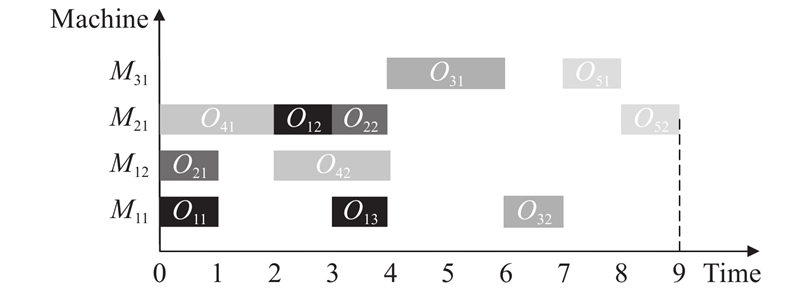
Table 4
Descriptions of the rules"
| Rule | Description | Calculation equation |
| First come first served (FCFS) | Select a VC | |
| Importance ratio (IR) | Select a VC | |
| Longest remaining time first (LRTF) | Select a VC processing time in the buffer | |
| Rule 1 | Select a machine | |
| Rule 2 | Select a machine |
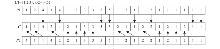
Fig 6
An example of the crossover"
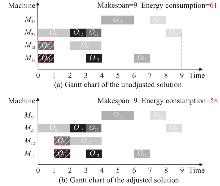
Fig 7
Effect of energy consumption inverse optimization strategy"
Fig 8
Three product structures"
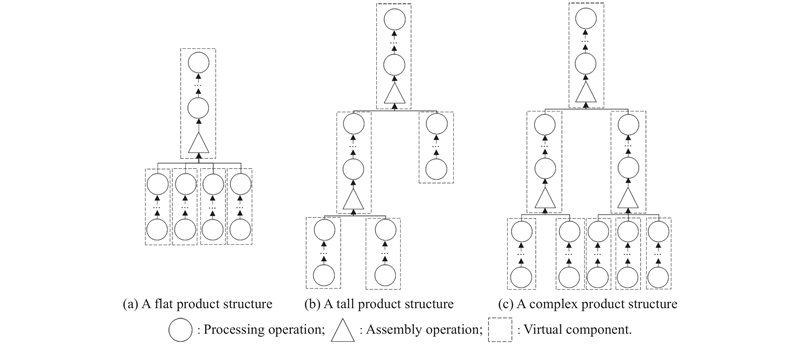
Table 5
Parameters for generating instances"
| Parameter | Small-scale instance | Large-scale instance |
| Range of operation amount | 40-160 | 100-600 |
| Number of the processing workstations NS | U[3,5] | U[3,5] |
| Number of the assembly workstations | 1 | 1 |
| Number of parallel machines in each processing workstation | U[1,2] | U[1,3] |
| Number of parallel machines in each assembly workstation | 1 | 1 |
| Number of the operations for processing | U[NS +1, max_N × NS] | U[NS +1, max_N × NS] |
| Number of reentries max_N | 2 | 3 |
| Number of the operations of the assembly | 1 | 1 |
| Processing time | U[1,10] | U[1,10] |
| Processing power of the machine per unit | U[40, 60] | U[40, 60] |
| Idle power of the machine per unit | U[10,30] | U[10,30] |
Table 6
Instances"
| Index of instances | Name of instances | Product structure | Problem scale | Index of configuration |
| 1 | a_s_1 | a | Small | 1 |
| 2 | a_s_2 | a | Small | 2 |
| 3 | a_l_1 | a | Large | 1 |
| 4 | a_l_2 | a | Large | 2 |
| 5 | b_s_1 | b | Small | 1 |
| 6 | b_s_2 | b | Small | 2 |
| 7 | b_l_1 | b | Large | 1 |
| 8 | b_l_2 | b | Large | 2 |
| 9 | c_s_1 | c | Small | 1 |
| 10 | c_s_2 | c | Small | 2 |
| 11 | c_l_1 | c | Large | 1 |
| 12 | c_l_2 | c | Large | 2 |
Table 7
Levels for each factor"
| Level | CR | MS | RS |
| Level 1 | 0.7 | 0.1 | 0.05 |
| Level 2 | 0.8 | 0.2 | 0.15 |
| Level 3 | 0.9 | 0.3 | 0.25 |
Table 8
Results of the orthogonal test"
| Index | CR | MS | RS | HV |
| 1 | 0.7 | 0.1 | 0.05 | |
| 2 | 0.7 | 0.2 | 0.15 | |
| 3 | 0.7 | 0.3 | 0.25 | |
| 4 | 0.8 | 0.1 | 0.15 | |
| 5 | 0.8 | 0.2 | 0.25 | |
| 6 | 0.8 | 0.3 | 0.05 | |
| 7 | 0.9 | 0.1 | 0.25 | |
| 8 | 0.9 | 0.2 | 0.05 | |
| 9 | 0.9 | 0.3 | 0.15 | |
| k1 | — | |||
| k2 | — | |||
| k3 | — | |||
| Best level | 3 | 2 | 2 | — |
Fig 9
Results of the orthogonal test"
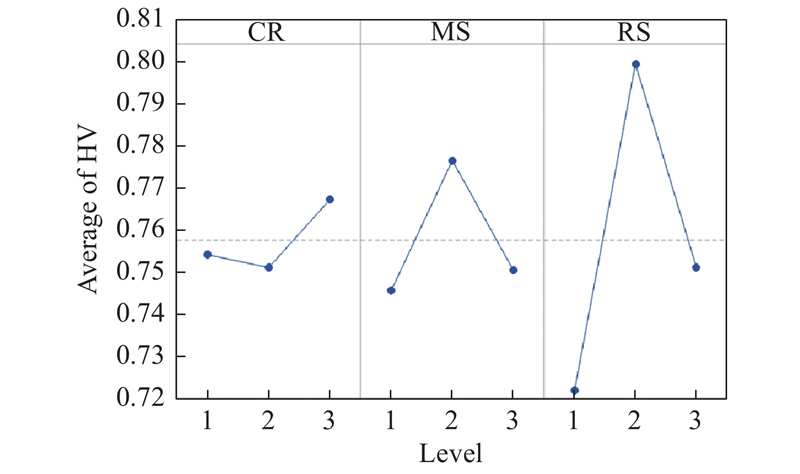
Fig 10
A Gantt chart of a solution optimized by the Gurobi on the instance of product A"
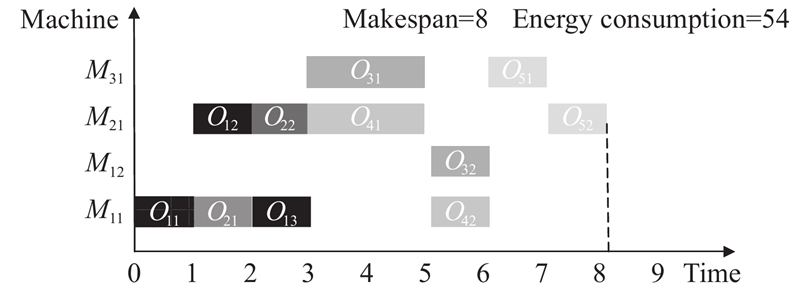
Table 9
Average value of HV, GD and IGD metric of the solutions obtained by Gurobi and IMOEA/D"
| Problem scale | Instance | Metric | Gurobi | IMOEA/D |
| Tiny | Instance of product A | HV | ||
| GD | ||||
| IGD | ||||
| A tiny instance of structure a | HV | |||
| GD | ||||
| IGD | ||||
| A tiny instance of structure b | HV | |||
| GD | ||||
| IGD | ||||
| A tiny instance of structure c | HV | |||
| GD | ||||
| IGD | ||||
| Small | Instance a_s_1 | HV | ||
| GD | ||||
| IGD |
Table 10
Statistical results in terms of HV metric obtained with the IMOEA/D and its variants"
| Instance | HV | |||||
| IMOEA/D | IMOEA/D_1 | IMOEA/D_2 | IMOEA/D_3 | IMOEA/D_4 | IMOEA/D_5 | |
| a_s_1 | ||||||
| a_s_2 | ||||||
| b_s_1 | ||||||
| b_s_2 | ||||||
| c_s_1 | ||||||
| c_s_2 | ||||||
| a_l_1 | ||||||
| a_l_2 | ||||||
| b_l_1 | ||||||
| b_l_2 | ||||||
| c_l_1 | ||||||
| c_l_2 | ||||||
Table 11
Statistical results in terms of GD metric obtained with the IMOEA/D and its variants"
| Instance | GD | |||||
| IMOEA/D | IMOEA/D_1 | IMOEA/D_2 | IMOEA/D_3 | IMOEA/D_4 | IMOEA/D_5 | |
| a_s_1 | ||||||
| a_s_2 | ||||||
| b_s_1 | ||||||
| b_s_2 | ||||||
| c_s_1 | ||||||
| c_s_2 | ||||||
| a_l_1 | ||||||
| a_l_2 | ||||||
| b_l_1 | ||||||
| b_l_2 | ||||||
| c_l_1 | ||||||
| c_l_2 | ||||||
Table 12
Statistical results in terms of IGD metric obtained with the IMOEA/D and its variants"
| Instance | IGD | |||||
| IMOEA/D | IMOEA/D_1 | IMOEA/D_2 | IMOEA/D_3 | IMOEA/D_4 | IMOEA/D_5 | |
| a_s_1 | 0.218 | |||||
| a_s_2 | ||||||
| b_s_1 | 0.321 | 0.265 | ||||
| b_s_2 | ||||||
| c_s_1 | ||||||
| c_s_2 | ||||||
| a_l_1 | 0.447 | |||||
| a_l_2 | 0.444 | |||||
| b_l_1 | ||||||
| b_l_2 | 0.763 | |||||
| c_l_1 | ||||||
| c_l_2 | ||||||
Table 13
Friedman rank of all metrics for the IMOEA/D and its variants"
| Algorithm | HV | GD | IGD | |||||
| Rank | p | Rank | p | Rank | p | |||
| IMOEA/D | 1.08 | 1.06E-16 | 1.08 | 1.56E-16 | 1.25 | 8.79E-15 | ||
| IMOEA/D_1 | 5.33 | 5.25 | 5.25 | |||||
| IMOEA/D_2 | 3.33 | 3.17 | 3.08 | |||||
| IMOEA/D_3 | 2.92 | 3.50 | 3.00 | |||||
| IMOEA/D_4 | 5.42 | 5.42 | 5.50 | |||||
| IMOEA/D_5 | 2.92 | 2.58 | 2.92 | |||||
Fig 11
Results of the Bonferroni-Dunn test"
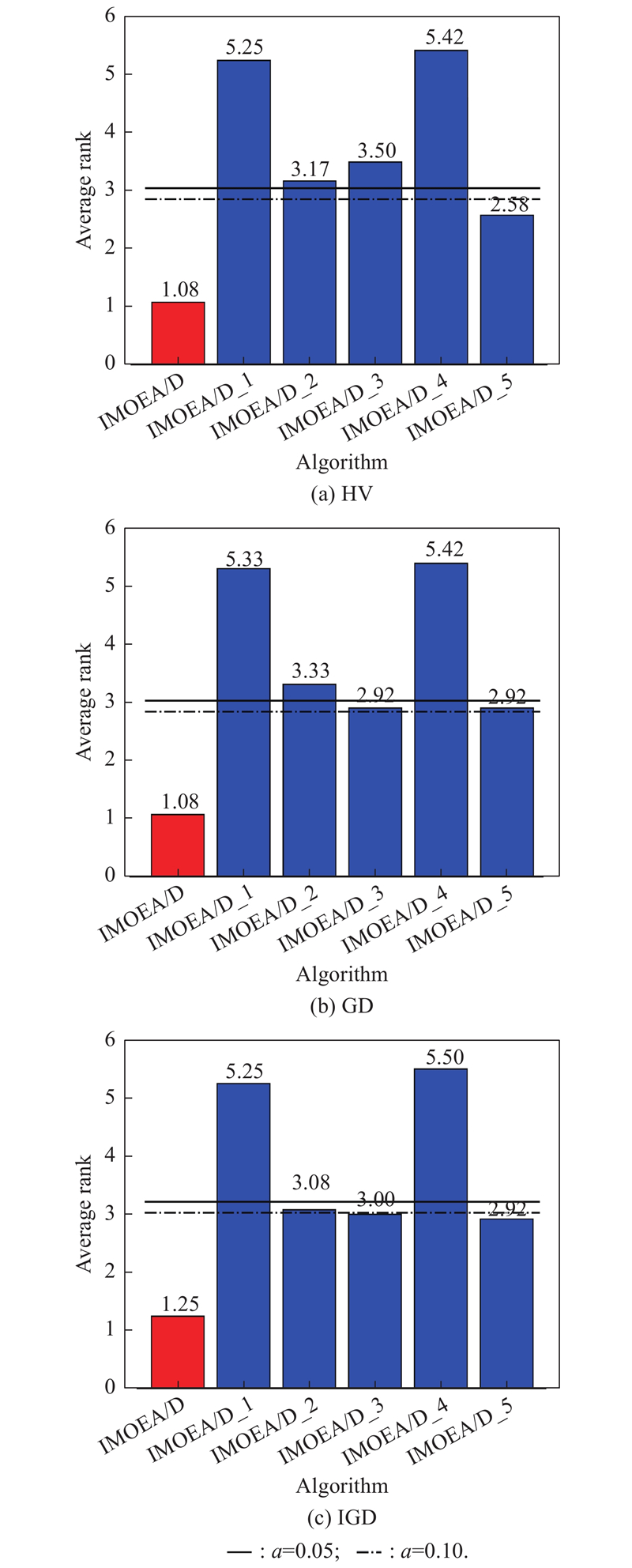
Table 14
Pareto solutions obtained by the proposed and the random population initialization strategy"
| Strategy | Pareto solution |
| The proposed population initialization strategy | [229.0, [257.0, |
| The random population initialization strategy | [276.0, [293.0, |
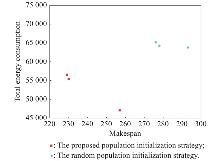
Fig 12
Pareto fronts obtained by the proposed and the random population initialization strategy"
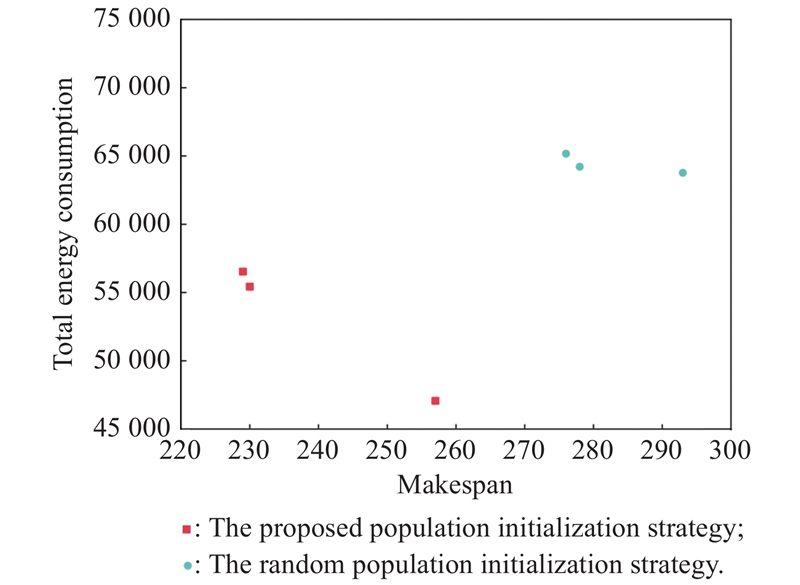
Table 15
Pareto solutions obtained by the IMOEA/D, the IMOEA/D_6, and the IMOEA/D_4 during iterations"
| Iteration | IMOEA/D | IMOEA/D_6 | IMOEA/D_4 |
| 0th | [237, [238, | [237, [238, | [237, [238, |
| 10th | [224, | [263, | [263, |
| 20th | [221, | [259, | [263, |
| 30th | [221, | [259, | [230, |
| 40th | [221, | [259, | [230, |
| 50th | [230, | [227, | [230, |
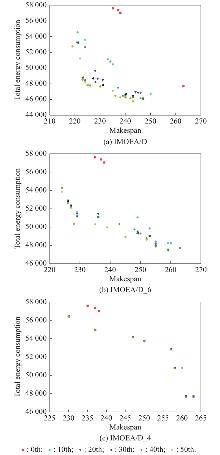
Fig 13
Pareto fronts obtained with the IMOEA/D, the IMOEA/D_4, and the IMOEA/D_6"
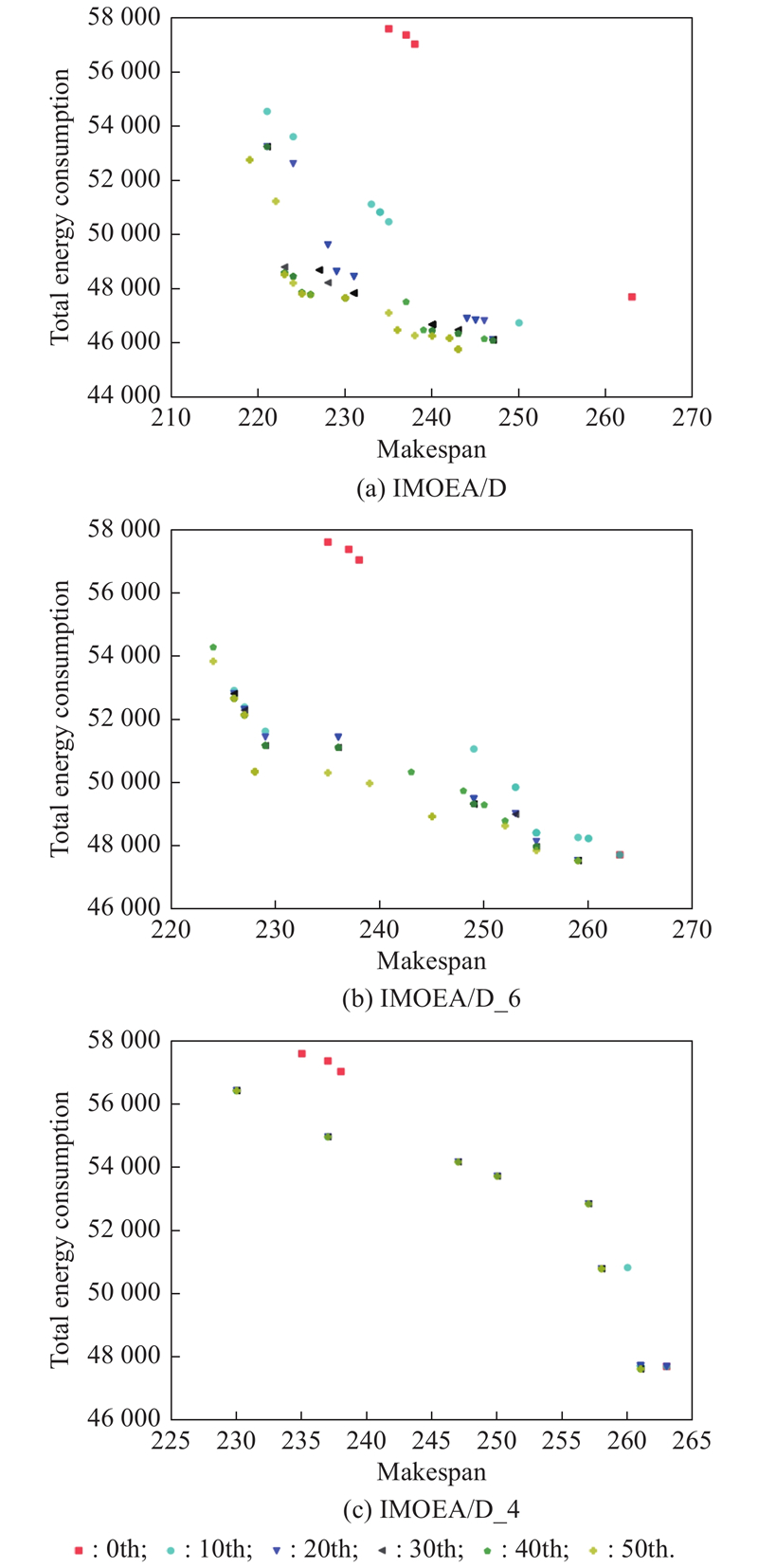
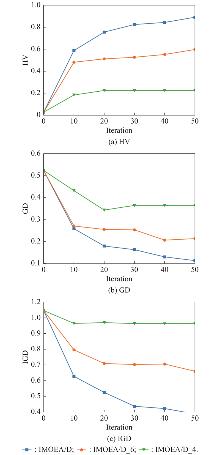
Fig 14
The HV, GD, and IGD values of the Pareto solutions obtained with the three algorithms"
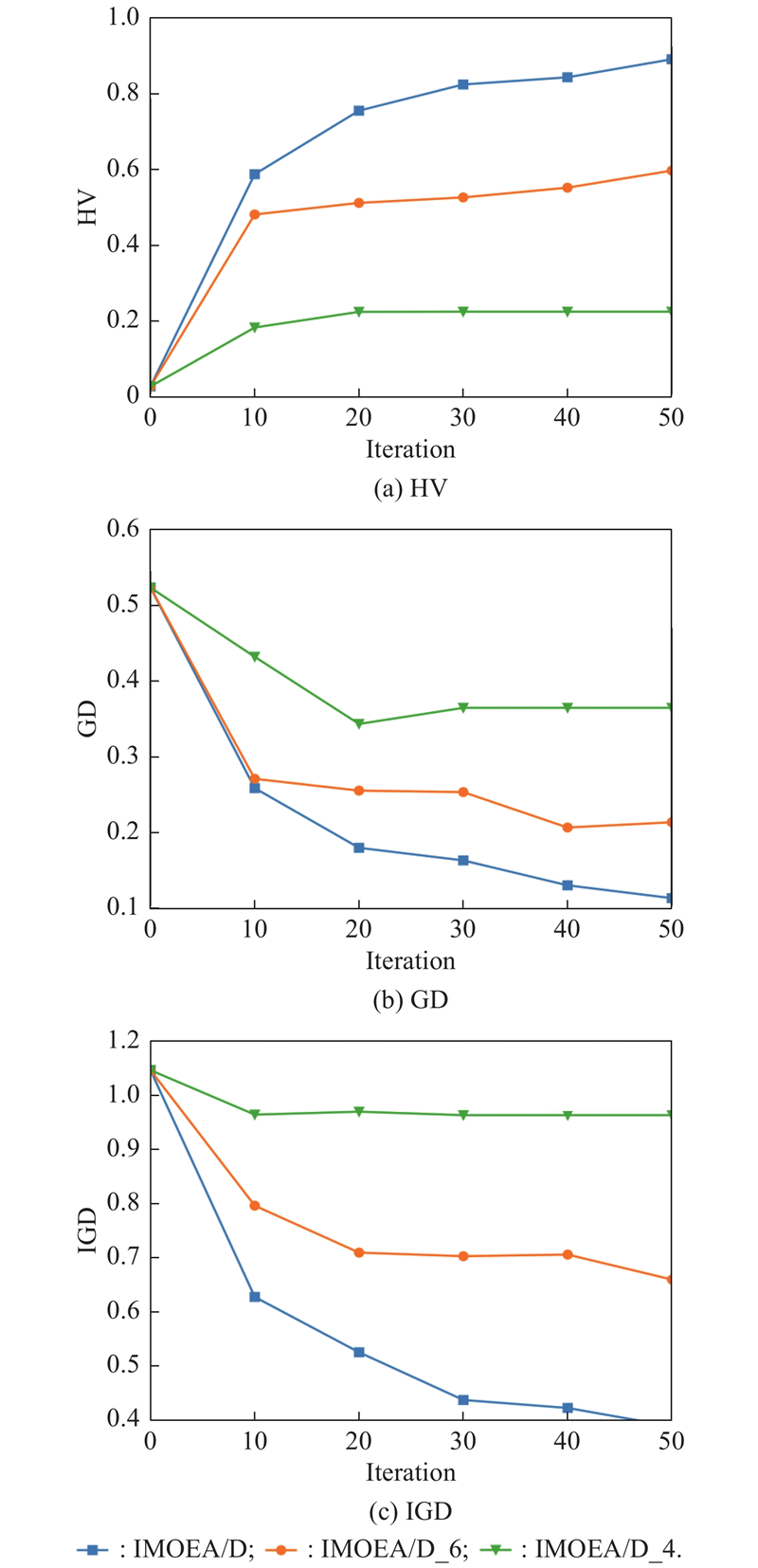
Table 16
Statistical results obtained with the IMOEA/D, the IMOEA/D_6, and the IMOEA/D_4"
| Metrics | IMOEA/D | IMOEA/D_6 | IMOEA/D_4 |
| HV | |||
| GD | |||
| IGD |
Table 17
Idle energy consumption before and after executing the energy consumption inverse optimization strategy"
| Number of solutions | The idle energy consumption before | The idle energy consumption after | The ratio of idle energy savings/% |
| 1 | 5.53 | ||
| 2 | 4.04 | ||
| 3 | 1.77 | ||
| 4 | 5.34 | ||
| 5 | 4.18 | ||
| 6 | 14.02 | ||
| 7 | 7.31 | ||
| 8 | 11.48 | ||
| 9 | 6.24 | ||
| 10 | 7.88 | ||
| 11 | 3.46 | ||
| 12 | 3.64 | ||
| 13 | 7.80 | ||
| 14 | 5.43 | ||
| 15 | 6.69 | ||
| 16 | 1.93 | ||
| 17 | 4.75 | ||
| 18 | 5.32 | ||
| 19 | 7.09 | ||
| 20 | 4.17 | ||
| 21 | 4.52 | ||
| 22 | 2.12 | ||
| 23 | 8.52 | ||
| 24 | 4.00 | ||
| 25 | 2.68 | ||
| 26 | 5.71 | ||
| 27 | 4.19 | ||
| 28 | 12.42 | ||
| 29 | 8.52 | ||
| 30 | 4.35 | ||
| Average | 5.84 |
Fig 15
Idle energy consumption before and after executing the energy consumption inverse optimization strategy"
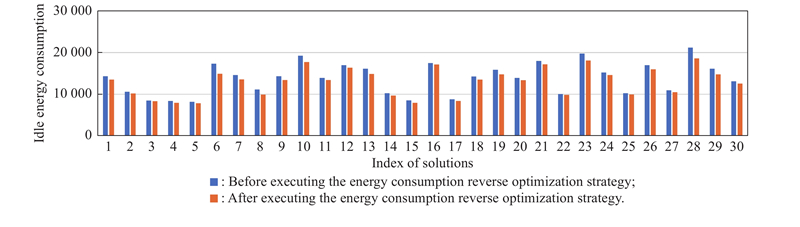
Fig 16
Non-dominated Pareto solutions obtained with the IMOEA/D and the comparison algorithms"
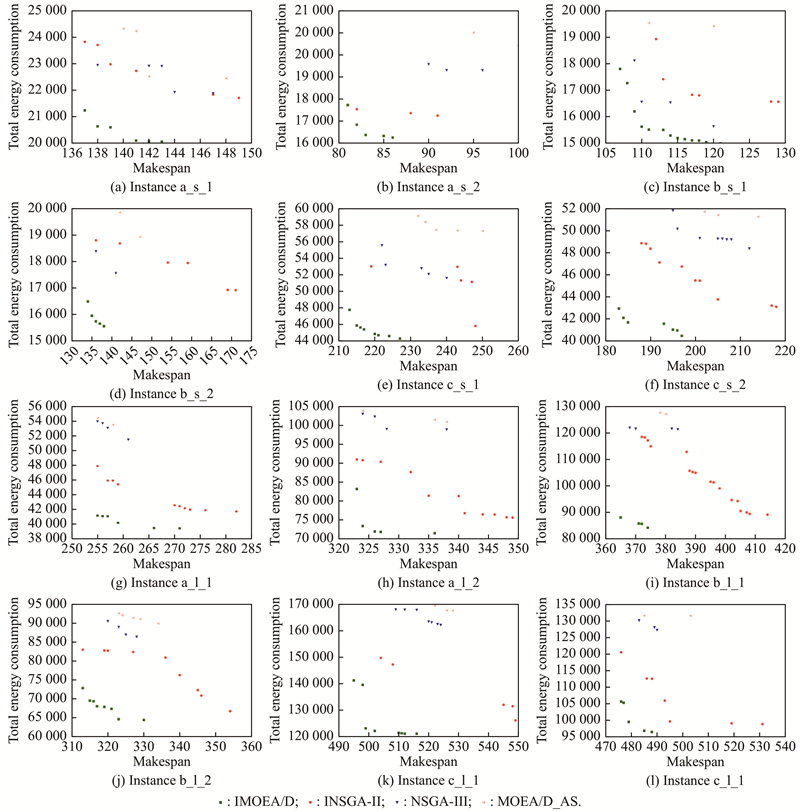
Table 18
Statistical results in terms of HV metric obtained with the IMOEA/D and the comparison algorithms"
| Instance | HV | IMOEA/D vs. INSGA-II | IMOEA/D vs. NSGA-III | IMOEA/D vs. MOEA/D_AS | |||||||||
| IMOEA/D | INSGA-II | NSGA-III | MOEA/D_AS | p | Sig | p | Sig | p | Sig | ||||
| a_s_1 | 3.36e-20 | Y | 6.50e-21 | Y | 3.51e-23 | Y | |||||||
| a_s_2 | 1.08e-13 | Y | 2.22e-27 | Y | 1.05e-28 | Y | |||||||
| b_s_1 | 4.99e-16 | Y | 3.42e-17 | Y | 1.54e-22 | Y | |||||||
| b_s_2 | 1.78e-19 | Y | 7.78e-18 | Y | 1.74e-23 | Y | |||||||
| c_s_1 | 1.97e-18 | Y | 6.07e-22 | Y | 8.13e-26 | Y | |||||||
| c_s_2 | 1.80e-19 | Y | 3.44e-25 | Y | 4.97e-28 | Y | |||||||
| a_l_1 | 1.51e-17 | Y | 1.90e-29 | Y | 8.84e-29 | Y | |||||||
| a_l_2 | 2.93e-21 | Y | 5.80e-36 | Y | 4.95e-35 | Y | |||||||
| b_l_1 | 6.90e-14 | Y | 2.63e-21 | Y | 4.71e-24 | Y | |||||||
| b_l_2 | 1.16e-19 | Y | 9.61e-30 | Y | 2.13e-31 | Y | |||||||
| c_l_1 | 5.94e-24 | Y | 2.52e-34 | Y | 5.15e-35 | Y | |||||||
| c_l_2 | 1.27e-20 | Y | 1.276e-33 | Y | 1.35e-34 | Y | |||||||
Table 19
Statistical results in terms of GD metric obtained with the IMOEA/D and the comparison algorithms"
| Instance | GD | IMOEA/D vs. INSGA-II | IMOEA/D vs. NSGA-III | IMOEA/D vs. MOEA/D_AS | |||||||||
| IMOEA/D | INSGA-II | NSGA-III | MOEA/D_AS | p | Sig | p | Sig | p | Sig | ||||
| a_s_1 | 3.78e-16 | Y | 5.25e-16 | Y | 2.44e-14 | Y | |||||||
| a_s_2 | 1.46e-14 | Y | 1.12e-17 | Y | 7.51e-22 | Y | |||||||
| b_s_1 | 2.06e-16 | Y | 7.89e-17 | Y | 7.85e-20 | Y | |||||||
| b_s_2 | 2.99e-15 | Y | 6.28e-13 | Y | 9.98e-18 | Y | |||||||
| c_s_1 | 1.48e-18 | Y | 1.07e-17 | Y | 4.94e-18 | Y | |||||||
| c_s_2 | 1.90e-12 | Y | 2.38e-17 | Y | 7.70e-19 | Y | |||||||
| a_l_1 | 2.77e-10 | Y | 1.57e-16 | Y | 5.03e-19 | Y | |||||||
| a_l_2 | 7.06e-12 | Y | 5.25e-16 | Y | 1.22e-23 | Y | |||||||
| b_l_1 | 7.90e-06 | Y | 3.92e-16 | Y | 3.01e-18 | Y | |||||||
| b_l_2 | 2.80e-14 | Y | 8.24e-20 | Y | 5.40e-19 | Y | |||||||
| c_l_1 | 2.21e-17 | Y | 1.33e-20 | Y | 4.56e-22 | Y | |||||||
| c_l_2 | 4.32e-11 | Y | 1.95e-19 | Y | 8.15e-24 | Y | |||||||
Table 20
Statistical results in terms of IGD metric obtained with the IMOEA/D and the comparison algorithms"
| Instance | IGD | IMOEA/D vs. INSGA-II | IMOEA/D vs. NSGA-III | IMOEA/D vs. MOEA/D_AS | |||||||||
| IMOEA/D | INSGA-II | NSGA-III | MOEA/D_AS | p | Sig | p | Sig | p | Sig | ||||
| a_s_1 | 0.654 | 2.43e-22 | Y | 2.00e-17 | Y | 7.38e-18 | Y | ||||||
| a_s_2 | 1.18e-09 | Y | 2.05e-24 | Y | 3.53e-23 | Y | |||||||
| b_s_1 | 1.07e-17 | Y | 2.48e-13 | Y | 5.29e-19 | Y | |||||||
| b_s_2 | 1.03e-25 | Y | 4.88e-18 | Y | 1.20e-19 | Y | |||||||
| c_s_1 | 3.14e-24 | Y | 9.78e-19 | Y | 4.15e-20 | Y | |||||||
| c_s_2 | 1.15e-20 | Y | 2.59e-18 | Y | 3.76e-21 | Y | |||||||
| a_l_1 | 8.21e-18 | Y | 8.17e-21 | Y | 1.65e-20 | Y | |||||||
| a_l_2 | 7.05e-21 | Y | 3.57e-29 | Y | 1.45e-25 | Y | |||||||
| b_l_1 | 3.05e-19 | Y | 7.49e-19 | Y | 1.21e-18 | Y | |||||||
| b_l_2 | 1.19e-21 | Y | 3.12e-25 | Y | 1.26e-21 | Y | |||||||
| c_l_1 | 9.08e-21 | Y | 7.22e-26 | Y | 8.74e-25 | Y | |||||||
| c_l_2 | 1.86e-20 | Y | 1.27e-25 | Y | 1.33e-23 | Y | |||||||
Table 21
Friedman rank of all metrics for the IMOEA/D and its comparison algorithms"
| Algorithm | HV | GD | IGD | |||||
| Rank | p | Rank | p | Rank | p | |||
| IMOEA/D | 1.00 | 1.24E-18 | 1.00 | 1.24E-18 | 1.00 | 2.03E-17 | ||
| INSGA-II | 2.25 | 2.25 | 2.33 | |||||
| NSGA-III | 2.75 | 2.75 | 2.67 | |||||
| MOEA/D_AS | 4.00 | 4.00 | 4.00 | |||||
Fig 17
Results of the Bonferroni-Dunn test"
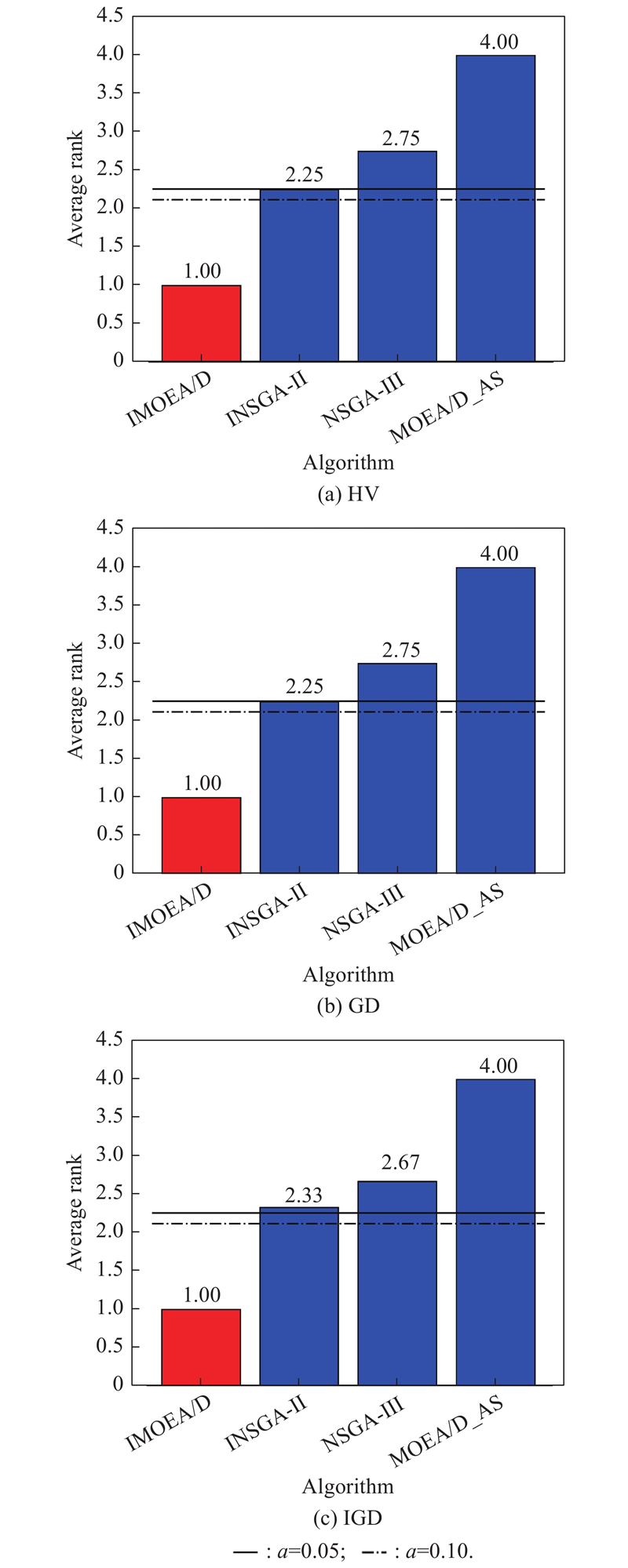
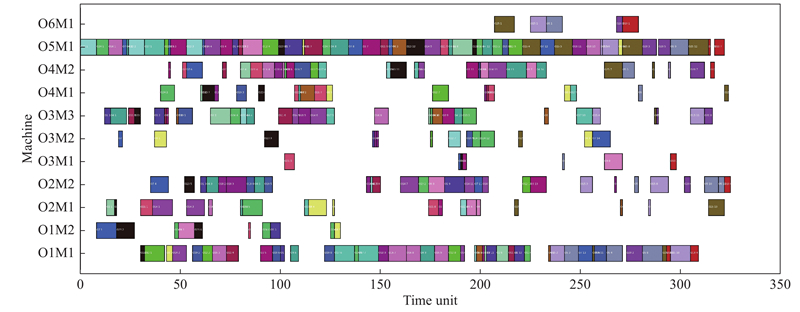
Fig 18
A Gantt chart for instance a_1_2"
| 1 |
Lin D P, Lee C K M A review of the research methodology for the re-entrant scheduling problem. International Journal of Production Research, 2011, 49 (6-8): 2221.
doi: 10.1080/00207541003720350 |
| 2 |
Dong J, Ye C M Research on collaborative optimization of green manufacturing in semiconductor wafer distributed heterogeneous factory. Applied Sciences, 2019, 9 (14): 2879.
doi: 10.3390/app9142879 |
| 3 |
Tay F E H, Lee L H, Wang L X Production scheduling of a MEMS manufacturing system with a wafer bonding process. Journal of Manufacturing Systems, 2002, 21 (4): 287.
doi: 10.1016/S0278-6125(02)80168-6 |
| 4 | Wang J, Tang H T, Lei D M A Q-learning artificial bee colony for distributed assembly flow shop scheduling with factory eligibility, transportation capacity and setup time. Engineering Applications of Artificial Intelligence: The International Journal of Intelligent Real-Time Automation, 2023, 123 (A): 106230. |
| 5 |
Zhang Z Q, Hu R, Qian B, et al A matrix cube-based estimation of distribution algorithm for the energy-efficient distributed assembly permutation flow-shop scheduling problem. Expert Systems with Applications, 2022, 194, 116484.
doi: 10.1016/j.eswa.2021.116484 |
| 6 |
Zhang Z K, Tang Q H Integrating flexible preventive maintenance activities into two-stage assembly flow shop scheduling with multiple assembly machines. Computers & Industrial Engineering, 2021, 159 (2): 107493.
doi: 10.1016/j.cie.2021.107493 |
| 7 | Zhao F Q, Di S L, Wang L, et al A self-learning hyper-heuristic for the distributed assembly blocking flow shop scheduling problem with total flowtime criterion. Engineering Applications of Artificial Intelligence: The International Journal of Intelligent Real-Time Automation, 2022, 116, 105418. |
| 8 |
Birgin E G, Ferreira J E, Ronconi D P List scheduling and beam search methods for the flexible job shop scheduling problem with sequencing flexibility. European Journal of Operational Research, 2015, 247 (2): 421.
doi: 10.1016/j.ejor.2015.06.023 |
| 9 |
Guo W F, Lei Q, Song Y C, et al A learning interactive genetic algorithm based on edge selection encoding for assembly job shop scheduling problem. Computers & Industrial Engineering, 2021, 159, 107455.
doi: 10.1016/j.cie.2021.107455 |
| 10 |
Lin W H, Deng Q W, Han W W, et al An effective algorithm for flexible assembly job-shop scheduling with tight job constraints. International Transactions in Operational Research, 2020, 1 (29): 496.
doi: 10.1111/itor.12767 |
| 11 |
Lunardi W T, Birgin E G, Ronconi D P, et al Metaheuristics for the online printing shop scheduling problem. European Journal of Operational Research, 2021, 293 (2): 419.
doi: 10.1016/j.ejor.2020.12.021 |
| 12 |
Shi F, Zhao S K, Meng Y Hybrid algorithm based on improved extended shifting bottleneck procedure and GA for assembly job shop scheduling problem. International Journal of Production Research, 2020, 58 (9): 2604.
doi: 10.1080/00207543.2019.1622052 |
| 13 |
Gonzalez T, Sahni S Flowshop and jobshop schedules: complexity and approximation. Operations Research, 1978, 26 (1): 36.
doi: 10.1287/opre.26.1.36 |
| 14 |
Rifai A P, Mara S T W, Sudiasso A Multi-objective distributed reentrant permutation flow shop scheduling with sequence-dependent setup time. Expert Systems with Applications, 2021, 183, 115339.
doi: 10.1016/j.eswa.2021.115339 |
| 15 |
Rifai A P, Nguyen H T, Aoyama H, et al Non-dominated sorting biogeography-based optimization for bi-objective reentrant flexible manufacturing system scheduling. Applied Soft Computing, 2018, 62, 187.
doi: 10.1016/j.asoc.2017.10.045 |
| 16 |
Dong J, Ye C M Green scheduling of distributed two-stage reentrant hybrid flow shop considering distributed energy resources and energy storage system. Computers & Industrial Engineering, 2022, 169, 108146.
doi: 10.1016/j.cie.2022.108146 |
| 17 |
Wu X L, Xie Z R Improved MOEA/D with local search for solving multi-stage distributed reentrant hybrid flow shop scheduling problem. Expert Systems with Applications, 2023, 232, 120893.
doi: 10.1016/j.eswa.2023.120893 |
| 18 |
Wu X L, Cao Z An improved multi-objective evolutionary algorithm based on decomposition for solving re-entrant hybrid flow shop scheduling problem with batch processing machines. Computers & Industrial Engineering, 2022, 169, 108236.
doi: 10.1016/j.cie.2022.108236 |
| 19 |
Lin C C, Liu W Y, Chen Y H Considering stockers in reentrant hybrid flow shop scheduling with limited buffer capacity. Computers & Industrial Engineering, 2020, 139, 106154.
doi: 10.1016/j.cie.2019.106154 |
| 20 |
Li M, Wang G G A review of green shop scheduling problem. Information Sciences, 2022, 589, 478.
doi: 10.1016/j.ins.2021.12.122 |
| 21 |
Wu X L, Yan X Y, Wang L Optimizing job release and scheduling jointly in a reentrant hybrid flow shop. Expert Systems with Applications, 2022, 209, 118278.
doi: 10.1016/j.eswa.2022.118278 |
| 22 | Geng K F, Ye C M, Dai Z H, et al. Bi-objective re-entrant hybrid flow shop scheduling considering energy consumption cost under time-of-use electricity tariffs[J]. Complexity, 2020, 8565921. |
| 23 | Wu X L, Zhang Y Q, Zhao K H. An improved NSGA-II for solving reentrant flexible assembly job shop scheduling problem[C]// 14th International Conference on Swarm Intelligence, 2023: 242. |
| 24 | Trivedi A, Srinivasan D, Sanyal K, et al A survey of multiobjective evolutionary algorithms based on decomposition. IEEE Trans. on Evolutionary Computation, 2017, 21 (3): 440. |
| 25 | Jiang E D, Wang L, Wang J J Decomposition-based multi-objective optimization for energy-aware distributed hybrid flow shop scheduling with multiprocessor tasks. Tsinghua Science and Technology, 2021, 26 (5): 646. |
| 26 |
Luo C, Gong W Y, Li R, et al Problem-specific knowledge MOEA/D for energy-efficient scheduling of distributed permutation flow shop in heterogeneous factories. Engineering Applications of Artificial Intelligence, 2023, 123, 106454.
doi: 10.1016/j.engappai.2023.106454 |
| 27 |
Shao W S, Shao Z S, Pi D C An ant colony optimization behavior-based MOEA/D for distributed heterogeneous hybrid flow shop scheduling problem under nonidentical time-of-use electricity tariffs. IEEE Trans. on Automation Science and Engineering, 2022, 19 (4): 3379.
doi: 10.1109/TASE.2021.3119353 |
| 28 |
Yan X Y, Wu X L IMOEA/D to optimize job release problem for a reentrant hybrid flow shop. Computers & Industrial Engineering, 2022, 163, 107800.
doi: 10.1016/j.cie.2021.107800 |
| 29 | Zhao S K, Han Q, Wang G C Product comprehensive scheduling algorithm based on virtual component level division coding. Computer Integrated Manufacturing Systems, 2015, 21, 2435. |
| 30 | Li Y J. Research on lot splitting and scheduling method of multi-level assembly job shop based on genetic algorithm[D]. Guangzhou: Guangdong University of Technology, 2020. (in Chinese) |
| 31 |
Qi Y T, Hou Z T, Li H, et al A decomposition based memetic algorithm for multi-objective vehicle routing problem with time windows. Computers & Operations Research, 2015, 62, 61.
doi: 10.1016/j.cor.2015.04.009 |
| 32 |
Yang M H, Gan Y, Gao L, et al A structural optimization model of a biochemical detection micromixer based on RSM and MOEA/D. Chemical Engineering and Processing - Process Intensification, 2022, 173, 108832.
doi: 10.1016/j.cep.2022.108832 |
| 33 |
Galeano-Brajones J, Luna-Valero F, Carmona-Murillo J, et al Designing problem-specific operators for solving the cell switch-off problem in ultra-dense 5G networks with hybrid MOEAs. Swarm and Evolutionary Computation, 2023, 78, 101290.
doi: 10.1016/j.swevo.2023.101290 |
| 34 |
Wang L, Wang J J, Jiang E D Decomposition based multiobjective evolutionary algorithm with adaptive resource allocation for energy-aware welding shop scheduling problem. Computers & Industrial Engineering, 2021, 162, 107778.
doi: 10.1016/j.cie.2021.107778 |
| 35 |
Ding J Y, Song S J, Wu C Carbon-efficient scheduling of flow shops by multi-objective optimization. European Journal of Operational Research, 2016, 248 (3): 758.
doi: 10.1016/j.ejor.2015.05.019 |
| 36 | Wang Z K, Zhang Q F, Gong M G, et al. A replacement strategy for balancing convergence and diversity in MOEA/D[C]// 2014 IEEE Congress on Evolutionary Computation, 2014: 2132. |
| 37 |
Fry T D, Oliff M D, Minor E D, et al The effects of product structure and sequencing rule on assembly shop performance. International Journal of Production Research, 1989, 27 (4): 671.
doi: 10.1080/00207548908942575 |
| 38 | Auger A, Bader J, Brockhoff D, et al. Theory of the hypervolume indicator: optimal μ-distributions and the choice of the reference point[C]// 10th ACM SIGEVO Workshop on Foundations of Genetic Algorithms, 2009: 87. |
| 39 | Van Velduizen D A, Lamont G B. Evolutionary computation and convergence to a Pareto front[R]. Stanford: Stanford University California, 1998. |
| 40 |
Bosman P A N, Thierens D The balance between proximity and diversity in multiobjective evolutionary algorithms. IEEE Trans. on Evolutionary Computation, 2003, 7 (2): 174.
doi: 10.1109/TEVC.2003.810761 |
| 41 |
Lou H Y, Wang X P, Dong Z M, et al Memetic algorithm based on learning and decomposition for multiobjective flexible job shop scheduling considering human factors. Swarm and Evolutionary Computation, 2022, 75, 101204.
doi: 10.1016/j.swevo.2022.101204 |
| 42 |
Wang Y, Jia Z H, Zhang X Y A hybrid meta-heuristic for the flexible flow shop scheduling with blocking. Swarm and Evolutionary Computation, 2022, 75, 101195.
doi: 10.1016/j.swevo.2022.101195 |
| 43 |
Deb K, Jain H An evolutionary many-objective optimization algorithm using reference-point-based nondominated sorting approach, part I: solving problems with box constraints. IEEE Trans. on Evolutionary Computation, 2014, 18 (4): 577.
doi: 10.1109/TEVC.2013.2281535 |
| [1] | Xiuli WU, Junjian PENG, Zirun XIE, Ning ZHAO, Shaomin WU. An improved multi-objective optimization algorithm for solving flexible job shop scheduling problem with variable batches [J]. Journal of Systems Engineering and Electronics, 2021, 32(2): 272-285. |
| [2] | Jian'gang PENG, Mingzhou LIU, Xi ZHANG, Lin LING. Hybrid heuristic algorithm for multi-objective scheduling problem [J]. Journal of Systems Engineering and Electronics, 2019, 30(2): 327-342. |
| Viewed | ||||||
|
Full text |
|
|||||
|
Abstract |
|
|||||
