
Journal of Systems Engineering and Electronics ›› 2026, Vol. 37 ›› Issue (3): 921-932.doi: 10.23919/JSEE.2024.000012
• SYSTEMS ENGINEERING • Previous Articles Next Articles
Renqi ZHU1( ), Yulong DAI1,*(), Yijun DONG2(), Jiaqing LI3(), Nannan ZHANG4(), Zhiran QIU3()
Received:2022-11-11
Online:2026-06-18
Published:2026-06-29
Contact:
Yulong DAI
E-mail:zhurenqi@163.com;yulongdai_nudt@nudt.edu.cn;850597566@qq.com;2970453506@qq.com;zhangnankexin@163.com;2924078853@qq.com
Supported by:Renqi ZHU, Yulong DAI, Yijun DONG, Jiaqing LI, Nannan ZHANG, Zhiran QIU. Combat task-oriented weapon portfolio selection method[J]. Journal of Systems Engineering and Electronics, 2026, 37(3): 921-932.
Add to citation manager EndNote|Reference Manager|ProCite|BibTeX|RefWorks
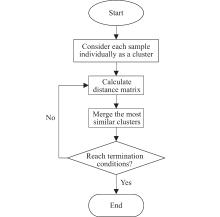
Fig 1
Flow chart of interval fuzzy clustering algorithm"
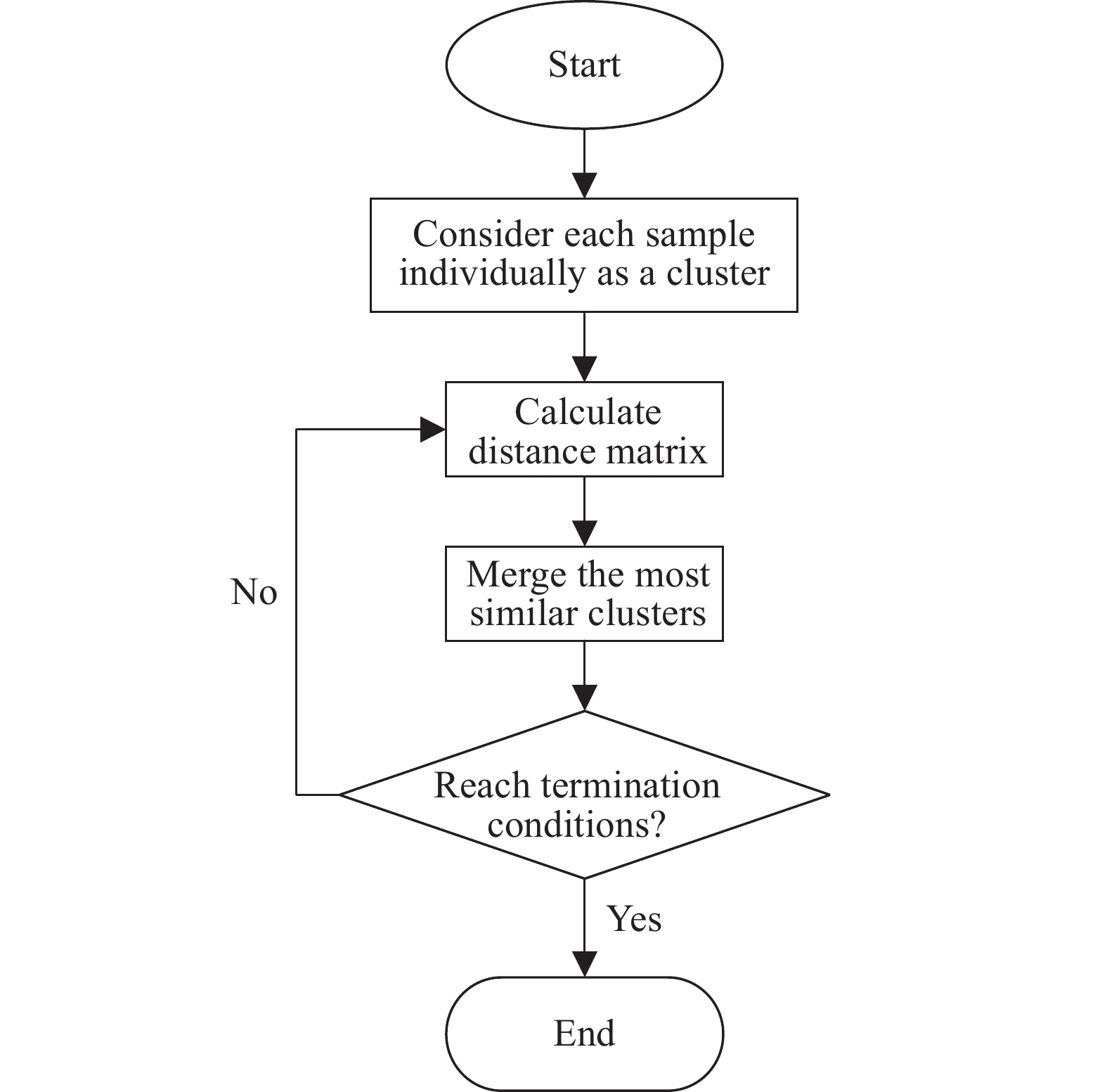
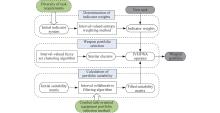
Fig 2
Selection method process of combat task-oriented weapon portfolio"

Table 1
Efficiency of weapon portfolio"
| q | ||||||||||
| [0.16,0.29] | [0.46,0.94] | [0.55,0.59] | [0.46,0.57] | [0.50,0.38] | [0.27,0.70] | [0.31,0.50] | [0.20,0.62] | [0.09,0.28] | [0.24,0.54] | |
| [0.46,0.81] | [0.34,0.31] | [0.48,0.74] | [0.45,0.43] | [0.40,0.37] | [0.34,0.65] | [0.39,0.44] | [0.37,0.47] | [0.39,0.75] | [0.36,0.67] | |
| [0.59,0.54] | [0.05,0.50] | [0.79,0.54] | [0.27,0.61] | [0.52,0.48] | [0.29,0.58] | [0.36,0.28] | [0.08,0.41] | [0.39,0.54] | [0.45,0.62] | |
| [0.53,0.49] | [0.51,0.55] | [0.34,0.95] | [0.71,0.39] | [0.25,0.41] | [0.17,0.70] | [0.67,0.47] | [0.36,0.48] | [0.29,0.45] | [0.15,0.40] | |
| [0.40,0.76] | [0.46,0.70] | [0.20,0.56] | [0.36,0.56] | [0.56,0.72] | [0.39,0.65] | [0.33,0.57] | [0.11,0.47] | [0.35,0.52] | [0.46,0.70] |
Table 2
Required effectiveness values of historical combat tasks"
| q | ||||||||||
| [0.06,0.33] | [0.73,0.92] | [0.42,0.61] | [0.37,0.59] | [0.23,0.40] | [0.45,0.69] | [0.38,0.56] | [0.35,0.54] | [0.07,0.21] | [0.31,0.54] | |
| [0.54,0.79] | [0.08,0.27] | [0.53,0.76] | [0.20,0.35] | [0.21,0.43] | [0.45,0.65] | [0.23,0.47] | [0.29,0.49] | [0.58,0.71] | [0.51,0.67] | |
| [0.36,0.55] | [0.30,0.47] | [0.32,0.60] | [0.41,0.70] | [0.24,0.49] | [0.37,0.58] | [0.03,0.27] | [0.15,0.43] | [0.36,0.58] | [0.35,0.62] | |
| [0.27,0.49] | [0.35,0.58] | [0.74,0.90] | [0.17,0.34] | [0.23,0.46] | [0.59,0.79] | [0.32,0.49] | [0.28,0.44] | [0.30,0.51] | [0.17,0.38] | |
| [0.59,0.80] | [0.53,0.74] | [0.41,0.53] | [0.39,0.56] | [0.55,0.79] | [0.46,0.74] | [0.41,0.56] | [0.24,0.43] | [0.28,0.46] | [0.50,0.66] |
Table 3
Initial interval suitability matrix of weapon portfolio to combat tasks"
| t | ||||||||||
| [0.23,0.38] | 0 | 0 | 0 | 0 | 0 | 0 | 0 | 0 | [0.42,0.57] | |
| [0.21,0.47] | [0.42,0.61] | [0.74,0.92] | [0.38,0.61] | [0.36,0.61] | [0.21,0.41] | 0 | 0 | 0 | 0 | |
| [0.74,0.97] | 0 | 0 | [0.70,0.95] | 0 | 0 | [0.75,0.92] | 0 | [0.09,0.23] | 0 | |
| 0 | 0 | 0 | 0 | [0.59,0.79] | [0.59,0.75] | 0 | [0.06,0.25] | 0 | 0 | |
| 0 | 0 | [0.76,0.94] | 0 | [0.20,0.45] | 0 | [0.18,0.43] | 0 | 0 | 0 | |
| [0.04,0.28] | [0.05,0.21] | 0 | [0.74,0.93] | 0 | [0.26,0.40] | [0.41,0.57] | [0.53,0.77] | 0 | 0 | |
| [0.35,0.64] | 0 | [0.78,1.00] | 0 | [0.56,0.80] | 0 | 0 | 0 | [0.08,0.23] | 0 | |
| [0.18,0.39] | 0 | [0.40,0.65] | 0 | [0.75,0.93] | [0.23,0.38] | [0.38,0.58] | 0 | 0 | [0.57,0.77] | |
| 0 | 0 | 0 | 0 | 0 | 0 | 0 | 0 | [0.26,0.47] | 0 | |
| [0.00,0.22] | [0.25,0.45] | 0 | 0 | 0 | 0 | 0 | 0 | [0.43,0.61] | [0.60,0.73] |
Table 4
Composition of the cluster when the clustering termination condition is reached"
| Cluster | Task |
Table 5
Estimates of the suitability"
| Value | |
Fig 3
Sparsity as a function of threshold parameter"
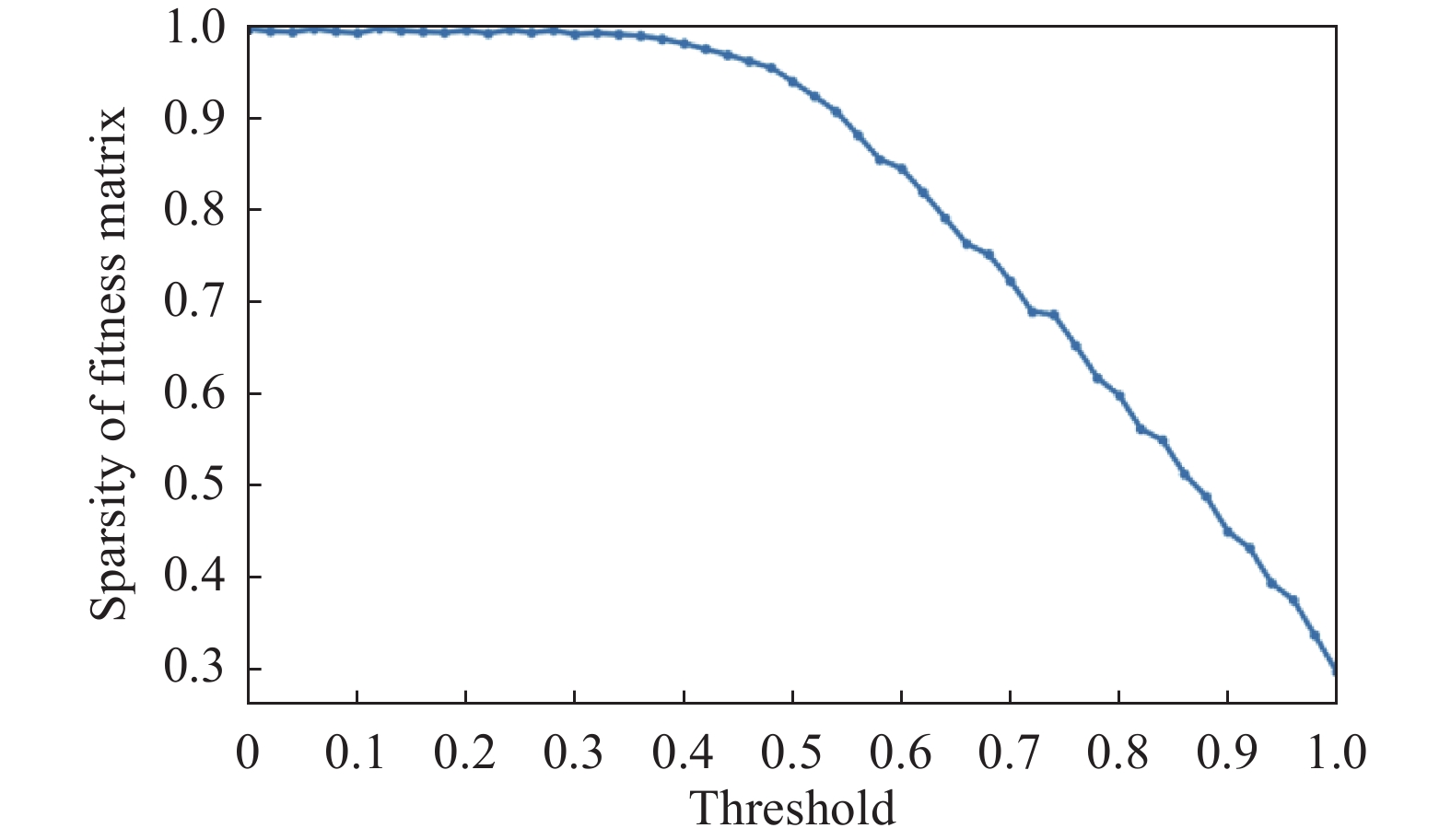
Fig 4
Variation of discrimination with threshold parameter"
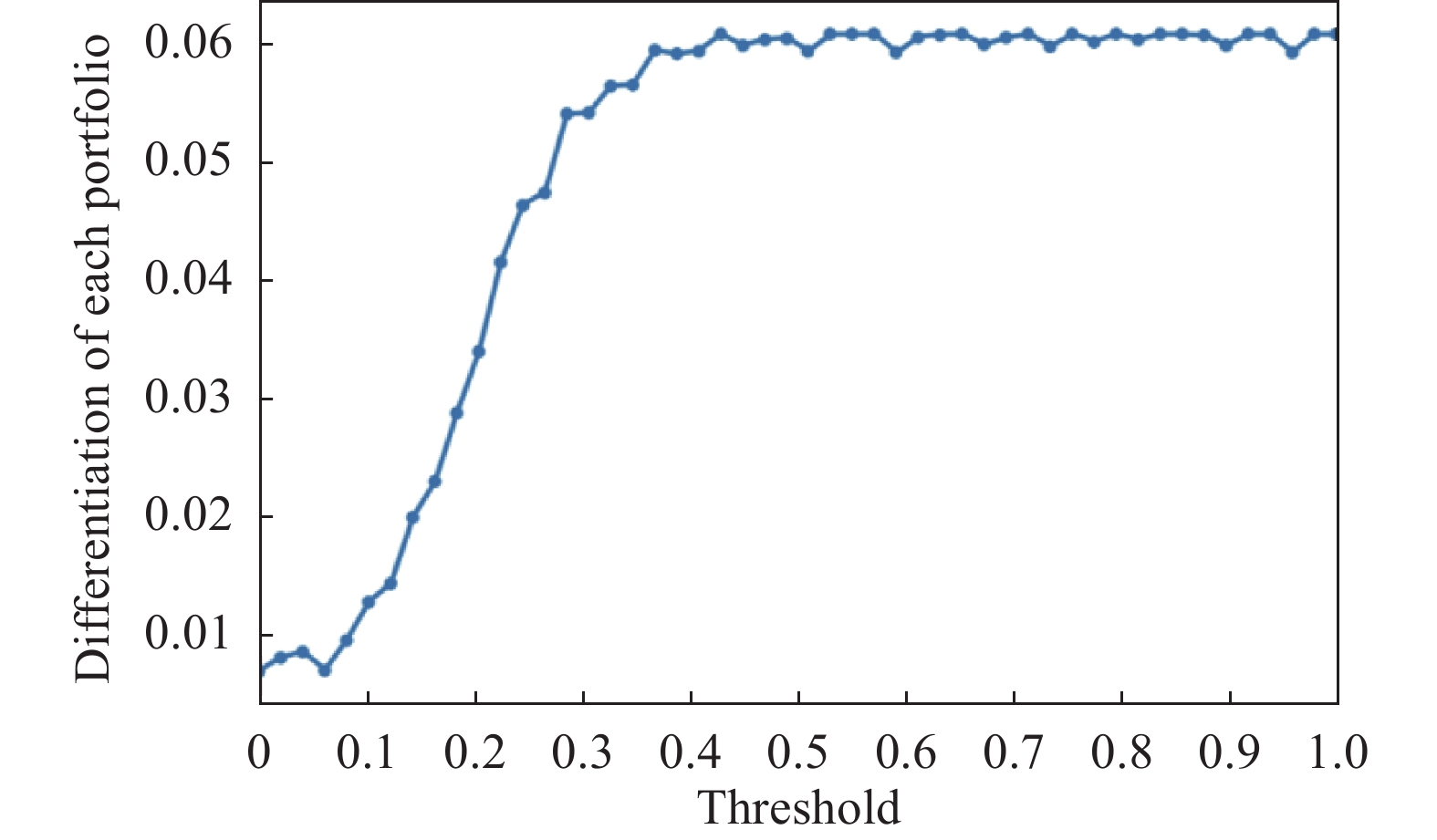
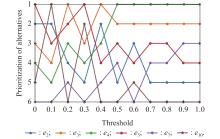
Fig 5
Prioritization of alternatives as a function of threshold parameter"
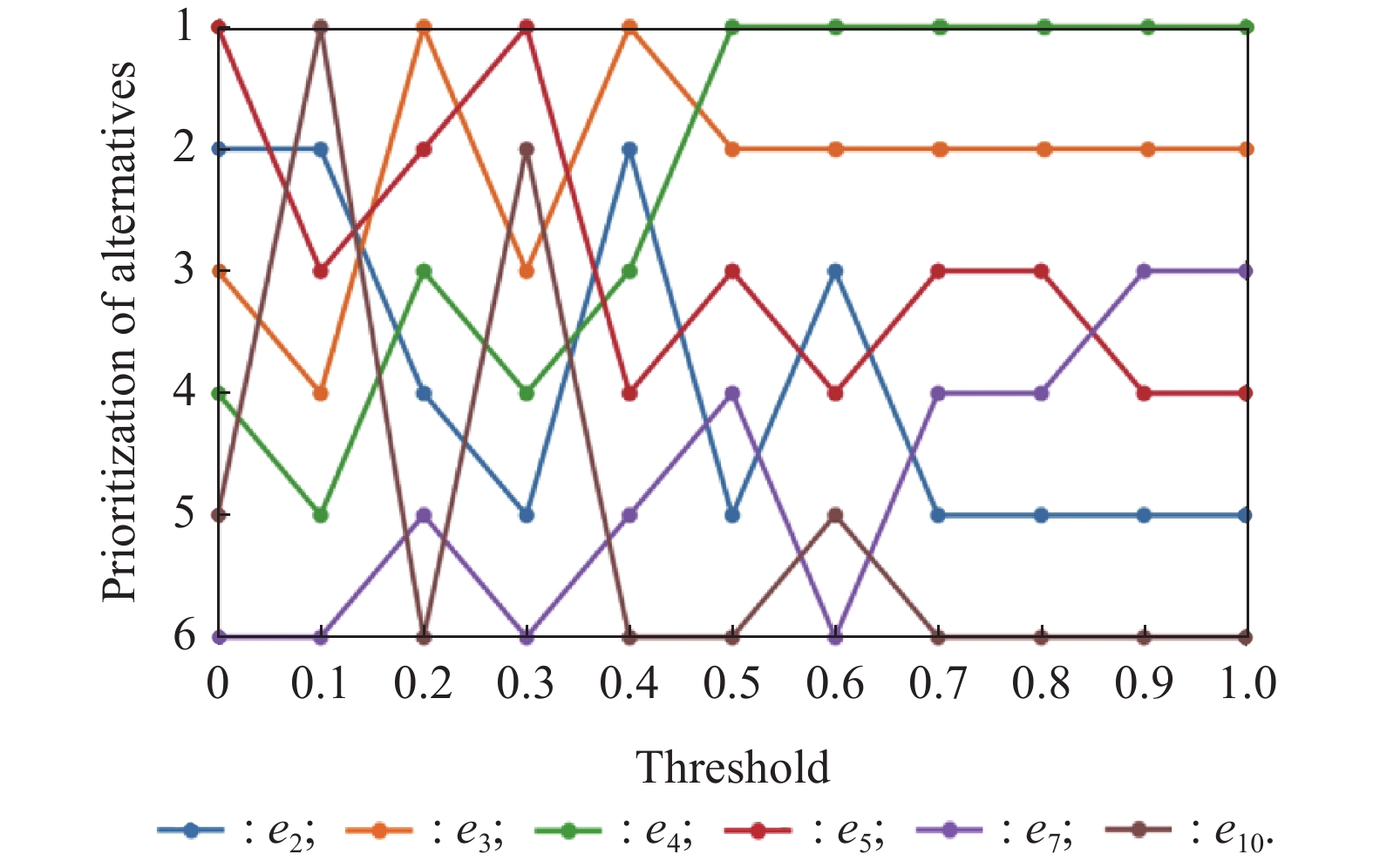
Table 6
Portfolio ranking for different methods"
| Method | Portfolio ranking |
| Our method | |
| TOPSIS | |
| VIKOR | |
| ELECTRE |
Table 7
Portfolio sorting of different comparison methods"
| Ranking method | Portfolio ranking |
| Our method | |
| Minimum safeguard principle | |
| Maximum benefit principle | |
| Average utility principle |
| 1 | DOU Y J, XU X Q, ZHOU Z X, et al Analysis of system portfolio selection and typical military application. Systems Engineering and Electronics, 2019, 41 (12): 2754- 2762. |
| 2 |
GE B F, HIPEL K W, FANG L P, et al An interactive portfolio decision analysis approach for system-of-systems architecting using the graph model for conflict resolution. IEEE Trans. on Systems, Man, Cybernetics-Systems, 2014, 44 (10): 1328- 1346.
doi: 10.1109/TSMC.2014.2309321 |
| 3 |
JIANG J Y, LI J C, YANG K W Weapon system portfolio selection based on structural robustness. Journal of Systems Engineering and Electronics, 2020, 31 (6): 1216- 1229.
doi: 10.23919/JSEE.2020.000094 |
| 4 | DOU Y J, ZHOU Z X, ZHAO D L, et al Weapons system portfolio selection based on the contribution rate evaluation of system of systems. Journal of Systems Engineering and Electronics, 2019, 30 (5): 905- 919. |
| 5 | CHEN Z Y, DOU Y J, XU X Q, et al Combinatorial optimization solution of complex equipment driven by contribution and sharing two-tier strategy. Systems Engineering and Electronics, 2023, 45 (2): 431- 443. |
| 6 | DOU Y J, ZHANG P L, GE B F, et al An integrated technology pushing and requirement pulling model for weapon system portfolio selection in defence acquisition and manufacturing. Proceedings of the Institution of Mechanical Engineers, Part B: Journal of Engineering Manufacture, 2015, 229 (6): 1046- 1067. |
| 7 |
DOU Y J, ZHOU Z X, XU X Q, et al System portfolio selection with decision-making preference baseline value for system of systems construction. Expert Systems with Applications, 2019, 123, 345- 356.
doi: 10.1016/j.eswa.2018.12.045 |
| 8 | MARKOWITZ H M Portfolio selection. The Journal of Finance, 1952, 7 (1): 77- 91. |
| 9 |
BUEDE D, BRESNICK T Applications of decision analysis to the military systems acquisition process. Interfaces, 1992, 22 (6): 110- 125.
doi: 10.1287/inte.22.6.110 |
| 10 |
LIU P, LI J C, XIA B Y, et al Weapons equipment portfolios selection based on equipment system contribution rates. Journal of Systems Engineering and Electronics, 2021, 32 (3): 584- 595.
doi: 10.23919/JSEE.2021.000050 |
| 11 | XIANG N, DOU Y J, JIANG J, et al Weapon selection decision-making based on expert trust network under incomplete information. Systems Engineering-Theory & Practice, 2021, 41 (3): 759- 770. |
| 12 | CAO Y H, FENG S X, FENG X F Research on conception representation of operational mission break. Computer Simulation, 2007, 24 (8): 1- 4. |
| 13 | XU R J, GONG L, ZHU M R, et al Combat plans recommendation method considering relativity and diversity under uncertain information. Systems Engineering and Electronics, 2022, 44 (10): 3115- 3123. |
| 14 | GOLDBERG D, NICHOLS D A , OKI B M, et al Using collaborative filtering to weave an information tapestry. Communications of the ACM, 1992, 35 (12): 61- 70. |
| 15 |
GOLDBERG K, ROEDER T, GUPTA D, et al Eigentaste: a constant time collaborative filtering algorithm. Information Retrieval, 2001, 4 (2): 133- 151.
doi: 10.1023/A:1011419012209 |
| 16 | RESNICK P. GroupLens: an open architecture for collaborative filtering of Netnews. Proc. of the ACM Conference on Computer Supported Cooperative work, 1994: 175−186. |
| 17 | BREESE J S. Empirical analysis of predictive algorithms for collaborative filtering. Proc. of the 14th Conference on Uncertainty in Artificial Intelligence, 1998: 43−52. |
| 18 | WANG J, VRIES A, REINDERS M. Unifying user-based and item-based collaborative filtering approaches by similarity fusion. Proc. of the 29th Annual International ACM SIGIR Conference on Research and Development in Information Retrieval, 2006: 501−508. |
| 19 | XUE G R, LIN C X, YANG Q, et al. Scalable collaborative filtering using cluster-based smoothing. Proce. of the 28th Annual International ACM SIGIR Conference on Research and Development in Information Retrieval, 2005: 114–121. |
| 20 |
LI Z Q, DOU Y J, XIA B Y, et al System portfolio selection based on GRA method under hesitant fuzzy environment. Journal of Systems Engineering and Electronics, 2022, 33 (1): 120- 133.
doi: 10.23919/JSEE.2022.000013 |
| 21 |
ZADEH L A Fuzzy sets. Information and Control, 1965, 8 (3): 338- 353.
doi: 10.1016/S0019-9958(65)90241-X |
| 22 | TURKSEN I B Interval valued fuzzy sets based on normal forms. Fuzzy Sets and Systems, 1986, 20 (2): 191- 210. |
| 23 | ATANASSOV K, STOEVA S Intuitionistic fuzzy sets. Fuzzy Sets and Systems, 1986, 31, 343- 349. |
| 24 | GOGUEN J A L-fuzzy sets. Journal of Mathematical Analysis and Applications, 1966, 18 (1): 145- 174. |
| 25 |
EULALIA S, JANUSZ K Distances between intuitionistic fuzzy sets. Fuzzy Sets and Systems, 2000, 114 (3): 505- 518.
doi: 10.1016/S0165-0114(98)00244-9 |
| 26 |
ZHANG C Z, FU H Y Similarity measures on three kinds of fuzzy sets. Pattern Recognition Letters, 2006, 27 (12): 1307- 1317.
doi: 10.1016/j.patrec.2005.11.020 |
| 27 | XU Z S Some similarity measures of intuitionistic fuzzy sets and their applications to multiple attribute decision making. Fuzzy Optimization & Decision Making, 2007, 6 (2): 109- 121. |
| 28 | XU Z S Intuitionistic preference relations and their application in group decision making. Information Sciences, 2007, 177 (11): 2363- 2379. |
| 29 |
XU Z S, CHEN J, WU J J Clustering algorithm for intuitionistic fuzzy sets. Information Sciences, 2008, 178 (19): 3775- 3790.
doi: 10.1016/j.ins.2008.06.008 |
| 30 |
XU Z S Dynamic intuitionistic fuzzy multi-attribute decision making. International Journal of Approximate Reasoning, 2008, 48 (1): 246- 262.
doi: 10.1016/j.ijar.2007.08.008 |
| 31 | HU H, XU Z S TOPSIS method for multiple attribute decision making with interval-valued intuitionistic fuzzy information. Fuzzy Systems and Mathematics, 2007, 21 (5): 108- 112. |
| 32 | XU Z S Methods for aggregating interval-valued intuitionistic fuzzy information and their application to decision making. Control and Decision, 2007, 22 (2): 215- 219. |
| 33 | XU Z S Approaches to multiple attribute decision making with intuitionistic fuzzy preference information. System Engineering-Theory & Practice, 2007, 27 (11): 62- 71. |
| 34 | MIKHAILOV L. A fuzzy programming method for deriving priorities in the analytic hierarchy process. Journal of the Operational Research Society, 2000, 51(3): 341−349. |
| 35 | HERRERA-VIEDMA E, ALONSO S, CHICLANA F, et al. A consensus model for group decision making with incomplete fuzzy preference relations. IEEE Trans. on Fuzzy Systems, 2007, 15(5): 863−877. |
| 36 | WANG W M, XU H Y Multiple attribute large-scale group decision making method based on hybrid information. Systems Engineering and Electronics, 2020, 42 (11): 2560- 2569. |
| 37 | WANG L, ZHAO C X, XUE H F, et al The expert synthesis and integration research method based on hesitant fuzzy language. System Engineering-Theory & Practice, 2021, 41 (8): 2157- 2168. |
| 38 | GONG R Z, LI S Y, TAN K X Possibility calculation model of symmetric distribution interval number and its ranking method. System Engineering-Theory & Practice, 2021, 41 (9): 2428- 2446. |
| 39 | LI Y, CHEN Y X, LUO C K, et al Multi-attribute decision making method based on probabilistic hesitant-intuitionistic fuzzy entropy and evidential reasoning. Systems Engineering and Electronics, 2020, 42 (5): 1116- 1123. |
| 40 | JIANG W Q, JIANG X L Interval hesitant fuzzy PROMETHEE decision method for attribute association. Systems Engineering and Electronics, 2021, 43 (11): 3250- 3258. |
| 41 | TAO X W, JIANG W Q Research on three-stage hesitant fuzzy information fusion method for group consensus. Systems Engineering and Electronics, 2021, 43 (12): 3603- 3613. |
| 42 | ZHU E G, DONG L J, GE L J, et al Interval entropy method for users’ electric equipment evaluation. Electrical Measurement & Instrumentation, 2014, 51 (24): 106- 112. |
| 43 | MCLAUGHLIN M R, HERLOCKER J L A collaborative filtering algorithm and evaluation metric that accurately model the user experience. Proc. of the 27th Annual International ACM SIGIR Conference on Research and Development in Information Retrieval, 2004, 329- 336. |
| 44 | CHEN B, GUO Y Y, GAO X, et al Dynamic multi-attribute decision-making method with interval-valued intuitionistic fuzzy power weighted operators. Systems Engineering and Electronics, 2019, 41 (4): 850- 855. |
| No related articles found! |
| Viewed | ||||||
|
Full text |
|
|||||
|
Abstract |
|
|||||
