
Journal of Systems Engineering and Electronics ›› 2025, Vol. 36 ›› Issue (6): 1407-1427.doi: 10.23919/JSEE.2025.000032
• ELECTRONICS TECHNOLOGY • Previous Articles
Peng SHANG1,2( ), Lishu GUO1,2,*(), Decai ZOU1,2,3(), Xue WANG4(), Shuaihe GAO1,2(), Pengfei LIU1,2()
Received:2024-07-24
Accepted:2024-07-24
Online:2025-12-18
Published:2026-01-07
Contact:
Lishu GUO
E-mail:shangpeng@ntsc.ac.cn;guolish@ntsc.ac.cn;zoudecai@ntsc.ac.cn;xuewang@xidian.edu.cn;gaoshuaihe@ntsc.ac.cn;liupengfei@ntsc.ac.cn
About author:Supported by:Peng SHANG, Lishu GUO, Decai ZOU, Xue WANG, Shuaihe GAO, Pengfei LIU. A novel multi-feature extraction based automatic modulation classification[J]. Journal of Systems Engineering and Electronics, 2025, 36(6): 1407-1427.
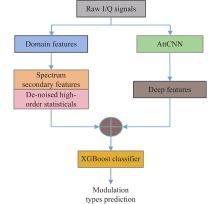
Fig 1
Flowchart of the proposed framework"
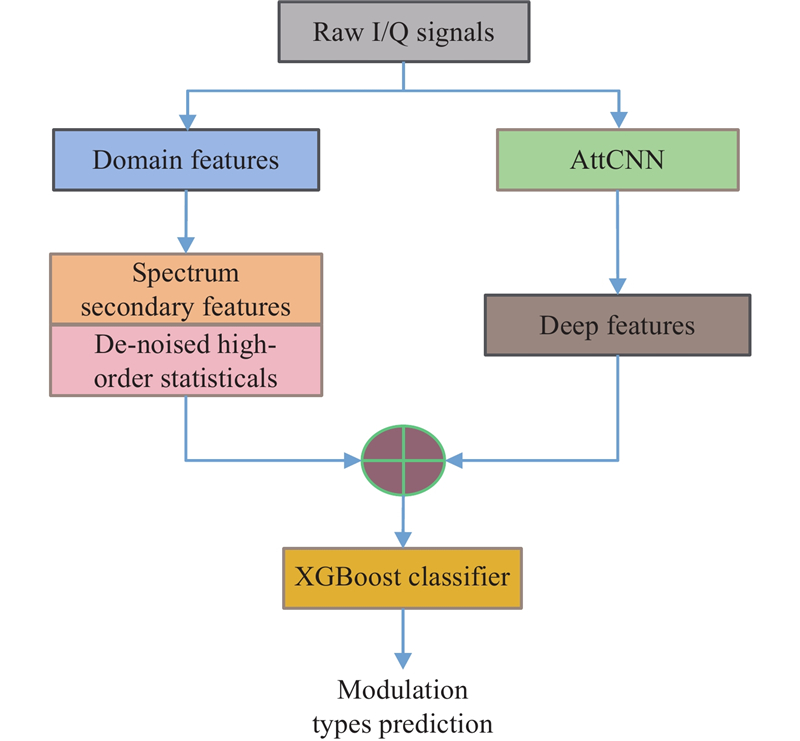
Fig 2
I/Q constellations of the high-order modulations"
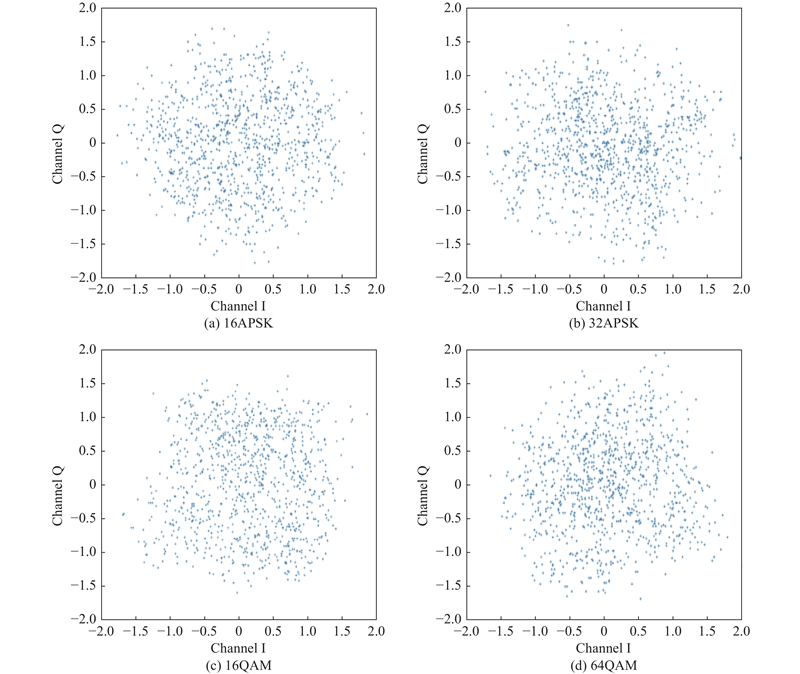
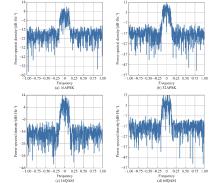
Fig 3
PSD of the high-order modulations"
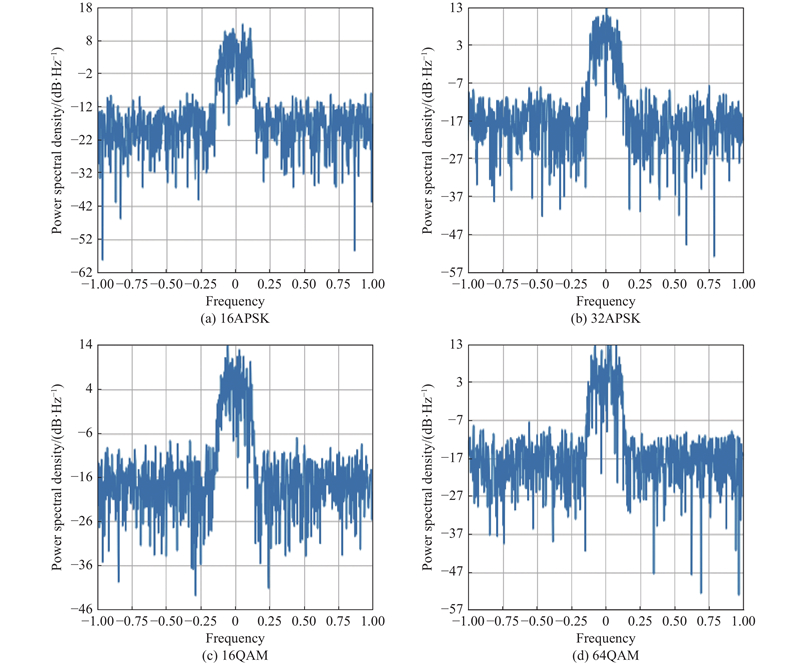
Table 1
Structure of the AttCNN network"
| Layer | Parameter | Value | Description |
| Conv1 | NF1 | 8 | Number of filters |
| NK1 | 5 | The kernel size | |
| Conv2 | NF2 | 16 | Number of filters |
| NK2 | 5 | The kernel size | |
| Maxpoo11 | ND1 | 2 | Down-sampling factor |
| NS1 | 2 | The pooling stride | |
| Conv3 | NF3 | 32 | Number of filters |
| NK3 | 5 | The kernel size | |
| Maxpool2 | ND2 | 2 | Down-sampling factor |
| NS2 | 2 | The pooling stride | |
| Conv4 | NF4 | 32 | Number of filters |
| NK4 | 5 | The kernel size | |
| LSTM | NO | 32 | Output dimension |
| Attention | − | − | Output from the previous layer |
| Den1 | NH1 | 64 | Units of hidden layer |
| Den2 | NH2 | 10 | The modulation types |
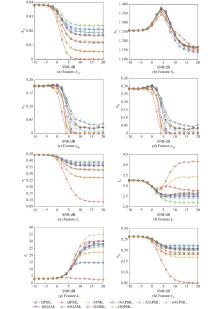
Fig 4
Instaneous features versus SNR"
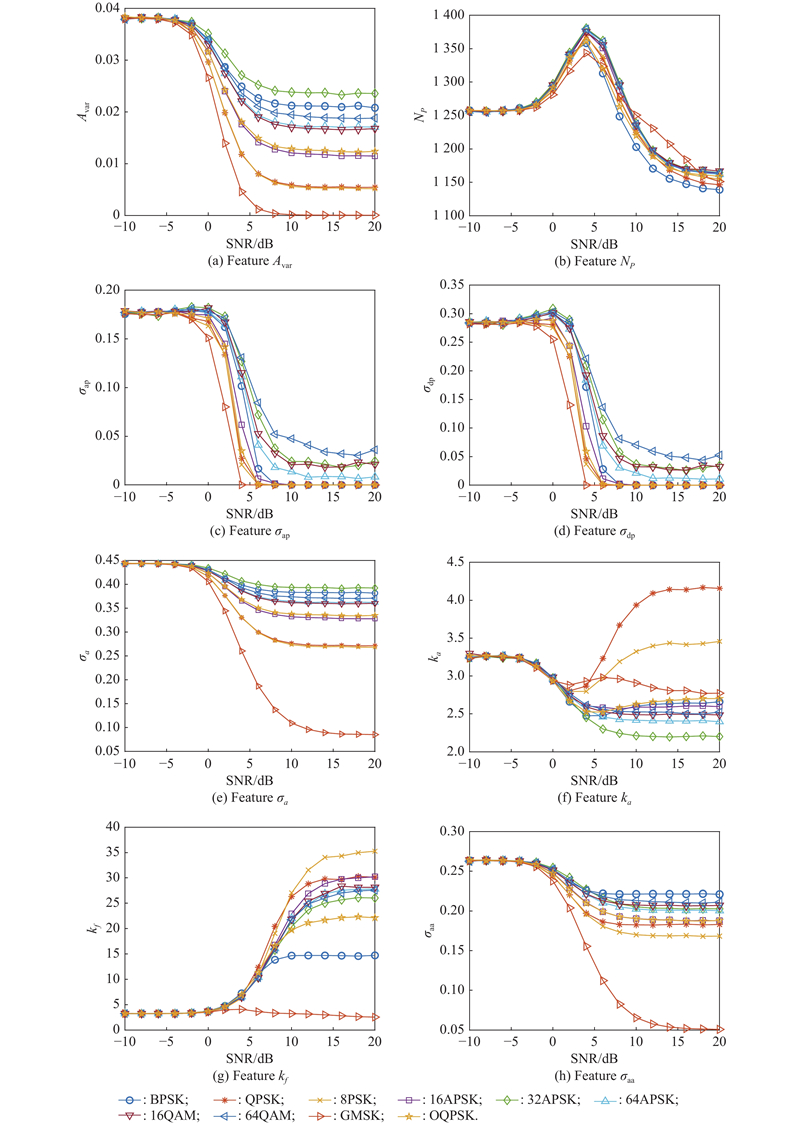
Fig 5
High-order cumulant features versus SNR"
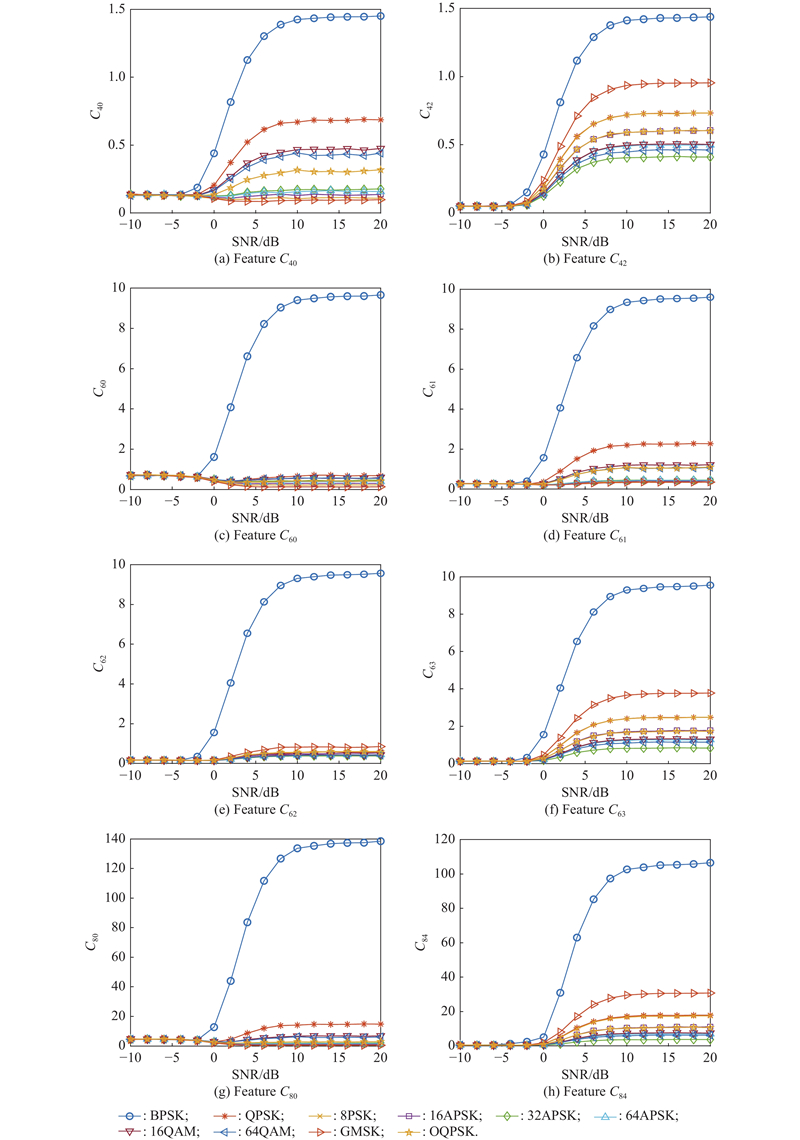
Fig 6
Spectral features versus SNR"
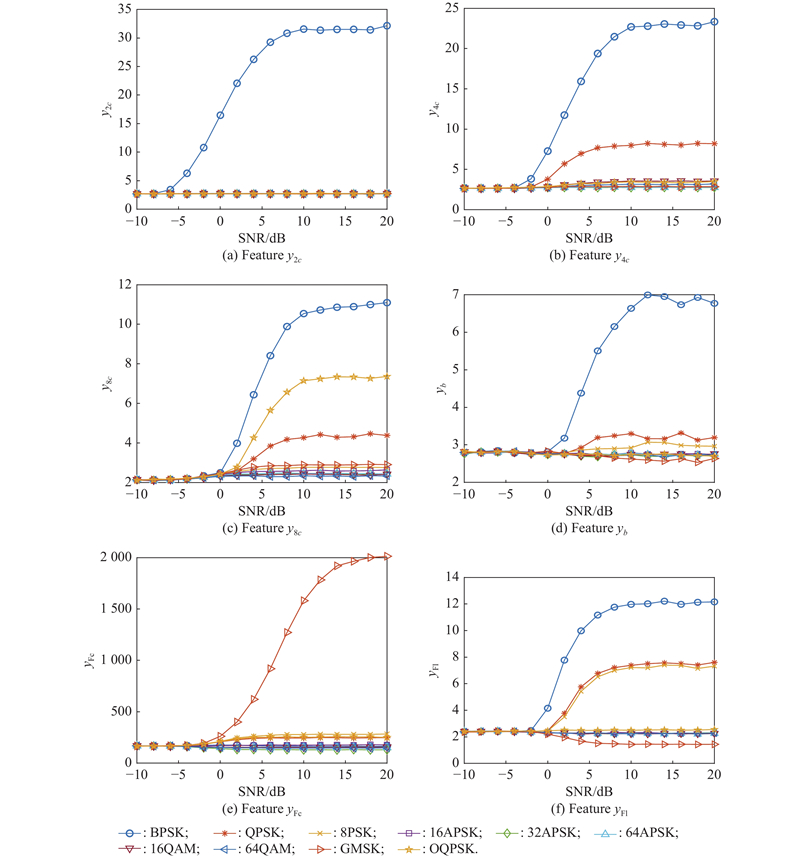
Fig 7
Spectral secondary features versus SNR"
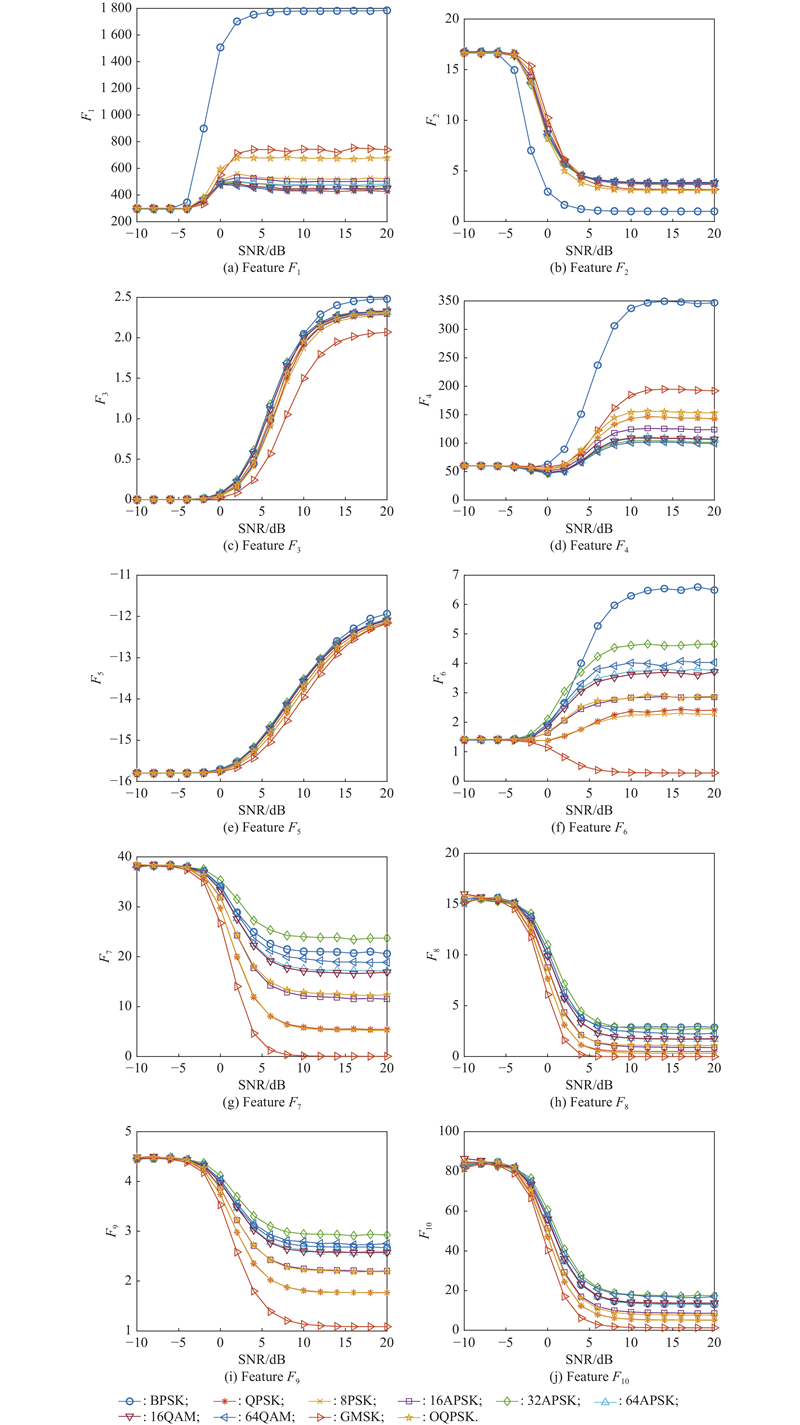

Fig 8
Flowchart of proposed de-noised moments"


Fig 9
Schematic of the distance clustering"

Fig 10
High-order moments versus SNR"
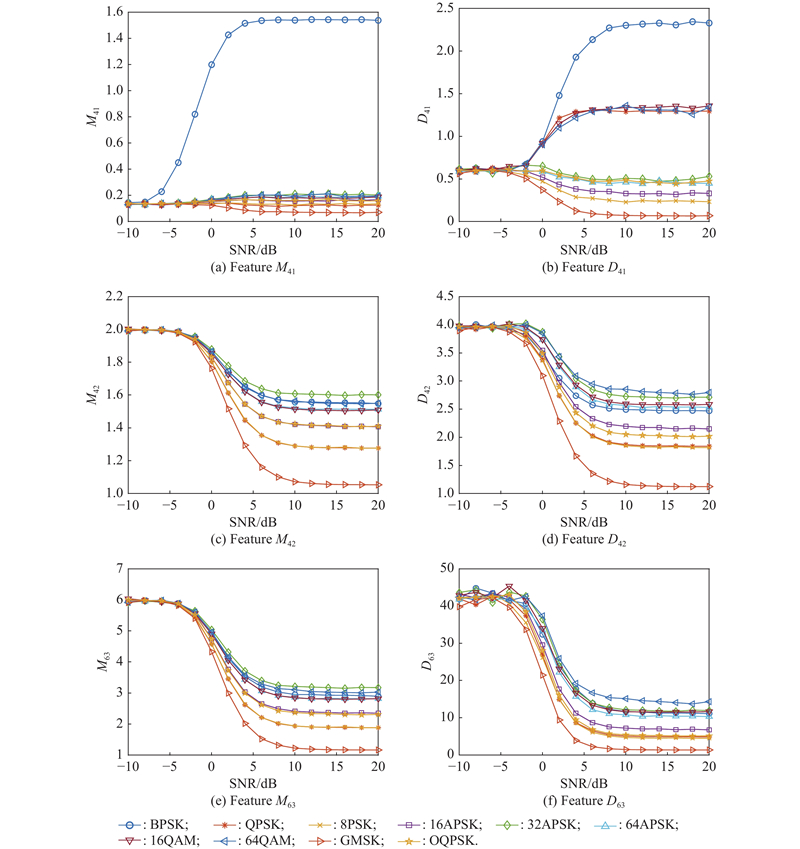
Table 2
Overall accuracy of the extracted features under the classifiers"
| Classifier | I | Y | F | H | D | O |
| DT | 46.55 | 47.45 | 49.77 | 47.93 | 50.08 | 46.33 |
| RF | 48.93 | 47.61 | 50.17 | 46.98 | 49.64 | 48.96 |
| XGBoost | 51.90 | 48.49 | 54.68 | 52.34 | 55.69 | 53.20 |
| SVM | 51.48 | 48.26 | 55.91 | 53.49 | 57.58 | 53.46 |
| DNN | 51.86 | 48.23 | 54.26 | 53.61 | 57.56 | 52.11 |
Fig 11
Overall accuracy of different classifiers"
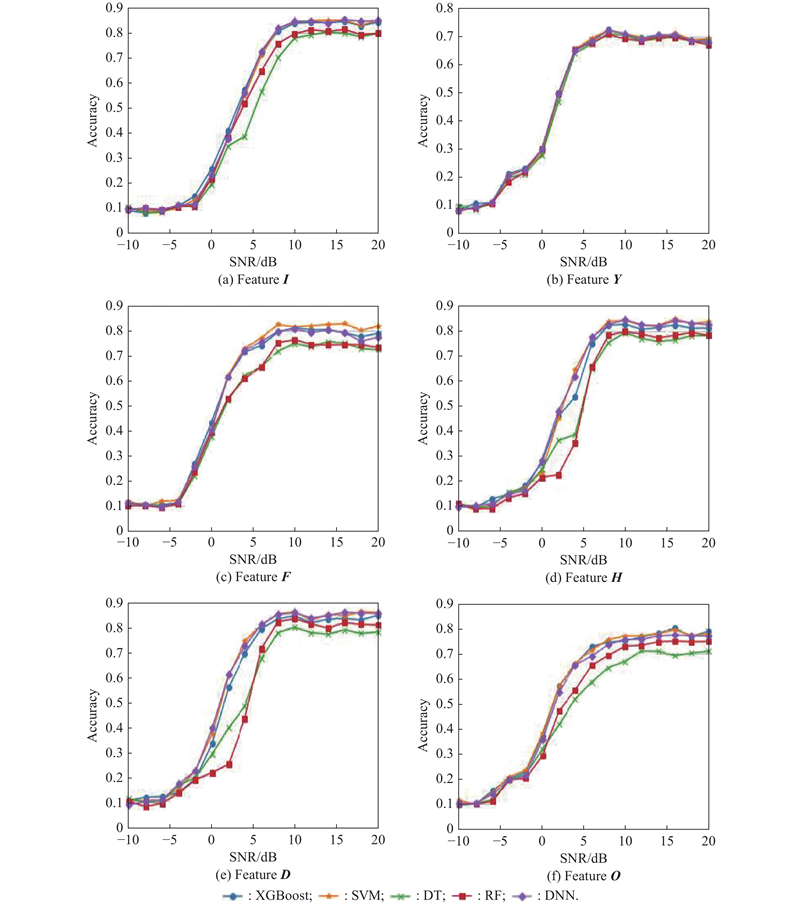
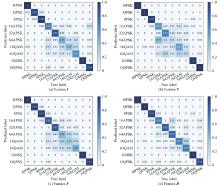
Fig 12
Confusion matrix at 8 dB"
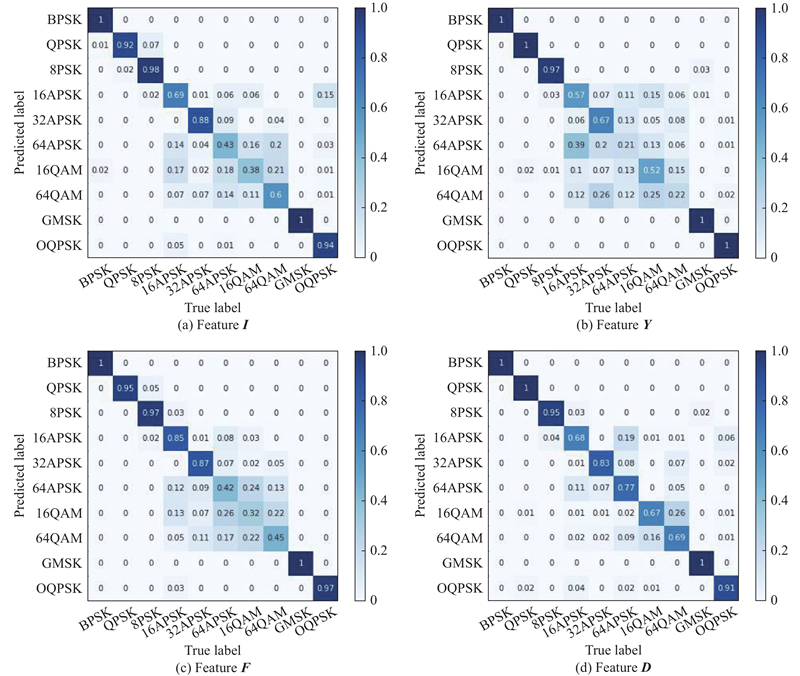
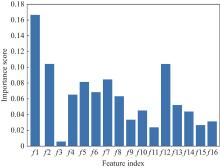
Fig 13
Importance socre of the concatenated features"
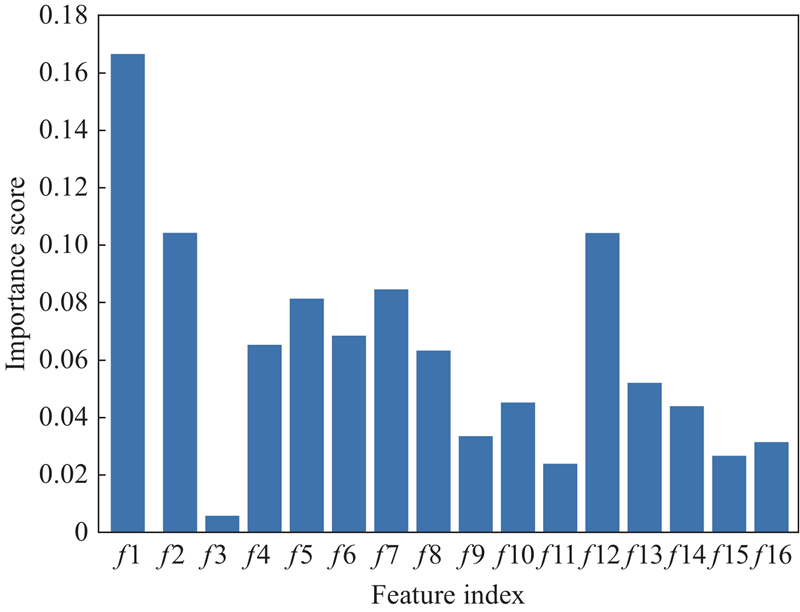
Table 3
Overall performance of the lightweight deep networks"
| Network | Accuracy/% | Parameter/K | Inference time/ms |
| CDSCNN | 67.27 | 330 | 0.28 |
| FEAT | 70.79 | 177 | 0.20 |
| PETCGDNN | 69.39 | 74 | 0.18 |
| TransGroupNet | 67.59 | 583 | 0.25 |
| AttCNN | 70.69 | 21 | 0.08 |
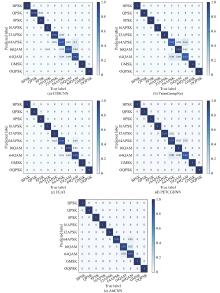
Fig 14
Confusion matrix at 8 dB of the networks"
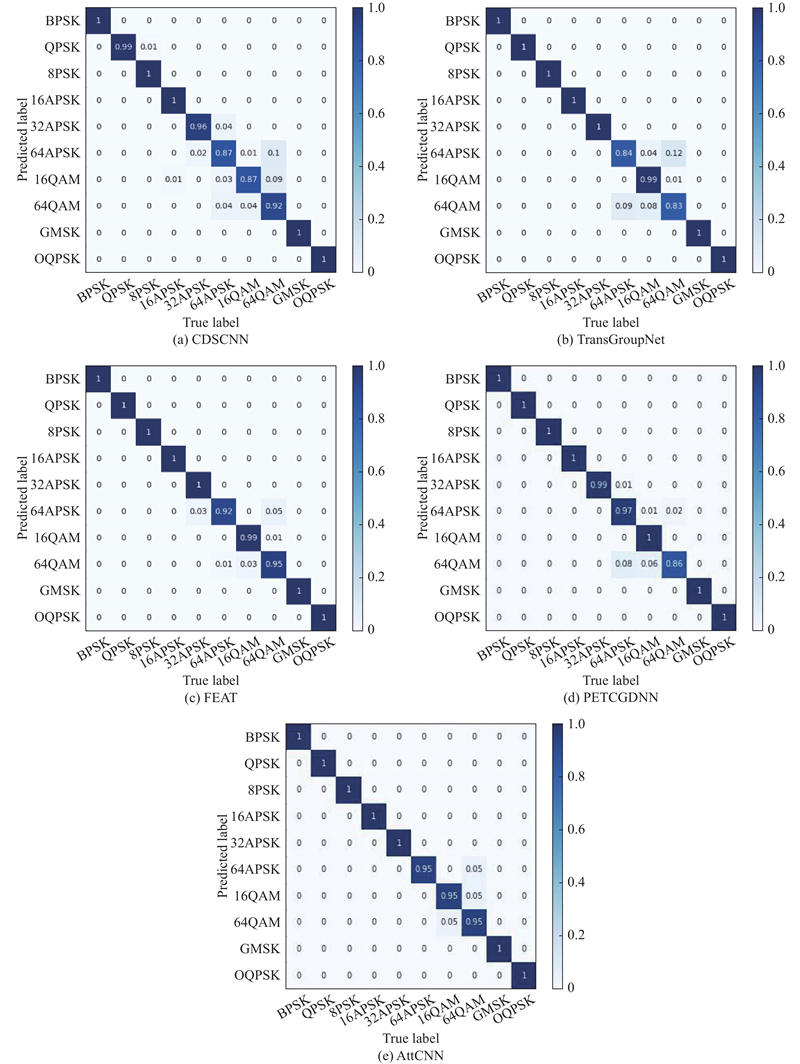
Fig 15
Visualized deep features at 8 dB"
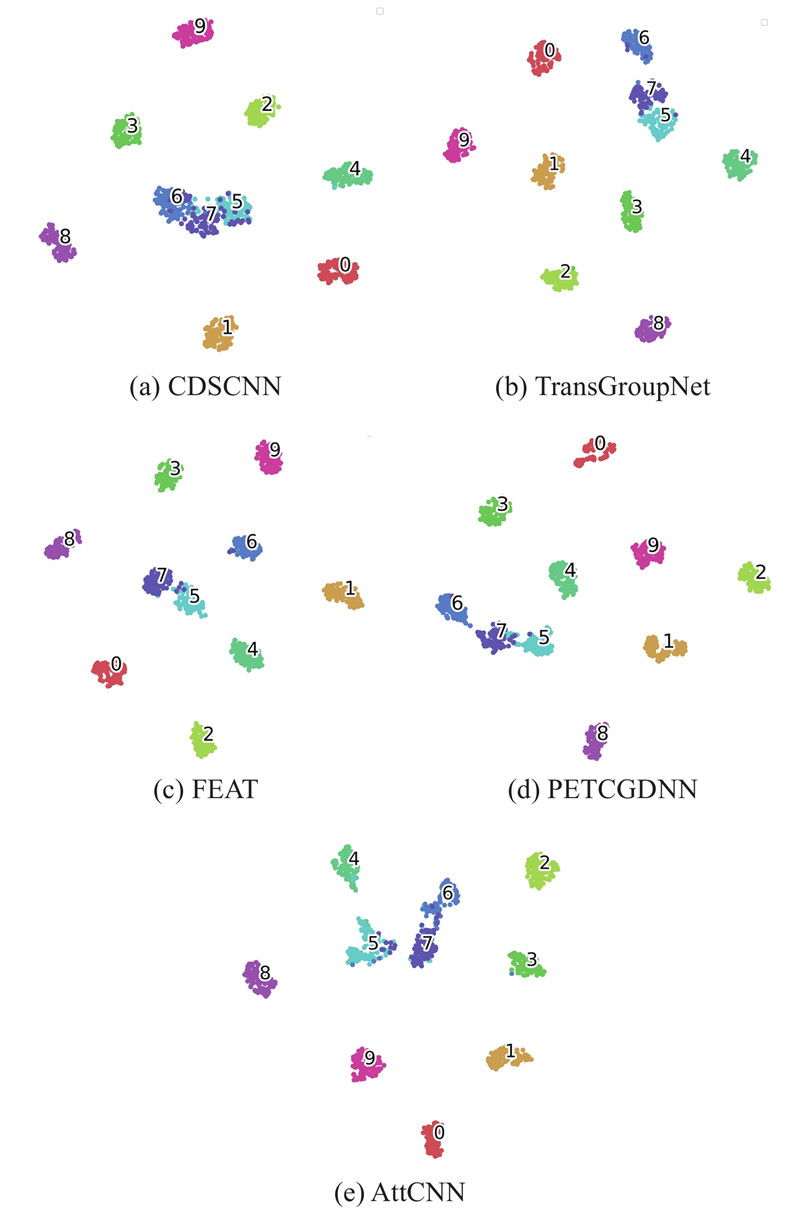
Table 4
Overall accuracy of the framework by various networks and the proposed features %"
| Network | Feature set | |
| Z+D | Z+V | |
| CDSCNN | 69.19 | 68.41 |
| TransGroupNet | 69.20 | 69.24 |
| FEAT | 72.58 | 72..47 |
| PETCGDNN | 71.58 | 70.91 |
| AttCNN | 72.95 | 72..66 |
Fig 16
Confusion matrix at 6 dB under the feature extraction framework"
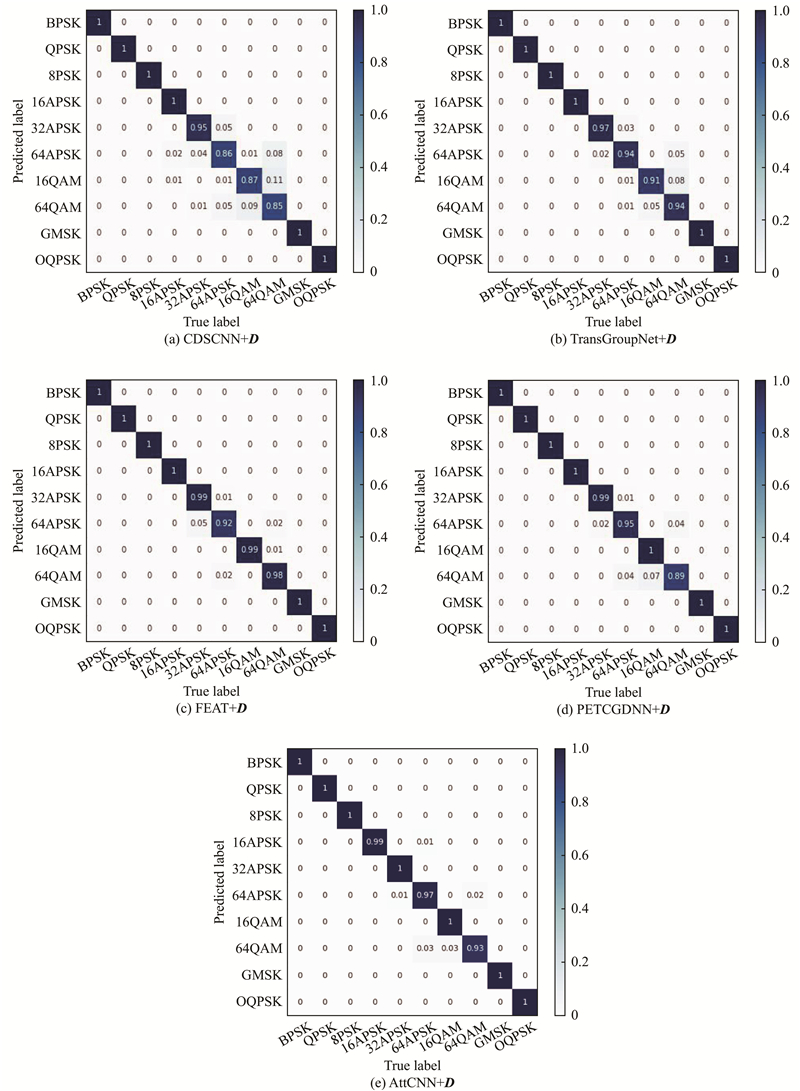
Fig 17
Average accuracy of the feature extraction framework"
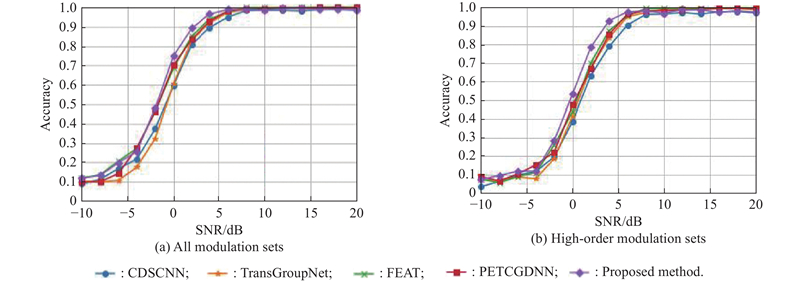
Table 5
Average accuracy of the framework on all modulation sets %"
| SNR/dB | Feature set | ||||
| CDSCNN+D | TransGroupNet+D | FEAT+D | PETCGDNN+D | AttCNN+D | |
| −2 | 37.30 | 32.36. | 46.37 | 46.17 | 47.98 |
| 0 | 59.71 | 60.54 | 68..80 | 70.14 | 75..00 |
| 2 | 81.00 | 83.23 | 85.26 | 83.64 | 89.23 |
| 4 | 89.42 | 91.83 | 94.03 | 92.64 | 96.47 |
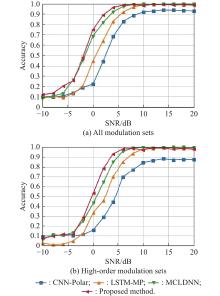
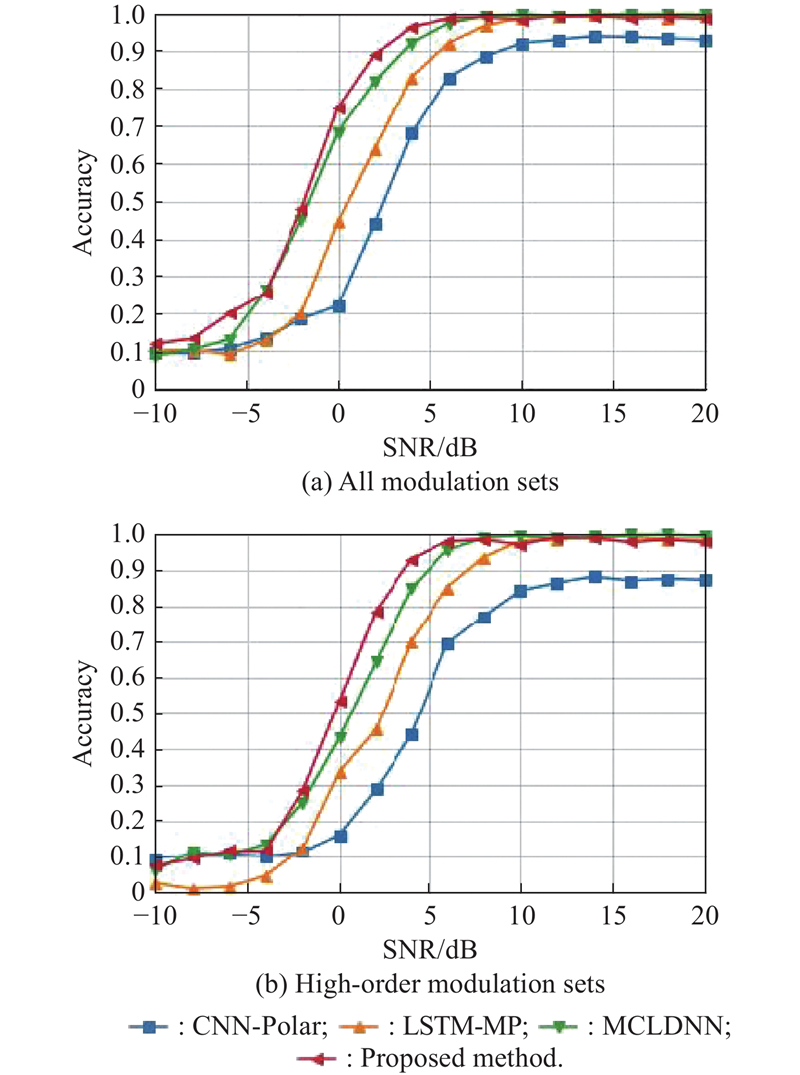
Fig 18
Results of the comparative methods"
| 1 | GHASEMZADEH P, BANERJEE S, HEMPEL M, et al. Analysis of distribution test-based and feature-based approaches toward automatic modulation classification. Proc. of the IEEE 30th Annual International Symposium on Personal, Indoor and Mobile Radio Communications (PIMRC), 2019. DOI: 10.1109/PIMRC.2019.8904428. |
| 2 | ZHOU R Y, HE P F, CAI Z R. An improved automatic modulation classification method based on complex-valued capsule network. Proc. of the Global Reliability and Prognostics and Health Management Conference, 2023. DOI: 10.1109/PHM-Hangzhou58797.2023.10482607. |
| 3 | ELSHEBANI M S, ALI Y, AZROUG N, et al. Convolutional neural networks with feature fusion method for automatic modulation classification. Proc. of the 9th International Conference on Computer and Communication Engineering, 2023: 340−345. |
| 4 | ZHANG J W, WANG T T, FENG Z X, et al. AMC-Net: an effective network for automatic modulation classification. Proc. of the IEEE International Conference on Acoustics, Speech and Signal Processing, 2023. DOI:10.1109/ICASSP49357.2023.10097070. |
| 5 | DEVI P K , KUMAR N N , VARUN M S, et al. Automatic modulation classification using software defined radio system. Proc. of the 3rd International Conference on Innovative Mechanisms for Industry Applications, 2023: 1322−1330. |
| 6 |
CHEN W H, XIE Z C, MA L, et al A faster maximum likelihood modulation classification in flat fading non-Gaussian channels. IEEE Communications Letters, 2019, 23 (3): 454- 457.
doi: 10.1109/LCOMM.2019.2894400 |
| 7 |
ZHU D, MATHEWS V J, DETIENNE D H A likelihood-based algorithm for blind identification of QAM And PSK signals. IEEE Trans. on Wireless Communications, 2018, 17 (5): 3417- 3430.
doi: 10.1109/TWC.2018.2811802 |
| 8 |
ZHENG J P, LYU Y F Likelihood-based automatic modulation classification in OFDM with index modulation. IEEE Trans. on Vehicular Technology, 2018, 67 (9): 8192- 8204.
doi: 10.1109/TVT.2018.2839735 |
| 9 | MOSER E, MORAN M K, HILLEN E, et al. Automatic modulation classification via instantaneous features. Proc. of the IEEE Aerospace & Electronics Conference, 2015: 218−223. |
| 10 | ZHOU S Y, WU Z L, YIN Z D, et al. Noise-robust feature combination method for modulation classification under fading channels. Proc. of the IEEE 88th Vehicular Technology Conference (VTC-Fall), 2018, DOI:10.1109/VTCFall.2018.8690662. |
| 11 |
SWAMI A, SADLER B M Hierarchical digital modulation classification using cumulants. IEEE Trans. on Communications, 2000, 48 (3): 416- 429.
doi: 10.1109/26.837045 |
| 12 |
HAN L B, XUE H F, GAO F, et al Low complexity automatic modulation classification based on order statistics. IEEE Trans. on Wireless Communications, 2017, 16 (1): 400- 411.
doi: 10.1109/TWC.2016.2623716 |
| 13 | SUETRONG N, TAPARUGSSANAGORN A, PROMSUK N. Deep learning-based robust automatic modulation classification Using higher order cumulant features. Proc. of the 15th International Conference on Information Technology and Electrical Engineering, 2023. DOI: 10.1109/ICITEE59582.2023.10317756. |
| 14 |
MAJHI S, GUPTA R, XIANG W, et al Hierarchical hypothesis and feature based blind modulation classification for linearly modulated signals. IEEE Trans. on Vehicular Technology, 2017, 66 (12): 11057- 11069.
doi: 10.1109/TVT.2017.2727858 |
| 15 |
CAMARA T, LIMA A, LIMA B, et al Automatic modulation classification architectures based on cyclostationary features in impulsive environments. IEEE Access, 2019, 7, 138512- 138527.
doi: 10.1109/ACCESS.2019.2943300 |
| 16 | GAO X C. Modulation recognition algorithm based on spectral feature extraction. Xi’an: XiDian University, 2020. |
| 17 |
ZHANG D N, LU Y Y, LI Y D, et al High-order convolutional attention networks for automatic modulation classification. IEEE Trans. on Wireless Communications, 2023, 22 (7): 4600- 4610.
doi: 10.1109/TWC.2022.3227518 |
| 18 | HUYNH T T , HUA C H , PHAM Q V , et al. MCNet: an efficient CNN architecture for robust automatic modulation classification. IEEE Communications Letters, 2020, 24(4): 811−815. |
| 19 |
KUMAR A, SRINIVAS K K, MAJHI S Automatic modulation classification for adaptive OFDM systems using convolutional neural networks with residual learning. IEEE Acess, 2023, 11, 61013- 61024.
doi: 10.1109/ACCESS.2023.3286939 |
| 20 |
HUANG S, DAI R, HUANG J, et al Automatic modulation classification using gated recurrent residual network. IEEE Internet of Things Journal, 2020, 7 (8): 7795- 7807.
doi: 10.1109/JIOT.2020.2991052 |
| 21 |
KE Z, VIKALO H Real-time radio technology and modulation classification via an LSTM auto-encoder. IEEE Trans. on Wireless Communications, 2022, 21 (1): 370- 382.
doi: 10.1109/TWC.2021.3095855 |
| 22 | CHAUDHARI M S, MAJHI S, JAIN S CNN-Attention-DNN design for CFO estimation of non-Pilot-assisted OFDM system. IEEE Communications Letters: A publication of the IEEE Communications Society, 2023, 27 (2): 551- 555. |
| 23 |
HU J, SHEN L, SUN G, et al Squeeze-and-excitation networks. IEEE Trans. on Pattern Analysis and Machine Intelligence, 2020, 42 (8): 2011- 2023.
doi: 10.1109/TPAMI.2019.2913372 |
| 24 |
TENG C F, CHOU C Y, CHEN C H, et al Accumulated polar feature-based deep learning for efficient and lightweight automatic modulation classification with channel compensation mechanism. IEEE Trans. on Vehicular Technology, 2020, 69 (12): 15472- 15485.
doi: 10.1109/TVT.2020.3041843 |
| 25 |
WU H, LI Y X, ZHOU L, et al Convolutional neural network and multi-feature fusion for automatic modulation classification. Electronics Letters, 2019, 55 (16): 895- 897.
doi: 10.1049/el.2019.1789 |
| 26 | CHEN T, GUESZTRIN C. XGboost: a scalable tree boosting system. ACM, 2016: 785−794. |
| 27 | YANG Z, YANG D, DYER C, et al. Hierarchical attention networks for document classification. Proc. of the Conference of the North American Chapter of the Association for Computational Linguistics: Human Language Technologies, 2016: 1480−1489. |
| 28 | DEVELOPS T F. Tensorflow. https://tensorflow.google.cn/tutorials/keras/keras_tuner. |
| 29 | JIANG Y Z. Research on high-order modulation recognition based on machine learning. Beijing: Beijing University of Posts and Telecommunications, 2019. |
| 30 | ALI A K, ERELEBI E Automatic modulation recognition of DVB-S2X standard-specific with an APSK-based neural network classifier. Measurement, 2019, 151, 1- 13. |
| 31 | KHARBECH S, SIMON E P, BELAZI A, et al. Denoising higher-order moments for blind digital modulation identification in mutiple-atenna systems. IEEE Wireless Communication Letters, 2020, 9(6): 765−769. |
| 32 | PHUONG T T, OHISHI K, YOKOKURA Y. Deep learning based singular spectrum analysis for realization of wideband force sensing. Proc. of the IEEE International Conference on Mechatronics, 2021. DOI:10.1109/ICM46511.2021.9385603. |
| 33 |
MONDINO L Y R, CORRAL B G Automatic modulation classification for low-power IoT applications. IEEE Latin America Transactions, 2024, 22 (3): 204- 212.
doi: 10.1109/TLA.2024.10431424 |
| 34 | XIAO C H, YANG S Y, FENG Z X Complex-valued depthwise separable convolutional neural network for automatic modulation classification. IEEE Trans. on Instrumentation and Measurement, 2023, 72, 2522310. |
| 35 |
CHEN Y T, DONG B H, LIU C T, et al Abandon locality: frame-wise embedding aided transformer for automatic modulation recognition. IEEE Communications Letters, 2023, 27 (1): 327- 331.
doi: 10.1109/LCOMM.2022.3213523 |
| 36 |
ZENG R, LU Z L, ZHANG X D, et al Convolutional neural network assisted transformer for automatic modulation recognition under large CFOs and SROs. IEEE Signal Processing Letters, 2024, 31, 741- 745.
doi: 10.1109/LSP.2024.3372770 |
| 37 |
ZHANG F X, LUO C B, XU J L, et al An Efficient deep learning model for automatic modulation recognition based on parameter estimation and transformation. IEEE Communications Letters, 2021, 25 (10): 3287- 329.
doi: 10.1109/LCOMM.2021.3102656 |
| 38 | KINGMA D P, BA J. Adam: a method for stochastic optimization. Proc. of the 3rd International Conference for Learning Representations, 2015. https://arxiv.org/abs/1412.6980. |
| 39 |
RAJENDRAN S, MEERT W, GIUSTINIANO D, et al Deep learning models for wireless signal classification with distributed low-cost spectrum sensors. IEEE Trans. on Cognitive Communications and Networking, 2018, 4 (3): 433- 445.
doi: 10.1109/TCCN.2018.2835460 |
| 40 |
XU J L, LUO C B, PARR G, et al A spatiotemporal multi-channel learning framework for automatic modulation recognition. IEEE Wireless Communications Letters, 2020, 9 (10): 1629- 1632.
doi: 10.1109/LWC.2020.2999453 |
| [1] | Hamidreza Hosseinzadeh. Tracking performance of large margin classifier in automatic modulation classification with a software radio environment [J]. Journal of Systems Engineering and Electronics, 2014, 25(5): 735-741. |
| Viewed | ||||||
|
Full text |
|
|||||
|
Abstract |
|
|||||
