


1 Introduction
Weapons equipment selection is a complicated systematic project and serves as a groundwork for equipment development planning. It determines the future development direction, scale structure, and ability levels of various types of weapons equipment. It is also related to national security and the success of future military struggles and possesses crucial military significance and research value [1]. The trend of modern warfare is joint operations and systems counterwork, not simply the reliance on individual weapons and weapons systems [2]. That is, the purpose of weapons equipment development has changed from the pursuit of maximizing the effectiveness of a single type of equipment or a single service to the pursuit of maximizing the overall effectiveness of the weapons equipment system. This requires that the project approval, research and acquisition of many types of weapons need to change from the bottom-up independent construction idea of each branch of armed forces to adopting design from top to bottom and combine planning of weapons equipment projects to make a systematic development of the weapons.
The concept of the contribution rate is proposed as an evaluation standard to support the research and development of weapon systems [3]. As an evaluation index, the system contribution rate is mainly used to measure the “function improvement” “performance improvement”, “capability gain” and “efficiency improvement” that may be generated by the weapons equipment system to the whole equipment system. It focuses on measuring the change and fluctuation of function/performance/capability/efficiency at the systems level due to the addition of a weapons equipment system, especially its positive impact, referred to as “contribution” [4]. The evaluation based on the system contribution rate can assist decision-makers to weigh the pros and cons from the overall perspective of the whole equipment system and formulate the development plan of weapons systems with a high system contribution rate.
In the development planning of weapons, in order to systematically plan and develop new equipment, it is necessary to consider the contribution of the newly developed equipment portfolio to the improvement of combat capability or combat effectiveness of the system after joining the original equipment system. At present, the weapons equipment portfolio selection, which is based on evaluating the system contribution rate, needs to consider the following points: first, different weapons equipment portfolios have different effects on the combat effectiveness of the same system; second, the same weapons equipment portfolio in different systems have different effects. Therefore, the evaluation of equipment should not only be based on its ability, but also consider the combined effects of the cooperation, dependence and restriction of the to-be-developed equipment portfolio and other equipment in the system, and focus on the contribution of the equipment portfolio to the whole system. Besides, the development of the equipment portfolio also needs to account for the exertion of equipment system efficiency. This is because an equipment portfolio with self-evaluation cannot form combat effectiveness alone; only when joined with other collaborative equipment can it play a significant value-adding role. In equipment development planning, the equipment portfolio should be developed in a systematic way, rather than just select the equipment development order according to the evaluation rank of a single piece of equipment or apparatus.
Therefore, it is necessary to evaluate and plan the development of weaponry from the systems level, to maximize the overall effectiveness of the weapons and equipment systems, so that the nation can gain ground in the future counterwork between weapons equipment systems. At the same time, we can reasonably use limited resources to avoid risks in the development process of weapons. By studying the theories, methods and models of weapons systems development planning based on contribution rates, we can deeply explore the systems connotations of equipment contribution rates, focus on the evaluation method of equipment contribution rates, and innovate the systematic development mode in the process of equipment planning. It is of great theoretical significance and application value to provide decision support for the iteration of weapons equipment, the design of equipment development roadmaps, and the demonstration of major equipment requirements. From the perspective of systems, this paper proposes a selection method for weapons equipment portfolios based on the contribution rate of the equipment system. The main contributions of this paper are summarized as follows.
(i) A combat network model of the weapons equipment system is established based on the function chain rule. The contribution rate of weapons equipment and the portfolio selection problem are analyzed from a systems perspective. On this basis, by fully considering the correlation between the components of the system and the heterogeneity of element types, the weapons equipment system is modeled and described in a network based on function chains.
(ii) A model of weapons equipment portfolio selection based on the contribution rate of the equipment system is proposed. The model comprehensively considers the interdependence between the to-be-developed equipment portfolio and the old equipment system and aims to maximize the combat capability of the whole weapons and equipment system under the constraints of capacity demand and cost budget resource.
(iii) Application research is carried out for typical cases. Taking an equipment system as an example, the whole calculation process and results of the weapons system portfolio selection based on the system contribution rate evaluation model are demonstrated and analyzed to verify the feasibility and effectiveness of the proposed method.
Using the results of this study, decision-makers can choose their preferred equipment portfolio selection method to develop weapons and equipment.
The organizational structure of this paper is as follows. Section 1 introduces the background and significance of weapons equipment portfolio selection. Section 2 analyzes current research concerning the contribution rate evaluation and weapons equipment portfolio selection of weapons equipment systems as well as the existing problems in the studies of weapons equipment portfolio selection. Section 3 studies the contribution rate and selection of weapons equipment portfolios under a systems background. Section 4 models the combat network of the weapons equipment system based on function chains and analyzes the contribution rate of the equipment portfolio system. Based on this model, this paper establishes the weapons systems portfolio selection model with full consideration of budget constraints, capability requirements, and other factors. Section 5 takes the space-based information acquisition equipment system as an example to demonstrate and analyze the whole calculation process and results of weapons systems portfolio selection based on the system contribution rate evaluation model.
2 Related work
Modern portfolio theory (MPT) is originated from the investment portfolio theory first proposed by Markowitz in 1952. With the increasing demand brought about by economic development, the portfolio theory has been widely used in the fields of project investment [5], product production [6], technology research and development [7], and national defense acquisition [8]. In the military field of national defense, due to the emergence of the system confrontation concept, the need for portfolio decisions is becoming more urgent. The research on portfolios of military projects, technologies, equipment and tasks has received wide attention. The most common analytical methods for selecting military equipment portfolios in the past 20 years include the multi-target analysis [9-12], multi-standard analysis [13], value analysis [14], cost-benefit analysis [15,16], expert evaluation [17], and the Monte Carlo method [18]. However, because of the overemphasis on mathematical and quantitative elements, the above methods tend to ignore the particularity and sensitivity of the military field, making them not directly applicable for practical equipment portfolio selection. At present, most studies are combining the methods of portfolio selection with the military characteristics. Some specific methods include the selection of high-end weapons equipment portfolios based on a heterogeneous combat network [19], selection of equipment portfolios under the evolution of dynamic function chains [20], analysis of equipment portfolio selection considering multiple combat scenarios [21], and portfolio decision-making considering the risks in the research and development of high-end equipment [22]. Besides, some evaluation indicators specific for the military field are proposed for evaluating the equipment portfolios, such as the equipment portfolio capability gap, capability satisfaction degree, equipment system contribution rate, combat effectiveness, task fulfilling degree, and equipment system invulnerability. Among them, the system contribution rate is an important new concept for military application.
The contribution rate of weapons equipment systems is a new concept in the military field, and relevant research is limited presently. Most studies mainly focus on the contribution rates of technology and equipment [23,24]. As for the evaluation of the contribution rate of weapons equipment systems, the current research focuses on the evaluation of a single apparatus and analyzes the impact of it, when added to the original system, on the system’s combat effectiveness. At present, the current research on the contribution rate of the system is mainly carried out from two aspects. On the one hand, the system contribution rate is analyzed from the concept level, including analyzing and clarifying the purpose and use of the equipment contribution rate analysis [25], summarizing the multiple perspectives needed to be considered in the capability evaluation and contribution rate analysis of the weapons equipment system [26], and studying the specific process and method of the contribution rate evaluation of the weapons equipment system with examples [3]. On the other hand, the evaluation methods of the contribution rate of the system are studied, mainly including using the analytic hierarchy process, expert experience, network analysis, and other methods to build the system contribution evaluation system. Also, the current research examines, using multi-attribute evaluation, grey target theory, complex network, function chain, and other related methods to construct the system contribution rate evaluation model [23, 27, 28]. In the research on the contribution rate of weapons equipment systems, to the best of our knowledge, there is no study that uses the evaluation method for analyzing contribution rates of equipment portfolios to the system. Selecting weapons equipment portfolios based on the contribution rate of equipment portfolios is also a new research idea.
There are three main problems in the existing research. First, the traditional tree equipment architecture modeling does not consider the complex correlation between weapons and equipment, and neglects the emergent properties on the systems level. Second, the current research on weapons equipment portfolio selection mostly chooses the capability of the weapons equipment portfolio itself as the objective function for deciding the development plan of weapons equipment, neglects the contribution of the equipment portfolio to the overall capability of the future combat system, and fails to consider the portfolio decision-making problem from the system perspective. Third, the existing studies on the contribution rate of weapons equipment systems mostly consider whether there is a certain single apparatus in the current equipment system and rarely study the contribution rate in terms of the equipment portfolio. However, it is unlikely that a future weapons equipment system only contains a specific new single piece of equipment. Giving the existing problems, based on the comprehensive analysis of the existing research on the portfolio selection of weapons equipment and the system contribution rate, this paper first fully considers the correlation between different weapons equipment, establishes the combat network model of the weapons and equipment system, and then puts forward a new definition for the contribution rate of the weapons equipment system, taking the “system contribution rate” as the “value focus” for the equipment portfolio selection. Finally, the contribution rate of the weapons equipment portfolio system is taken as the evaluation index to plan the development of equipment portfolio selection, which provides a new idea for the weapons portfolio selection.
3 Problem formulation and analysis
3.1 Contribution rate evaluation problem of weapons equipment systems
The traditional definition of the contribution rate evaluation is the role and value of a single apparatus in the combat capability of the system, that is, the ratio of the difference in the combat capability of the system with or without the equipment, i.e.,
where
It is believed that there should be two types of models for measuring the contribution rate of equipment systems: one is the evaluation of contribution rates of different equipment systems according to their respective roles in the system; the other is the evaluation of contribution rates of similar equipment systems. Due to the similarity in function and performance for the same kind of equipment, mature theoretical methods can be utilized to establish the corresponding system contribution rate evaluation model, which is a credible and simple approach. However, to study the evaluation of system contribution rates for different kinds of equipment, we must correct the wrong cognition. For example, if we think that a complete combat unit contains reconnaissance equipment, command and control equipment, and weapons platform and support equipment, the comparison among them shows that a system or a weapons platform is the most important and has the largest contribution rate. In fact, as part of a combat unit, the contribution rates of these components are the same as they are running in a series and cooperating to accomplish the mission. The new theory can prove that the two series systems perform tasks in concert, and the contribution rates of the two systems are the same. Through the combination of the new artificial intelligence technology and combat simulation, the contribution rates of different pieces of equipment can be extracted by the machine/deep learning analysis. At present, there are still some technical difficulties. This paper takes a different approach and considers the portfolio of different equipment as the research object to evaluate the system contribution rate, thereby avoiding the above problems and difficulties.
It is worth noting that the definition of contribution rate presented in this article reflects the following three points.
(i) The contribution rate discussed in this paper is the system contribution rate of the equipment portfolio, which only considers a single task.
(ii) The contribution rate can be studied from capability, efficiency, structure, technology, invulnerability, and other dimensions, but this paper only considers the contribution of the equipment portfolio to the system combat capability.
(iii) The contribution rate can be divided into absolute contribution rate and relative contribution rate according to the measurement relationship. This paper discusses the relative contribution rate, which is a relative value and dimensionless.
3.2 Weapons equipment portfolio selection problem formulation and analysis
Let
There are some challenges when solving the problem of weapons equipment portfolio selection under the system background. Firstly, for a large-scale complex weapons system, the increase in the number of candidate weapons systems will lead to the exponential growth of the complexity of the portfolio problem, which is a classic NP-hard problem. A more effective optimization algorithm is required for the explosive growth of feasible portfolio space. To solve this problem, this paper introduces the observation, orientation, decision-making, and attack (OODA) combat cycle theory to classify different types of weapons equipment and then considers the portfolio selection of different types of weapons equipment, which greatly reduces the portfolio space of weapons systems. The combat system consists of various types of functional entity interactions to support the combat requirements of future joint operations and requires a more complex network architecture and higher-level structure than the traditional combinatorial selection problem with independent systems. In this paper, the complex network theory is applied to the modeling of the weapons system combat network, and the complex structure and function relationships between weapons systems are discussed and classified. On this basis, the portfolio selection model of the weapons system is established.
4 Methods of portfolio selection based on system contribution rate
Although the traditional equipment contribution rate evaluation method evaluates the equipment in the whole system, the main body of the evaluation still focuses on a single apparatus, and the cooperation between equipment is ignored. Therefore, it is necessary to regard the equipment portfolio with cooperative joint relationships as a subject to be evaluated, and to analyze the function and contribution of the equipment portfolio in the system. This involves considering how to determine the joint relationships between pieces of equipment, how to analyze the comprehensive ability of the equipment portfolio after adding it to the system, and further analyzing its contribution to the whole system.
The research content of this section firstly references the idea of complex networks to model the equipment system, identifies the function chain with the joint function in the equipment portfolio based on the OODA theory, and focuses on how to identify the effective function chain of the whole equipment system based on the equipment performance. Then, the original equipment system and the to-be-developed equipment portfolio are regarded as a whole, and its capabilities are aggregated to avoid the bottom-up weighted aggregation. From the perspective of actual combat, the capabilities of reconnaissance, communications, attack and defense of the function chain are comprehensively considered, and the capability aggregation evaluation method based on the combat process is studied. Finally, the contribution rate evaluation method of equipment portfolios is studied, and the contribution rate evaluation model is constructed to calculate whether there is a certain equipment portfolio affecting the overall capability of the equipment system, and then the evaluation ranking of each equipment portfolio is obtained.
This section refers to the idea of using a complex network to solve the problem of equipment portfolio selection. Firstly, the network model of the combat capability system based on function chains is established. Secondly, a capability evaluation index is proposed to calculate the capability contribution rate of the weapons equipment portfolio to the combat system. Thirdly, under given constraints, the model of weapons system portfolio selection is established based on the evaluation criteria of maximizing the contribution rate of the weapons system portfolio.
4.1 Network model of weapons equipment systems based on function chains
The weapons equipment system is a complex whole, which includes weapons equipment systems with different functions and complex interaction relationships [29]. To better reflect the correlation between equipment, this paper uses a complex network model to describe the weapons equipment system and construct the combat network. In the combat network, equipment entities can be represented as nodes, and interactions between equipment can be represented as edges, as shown in Fig. 1.
Fig 1

Fig 1
Schematic diagram of the combat network of two sides (A and B)
Modern combat cycle theory holds that the combat process is a circular process consisting of OODA. That is, the reconnaissance node discovers enemy targets and passes the relevant information to its decision-making node, which sends commands to the attack node after detailed analysis, and the attack node carries out the attack on the enemy target after receiving the attack command [16,17]. In view of the different roles each apparatus plays in combat, the types of equipment can be categorized as follows.
(i) Reconnaissance, surveillance, and early warning equipment: the weapons equipment that uses sensors to collect target and battlefield information; their main functions including target reconnaissance, intelligence acquisition, and battlefield surveillance.
(ii) Communication, command, and control equipment entities: the weapons equipment that possesses information processing and analysis capability, can assist with decision-making, and perform command and control functions on interference entities.
(iii) Joint fire strike and interference entities: the equipment entities that mainly carry out combat damage operations, specifically with the functions of precision strikes, fire damage, and electronic interference.
In the equipment system, different pieces of equipment are connected by different correlations, thus reflecting different interactions. From this, the definition of the function chain can be obtained.
Definition 1 Function chain. To complete a specific combat task, the reconnaissance, decision-making, strike, and other pieces of equipment in the weapons equipment system form a link that can exert certain combat capabilities through interactions.
In the function chain, each equipment node can realize the cooperative combat through the information network, break the hard hinge between the traditional combat platform, the sensors, and the weapons systems, and build a complete chain of reconnaissance-decision-attack in a loosely coupled way, thereby realizing the cooperative combat between the pieces of equipment.
4.2 Calculation of contribution rate of the weapons equipment portfolio system
4.2.1 Combat capability evaluation index of weapons equipment systems based on the function chain
The most basic task of our weapons equipment systems is to carry out a joint attack on enemy targets and reduce their combat capability until they are completely lost. Therefore, when evaluating the capability of a combat network of equipment systems, the emphasis should be on the influence ability of our weapons equipment systems on enemy targets.
Based on the idea of complex networks, this paper proposes the function chain-based combat capability evaluation index for the weapons equipment system to aggregate system capability.
The goal of system capability calculation is to plan the future-oriented equipment development strategy, and to focus on the capability constraints based on future mission requirements. In the calculation process, the specific target defense capability of the enemy is not considered. In order to calculate the comprehensive evaluation index of combat capability of the system
A function chain L is set up to contain reconnaissance node
where
where a represents the existing capability of the equipment and b represents the capability requirements of the equipment. By drawing the capability satisfaction function, the following curve can be obtained in Fig. 2.
Fig 2
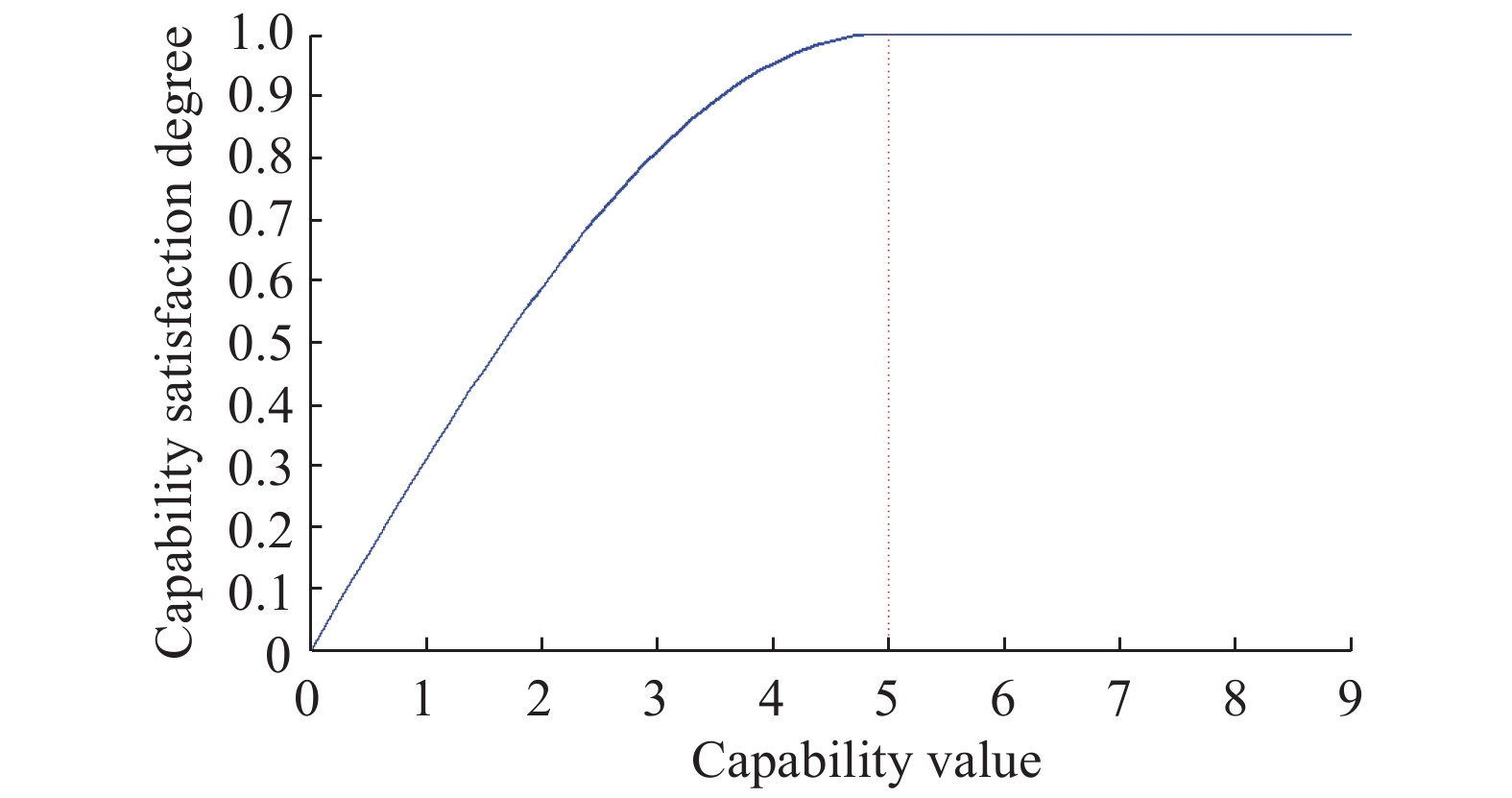
Fig 2
Graph of capability satisfaction function [31]
Visually, the capability satisfaction function shows that as the equipment capability index value increases, the combat capability of the equipment for a specific task is also strengthened; however, the increasing trend will slow down, which is consistent with the actual phenomenon. When the capability index of equipment reaches a relatively high level, even if a certain index is strengthened, it can no longer play a greater role in specific combat tasks.
By referring to the idea of function chains, when the reconnaissance equipment completes the reconnaissance and early warning of the enemy target, and then transmits the information to the decision-making equipment, the decision-making equipment processes the information and issues the decision-making order to the striking equipment, and the striking equipment uses its strike function to destroy the enemy target. Only when the whole process of the function chain is completed, can the equipment be considered to have exerted its combat capability. Therefore, the combat capability of the function chain is
where
All function chains in the combat network of the weapons equipment system are set to
where
4.2.2 Evaluation model of contribution rate of weapons equipment portfolio systems
The original contribution rate formula does not account for the cost of equipment. However, the budget for equipment development demonstration is limited, and the constraints of time and cost must be considered in equipment development planning. Therefore, the cost factor cannot be ignored when analyzing the contribution rate of equipment portfolios in the system. In other words, the system contribution rate is used to study the contribution effect of the to-be-developed equipment portfolio to the system with the same cost input. In Fig. 3, the new equipment portfolio (indicated in red) forms a new equipment system relationship after joining the original equipment system. According to the definition, the system contribution rate that accounts for cost is calculated by
where
Fig 3

Fig 3
Equipment system network after adding the new equipment portfolio
4.3 Model of weapons equipment portfolio selection
4.3.1 Objective function
Based on the combat network model, the contribution rate of the weapons equipment portfolio is calculated, and the portfolio selection of weapons systems is analyzed and optimized from the perspective of the system. The biggest problem in the study of weapons equipment portfolio selection is to find the equipment portfolio with the largest contribution rate to the improvement of the combat capability of the whole weapons equipment system. The objective function can be expressed as
where
4.3.2 Constraints
The viable set of portfolios
For cost budget constraints, the cost of the weapons system portfolio must not exceed the budget limit:
where
For capability requirement constraints, it is feasible when the weapons system portfolio can fully meet k capability requirements as follows:
where
5 Results and discussion
5.1 Description of data
In the development planning of weapons equipment, the main involved factors are the equipment contained in the original equipment system, the equipment capabilities, the capability requirement value for the mission, the cost budget, the candidate equipment, and the equipment capability attributes and costs. The equipment capabilities and capability levels of the original equipment systems are shown in Table 1.
Table 1 Equipment capabilities and capability levels of the original equipment system
| Equipment | Capability type | Capability level (1 to 9) |
| E1 | Reconnaissance | 2 |
| E2 | Reconnaissance | 3 |
| E3 | Decision-making | 2 |
| E4 | Decision-making | 3 |
| E5 | Strike | 2 |
| E6 | Strike | 3 |
At this point, the capability requirements of the forthcoming combat scenario for the weapons equipment system are as follows: the minimum capability for reconnaissance is 16 units; the minimum capability for decision-making is 7 units; the minimum capability for strikes is 15 units; and the budget provided cannot exceed 500 units.
To further meet the combat needs, new equipment will need to be developed. The cost budget of the 20-candidate weapons equipment systems and their main capabilities are shown in Table 2, where the capability categories include reconnaissance, decision-making and strikes.
Table 2 Cost, capability type and capability level of the to-be-developed equipment
| Equipment | Capability type | Capability level (1 to 9) | Cost |
| S1 | Reconnaissance | 3 | 30 |
| S2 | 4 | 40 | |
| S3 | 5 | 50 | |
| S4 | 6 | 60 | |
| S5 | 7 | 70 | |
| S6 | 9 | 100 | |
| S7 | Decision-making | 3 | 30 |
| S8 | 4 | 40 | |
| S9 | 5 | 50 | |
| S10 | 6 | 60 | |
| S11 | 7 | 70 | |
| S12 | 8 | 100 | |
| S13 | Strike | 3 | 28 |
| S14 | 4 | 40 | |
| S15 | 5 | 50 | |
| S16 | 6 | 60 | |
| S17 | 7 | 70 | |
| S18 | 8 | 78 | |
| S19 | 8 | 80 | |
| S20 | 9 | 88 |
5.2 Results demonstration and analysis
The calculation process is demonstrated in this section. Theoretically, 20 pieces of the candidate equipment can form
According to (4), the combat capability of each function chain is calculated respectively. Then, the comprehensive combat capability of the system is calculated according to (5). Finally, according to the contribution rate calculation formula in (7), we obtain the impact of each equipment portfolio on the combat capability of the system when facing a mission, that is, the degree of change in the system’s combat capability with and without this equipment portfolio. The top 30 equipment portfolios are selected according to the contribution rate
Fig 4

Fig 4
Top 30 equipment portfolios considering cost-effectiveness
In Fig. 4, the horizontal axis represents the 20 equipment candidates, the yellow grid indicates that the equipment is selected in the portfolio, and the blue grid indicates that the equipment is not selected in the portfolio. The vertical axis represents the 30 best portfolios ranked by the contribution rate. More specifically, the bottom row represents the portfolio with the highest contribution rate. Table 3 lists the top 10 equipment portfolios ranked by the system contribution rate
Table 3 Combat capability values and contribution rates of the equipment portfolios considering cost-effectiveness
| Number | Equipment portfolio | System contribution rate | Normalized system contribution rate | System capability value | Cost |
| 1 | S2, S5, S9, S13, S17 | 0.462 4 | 1.000 0 | 0.987 2 | 258 |
| 2 | S3, S4, S9, S13, S17 | 0.462 1 | 0.999 4 | 0.987 1 | 258 |
| 3 | S2, S5, S9, S14, S16 | 0.458 9 | 0.992 4 | 0.987 2 | 260 |
| 4 | S2, S4, S9, S14, S16 | 0.458 5 | 0.991 6 | 0.987 1 | 260 |
| 5 | S3, S4, S9, S13, S17 | 0.452 7 | 0.979 0 | 0.988 7 | 268 |
| 6 | S1, S2, S3, S9, S13, S17 | 0.451 9 | 0.977 3 | 0.988 5 | 268 |
| 7 | S2, S5, S10, S13, S17 | 0.450 2 | 0.973 6 | 0.988 2 | 268 |
| 8 | S3, S4, S10, S13, S17 | 0.449 4 | 0.971 9 | 0.988 7 | 270 |
| 9 | S1, S2, S3, S9, S14, S16 | 0.448 5 | 0.969 9 | 0.988 5 | 270 |
| 10 | S2, S5, S10, S14, S16 | 0.448 5 | 0.969 9 | 0.987 2 | 266 |
In the same way, without considering cost-effectiveness, the top 30 equipment portfolios are selected according to the contribution rate
Fig 5

Fig 5
Equipment portfolios without considering cost-efficiency
Table 4 Combat capability values and contribution rates of the equipment portfolios without considering cost-effectiveness
| Number | Equipment portfolio | System contribution rate | Normalized system contribution rate | System capability value | Cost |
| 1 | S5, S6, S12, S13, S14, S16 | 0.112 | 1 | 0.998 | 398 |
| 2 | S5, S6, S12, S13, S14, S15 | 0.112 | 1 | 0.998 | 388 |
| 3 | S1, S6, S9, S12, S13, S14, S15 | 0.112 | 1 | 0.998 | 398 |
| 4 | S3, S6, S12, S13, S14, S15 | 0.112 | 1 | 0.998 | 398 |
| 5 | S2, S6, S8, S12, S13, S14, S15 | 0.112 | 1 | 0.998 | 398 |
| 6 | S1, S3, S6, S12, S13, S14, S15 | 0.112 | 1 | 0.998 | 398 |
| 7 | S1, S6, S8, S12, S13, S14, S16 | 0.112 | 1 | 0.998 | 398 |
| 8 | S1, S6, S8, S12, S13, S14, S15 | 0.112 | 1 | 0.998 | 388 |
| 9 | S2, S6, S7, S12, S13, S14, S16 | 0.112 | 1 | 0.998 | 398 |
| 10 | S2, S6, S7, S12, S13, S14, S15 | 0.112 | 1 | 0.998 | 388 |
Comparing the results in Table 3 and Table 4, it is obvious that the system capability value of the equipment portfolio is a little higher when maximizing the system contribution rate
To further analyze the relationship between the development cost of equipment portfolios and the portfolio contribution rates, in this paper, the relationships between the contribution rates and cost of 15 494 feasible portfolios that meet cost constraints are shown in Fig. 6, with and without cost-effectiveness ratios.
Fig 6
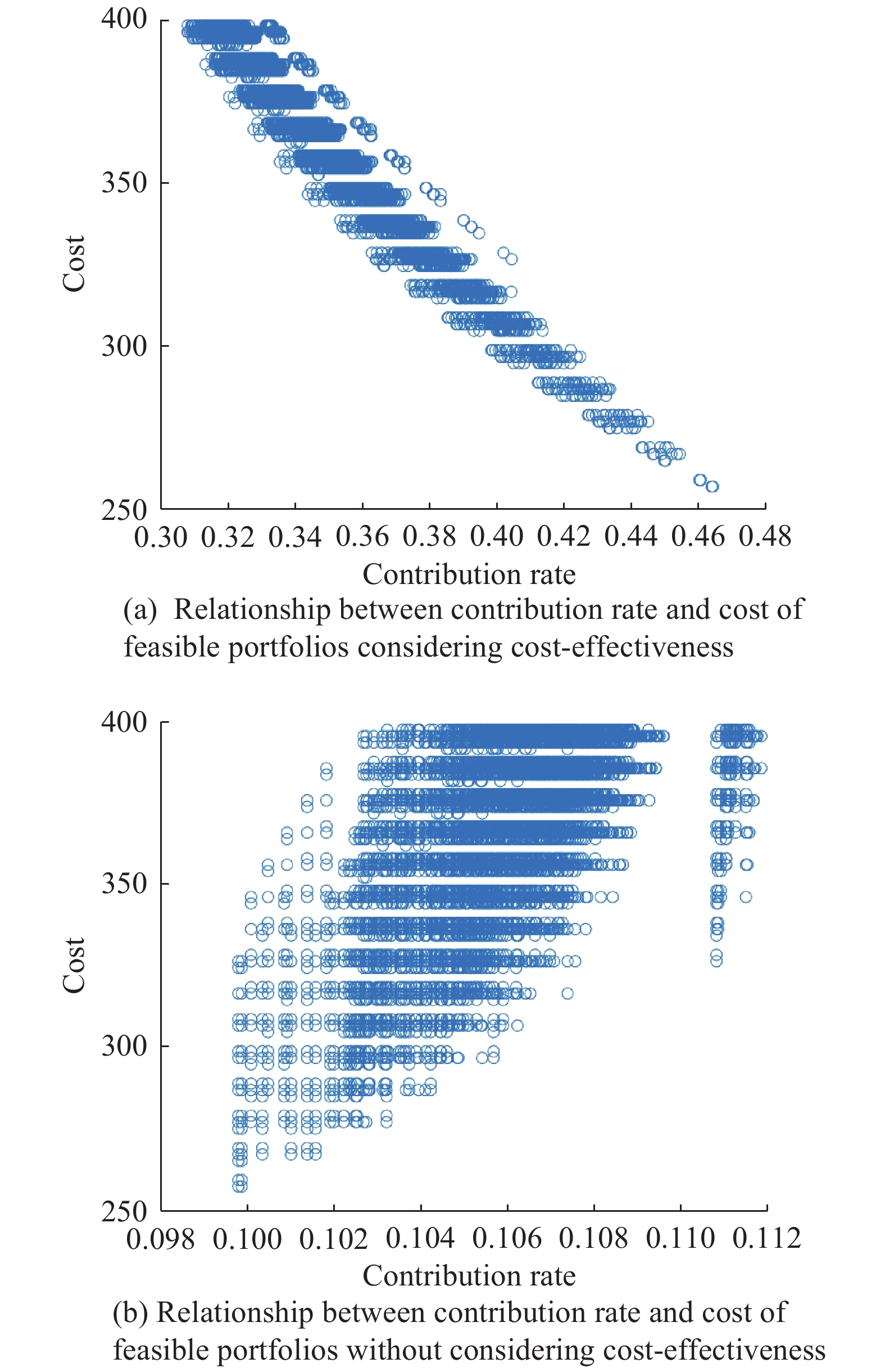
Fig 6
Diagram of the relationship between the contribution rate and cost of all feasible portfolios satisfying cost constraints
Comparing Fig. 6(a) and Fig. 6(b), and considering the cost factor or cost-effectiveness ratio, most of the selected equipment portfolios meet the basic capacity requirements, and the lower the cost, the better the portfolio. Without considering the cost-effectiveness ratio, the combined cost of the top 9 is 398, which is basically equal to the budget value. Most of the selected equipment are equipment with strong capabilities. Thus, decision-makers can choose their preferred equipment portfolio selection method to develop weapons and equipment.
6 Conclusions
This paper studies the selection of weapons equipment portfolios from a system perspective and puts forward a selection method based on the system contribution rate. The combat capability of the weapons system portfolio is a comprehensive embodiment of intelligence reconnaissance, information processing, decision-making, and strike capabilities. The proposed method fully considers the interrelation between the to-be-developed equipment portfolio and the old equipment system, and can be used to identify the equipment portfolio to maximize the combat capability of the whole weapons equipment system under the constraints of capability requirements and cost budget resources.
The work of this paper has limitations, and research has to be conducted further. This paper only analyzes the contribution rate from the perspective of capability, while the research on the contribution rate of the equipment system should be multi-level, multi-dimensional, and multi-angle. In this study, the amount of to-be-developed equipment is relatively low, but the number of equipment portfolios would increase exponentially with the amount of to-be-developed equipment; thus, more efficient intelligent optimization algorithms need to be used for calculations.
Reference
Armament system of systems contribution evaluation based on operation loop
The research framework, progress, and key directions of system-of-systems contribution ratio evaluation
Project portfolio management strategies in housing estate development organizations in Nigeria’s built environment
DOI:10.2991/jrarc.2018.8.2.2 [Cited within: 1]
Environmental management practices, environmental technology portfolio, and environmental commitment: a content analytic approach for UK manufacturing firms
DOI:10.1016/j.ijpe.2015.09.040 [Cited within: 1]
Applications of decision analysis to the military systems acquisition process
DOI:10.1287/inte.22.6.110 [Cited within: 1]
Weapon selection using the AHP and TOPSIS methods under fuzzy environment
DOI:10.1016/j.eswa.2008.10.016
An integrated portfolio management approach to weapon system investments could improve DoD’s acquisition outcomes
Multiple perspective R&D portfolio analysis for the National Reconnaissance Office’s technology enterprise
Improving resource allocation within the National Reconnaissance Office
DOI:10.1287/inte.32.3.77.40 [Cited within: 1]
Scenario and multiple criteria decision analysis for energy and environmental security of military and industrial installations
DOI:10.1002/ieam.137 [Cited within: 1]
Air Force Research Laboratory space technology value model: creating capabilities for future customers
DOI:10.5711/morj.9.1.5 [Cited within: 1]
Cost-efficiency analysis of weapon system portfolios
DOI:10.1016/j.ejor.2012.05.042 [Cited within: 2]
Mission oriented risk and design analysis of critical information systems
DOI:10.5711/morj.10.2.19 [Cited within: 2]
Multiple perspective R & D portfolio analysis for the national reconnaissance office’s technology enterprise
DOI:10.5711/morj.6.3.19 [Cited within: 1]
High-end weapon equipment portfolio selection based on a heterogeneous network model
DOI:10.1007/s10898-018-0687-1 [Cited within: 1]
A multi-objective approach for weapon selection and planning problems in dynamic environments
Scenario-based modeling and solving research on robust weapon project planning problems
DOI:10.21629/JSEE.2019.01.09 [Cited within: 1]
A mathematical modeling approach for high and new technology-project portfolio selection under uncertain environments
Equipment contribution degree evaluation method based on combat network of weapon system-of-systems
DOI:10.13306/j.1672-3813.2016.03.001 [Cited within: 1]
Review of assessment methods for contribution rate of weaponry system
Evaluation method of equipment’s contribution rate to system-of-systems based on operation loop and self-information quantity
Mission evaluation: expert evaluation system for large-scale combat tasks of the weapon system of systems
DOI:10.1007/s11432-016-9071-5 [Cited within: 1]
Grey relation evaluation model of weapon system based on rough set
Modeling of capability relations oriented to the evolution of operational system-of-systems
Task-oriented requirement satisfactory degree analysis method for combat capability of equipment system of systems
Multi-task oriented contribution evaluation of weapon equipment system of systems


