
Journal of Systems Engineering and Electronics ›› 2026, Vol. 37 ›› Issue (1): 127-136.doi: 10.23919/JSEE.2025.000046
• DEFENCE ELECTRONICS TECHNOLOGY • Previous Articles Next Articles
Tao HAN1,2( ), Gongjian ZHOU1,*()
Received:2024-08-02
Accepted:2025-03-13
Online:2026-02-18
Published:2026-03-09
Contact:
Gongjian ZHOU
E-mail:hantao@hit.edu.cn;zhougj@hit.edu.cn
About author:Supported by:Tao HAN, Gongjian ZHOU. Pseudo-spectrum based track-before-detect for bistatic radar network[J]. Journal of Systems Engineering and Electronics, 2026, 37(1): 127-136.
Add to citation manager EndNote|Reference Manager|ProCite|BibTeX|RefWorks
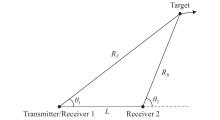
Fig 1
Geometry of bistatic radar"
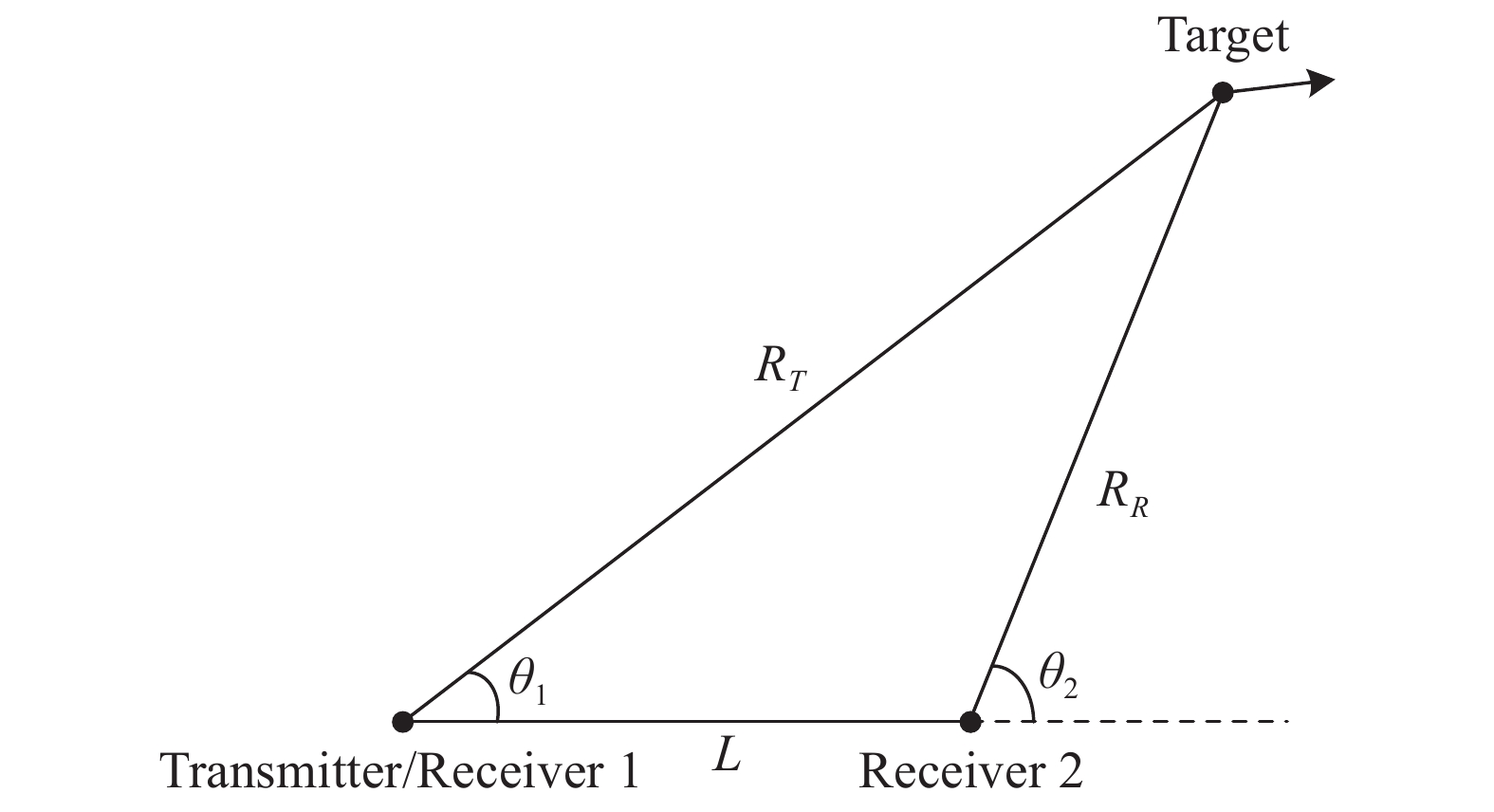
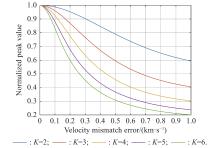
Fig 2
Normalized output peak value"
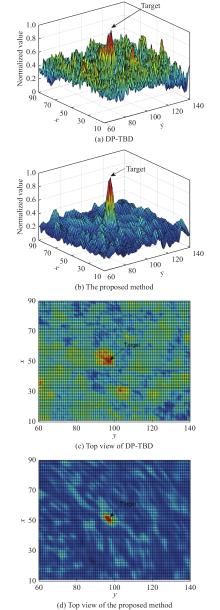
Fig 3
Integration results"

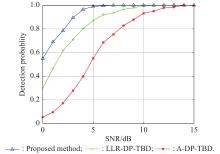
Fig 4
${{\boldsymbol{P}}_{\boldsymbol{d}}}$ vs. input SNRs in Scenario 1"
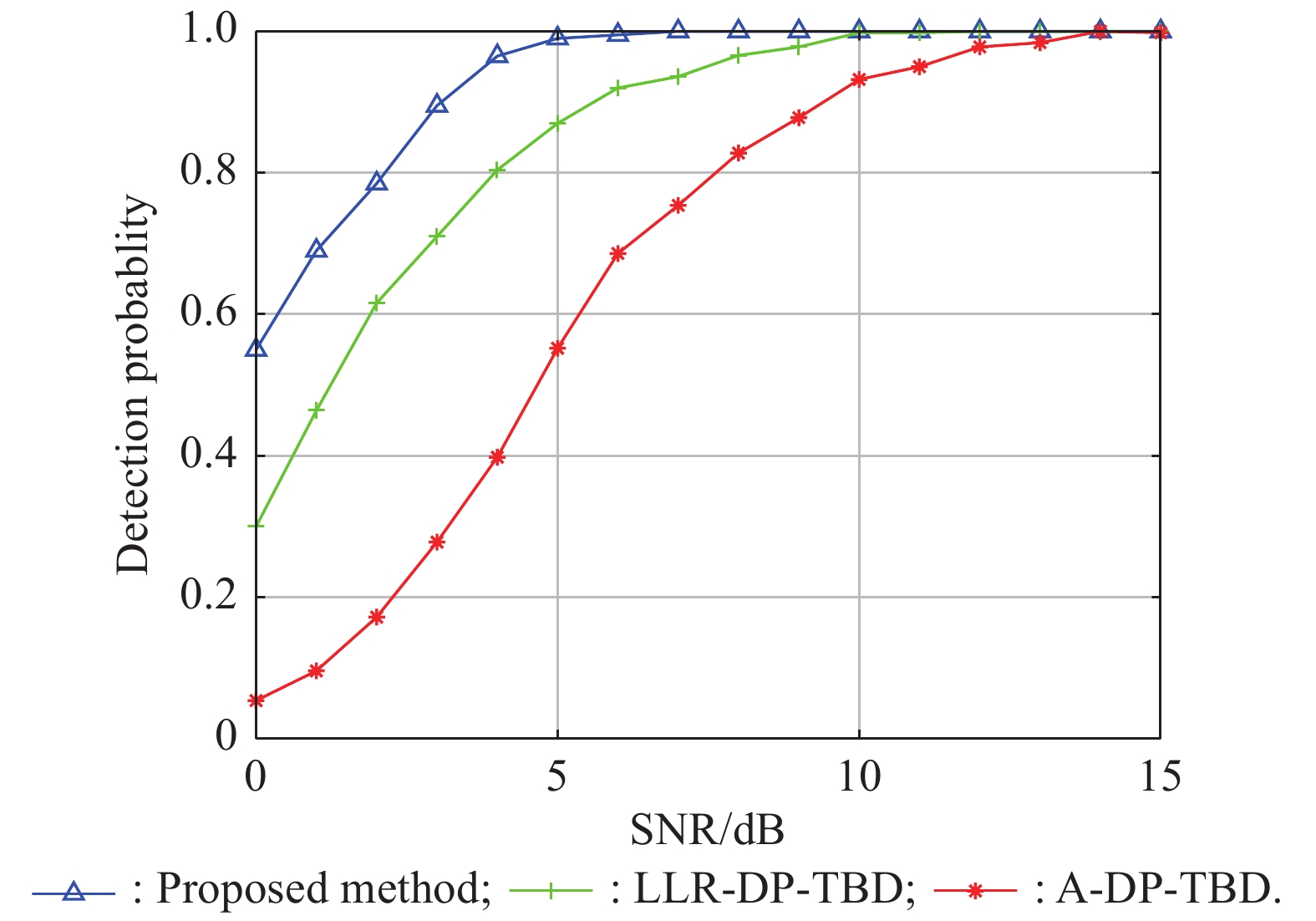
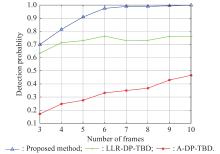
Fig 5
${{\boldsymbol{P}}_{\boldsymbol{d}}}$ vs. number of frames in Scenario 2"
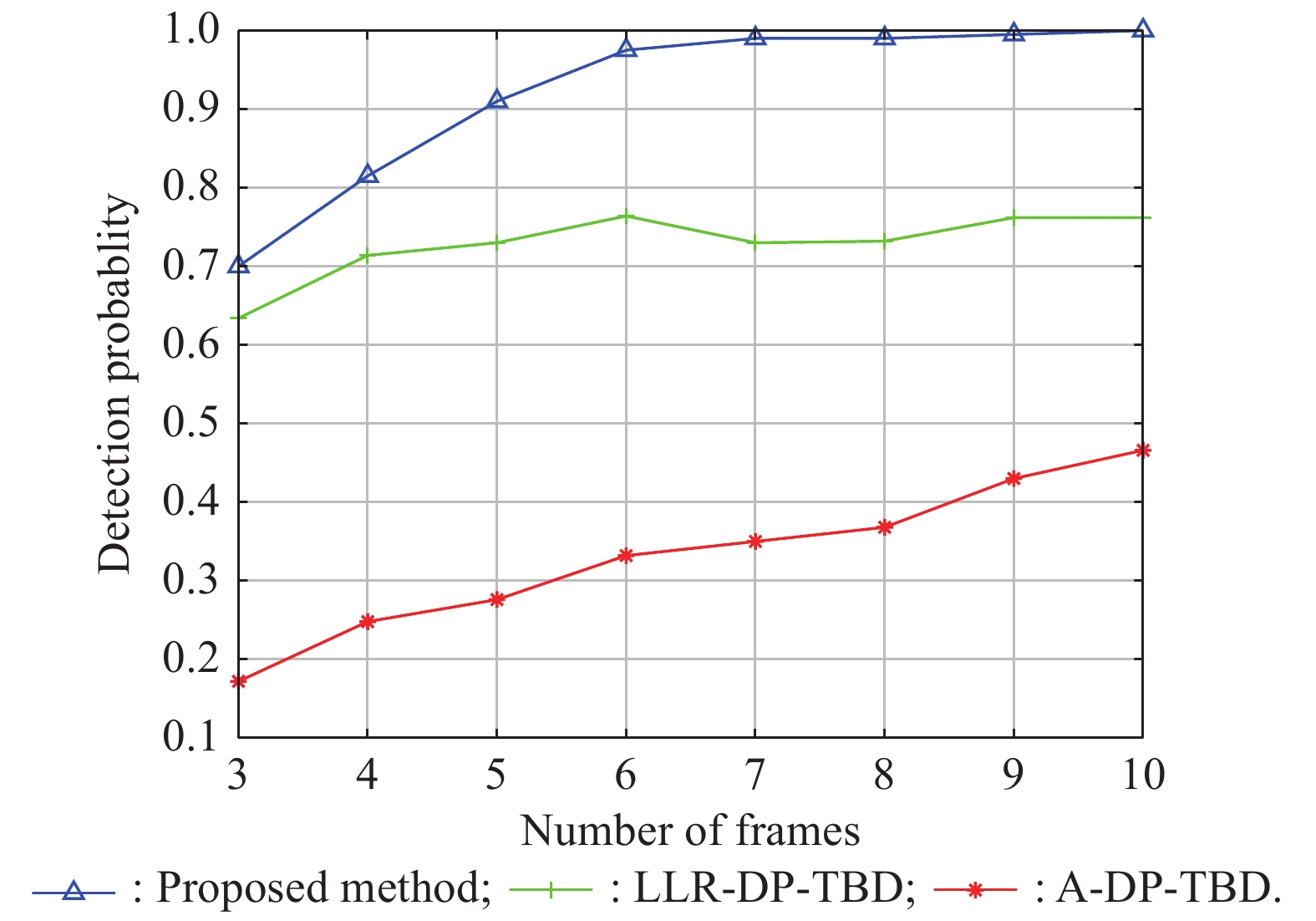
Fig 6
RMSE of position vs. input SNRs in Scenario 1"
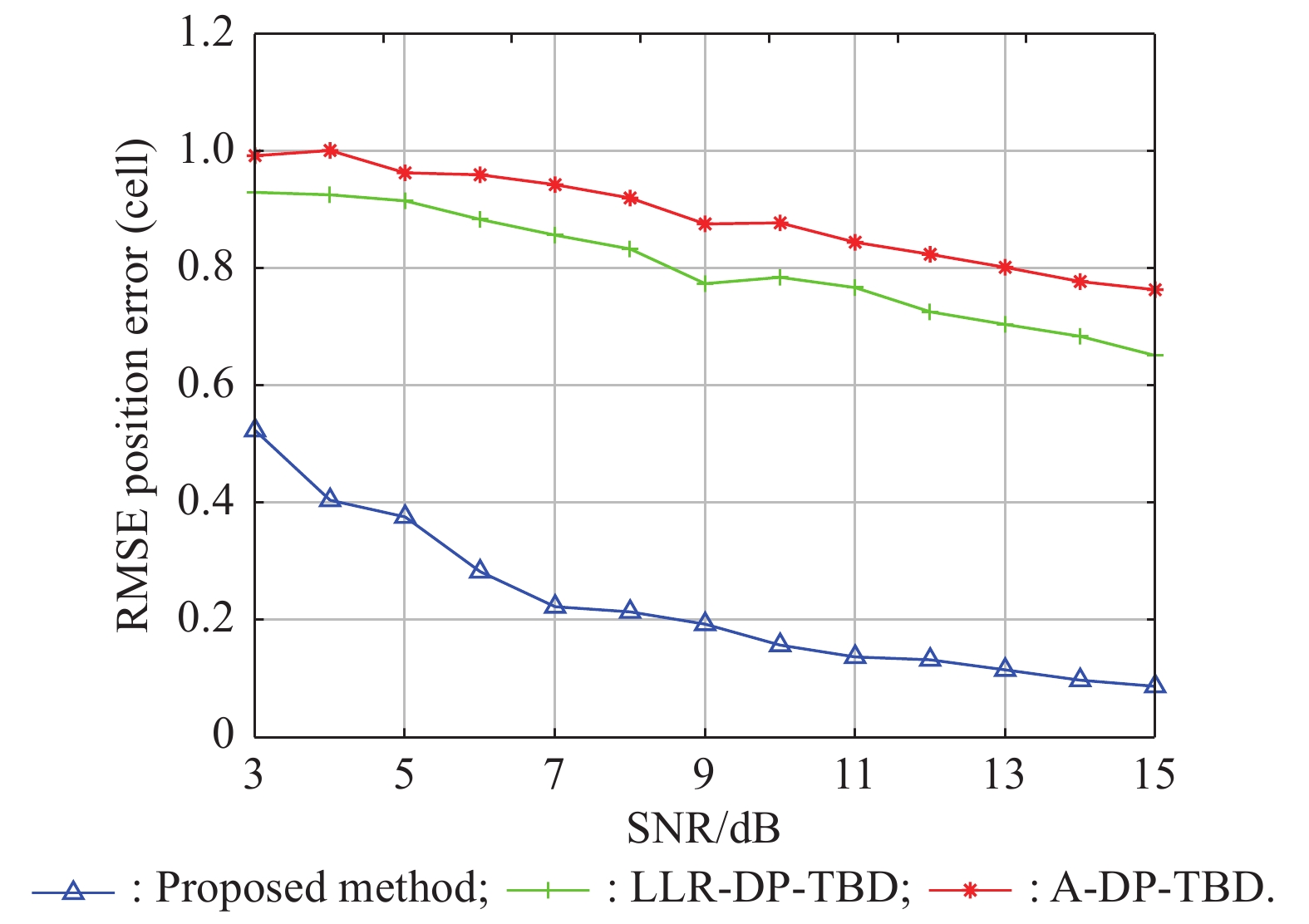
Fig 7
RMSE of position vs. number of frames in Scenario 1"
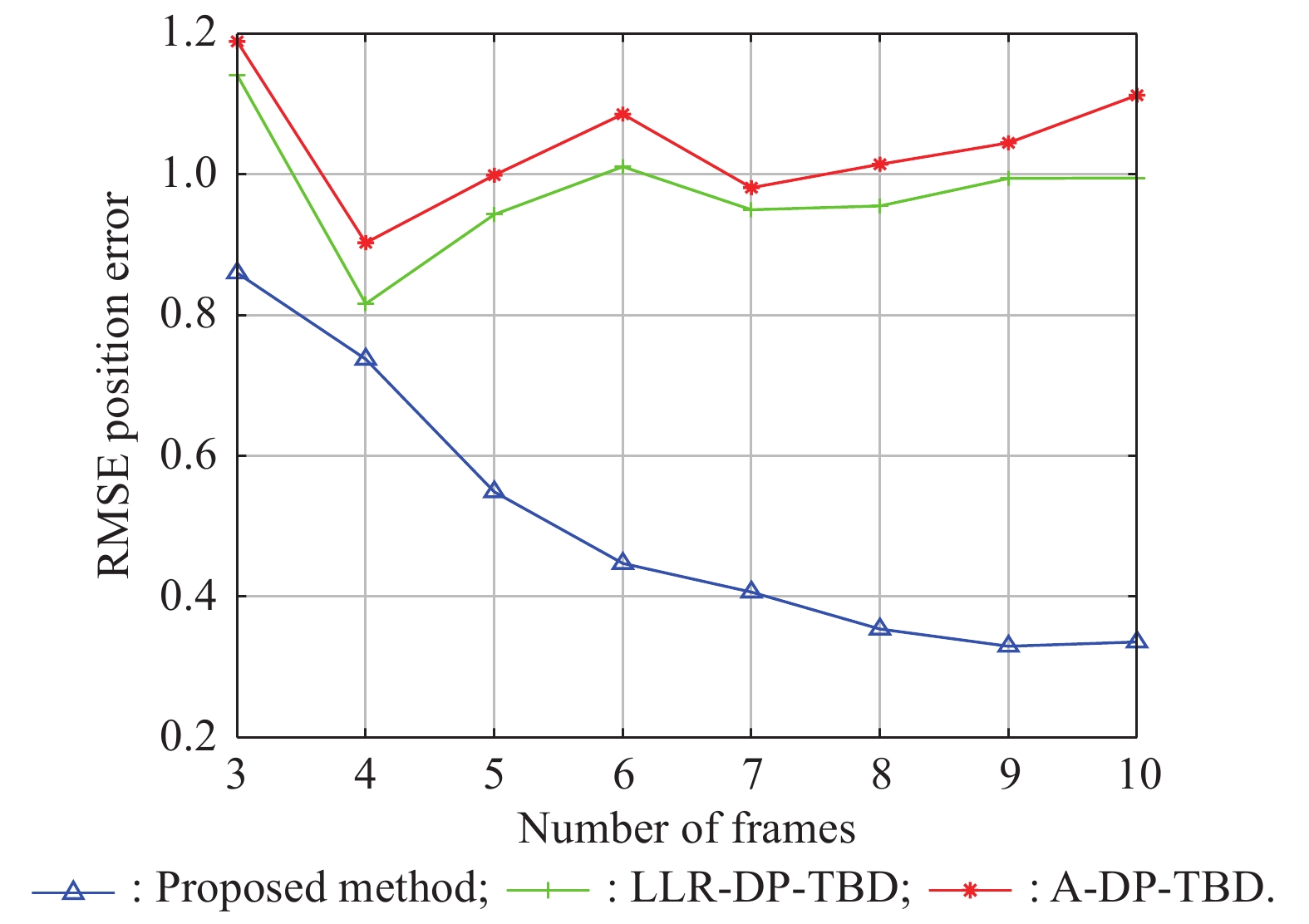
Fig 8
RMSE of velocity vs. input SNRs in Scenario 1"
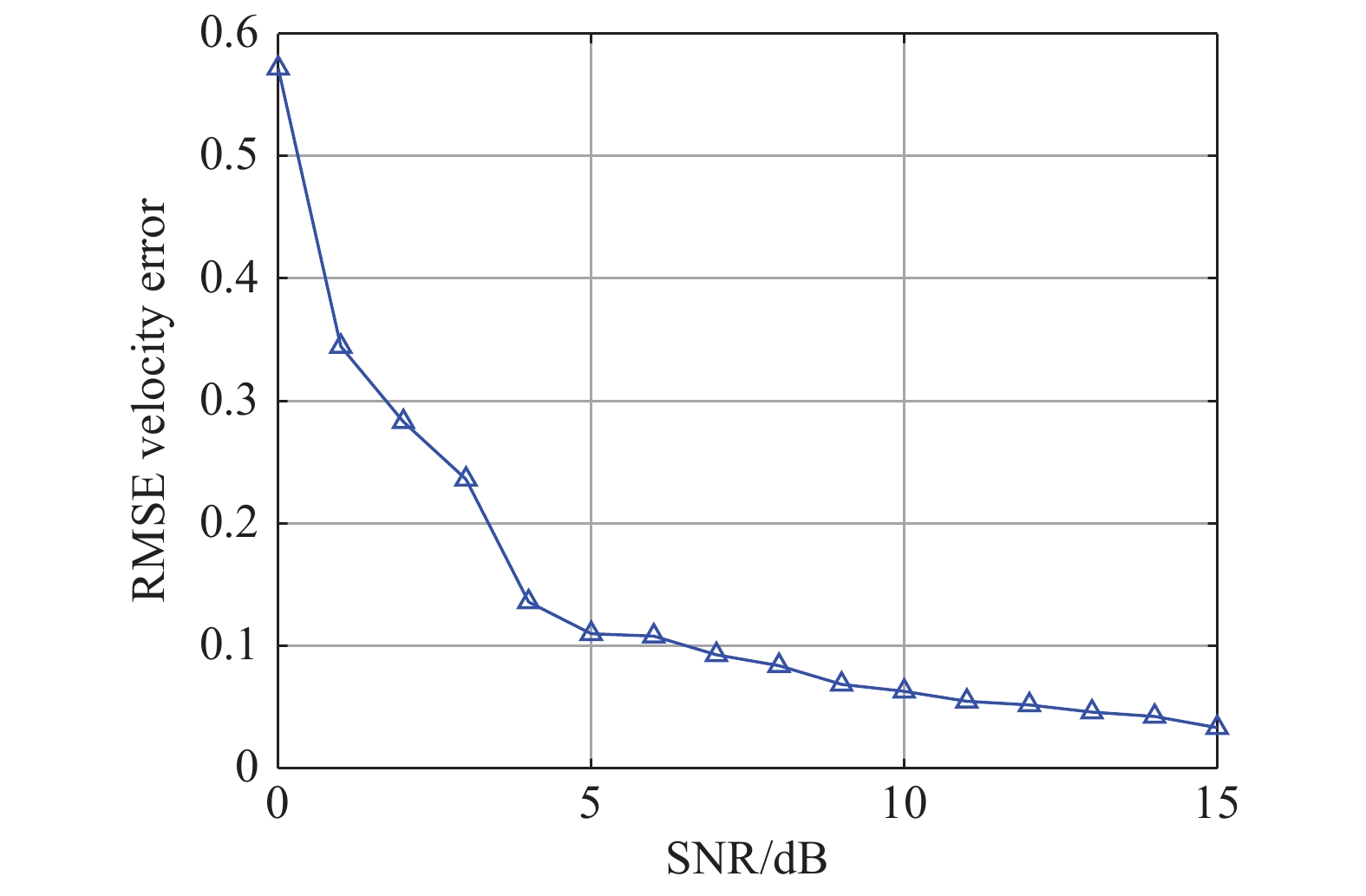
Fig 9
RMSE of velocity vs. number of frames in Scenario 1"
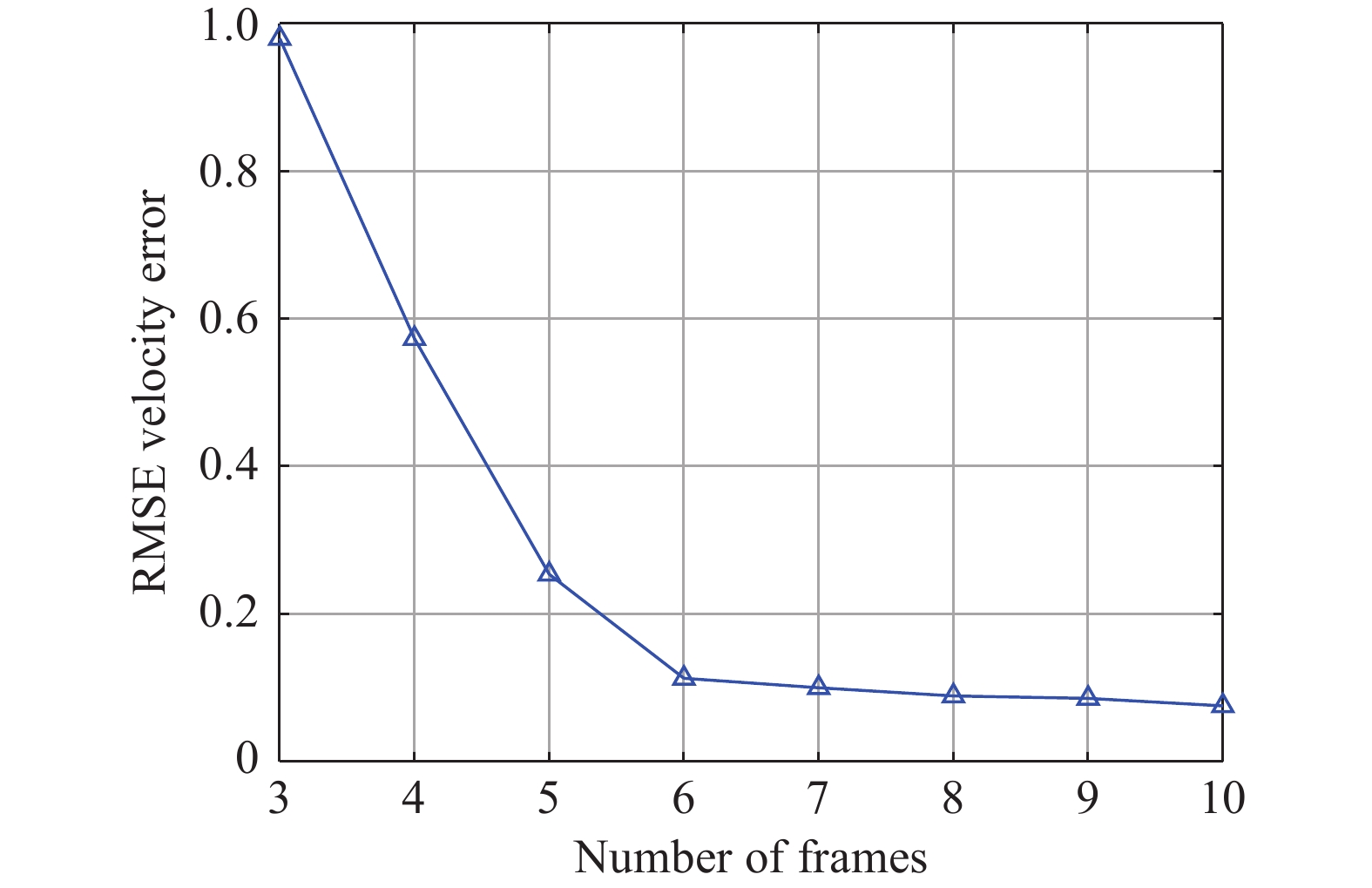
Fig 10
${{\boldsymbol{P}}_{\boldsymbol{d}}}$ vs. input SNRs in Scenario 2"
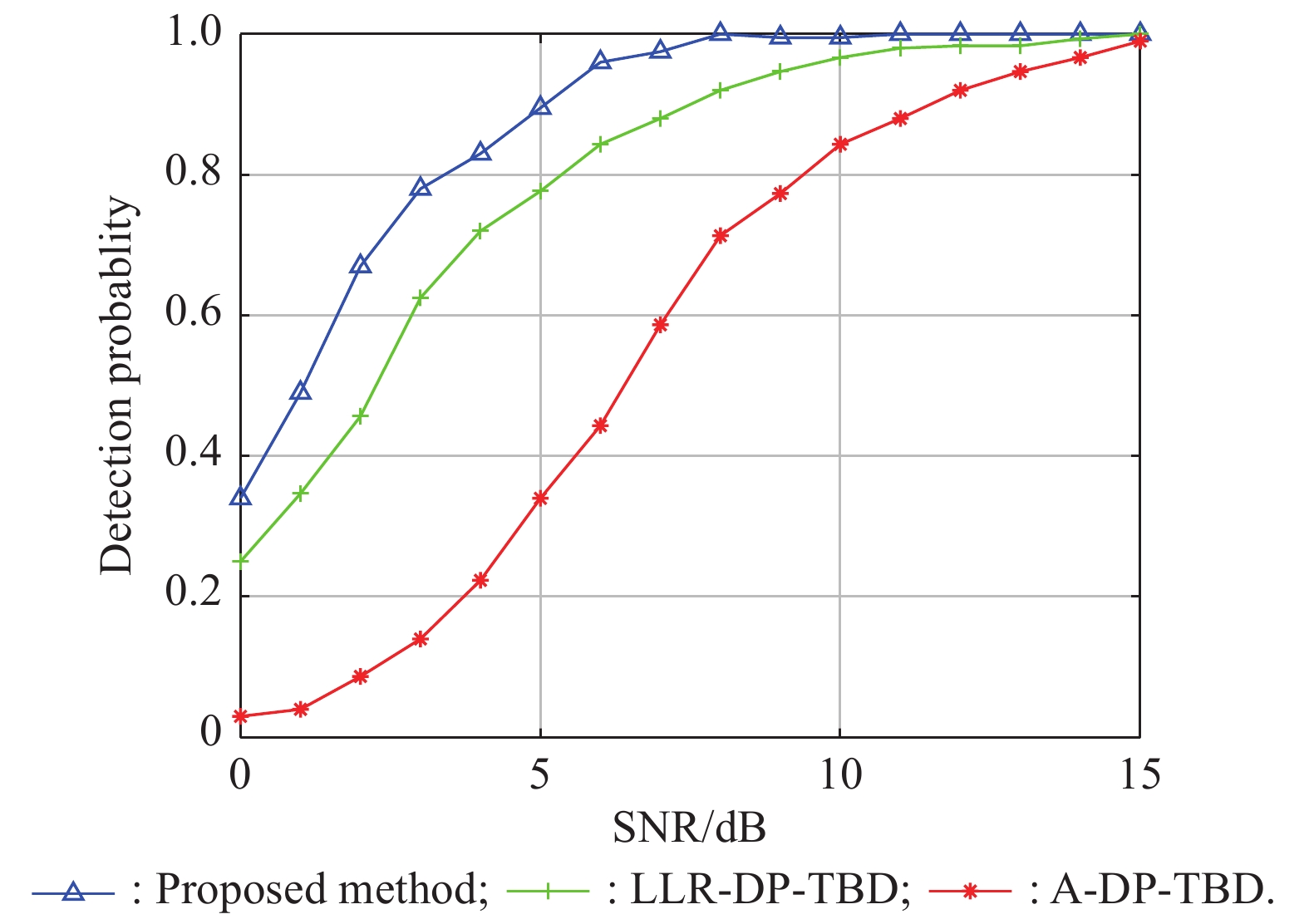
Fig 11
RMSE of position vs. input SNRs in Scenario 2"
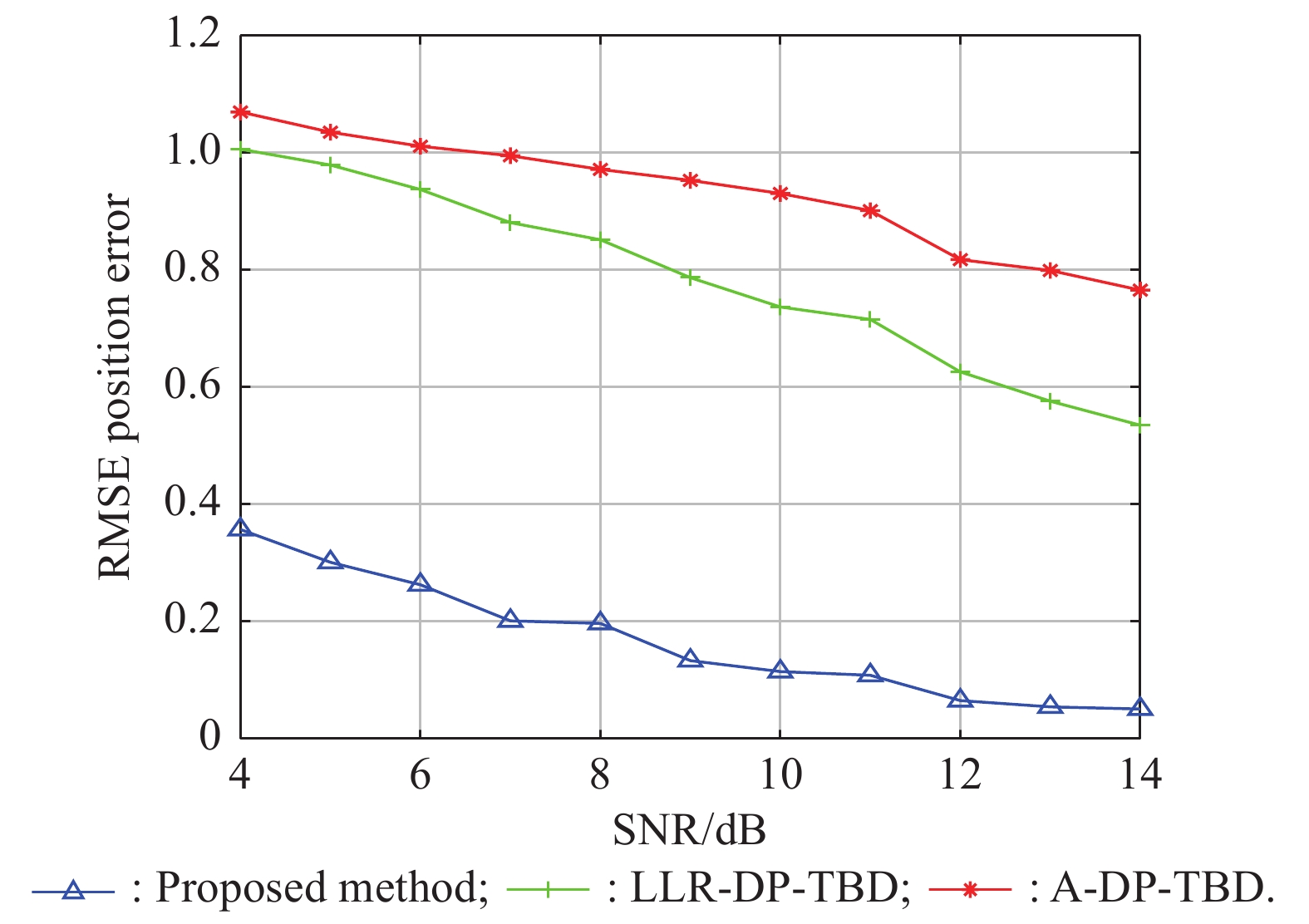
Fig 12
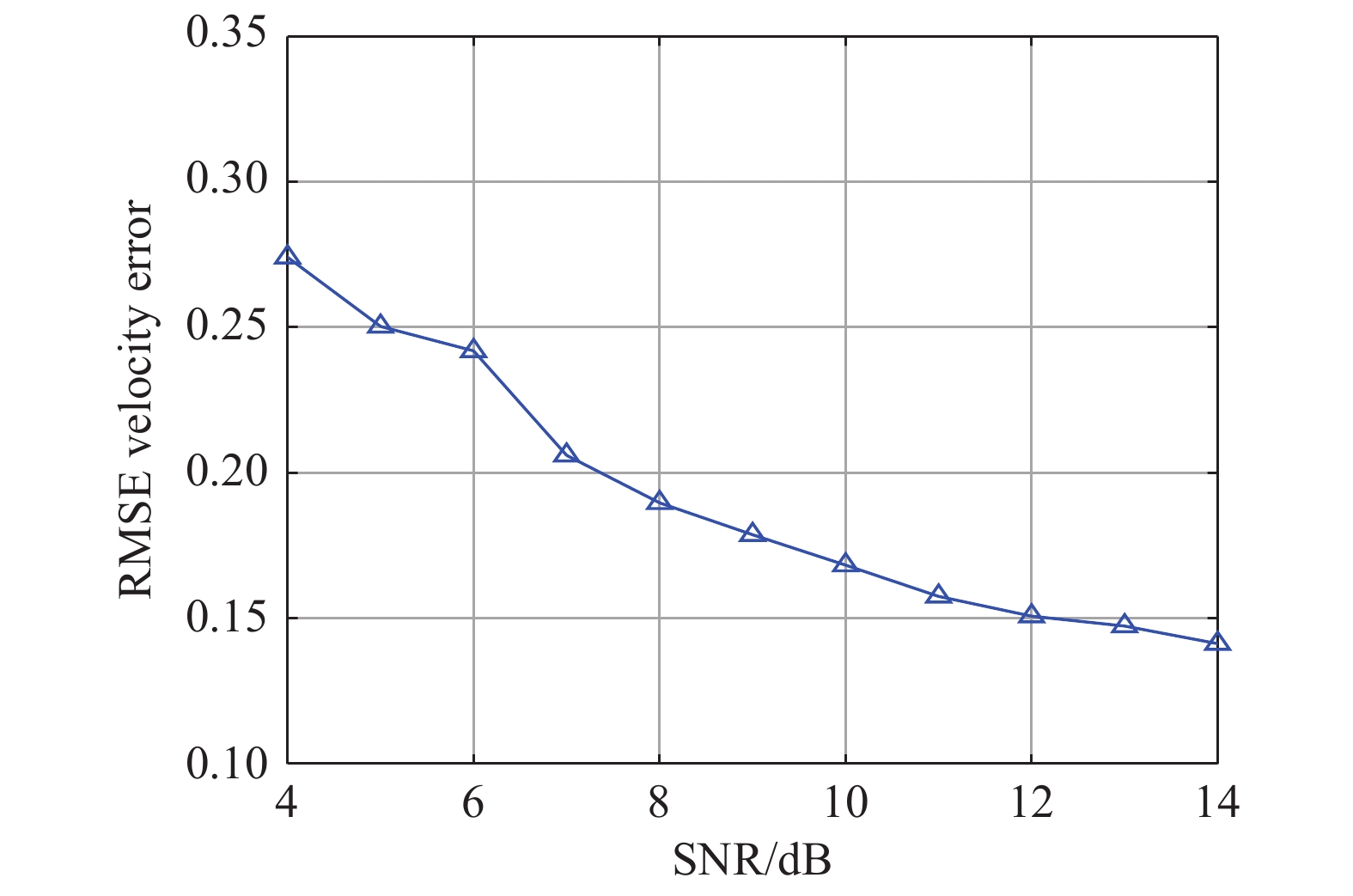
RMSE of velocity vs. input SNRs in Scenario 2"
| 1 |
MAHLER R P S Multitarget Bayes filtering via first-order multitarget moments. IEEE Trans. on Aerospace and Electronic Systems, 2003, 39 (4): 1152- 1178.
doi: 10.1109/TAES.2003.1261119 |
| 2 | HU Z, TIAN L, HOU W, et al. New joint probabilistic data association algorithm based on variational Bayesian adaptive moment estimation. Transactions of the Institute of Measurement and Control, 2024, 46(7): 1235−1248. |
| 3 | TAPLIN T, LYALL A E, DANI A P Multiple user intent prediction using interacting multiple model joint probabilistic data association filter. International Federation of Automatic Control, 2023, 56 (2): 6946- 6951. |
| 4 | MORELANDE M R, KREUCHER C M, KASTELLA K A Bayesian approach to multiple target detection and tracking. IEEE Trans. on Signal Processing, 2007, 55 (5): 1589- 1604. |
| 5 | WSETERKAM A M, MANCHON C N, MOGENSEN P, et al. Bayesian joint localization and tracking algorithm using multiple-input multiple-output radar. Proc. of the IEEE International Workshop on Computational Advances in Multi-Sensor Adaptive Processing, 2023: 316−320. |
| 6 | LI C, ZHANG K N, ZHANG J Z, et al. An improved particle filter based track-before-detect method. Proc. of the IEEE Advanced Information Management, Communicates, Electronic and Automation Control Conference, 2024: 802−806. |
| 7 | DAVIES E S, GARCIA-FERNANDEZ Á F Information exchange track-before-detect multi-Bernoulli filter for super positional sensors. IEEE Trans. on Signal Processing, 2024, 72, 607- 621. |
| 8 |
PENG X Y, SONG Q, ZHANG Y, et al A hybrid integration method-based track-before-detect for high-speed and high-maneuvering targets in ubiquitous radar. Remote Sensing, 2023, 15 (14): 3507.
doi: 10.3390/rs15143507 |
| 9 |
JIANG H C, YI W, KIRUBARAJAN T, et al Multiframe radar detection of fluctuating targets using phase information. IEEE Trans. on Aerospace and Electronic Systems, 2017, 53 (2): 736- 749.
doi: 10.1109/TAES.2017.2664639 |
| 10 | LI M, CHANG Q Y, CUI Z, et al. Multi-frame detection and angle estimation algorithm in 4D millimeter wave radar. Proc. of the IEEE International Conference on Control, Automation and Information Sciences, 2024. DOI: 10.1109/ICCAIS63750.2024.10814603. |
| 11 | MOU P, MIAO Q Y, ZHU C, et al. Transformer architecture based multi-frame TBD algorithms for maneuvering targets. Proc. of the IEEE International Conference on Control, Automation and Information Sciences, 2023: 224−229. |
| 12 | REED I S, GAGLIARDI R M, SHAO H M Application of three-dimensional filtering to moving target detection. IEEE Trans. on Aerospace and Electronic Systems, 1983, AES-19 (6): 898- 905. |
| 13 | AMBELLOUIS S, CABESTAING F, POSTAIRE J G Velocity selective filters recursively implemented in the spatiotemporal domain. IEEE Trans. on Image Processing, 2006, 15 (6): 1601- 1609. |
| 14 | KENNEDY H L Efficient velocity filter implementations for dim target detection. IEEE Trans. on Aerospace and Electronic Systems, 2011, 47 (4): 2991- 2999. |
| 15 | ZHOU G J, WANG L L, KIRUBARAJN T A pseudo-spectrum approach for weak target detection and tracking. IEEE Trans. on Aerospace and Electronic Systems, 2019, 55 (6): 3394- 3412. |
| 16 | DRAGOVIC M. Velocity filtering for target detection and track initiation. Edinburgh South Australia: DSTO Systems Sciences Laboratory, 2003. |
| 17 | GROSSI E, LOPS M, VENTURINO L. A novel dynamic programming algorithm for track-before-detect in radar systems. IEEE Trans. on Signal Processing, 2013, 61(10): 2608–2619. |
| 18 | JIANG H C, YI W, CUI G L, et al. Track-before-detect strategy for HRR radars. Proc. of the IEEE Radar Conference, 2015: 0362–0367. |
| 19 | WANG L L, ZHOU G J, KIRUBARAJAN T. Track-before-detect technique in mixed coordinates. Proc. of the IEEE International Conference on Information Fusion, 2018. DOI: 10.23919/ICIF.2018.8455652. |
| 20 | BROWN J, WOODBRIDGE K, GRIFFITHS H, et al Passive bistatic radar experiments from an airborne platform. IEEE Trans. on Aerospace and Electronic Systems, 2012, 27 (11): 50- 55. |
| 21 |
OLSEN K E, ASEN W Bridging the gap between civilian and military passive radar. IEEE Trans. on Aerospace and Electronic Systems, 2017, 32 (2): 4- 12.
doi: 10.1109/MAES.2017.160030 |
| 22 | WANG D H, BAO Q L, NIU Z D, et al. Weak target detection algorithm for non-cooperative bistatic radar. Proc. of the IET International Radar Conference, 2015. DOI: 10.1049/cp.2015.1124. |
| 23 | LEHMANN F Recursive Bayesian filtering for multitarget track-before-detect in passive radars. IEEE Trans. on Aerospace and Electronic Systems, 2012, 48 (3): 2458- 2480. |
| 24 | GUAN X, ZHONG L, HU D H, et al. Threshold determination for dynamic programming based track-before-detect in passive bistatic radar. Proc. of the IEEE International Conference on Signal Processing, 2014: 1938–1943. |
| 25 | ZHANG P N, ZHENG J, PAN J X, et al. ANNDP-TBD algorithm for passive coherent location. Proc. of the Chinese Control Conference, 2017: 49–53. |
| 26 | HAN T, WANG L L, ZHOU G J. Track-before-detect for bistatic radar based on velocity filtering. Proc. of the IEEE International Conference on Information Fusion, 2020. DOI: 10.23919/Chicc.2017/8027319. |
| 27 |
HAN T, ZHOU G J Track-before-detect for bistatic radar based on pseudo-spectrum. Chinese Journal of Aeronautics, 2024, 37 (1): 236- 246.
doi: 10.1016/j.cja.2023.08.021 |
| 28 | WANG J H, YI W, KIRUBARAJAN T, et al An efficient recursive multiframe track-before-detect algorithm. IEEE Trans. on Aerospace and Electronic Systems, 2018, 54 (1): 190- 204. |
| 29 | JOHNSTON L A, KRISHNAMURTHY V Performance analysis of a dynamic programming track before detect algorithm. IEEE Trans. on Aerospace and Electronic Systems, 2002, 38 (1): 228- 242. |
| 30 | DENG X, PI Y, MORELANDE M, et al Track-before-detect procedures for low pulse repetition frequency surveillance radars. IET Radar, Sonar & Navigation, 2011, 5 (1): 65- 73. |
| [1] | Chenghu CAO, Yongbo ZHAO. Multiple-model GLMB filter based on track-before-detect for tracking multiple maneuvering targets [J]. Journal of Systems Engineering and Electronics, 2024, 35(5): 1109-1121. |
| [2] | Liangliang WANG, Gongjian ZHOU. Multiframe track-before-detect method based on velocity filtering in mixed coordinates [J]. Journal of Systems Engineering and Electronics, 2022, 33(2): 247-258. |
| [3] | Cong XU, Zishu HE, Haicheng LIU, Yadan LI. Bayesian track-before-detect algorithm for nonstationary sea clutter [J]. Journal of Systems Engineering and Electronics, 2021, 32(6): 1338-1344. |
| [4] | Meiyan PAN, Jun SUN, Yuhao YANG, Dasheng LI, Junpeng YU. M-FCN based sea-surface weak target detection [J]. Journal of Systems Engineering and Electronics, 2021, 32(5): 1111-1118. |
| [5] | Zhichao BAO, Qiuxi JIANG, Fangzheng LIU. Multiple model efficient particle filter based track-before-detect for maneuvering weak targets [J]. Journal of Systems Engineering and Electronics, 2020, 31(4): 647-656. |
| [6] | Gang CHEN, Jun WANG. Target detection method in passive bistatic radar [J]. Journal of Systems Engineering and Electronics, 2020, 31(3): 510-519. |
| [7] | Haitao Wang, Jun Wang, and Hongwei Li. Target detection using CDMA based passive bistatic radar [J]. Journal of Systems Engineering and Electronics, 2012, 23(6): 858-865. |
| [8] | Duan Rui, Wang Xuegang, Jiang Chaoshu & Chen Zhuming. Space-time clutter model for airborne bistatic radar with non-Gaussian statistics [J]. Journal of Systems Engineering and Electronics, 2009, 20(2): 283-290. |
| [9] | Zeng Jiankui & He Zishu. Detection of weak target for MIMO radar based on Hough transform [J]. Journal of Systems Engineering and Electronics, 2009, 20(1): 76-80. |
| [10] | Huang Yulin, Yang Jianyu, Wu Junjie & Xiong Jintao. Precise time frequency synchronization technology for bistatic radar [J]. Journal of Systems Engineering and Electronics, 2008, 19(5): 929-933. |
| [11] | Shan Tao, Tao Ran, Wang Yue & Zhou Siyong. Study of detection performance of passive bistatic radars based on FM broadcast [J]. Journal of Systems Engineering and Electronics, 2007, 18(1): 22-26. |
| Viewed | ||||||
|
Full text |
|
|||||
|
Abstract |
|
|||||
