
Journal of Systems Engineering and Electronics ›› 2025, Vol. 36 ›› Issue (6): 1562-1578.doi: 10.23919/JSEE.2025.000124
• SYSTEMS ENGINEERING • Previous Articles
Yue WANG1( ), Yajie MA2(), Jiangnan ZHOU2(), Yanxia WU1,*()
Received:2024-09-19
Online:2025-12-18
Published:2026-01-07
Contact:
Yanxia WU
E-mail:563669810@qq.com;yajiema@nuaa.edu.cn;zhoujiangnan0899@163.com;wuyanxia@hrbeu.edu.cn
About author:Supported by:Yue WANG, Yajie MA, Jiangnan ZHOU, Yanxia WU. A tool wear monitoring method based on improved DenseNet and GRU[J]. Journal of Systems Engineering and Electronics, 2025, 36(6): 1562-1578.
Fig 1
Basic structure of DenseNet"
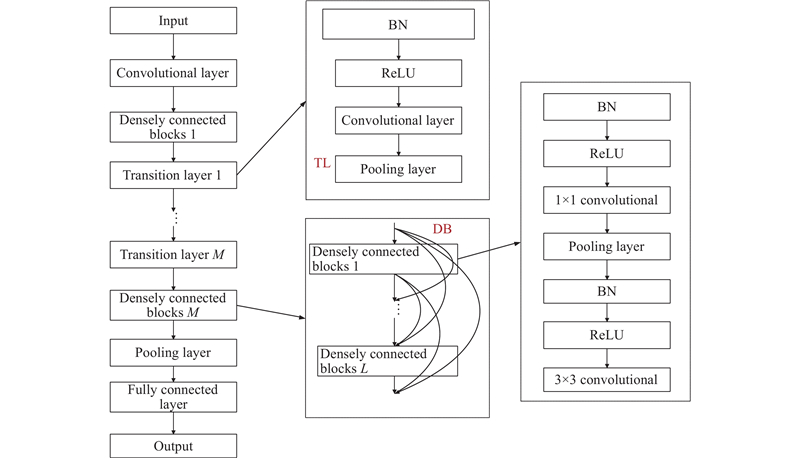
Fig 2
Basic unit structure of GRU"
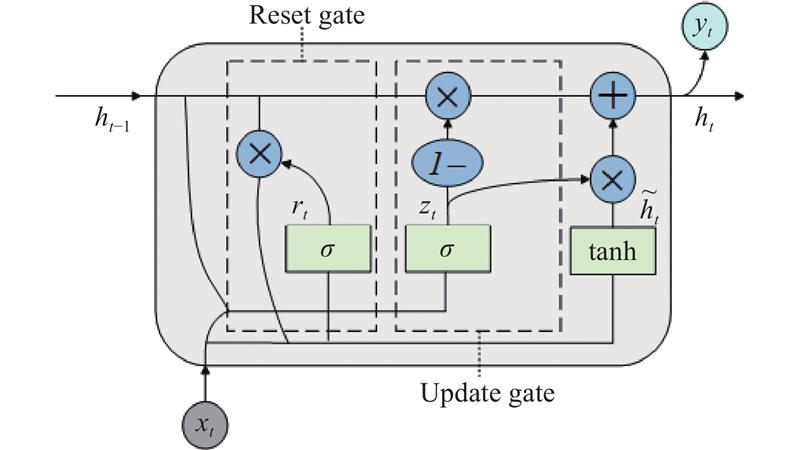
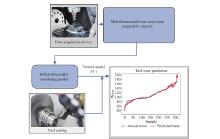
Fig 3
Tool wear monitoring framework"
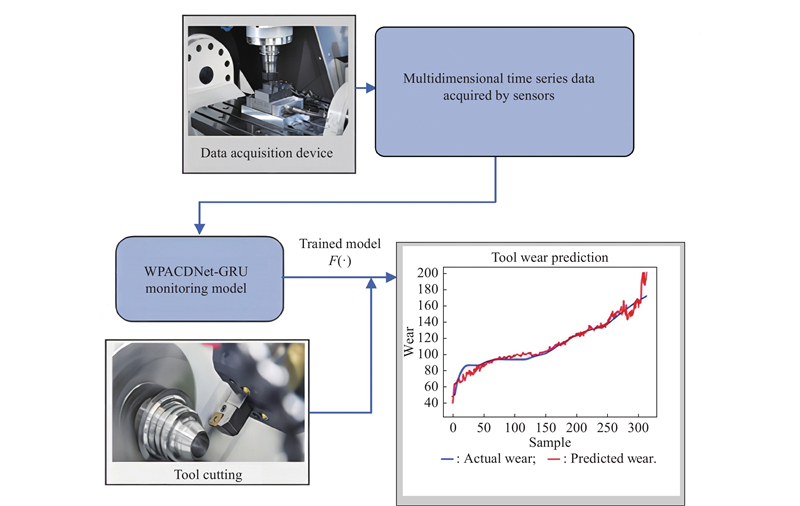
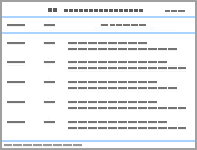
Table 1
Comparison of performance between different levels of WPT"
| Model | PMAE | PRMSE | |||||
| S1 | S2 | S3 | S1 | S2 | S3 | ||
| 2-level WPT | 5.76 | 12.91 | 20.67 | 6.85 | 16.51 | 25.55 | |
| 3-level WPT | 5.13 | 6.01 | 5.63 | 6.46 | 9.02 | 8.29 | |
| 4-level WPT | 7.19 | 16.29 | 28.43 | 9.01 | 19.16 | 22.52 | |
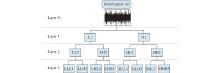
Fig 4
Three-level wavelet packet decomposition"
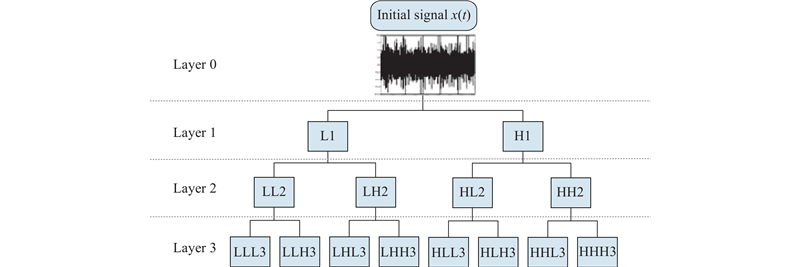
Fig 5
Structure of multi-dimensional feature extraction model"
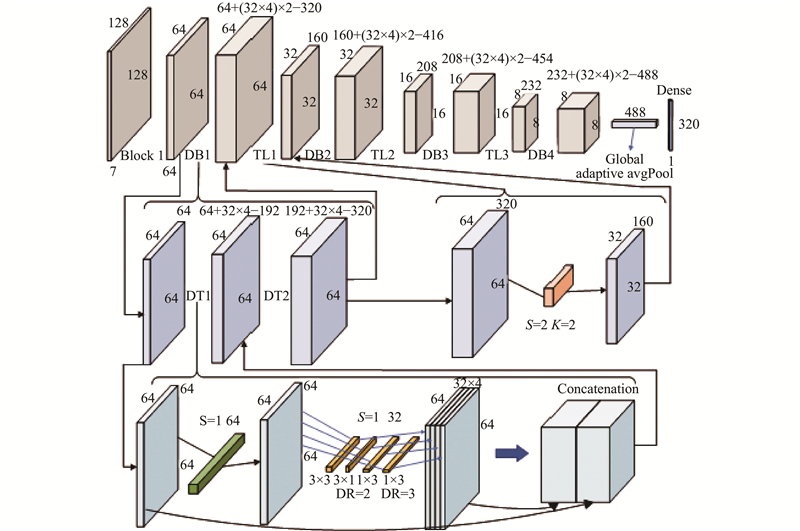
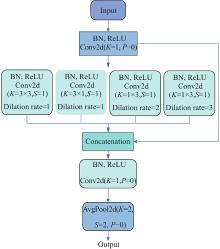
Fig 6
Structural diagram of dense connectivity layer and TL"
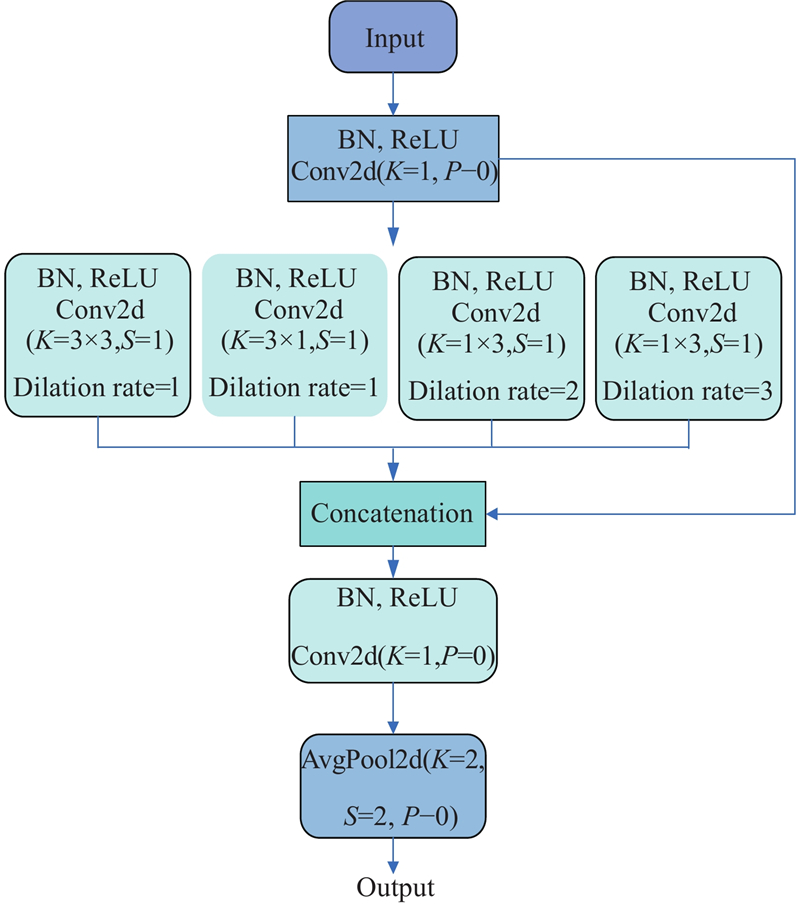
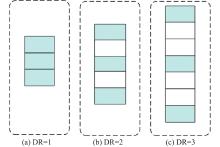
Fig 7
Expansion kernels with different DRs"
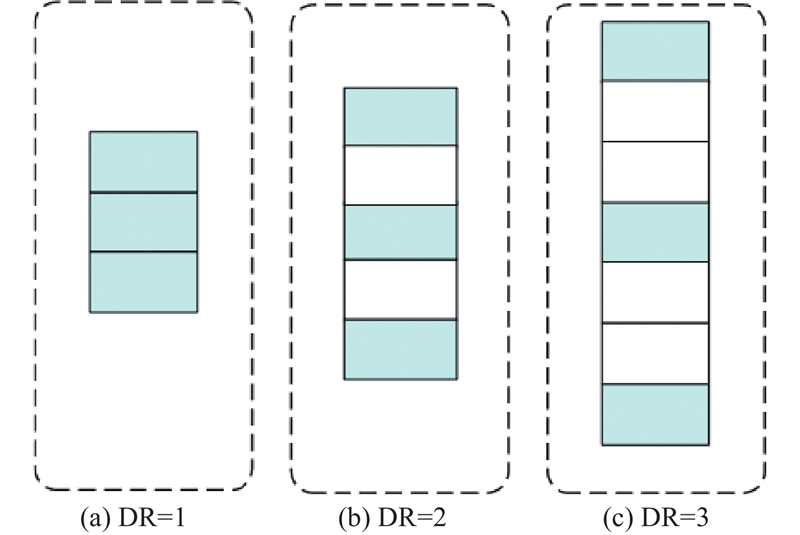
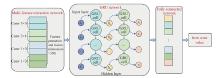
Fig 8
Structure of GRU time series feature extraction"
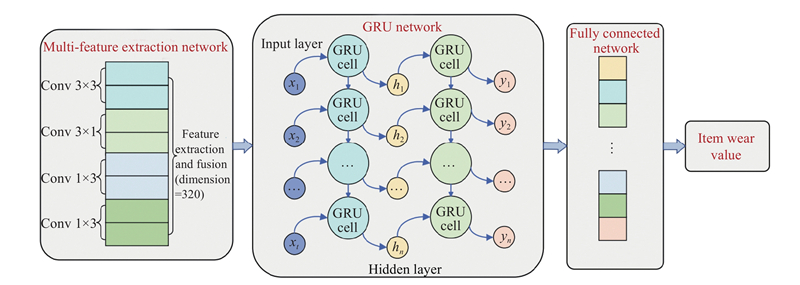
Fig 9
Experiment acquisition device"
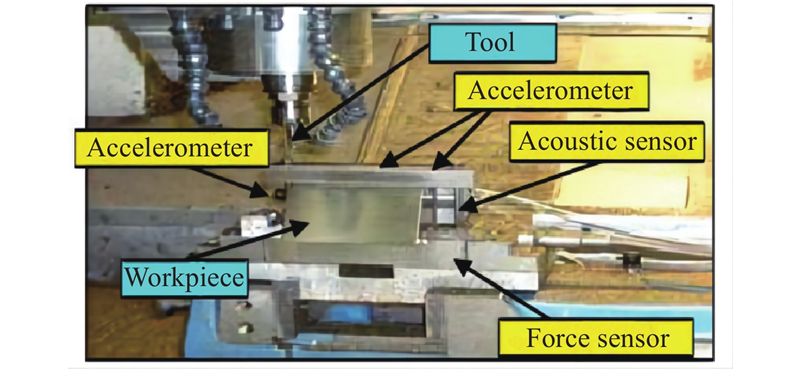
Table 2
Main equipment and machining parameters of tool cutting experiment"
| Cutting tool | Three-flute tungsten carbide ball end milling tool | ||||
| Data acquisition equipment | NI DAQ PCI | ||||
| Workpiece material | Stainless steel HRC52 | ||||
| Force sensor | Kistler 9265B 3-way Force Gauge | ||||
| Vibration acceleration sensor | Kistler 8636C | ||||
| Acoustic emission sensor | Kistler8152 | ||||
| Wear value measuring equipment | LEICI MZ12 Microscope |
Table 3
Experimental data set settings"
| Data set symbol | Training set | Test set |
| S1 | C4, C6 | C1 |
| S2 | C1, C6 | C4 |
| S3 | C1, C4 | C6 |
Table 4
PRMSE for each model on the tool dataset"
| Model | Modelling | PRMSE | ||
| S1 | S2 | S3 | ||
| ResNet | Input -ResNet-Dense-wear value | 13.746 | 16.398 | 23.051 |
| DenseNet-LSTM | Input-DenseNet-LSTM-Dense-wear value | 18.638 | 20.715 | 20.185 |
| DenseNet-GRU | Input-DenseNet-GRU-Dense-wear value | 18.723 | 17.741 | 18.906 |
| WPT-DenseNet | Input-WPT-DenseNet-Dense-wear value | 12.670 | 15.578 | 16.419 |
| WPDNet-GRU | Input-WPT-DenseNet-GRU-Dense-wear value | 9.667 | 13.134 | 14.637 |
| WPACDNet-GRU | Input-WPT-ACDNet-GRU-Dense-wear value | 6.457 | 9.021 | 8.289 |
Table 5
PMAE for each model on the tool dataset"
| Model | Modelling | PMAE | ||
| S1 | S2 | S3 | ||
| ResNet | Input -ResNet-Dense-wear value | 11.098 | 14.036 | 20.671 |
| DenseNet-LSTM | Input-DenseNet-LSTM-Dense-wear value | 15.606 | 16.389 | 18.190 |
| DenseNet-GRU | Input-DenseNet-GRU-Dense-wear value | 18.723 | 17.741 | 17.265 |
| WPT-DenseNet | Input-WPT-DenseNet-Dense-wear value | 10.704 | 11.247 | 11.040 |
| WPDNet-GRU | Input-WPT-DenseNet-GRU-Dense-wear value | 7.609 | 9.406 | 12.920 |
| WPACDNet-GRU | Input-WPT-ACDNet-GRU-Dense-wear value | 5.133 | 6.008 | 5.629 |
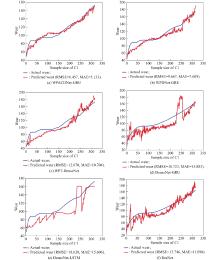
Fig 10
Plot of prediction results of different models on S1 dataset"
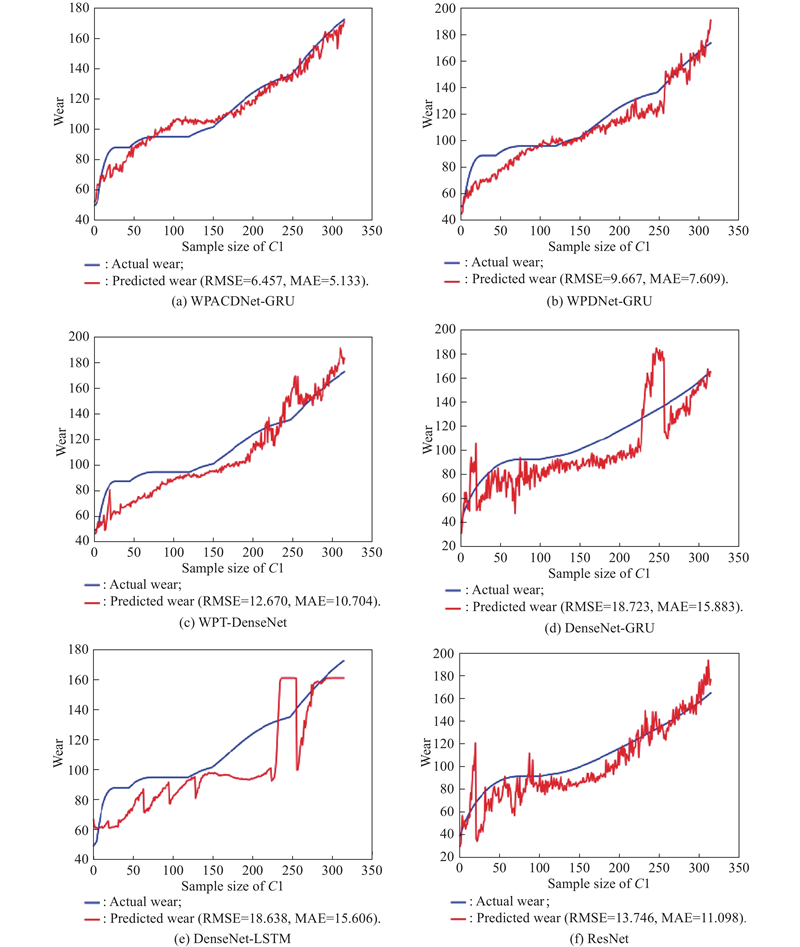
Fig 11
Plot of prediction results of different models on S2 dataset"
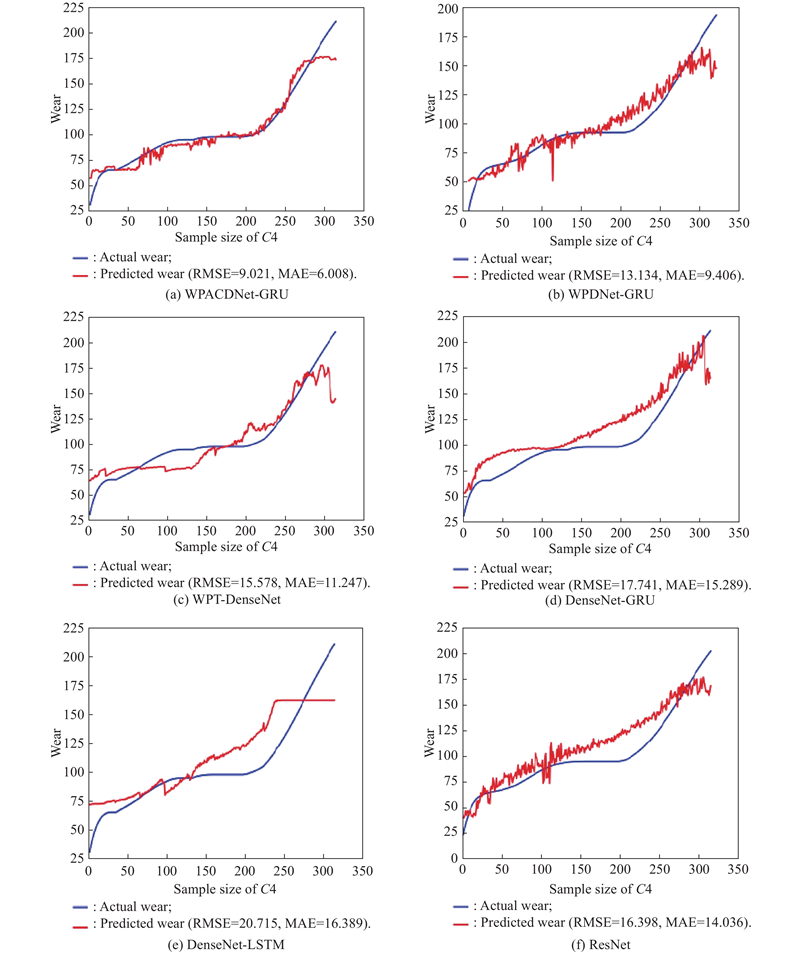
Fig 12
Plot of prediction results of different models on S3 dataset"
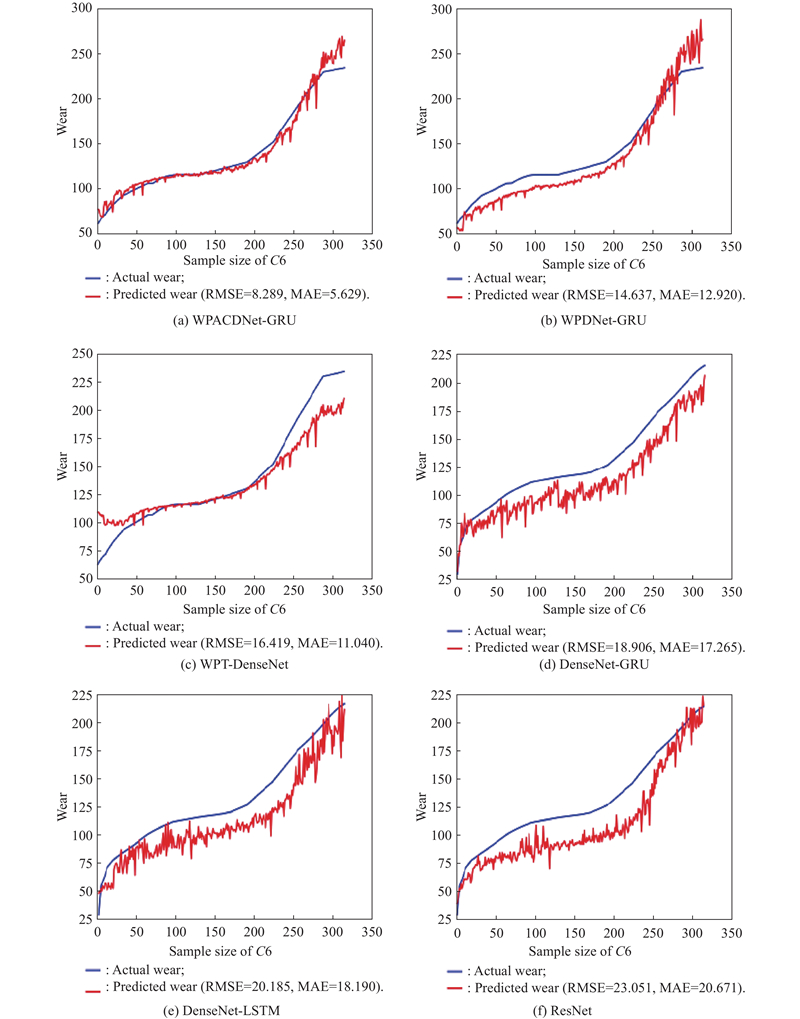
Table 6
Comparison of performance between different models"
| Model | PMAE | PMSE | |||||
| S1 | S2 | S3 | S1 | S2 | S3 | ||
| HMM | − | − | − | 276.3 | 85.8 | 121.2 | |
| TDConvLSTM | 6.99 | 6.96 | 7.50 | 69.39 | 70.39 | 104.4 | |
| TCN | 6.12 | 7.44 | 5.08 | 56.69 | 93.43 | 45.37 | |
| HACDNet-GRU | 5.85 | 7.80 | 6.33 | 51.98 | 86.68 | 48.16 | |
| Transformer | 8.95 | 5.73 | 9.47 | 60.09 | 75.16 | 100.17 | |
| WPACDNet-GRU | 5.13 | 6.01 | 5.63 | 41.69 | 81.38 | 68.71 | |
| 1 |
BAROROH D K, CHU C H, WANG L Systematic literature review on augmented reality in smart manufacturing: collaboration between human and computational intelligence. Journal of Manufacturing Systems, 2021, 61, 696- 711.
doi: 10.1016/j.jmsy.2020.10.017 |
| 2 |
ANTIC A, POPOVIC B, KRSTANOVIC L, et al Novel texture-based descriptors for tool wear condition monitoring. Mechanical Systems and Signal Processing, 2018, 98, 1- 15.
doi: 10.1016/j.ymssp.2017.04.030 |
| 3 | LIU X L , ZHANG B W, LI X B, et al. An approach for tool wear prediction using customised DenseNet and GRU integrated model based on multi-sensor feature fusion [J]. Journal of Intelligent Manufacturing, 2022, 34: 885−902. |
| 4 | GUO J C, LI A H Advances in monitoring technology of tool wear condition. Tool Engineering, 2019, 53 (5): 3- 13. |
| 5 | CAO D L, SUN H B, ZHANG J D, et al In-process tool condition monitoring based on convolution neural network. Computer Integrated Manufacturing Systems, 2020, 26 (1): 74- 80. |
| 6 |
REHORN A G, JIANG J, ORBAN P E State-of-the-art methods and results in tool condition monitoring: a review. The International Journal of Advanced Manufacturing Technology, 2005, 26, 693- 710.
doi: 10.1007/s00170-004-2038-2 |
| 7 |
ELSHEIKH A, YACOUT S, OUALI M S Bidirectional handshaking LSTM for remaining useful life prediction. Neurocomputing, 2019, 323, 148- 156.
doi: 10.1016/j.neucom.2018.09.076 |
| 8 | WANG G F, LI Q M, QIN X D, et al Application of support-vector-machine in tool wear of multi-state monitoring. Journal of Tianjin University, 2011, 44 (1): 35- 39. |
| 9 | WANG X Q, ZHANG Y, ZHOU H M, et al Continuous tool wear based on hidden Markov model. Modular Machine Tool Automatic Manufacturing Technique, 2016, (10): 87- 90. |
| 10 | GUO H, REN B C, YAN X G, et al Research on dynamic prediction of tool life based on deep convolutional neural netwok. Control and Decision, 2022, 37 (8): 2119- 2126. |
| 11 |
ZHAO R, YAN R Q, CHEN Z H, et al Deep learning and its applications to machine health monitoring. Mechanical Systems and Signal Processing, 2019, 115, 213- 237.
doi: 10.1016/j.ymssp.2018.05.050 |
| 12 |
HINTON G E, SALAKHUTDINOV R R Reducing the dimensionality of data with neural networks. Science, 2006, 313 (5786): 504- 507.
doi: 10.1126/science.1127647 |
| 13 |
AGHAZADEH F, TAHAN A, THOMAS M Tool condition monitoring using spectral subtraction and convolutional neural networks in milling process. The International Journal of Advanced Manufacturing Technology, 2018, 98, 3217- 3227.
doi: 10.1007/s00170-018-2420-0 |
| 14 |
HUANG Z W, ZHU J M, LEI J , et al Tool wear predicting based on multi-domain feature fusion by deep convolutional neural network in milling operations. Journal of Intelligent Manufacturing, 2020, 31, 953- 966.
doi: 10.1007/s10845-019-01488-7 |
| 15 | CHEN Q P, XIE Q S, YUAN Q N, et al Realtime monitoring method for wear state of tool based on deep bidirectional GRU model. Computer Integrated Manufacturing Systems, 2020, 26 (7): 1782- 1793. |
| 16 |
SUN H B, ZHANG J D, MO R, et al In-process tool condition forecasting based on a deep learning method. Robotics and Computer-Integrated Manufacturing, 2020, 64, 101924.
doi: 10.1016/j.rcim.2019.101924 |
| 17 | HUANG G, LIU Z, LAURENS V, et al. Densely connected convolutional networks. Proc. of the IEEE Conference on Computer Vision and Pattern Recognition, 2017: 4700−4708. |
| 18 | HE K M, ZHANG X Y, REN S Q, et al. Deep residual learning for image recognition. Proc. of the IEEE Conference on Computer Vision and Pattern Recognition, 2016: 770−778. |
| 19 |
KRIZHEVSKY A, SUTSKEVER I, HINTON G E Imagenet classification with deep convolutional neural networks. Communications of the ACM, 2017, 60 (6): 84- 90.
doi: 10.1145/3065386 |
| 20 | CHEN X Y, XU P Research on tool wear monitoring method based on long short-term memory networks. Mechanical Manufacturing and Automation, 2023, 52 (3): 106- 111. |
| 21 | CHENG M S , WANG Y J , ZHANG X C, et al. Research on milling cutter wear using residual structure and convolutional neural networks. Mechanical Science and Technology, 2024, 43(8): 1403−1410. (in Chinese) |
| 22 |
YAN R Q, GAO R X, CHEN X F Wavelets for fault diagnosis of rotary machines: a review with applications. Signal Processing, 2014, 96, 1- 15.
doi: 10.1016/j.sigpro.2013.04.015 |
| 23 |
COIFMAN R R, WICKERHAUSER M V Entropy-based algorithms for best basis selection. IEEE Trans. on Information Theory, 1992, 38 (2): 713- 718.
doi: 10.1109/18.119732 |
| 24 | DING X H, GUO Y C, DING G G, et al. ACNET: strengthening the kernel skeletons for powerful CNN via asymmetric convolution blocks. Proc. of the IEEE/CVF International Conference on Computer Vision, 2019: 1911−1920. |
| 25 | IOFFE S, SZEGEDY C. Batch normalisation: accelerating deep network training by reducing internal covariate shift. Proc. of the International Conference on Machine Learning, 2015: 448−456. |
| 26 |
CHADHA G S, PANARA U, SCHWUNG A, et al Generalised dilation convolutional neural networks for remaining useful lifetime estimation. Neurocomputing, 2021, 452, 182- 199.
doi: 10.1016/j.neucom.2021.04.109 |
| 27 |
ZHAO D Z, WANG T Y, CHU F L Deep convolutional neural network based planet bearing fault classification. Computers in Industry, 2019, 107, 59- 66.
doi: 10.1016/j.compind.2019.02.001 |
| 28 | PHM Society. phm data challenge 2010. https://www.phmsociety.org/competition/phm/10. |
| 29 |
QIAO H H, WANG T Y, WANG P, et al A time-distributed spatiotemporal feature learning method for machine health monitoring with multi-sensor time series. Sensors, 2018, 18 (9): 2932.
doi: 10.3390/s18092932 |
| 30 | LIU D H , WANG Y C , HE H Online tool wear monitoring based on temporal convolutional networks. Journal of Machine Tools & Automatic Manufacturing Technology, 2023, (4): 174- 176. |
| 31 | LI Z G, ZHOU X L, SUN P L A tool wear monitoring method that combines residual blocks and Swin-Transformer mechanism. Modern Manufacturing Engineering, 2024, (8): 126- 135. |
| [1] | Chen CHEN, Wei QUAN, Zhuang SHAO. Aerial target threat assessment based on gated recurrent unit and self-attention mechanism [J]. Journal of Systems Engineering and Electronics, 2024, 35(2): 361-373. |
| [2] | Caihua WU, Jianchao MA, Xiuwei ZHANG, Dang XIE. User space transformation in deep learning based recommendation [J]. Journal of Systems Engineering and Electronics, 2020, 31(4): 674-684. |
| Viewed | ||||||
|
Full text |
|
|||||
|
Abstract |
|
|||||
