
Journal of Systems Engineering and Electronics ›› 2026, Vol. 37 ›› Issue (3): 725-742.doi: 10.23919/JSEE.2026.000026
• CROSS-DOMAIN ELECTROMAGNETIC PERCEPTION AND COMMUNICATION & NETWORKING TECHNOLOGY (PART I) • Next Articles
Jing JIN( ), Weibo QIN(), Zifei LI(), Feng WANG()
Received:2025-09-16
Accepted:2026-01-16
Online:2026-06-18
Published:2026-06-29
Contact:
Feng WANG
E-mail:jinjing@fudan.edu.cn;wbqin23@m.fudan.edu.cn;zfli24@m.fudan.edu.cn;fengwang@fudan.edu.cn
Supported by:Jing JIN, Weibo QIN, Zifei LI, Feng WANG. Federated feature distillation for Non-IID remote sensing scene classification[J]. Journal of Systems Engineering and Electronics, 2026, 37(3): 725-742.
Add to citation manager EndNote|Reference Manager|ProCite|BibTeX|RefWorks
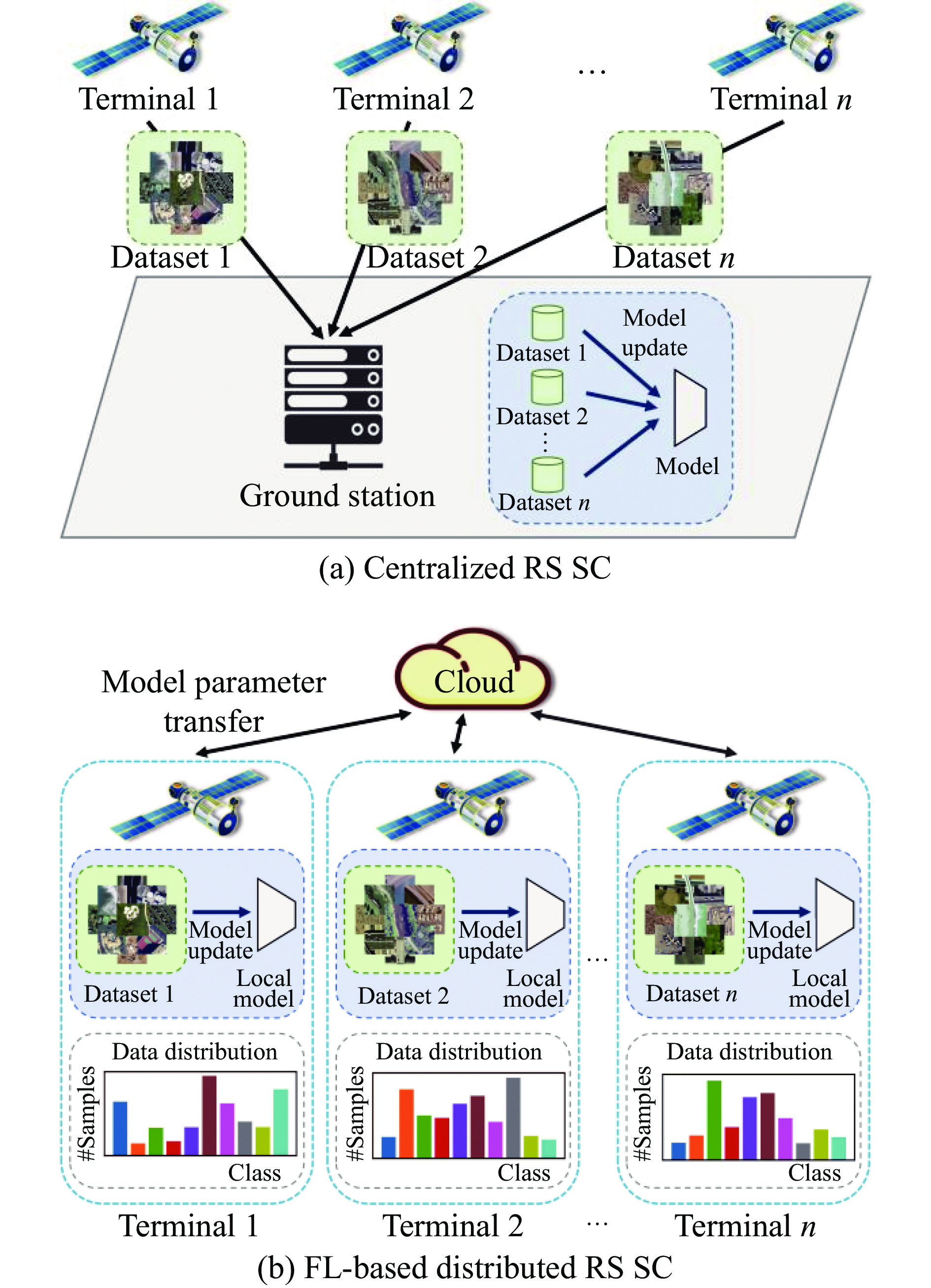
Fig 1
Comparison between conventional centralized and FL-based distributed RS SC methods"
Fig 2
Visualization of Non-IID data distribution across terminals via LDA for different $ {\boldsymbol{\alpha}} $ values"
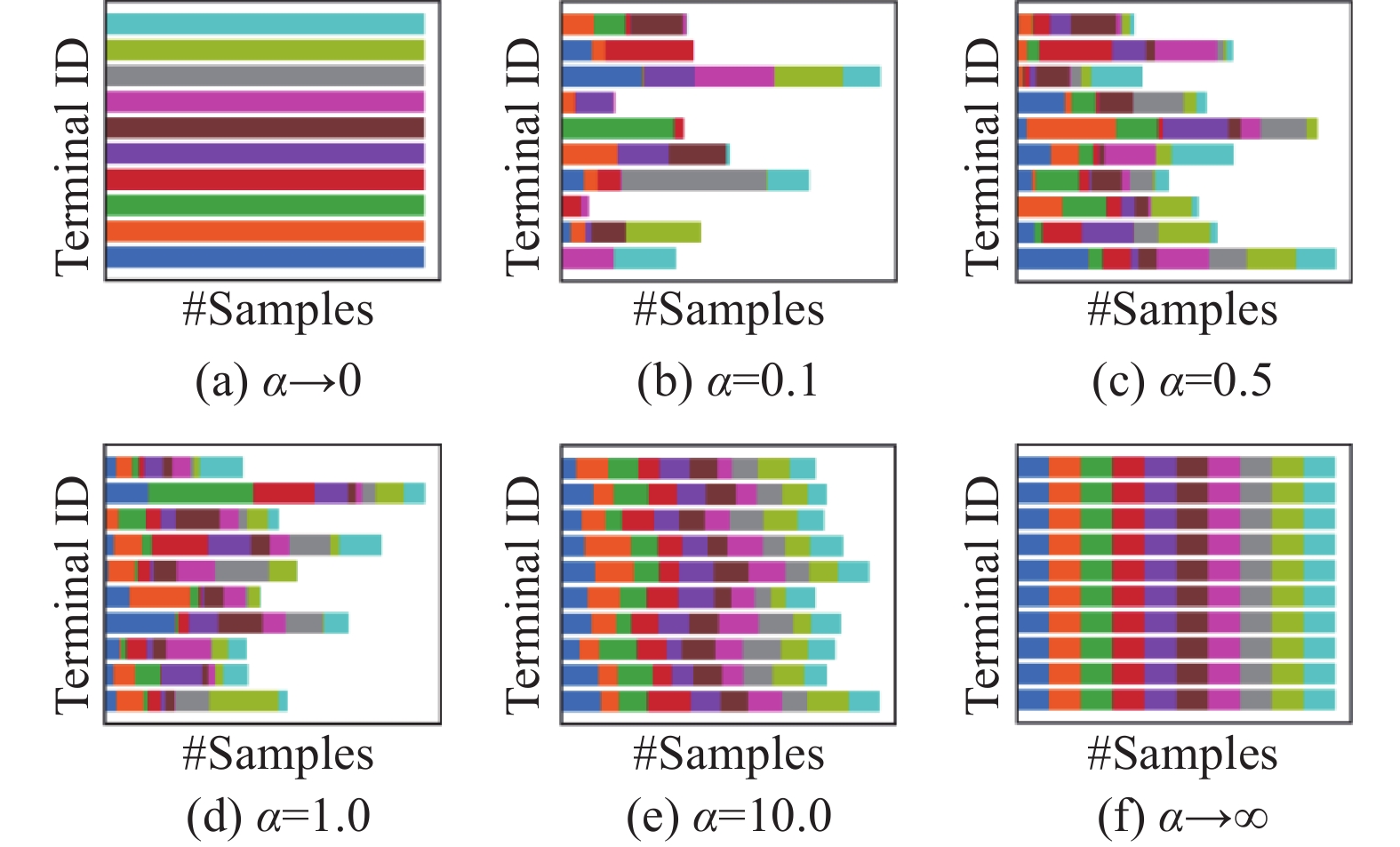
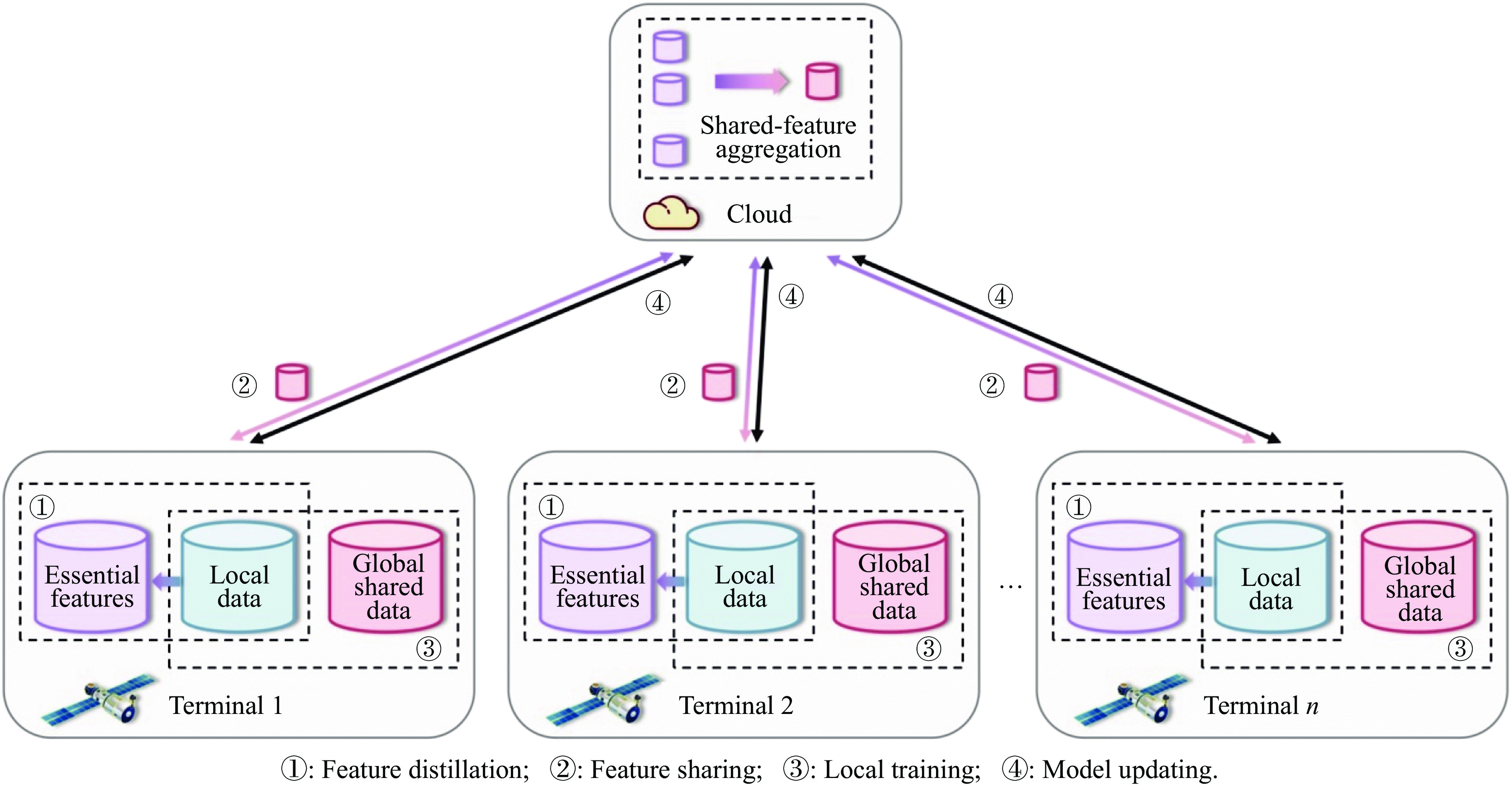
Fig 3
Illustration of the proposed FedFD framework for FL-based Non-IID RS SC"
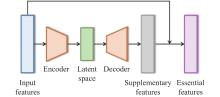
Fig 4
Illustration of the VAE-based FD workflow within FedFD"
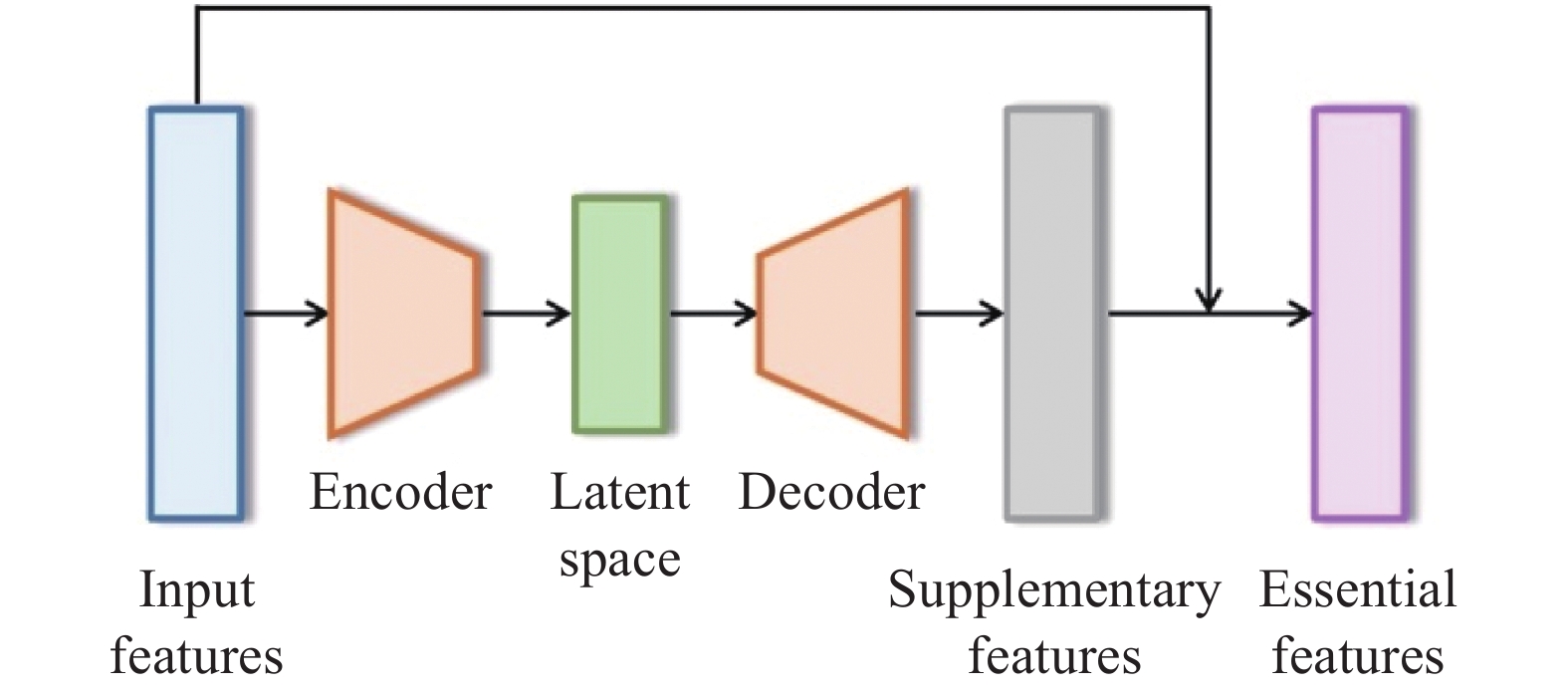
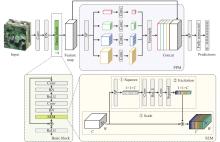
Fig 5
Architecture of the SC network in the FedFD framework"
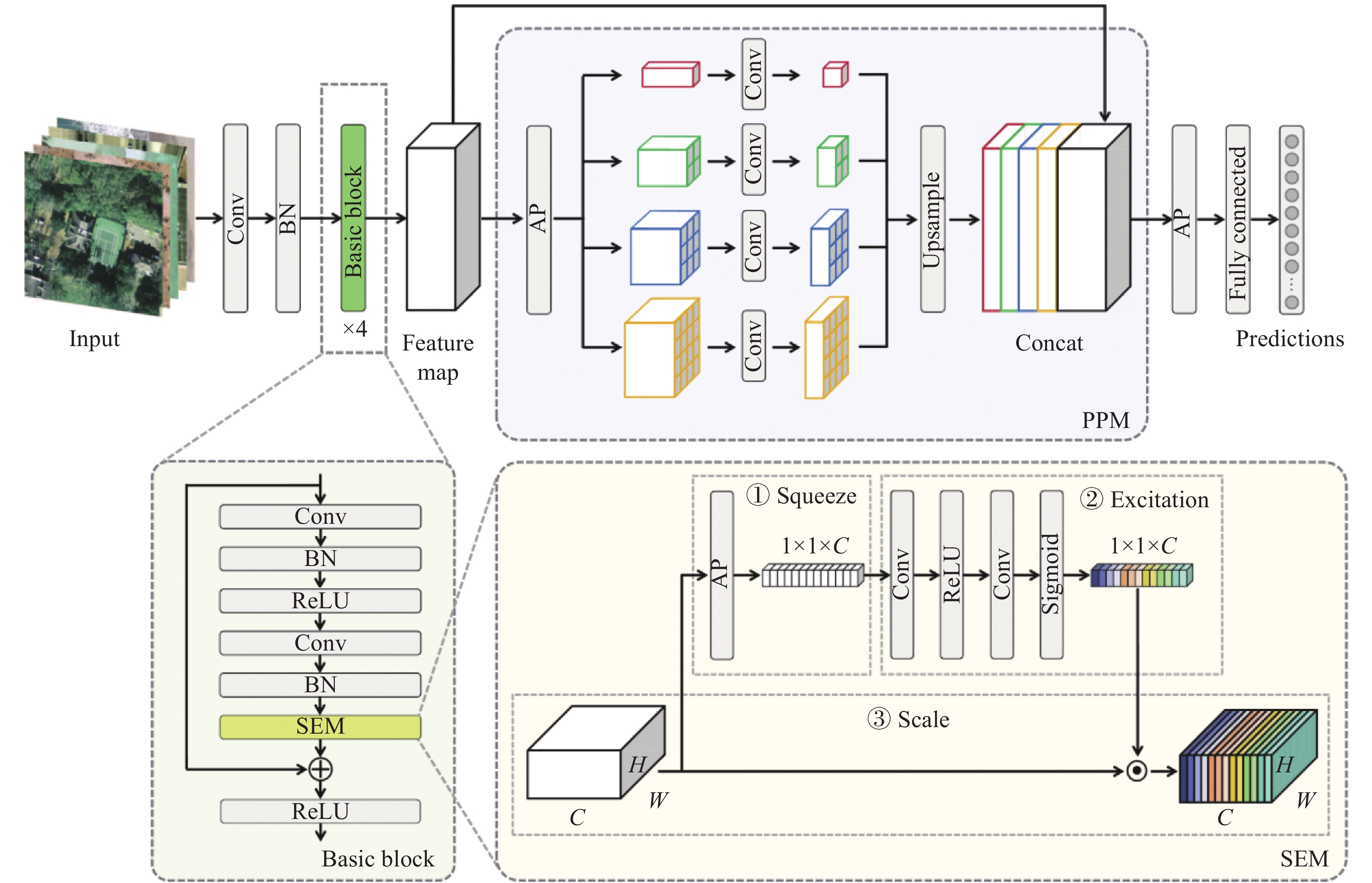
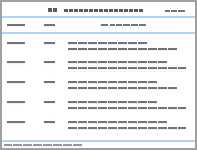
Table 1
Details of UC-Merced and NWPU-RESISC45 RS SC datasets"
| Dataset | Source | Number of images per class | Number of classes | Spatial resolution/m | Image size | Training/Test ratio |
| UC-Merced | USGS National Map | 100 | 21 | 0.3 | 256×256 | 50% / 50%, 80% / 20% |
| NWPU-RESISC45 | Google Earth | 700 | 45 | 0.2 ~ 30 | 256×256 | 10% / 90%, 20% / 80% |
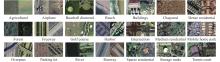
Fig 6
Sample images from the UC-Merced dataset, illustrating two examples from each of the 21 scene categories"
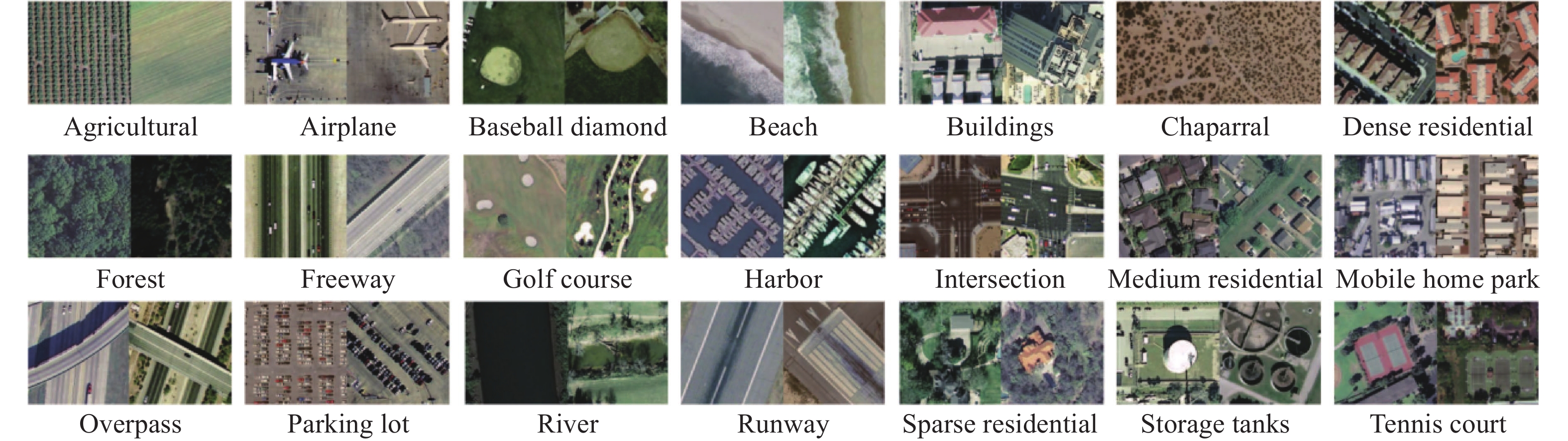

Fig 7
Sample images from the NWPU-RESISC45 dataset, illustrating two examples from each of the 45 scene categories"
Table 2
OA comparison of FedFD-integrated and vanilla methods on the UC-Merced dataset under varying training ratios and Non-IID levels %"
| Method | Training ratio = 50% | Training ratio = 80% | |||||
| FedAvg (vanilla) [ | 77.045 | 81.606 | 85.371 | 78.571 | 86.190 | 87.619 | |
| FedProx (vanilla) [ | 78.658 | 82.280 | 83.478 | 80.609 | 86.575 | 87.781 | |
| FedNova (vanilla) [ | 79.305 | 82.582 | 84.668 | 84.013 | 86.667 | 90.476 | |
| FedFD+FedAvg | 83.619 (6.574↑) | 86.762 (5.156↑) | 89.764 (4.394↑) | 85.938 (7.366↑) | 92.976 (6.786↑) | 94.976 (7.357↑) | |
| FedFD+FedProx | 83.376 (4.718↑) | 88.750 (6.470↑) | 89.359 (5.881↑) | 87.235 (6.626↑) | 91.850 (5.275↑) | 95.652 (7.871↑) | |
| FedFD+FedNova | 82.211 (2.906↑) | 87.848 (5.266↑) | 89.840 (5.172↑) | 87.143 (3.130↑) | 92.115 (5.449↑) | 95.238 (4.762↑) | |
Table 3
OA comparison of FedFD-integrated and vanilla methods on the NWPU-RESISC45 dataset under varying training ratios and Non-IID levels %"
| Method | Training ratio = 10% | Training ratio = 20% | |||||
| FedAvg (vanilla) [ | 62.891 | 67.068 | 69.278 | 74.516 | 79.600 | 80.087 | |
| FedProx (vanilla) [ | 65.241 | 69.379 | 70.643 | 72.101 | 80.047 | 80.852 | |
| FedNova (vanilla) [ | 65.054 | 69.691 | 70.826 | 74.282 | 78.363 | 80.306 | |
| FedFD+FedAvg | 70.261(7.370↑) | 75.216(8.148↑) | 76.658(7.380↑) | 76.568(2.053↑) | 84.829(5.230↑) | 85.202(5.115↑) | |
| FedFD+FedProx | 70.230(4.989↑) | 76.795(7.415↑) | 77.731(7.087↑) | 76.898(4.797↑) | 84.927(4.881↑) | 84.935(4.083↑) | |
| FedFD+FedNova | 71.243(6.189↑) | 76.952(7.261↑) | 77.580(6.755↑) | 76.312(2.030↑) | 84.724(6.361↑) | 85.448(5.142↑) | |

Fig 8
Scalability comparison of the proposed FedFD and baseline method on two datasets under various Non-IID levels with varying terminal numbers $ {\boldsymbol{K}} $"
Table 4
Ablation experiments of the SEM and PPM in the SC network on two datasets ($ {{\boldsymbol{K}}}{\boldsymbol{=5}} $, $ {\boldsymbol{\alpha =0.1}} $) %"
| Configuration | UC-Merced | NWPU-RESISC45 | |||||
| SEM | PPM | 50% | 80% | 10% | 20% | ||
| − | − | 73.046 | 80.238 | 62.483 | 72.089 | ||
| − | √ | 76.227 | 83.066 | 63.559 | 73.926 | ||
| √ | − | 77.714 | 82.619 | 64.657 | 72.545 | ||
| √ | √ | 83.619 | 85.938 | 70.261 | 76.568 | ||
Table 5
Ablation experiments of the SEM and PPM in the SC network on two datasets ($ {\boldsymbol{{K}=5}} $, $ {\boldsymbol{\alpha =0.}} $5) %"
| Configuration | UC-Merced | NWPU-RESISC45 | |||||
| SEM | PPM | 50% | 80% | 10% | 20% | ||
| − | − | 80.194 | 83.061 | 71.139 | 78.764 | ||
| − | √ | 84.767 | 85.967 | 72.373 | 81.609 | ||
| √ | − | 82.525 | 84.143 | 71.823 | 80.962 | ||
| √ | √ | 86.762 | 92.976 | 75.216 | 84.829 | ||
Table 6
Ablation experiments of the SEM and PPM in the SC network on two datasets ($ {\boldsymbol{{K}=5}} $, $ {\boldsymbol{\alpha =1.0}} $) %"
| Configuration | UC-Merced | NWPU-RESISC45 | |||||
| SEM | PPM | 50% | 80% | 10% | 20% | ||
| − | − | 86.761 | 91.051 | 74.562 | 81.156 | ||
| − | √ | 87.142 | 92.839 | 75.045 | 82.505 | ||
| √ | − | 88.855 | 91.904 | 75.554 | 82.979 | ||
| √ | √ | 89.764 | 94.976 | 76.658 | 85.202 | ||
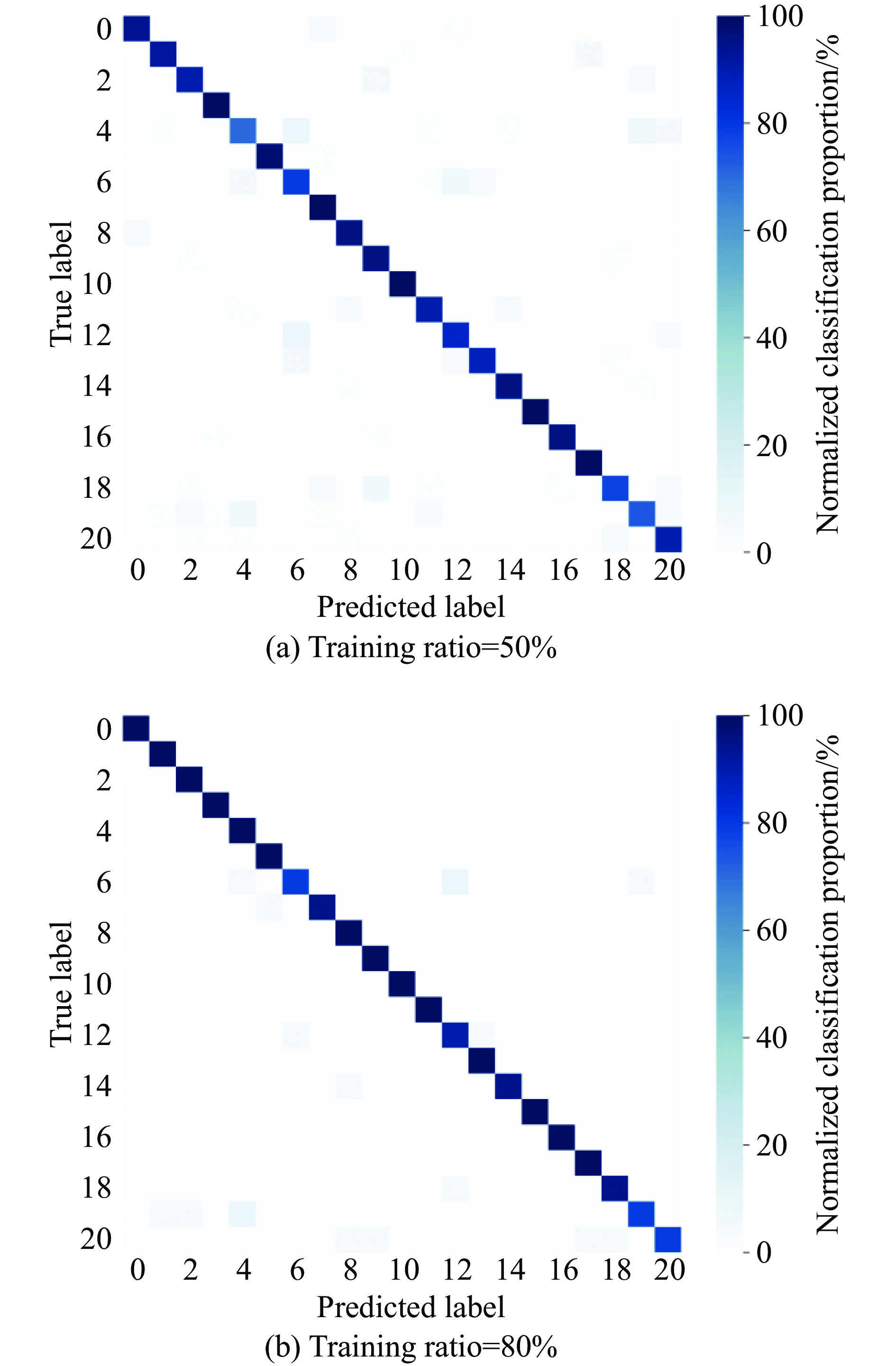
Fig 9
CMs of classification results achieved by FedAvg integrated with FedFD on the UC-Merced dataset ($ {\boldsymbol{K=5}} $, $ {\boldsymbol{\alpha =0.5}} $)"
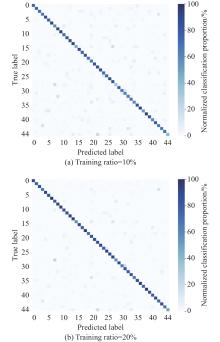
Fig 10
CMs of classification results achieved by FedAvg integrated with FedFD on the NWPU-RESISC45 dataset ($ {\boldsymbol{K=5}} $, $ {\boldsymbol{\alpha =0.5}} $)"
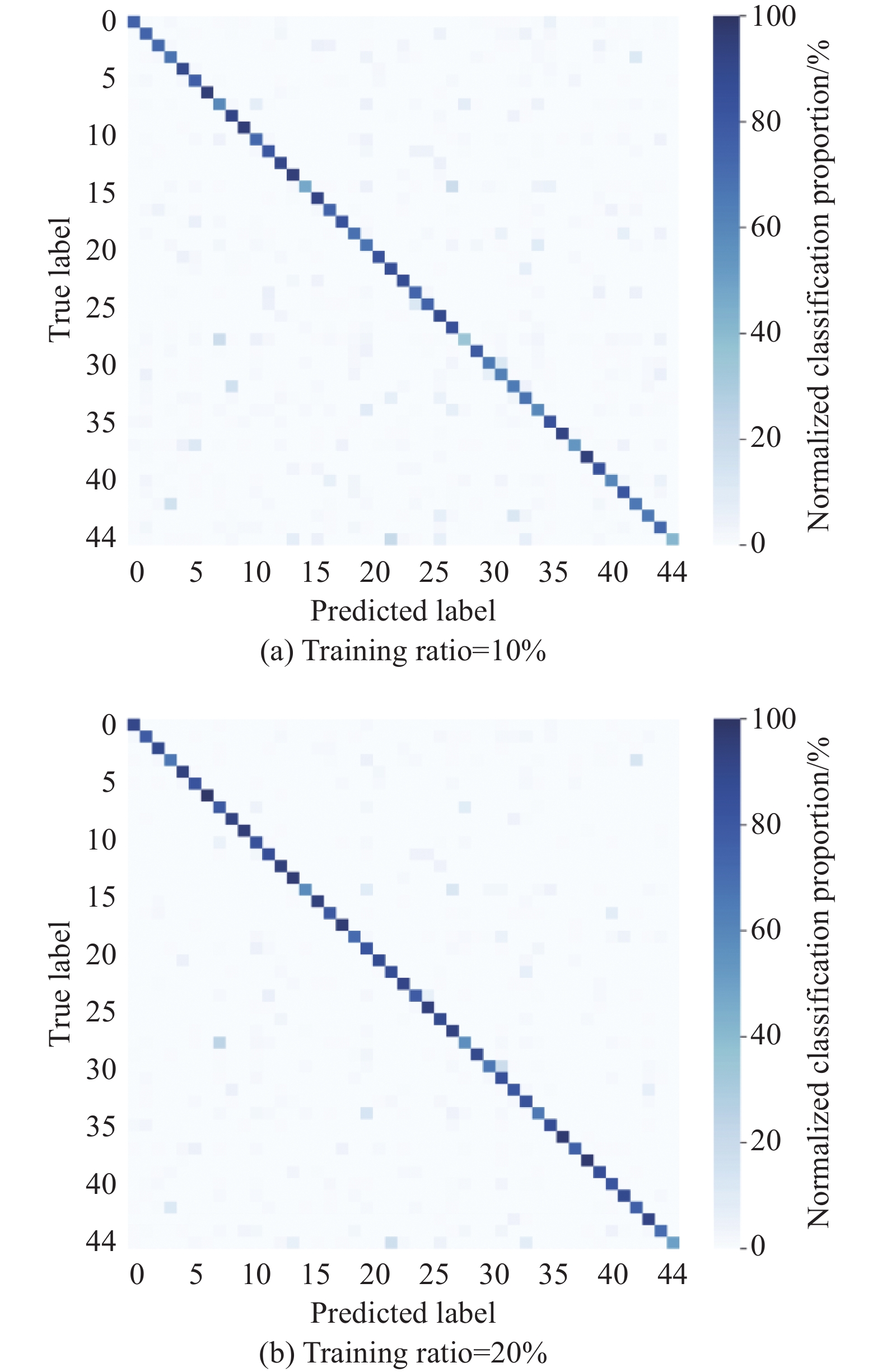
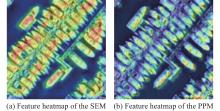
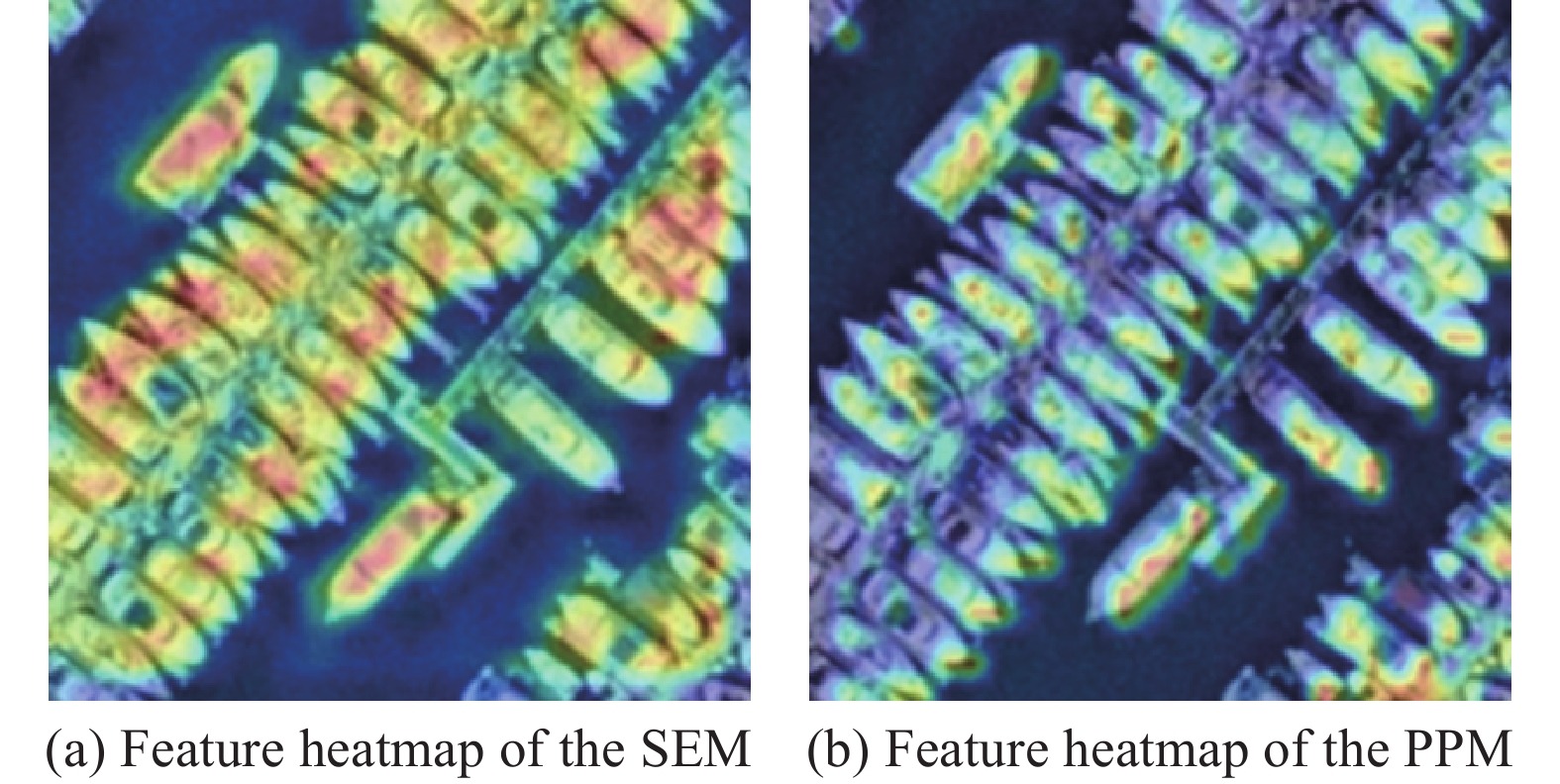
Fig 11
Grad-CAM visualizations of the SEM and PPM modules on a representative harbor sample from the UC-Merced dataset"
| 1 |
WANG J J, LI W, ZHANG M M, et al Remote-sensing scene classification via multistage self-guided separation network. IEEE Trans. on Geoscience and Remote Sensing, 2023, 61, 5615312.
doi: 10.1109/tgrs.2023.3295797 |
| 2 |
ZHENG X T, YUAN Y, LU X Q A deep scene representation for aerial scene classification. IEEE Trans. on Geoscience and Remote Sensing, 2019, 57 (7): 4799- 4809.
doi: 10.1109/TGRS.2019.2893115 |
| 3 |
XIA J M, ZHOU Y, TAN L DBGA-Net: dual-branch global-local attention network for remote sensing scene classification. IEEE Geoscience and Remote Sensing Letters, 2023, 20, 7502305.
doi: 10.1109/lgrs.2023.3264817 |
| 4 |
WANG Q, HUANG W, XIONG Z T, et al Looking closer at the scene: multiscale representation learning for remote sensing image scene classification. IEEE Trans. on Neural Networks and Learning Systems, 2020, 33 (4): 1414- 1428.
doi: 10.1109/tnnls.2020.3042276 |
| 5 |
ZHANG L P, ZHANG L F, DU B Deep learning for remote sensing data: a technical tutorial on the state of the art. IEEE Geoscience and Remote Sensing Magazine, 2016, 4 (2): 22- 40.
doi: 10.1109/MGRS.2016.2540798 |
| 6 | WANG Q, LIU S T, CHANUSSOT J, et al Scene classification with recurrent attention of VHR remote sensing images. IEEE Trans. on Geoscience and Remote Sensing, 2018, 57 (2): 1155- 1167. |
| 7 |
ZHAO Z C, LI J Q, LUO Z, et al Remote sensing image scene classification based on an enhanced attention module. IEEE Geoscience and Remote Sensing Letters, 2020, 18 (11): 1926- 1930.
doi: 10.1109/icdcot61034.2024.10515887 |
| 8 |
LIU Y F, ZHONG Y F, QIN Q Q Scene classification based on multiscale convolutional neural network. IEEE Trans. on Geoscience and Remote Sensing, 2018, 56 (12): 7109- 7121.
doi: 10.1109/TGRS.2018.2848473 |
| 9 |
HE N J, FANG L Y, LI S T, et al Skip-connected covariance network for remote sensing scene classification. IEEE Trans. on Neural Networks and Learning Systems, 2019, 31 (5): 1461- 1474.
doi: 10.1080/2150704x.2023.2266118 |
| 10 | GAO S H, CHENG M M, ZHAO K, et al Res2net: a new multi-scale backbone architecture. IEEE Trans. on Pattern Analysis and Machine Intelligence, 2019, 43 (2): 652- 662. |
| 11 |
WANG Y L, WANG Z R, CHENG P R, et al DCM: a distributed collaborative training method for the remote sensing image classification. IEEE Trans. on Geoscience and Remote Sensing, 2023, 61, 5605018.
doi: 10.1109/tgrs.2023.3252544 |
| 12 | LI J Z, GONG M G, LIU Z T, et al Toward multiparty personalized collaborative learning in remote sensing. IEEE Trans. on Geoscience and Remote Sensing, 2024, 62, 4503616. |
| 13 |
XU Y H, BAI T, YU W K, et al AI security for geoscience and remote sensing: challenges and future trends. IEEE Geoscience and Remote Sensing Magazine, 2023, 11 (2): 60- 85.
doi: 10.1109/MGRS.2023.3272825 |
| 14 |
LI D X, XIE W Y, LI Y S, et al FedFusion: manifold-driven federated learning for multi-satellite and multi-modality fusion. IEEE Trans. on Geoscience and Remote Sensing, 2023, 62, 5500813.
doi: 10.1109/tgrs.2023.3339522 |
| 15 | MCMAHAN H B, MOORE E, RAMAGE D, et al. Communication-efficient learning of deep networks from decentralized data. Proc. of the Artificial Intelligence and Statistics, 2017: 1273−1282. |
| 16 |
ZHANG X K, ZHANG B N, YU W K, et al Federated deep learning with prototype matching for object extraction from very-high-resolution remote sensing images. IEEE Trans. on Geoscience and Remote Sensing, 2023, 61, 5603316.
doi: 10.1109/tgrs.2023.3244136 |
| 17 | TANG X C, YAN X C, YUAN X J, et al FedLD: federated learning for privacy-preserving collaborative landslide detection. IEEE Geoscience and Remote Sensing Letters, 2024, 21, 8003105. |
| 18 | KAWAGUCHI K, KAELBLING L P, BENGIO Y. Generalization in deep learning. https://arxiv.org/abs/1710.05468. |
| 19 | JAKUBOVITZ D, GIRYES R, RODRIGUES M R D. Compressed sensing and its applications. 2017. Cham: Springer International Publishing, 2019. |
| 20 |
KAIROUZ P, MCMAHAN H B, AVENT B, et al Advances and open problems in federated learning. Foundations and Trends in Machine Learning, 2021, 14 (1/2): 1- 210.
doi: 10.1561/2200000083 |
| 21 | LI X X, JIANG M R, ZHANG X F, et al. FedBN: federated learning on non-IID features via local batch normalization. https://arxiv.org./abs/2102.07623. |
| 22 | KARIMIREDDY S P, KALE S, MOHRI M, et al. Scaffold: stochastic controlled averaging for federated learning. Proc. of the International Conference on Machine Learning, 2020: 5132−5143. |
| 23 | LI T, SAHU A K, ZAHEER M, et al. Federated optimization in heterogeneous networks. https://arxiv.org/abs/1812.06127. |
| 24 | WANG H Y, YUROCHKIN M, SUN Y K, et al. Federated learning with matched averaging. https:/arxiv.org/abs/2002.06440. |
| 25 | WANG J Y, LIU Q H, LIANG H, et al Tackling the objective inconsistency problem in heterogeneous federated optimization. Advances in Neural Information Processing Systems, 2020, 33, 7611- 7623. |
| 26 |
XIE Z J, SONG S H FedKL: tackling data heterogeneity in federated reinforcement learning by penalizing KL divergence. IEEE Journal on Selected Areas in Communications, 2023, 41 (4): 1227- 1242.
doi: 10.1109/JSAC.2023.3242734 |
| 27 | TAN Y, LIU Y X, LONG G D, et al. Federated learning on non-IID graphs via structural knowledge sharing. Proc. of the AAAI Conference on Artificial Intelligence, 2023, 37: 9953−9961. |
| 28 |
YAO X W, HAN J W, CHENG G, et al Semantic annotation of high-resolution satellite images via weakly supervised learning. IEEE Trans. on Geoscience and Remote Sensing, 2016, 54 (6): 3660- 3671.
doi: 10.1109/TGRS.2016.2523563 |
| 29 |
GAO Y H, ZHANG M M, LI W, et al Adversarial complementary learning for multisource remote sensing classification. IEEE Trans. on Geoscience and Remote Sensing, 2023, 61, 5505613.
doi: 10.1109/tgrs.2023.3255880 |
| 30 |
WANG J J, LI W, GAO Y H, et al Hyperspectral and SAR image classification via multiscale interactive fusion network. IEEE Trans. on Neural Networks and Learning Systems, 2022, 34 (12): 10823- 10837.
doi: 10.1109/igarss52108.2023.10282312 |
| 31 |
HUANG X, LIU H, ZHANG L P Spatiotemporal detection and analysis of urban villages in mega city regions of China using high-resolution remotely sensed imagery. IEEE Trans. on Geoscience and Remote Sensing, 2015, 53 (7): 3639- 3657.
doi: 10.1109/TGRS.2014.2380779 |
| 32 |
HU F, XIA G S, HU J W, et al Transferring deep convolutional neural networks for the scene classification of high-resolution remote sensing imagery. Remote Sensing, 2015, 7 (11): 14680- 14707.
doi: 10.3390/rs71114680 |
| 33 | YU F, WANG D Q, SHELHAMER E, et al. Deep layer aggregation. Proc. of the IEEE Conference on Computer Vision and Pattern Recognition, 2018: 2403−2412. |
| 34 |
MILLS J, HU J, MIN G Y Multi-task federated learning for personalised deep neural networks in edge computing. IEEE Trans. on Parallel and Distributed Systems, 2021, 33 (3): 630- 641.
doi: 10.1109/tpds.2021.3098467 |
| 35 |
CHEN Y Q, QIN X, WANG J D, et al Fedhealth: a federated transfer learning framework for wearable healthcare. IEEE Intelligent Systems, 2020, 35 (4): 83- 93.
doi: 10.1109/MIS.2020.2988604 |
| 36 | LONG G D, TAN Y, JIANG J, et al. Federated learning: privacy and incentive. Cham: Springer International Publishing, 2020. |
| 37 | YAN J T, CHEN T, XIE B W, et al Hierarchical federated learning: architecture, challenges, and its implementation in vehicular networks. ZTE Communications, 2023, 21 (1): 38- 45. |
| 38 |
YAN J T, CHEN T, SUN Y X, et al Dynamic scheduling for vehicle-to-vehicle communications enhanced federated learning. IEEE Trans. on Wireless Communications, 2025, 24 (11): 9373- 9390.
doi: 10.1109/TWC.2025.3573048 |
| 39 |
CHELLAPANDI V P, YUAN L Q, BRINTON C G, et al Federated learning for connected and automated vehicles: a survey of existing approaches and challenges. IEEE Trans. on Intelligent Vehicles, 2023, 9 (1): 119- 137.
doi: 10.1109/tiv.2023.3332675 |
| 40 | ZHANG B N, ZHANG X K, PUN M O, et al. Prototype-based clustered federated learning for semantic segmentation of aerial images. Proc. of the IEEE International Geoscience and Remote Sensing Symposium, 2022: 2227−2230. |
| 41 | BUYUKTAS B, SUMBUL G, DEMIR B. Learning across decentralized multi-modal remote sensing archives with federated learning. Proc. of the IEEE International Geoscience and Remote Sensing Symposium, 2023: 4966−4969. |
| 42 | ZHAO H S, SHI J P, QI X J, et al. Pyramid scene parsing network. Proc. of the IEEE Conference on Computer Vision and Pattern Recognition, 2017: 6230−6239. |
| 43 | YANG Y, NEWSAM S. Bag-of-visual-words and spatial extensions for land-use classification. Proc. of the 18th International Conference on Advances in Geographic Information Systems, 2010: 270−279. |
| 44 |
CHENG G, HAN J W, LU X Q Remote sensing image scene classification: benchmark and state of the art. Proceedings of the IEEE, 2017, 105 (10): 1865- 1883.
doi: 10.1109/JPROC.2017.2675998 |
| 45 | LI Q B, DIAO Y Q, CHEN Q, et al. Federated learning on non-IID data silos: an experimental study. Proc. of the IEEE 38th International Conference on Data Engineering, 2022: 965−978. |
| 46 | REDDI S, CHARLES Z, ZAHEER M, et al. Adaptive federated optimization. https://arxiv.org/abs/2003.00295. |
| 47 | HSU T M H, QI H, BROWN M. Measuring the effects of non-identical data distribution for federated visual classification. https://arxiv.org/abs/1409.06335. |
| [1] | Yumin DONG, Ziyang LI, Xuesong LI, Xiaohui LI. Using ontology and rules to retrieve the semantics of disaster remote sensing data [J]. Journal of Systems Engineering and Electronics, 2024, 35(5): 1211-1218. |
| [2] | Wei FENG, Yijun LONG, Shuo WANG, Yinghui QUAN. A review of addressing class noise problems of remote sensing classification [J]. Journal of Systems Engineering and Electronics, 2023, 34(1): 36-46. |
| [3] | Hao DU, Wei WANG, Xuerao WANG, Yuanda WANG. Autonomous landing scene recognition based on transfer learning for drones [J]. Journal of Systems Engineering and Electronics, 2023, 34(1): 28-35. |
| [4] | Tingting WEI, Weilin YUAN, Junren LUO, Wanpeng ZHANG, Lina LU. VLCA: vision-language aligning model with cross-modal attention for bilingual remote sensing image captioning [J]. Journal of Systems Engineering and Electronics, 2023, 34(1): 9-18. |
| [5] | Binquan LI, Xiaohui HU. Effective distributed convolutional neural network architecture for remote sensing images target classification with a pre-training approach [J]. Journal of Systems Engineering and Electronics, 2019, 30(2): 238-244. |
| [6] | Yongpeng Zhu, Yinsheng Wei, and Peng Tong. First order sea clutter cross section for bistatic shipborne HFSWR [J]. Systems Engineering and Electronics, 2017, 28(4): 681-. |
| [7] | Hao Chen, Jun Li, Ning Jing, and Jun Li. User-oriented data acquisition chain task planning algorithm for operationally responsive space satellite [J]. Journal of Systems Engineering and Electronics, 2016, 27(5): 1028-1039. |
| [8] | Gensheng Hu, Xiaoqi Sun, Dong Liang, and Yingying Sun. Cloud removal of remote sensing image based on multi-output support vector regression [J]. Journal of Systems Engineering and Electronics, 2014, 25(6): 1082-1088. |
| [9] | Qunming Wang, Liguo Wang, and Danfeng Liu. Integration of spatial attractions between and within pixels for sub-pixel mapping [J]. Journal of Systems Engineering and Electronics, 2012, 23(2): 293-303. |
| [10] | Zhu Zhengwei, & Zhou Jianjiang. Optimum selection of common master image for ground deformation monitoring based on PS-DInSAR technique [J]. Journal of Systems Engineering and Electronics, 2009, 20(6): 1213-1220. |
| [11] | Nian Feng, Yang Yujie & Wang Wei. Research of optimizing the microwave wide band blackbody calibration target [J]. Journal of Systems Engineering and Electronics, 2009, 20(1): 6-12. |
| [12] | Nian Feng, Yang Yujie, Chen Yunmei, Xu Dezhong & Wang Wei. Recent progress on space-borne microwave sounder pre-launch calibration technologies in China [J]. Journal of Systems Engineering and Electronics, 2008, 19(4): 643-651. |
| Viewed | ||||||
|
Full text |
|
|||||
|
Abstract |
|
|||||
