
Journal of Systems Engineering and Electronics ›› 2026, Vol. 37 ›› Issue (2): 534-547.doi: 10.23919/JSEE.2026.000060
• SYSTEMS ENGINEERING • Previous Articles
Shulin DING1,2( ), Yuhui WANG1,*(), Haodi ZHANG1()
Received:2024-03-27
Online:2026-04-18
Published:2026-04-30
Contact:
Yuhui WANG
E-mail:dingsl@nuaa.edu.cn;wangyh@nuaa.edu.cn;zhanghd@nuaa.edu.cn
About author:Supported by:Shulin DING, Yuhui WANG, Haodi ZHANG. Research on the evaluation of dynamic decision-making effectiveness of UAV’s air combat[J]. Journal of Systems Engineering and Electronics, 2026, 37(2): 534-547.
Add to citation manager EndNote|Reference Manager|ProCite|BibTeX|RefWorks
Fig 1
Dynamic evaluation process of air combat from the ${\boldsymbol{k}} $th round to the (${\boldsymbol{k}} $+1)th round"
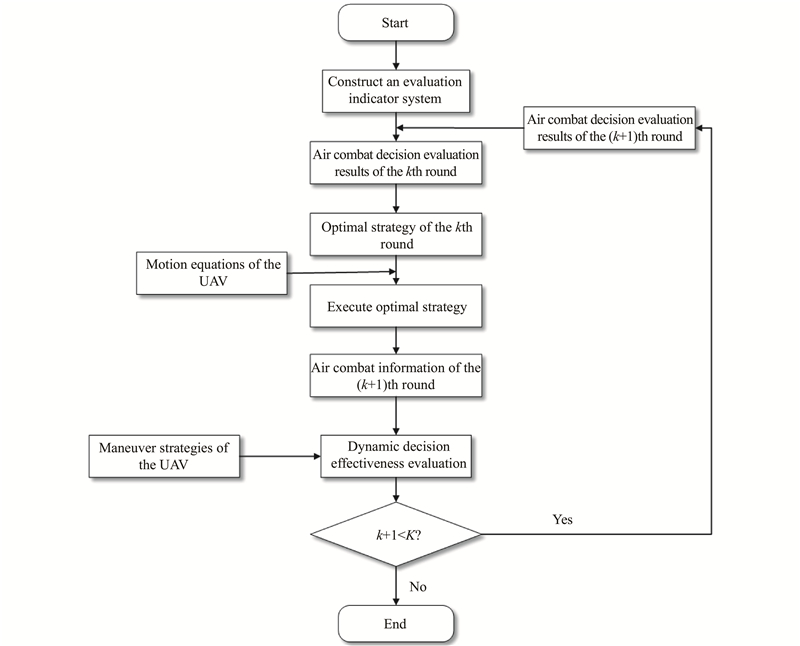
Fig 2
Process for evaluating the effectiveness of decisions in the (${\boldsymbol{k}} $+1)th round"
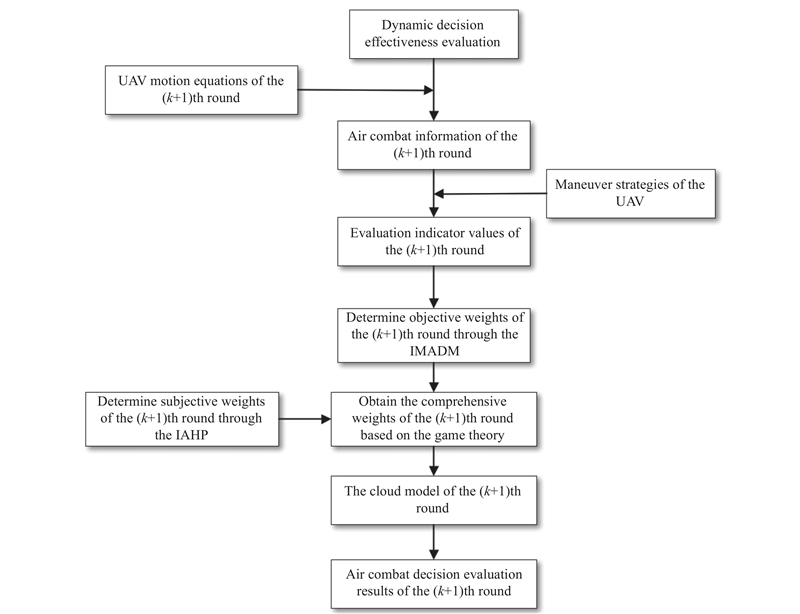
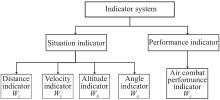
Fig 3
Indicator system for evaluating the effectiveness of decision-making"
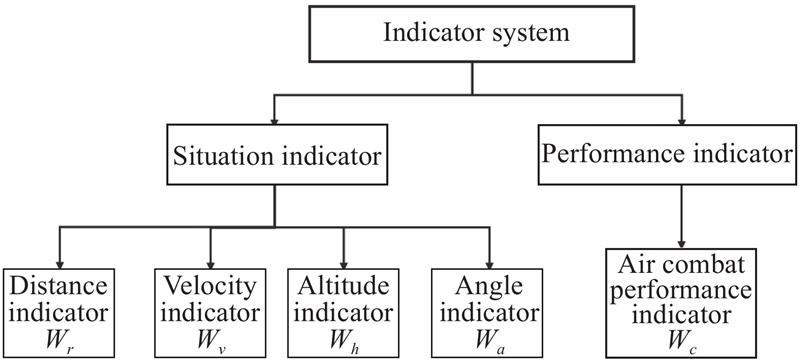

Table 1
Case 1 initial information"
| R/B | Performance | ||||||
| 5 | 5 | 4.95 | 125 | 5 | 30 | 0.6 | |
| 5.5 | 5 | 4.9 | 125 | 7.5 | 45 | 0.6 | |
| 50 | 52 | 4.85 | 100 | 15 | −120 | 0.4 | |
| 50 | 55 | 4.75 | 100 | 7.5 | −150 | 0.4 | |
| 50 | 60 | 4.75 | 100 | 7.5 | −120 | 0.4 | |
| 48 | 55 | 4.85 | 100 | 7.5 | −77 | 0.4 |
Table 2
Case 1 evaluation time"
| Method | Evaluation time/s |
| Virtual cloud evaluation method without considering opponent’s strategies | 231.357 |
| Cloud evaluation method without considering opponent’s strategies | 128.166 |
| Virtual cloud evaluation method under opponent’s optimal strategy | 100.243 |
| Cloud evaluation method under opponent’s optimal strategy | 2.448 |
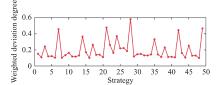
Fig 4
Weighted deviation degree of strategy"
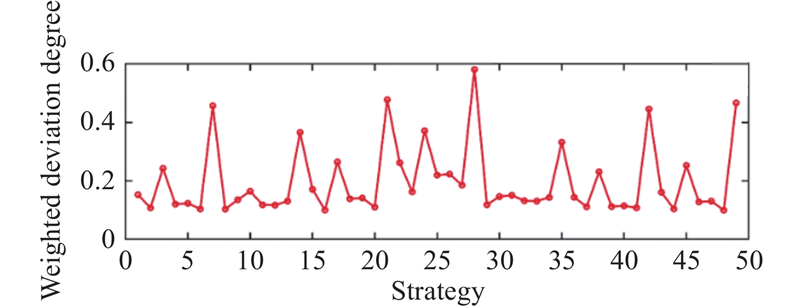
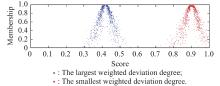
Fig 5
Evaluation cloud model"
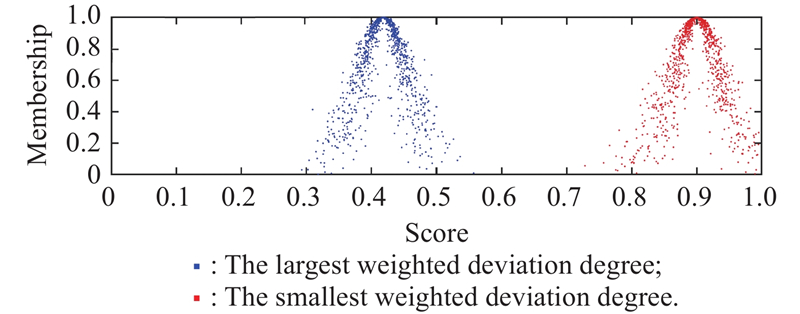
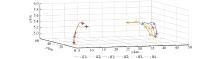
Fig 6
Flight path"
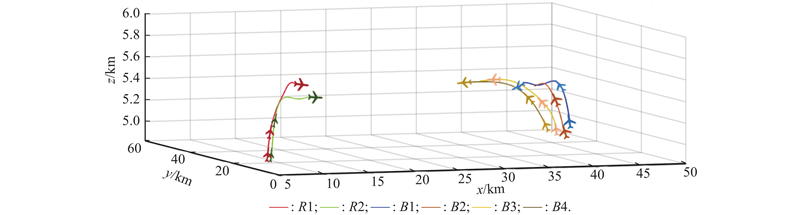
Table 3
Maneuver action plan of R"
| Round | Round | |||||
| 1 | Acceleration flight | Climb | 10 | Yaw left | Acceleration flight | |
| 2 | Acceleration flight | Yaw right | 11 | Yaw left | Dive | |
| 3 | Acceleration flight | Acceleration flight | 12 | Yaw right | Acceleration flight | |
| 4 | Acceleration flight | Acceleration flight | 13 | Yaw right | Acceleration flight | |
| 5 | Acceleration flight | Acceleration flight | 14 | Yaw right | Acceleration flight | |
| 6 | Acceleration flight | Acceleration flight | 15 | Acceleration flight | Dive | |
| 7 | Acceleration flight | Acceleration flight | 16 | Acceleration flight | Dive | |
| 8 | Acceleration flight | Acceleration flight | 17 | Uniformity flight | Acceleration flight | |
| 9 | Acceleration flight | Acceleration flight | 18 | Climb | Dive |
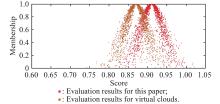
Fig 7
Compare cloud model"
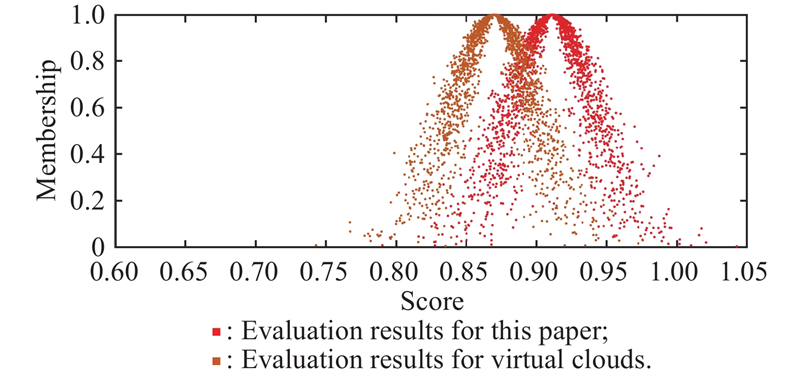
Table 4
Comparative analysis of AHP and IAHP"
| Method | Subjective weights of situational indicators | Manual modification of the judgment matrix | Number of computations |
| AHP | Yes | Greater than or equal to twice | |
| IAHP | No | Once |
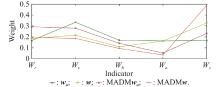
Fig 8
Actual objective weight and the comprehensive weight"
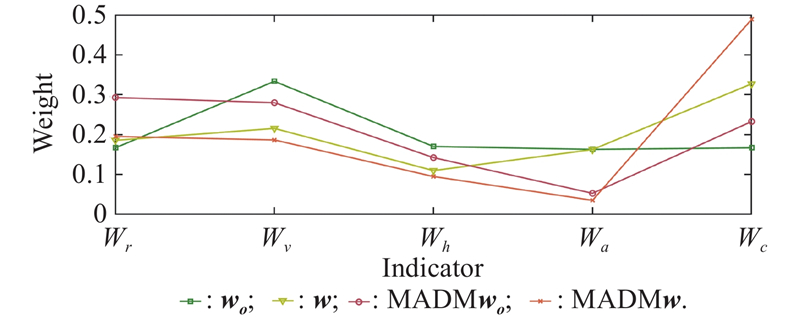
Table 5
Case 2 initial information"
| R/B | Performance | ||||||
| 21 | 40 | 4.9 | 125 | 5 | 30 | 0.6 | |
| 25 | 45 | 5.4 | 125 | 7.5 | 45 | 0.6 | |
| 80 | 75 | 4.75 | 100 | 15 | −120 | 0.4 | |
| 80 | 70 | 4.85 | 100 | 15 | −150 | 0.4 | |
| 80 | 80 | 4.85 | 100 | 7.5 | −120 | 0.4 | |
| 78 | 80 | 4.75 | 100 | 7.5 | −77 | 0.4 |
Table 6
Case 2 evaluation time"
| Method | Evaluation time/s |
| Virtual cloud evaluation method without considering opponent’s strategies | 225.326 |
| Cloud evaluation method without considering opponent’s strategies | 125.763 |
| Virtual cloud evaluation method under opponent’s optimal strategy | 104.654 |
| Cloud evaluation method under opponent’s optimal strategy | 3.225 |
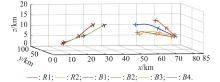
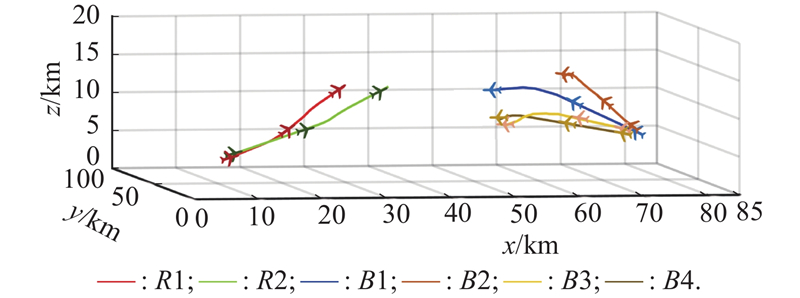
Fig 9
Flight path"
| 1 |
LI S Y, CHEN M, WANG Y H, et al Air combat decision-making of multiple UCAVs based on constraint strategy games. Defence Technology, 2022, 18 (3): 368- 383.
doi: 10.1016/j.dt.2021.01.005 |
| 2 |
ZHOU W Q, ZHU J H, KUANG M C, et al Multi-UAV cooperative swarm algorithm in air combat based on predictive game tree. SCIENTIA SINICA Technologica, 2023, 53 (2): 187- 199.
doi: 10.1360/SST-2021-0294 |
| 3 |
FAN J R, LI D G, LI R P, et al Analysis on MAV/UAV cooperative combat based on complex network. Defence Technology, 2020, 16 (1): 150- 157.
doi: 10.1016/j.dt.2019.09.002 |
| 4 |
BAYKASOGLU A, GOLCUK I A dynamic multiple attribute decision making model with learning of fuzzy cognitive maps. Computers & Industrial Engineering, 2019, 135, 1063- 1076.
doi: 10.1016/j.cie.2019.06.032 |
| 5 | ZAYAT W, KILIC H S, YALCIN A S, et al. Application of MADM methods in industry 4.0: a literature review. Computers & Industrial Engineering, 2023, 177: 109075. |
| 6 |
JANA C, PAL M A dynamical hybrid method to design decision making process based on GRA approach for multiple attributes problem. Engineering Applications of Artificial Intelligence, 2021, 100, 104203.
doi: 10.1016/j.engappai.2021.104203 |
| 7 |
CHEN S W, LI Z G, XU Q S Grey target theory based equipment condition monitoring and wear mode recognition. Wear, 2006, 260 (4/5): 438- 449.
doi: 10.1016/j.wear.2005.02.085 |
| 8 | YOON K, HWANG C L. Multiple attribute decision making: methods and applications. Berlin: Springer-Verlag, 1981. |
| 9 |
HU H J, LIAO Y L Application of Bayesian network and genetic algorithm in construction safety evaluation. Proceedings of the Institution of Civil Engineers-Smart Infrastructure and Construction, 2024, 177 (3): 199- 208.
doi: 10.1680/jsmic.22.00034 |
| 10 |
ZHOU J X, WEI S B, CHAI Y Using improved dynamic Bayesian networks in reliability evaluation for flexible test system of aerospace pyromechanical device products. Reliability Engineering & System Safety, 2021, 210, 107508.
doi: 10.1016/j.ress.2021.107508 |
| 11 |
XING Z K, HE Y G, CHEN J F, et al Health evaluation of power transformer using deep learning neural network. Electric Power Systems Research, 2023, 215, 109016.
doi: 10.1016/j.jpgr.2022.109016 |
| 12 |
SUN W, XU Y F Financial security evaluation of the electric power industry in China based on a back propagation neural network optimized by genetic algorithm. Energy, 2016, 101, 366- 379.
doi: 10.1016/j.energy.2016.02.046 |
| 13 | SUN Y K, FANG Z G, CHEN D Multi temporal threat assessment based on dynamic grey principal component analysis. Systems Engineering and Electronics, 2021, 43 (3): 740- 746. |
| 14 | SU L. Research on the efficiency evaluation model and method of airborne fire control radar under multi-machine collaborative conditions. Zhengzhou: Zhengzhou University, 2016. (in Chinese) |
| 15 |
SHIDPOUR H, CUNHA C D, BERNARD A Group multi-criteria design concept evaluation using combined rough set theory and fuzzy set theory. Expert Systems with Applications, 2016, 64, 633- 644.
doi: 10.1016/j.eswa.2016.08.022 |
| 16 |
HE Y X, PANG Y X, ZHANG Q, et al Comprehensive evaluation of regional clean energy development levels based on principal component analysis and rough set theory. Renewable Energy, 2018, 122, 643- 653.
doi: 10.1016/j.renene.2018.02.028 |
| 17 |
WU H W, ZHEN J, ZHANG J Urban rail transit operation safety evaluation based on an improved CRITIC method and cloud model. Journal of Rail Transport Planning & Management, 2020, 16, 100206- 100221.
doi: 10.1016/j.jrtpm.2020.100206 |
| 18 |
SHI L K, PEI Y, YUN Q J, et al Agent-based effectiveness evaluation method and impact analysis of airborne laser weapon system in cooperation combat. Chinese Journal of Aeronautics, 2023, 36 (4): 442- 454.
doi: 10.1016/j.cja.2022.11.006 |
| 19 |
MA S D, ZHANG H Z, YANG G Q Target threat level assessment based on cloud model under fuzzy and uncertain conditions in air combat simulation. Aerospace Science and Technology, 2017, 67, 49- 53.
doi: 10.1016/j.ast.2017.03.033 |
| 20 | XU A, CHEN X, LI Z W, et al A situation assessment method for beyond visual range air combat based on tactical attack zone. Firepower and Command and Control, 2020, 45 (9): 97- 102. |
| 21 | GAO Y Y, YU M J Multi-target threat level assessment in air combat based on cloud model and improved entropy weight. Firepower and Command and Control, 2018, 43 (9): 35- 39. |
| 22 |
ZHANG H J, LU M K, KE X B, et al Evaluation model of black-start schemes based on optimal combination weights and improved VIKOR method. International Journal of Electrical Power & Energy Systems, 2021, 129, 106762.
doi: 10.1016/j.ijepes.2021.106762 |
| 23 |
MARAVER D, SIN A, SEBASTIAN F, et al Environmental assessment of CCHP (combined cooling heating and power) systems based on biomass combustion incomparison to conventional generation. Energy, 2013, 57 (8): 17- 23.
doi: 10.1016/j.energy.2013.02.014 |
| 24 | LI H. Research on threat assessment methods for air raid targets in air defense operations. Xi’an: Xi’an University of Technology, 2023. (in Chinese) |
| 25 |
DING J F, SI G Y, MA J, et al Mission evaluation: expert evaluation system for large-scale combat tasks of the weapon system of systems. SCIENCE CHINA Information Sciences, 2018, 61 (1): 1- 19.
doi: 10.1007/s11432-016-9071-5 |
| 26 | HUANG L, ZHU J, DUAN Q F Extensive game decision based on the PPO-CFR algorithm under incomplete information. SCIENTIA SINICA Information Sciences, 2022, 52 (12): 2178. |
| 27 | LI D Y, LIU C Y On the universality of normal cloud model. Engineering Science of China, 2004, (8): 28- 34. |
| 28 |
ZHU J H, YANG Q, JIANG J Identifying crucial deficiency categories influencing ship detention: a method of combining cloud model and prospect theory. Reliability Engineering & System Safety, 2023, 230, 108949.
doi: 10.1016/j.ress.2022.108949 |
| 29 | RUAN D M, BIAN J M, WANG Q, et al Application of modified cloud model-level eigenvalue method in water quality evaluation. Journal of Hydrology, 2021, 603, 606980. |
| 30 |
WEN X X, NIE Y, DU Z X, et al Operational safety assessment of straddle-type monorail vehicle system based on cloud model and improved CRITIC method. Engineering Failure Analysis, 2022, 139, 106463.
doi: 10.1016/j.engfailanal.2022.106463 |
| [1] | Xingyu WANG, Zhen YANG, Shiyuan CHAI, Yupeng HE, Weiyu HUO, Deyun ZHOU. Integrated threat assessment method of beyond-visual-range air combat [J]. Journal of Systems Engineering and Electronics, 2025, 36(1): 176-193. |
| [2] | Xiaoyan NING, Ying WANG, Zhenduo WANG, Zhiguo SUN. Link-16 anti-jamming performance evaluation based on grey relational analysis and cloud model [J]. Journal of Systems Engineering and Electronics, 2025, 36(1): 62-72. |
| [3] | Kewei YANG, Jichao LI, Maidi LIU, Tianyang LEI, Xueming XU, Hongqian WU, Jiaping CAO, Gaoxin QI. Complex systems and network science: a survey [J]. Journal of Systems Engineering and Electronics, 2023, 34(3): 543-573. |
| [4] | Yunxiu ZENG, Kai XU. Recognition and interfere deceptive behavior based on inverse reinforcement learning and game theory [J]. Journal of Systems Engineering and Electronics, 2023, 34(2): 270-288. |
| [5] | Xin GUAN, Shuangming LI, Guidong SUN, Haibin WANG. IFCEM based recognition method for target with interval-overlapped hybrid attributes [J]. Journal of Systems Engineering and Electronics, 2023, 34(2): 408-421. |
| [6] | Bing HUA, Rui NI, Mohong ZHENG, Yunhua WU, Zhiming CHEN. Cooperative game theory-based steering law design of a CMG system [J]. Journal of Systems Engineering and Electronics, 2023, 34(1): 185-196. |
| [7] | Shouyi LI, Mou CHEN, Qingxian WU, Yuhui WANG. Threat sequencing of multiple UCAVs with incomplete information based on game theory [J]. Journal of Systems Engineering and Electronics, 2022, 33(4): 986-996. |
| [8] | Ming ZHANG, Jianjun ZHU, Hehua WANG. Evolutionary game analysis of problem processing mechanism in new collaboration [J]. Journal of Systems Engineering and Electronics, 2021, 32(1): 136-150. |
| [9] | Jie ZHANG, Gang WANG, Shaohua YUE, Yafei SONG, Jiayi LIU, Xiaoqiang YAO. Multi-agent system application in accordance with game theory in bi-directional coordination network model [J]. Journal of Systems Engineering and Electronics, 2020, 31(2): 279-289. |
| [10] | Zhuoming LI, Xing CHEN, Yu ZHANG, Peng WANG, Wei QIANG, Ningqing LIU. Fuzzy mathematics and game theory based D2D multicast network construction [J]. Journal of Systems Engineering and Electronics, 2019, 30(1): 13-21. |
| [11] | Xiaolong XU, Qitong ZHANG, Yiqi MOU, Xinyuan LU. Server load prediction algorithm based on CM-MC for cloud systems [J]. Journal of Systems Engineering and Electronics, 2018, 29(5): 1069-1078. |
| [12] | Chao GENG, Shiyou QU, Yingying XIAO, Mei WANG, Guoqiang SHI, Tingyu LIN, Junjie XUE, Zhengxuan JIA. Diffusion mechanism simulation of cloud manufacturing complex network based on cooperative game theory [J]. Journal of Systems Engineering and Electronics, 2018, 29(2): 321-335. |
| [13] | Qilong SUN, Naiming QI, Longxu XIAO, Haiqi LIN. Differential game strategy in three-player evasion and pursuit scenarios [J]. Journal of Systems Engineering and Electronics, 2018, 29(2): 352-366. |
| [14] | Qiang Guo, Pulong Nan, and Jian Wan. Signal classification method based on data mining for multi-mode radar [J]. Journal of Systems Engineering and Electronics, 2016, 27(5): 1010-1017. |
| [15] | Yufei Liu, Dechang Pi, and Qiyou Cheng. Ensemble kernel method: SVM classification based on game theory [J]. Systems Engineering and Electronics, 2016, 27(1): 251-. |
| Viewed | ||||||
|
Full text |
|
|||||
|
Abstract |
|
|||||
