
Journal of Systems Engineering and Electronics ›› 2026, Vol. 37 ›› Issue (2): 357-366.doi: 10.23919/JSEE.2026.000061
• ELECTRONICS TECHNOLOGY • Previous Articles
Chang CUI1,2,3( ), Guiyan WEI2(), Xichao DONG1,2,3,*(), Cheng HU1,2,3(), Jianping WANG1,2,3()
Received:2024-07-16
Accepted:2026-03-26
Online:2026-04-18
Published:2026-04-30
Contact:
Xichao DONG
E-mail:cuichang0329@qq.com;weigy9677@163.com;xcdong@bit.edu.cn;cchchb@163.com;jianpingwang@bit.edu.cn
About author:Supported by:Chang CUI, Guiyan WEI, Xichao DONG, Cheng HU, Jianping WANG. MMF-SLR: a sign language recognition method based on multi-modal feature using millimeter-wave radar[J]. Journal of Systems Engineering and Electronics, 2026, 37(2): 357-366.
Add to citation manager EndNote|Reference Manager|ProCite|BibTeX|RefWorks
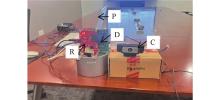
Fig 1
Composition of the data acquisition hardware"
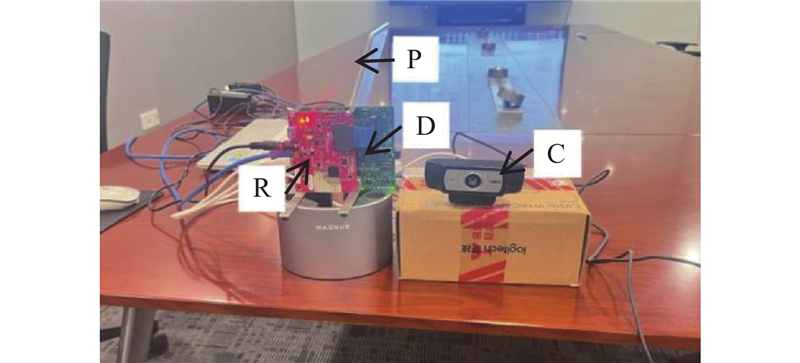
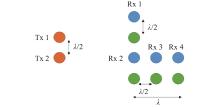
Fig 2
Distribution of AWR1642BOOST-ODS antennas: the blue circles are the real antennas and the green circles are the virtual antennas"
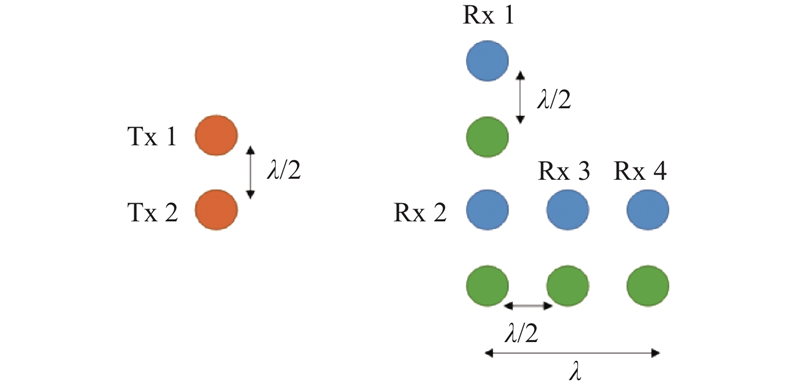
Fig 3
Multimodal features fusion framework for SLR"
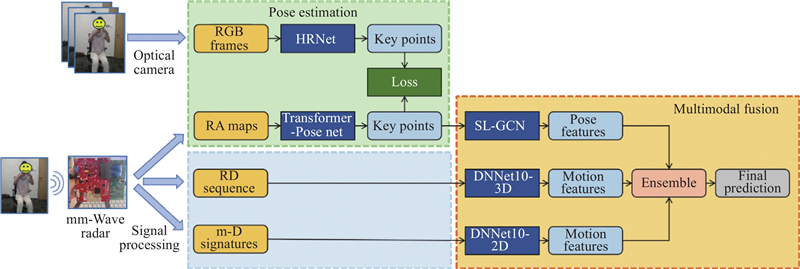
Fig 4
Transformer-pose attitude estimation network frame diagram"
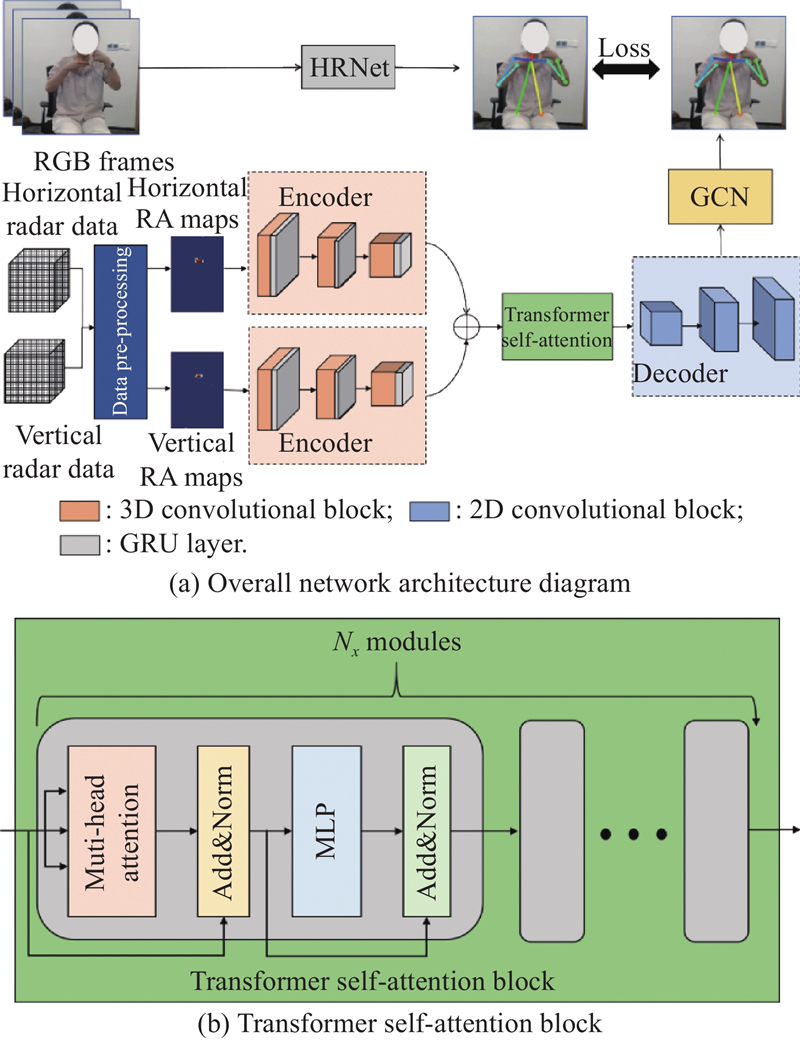
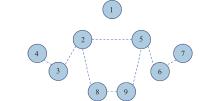
Fig 5
Key points for SLR"
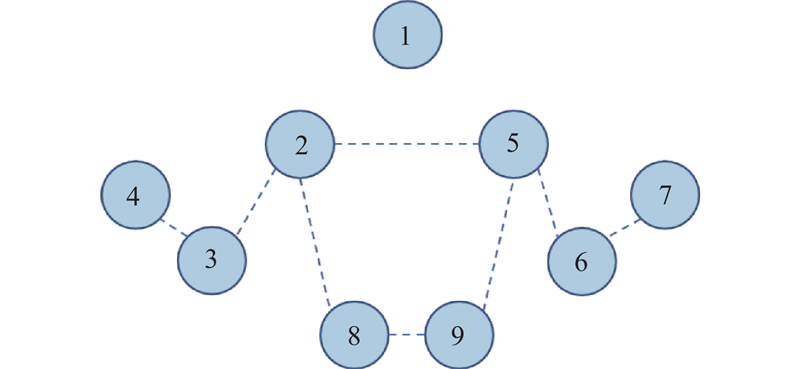
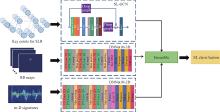
Fig 6
Multimodal fusion SLR network"
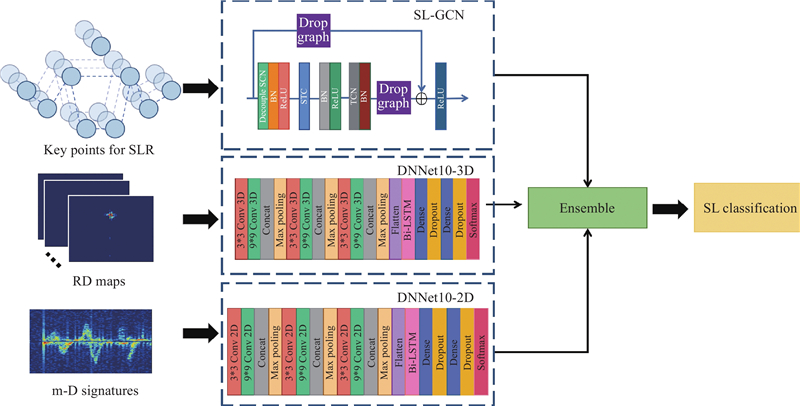
Fig 7
Diagram of SL data collection"
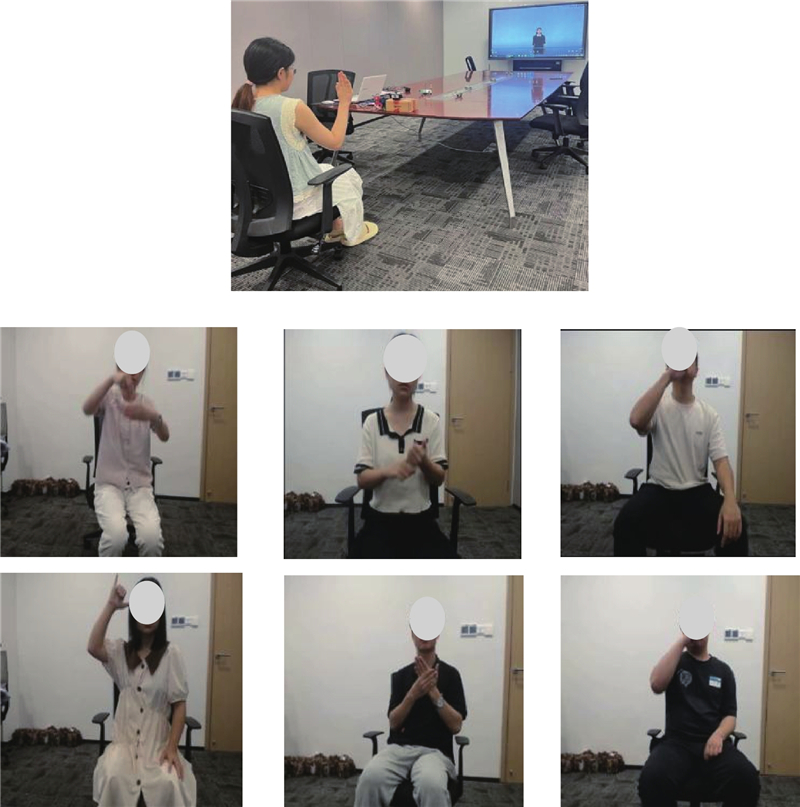

Table 1
Parameters of the mm-wave radar"
| Parameter name | Value | Parameter name | Value | |
| Frequency/GHz | 77 | Bandwidth/GHz | 4 | |
| Sweep slope/(MHz/μs) | 66.578 | ADC sampling rate/MHz | 6.25 | |
| ADC sampling points | 256 | PRF/kHz | 3.1 | |
| Number of frames | 32 | Frame period/ms | 82 |
Fig 8
Diagram of SL skeletal poses"
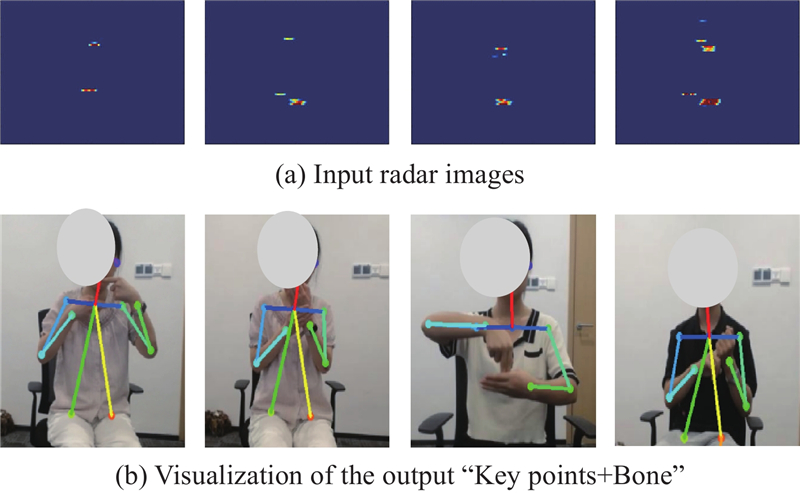
Table 2
Performance of key point detection"
| Key point | Head | Shoulder | Elbow | Wrist | Hip |
| 75.8 | 67.9 | 53.1 | 30.2 | 90.1 |
Table 3
Ablation experimental results with and without the Transformer module"
| Model | mAP | AP50 | AP75 | Average OKS |
| Without Transformer module | 57.1 | 95.5 | 61.5 | 70.8 |
| With Transformer module | 59.0 | 94.4 | 71.6 | 75.0 |
Table 4
SLR performance by using skeleton information"
| Stream | SLR accuracy/% |
| RA maps | 51.94 |
| Bone feature | 94.95 |
| Key points feature | 95.96 |
| Key points + Bone | 96.79 |
Table 5
Recognition accuracy for each sign language"
| Sign | A | B | C | D | E | Sign | F | G | H | I | J | |
| Key points | 100 | 100 | 100 | 100 | 100 | Key points | 100 | 90 | 100 | 70 | 100 | |
| Bone | 80 | 100 | 100 | 100 | 100 | Bone | 100 | 80 | 100 | 100 | 100 | |
| Enseme | 100 | 100 | 100 | 100 | 100 | enseme | 100 | 100 | 100 | 80 | 100 |
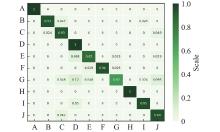
Fig 9
SLR Confusion matrix based on the m-D signature"
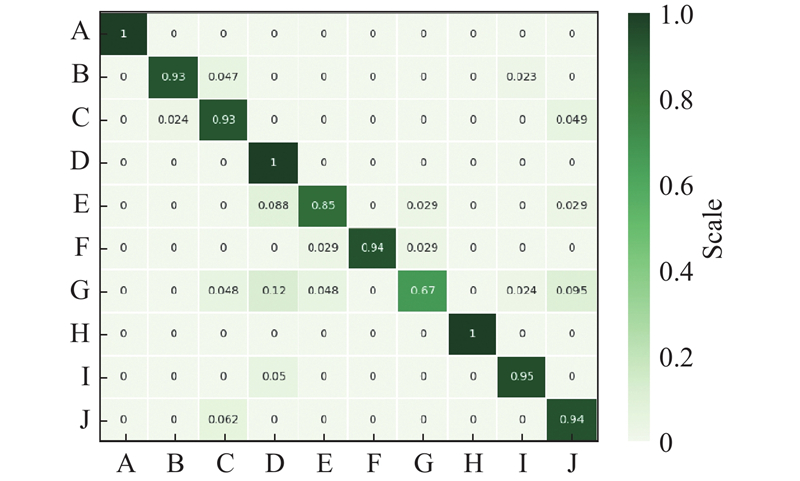
Table 6
Ablation experiments results with and without the Bi-LSTM module"
| SL | Without Bi-LSTM | With Bi-LSTM |
| A | 96.6 | 100 |
| B | 79.6 | 100 |
| C | 92.7 | 90.9 |
| D | 96 | 96.4 |
| E | 80.6 | 76.3 |
| F | 90.6 | 94.1 |
| G | 62.8 | 70 |
| H | 94.9 | 100 |
| I | 89.7 | 100 |
| J | 88.9 | 93.5 |
| Average | 87.24 | 92.12 |
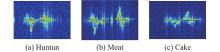
Fig 10
m-D signatures of different SL"
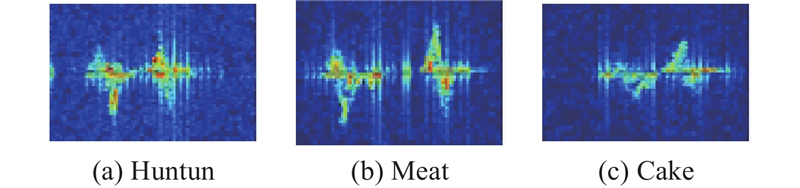
Table 7
Performance of MMF-SLR network"
| Streams | SLR accuracy/% |
| RA maps | 51.94 |
| RD sequence | 53.05 |
| m-D signatures | 92.06 |
| Key points + Bone | 96.79 |
| RA + RD + m-D | 78.80 |
| Key points + Bone + RD + m-D | 98.99 |
| 1 |
VERMIGLIO A J, FANG X M The World Health Organization (WHO) hearing impairment guidelines and a speech recognition in noise (SRN) disorder. International Journal of Audiology, 2022, 61 (10): 818- 825.
doi: 10.1080/14992027.2021.1976424 |
| 2 |
TUBAIZ N, SHANABLEH T, ASSALEH K Glove-based continuous Arabic sign language recognition in user-dependent mode. IEEE Trans. on Human-Machine Systems, 2015, 45 (4): 526- 533.
doi: 10.1109/THMS.2015.2406692 |
| 3 |
GUO W C, WANG M, SHENG X J, et al Towards semi-supervised myoelectric finger motion recognition based on spatial motor units activation. Science China Technological Sciences, 2022, 65 (6): 1232- 1242.
doi: 10.1007/s11431-022-2035-9 |
| 4 |
ZOU Y X, CHENG L, HAN L J, et al Multi-modal fusion for robust hand gesture recognition based on heterogeneous networks. Science China Technological Sciences, 2023, 66 (11): 3219- 3230.
doi: 10.1007/s11431-022-2345-2 |
| 5 |
BAI X, LI Y H, GUO S Z, et al Recognition for underground voids in C-scans based on GMM-HMM. Journal of Systems Engineering and Electronics, 2025, 36 (1): 82- 94.
doi: 10.23919/JSEE.2024.000093 |
| 6 |
ADALOGLOU N, CHATZIS T, PAPASTRAITS I, et al A comprehensive study on deep learning-based methods for sign language recognition. IEEE Trans. on Multimedia, 2022, 24, 1750- 1762.
doi: 10.1109/TMM.2021.3070438 |
| 7 |
CHEN J Y, WANG X H, CHEN X Track correlation algorithm based on CNN-LSTM for swarm targets. Journal of Systems Engineering and Electronics, 2024, 35 (2): 417- 429.
doi: 10.23919/JSEE.2024.000033 |
| 8 |
XIA Z Y, LUOMEI Y X, ZHOU C L, et al Multidimensional feature representation and learning for robust hand-gesture recognition on commercial millimeter-wave radar. IEEE Trans. on Geoscience and Remote Sensing, 2021, 59 (6): 4749- 4764.
doi: 10.1109/TGRS.2020.3010880 |
| 9 |
MA T K, CHEN Z P, WU J X, et al A 77 GHz FMCW MIMO radar system based on 65nm CMOS cascadable 2T3R transceiver. Science China Information Sciences, 2021, 64 (1): 114301.
doi: 10.1007/s11432-019-1511-5 |
| 10 | ZHU Z L, YANG D G, ZHANG J C, et al Dataset of human motion status using IR-UWB through-wall radar. Journal of Systems Engineering and Electronics, 2021, 32 (5): 1083- 1096. |
| 11 |
DONG X C, FENG Y, CUI C, et al CEEMDAN-ICA-based radar monitoring of adjacent multi-target vital signs. Electronics, 2023, 12 (12): 2732.
doi: 10.3390/electronics12122732 |
| 12 |
LONG T, LIANG Z N, LIU Q H Advanced technology of high-resolution radar: target detection, tracking, imaging, and recognition. Science China Information Sciences, 2019, 62, 40301.
doi: 10.1007/s11432-018-9811-0 |
| 13 | GURBUZ S Z, GURBUZ A C, MALAIA E A, et al American sign language recognition using RF sensing. IEEE Sensors Journal, 2021, 21 (3): 3763- 3775. |
| 14 |
LI B C, YANG J Y, YANG Y, et al Sign language/gesture recognition based on cumulative distribution density features using UWB radar. IEEE Trans. on Instrumentation and Measurement, 2021, 70, 2511113.
doi: 10.1109/tim.2021.3092072 |
| 15 | RAHMAN M M, MDRAFI R, GURBUZ A C, et al. Word-level sign language recognition using linguistic adaptation of 77 GHz FMCW radar data. Proc. of the IEEE Radar Conference, 2021: 1−6. |
| 16 | MCCLEARY J, GARCIA L P, ILIOUDIS C, et al. Sign language recognition using micro-Doppler and explainable deep learning. Proc. of the IEEE Radar Conference (RadarConf21), 2021. DOI: 10.1109/RadarConf2147009.2021.9455257. |
| 17 | GURBUZ S Z, GURBUZ A C, MALAIA E A, et al. A linguistic perspective on radar micro-Doppler analysis of American sign language. Proc. of the IEEE International Radar Conference, 2020: 232−237. |
| 18 |
LI Y D, ZHANG D H, CHEN J B, et al Towards domain-independent and real-time gesture recognition using mmWave signal. IEEE Trans. on Mobile Computing, 2023, 22 (12): 7355- 7369.
doi: 10.1109/tmc.2022.3207570 |
| 19 | CHEN M H, GAO H Y, DU Y N, et al Direction finding of bistatic MIMO radar in strong impulse noise. Journal of Systems Engineering and Electronics, 2024, 35 (4): 888- 898. |
| 20 |
DANG X C, WEI K F, HAO Z J, et al Cross-scene sign language gesture recognition based on frequency-modulated continuous wave radar. Signals, 2022, 3 (4): 875- 894.
doi: 10.3390/signals3040052 |
| 21 |
KURTOGLU E, GURBUZ A C, MALAIA E A, et al ASL trigger recognition in mixed activity/signing sequences for RF sensor-based user interfaces. IEEE Trans. on Human-Machine Systems, 2022, 52 (4): 699- 712.
doi: 10.1109/THMS.2021.3131675 |
| 22 | DONG X C, ZHAO Z W, WANG Y P, et al FMCW radar-based hand gesture recognition using spatiotemporal deformable and context-aware convolutional 5-D feature representation. IEEE Trans. on Geoscience and Remote Sensing, 2022, 60, 5107011. |
| 23 | JANKIRAMAN M. FMCW radar design. London: Artech House, 2018. |
| 24 | ZHAO M M, LI T H, ALSHEIKH M A, et al. Through-wall human pose estimation using radio signals. Proc. of the IEEE/CVF Conference on Computer Vision and Pattern Recognition, 2018: 7356−7365. |
| 25 |
HUANG Y, ZHANG Y J, TAO J, et al Off-grid DOA estimation via a deep learning framework. Science China Information Sciences, 2023, 66 (12): 222305.
doi: 10.1007/s11432-022-3750-5 |
| 26 |
WANG Y Z, JIANG Z Y, LI Y D, et al RODNet: a real-time radar object detection network cross-supervised by camera-radar fused object 3D localization. IEEE Journal of Selected Topics in Signal Processing, 2021, 15 (4): 954- 967.
doi: 10.1109/JSTSP.2021.3058895 |
| 27 | SUN K, XIAO B, LIU D, et al. Deep high-resolution representation learning for human pose estimation. Proc. of the IEEE/CVF Conference on Computer Vision and Pattern Recognition, 2019: 5693−5703. |
| 28 | LEE S P, KINI N P, PENG W H, et al. HuPR: a benchmark for human pose estimation using millimeter wave radar. Proc. of the IEEE/CVF Winter Conference on Applications of Computer Vision , 2023: 5704−5713. |
| 29 | KO S K, SON J G, JUNG H. Sign language recognition with recurrent neural network using human keypoint detection. Proc. of the Conference on Research in Adaptive and Convergent Systems, 2018: 326−328. |
| 30 | JIANG S Y, SUN B, WANG L C, et al. Skeleton aware multi-modal sign language recognition. Proc. of the IEEE/CVF Conference on Computer Vision and Pattern Recognition, 2021: 3408−3418. |
| [1] | Bingdong LIU, Ruihang YU, Zhiming XIONG, Meiping WU. A lightweight pure visual BEV perception method based on dual distillation of spatial-temporal knowledge [J]. Journal of Systems Engineering and Electronics, 2026, 37(1): 36-44. |
| [2] | Delong WU, Hao FANG, Yiren HAO, Aobo WANG. Outdoor navigation of millimeter-wave radar quadrotors based on optimal virtual tube [J]. Journal of Systems Engineering and Electronics, 2025, 36(4): 1057-1067. |
| [3] | Jun TANG, Wanting QIN, Qingtao PAN, Songyang LAO. A deep multimodal fusion and multitasking trajectory prediction model for typhoon trajectory prediction to reduce flight scheduling cancellation [J]. Journal of Systems Engineering and Electronics, 2024, 35(3): 666-678. |
| [4] | Weikun HE, Jingbo SUN, Xinyun ZHANG, Zhenming LIU. Micro-Doppler feature extraction of micro-rotor UAV under the background of low SNR [J]. Journal of Systems Engineering and Electronics, 2022, 33(6): 1127-1139. |
| [5] | Zijian ZHU, Wenhao XIANG, Ju HUO, Ming YANG, Guiyang ZHANG, Liang WEI. Non-cooperative target pose estimation based on improved iterative closest point algorithm [J]. Journal of Systems Engineering and Electronics, 2022, 33(1): 1-10. |
| [6] | Yong WANG, Xingyu ZHOU, Xiaofei LU, Yajun LI. An approach of motion compensation and ISAR imaging for micro-motion targets [J]. Journal of Systems Engineering and Electronics, 2021, 32(1): 68-80. |
| [7] | Wantian WANG, Ziyue TANG, Yichang CHEN, Yongjian SUN. Parity recognition of blade number and manoeuvre intention classification algorithm of rotor target based on micro-Doppler features using CNN [J]. Journal of Systems Engineering and Electronics, 2020, 31(5): 884-889. |
| [8] | Hongzhi LI, Yong WANG. Particle swarm optimization for rigid body reconstruction after micro-Doppler removal in radar analysis [J]. Journal of Systems Engineering and Electronics, 2020, 31(3): 488-499. |
| [9] | Jingqing Li, Sisan He, Cunqian Feng, and Yizhe Wang. Method for compensating translational motion of rotationally symmetric target based on local symmetry cancellation [J]. Systems Engineering and Electronics, 2017, 28(1): 36-. |
| [10] | Yuling Liu, Xizhang Wei, Bo Peng, and Yongshun Ling. Dimensions estimation for cone-cylinder target based on sliding-type scatterers analysis [J]. Systems Engineering and Electronics, 2017, 28(1): 10-. |
| [11] | Yong Wang and Jian Kang. Parameter estimation for rigid body after micro-Doppler removal based on L-statistics in the radar analysis [J]. Systems Engineering and Electronics, 2015, 26(3): 457-467. |
| [12] | Bin Deng, Yuliang Qin, Hongqiang Wang, and Yanpeng Li. Angular extent effect of micromotion target in SAR image by polar format algorithm [J]. Journal of Systems Engineering and Electronics, 2014, 25(3): 428-433. |
| [13] | Yuliang Qin, Bin Deng, Zonghui Huang, and Wuge Su. Hybrid micromotion-scattering center model for synthetic aperture radar micromotion target imaging [J]. Journal of Systems Engineering and Electronics, 2013, 24(6): 931-937. |
| [14] | Wei Wei, Yanning Zhang, and Chunna Tian. Head pose estimation method based on pose manifold and tensor decomposition [J]. Journal of Systems Engineering and Electronics, 2010, 21(5): 907-913. |
| [15] | Yan Wu, Yuping Wang, Xiaoxiong Liu, and Jimin Ye. Multi-population and diffusion UMDA for dynamic multimodal problems [J]. Journal of Systems Engineering and Electronics, 2010, 21(5): 777-783. |
| Viewed | ||||||
|
Full text |
|
|||||
|
Abstract |
|
|||||
