
Journal of Systems Engineering and Electronics ›› 2026, Vol. 37 ›› Issue (2): 548-566.doi: 10.23919/JSEE.2026.000065
• SYSTEMS ENGINEERING • Previous Articles
Yingying MA1,2( ), He LUO1,3,*(), Guoqiang WANG1,4(), Waiming ZHU1,4(), Xiaoxuan HU1,2()
Received:2023-12-05
Accepted:2026-03-19
Online:2026-04-18
Published:2026-04-30
Contact:
He LUO
E-mail:mayy@hfuu.edu.cn;luohe@hfut.edu.cn;gqwang2017@hfut.edu.cn;zhuwaiming@hfut.edu.cn;xiaoxuanhu@hfut.edu.cn
About author:Supported by:Yingying MA, He LUO, Guoqiang WANG, Waiming ZHU, Xiaoxuan HU. A game theoretic model and a double oracle algorithm for the heterogeneous weapon target assignment problem[J]. Journal of Systems Engineering and Electronics, 2026, 37(2): 548-566.
Add to citation manager EndNote|Reference Manager|ProCite|BibTeX|RefWorks
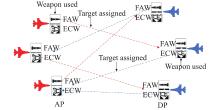
Fig 1
Diagram of the HWTA problem"
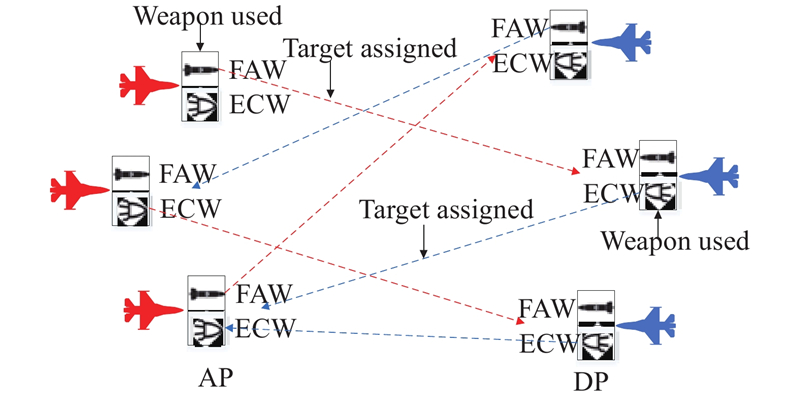
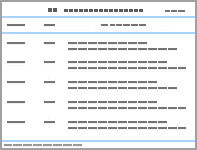
Table 1
Parameters declaration"
| Symbol | Description |
| m | The number of APs |
| n | The number of DPs |
| The kill probability of the AP | |
| The interference probability of the AP | |
| The value of the AP | |
| The kill probability of the DP | |
| The interference probability of the DP | |
| The value of the DP |
Table 2
Parameter generation range for Set 1"
| Parameter | Range |
| 0.30−0.90 | |
| 0.30−0.70 | |
| 25−100 | |
| 0.30−0.90 | |
| 0.30−0.70 | |
| 25−100 |
Table 3
Average computing time of different algorithms s"
| Instance | m | n | LH | DOEM | DONS | DOCH |
| 1-1 | 3 | 3 | 115.55 | 1.20 | 0.03 | 0.04 |
| 1-2 | 4 | 21.75 | 0.07 | 0.06 | ||
| 1-3 | 5 | − | 15.88 | 0.11 | 0.01 | |
| 1-4 | 6 | − | 976.72 | 0.17 | 0.05 | |
| 2-1 | 4 | 5 | − | 0.62 | 0.05 | |
| 2-2 | 5 | − | 0.23 | 0.09 | ||
| 2-3 | 6 | − | − | 0.83 | 0.20 | |
| 2-4 | 7 | − | − | 0.93 | 0.13 | |
| 3-1 | 7 | 10 | − | − | 7.57 | 0.24 |
| 3-2 | 10 | − | − | 16.21 | 0.37 | |
| 3-3 | 12 | − | − | 6.22 | 0.28 | |
| 3-4 | 15 | − | − | 9.51 | 0.52 | |
| 4-1 | 10 | 20 | − | − | 34.37 | 0.41 |
| 4-2 | 20 | − | − | 80.81 | 1.56 | |
| 4-3 | 30 | − | − | 194.06 | 2.72 | |
| 4-4 | 40 | − | − | 602.91 | 1.84 | |
| 5-1 | 30 | 40 | − | − | 944.54 | 5.32 |
| 5-2 | 40 | − | − | 3.43 | ||
| 5-3 | 50 | − | − | 7.03 | ||
| 5-4 | 60 | − | − | 7.16 | ||
| 6-1 | 50 | 60 | − | − | − | 10.24 |
| 6-2 | 60 | − | − | − | 12.10 | |
| 6-3 | 70 | − | − | − | 13.43 | |
| 6-4 | 80 | − | − | − | 16.93 |
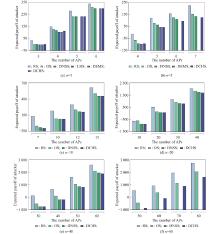
Fig 2
Comparison of the expected payoff of attacker when the attacker takes the DCHS"
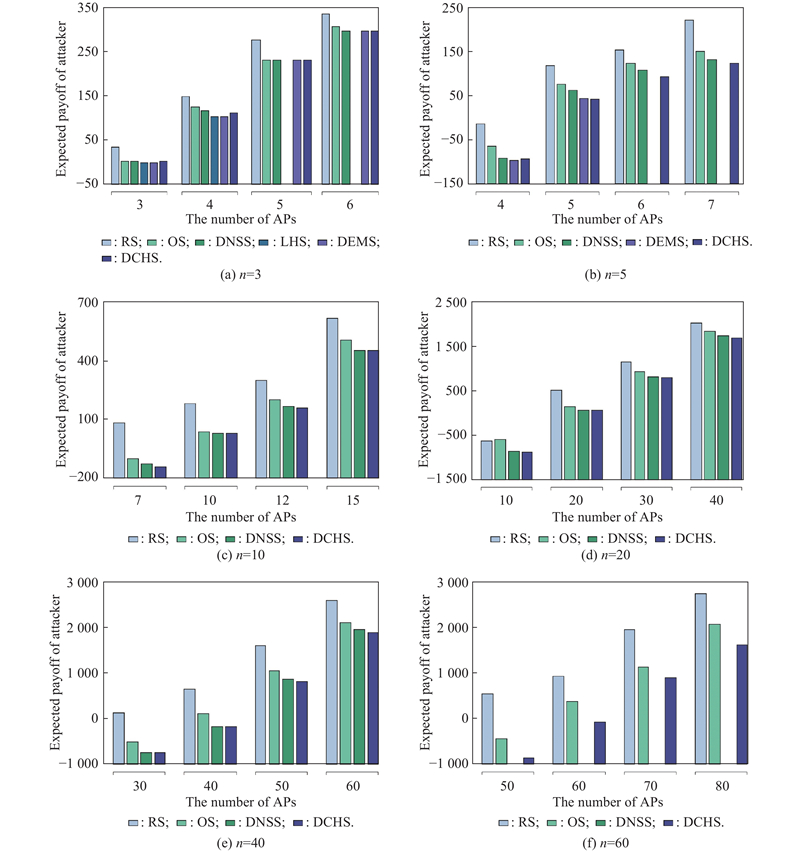
Fig 3
Comparison of the expected payoff of attacker when the defender takes the DCHS"
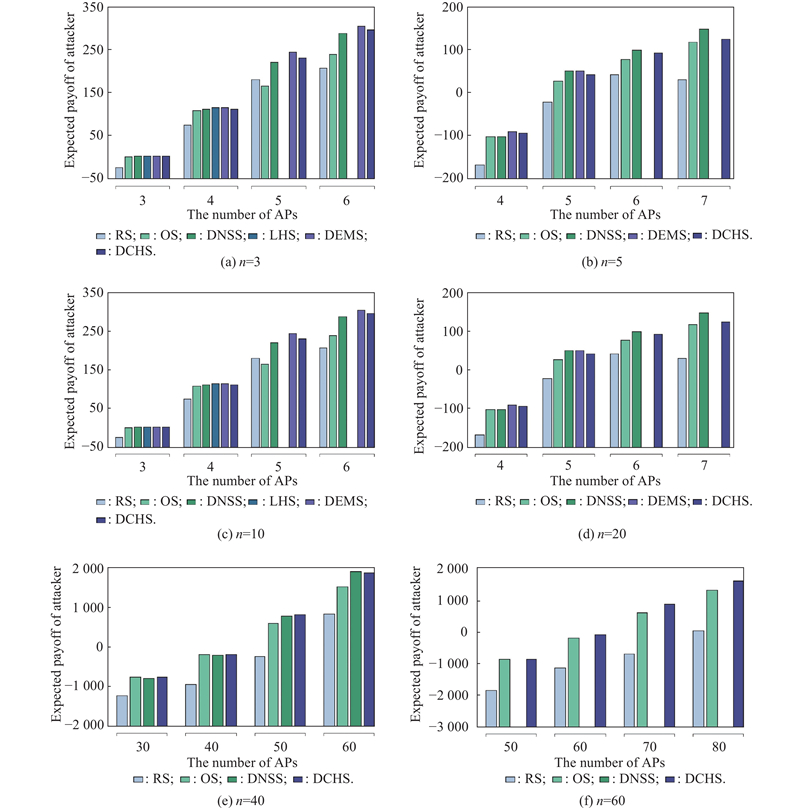
Table 4
Relative percentage deviation of different solutions %"
| Instance | m | n | RS | OS | DNSS | LHS | DEMS | DCHS |
| 1-1 | 3 | 3 | 71.44 | 16.65 | 0.00 | 0.00 | 16.65 | |
| 1-2 | 4 | 35.87 | 6.60 | 3.01 | 0.00 | 0.64 | 3.01 | |
| 1-3 | 5 | 26.38 | 32.33 | 9.65 | − | 0.00 | 5.61 | |
| 1-4 | 6 | 31.77 | 21.12 | 5.08 | − | 0.00 | 2.62 | |
| 2-1 | 4 | 5 | 84.45 | 12.33 | 12.33 | − | 0.00 | 2.94 |
| 2-2 | 5 | 143.08 | 46.97 | 0.26 | − | 0.00 | 18.68 | |
| 2-3 | 6 | 57.91 | 21.75 | 0.00 | − | − | 5.61 | |
| 2-4 | 7 | 79.26 | 20.22 | 0.00 | − | − | 15.80 | |
| 3-1 | 7 | 10 | 68.04 | 0.00 | 0.41 | − | − | 0.00 |
| 3-2 | 10 | 537.43 | 99.75 | 22.25 | − | − | 0.00 | |
| 3-3 | 12 | 127.63 | 22.32 | 4.60 | − | − | 0.00 | |
| 3-4 | 15 | 48.36 | 15.48 | 0.00 | − | − | 1.46 | |
| 4-1 | 10 | 20 | 16.70 | 0.02 | 0.00 | − | − | 0.02 |
| 4-2 | 20 | 437.42 | 24.03 | 0.00 | − | − | 24.03 | |
| 4-3 | 30 | 62.75 | 12.89 | 0.00 | − | − | 3.09 | |
| 4-4 | 40 | 31.70 | 11.49 | 0.75 | − | − | 0.00 | |
| 5-1 | 30 | 40 | 64.36 | 0.00 | 4.91 | − | − | 0.00 |
| 5-2 | 40 | 410.36 | 0.00 | 10.46 | − | − | 0.00 | |
| 5-3 | 50 | 127.36 | 25.10 | 2.64 | − | − | 0.00 | |
| 5-4 | 60 | 56.28 | 20.18 | 0.00 | − | − | 1.37 | |
| 6-1 | 50 | 60 | 114.85 | 0.00 | 7.51 | − | − | 0.00 |
| 6-2 | 60 | 135.53 | 62.71 | − | − | 0.00 | ||
| 6-3 | 70 | 176.31 | 29.95 | − | − | − | 0.00 | |
| 6-4 | 80 | 96.98 | 18.36 | − | − | − | 0.00 | |
| Average | 230.00 | 26.99 | 7.42 | 0 | 0.11 | 4.20 | ||
Table 5
Results of different algorithms in solving the AOPs given the strategy d1"
| Instance | m | n | EM | NS | MMRCH | |||||
| AOV | ACT | AOV | ACT | AOV | ACT | |||||
| 1-1 | 3 | 3 | 92.23 | 0.10 | 78.07 | 0.00 | 92.23 | 0.00 | ||
| 1-2 | 4 | 256.12 | 1.62 | 220.97 | 0.01 | 256.12 | 0.001 | |||
| 1-3 | 5 | 329.31 | 11.15 | 309.19 | 0.01 | 329.31 | 0.00 | |||
| 1-4 | 6 | 403.96 | 61.01 | 379.34 | 0.02 | 401.82 | 0.00 | |||
| 2-1 | 4 | 5 | 89.24 | 7.43 | 22.29 | 0.01 | 78.61 | 0.00 | ||
| 2-2 | 5 | 250.54 | 73.73 | 178.28 | 0.01 | 230.26 | 0.00 | |||
| 2-3 | 6 | 324.48 | 245.88 | 0.02 | 311.00 | 0.00 | ||||
| 2-4 | 7 | 317.61 | 255.74 | 0.03 | 310.69 | 0.00 | ||||
| 3-1 | 7 | 10 | − | − | 241.68 | 0.04 | 347.07 | 0.01 | ||
| 3-2 | 10 | − | − | 325.29 | 0.08 | 483.92 | 0.01 | |||
| 3-3 | 12 | − | − | 460.92 | 0.11 | 610.80 | 0.01 | |||
| 3-4 | 15 | − | − | 766.71 | 0.22 | 885.81 | 0.01 | |||
| 4-1 | 10 | 20 | − | − | −289.37 | 0.11 | −79.03 | 0.02 | ||
| 4-2 | 20 | − | − | 795.38 | 0.73 | 0.05 | ||||
| 4-3 | 30 | − | − | 2.39 | 0.07 | |||||
| 4-4 | 40 | − | − | 4.46 | 0.12 | |||||
| 5-1 | 30 | 40 | − | − | 745.28 | 3.49 | 0.16 | |||
| 5-2 | 40 | − | − | 6.62 | 0.26 | |||||
| 5-3 | 50 | − | − | 14.68 | 0.15 | |||||
| 5-4 | 60 | − | − | 22.84 | 0.18 | |||||
| 6-1 | 50 | 60 | − | − | 17.68 | 0.20 | ||||
| 6-2 | 60 | − | − | 30.21 | 0.29 | |||||
| 6-3 | 70 | − | − | 47.61 | 0.36 | |||||
| 6-4 | 80 | − | − | 68.50 | 0.48 | |||||
Table 6
Results of different algorithms in solving the AOPs given the strategy d2"
| Instance | m | n | EM | NS | MMRCH | |||||
| AOV | ACT | AOV | ACT | AOV | ACT | |||||
| 1-1 | 3 | 3 | 2.52 | 0.13 | −12.45 | 0.01 | 2.52 | 0.00 | ||
| 1-2 | 4 | 126.79 | 1.00 | 101.90 | 0.01 | 125.50 | 0.00 | |||
| 1-3 | 5 | 244.85 | 6.62 | 224.59 | 0.01 | 231.12 | 0.00 | |||
| 1-4 | 6 | 311.25 | 60.55 | 262.83 | 0.02 | 306.94 | 0.00 | |||
| 2-1 | 4 | 5 | −61.41 | 7.03 | −118.98 | 0.01 | −64.34 | 0.00 | ||
| 2-2 | 5 | 76.43 | 90.73 | 9.12 | 0.02 | 76.43 | 0.00 | |||
| 2-3 | 6 | 123.35 | 978.62 | 65.78 | 0.02 | 123.35 | 0.00 | |||
| 2-4 | 7 | 180.42 | 93.23 | 0.03 | 150.74 | 0.00 | ||||
| 3-1 | 7 | 10 | − | − | −149.75 | 0.05 | −65.33 | 0.01 | ||
| 3-2 | 10 | − | − | −42.66 | 0.11 | 86.65 | 0.01 | |||
| 3-3 | 12 | − | − | 73.00 | 0.15 | 200.32 | 0.01 | |||
| 3-4 | 15 | − | − | 364.67 | 0.28 | 507.22 | 0.02 | |||
| 4-1 | 10 | 20 | − | − | −840.28 | 0.14 | −592.48 | 0.02 | ||
| 4-2 | 20 | − | − | −54.39 | 1.13 | 158.99 | 0.07 | |||
| 4-3 | 30 | − | − | 673.52 | 3.15 | 943.08 | 0.15 | |||
| 4-4 | 40 | − | − | 5.33 | 0.17 | |||||
| 5-1 | 30 | 40 | − | − | −852.71 | 5.14 | −466.97 | 0.40 | ||
| 5-2 | 40 | − | − | −379.88 | 9.56 | 105.20 | 0.67 | |||
| 5-3 | 50 | − | − | 570.27 | 21.45 | 0.12 | ||||
| 5-4 | 60 | − | − | 28.96 | 0.16 | |||||
| 6-1 | 50 | 60 | − | − | − | 27.79 | −365.80 | 0.45 | ||
| 6-2 | 60 | − | − | −282.46 | 41.31 | 376.45 | 0.69 | |||
| 6-3 | 70 | − | − | 468.24 | 71.31 | 0.75 | ||||
| 6-4 | 80 | − | − | 96.43 | 0.63 | |||||
Table 7
Improvement results of MMRCH compared to NS"
| Instance | Given the strategy d1 | Given the strategy d2 | |||
| PDOV | PDR | PDOV | PDR | ||
| 1-1 | 18.13 | 58.57 | 120.28 | 77.48 | |
| 1-2 | 15.91 | 85.90 | 23.16 | 72.41 | |
| 1-3 | 6.51 | 87.61 | 2.91 | 72.63 | |
| 1-4 | 5.93 | 84.00 | 16.78 | 86.38 | |
| 2-1 | 252.75 | 80.25 | 45.93 | 69.89 | |
| 2-2 | 29.16 | 71.83 | 737.54 | 81.42 | |
| 2-3 | 26.49 | 80.06 | 87.53 | 83.15 | |
| 2-4 | 21.49 | 82.64 | 61.68 | 89.41 | |
| 3-1 | 43.61 | 85.09 | 56.37 | 84.95 | |
| 3-2 | 48.77 | 90.58 | 303.12 | 89.96 | |
| 3-3 | 32.52 | 91.62 | 174.42 | 91.33 | |
| 3-4 | 15.53 | 94.04 | 39.09 | 93.28 | |
| 4-1 | 72.69 | 86.04 | 29.49 | 81.93 | |
| 4-2 | 38.69 | 92.83 | 392.33 | 93.94 | |
| 4-3 | 14.97 | 96.96 | 40.02 | 95.38 | |
| 4-4 | 6.56 | 97.32 | 22.63 | 96.81 | |
| 5-1 | 69.34 | 95.29 | 45.24 | 92.18 | |
| 5-2 | 52.57 | 96.02 | 127.69 | 93.00 | |
| 5-3 | 20.17 | 98.98 | 85.94 | 99.43 | |
| 5-4 | 11.31 | 99.22 | 36.31 | 99.46 | |
| 6-1 | 60.75 | 98.87 | 63.43 | 98.40 | |
| 6-2 | 34.71 | 99.04 | 233.28 | 98.32 | |
| 6-3 | 25.87 | 99.24 | 143.29 | 98.94 | |
| 6-4 | 15.68 | 99.29 | 59.34 | 99.34 | |
| Average | 39.17 | 89.64 | 122.82 | 89.14 | |
Fig 4
Comparison results of expected payoff under different kill probability ranges"
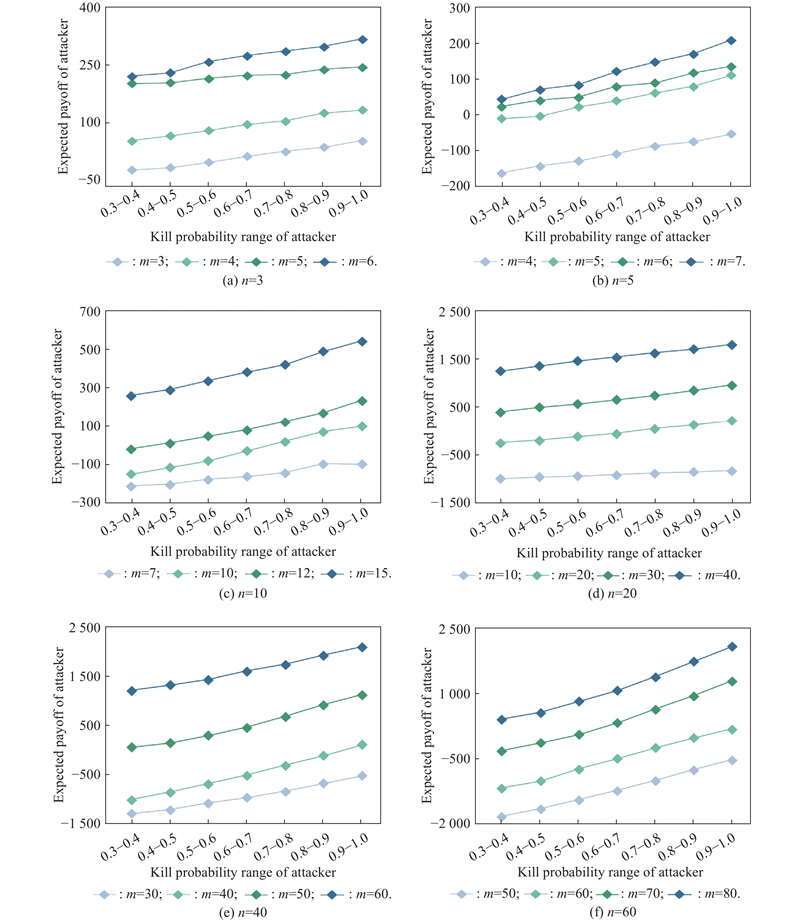
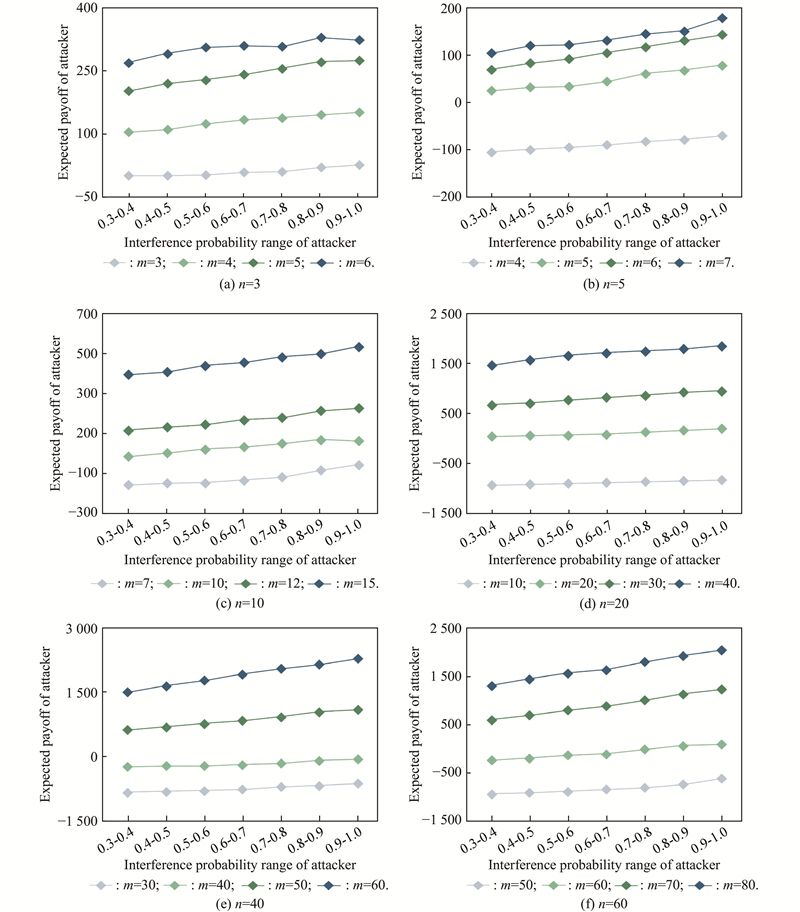
Fig 5
Comparison results of expected payoff under different interference probability ranges"
| 1 |
BAI Z Z, ZHOU H Y, SHI J M, et al A hybrid multi-objective evolutionary algorithm with high solving efficiency for UAV defense programming. Swarm and Evolutionary Computation, 2024, 87, 101572.
doi: 10.1016/j.swevo.2024.101572 |
| 2 |
ACAR E, HATIPOGLU S, YILMAZ I A quantum algorithm for solving weapon target assignment problem. Engineering Applications of Artificial Intelligence, 2023, 125, 106668.
doi: 10.1016/j.engappai.2023.106668 |
| 3 |
ARSLAN C, KARASAKAL O, KIRCA O Naval air defense planning problem: a novel formulation and heuristics. Naval Research Logistics, 2024, 71 (7): 895- 919.
doi: 10.1002/nav.22186 |
| 4 |
LILES J M, ROBBINS M J, LUNDAY B J Improving defensive air battle management by solving a stochastic dynamic assignment problem via approximate dynamic programming. European Journal of Operational Research, 2023, 305 (3): 1435- 1449.
doi: 10.1016/j.ejor.2022.06.031 |
| 5 |
JIANG R H, LUO H, MA Y Y, et al Multicriteria game approach to air-to-air combat tactical decisions for multiple UAVs. Journal of Systems Engineering and Electronics, 2023, 34 (6): 1447- 1464.
doi: 10.23919/JSEE.2023.000115 |
| 6 |
WANG T, FU L Y, WEI Z X, et al Unmanned ground weapon target assignment based on deep Q-learning network with an improved multi-objective artificial bee colony algorithm. Engineering Applications of Artificial Intelligence, 2023, 117, 105612.
doi: 10.1016/j.engappai.2022.105612 |
| 7 |
ANDERSEN A C, PAVLIKOV K, TOFFOLO T A Weapon-target assignment problem: exact and approximate solution algorithms. Annals of Operations Research, 2022, 312 (2): 581- 606.
doi: 10.1007/s10479-022-04525-6 |
| 8 |
ZHAO L D, AN Z X, WANG B, et al A hybrid multi-objective bi-level interactive fuzzy programming method for solving ECM-DWTA problem. Complex & Intelligent Systems, 2022, 8 (6): 4811- 4829.
doi: 10.1007/s40747-022-00730-9 |
| 9 |
KLINE A, AHNER D, HILL R The weapon-target assignment problem. Computers & Operations Research, 2019, 105, 226- 236.
doi: 10.1016/j.cor.2018.10.015 |
| 10 |
ZHANG L L, GANG D U, JUN W U, et al Joint production planning, pricing and retailer selection with emission control based on Stackelberg game and nested genetic algorithm. Expert Systems with Applications, 2020, 161, 113733.
doi: 10.1016/j.eswa.2020.113733 |
| 11 |
KOSE E, ERBAS M, ERSEN E An integrated approach based on game theory and geographical information systems to solve decision problems. Expert Systems with Applications, 2017, 308 (C): 105- 114.
doi: 10.1016/j.amc.2017.03.020 |
| 12 |
WU Y F, KANG B Y, WU H Strategies of attack–defense game for wireless sensor networks considering the effect of confidence level in fuzzy environment. Engineering Applications of Artificial Intelligence, 2021, 102, 104238.
doi: 10.1016/j.engappai.2021.104238 |
| 13 |
CHANG X N, SHI J M, LUO Z H, et al Adaptive large neighborhood search algorithm for multi-stage weapon target assignment problem. Computers & Industrial Engineering, 2023, 181, 109303.
doi: 10.1016/j.cie.2023.109303 |
| 14 | SUMMERS D S. , ROBBINS M J. , LUNDAY B J. An approximate dynamic programming approach for comparing firing policies in a networked air defense environment. Computers & Operations Research, 2020, 117: 104890. |
| 15 |
MA Y Y, WANG G Q, HU X X, et al Two-stage hybrid heuristic search algorithm for novel weapon target assignment problems. Computers & Industrial Engineering, 2021, 162, 107717.
doi: 10.1016/j.cie.2021.107717 |
| 16 |
XU H, ZHANG A, BI W H, et al Dynamic gaussian mutation beetle swarm optimization method for large-scale weapon target assignment problems. Applied Soft Computing, 2024, 162, 111798.
doi: 10.1016/j.asoc.2024.111798 |
| 17 |
LAI C M, WU T H Simplified swarm optimization with initialization scheme for dynamic weapon-target assignment problem. Applied Soft Computing, 2019, 82, 105542.
doi: 10.1016/j.asoc.2019.105542 |
| 18 |
ZHANG K, ZHOU D Y, YANG Z, et al Efficient decision approaches for asset-based dynamic weapon target assignment by a receding horizon and marginal return heuristic. Electronics, 2020, 9 (9): 1511.
doi: 10.3390/electronics9091511 |
| 19 |
LI G J, HE G J, ZHENG M F, et al Uncertain multi-objective dynamic weapon-target allocation problem based on uncertainty theory. AIMS Mathematics, 2023, 8 (3): 5639- 5669.
doi: 10.3934/math.2023284 |
| 20 |
KONG L R, WANG J Z, ZHAO P Solving the dynamic weapon target assignment problem by an improved multiobjective particle swarm optimization algorithm. Applied Sciences, 2021, 11 (19): 9254.
doi: 10.3390/app11199254 |
| 21 |
SILAV A, KARASAKAL E, KARASAKAL O Bi-objective dynamic weapon-target assignment problem with stability measure. Annals of Operations Research, 2021, 311 (2): 1229- 1247.
doi: 10.1007/s10479-020-03919-8 |
| 22 |
YI X J, YU H Y, XU T Solving multi-objective weapon-target assignment considering reliability by improved MOEA/D-AM2M. Neurocomputing, 2024, 563, 126906.
doi: 10.1016/j.neucom.2023.126906 |
| 23 |
GULPINAR N, CANAKOGLU E, BRANKE J Heuristics for the stochastic dynamic task-resource allocation problem with retry opportunities. European Journal of Operational Research, 2018, 266 (1): 291- 303.
doi: 10.1016/j.ejor.2017.09.006 |
| 24 | ZHANG J Z, KONG M, ZHANG G, et al Weapon-target assignment using a whale optimization algorithm. International Journal of Computational Intelligence Systems, 2023, 16 (1): 1- 18. |
| 25 |
AHUJA R K, KUMAR A, JHA K C, et al Exact and heuristic algorithms for the weapon-target assignment problem. Operations Research, 2007, 55 (6): 1136- 1146.
doi: 10.1287/opre.1070.0440 |
| 26 |
LU Y P, CHEN D Z A new exact algorithm for the weapon-target assignment problem. Omega, 2021, 98, 102138.
doi: 10.1016/j.omega.2019.102138 |
| 27 |
ZHI P F, LIANG Z Z, ZHU W L, et al Weapon target assignment strategy for shipboard power system considering high power pulse loads integration. Energy Reports, 2023, 9, 32- 40.
doi: 10.1016/j.egyr.2023.04.257 |
| 28 |
YADAV K, ALSHUDUKHI J S, DHIMAN G, et al ITSA: an improved tunicate swarm algorithm for defensive resource assignment problem. Soft Computing, 2022, 26 (10): 4929- 4937.
doi: 10.1007/s00500-022-06979-z |
| 29 |
NIU W T, SHE W, ZHONG L H, et al Elite-centered artificial bee colony algorithm with extended solution boundary. Applied Soft Computing, 2023, 148, 110906.
doi: 10.1016/j.asoc.2023.110906 |
| 30 |
WANG Y P, XIN B, CHEN J An adaptive memetic algorithm for the joint allocation of heterogeneous stochastic resources. IEEE Trans. on Cybernetics, 2022, 52 (11): 11526- 11538.
doi: 10.1109/TCYB.2021.3087363 |
| 31 |
ZHAO Y, LIU J C, JIANG J, et al Shuffled frog leaping algorithm with non-dominated sorting for dynamic weapon-target assignment. Journal of Systems Engineering and Electronics, 2023, 34 (4): 1007- 1019.
doi: 10.23919/JSEE.2023.000102 |
| 32 |
XU W Q, CHEN C, DING S X, et al A bi-objective dynamic collaborative task assignment under uncertainty using modified MOEA/D with heuristic initialization. Expert Systems with Applications, 2020, 140, 112844.
doi: 10.1016/j.eswa.2019.112844 |
| 33 | LI J, XIN B, PARDALOS P M, et al Solving bi-objective uncertain stochastic resource allocation problems by the CVAR-based risk measure and decomposition-based multi-objective evolutionary algorithms. Annals of Operations Research, 2019, 296 (1−2): 639- 666. |
| 34 |
XIN B, WANG Y P, CHEN J An efficient marginal-return-based constructive heuristic to solve the sensor-weapon-target assignment problem. IEEE Trans. on Systems, Man, and Cybernetics: Systems, 2019, 49 (12): 2536- 2547.
doi: 10.1109/TSMC.2017.2784187 |
| 35 | KLINE A G, AHNER D K, LUNDAY B J A heuristic and metaheuristic approach to the static weapon target assignment problem. Journal of Global Optimization, 2020, 78 (4): 791- 812. |
| 36 |
HAYWOOD A B, LUNDAY B J, ROBBINS M J Intruder detection and interdiction modeling: a bilevel programming approach for ballistic missile defense asset location. Omega, 2022, 110, 102640.
doi: 10.1016/j.omega.2022.102640 |
| 37 |
SUN B, ZENG Y R, SU Z N Task allocation in multi-AUV dynamic game based on interval ranking under uncertain information. Ocean Engineering, 2023, 288, 116057.
doi: 10.1016/j.oceaneng.2023.116057 |
| 38 |
HAN C Y, LUNDAY B J, ROBBINS M J A game theoretic model for the optimal location of integrated air defense system missile batteries. Informs Journal on Computing, 2016, 28 (3): 405- 416.
doi: 10.1287/ijoc.2016.0690 |
| 39 |
XU J W, DENG Z H, SONG Q, et al Multi-UAV counter-game model based on uncertain information. Applied Mathematics and Computation, 2020, 366, 124684.
doi: 10.1016/j.amc.2019.124684 |
| 40 |
LI S Y, CHEN M, WANG Y H, et al Air combat decision-making of multiple UCAVs based on constraint strategy games. Defence Technology, 2022, 18 (3): 368- 383.
doi: 10.1016/j.dt.2021.01.005 |
| 41 |
ROSENMULLER J On a generalization of the Lemke-Howson algorithm to noncooperative N-person games. SIAM Journal on Applied Mathematics, 1971, 1 (21): 73- 79.
doi: 10.1137/0121010 |
| 42 | MCMAHAN H B, GORDON G J, BLUM A. Planning in the presence of cost functions controlled by an adversary. Proc. of the 20th International Conference on Machine Learning, 2003: 536–543. |
| 43 |
JIE Y M, LIU C Z C, LI M C, et al Game theoretic resource allocation model for designing effective traffic safety solution against drunk driving. Applied Mathematics and Computation, 2020, 376, 125142.
doi: 10.1016/j.amc.2020.125142 |
| 44 |
WU D W, LISSER A Using CNN for solving two-player zero-sum games. Expert Systems with Applications, 2022, 204, 117545.
doi: 10.1016/j.eswa.2022.117545 |
| 45 |
WU Y H, QURESHI A G, YAMADA T Adaptive large neighborhood decomposition search algorithm for multi-allocation hub location routing problem. European Journal of Operational Research, 2022, 302 (3): 1113- 1127.
doi: 10.1016/j.ejor.2022.02.002 |
| 46 |
LEI X, HU X X, WANG G Q, et al A multi-UAV deployment method for border patrolling based on Stackelberg game. Journal of Systems Engineering and Electronics, 2023, 34 (1): 99- 116.
doi: 10.23919/JSEE.2023.000022 |
| [1] | Zhanwu LI, Yizhe CHANG, Yingxin KOU, Haiyan YANG, An XU, You LI. Approach to WTA in air combat using IAFSA-IHS algorithm [J]. Journal of Systems Engineering and Electronics, 2018, 29(3): 519-529. |
| [2] | Wang Yanxia, Qian Longjun, Guo Zhi & Ma Lifeng. Weapon target assignment problem satisfying expected damage probabilities based on ant colony algorithm [J]. Journal of Systems Engineering and Electronics, 2008, 19(5): 939-944. |
| Viewed | ||||||
|
Full text |
|
|||||
|
Abstract |
|
|||||
