
Journal of Systems Engineering and Electronics ›› 2026, Vol. 37 ›› Issue (4): 1383-1398.doi: 10.23919/JSEE.2026.000149
• CONTROL THEORY AND APPLICATION • Previous Articles
Youtao Gao1,2( ), Yinghui Xin1(), Chaoyong Hu1(), Chenliang Li3,*()
Received:2025-02-27
Online:2026-08-18
Published:2026-09-03
Contact:
Chenliang Li
E-mail:ytgao@nuaa.edu.cn;ingridinny@163.com;chaoyonghu@nuaa.edu.cn;lcl520@nuaa.edu.cn
Supported by:Youtao Gao, Yinghui Xin, Chaoyong Hu, Chenliang Li. Terminal sliding mode control for a type of special long-periodic orbit[J]. Journal of Systems Engineering and Electronics, 2026, 37(4): 1383-1398.

Fig 1
Rotating coordinate system"

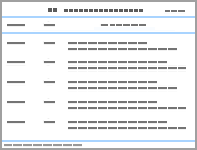
Table 1
Average magnitude of perturbations"
| Source of acceleration | Average magnitude of acceleration / |
| Lunar-centered gravity | |
| Earth’s gravity | |
| Solar gravity | |
| Solar radiation pressure | |
| Asymmetric gravity of the Moon | |
| Venusian gravity | |
| Jovian gravity |
Table 2
Comparison of dynamical models"
| Gravity sources | Nominal orbit | Simulation environment |
| Earth’s gravity and Lunar gravity | √ | √ |
| Solar gravity | √ |

Fig 2
BCRFBM coordinate system"

Table 3
Quantitative comparison of orbital characteristics"
| Characteristic | Traditional Halo orbits | Special long-period orbits |
| Orbit period/days | 14−16 | 76 |
| Nonlinearity (measured via phase portrait curvature) | Mild | Strong |
| Position error without control (Δr in 10 days)/m | <50 | >200 |
| Trajectory stability | Higher | Weaker |
| Maneuver cost/(m/s) | 0.1−1.0 | 30−80 |
| Navigation suitability | Limited spatial coverage | Wide coverage via extended drift regions |

Fig 3
Special long-period orbit station-keeping control system"


Fig 4
Nominal orbit and actual trajectory (without control)"

Table 4
Simulation parameter settings"
| Parameter | Value |
| Insertion time | 2035,11,1 |
| Running time/days | 76 |
| Integration time step/s | 10 |
| Initial position error/m | (10,10,10) |
| Initial velocity error/m/s | (0.01, 0.01, 0.01) |
| Initial ranging error/m | 0.17 |
Table 5
Controller parameter settings"
| Parameter | Value |
| 10 | |
| 10 | |
| 200 | |
| 0.17 |

Fig 5
Nominal orbit, actual trajectory (without control), and actual trajectory (under control)"


Fig 6
Position error (under control)"


Fig 7
Velocity error between the nominal orbit and the actual trajectory (5 000 s)"


Fig 8
Velocity error (under control)"


Fig 9
Control input for station-keeping"


Fig 10
Control input (1 000 s)"


Fig 11
Positions of error peaks in orbit"


Fig 12
Position observation error"


Fig 13
Velocity observation error"


Fig 14
Position error (LESO-SMC)"


Fig 15
Velocity error (LESO-SMC)"


Fig 16
Velocity error (LESO-SMC) (5000s)"


Fig 17
Control input (LESO-SMC)"

Table 6
Performance comparison under parameter variations"
| Parameters (c, k, G, ω) | Controller | Position error/m | Velocity increment/(m/s) |
| ( | LESO-TSMC | 259.95 | 30.96 |
| LESO-SMC | 422.65 | 30.81 | |
| (100,100,10,10) | LESO-TSMC | 480.84 | 32.21 |
| LESO-SMC | 30.79 | ||
| ( | LESO-TSMC | 266.52 | 33.46 |
| LESO-SMC | 30.80 |

Fig 18
Position error comparison of controllers under parameter variations"

| 1 |
Liu L, Wu W R, Liu Y Design and implementation of Chinese libration point missions. Science China Information Sciences, 2023, 66 (9): 191201.
doi: 10.1007/s11432-022-3716-9 |
| 2 |
Farres A, Gao C, Masdemont J J, et al Geometrical analysis of station-keeping strategies about libration point orbits. Journal of Guidance, Control, and Dynamics, 2022, 45 (6): 1108.
doi: 10.2514/1.G006014 |
| 3 |
Kayama Y, Howell K C, Bando M, et al Low-thrust trajectory design with successive convex optimization for libration point orbits. Journal of Guidance, Control, and Dynamics, 2022, 45 (4): 623.
doi: 10.2514/1.G005916 |
| 4 |
Circi C, Romagnoli D, Fumenti F Halo orbit dynamics and properties for a lunar global positioning system design. Monthly Notices of the Royal Astronomical Society, 2014, 442 (4): 3511.
doi: 10.1093/mnras/stu1085 |
| 5 |
Gao Y T, Xu B, Zhang L Feasibility study of autonomous orbit determination using only the crosslink range measurement for a combined navigation constellation. Chinese Journal of Aeronautics, 2014, 27 (5): 1199.
doi: 10.1016/j.cja.2014.09.005 |
| 6 |
Gao Y T, Hu C Y, Xin Y H, et al Design of a Cislunar space navigation constellation based on special long-period orbits. Advances in Space Research, 2024, 74 (7): 3137.
doi: 10.1016/j.asr.2024.06.020 |
| 7 |
Simo C, Gomez G, Llibre J, et al On the optimal station keeping control of halo orbits. Acta Astronautica, 1987, 15 (6-7): 391.
doi: 10.1016/0094-5765(87)90175-5 |
| 8 |
Duan M, Jia J, Ito T Fast terminal sliding mode control based on speed and disturbance estimation for an active suspension gravity compensation system. Mechanism and Machine Theory, 2021, 155, 104073.
doi: 10.1016/j.mechmachtheory.2020.104073 |
| 9 |
Howell K C, Pernicka H J Station-keeping method for libration point trajectories. Journal of Guidance, Control, and Dynamics, 1993, 16 (1): 151.
doi: 10.2514/3.11440 |
| 10 | Xu M Stationkeeping strategy of halo orbit in linear periodic control. Aerospace Control, 2008, 26 (3): 13. |
| 11 | Xin M, Dancer M W, Balakrishnan S N, et al. Stationkeeping of an L/sub 2/libration point satellite with/spl theta/-D technique [C]//American Control Conference, 2004: 1037. |
| 12 |
Darvish K, Pourtakdoust S H, Assadian N Linear and nonlinear control strategies for formation and station keeping of spacecrafts within the context of the three body problem. Aerospace Science and Technology, 2015, 42, 12.
doi: 10.1016/j.ast.2014.12.030 |
| 13 |
Lian Y, Gomez G, Masdemont J J, et al Station-keeping of real Earth–Moon libration point orbits using discrete-time sliding mode control. Communications in Nonlinear Science and Numerical Simulation, 2014, 19 (10): 3792.
doi: 10.1016/j.cnsns.2014.03.026 |
| 14 | Wu L, Liu J, Vazquez S, et al Sliding mode control in power converters and drives: a review. IEEE/CAA Journal of Automatica Sinica, 2021, 9 (3): 392. |
| 15 |
Zhuang K Y, Su H Y, Zhang K Q, et al Adaptive terminal sliding mode control for high-order nonlinear dynamic systems. Journal of Zhejiang University. Science, 2003, 4 (1): 58.
doi: 10.1631/BF02841080 |
| 16 |
Man Z H, Yu X H Terminal sliding mode control of MIMO linear systems. IEEE Trans. on Circuits and Systems I: Fundamental Theory and Applications, 1997, 44 (11): 1065.
doi: 10.1109/81.641769 |
| 17 |
Narula A, Biggs J D Fault-tolerant station-keeping on libration point orbits. Journal of Guidance, Control, and Dynamics, 2018, 41 (4): 879.
doi: 10.2514/1.G003115 |
| 18 |
Zhu M, Karimi H R, Zhang H, et al Active disturbance rejection station-keeping control of unstable orbits around collinear libration points. Mathematical Problems in Engineering, 2014, 2014 (1): 410989.
doi: 10.1155/2014/410989 |
| 19 |
Sun G J, Zhou M Q, Jiang X Q Non-cooperative spacecraft proximity control considering target behavior uncertainty. Astrodynamics, 2022, 6 (4): 399.
doi: 10.1007/s42064-022-0133-5 |
| 20 | Jin H Y, Zhang R Q, Wang L, et al Root locus analysis on parameter tuning robustness of linear active disturbance rejection control. Control Theory & Applications, 2018, 35 (11): 1648. |
| 21 |
Zheng Q, Gao Z Q Active disturbance rejection control: between the formulation in time and the understanding in frequency. Control Theory and Technology, 2016, 14, 250.
doi: 10.1007/s11768-016-6059-9 |
| 22 | Izzo D, Sprague C I, Tailor D V. Machine learning and evolutionary techniques in interplanetary trajectory design[M]//Modeling and Optimization in Space Engineering: State of the Art and New Challenges. Bethlehem, USA: Springer, 2019: 191. |
| 23 |
Quartullo R, Garulli A, Kolmanovsky I Periodic model predictive control for tracking halo orbits in the elliptic restricted three-body problem. IEEE Trans. on Control Systems Technology, 2023, 31 (5): 1971.
doi: 10.1109/TCST.2023.3291548 |
| 24 |
Li L C, Colombo C, Gkolias I, et al Low-thrust station-keeping strategy toward exploiting the resonances in the geostationary region. Journal of Aerospace Engineering, 2024, 37 (2): 04023123.
doi: 10.1061/JAEEEZ.ASENG-5330 |
| 25 | Lozano-Cuadra F, Soret B. Multi-agent deep reinforcement learning for distributed satellite routing [C]//IEEE International Conference on Machine Learning for Communication and Networking, 2024. doi: 10.1109/ICMLCN59089.2024.10624767. |
| 26 |
Albidah A B Halo orbits under some perturbations in cr3bp. Symmetry, 2023, 15 (2): 481.
doi: 10.3390/sym15020481 |
| 27 | Xu M Overview of orbital dynamics and control for libration point orbits. Journal of Astronautics, 2009, 30, 1299. |
| 28 |
Zhang R Y A review of periodic orbits in the circular restricted three-body problem. Journal of Systems Engineering and Electronics, 2022, 33 (3): 612.
doi: 10.23919/JSEE.2022.000059 |
| 29 | Wu X J, Zeng L C, Gong Y K DRO computation and its perturbative force in the Earth-Moon system. Journal of Beijing University of Aeronautics and Astronautics, 2020, 46 (5): 883. |
| 30 |
Lou Z P, Wang Y Robust station-keeping control of sun-earth/moon libration point orbits using electric propulsion. Journal of Aerospace Engineering, 2019, 32 (2): 04018142.
doi: 10.1061/(ASCE)AS.1943-5525.0000971 |
| [1] | Junjie LIU, Mingwei SUN, Zengqiang CHEN, Qinglin SUN. High AOA decoupling control for aircraft based on ADRC [J]. Journal of Systems Engineering and Electronics, 2020, 31(2): 393-402. |
| [2] | Yueneng Yang and Ye Yan. Decoupled nonsingular terminal sliding mode control for affine nonlinear systems [J]. Systems Engineering and Electronics, 2016, 27(1): 192-. |
| Viewed | ||||||
|
Full text |
|
|||||
|
Abstract |
|
|||||
