
Journal of Systems Engineering and Electronics ›› 2026, Vol. 37 ›› Issue (1): 242-256.doi: 10.23919/JSEE.2023.000165
• SYSTEMS ENGINEERING • Previous Articles Next Articles
Weilin YUAN( ), Shaofei CHEN(), Zhenzhen HU(), Xiang JI(), Lina LU(), Xiaolong SU(), Jing CHEN()
Received:2022-12-12
Online:2026-02-18
Published:2026-03-11
Contact:
Shaofei CHEN
E-mail:yuanweilin12@nudt.edu.cn;chensf005@163.com;hzzmail@163.com;jixiang14@nudt.edu.cn;lulina16@nudt.edu.cn;xiaolongsu@nudt.edu.cn;Chenjing001@vip.sina.com
About author:Supported by:Weilin YUAN, Shaofei CHEN, Zhenzhen HU, Xiang JI, Lina LU, Xiaolong SU, Jing CHEN. Optimal competitive resource assignment in two-stage Colonel Blotto game with Lanchester-type attrition[J]. Journal of Systems Engineering and Electronics, 2026, 37(1): 242-256.
Add to citation manager EndNote|Reference Manager|ProCite|BibTeX|RefWorks
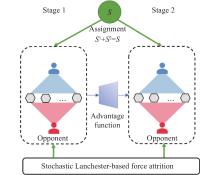
Fig 1
Overview framework"
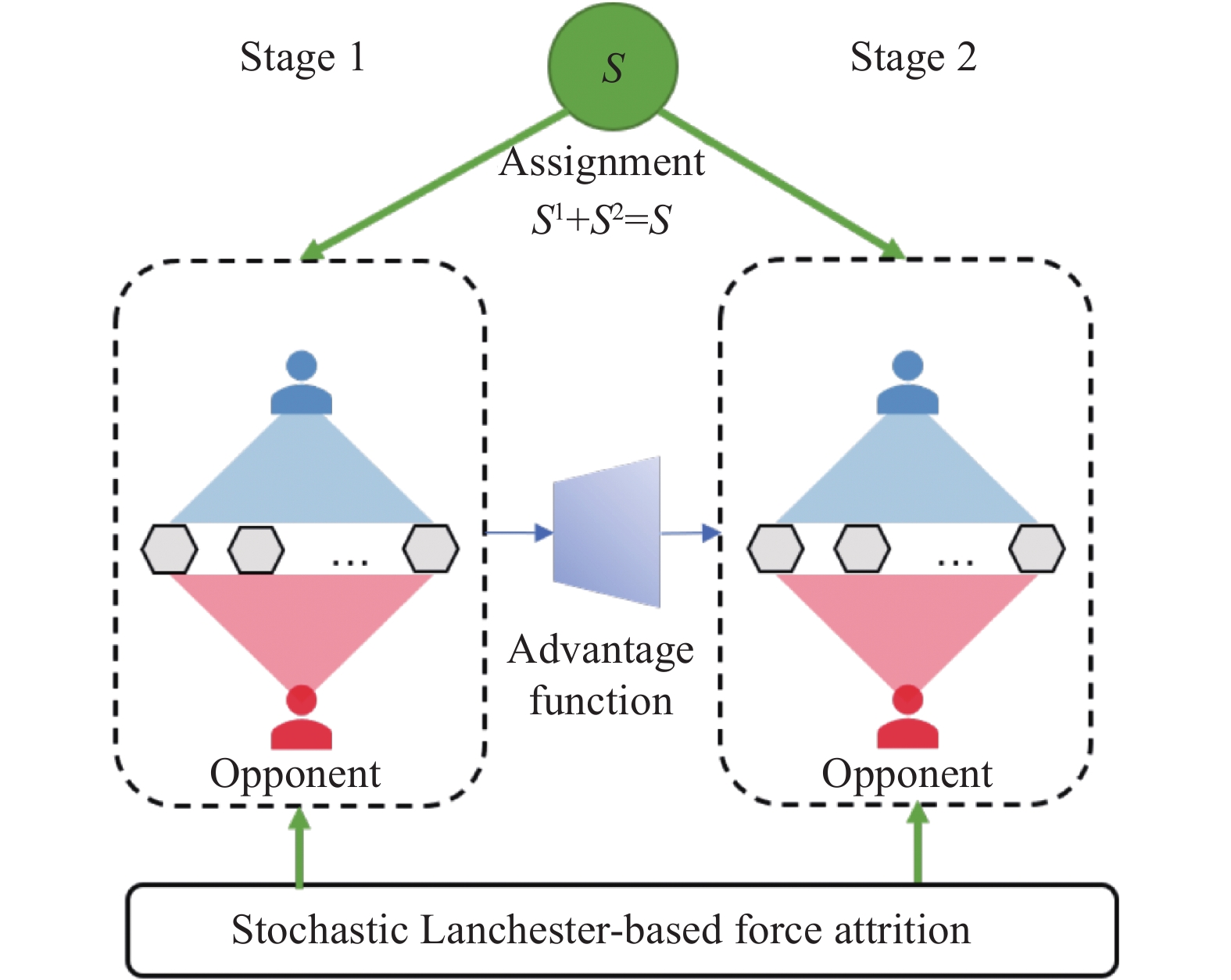
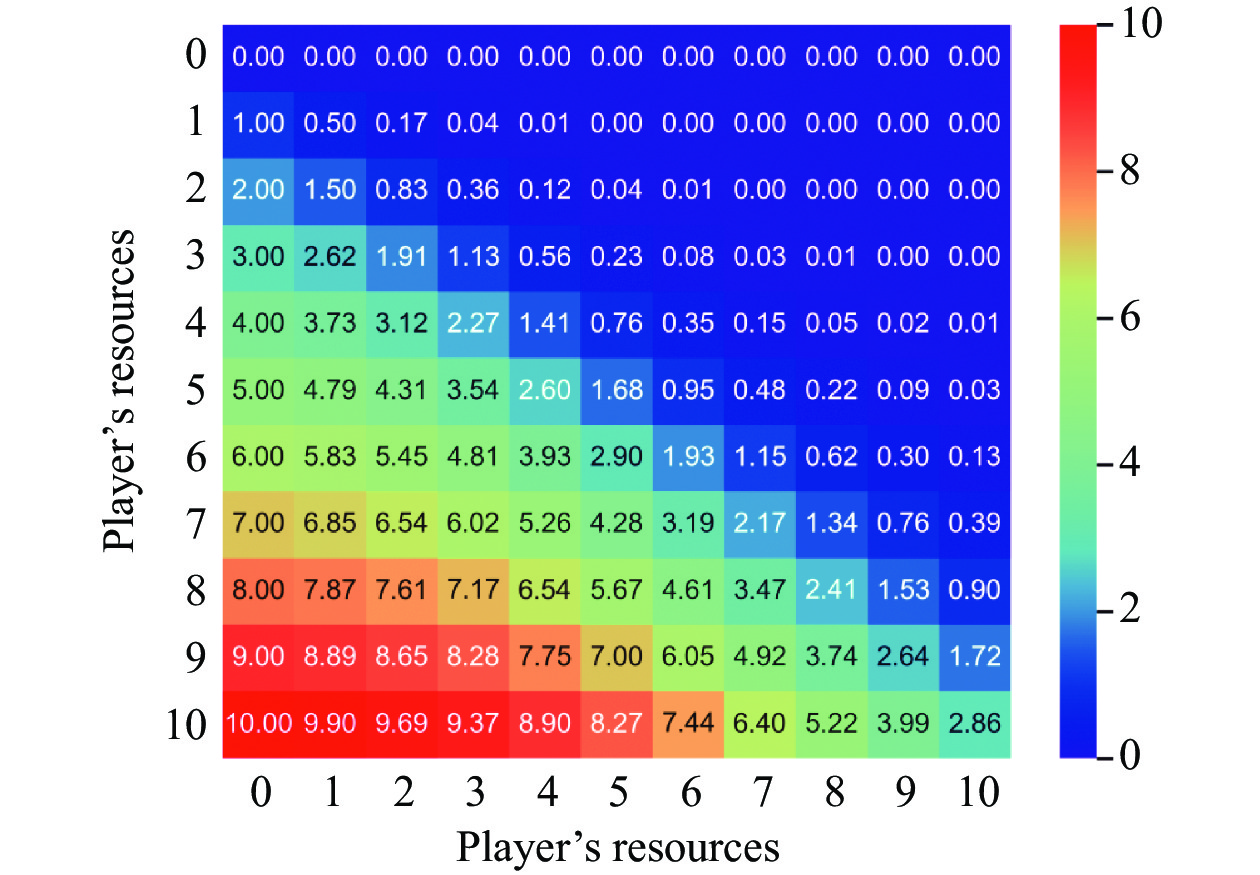
Fig 2
Visualization of stochastic Lanchester-based force attrition ($ {\boldsymbol{n}} \leqslant {\boldsymbol{10}} $)"
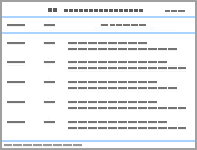
Table 1
Time optimal assignment resource strategies in GB-2T with base case parameters ($ {{\boldsymbol{S}}_{\boldsymbol{x}}} {\boldsymbol{=}} {{\boldsymbol{S}}_{\boldsymbol{y}}} {\boldsymbol{= s}} $)"
| Condition | Parameter | Result in CB-2T | |||
| c1 | c2 | κ(x) | x(1) | x(2) | |
| (0,0) | (2,3) | ||||
| (0,1) | (4,0) | ||||
| (1,1) | (3,0) | ||||
| (1,1) | (2,1) | ||||
| (1,1) | (3,0) | ||||
| (0,0,0) | (5,4,1) | ||||
| (0,1,1) | (8,0,0) | ||||
| (1,2,2) | (5,0,0) | ||||
| (2,0,2) | (0,6,0) | ||||
| (2,2,2) | (4,0,0) | ||||
Table 2
Performance of RM-2T against two-stage visible baselines by playing 10 000 CB-2T game under the uncertainty from SLE"
| Algorithm | RM-2T | DQN-2T | Rand-2T | |||||
| WP/% | AWR | WP/% | AWR | WP/% | AWR | |||
| RM-2T | — | — | 51.5 | −0.110 | 78.0 | 0.361 | ||
| DQN-2T | 48.5 | −0.181 | — | — | 89.4 | 0.588 | ||
| Rand-2T | 22.0 | −0.711 | 10.6 | -0.928 | — | — | ||
Table 3
Performance of RM-2T against one-stage visible baselines by playing 10 000 CB-2T game under the uncertainty from SLE"
| Algorithm | RM-2T | Rand-T1 | Rand-T2 | |||||
| WP/% | AWR | WP/% | AWR | WP/% | AWR | |||
| RM-2T | — | — | 54.0 | −0.120 | 76.1 | 0.382 | ||
| Rand-T1 | 46.0 | −0.280 | — | — | 83.4 | 0.468 | ||
| Rand-T2 | 23.9 | −0.622 | 16.6 | −0.768 | — | — | ||
Table 4
Results of pre-allocated resource assignment with total resource $ {{\boldsymbol{S}}_{\boldsymbol{x}}} {\boldsymbol{= 10}} $ and the number of battlefields $ {\boldsymbol{n}} {\boldsymbol{= 3}} $, $ {{\boldsymbol{c}}_{\boldsymbol{1}}} {\boldsymbol{=}} {\boldsymbol{0.2}} $, $ {{\boldsymbol{c}}_{\boldsymbol{2}}} {\boldsymbol{= 0.1}} $"
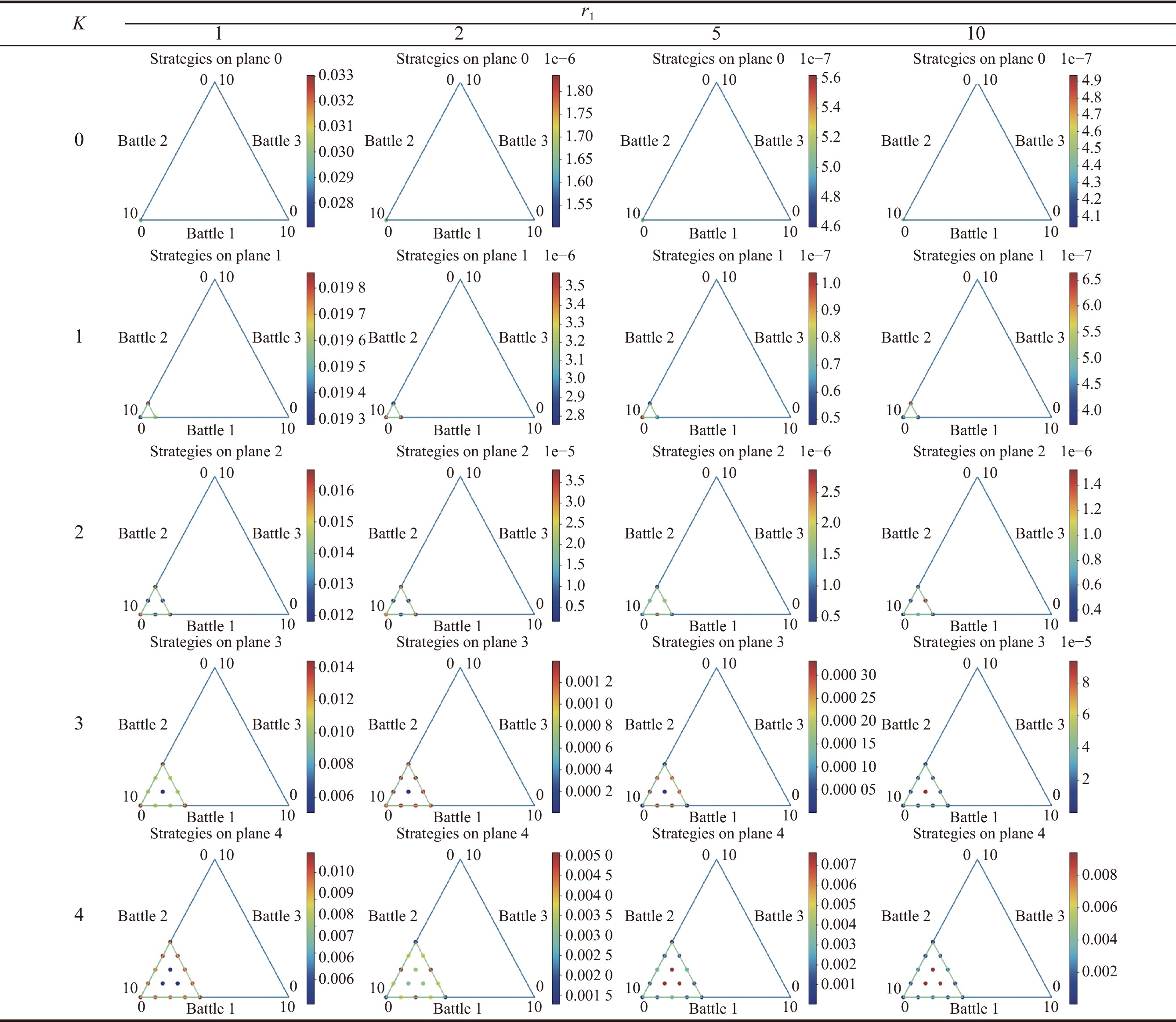 |
Table 5
Results of pre-allocated resource assignment with total resource $ {{\boldsymbol{S}}_{\boldsymbol{x}}} {\boldsymbol{= 10}} $ and the number of battlefields $ {\boldsymbol{n}} {\boldsymbol{= 3}} $, $ {{\boldsymbol{c}}_{\boldsymbol{1}}} {\boldsymbol{=}} {\boldsymbol{0.2}} $, $ {{\boldsymbol{c}}_{\boldsymbol{2}}} {\boldsymbol{= 0.1}} $"
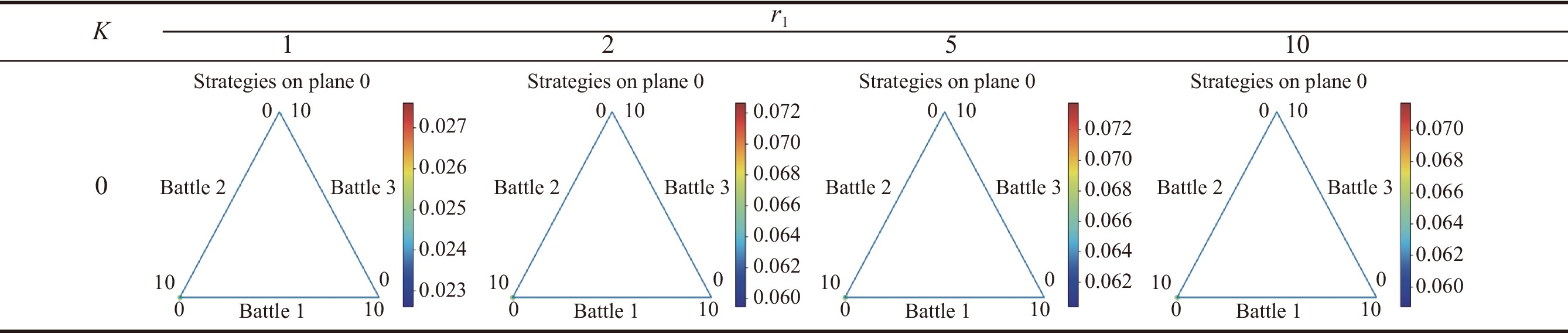 |
Fig 6
Results of pre-allocated resource assignment with total resource $ {{\boldsymbol{S}}_{\boldsymbol{x}}} {\boldsymbol{= 10}} $ and the number of battlefields $ {\boldsymbol{n = 3}} $, $ {{\boldsymbol{r}}_{\boldsymbol{1}}} {\boldsymbol{= 2}} $"
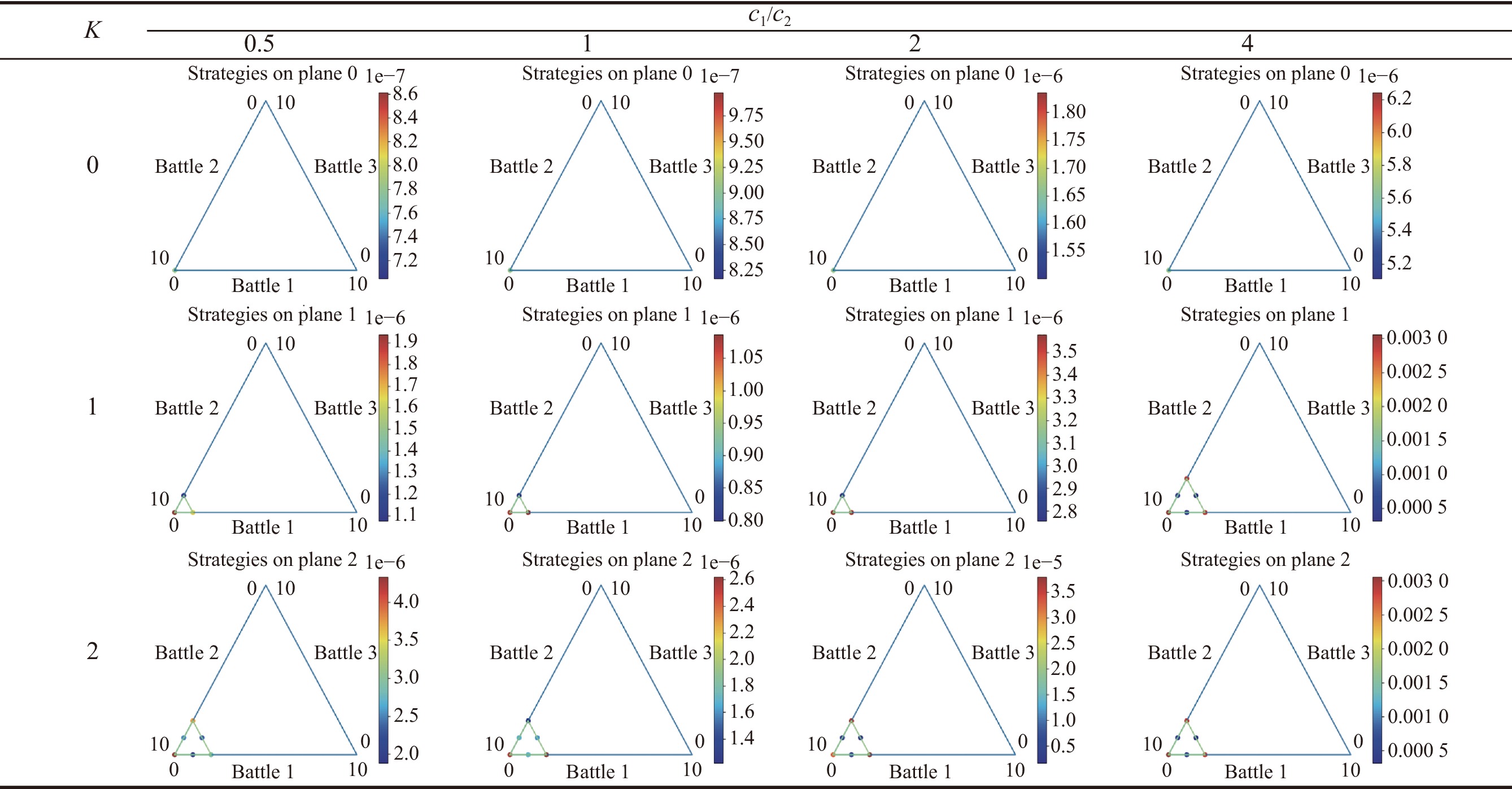
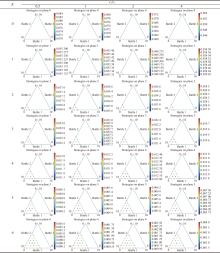
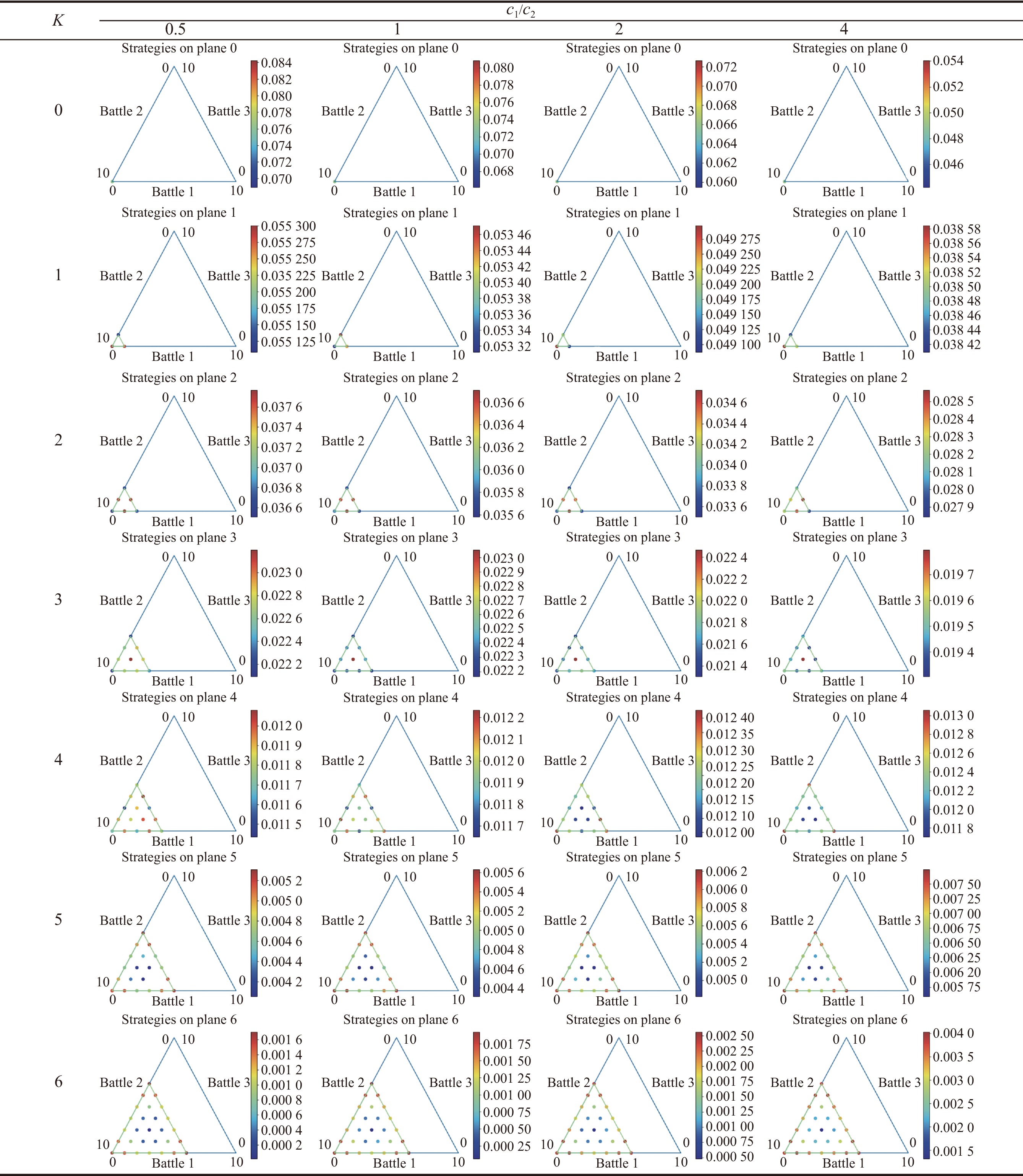
Fig 7
Results of support resource assignment with total resource $ {{\boldsymbol{S}}_{\boldsymbol{x}}} {\boldsymbol{= 10}} $ and the number of battlefields $ {\boldsymbol{n = 3}} $, $ {{\boldsymbol{r}}_{\boldsymbol{1}}} {\boldsymbol{= 2}} $"
| 1 |
ROBERSON B The Colonel Blotto game. Economic Theory, 2006, 29 (1): 1- 24.
doi: 10.1007/s00199-005-0071-5 |
| 2 |
DAN K, ROBERSON B Coalitional Colonel Blotto games with application to the economics of alliances. Journal of Public Economic Theory, 2012, 14 (4): 653- 676.
doi: 10.1111/j.1467-9779.2012.01556.x |
| 3 | MASUCCI A M, SILVA A. Strategic resource allocation for competitive influence in social networks. https://doi.org/10.48550/arXiv.1402.5388. |
| 4 | KUMAR D, SINGH A S. A survey on resource allocation techniques in cloud computing. Proc. of the International Conference on Computing, Communication & Automation, 2015: 655−660. |
| 5 | SCHWARTZ G, LOISEAU P, SASTRY S S. The heterogeneous Colonel Blotto game. Proc. of the International Conference on Network Games, 2017: 232−238. |
| 6 | ADAM L, HORCIK R, KASL T, et al. Double oracle algorithm for computing equilibria in continuous games. Proc. of the National Conference on Artificial Intelligence, 2021, 35(6): 5070−5077. |
| 7 | GUPTA A, BASAR T, SCHWARTZ G A. A three-stage Colonel Blotto game: when to provide more information to an adversary. Proc. of the International Conference on Decision and Game Theory for Security, 2014: 216−233. |
| 8 | KOVENOCK D, MAUBOUSSIN M J, ROBERSON B Asymmetric conflicts with endogenous dimensionality. Korean Economic Review, 2010, 26 (1): 287- 305. |
| 9 |
AYTON A, PRESTON P, AUTRAND F, et al The battle of crecy. The Journal of Military History, 2005, 69 (4): 1198- 1199.
doi: 10.1353/jmh.2005.0214 |
| 10 | LI X M, ZHENG J. Pure strategy Nash equilibrium in 2-contestant generalized lottery Colonel Blotto games. Social Science Electronic Publishing, 2022, 103: 102771. |
| 11 |
HAN Q, LI W M, XU Q L, et al Lanchester equation for cognitive domain using hesitant fuzzy linguistic terms sets. Journal of Systems Engineering and Electronics, 2022, 33 (3): 674- 682.
doi: 10.23919/JSEE.2022.000062 |
| 12 |
CANGIOTTI N, CAPOLLI M, MATTIA S A generalization of unaimed fire Lanchester’s model in multi-battle warfare. Operational Research, 2023, 23 (2): 38- 57.
doi: 10.1007/s12351-023-00776-8 |
| 13 | FENG B S, ZHOU X G, LIN Y J Study of air combat efficiency of carrier-borne fighter based on stochastic Lanchester battle theory. Computer Technology and Development, 2013, 23 (5): 199- 201. |
| 14 |
DEITCHMANS J A Lanchester model of guerrilla warfare. Operations Research, 1962, 10 (6): 818- 827.
doi: 10.1287/opre.10.6.818 |
| 15 |
TAYLOR J G, BROWN G G Further canonical methods in the solution of variable-coefficient Lanchester-type equations of modern warfare. Operations Research, 1976, 24 (1): 44- 69.
doi: 10.1287/opre.24.1.44 |
| 16 | MACKAY N J. Lanchester combat models. https://arxiv.org/abs/math/0606300. |
| 17 |
KRESS M, LIN K Y, MACKAY N J The attrition dynamics of multilateral war. Operation Research, 2018, 66 (4): 950- 956.
doi: 10.1287/opre.2018.1718 |
| 18 |
KALLONIATIS A C, HOEK K, ZUPARIC M, et al Optimising structure in a networked Lanchester model for fires and manoeuvre in warfare. Journal of the Operational Research Society, 2021, 72 (8): 1863- 1878.
doi: 10.1080/01605682.2020.1745701 |
| 19 |
ZUPARIC M, SHELYAG S, ANGELOVA M, et al Modelling host population support for combat adversaries. Journal of the Operational Research Society, 2023, 74 (3): 928- 943.
doi: 10.1080/01605682.2022.2122736 |
| 20 | CHEN X Y, JING Y W, LI C J, et al Analysis of optimum strategy using Lanchester equation for naval battles like Trafalgar. Journal of Northeastern University, 2009, 30 (4): 535- 538. |
| 21 |
JI X, ZHANG W P, XIANG F T, et al A swarm confrontation method based on Lanchester law and Nash equilibrium. Electronics, 2022, 11 (6): 896- 911.
doi: 10.3390/electronics11060896 |
| 22 | CHE Y K, GALE I Difference-form contests and the robustness of all-pay auctions. Games & Economic Behavior, 2000, 30 (1): 22- 43. |
| 23 | ALCALDE J, DAHM M Tullock and Hirshleifer: a meeting of the minds. Review of Economic Design, 2007, 11 (1): 101- 124. |
| 24 |
DAHM L C Foundations for contest success functions. Economic Theory, 2010, 43 (1): 81- 98.
doi: 10.1007/s00199-008-0425-x |
| 25 | DONG Q V. Models and solutions of strategic resource allocation problems: approximate equilibrium and online learning in Blotto games. Paris: Sorbonne University, 2020. |
| 26 | DONG Q V, LOISEAU P, SILVA A. Approximate equilibria in non-constant-sum Colonel Blotto and lottery Blotto games with large numbers of battlefields. https://arxiv.org/abs/1910.06559v1. |
| 27 | TODD W N, MARC L An introduction to counterfactual regret minimization. Proc. of the 4th Symposium on Educational Advances in Artificial Intelligence, 2013, 11, 1- 38. |
| 28 | MNIH V, KAVUKCUOGLU K, SILVER D, et al. Playing Atari with deep reinforcement learning. https://arxiv.org/pdf/1312.5602.pdf. |
| 29 | ZHA D C, XIE J R, MA W Y, et al. DouZero: mastering DouDizhu with self-play deep reinforcement learning. https://arxiv.org/pdf/2106.06135.pdf. |
| No related articles found! |
| Viewed | ||||||
|
Full text |
|
|||||
|
Abstract |
|
|||||
