
Journal of Systems Engineering and Electronics ›› 2026, Vol. 37 ›› Issue (1): 257-271.doi: 10.23919/JSEE.2026.000022
• SYSTEMS ENGINEERING • Previous Articles Next Articles
Jianjun ZHU1( ), Lin JIANG1,2,*()
Received:2021-07-21
Accepted:2026-01-06
Online:2026-02-18
Published:2026-03-09
Contact:
Lin JIANG
E-mail:zhujianjun@nuaa.edu.cn;42952775@qq.com
About author:Supported by:Jianjun ZHU, Lin JIANG. Performance improvement method of new R&D institutions considering Bayesian network[J]. Journal of Systems Engineering and Electronics, 2026, 37(1): 257-271.
Add to citation manager EndNote|Reference Manager|ProCite|BibTeX|RefWorks
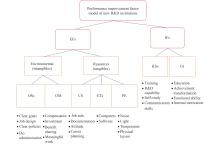
Fig 1
Performance improvement factor model of new R&D institutions"
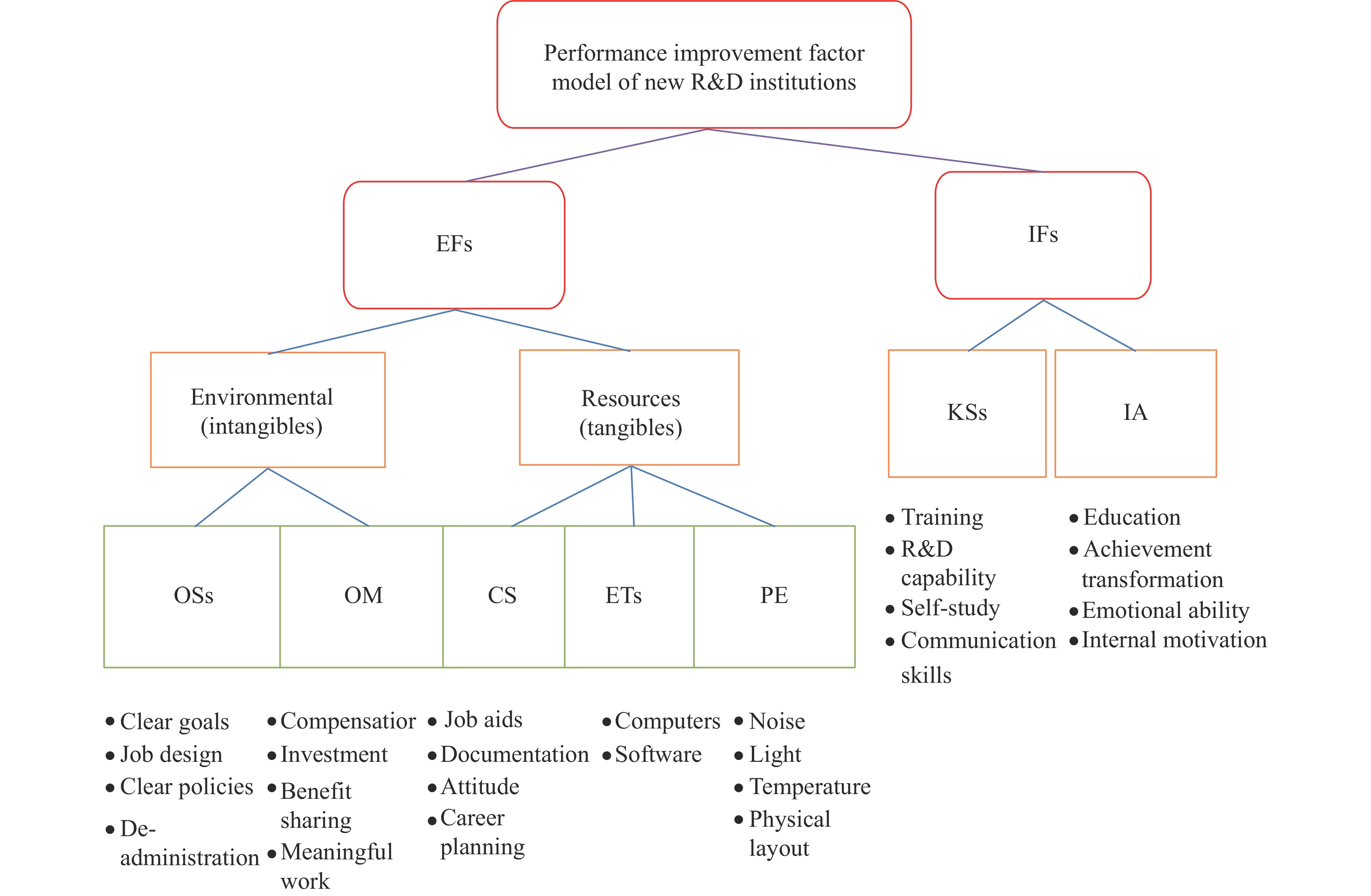

Table 1
Institution-employee basic performance improvement game matrix"
| Institution | Employee | ||||
| Cooperation (Y) | No cooperation (1−Y) | ||||
| Improvement (X) | N | ||||
| No improvement (1−X) | 0 | 0 | |||
Table 2
Performance improvement game matrix under institution-employee revenue sharing"
| Institution | Employee | |||
| Cooperation (Y) | No cooperation (1−Y) | |||
| Improvement (X) | N | |||
| No improvement (1−X) | ||||
Table 3
Analysis of the stability of the equilibrium point of the performance improvement game under the institution-employee revenue sharing"
| Equilibrium point | Partialstability | Eigenvalues | Eigenvalues | Stable condition | Remarks |
| ESS | − | ||||
| Unstable | − | − | |||
| Unstable | − | − | |||
| ESS | − | ||||
| Unstable | − |
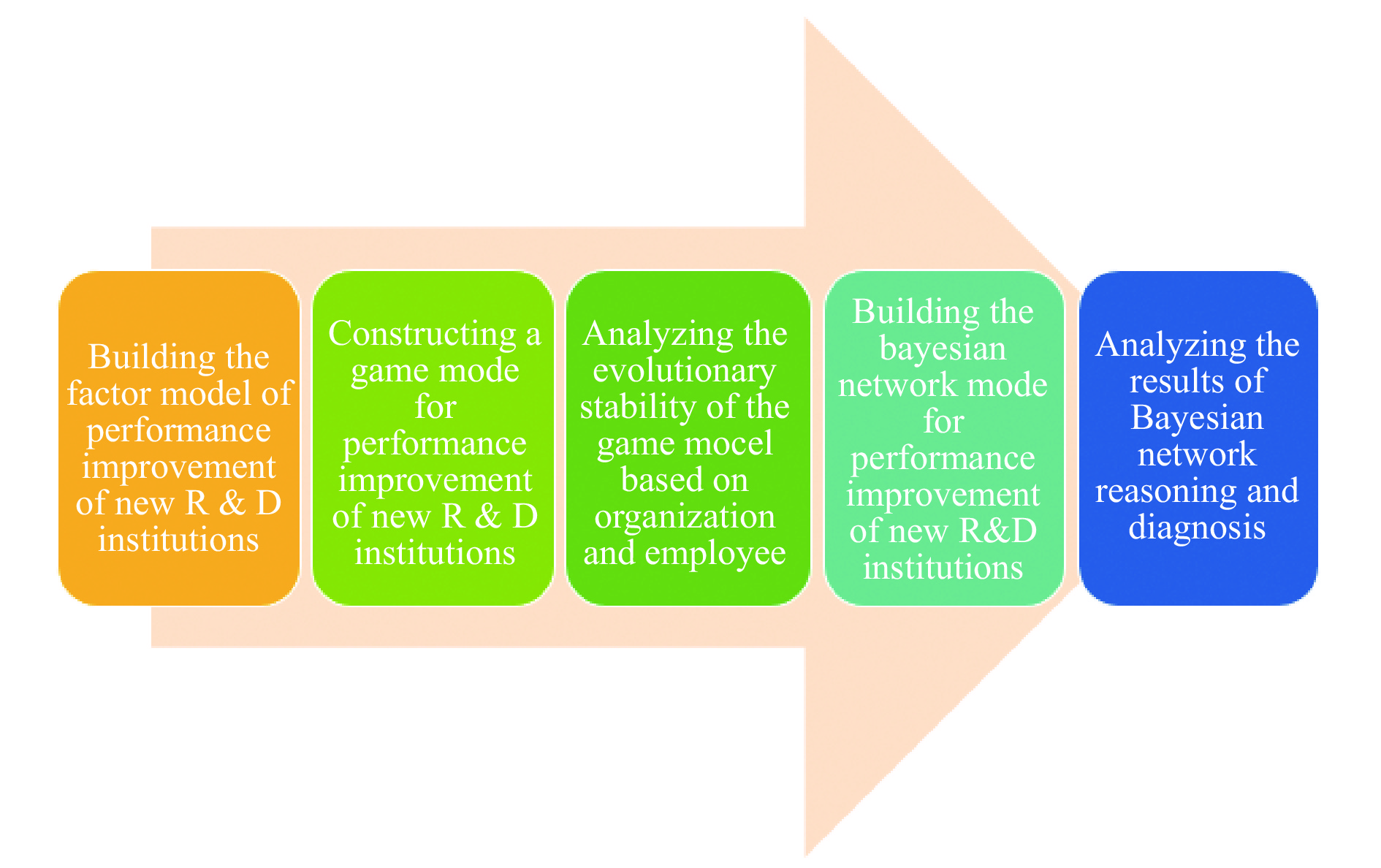
Fig 2
Steps of performance improvement methods for new R&D institutions"
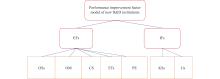
Fig 3
Simplified model of performance improvement factors for new R&D institution $ \bf{T} $"
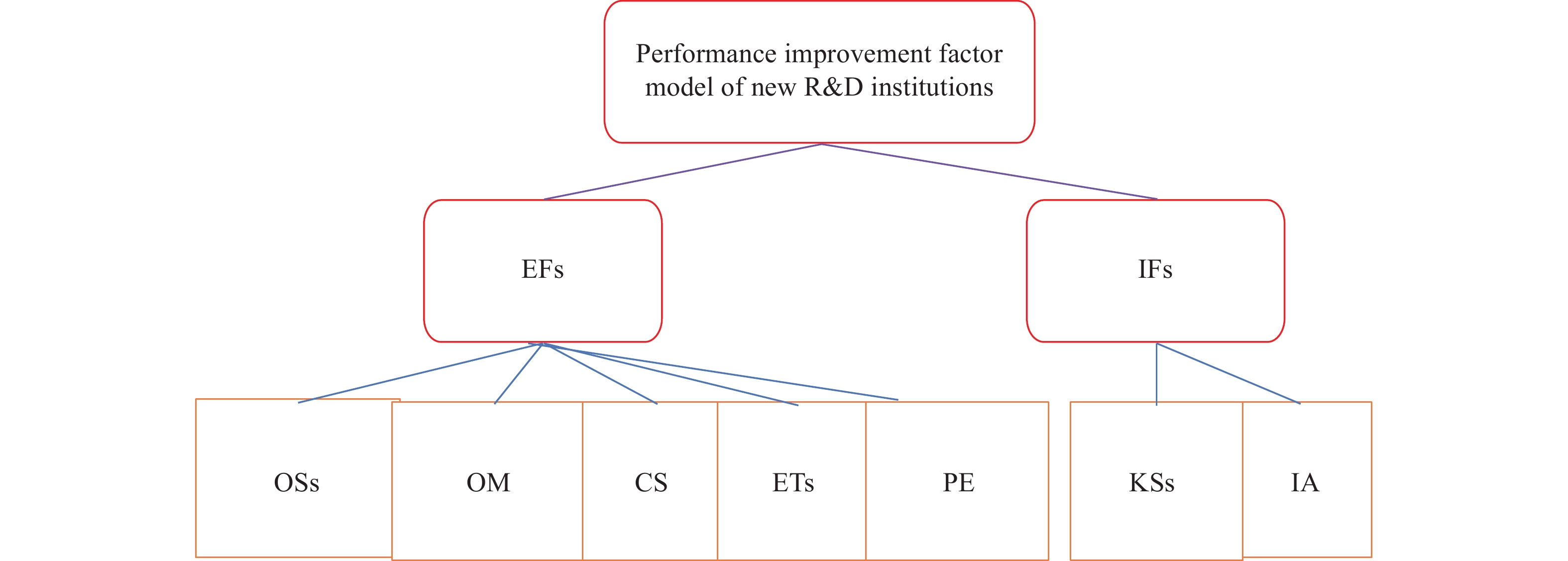
Table 4
Parameter information of new R&D institution T"
| Factor | |||||||
| OS | 400 | 80 | 8 | 80 | 10 | 31.25 | 27.78 |
| OM | 500 | 300 | 15 | 50 | 30 | 40.00 | 80.00 |
| CS | 150 | 50 | 5 | 50 | 5 | 66.67 | 54.05 |
| ET | 800 | 300 | 10 | 150 | 40 | 50.00 | 52.63 |
| PE | 380 | 80 | 5 | 100 | 5 | 26.32 | 30.65 |
| KS | 650 | 100 | 10 | 300 | 40 | 61.54 | 35.09 |
| IA | 600 | 100 | 20 | 300 | 50 | 41.67 | 55.56 |
Table 5
Tests whether the parameters of the case meet the stable conditions"
| Factor | Yes/No | ||
| OS | 208 | 22 | Yes |
| OM | 75 | 45 | Yes |
| CS | 42.5 | 2.5 | Yes |
| ET | 270 | 40 | Yes |
| PE | 181 | 14 | Yes |
| KS | 185 | 25 | Yes |
| IA | 80 | 70 | Yes |
Table 6
Conditional probability table of seven improvement factors %"
| Factor | High state before performance improvement | Low state before performance improvement | |||
| OS | 31.25 | 68.75 | 37.50 | 62.50 | |
| OM | 40.00 | 60.00 | 48.00 | 52.00 | |
| CS | 66.67 | 33.33 | 80.00 | 20.00 | |
| ET | 50.00 | 50.00 | 60.00 | 40.00 | |
| PE | 26.32 | 73.68 | 31.58 | 68.42 | |
| KS | 61.54 | 38.46 | 73.85 | 26.15 | |
| IA | 41.67 | 58.33 | 50.00 | 50.00 | |
Table 7
Probability table of high performance under seven improvement factors %"
| Factor | |||||
| OS | 27.78 | 72.22 | 70.00 | 30.00 | 41.11 |
| OM | 80.00 | 20.00 | 90.00 | 30.00 | 78.00 |
| CS | 54.05 | 45.95 | 70.00 | 30.00 | 51.62 |
| ET | 52.63 | 47.37 | 85.00 | 30.00 | 58.95 |
| PE | 30.65 | 69.35 | 85.00 | 30.00 | 46.86 |
| KS | 35.09 | 64.91 | 90.00 | 30.00 | 51.05 |
| IA | 55.56 | 44.44 | 90.00 | 30.00 | 63.33 |
Table 8
Conditional probability table of high performance produced by external factor $ \left(\bf{EF}\right) $"
| Status | OS | OM | CS | ET | PE | |||
| 1 | Yes | Yes | Yes | Yes | Yes | 5 | 82.49 | 17.51 |
| 2 | Yes | Yes | Yes | Yes | No | 4 | 81.99 | 18.01 |
| 3 | Yes | Yes | Yes | No | Yes | 4 | 79.12 | 20.88 |
| 4 | Yes | Yes | Yes | No | No | 3 | 78.90 | 21.10 |
| 5 | Yes | Yes | No | Yes | Yes | 4 | 81.29 | 18.71 |
| 6 | Yes | Yes | No | Yes | No | 3 | 81.69 | 18.31 |
| 7 | Yes | Yes | No | No | Yes | 3 | 77.99 | 22.01 |
| 8 | Yes | Yes | No | No | No | 2 | 79.30 | 20.70 |
| 9 | Yes | No | Yes | Yes | Yes | 4 | 74.39 | 25.61 |
| 10 | Yes | No | Yes | Yes | No | 3 | 72.81 | 27.19 |
| 11 | Yes | No | Yes | No | Yes | 3 | 69.11 | 30.89 |
| 12 | Yes | No | Yes | No | No | 2 | 66.46 | 33.54 |
| 13 | Yes | No | No | Yes | Yes | 3 | 71.90 | 28.10 |
| 14 | Yes | No | No | Yes | No | 2 | 70.49 | 29.51 |
| 15 | Yes | No | No | No | Yes | 2 | 65.15 | 34.85 |
| 16 | Yes | No | No | No | No | 1 | 60.27 | 39.73 |
| 17 | No | Yes | Yes | Yes | Yes | 4 | 83.57 | 16.43 |
| 18 | No | Yes | Yes | Yes | No | 3 | 84.63 | 15.37 |
| 19 | No | Yes | Yes | No | Yes | 3 | 80.94 | 19.06 |
| 20 | No | Yes | Yes | No | No | 2 | 83.56 | 16.44 |
| 21 | No | Yes | No | Yes | Yes | 3 | 83.72 | 16.28 |
| 22 | No | Yes | No | Yes | No | 2 | 87.59 | 12.41 |
| 23 | No | Yes | No | No | Yes | 2 | 82.25 | 17.75 |
| 24 | No | Yes | No | No | No | 1 | 93.20 | 6.80 |
| 25 | No | No | Yes | Yes | Yes | 3 | 74.85 | 25.15 |
| 26 | No | No | Yes | Yes | No | 2 | 74.75 | 25.25 |
| 27 | No | No | Yes | No | Yes | 2 | 69.41 | 30.59 |
| 28 | No | No | Yes | No | No | 1 | 68.46 | 31.54 |
| 29 | No | No | No | Yes | Yes | 2 | 73.44 | 26.56 |
| 30 | No | No | No | Yes | No | 1 | 76.23 | 23.77 |
| 31 | No | No | No | No | Yes | 1 | 65.94 | 34.06 |
| 32 | No | No | No | No | No | 0 | 10.00 | 90.00 |
Table 9
Conditional probability table of $ \bf{IF}$"
| j | KS | IA | |||
| 1 | Yes | Yes | 2 | 85.19 | 14.81 |
| 2 | Yes | No | 1 | 67.54 | 32.46 |
| 3 | No | Yes | 1 | 77.78 | 22.22 |
| 4 | No | No | 0 | 10.00 | 90.00 |
Table 10
Conditional probability table of IP"
| j | EF | IF | |||
| 1 | H | H | 2 | 90 | 10 |
| 2 | H | L | 1 | 70 | 30 |
| 3 | L | H | 1 | 75 | 25 |
| 4 | L | L | 0 | 40 | 60 |
Fig 4
Bayesian network model for performance improvement of new R&D institutions"
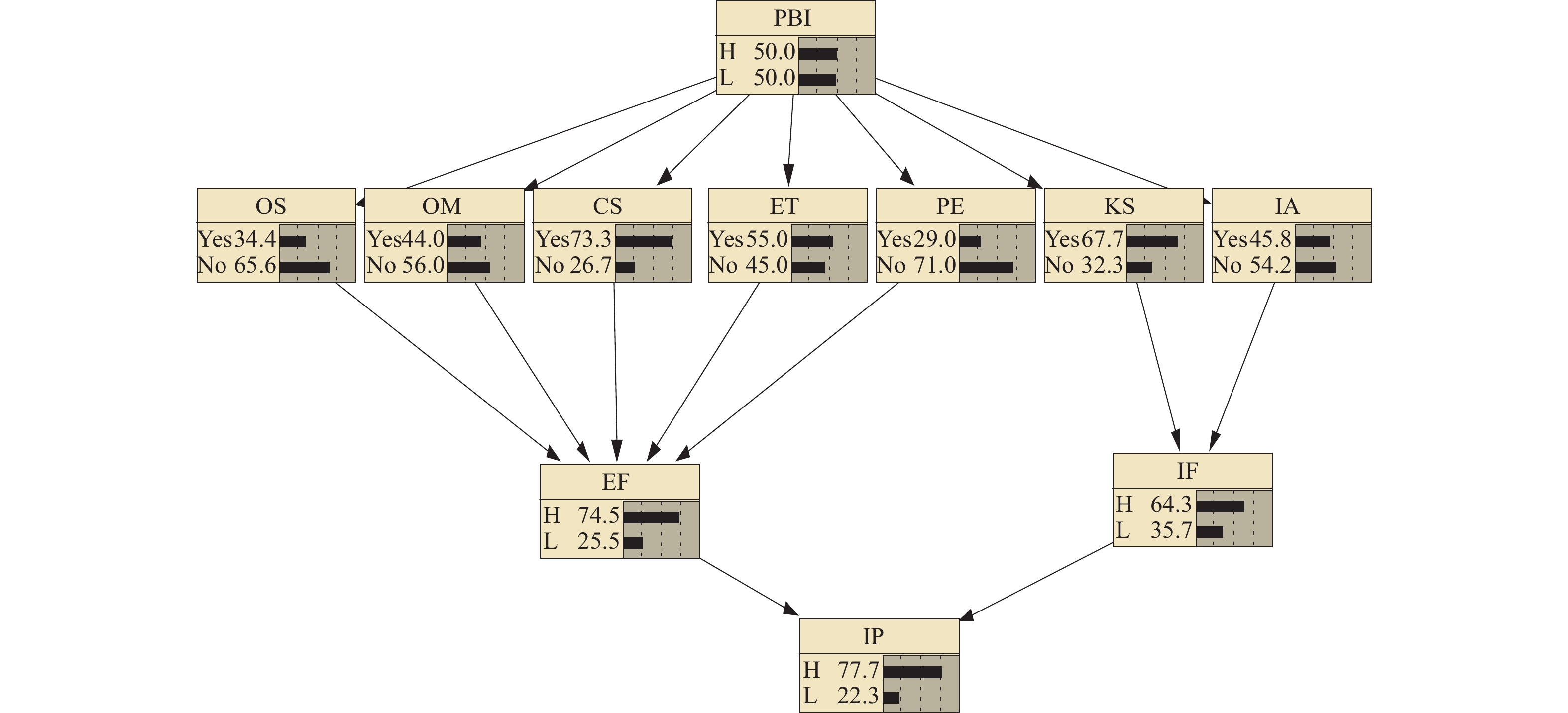
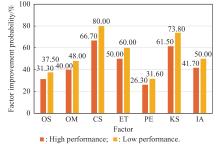
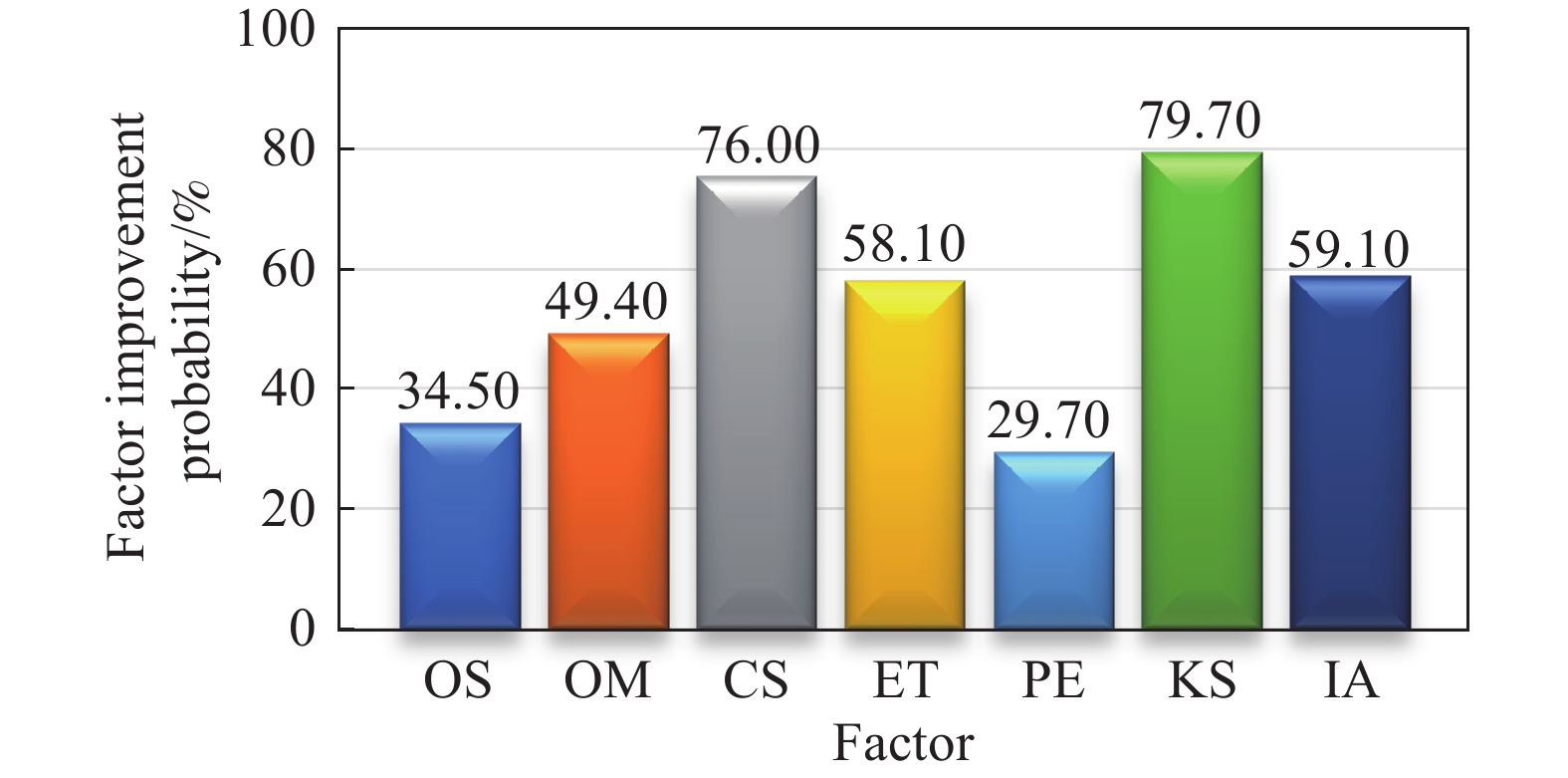
Fig 5
Improvement probability of factors for performance before improvement $ {{\boldsymbol{S}}} $ being high performance and low performance"
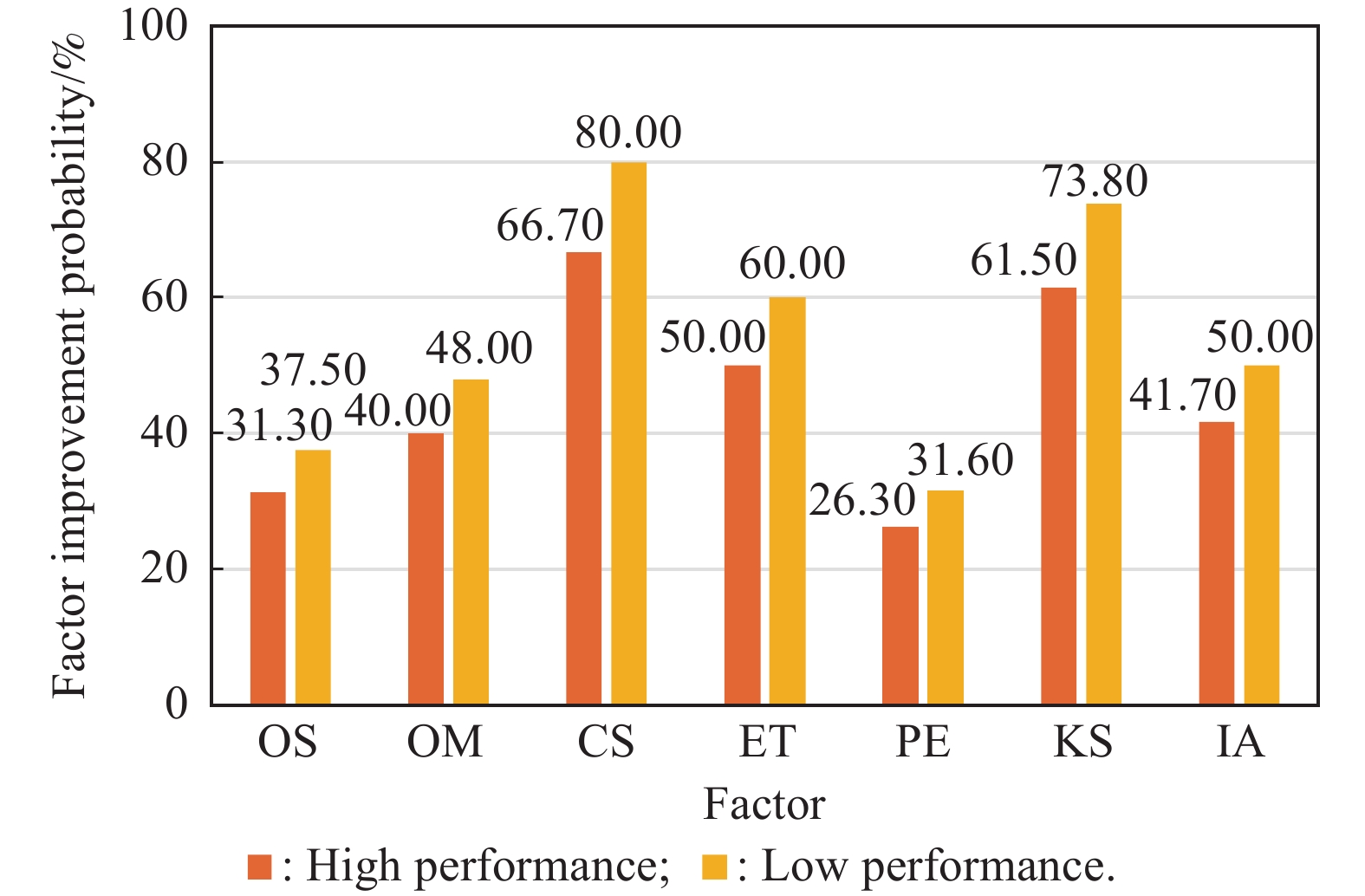
Fig 6
Factor improvement probability of performance $ {{{\boldsymbol{S}}}}{{{\boldsymbol{'}}}} $ after imporvement being high performance"
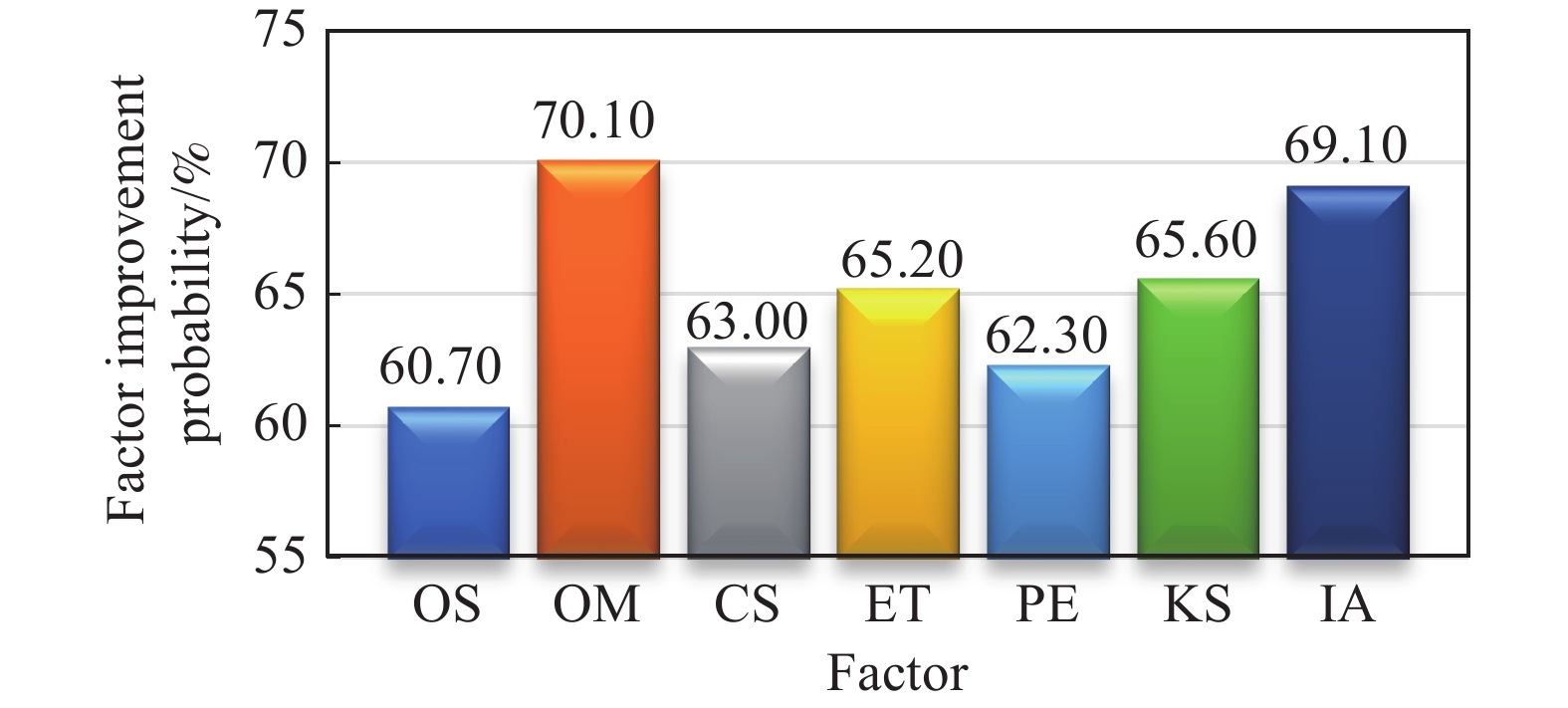
Fig 7
Factor improvement probability of the performance before improvement $ {\boldsymbol{S}} $ and the performance after the improvement $ {{{\boldsymbol{S}}}}{{{\boldsymbol{'}}}} $ being both at a high state of 100%"
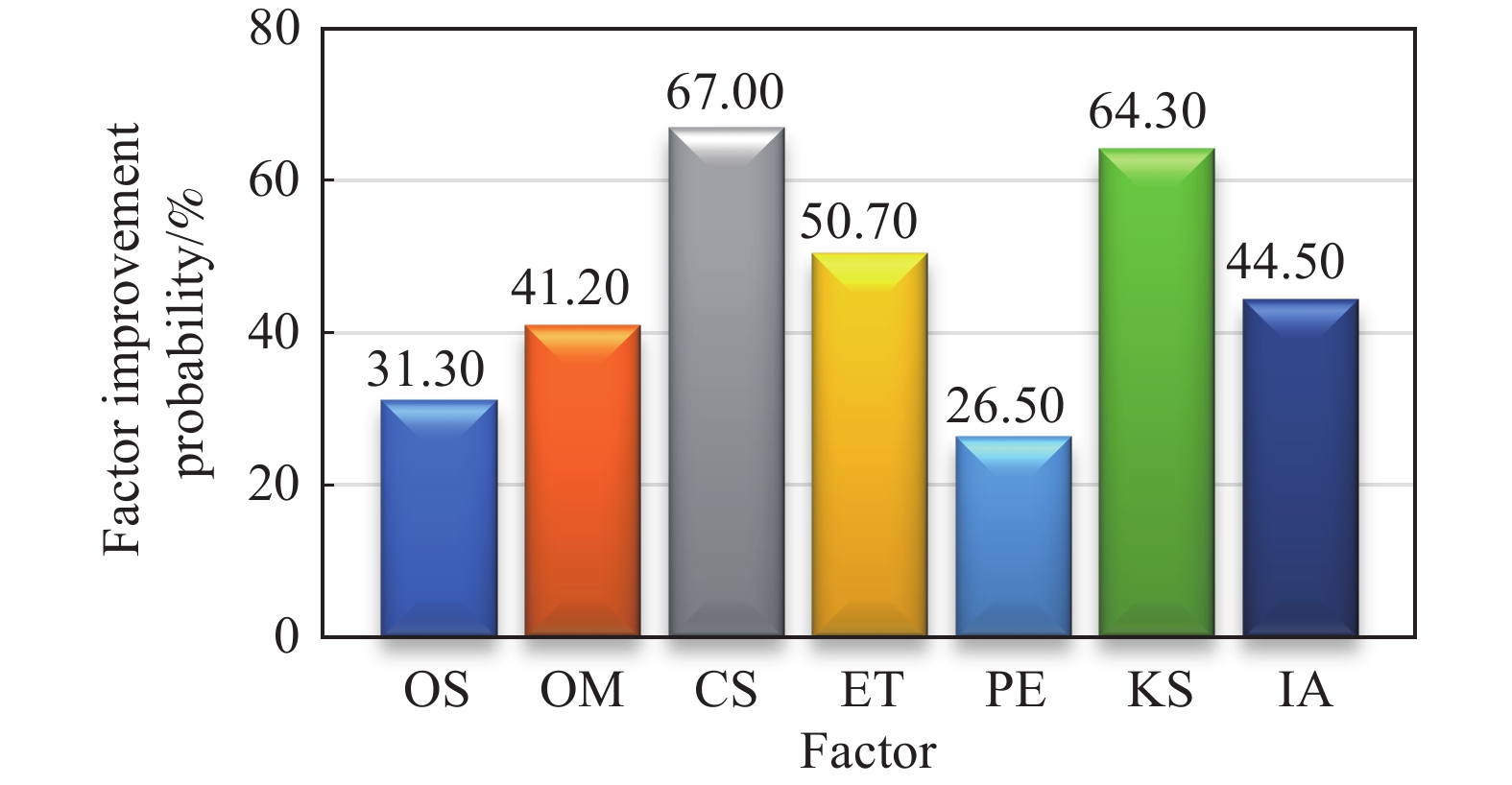
Fig 8
Factor improvement probability when the performance before improvement is 100% in the low state and the performance after improvement is 100% in the high state"
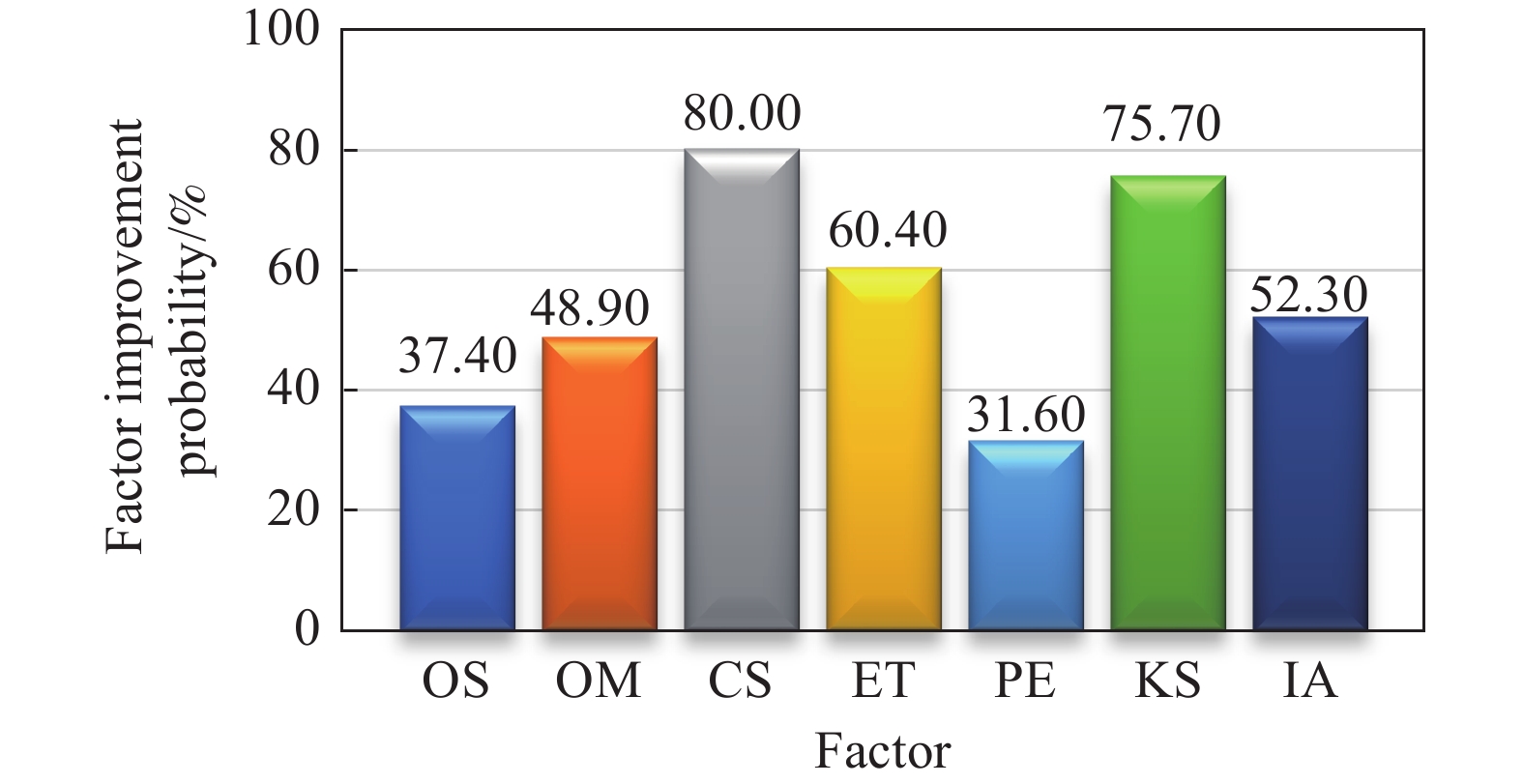
Fig 9
Factor improvement probability when the performance after improvement $ {{{\boldsymbol{S}}}}{{{\boldsymbol{'}}}} $, external factors, and internal factors are all at a 100% high state"
| 1 | LI H G, RU S F, SHI V, et al The effect of government subsidy policy for foreign capital R&D from the perspective of global supply chains: an empirical analysis with time lag and propensity score matching. Sustainability, 2021, 13 (15): 1- 9. |
| 2 | ZHANG A B, DANISH B, CHEN R, et al The paradox of artificial intelligence and environmental performance: the critical role of energy transition and institutional quality. Journal of Environmental Management, 2025, 394 (1): 127- 153. |
| 3 | YESIM D O, ERHAN A, YIGIT K, et al. Incorporating multidimensional risk evaluation in sustainable maintenance for operational performance. International Journal of Productivity and Performance Management, 2025, 74 (9): 3262−3286. |
| 4 | WANG C X, GUO F, ZHANG Q P, et al. How does disruptive innovation influence firm performance? A moderated mediation model. European Journal of Innovation Management, 2023, 26(3): 798−820. |
| 5 | GAO X, ZHANG F, JIANG S Y, et al Adapting to policy changes: how firms’ R&D responses affect their performance. Research Policy, 2025, 54 (1): 105- 143. |
| 6 | GUO H L, SHEN Z, CHEN Y T, et al Analyzing the impact of government R&D subsidy and digital transformation on supply chain risk dynamics management and firm performance in the China’s chip industry. International Journal of Production Economics, 2025, 281 (1): 109- 152. |
| 7 |
LIU T S, SONG Y Z, XIANG X P, et al Bridging production factors allocation and environmental performance of China’s heavy-polluting energy firms: the moderation effect of financing and internationalization. Energy, 2021, 2 (1): 222- 234.
doi: 10.1016/j.energy.2021.119943 |
| 8 |
JIANG L, ZHU J J A dynamic grey target evaluation method with multiple reference points for new R&D institution performance. Journal of Intelligent & Fuzzy Systems, 2021, 40 (3): 3831- 3847.
doi: 10.3233/jifs-190602 |
| 9 |
JIA C, CHEN Z, GUO X D, et al Balancing greenwashing and genuine change: how environmental management and technology drive sustainable corporate performance. Journal of Environmental Management, 2025, 395 (1): 127- 143.
doi: 10.1016/j.jenvman.2025.127770 |
| 10 |
LIU Z F, WANG Y N, FENG J, et al Identifying supply chain R&D partners via multilayer institutional cooperation network and tailored link prediction. Computers & Industrial Engineering, 2025, 201 (1): 110- 128.
doi: 10.1016/j.cie.2025.110887 |
| 11 |
CHO H J, AHN H J, PARK E, et al Data-driven analysis on the performance evaluation of national R&D projects in Korea. Evaluation and Program Planning, 2024, 102 (1): 102- 128.
doi: 10.1016/j.evalprogplan.2023.102383 |
| 12 | FOK L, ZEE S. Green practices and sustainability performance: the exploratory links of organizational culture and quality improvement practices. Journal of Manufacturing Technology Management, 2023, 33(5): 913−933. |
| 13 |
LIU Y Y, TIAN X M, LONG Y, et al Digital economy and corporate ESG performance: cost reduction or efficiency improvement?. Finance Research Letters, 2025, 77 (1): 107- 144.
doi: 10.1016/j.frl.2025.107044 |
| 14 | JIANG G G, LI Y M, TENG X Y, et al Performance improvement of energy extraction and energy utilization to reduce carbon emissions in resource-rich Belt and Road initiative countries: applying a meta two-stage non-radial dynamic DEA model. Energy, 2025, 328 (1): 136- 147. |
| 15 |
IVANNE M, ALEXANDRE L Shifting visions of human performance improvement tools-Risks and potential outcomes. Safety Science, 2025, 181 (1): 106- 117.
doi: 10.1016/j.ssci.2024.106671 |
| 16 | LIU M F, FANG Y Y. Human performance improvement. Beijing: Peking University Press, 2011. (in Chinese) |
| 17 | CHEN J L, LIU Z H, CAI Q R, et al. Diffusion of low-carbon policies among cities: a complex network and evolutionary game approach. Journal of Cleaner Production, 2025 536(15): 147−164. |
| 18 | CHEN F, WU B, LOU W Q, et al An evolutionary analysis on the effect of government policies on green R&D of photovoltaic industry diffusion in complex network. Energy Policy, 2021, 152 (1): 1- 12. |
| 19 | ZOU B L, JU C H, BAO F G, et al Exploring an efficient evolutionary game model for the government-enterprise-public during the double carbon policy in China. International Journal of Environmental Research and Public Health, 2022, 19 (8): 1- 14. |
| 20 |
LI P, WU B, WU N, et al The three-party evolutionary game of preannouncement strategies for platform’s AI updates considering users’ loyalties. Engineering Applications of Artificial Intelligence, 2025, 162 (1): 112- 128.
doi: 10.1016/j.engappai.2025.112782 |
| 21 | DU W H, HE Q Z, WU J J, et al Intellectual property protection, green technology innovation, and energy transition: an evolutionary game analysis. Energy Economics, 2025, 151 (1): 108- 119. |
| 22 |
BEI H H, ZHANG J S, YANG T R, et al Analysis of maritime accident governance behaviors based on evolutionary game theory and system dynamics. Ocean Engineering, 2025, 335 (1): 121- 137.
doi: 10.1016/j.oceaneng.2025.121737 |
| 23 |
WANG F, FENG J E, WANG B, et al Reconstructing networks from the algebraic model of networked evolutionary games. Nonlinear Analysis: Hybrid Systems, 2025, 57 (1): 101- 136.
doi: 10.1016/j.nahs.2025.101603 |
| 24 |
HE D X, WANG Y Y A network embedding-enhanced Bayesian model for generalized community detection in complex networks. Information Sciences, 2021, 575 (1): 306- 322.
doi: 10.1016/j.ins.2021.06.020 |
| 25 |
ZHENG J, GUO Y C, RONG W Y, et al A Bayesian network approach to cognitive alignment and trust in human-unmanned ship collision avoidance. Ocean Engineering, 2025, 342 (1): 122- 139.
doi: 10.1016/j.oceaneng.2025.122913 |
| 26 |
MIGUEL F, JOAO S, JOAO N, et al Assessing ecosystem services provision using Bayesian belief network in Southern Europe marine forests. Ecosystem Services, 2025, 76 (1): 78- 101.
doi: 10.1016/j.ecoser.2025.101789 |
| 27 | ZULFIQAR M Optimizing long short-term memory network with genetic and Bayesian optimization algorithms for accurate forecasting. Next Energy, 2025, 9 (1): 100- 125. |
| 28 |
BELIVEAU A, GUSTAFSON P A Theoretical investigation of how evidence flows in Bayesian network meta-analysis of disconnected networks. Bayesian Analysis, 2021, 16 (3): 803- 823.
doi: 10.1214/20-ba1224 |
| 29 | LUO W H, LIU W C, XIA L Y, et al. Application of cloud model-Bayesian network and genetic algorithm for assessment and optimization of building energy consumption. Energy, 2025, 335(1): 138−172. |
| 30 | GUO B T, WANG S B, WANG J N, et al Research on the co-construction performance evaluation system of new R&D institutions based on network level analysis. Science and Technology Management Research, 2020, 2 (10): 72- 79. |
| 31 | ZHANG Y L, ZHENG Y, LUO J W, et al Research and prospect of new R&D institutions based on systematic literature review. Science and Technology Management Research, 2019, 3 (15): 83- 91. |
| [1] | Jingwei DONG, Wei TANG, Minggang YU. A method for modeling and evaluating the interoperability of multi-agent systems based on hierarchical weighted networks [J]. Journal of Systems Engineering and Electronics, 2025, 36(3): 754-767. |
| [2] | Weijian PANG, Xinyi MA, Xueming LIANG, Xiaogang LIU, Erwa DONG. Role-based Bayesian decision framework for autonomous unmanned systems [J]. Journal of Systems Engineering and Electronics, 2023, 34(6): 1397-1408. |
| [3] | Shunqi YANG, Ying ZENG, Xiang LI, Yanfeng LI, Hongzhong HUANG. Reliability analysis for wireless communication networks via dynamic Bayesian network [J]. Journal of Systems Engineering and Electronics, 2023, 34(5): 1368-1374. |
| [4] | Renjie XU, Xin LIU, Donghao CUI, Jian XIE, Lin GONG. An evaluation method of contribution rate based on fuzzy Bayesian networks for equipment system-of-systems architecture [J]. Journal of Systems Engineering and Electronics, 2023, 34(3): 574-587. |
| [5] | Minggang YU, Yanjie NIU, Xueda LIU, Dongge ZHANG, Peng ZHENG, Ming HE, Ling LUO. Adaptive dynamic reconfiguration mechanism of unmanned swarm topology based on an evolutionary game [J]. Journal of Systems Engineering and Electronics, 2023, 34(3): 598-614. |
| [6] | Fang YE, Ying MAO, Yibing LI, Xinrui LIU. Target threat estimation based on discrete dynamic Bayesian networks with small samples [J]. Journal of Systems Engineering and Electronics, 2022, 33(5): 1135-1142. |
| [7] | Xiangyuan TAN, Xiaoguang GAO, Chuchao HE, Zidong WANG. Causal constraint pruning for exact learning of Bayesian network structure [J]. Journal of Systems Engineering and Electronics, 2021, 32(4): 854-872. |
| [8] | Ye MA, Tianqing CHANG, Wenhui FAN. A single-task and multi-decision evolutionary game model based on multi-agent reinforcement learning [J]. Journal of Systems Engineering and Electronics, 2021, 32(3): 642-657. |
| [9] | Ming ZHANG, Jianjun ZHU, Hehua WANG. Evolutionary game analysis of problem processing mechanism in new collaboration [J]. Journal of Systems Engineering and Electronics, 2021, 32(1): 136-150. |
| [10] | Yu YANG, Xiaoguang GAO, Zhigao GUO. Finding optimal Bayesian networks by a layered learning method [J]. Journal of Systems Engineering and Electronics, 2019, 30(5): 946-958. |
| [11] | Xiaoguang GAO, Yu YANG, Zhigao GUO. Learning Bayesian networks by constrained Bayesian estimation [J]. Journal of Systems Engineering and Electronics, 2019, 30(3): 511-524. |
| [12] | Chuchao HE, Xiaoguang GAO, Zhigao GUO. Structure learning on Bayesian networks by finding the optimal ordering with and without priors [J]. Journal of Systems Engineering and Electronics, 2018, 29(6): 1209-1227. |
| [13] | Ruohai Di, Xiaoguang Gao, and Zhigao Guo. Learning Bayesian network parameters under new monotonic constraints#br# [J]. Journal of Systems Engineering and Electronics, 2017, 28(6): 1248-1255. |
| [14] | Binghua Song, Zhongbao Zhou, Chaoqun Ma, Jinglun Zhou, and Shaofeng Geng. Reliability analysis of monotone coherent multi-state systems based on Bayesian networks [J]. Journal of Systems Engineering and Electronics, 2016, 27(6): 1326-1335. |
| [15] | Zhiqiang Cai, Shubin Si, Shudong Sun, and Hongyan Dui. Learning Bayesian network structure with immune algorithm [J]. Journal of Systems Engineering and Electronics, 2015, 26(2): 282-291. |
| Viewed | ||||||
|
Full text |
|
|||||
|
Abstract |
|
|||||
