
Journal of Systems Engineering and Electronics ›› 2026, Vol. 37 ›› Issue (3): 816-825.doi: 10.23919/JSEE.2026.000059
• ELECTRONICS TECHNOLOGY • Previous Articles Next Articles
Zijian YU( ), Lijing LI(), Siyuan WANG(), Yue ZHENG()
Received:2024-04-15
Accepted:2026-03-23
Online:2026-06-18
Published:2026-06-29
Contact:
Yue ZHENG
E-mail:sy2117112@buaa.edu.cn;lilijing@buaa.edu.cn;wangsiyuan_1995@buaa.edu.cn;zhengyue@buaa.edu.cn
Supported by:Zijian YU, Lijing LI, Siyuan WANG, Yue ZHENG. Multi-scale optical convolutional neural network for target classification[J]. Journal of Systems Engineering and Electronics, 2026, 37(3): 816-825.
Add to citation manager EndNote|Reference Manager|ProCite|BibTeX|RefWorks
Fig 1
Optoelectronic hybrid neural network framework"
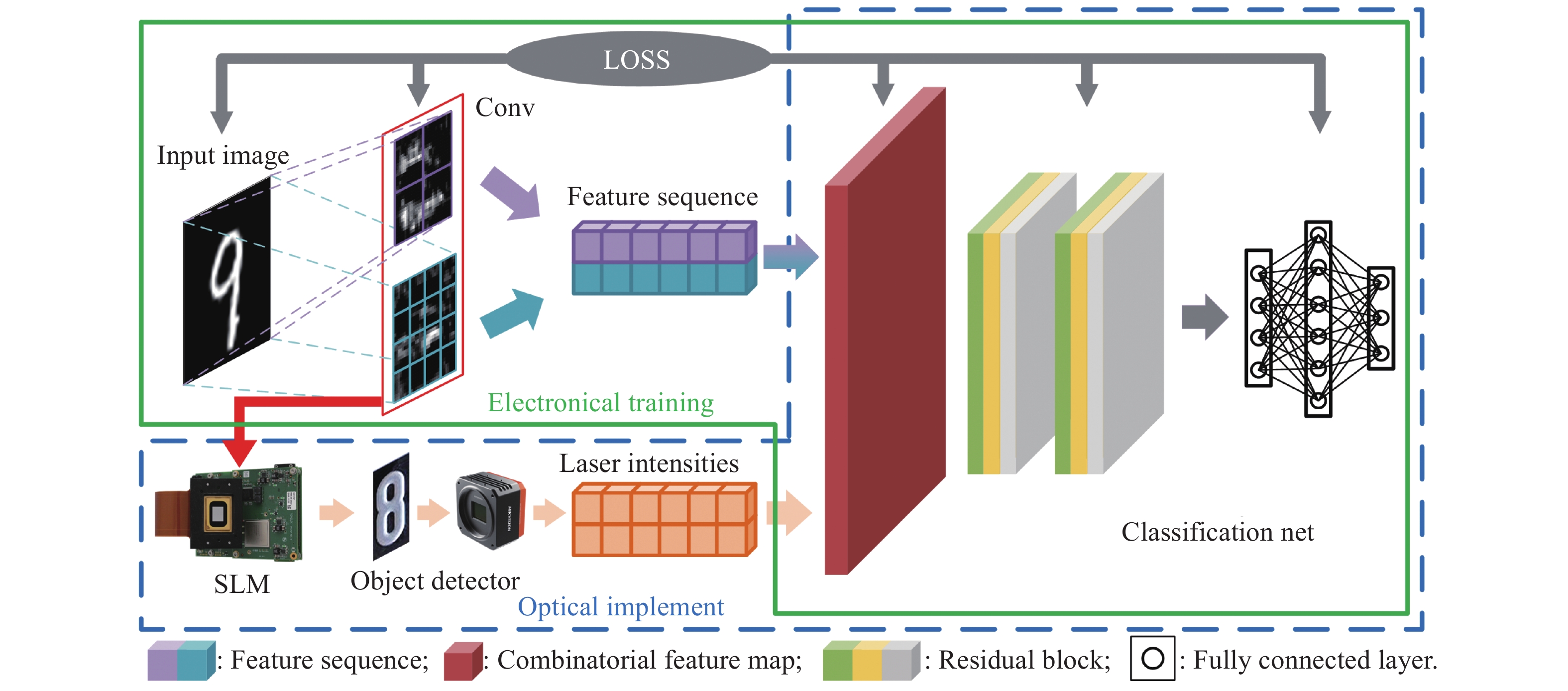
Fig 2
Schematic diagram of the proposed multiscale optical convolutional module"
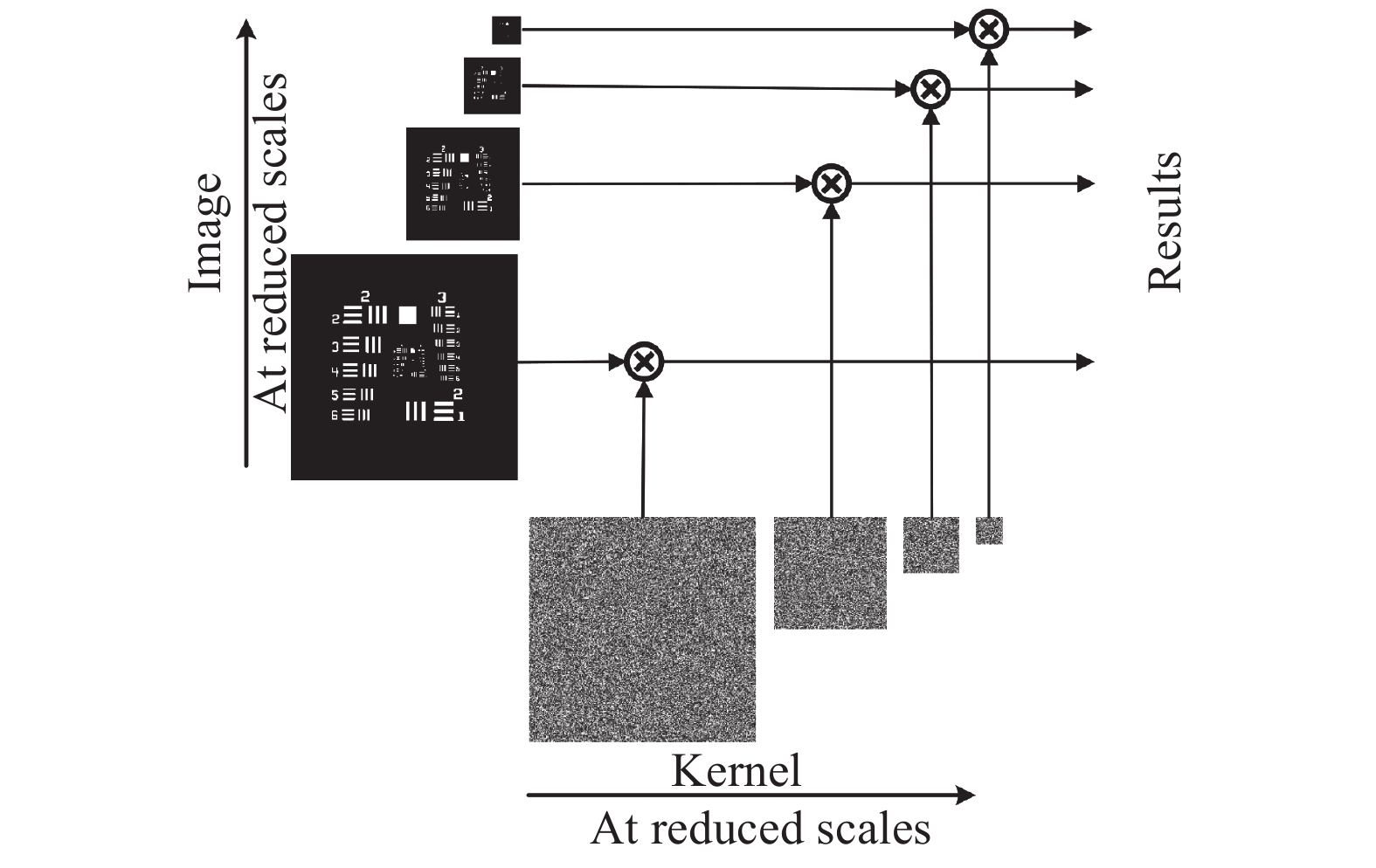

Fig 3
Training framework for MS optical convolutional non-imaging neural network"
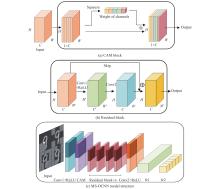
Fig 4
Model structure diagram"
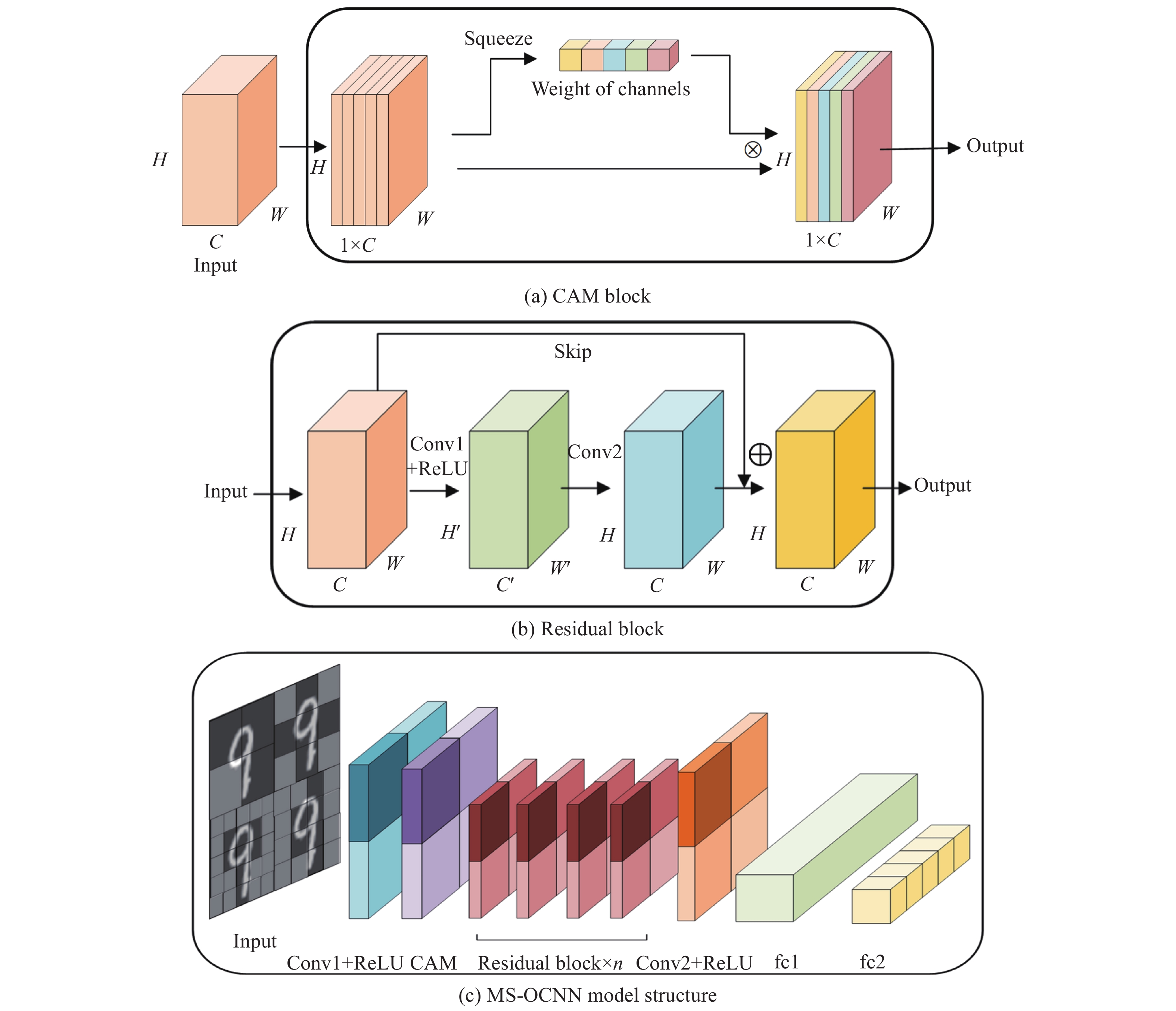
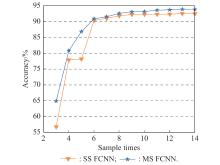
Fig 5
Comparison of MS FCNN and SS FCNN"
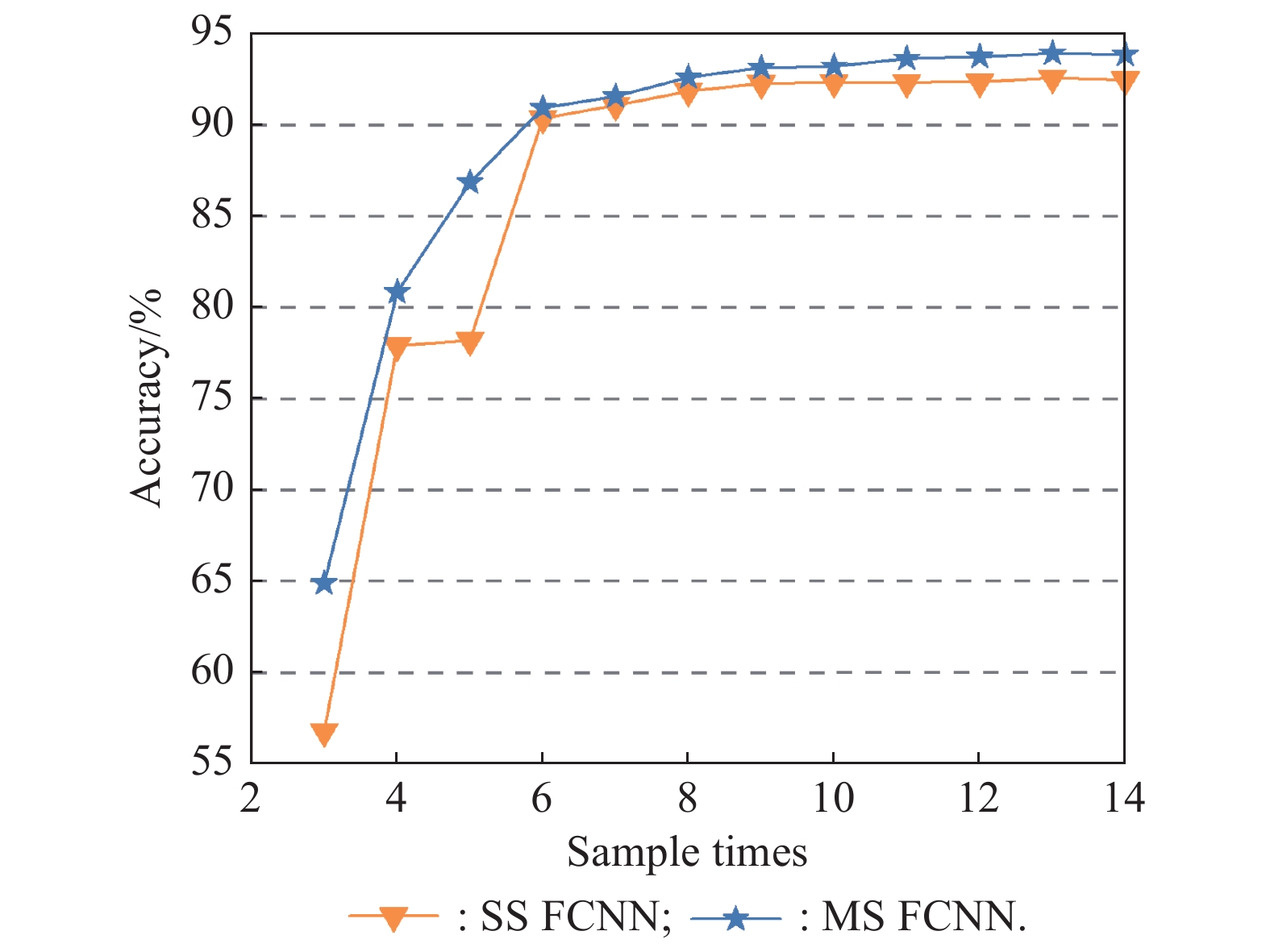

Table 1
Ablation experiments %"
| Model | MNIST | Fashion-MNIST |
| MS-FCN | 94.86 | 84.74 |
| MS-FCN+CAM | 94.92 | 86.66 |
| MS-FCN+Residual block | 98.07 | 89.66 |
| MS-OCNN (proposed) | 98.67 | 90.67 |
Table 2
Simulation results of the classification accuracy for different models with low sample times"
| Model | ST | SR/% | MNIST/% | Fashion-MNIST/% |
| FCFNN [ | 8 | 0.78 | 58.17 | 63.50 |
| DICNN [ | 8 | 1 | 58.94 | − |
| SPSCNN [ | 8 | 1 | 91.73 | 82.15 |
| MS-OCNN (proposed) | 8 | 0.78 | 91.93 | 84.00 |
Table 3
Simulation results of the classification accuracy for different models with high sample times"
| Model | ST | SR/% | MNIST/% | Fashion-MNIST/% |
| FCFNN [ | 64 | 6.25 | 97.25 | 87.46 |
| DICNN [ | 39 | 5 | 94.82 | − |
| SPSCNN [ | 40 | 5 | 96.98 | 84.98 |
| MS-OCNN (proposed) | 36 | 3.5 | 98.27 | 90.02 |
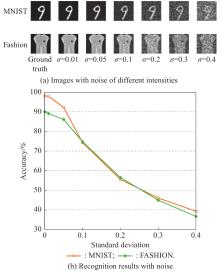
Fig 6
Recognition results under different light source noise interference"
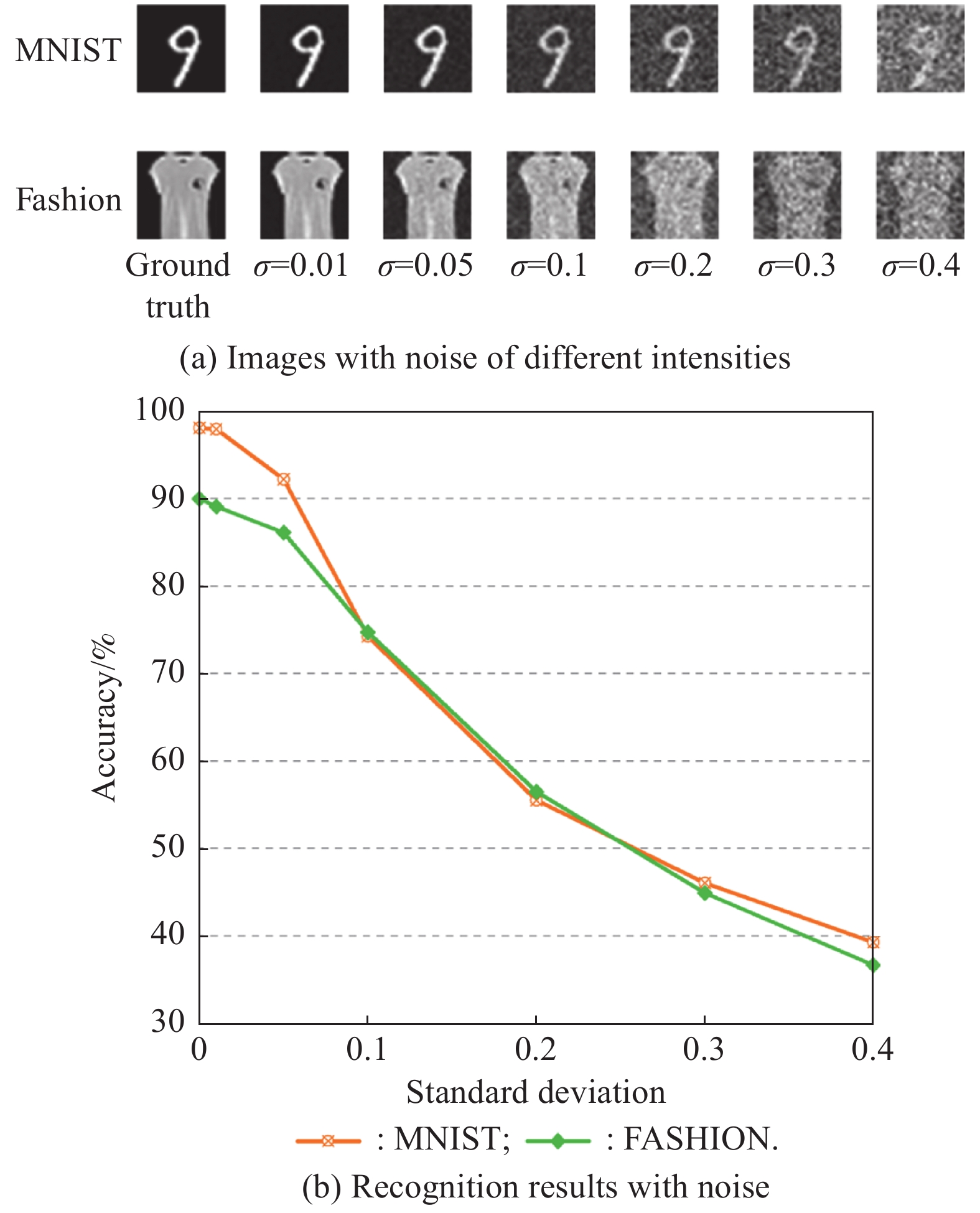
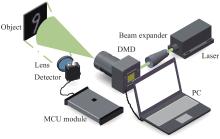
Fig 7
Experiment Setup for online non-imaging target recognition with MS features"
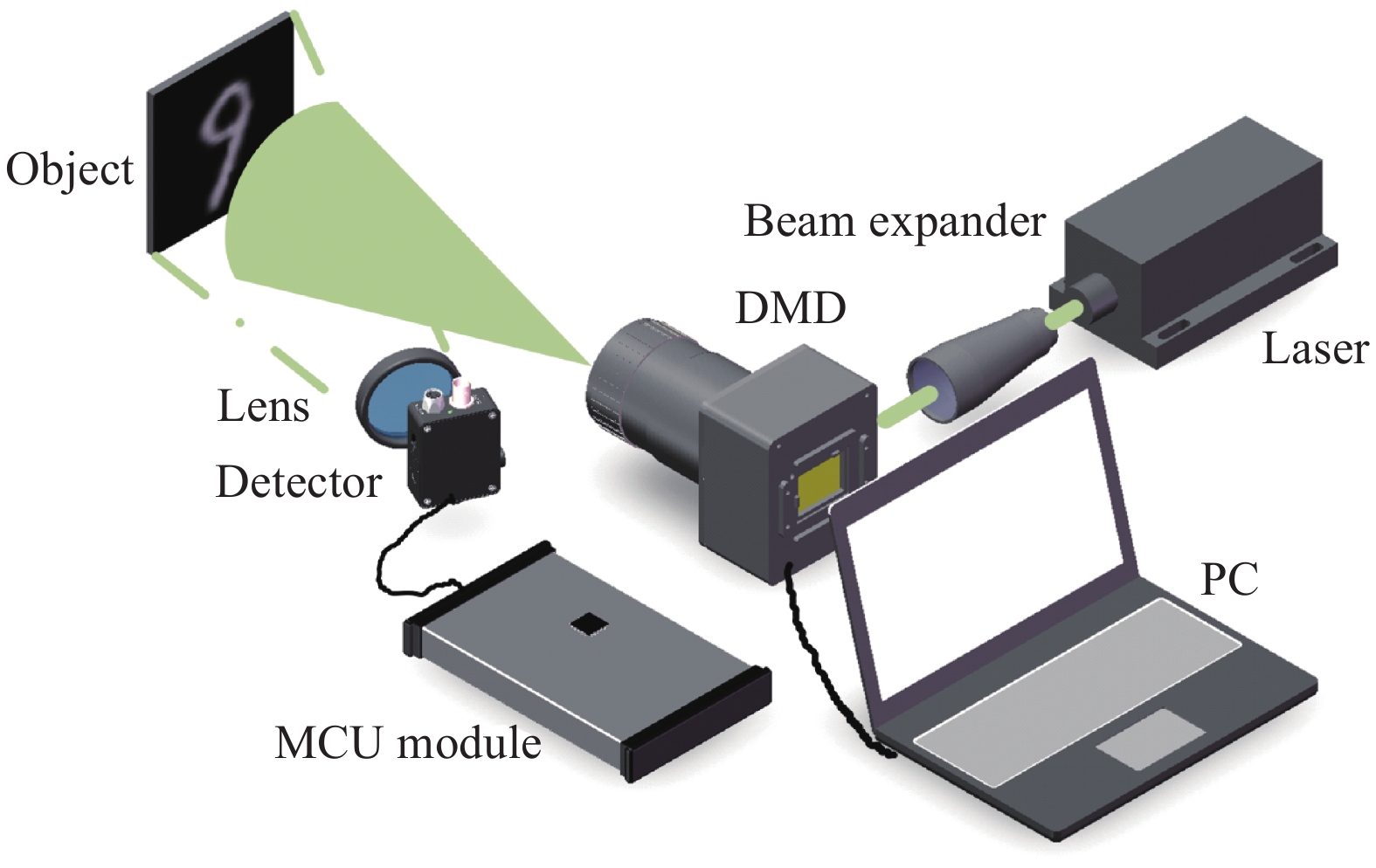
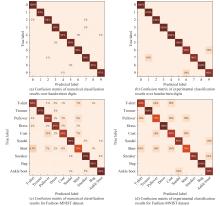
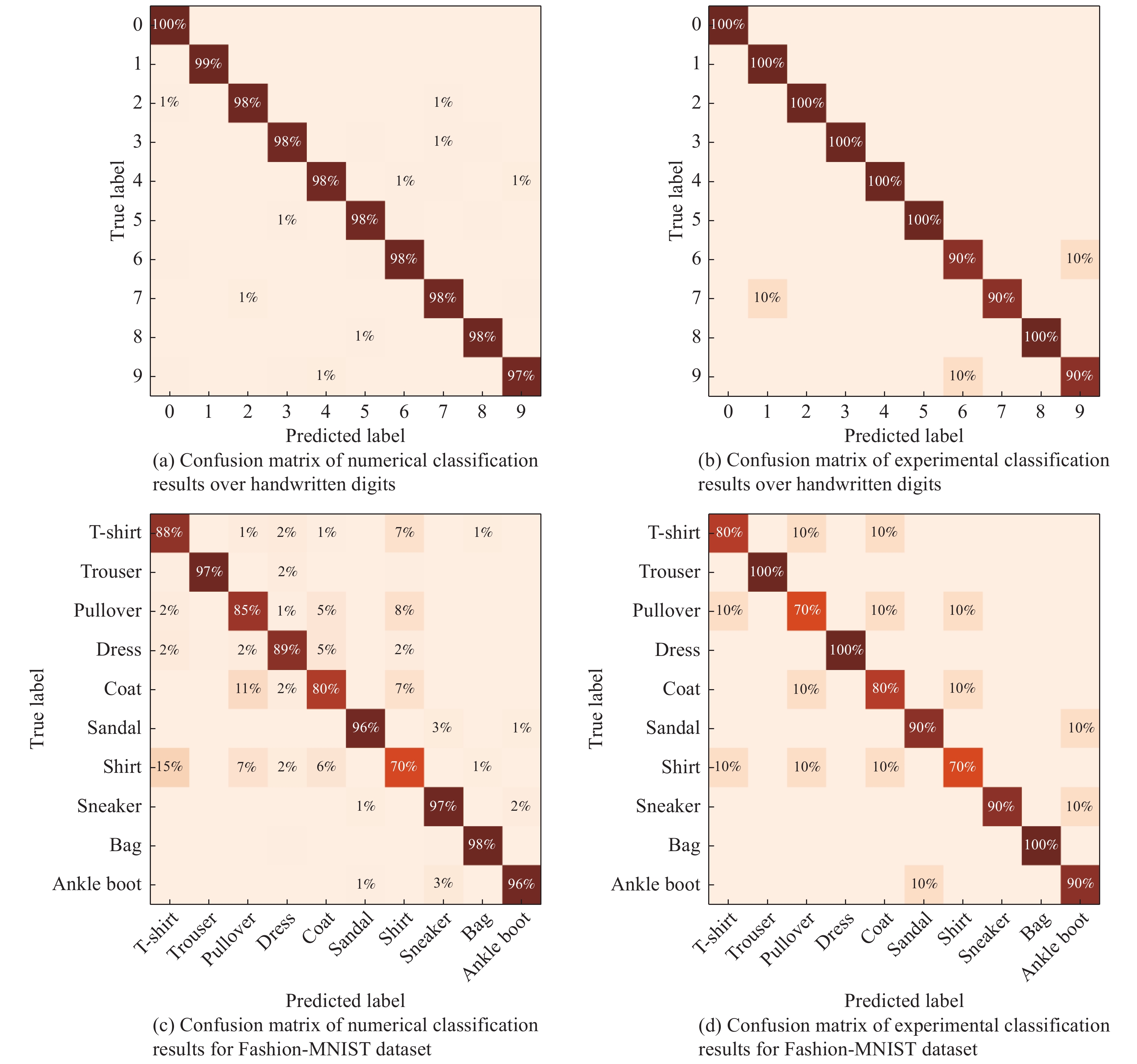
Fig 8
MS image-free experiment results based on MNIST and Fashion-MNIST"
| 1 |
YU C P, XIONG W, LI X Q, et al Deep convolutional neural network for meteorology target detection in airborne weather radar images. Journal of Systems Engineering and Electronics, 2023, 34 (5): 1147- 1157.
doi: 10.23919/JSEE.2023.000142 |
| 2 |
WANG S Y, LI L J, YU Z J, et al Image-free target classification with semiactive laser detection system. IEEE Sensors Journal, 2022, 22 (23): 23088- 23094.
doi: 10.1109/JSEN.2022.3217281 |
| 3 | NIRANJAN D R, VINAYKARTHIK B C, MOHANA. Deep learning based object detection model for autonomous driving research using CARLA simulator. Proc. of the 2nd International Conference on Smart Electronics and Communication, 2021: 1251−1258. |
| 4 |
YAO Q H, WANG Y, YANG Y X Range estimation of few-shot underwater sound source in shallow water based on transfer learning and residual CNN. Journal of Systems Engineering and Electronics, 2023, 34 (4): 839- 850.
doi: 10.23919/JSEE.2023.000095 |
| 5 |
LI Z W, LIU F, YANG W J, et al A survey of convolutional neural networks: analysis, applications, and prospects. IEEE Trans. on Neural Networks and Learning Systems, 2022, 33 (12): 6999- 7019.
doi: 10.1109/TNNLS.2021.3084827 |
| 6 | VOULODIMOS A, DOULAMIS N, DOULAMIS A, et al. Deep learning for computer vision: a brief review. Computational Intelligence and Neuroscience, 2018, 2018(1): 7068349. |
| 7 | SIMONYAN K, ZISSERMAN A. Very deep convolutional networks for large-scale image recognition. https://doi.org/10.48550/arXiv.1409.1556. |
| 8 | REDMON J, DIVVALA S, GIRSHICK R, et al. You only look once: unified, real-time object detection. Proc. of the IEEE Conference on Computer Vision and Pattern Recognition, 2016: 779−788. |
| 9 | VASWANI A, SHAZEER N, PARMAR N, et al. Attention is all you need. Advances in Neural Information Processing Systems. https://arxiv.org/abs/1706.03762. |
| 10 | DOSOVITSKIY A, BEYER L, KOLESNIKOV A, et al. An image is worth 16×16 words: transformers for image recognition at scale. https://doi.org/10.48550/arXiv.2010.11929. |
| 11 | HOWARD A G. MobileNets: efficient convolutional neural networks for mobile vision applications. https://doi.org/10.48550/arXiv.1704.04861. |
| 12 | SZEGEDY C, VANHOUCKE V, IOFFE S, et al. Rethinking the inception architecture for computer vision. Proc. of the IEEE Conference on Computer Vision and Pattern Recognition, 2016: 2818–2826. |
| 13 |
FENG T X, ZHANG S Y, WU T, et al Entangled photon-pair source using a wedge-shaped nonlinear crystal. Optical Materials, 2023, 145, 114441.
doi: 10.1016/j.optmat.2023.114441 |
| 14 |
WETZSTEIN G, OZCAN A, GIGAN S, et al Inference in artificial intelligence with deep optics and photonics. Nature, 2020, 588 (7836): 39- 47.
doi: 10.1038/s41586-020-2973-6 |
| 15 |
LIN X, RIVENSON Y, YARDIMCI N T, et al All-optical machine learning using diffractive deep neural networks. Science, 2018, 361 (6406): 1004- 1008.
doi: 10.1126/science.aat8084 |
| 16 |
LI J X, MENGU D, YARDIMCI N T, et al Spectrally encoded single-pixel machine vision using diffractive networks. Science Advances, 2021, 7 (13): eabd7690.
doi: 10.1126/sciadv.abd7690 |
| 17 |
JIAO S M, FENG J, GAO Y, et al Optical machine learning with incoherent light and a single-pixel detector. Optics Letters, 2019, 44 (21): 5186- 5189.
doi: 10.1364/OL.44.005186 |
| 18 | SANDLER M, HOWARD A, ZHU M L, et al. MobileNetV2: inverted residuals and linear bottlenecks. Proc. of the IEEE Conference on Computer Vision and Pattern Recognition, 2018: 4510–4520. |
| 19 | LIU W, ANGUELOV D, ERHAN D, et al. SSD: single shot multibox detector. Proc. of the Computer Vision–ECCV , 2016: 21–37. |
| 20 | ZHAO B J, ZHAO B Y, TANG L B, et al Multi-scale object detection by top-down and bottom-up feature pyramid network. Journal of Systems Engineering and Electronics, 2019, 30 (1): 1- 12. |
| 21 | KRIZHEVSKY A, SUTSKEVER I, HINTON G E. Imagenet classification with deep convolutional neural networks. Advances in Neural Information Processing Systems, 2012: 25. |
| 22 |
HE K M, ZHANG X Y, REN S Q, et al Spatial pyramid pooling in deep convolutional networks for visual recognition. IEEE Trans. on Pattern Analysis Machine Intelligence, 2015, 37 (9): 1904- 1916.
doi: 10.1109/TPAMI.2015.2389824 |
| 23 |
REN S Q, HE K M, GIRSHICK R, et al Faster R-CNN: towards real-time object detection with region proposal networks. IEEE Trans. on Pattern Analysis and Machine Intelligence, 2017, 39 (6): 1137- 1149.
doi: 10.1109/TPAMI.2016.2577031 |
| 24 | ADELSON E H, ANDERSON C H, BERGEN J R, et al Pyramid methods in image processing. RCA Engineer, 1984, 29 (6): 33- 41. |
| 25 | HU J, SHEN L, ALBANIE S, et al. Squeeze-and-excitation networks. Proc. of the IEEE Conference on Computer Vision and Pattern Recognition, 2018: 7132–7141. |
| 26 |
ZHAN X R, ZHU C L, SUO J L, et al Weighted sampling-adaptive single-pixel sensing. Optics Letters, 2022, 47 (11): 2838- 2841.
doi: 10.1364/OL.458311 |
| 27 | HE K M, ZHANG X Y, REN S Q, et al. Deep residual learning for image recognition. Proc. of the IEEE Conference on Computer Vision and Pattern Recognition, 2016: 770–778. |
| 28 |
DENG L The MNIST database of handwritten digit images for machine learning research. IEEE Signal Processing Magazine, 2012, 29 (6): 141- 142.
doi: 10.1109/MSP.2012.2211477 |
| 29 |
CAO J N, ZUO Y H, WANG H H, et al Single-pixel neural network object classification of sub-Nyquist ghost imaging. Applied Optics, 2021, 60 (29): 9180- 9187.
doi: 10.1364/AO.438392 |
| 30 | LOHIT S, KULKARNI K, TURAGA P. Direct inference on compressive measurements using convolutional neural networks. Proc. of the IEEE International Conference on Image Processing, 2016: 1913–1917. |
| 31 |
FU H, BIAN L H, ZHANG J Single-pixel sensing with optimal binarized modulation. Optics Letters, 2020, 45 (11): 3111- 3114.
doi: 10.1364/OL.395150 |
| 32 |
ZHU X X, MONTAZERI S, ALI M, et al Deep learning meets SAR: concepts, models, pitfalls, and perspectives. IEEE Geoscience and Remote Sensing Magazine, 2021, 9 (4): 143- 172.
doi: 10.1109/MGRS.2020.3046356 |
| 33 |
LIN Z, JI K F, LENG X G, et al Squeeze and excitation rank faster R-CNN for ship detection in SAR images. IEEE Geoscience and Remote Sensing Letters, 2019, 16 (5): 751- 755.
doi: 10.1109/LGRS.2018.2882551 |
| 34 |
KANG M, JI K F, LENG X G, et al Contextual region-based convolutional neural network with multilayer fusion for SAR ship detection. Remote Sensing, 2017, 9 (8): 860.
doi: 10.3390/rs9080860 |
| [1] | Xiansong GU, Qiang FU, Liya WANG, Xuanwei LIU, Xinyu FAN, Jin DUAN, Yingchao LI. Analysis and inversion of target polarization characteristics based on pBRDF [J]. Journal of Systems Engineering and Electronics, 2024, 35(5): 1073-1083. |
| [2] | Jia DUAN, Lei ZHANG, Yifeng WU, Yue ZHANG, Zeya ZHAO, Xinrong GUO. Classification of birds and drones by exploiting periodical motions in Doppler spectrum series [J]. Journal of Systems Engineering and Electronics, 2023, 34(1): 19-27. |
| [3] | Yue LI, Xianghua WEN, Wei LI, Lan WEI, Qunli XIA. Influence of roll-pitch seeker DRR and parasitic loop on Lyapunov stability of guidance system [J]. Journal of Systems Engineering and Electronics, 2021, 32(6): 1509-1526. |
| [4] | Binquan LI, Xiaohui HU. Effective distributed convolutional neural network architecture for remote sensing images target classification with a pre-training approach [J]. Journal of Systems Engineering and Electronics, 2019, 30(2): 238-244. |
| [5] | Xufeng Zhu, Caiwen Ma, Bo Liu, and Xiaoqian Cao. Target classification using SIFT sequence scale invariants [J]. Journal of Systems Engineering and Electronics, 2012, 23(5): 633-639. |
| [6] | Wang Yang, Lu Jiaguo & Wu Xianliang. New algorithm of target classification in polarimetric SAR [J]. Journal of Systems Engineering and Electronics, 2008, 19(2): 273-279. |
| Viewed | ||||||
|
Full text |
|
|||||
|
Abstract |
|
|||||
