
Journal of Systems Engineering and Electronics ›› 2026, Vol. 37 ›› Issue (4): 1120-1137.doi: 10.23919/JSEE.2026.000123
• RADAR PERFORMANCE IMPROVEMENT USING BEYOND LINEAR SIGNAL PROCESSING • Previous Articles
Ken Chen1,2( ), Xinyu Guan1(), Hui Zhang1(), Ruizhe Zhang1(), Yan Huang1,3,*(), Xiaowei Zhu1(), Wei Hong1,3()
Received:2025-01-25
Accepted:2025-06-30
Online:2026-08-18
Published:2026-09-03
Contact:
Yan Huang
E-mail:chenken@foxmail.com;xinyu_guan@seu.edu.cn;huizhang@seu.edu.cn;220200965@seu.edu.cn;yellowstone0636@hotmail.com;xwzhu@seu.edu.cn;weihong@seu.edu.cn
Supported by:Ken Chen, Xinyu Guan, Hui Zhang, Ruizhe Zhang, Yan Huang, Xiaowei Zhu, Wei Hong. Mutual interference mitigation for automotive FMCW radar based on TRPCA[J]. Journal of Systems Engineering and Electronics, 2026, 37(4): 1120-1137.
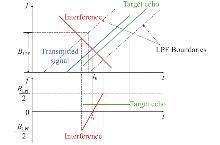
Fig 1
Waveform of the interference signal and the target signal within a single chirp in the case of complex sampling"
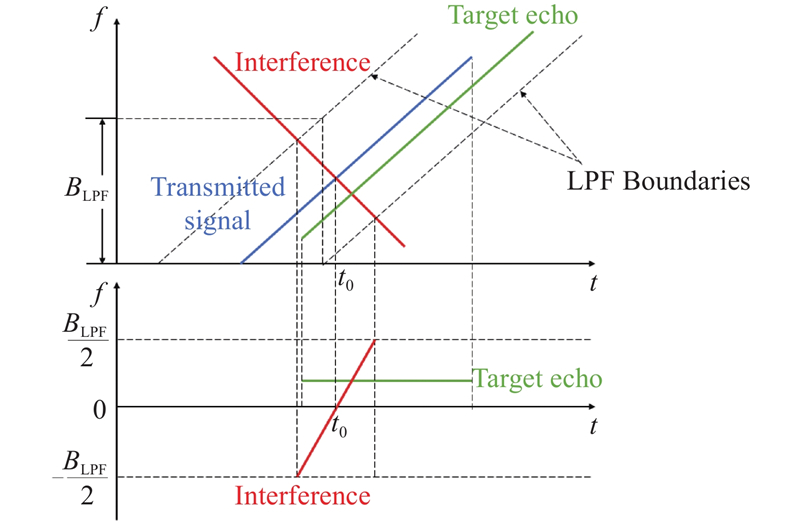
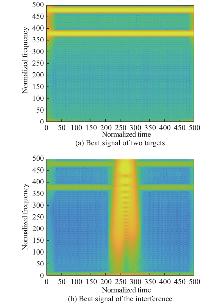
Fig 2
Time-frequency spectrum of the beat signal"
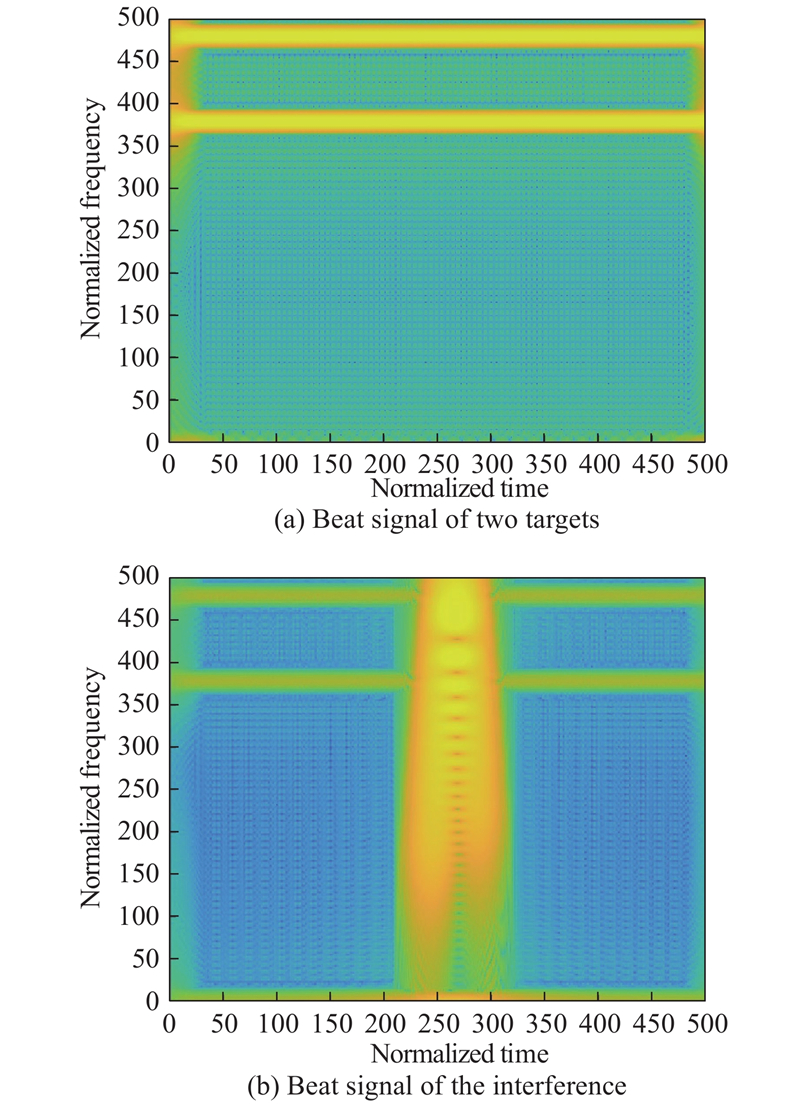
Fig 3
Illustration of the real sampling and the complex sampling of the beat signal"
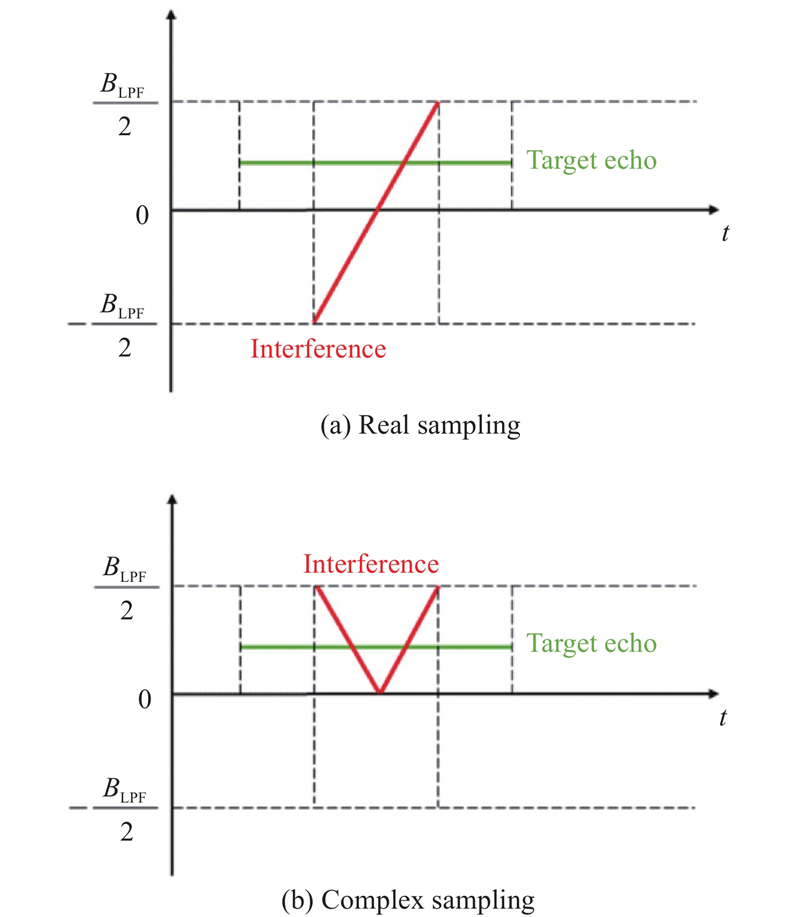
Fig 4
STFT matrix of the target echo and the interference"
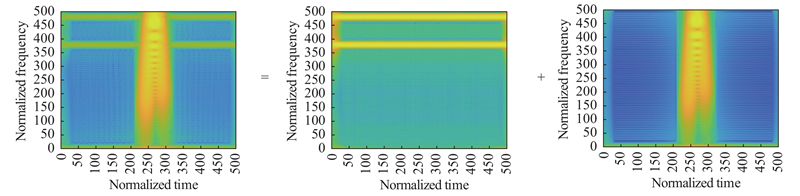
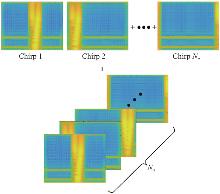
Fig 5
Stacking process of the 3D time-frequency tensor of the echo"
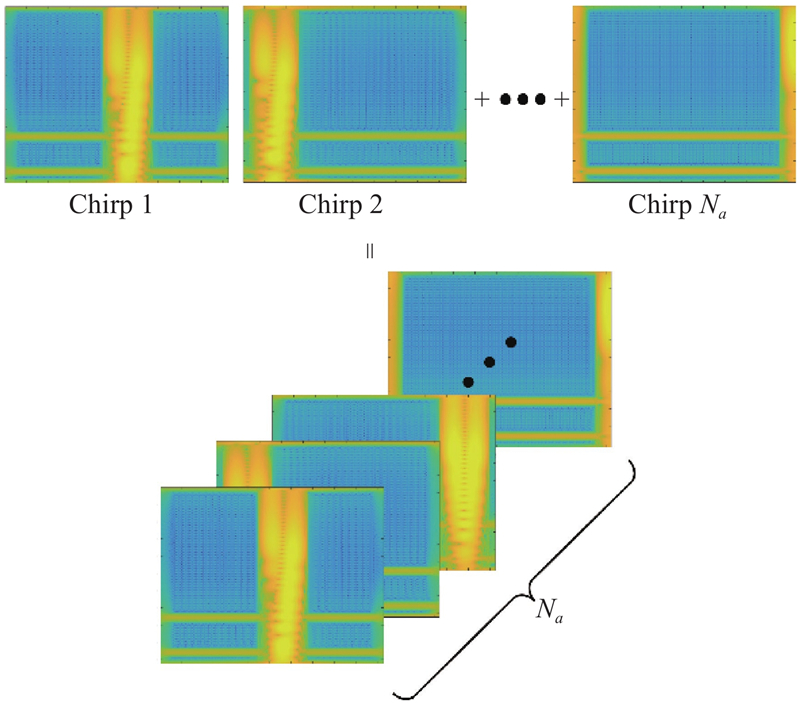
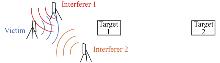
Fig 6
Interference scenario simulated with two targets in front of the victim radar and two interferer radars located on the both sides of the victim radar"
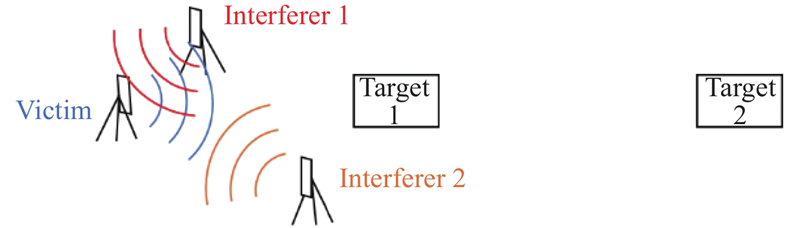
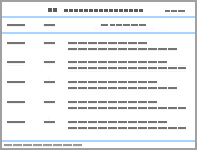
Table 1
Radar waveform parameters of simulation"
| Parameters | Victim | Interferer |
| Start frequency/GHz | 76.5 | 76.505 |
| Chirp duration/ | 46.079 | 51.079 |
| Repetition period/ | 51.2 | 101.08 |
| Slope/(MHz/ | − | |
| Number of chirps | 64 | 33 |
| Number of samples | ||
| Sampling rate/MHz | 25 | 25 |
| Bandwidth/MHz | 113.51 | 125.828 |
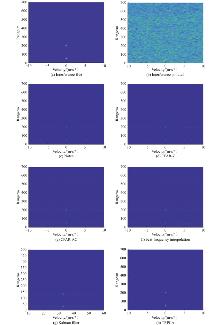
Fig 7
RD maps of the simulations with different methods"
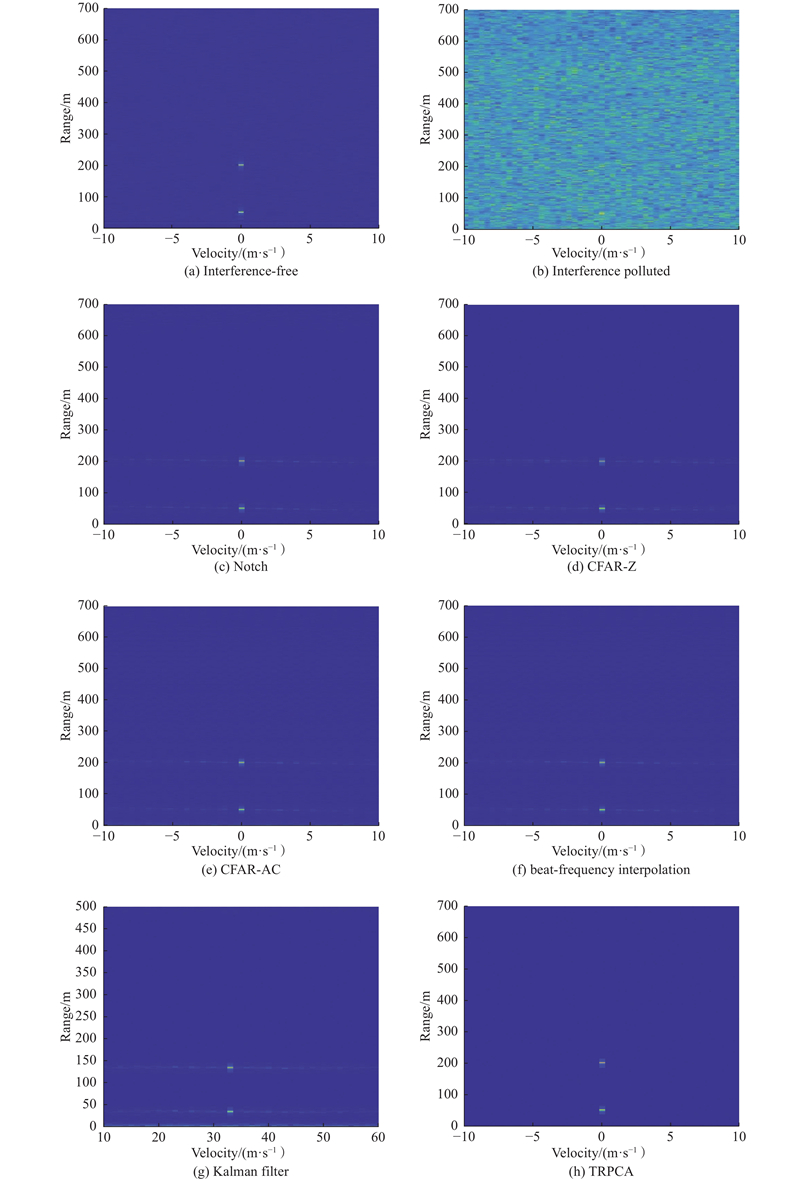
Table 2
SINR & RMSE of the methods simulated dB"
| Indicator | Method | |||||
| Notch | CFAR-Z | CFAR-AC | Beat-frequency interpolation | Kalman filter | TRPCA | |
| SINR of Target 1 | ||||||
| SINR of Target 2 | ||||||
| RMSE | ||||||
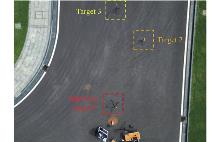
Fig 8
Vertical view of the simple scenario of static interference source"
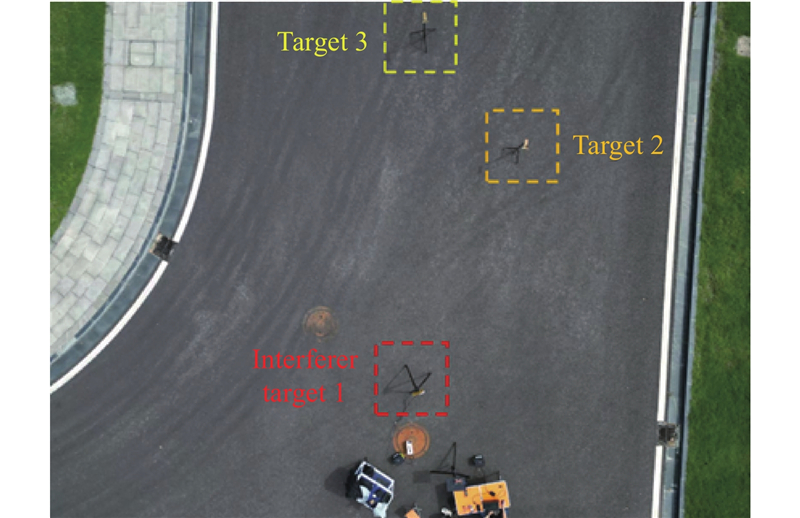
Table 3
Radar waveform parameters of the simple scenario of static interference source"
| Parameter | Victim | Interferer |
| Start Frequency/GHz | 79.47 | 77 |
| Chirp duration/ | 29.5 | 110 |
| Slope/(MHz/ | −32.23 | 32.23 |
| Number of Chirps | 128 | 128 |
| Number of samples | 512 | 512 |
| Bandwidth/MHz | 950 |
Fig 9
RD maps of the simple scenario of static interference source"
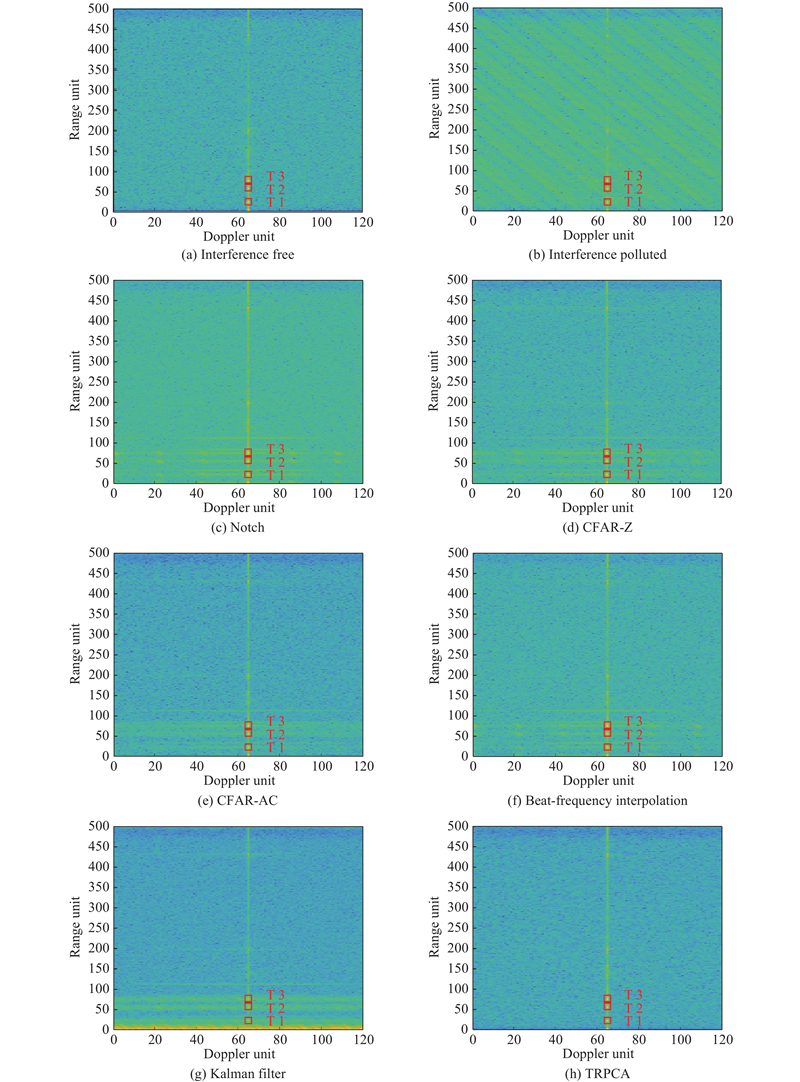
Table 4
SINR & RMSE of the methods in the simple scenario of static interference source"
| Indicator | Method | |||||
| Notch | CFAR-Z | CFAR-AC | Beat-frequency interpolation | Kalman filter | TRPCA | |
| SINR of Target 1/dB | ||||||
| SINR of Target 2/dB | ||||||
| SINR of Target 3/dB | ||||||
| RMSE | ||||||
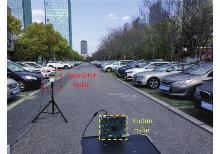
Fig 10
Front view of the complex scenario of static interference source"
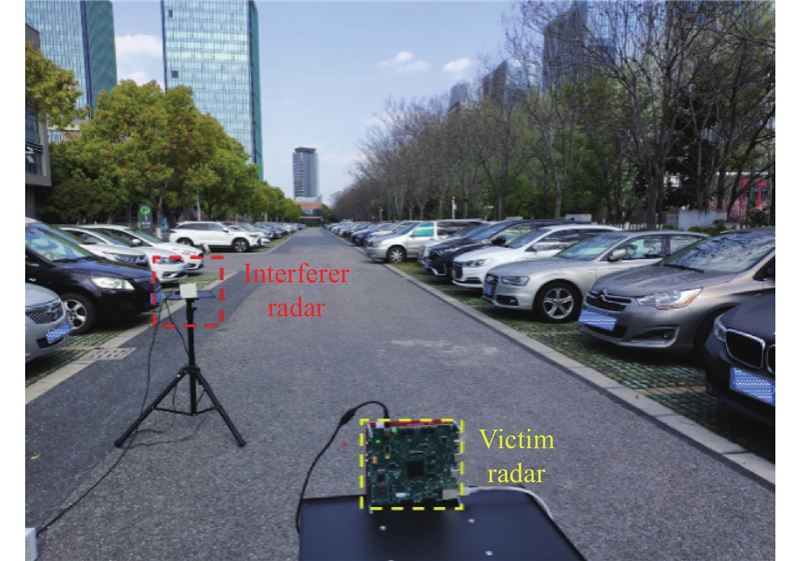
Fig 11
Side view of the complex scenario of static interference source"
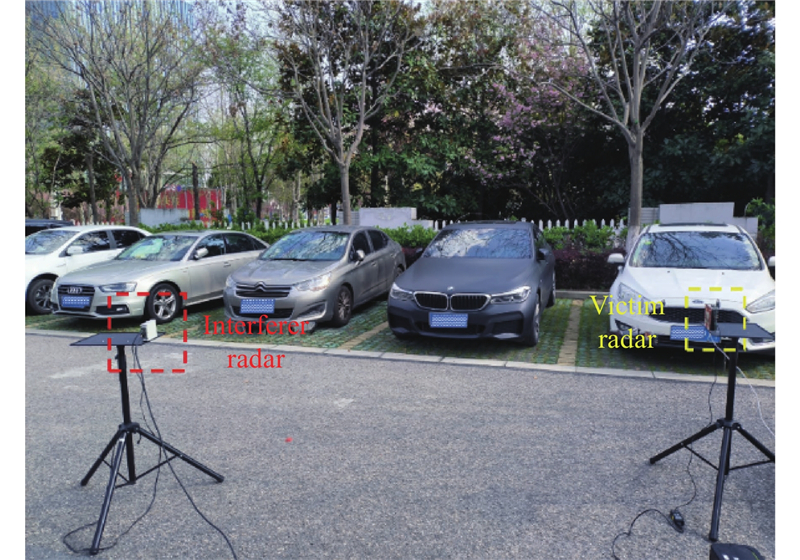
Table 5
Radar waveform parameters of the complex scenario of static interference source"
| Parameter | Victim | Interferer |
| Start frequency/GHz | 79.47 | 77 |
| Chirp Duration/ | 105 | 110 |
| Slope/(MHz/ | −16.11 | 32.23 |
| Number of chirps | 128 | 128 |
| Number of samples | 512 | 512 |
| Bandwidth/GHz |
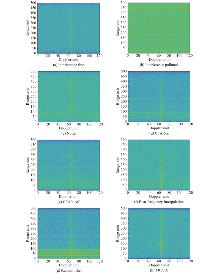
Fig 12
RD maps of the complex scenario of static interference source"
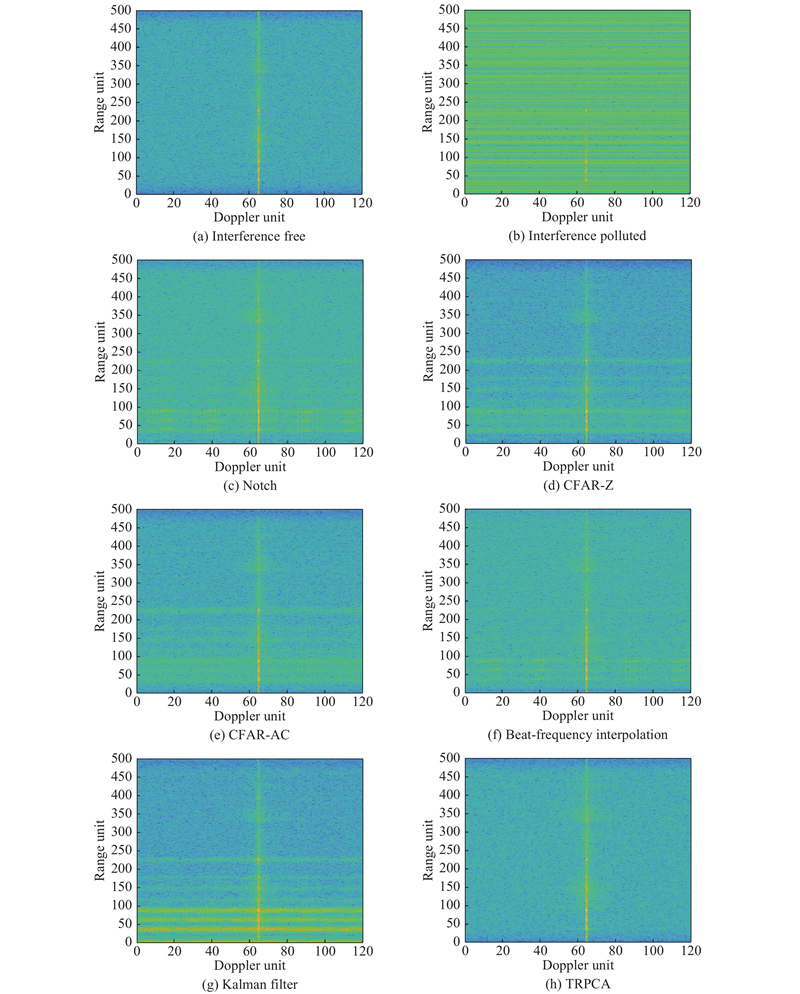
Table 6
RMSE of the methods in the complex scenario of static interference source"
| Method | RMSE |
| Notch | |
| CFAR-Z | |
| CFAR-AC | |
| Beat-frequency interpolation | |
| Kalman filter | |
| TRPCA |
Fig 13
Front view of the scenario of dynamic interference source"
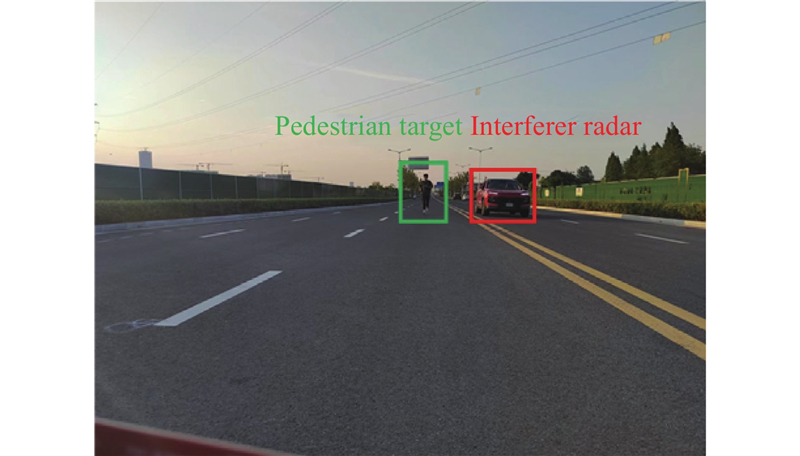
Fig 14
Vertical view of the scenario of dynamic interference source"
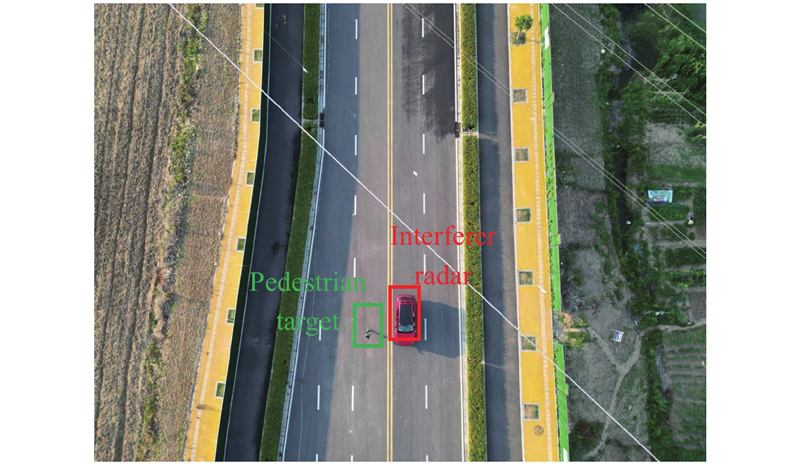
Table 7
Radar waveform parameters of the scenario of dynamic interference source"
| Parameter | Victim | Interferer |
| Start frequency/GHz | 77 | 76.25 |
| Chirp duration/ | 29.5 | 150 |
| Slope/(MHz/ | −20 | 3 |
| Number of chirps | 64 | 64 |
| Number of samples | 512 | 512 |
| Bandwidth/MHz | 590 | 450 |
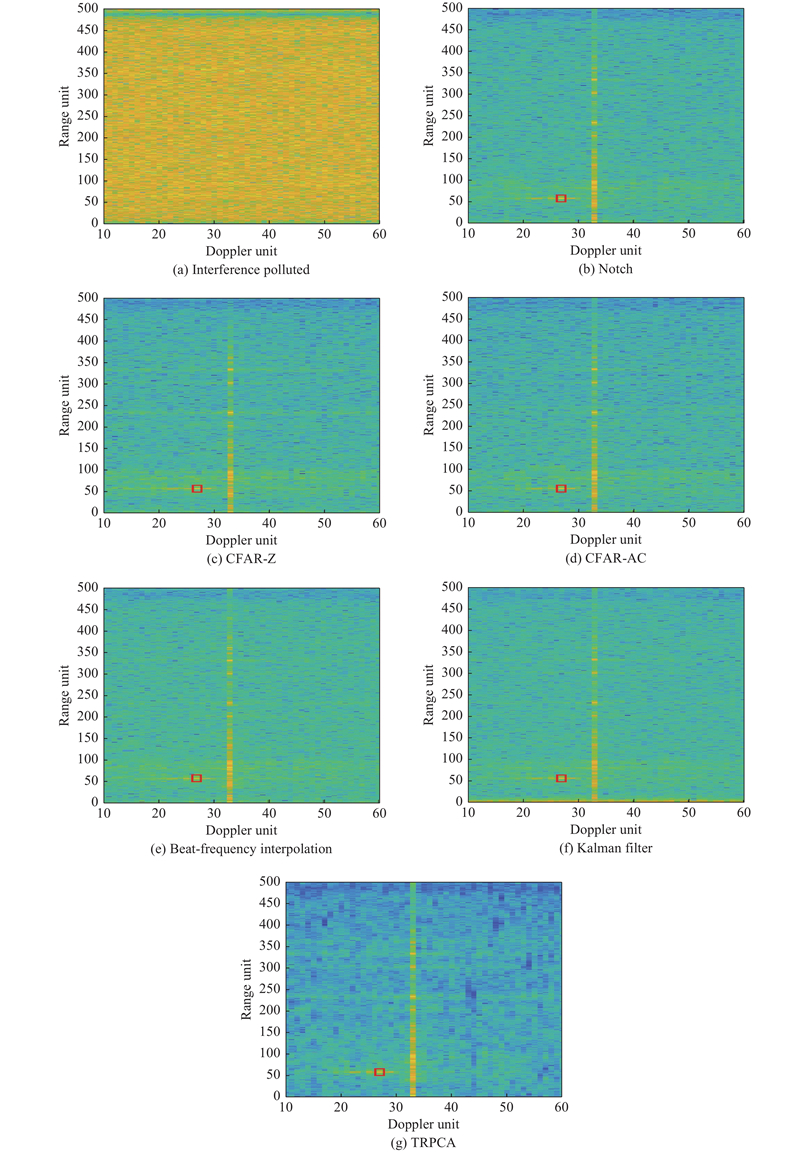
Fig 15
RD maps of the scenario of dynamic interference source"
| 1 | World Health Organization. Global status report on road safety 2018 [R]. Geneva: World Health Organization, 2018. |
| 2 | Patole S, Torlak M, Wang D, et al Automotive radars: a review of signal processing techniques. IEEE Signal Processing Magazine, 2017, 34 (2): 22. |
| 3 | Bilik I Comparative analysis of radar and lidar technologies for automotive applications. IEEE Intelligent Transportation Systems Magazine, 2023, 15 (1): 244. |
| 4 | Federal Communications Commission. Operation of radar services in the 76-81 GHz band [R/OL]. 2025-01-25. https://public-inspection.federalregister.gov/2015-04032.pdf. |
| 5 | Romain F, Matthias N, Frank N, et al Fabrication of organic light-emitting diode pixels by laser-assisted forward transfer. Applied Physics Letters, 2007, 91 (6): 061103. |
| 6 | Hakobyan G, Yang B High-performance automotive radar: a review of signal processing algorithms and modulation schemes. IEEE Signal Processing Magazine, Signal Processing Magazine, 2019, 36 (5): 32. |
| 7 | Luo T N, Wu C H E, Chen Y J E A 77 GHz CMOS automotive radar transceiver with anti-interference function. IEEE Trans. on Circuits and Systems, 2013, 60 (12): 3247. |
| 8 | Kim Y. Identification of FMCW radar in mutual interference environments using frequency ramp modulation [C]//10th European Conference on Antennas and Propagation, 2016. |
| 9 | Kitsukawa Y, Mitsumoto M, Mizutani H, et al. An interference suppression method by transmission chirp waveform with random repetition interval in fast-chirp FMCW radar[C]//16th European Radar Conference, 2019: 165. |
| 10 | Hossain M, Elshafiey I, Al-sanie A. Mutual interference mitigation in automotive radars under realistic road environments[C]//8th International Conference on Information Technology, 2017: 895. |
| 11 | Bechter J, Sippel C, Waldschmidt C. Bats-inspired frequency hopping for mitigation of interference between automotive radars[C]//IEEE MTT-S International Conference on Microwaves for Intelligent Mobility, 2016. |
| 12 | Liu T H, Hsu M L, Tsai Z M. Mutual interference of pseudorandom noise radar in automotive collision avoidance application at 24 GHz[C]//IEEE 5th Global Conference on Consumer Electronics, 2016. |
| 13 | Uysal F Phase-coded FMCW automotive radar: system design and interference mitigation. IEEE Trans. on Vehicular Technology, 2020, 69 (1): 270. |
| 14 | Xu Z H, Shi Q Interference mitigation for automotive radar using orthogonal noise waveforms. IEEE Geoscience and Remote Sensing Letters, 2018, 15 (1): 137. |
| 15 | Hakobyan G, Armanious K, Yang B Interference-aware cognitive radar: a remedy to the automotive interference problem. IEEE Trans. on Aerospace and Electronic Systems, 2020, 56 (3): 2326. |
| 16 |
Basireddy A, Moradi H OFDM waveform design for interference resistant automotive radars. IEEE Sensors Journal, 2021, 21 (14): 15670.
doi: 10.1109/JSEN.2021.3057119 |
| 17 | Khoury J, Ramanathan R, Mccloskey D, et al. RadarMAC: mitigating radar interference in self-driving cars[C]//13th Annual IEEE International Conference on Sensing, Communication, and Networking, 2016. |
| 18 | Aydogdu C, Garcia N, Hammarstrand L, et al. Radar communications for combating mutual interference of FMCW radars[C]//IEEE Radar Conference, 2019. |
| 19 | Aydogdu C, Keskin M, Garcia N, et al RadChat: spectrum sharing for automotive radar interference mitigation. IEEE Trans. on Intelligent Transportation Systems, 2021, 22 (1): 416. |
| 20 | Mazher K, Heath R, Gulati K, et al. Automotive radar interference characterization and reduction by partial coordination[C]//IEEE Radar Conference, 2020. |
| 21 | Ishikawa S, Kurosawa M, Umehira M, et al. Packet-based FMCW radar using CSMA technique to avoid narrowband interference[C]//International Radar Conference, 2019. |
| 22 | Jin F, Cao S Y Automotive radar interference mitigation using adaptive noise canceller. IEEE Trans. on Vehicular Technology, 2019, 68 (4): 3747. |
| 23 | Wagner M, Sulejmani F, MelzeR A, et al. Threshold-free interference cancellation method for automotive FMCW radar systems[C]//IEEE International Symposium on Circuits and Systems, 2018. |
| 24 | Bechter J, Rameez M, Waldschmidt C Analytical and experimental investigations on mitigation of interference in a DBF MIMO radar. IEEE Trans. on Microwave Theory and Techniques, 2017, 65 (5): 1727. |
| 25 | Rameez M, Dahl M, Pettersson M. Adaptive digital beamforming for interference suppression in automotive FMCW radars[C]//IEEE Radar Conference, 2018: 0252. |
| 26 | Takuya N, Yuya M, Nobuyuki T, et al. An anti-collision automotive FMCW radar using time-domain interference detection and suppression[C]//International Conference on Radar Systems, 2017. |
| 27 | Liu Z Y, Lu W, Wu J Y, et al A PELT-KCN algorithm for FMCW radar interference suppression based on signal reconstruction. IEEE Access, 2020, 8, 45108. |
| 28 |
Zhou B L, Liu W J, Li R F, et al A target parameter estimation method via atom-reconstruction in radar mainlobe jamming. Journal of Systems Engineering and Electronics, 2024, 35 (2): 350.
doi: 10.23919/JSEE.2024.000001 |
| 29 | Neemat S, Krasnov O, Yarovoy A An interference mitigation technique for FMCW radar using beat-frequencies interpolation in the STFT domain. IEEE Trans. on Microwave Theory and Techniques, 2019, 67 (3): 1207. |
| 30 | Wang J P CFAR-based interference mitigation for FMCW automotive radar systems. IEEE Trans. on Intelligent Transportation Systems, 2022, 23 (8): 12229. |
| 31 | Wang J P, Ding M, Yarovoy A Matrix-pencil approach-based interference mitigation for FMCW radar systems. IEEE Trans. on Microwave Theory and Techniques, 2021, 69 (11): 5099. |
| 32 | Rameez M, Dahl M, Pettersson M Autoregressive model-based signal reconstruction for automotive radar interference mitigation. IEEE Sensors Journal, 2021, 21 (5): 6575. |
| 33 | Zhang H L, Zhang G, Xue B, et al Mainlobe jamming suppression via improved BSS method for rotated array radar. Journal of Systems Engineering and Electronics, 2022, 33 (6): 1151. |
| 34 | Uysal F, Sanka S. Mitigation of automotive radar interference[C]//IEEE Radar Conference, 2018: 0405. |
| 35 | Liu Z Y, Wu J Y, Yang S Y, et al DOA estimation method based on EMD and MUSIC for mutual interference in FMCW automotive radars. IEEE Geoscience and Remote Sensing Letters, 2022, 19, 3504005. |
| 36 | Lee S, Lee J, Kim S Mutual interference suppression using wavelet denoising in automotive FMCW radar systems. IEEE Trans. on Intelligent Transportation Systems, 2021, 22 (2): 887. |
| 37 | Xu Z H, Yuan M An interference mitigation technique for automotive millimeter wave radars in the tunable Q-factor wavelet transform domain. IEEE Trans. on Microwave Theory and Techniques, 2021, 69 (12): 5270. |
| 38 | Wang J P, Ding M, Yarovoy A Interference mitigation for FMCW radar with sparse and low-rank Hankel matrix decomposition. IEEE Trans. on Signal Processing, Signal Processing, 2022, 70, 822. |
| 39 | Lee W, Lee S Geometric sequence decomposition-based interference cancellation in automotive radar systems. IEEE Access, 2022, 10, 4318. |
| 40 | Wang Y X, Huang Y, Wen C, et al. Mutual interference mitigation for automotive FMCW radar with time and frequency domain decomposition[J]. IEEE Trans. on Microwave Theory and Techniques, 2023, 71(11): 5028. |
| 41 | Mun J, Kim H, Lee J. A deep learning approach for automotive radar interference mitigation[C]//IEEE 88th Vehicular Technology Conference, 2018. |
| 42 | Mun J, Ha S, Lee J. Automotive radar signal interference mitigation using RNN with self attention[C]//ICASSP IEEE International Conference on Acoustics, Speech and Signal Processing, 2020: 3802. |
| 43 | Rock J, Toth M, Messner E, et al. Complex signal denoising and interference mitigation for automotive radar using convolutional neural networks[C]//22th International Conference on Information Fusion, 2019. |
| 44 | Fuchs J, Dubey A, Lubke M, et al. Automotive radar interference mitigation using a convolutional autoencoder[C]//IEEE International Radar Conference, 2020: 315. |
| 45 | Ristea N, Anghel A, Ionescu R. Fully convolutional neural networks for automotive radar interference mitigation[C]//IEEE 92nd Vehicular Technology Conference, 2020. |
| 46 | Durak L, Arikan O Short-time Fourier transform: two fundamental properties and an optimal implementation. IEEE Trans. on Signal Processing, 2003, 51 (5): 1231. |
| 47 | Su J, Tao H H, Tao M L, et al Narrow-band interference suppression via RPCA-based signal separation in time-frequency domain. IEEE Journal of Selected Topics in Applied Earth Observations and Remote Sensing, 2017, 10 (11): 5016. |
| 48 | Lu C Y, Feng J S, Chen Y D, et al. Tensor robust principal component analysis: exact recovery of corrupted low-rank tensors via convex optimization[C]//IEEE Conference on Computer Vision and Pattern Recognition, 2016: 5249. |
| 49 | Jung J, Lim S, Kim J, et al. Interference suppression and signal restoration using Kalman filter in automotive radar systems[C]//IEEE International Radar Conference, 2020: 726. |
| No related articles found! |
| Viewed | ||||||
|
Full text |
|
|||||
|
Abstract |
|
|||||
