
Journal of Systems Engineering and Electronics ›› 2026, Vol. 37 ›› Issue (5): 1587-1605.doi: 10.23919/JSEE.2026.000034
• SYSTEMS ENGINEERING • Previous Articles
Zhaojie Ke1( ), Wenya Zhou1,*(), Shujun Tan1(), Yanchang Huang2(), Junchao Shang3(), Xiaoting Fang3()
Received:2025-06-26
Online:2026-10-18
Published:2026-11-09
Contact:
Wenya Zhou
E-mail:kzj0924@foxmail.com;zwy@dlut.edu.cn;tansj@dlut.edu.cn;1577271339@qq.com;shangjc2011@163.com;fangxiaotingmao@163.com
Zhaojie Ke, Wenya Zhou, Shujun Tan, Yanchang Huang, Junchao Shang, Xiaoting Fang. Effectiveness validation of evaluation index systems of equipment SoS operational capability: a framework and grey clustering model[J]. Journal of Systems Engineering and Electronics, 2026, 37(5): 1587-1605.
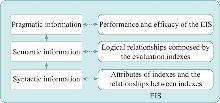
Fig 1
Three-layer information model for the effectiveness of EIS"
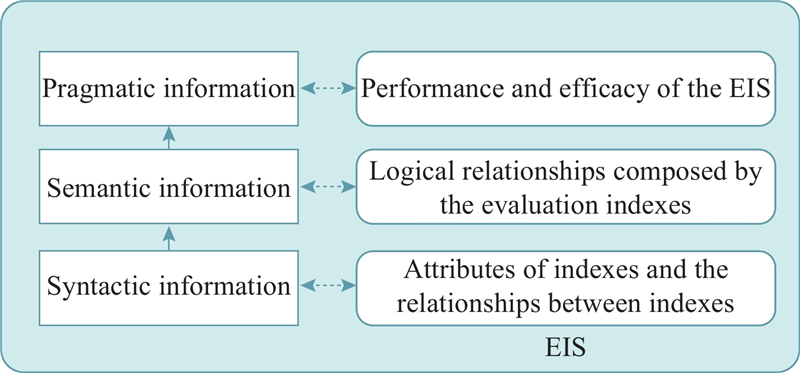
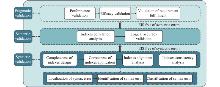
Fig 2
Three-layer validation mechanism model for the effectiveness of EIS"
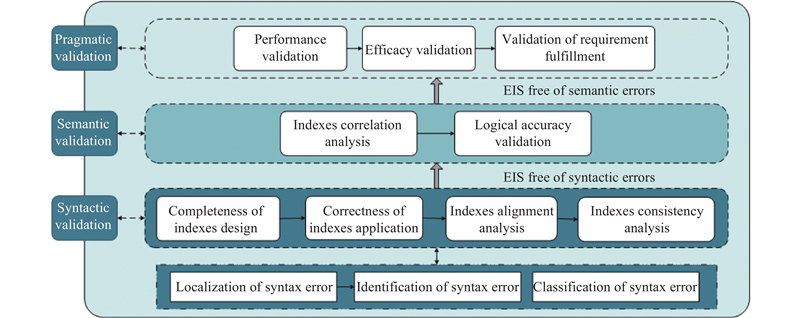
Fig 3
Validation framework for the effectiveness of EIS"
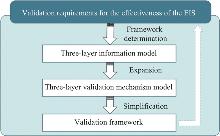
Fig 4
Relationship between the three-layer information model, the three-layer validation mechanism model, and the final effectiveness validation framework"
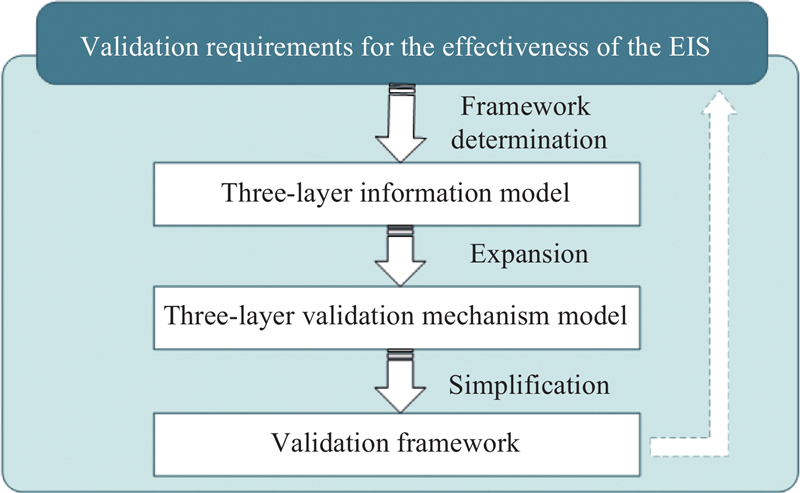
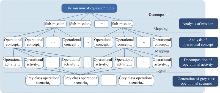
Fig 5
Process of analyzing multi-grey class operational scenarios"
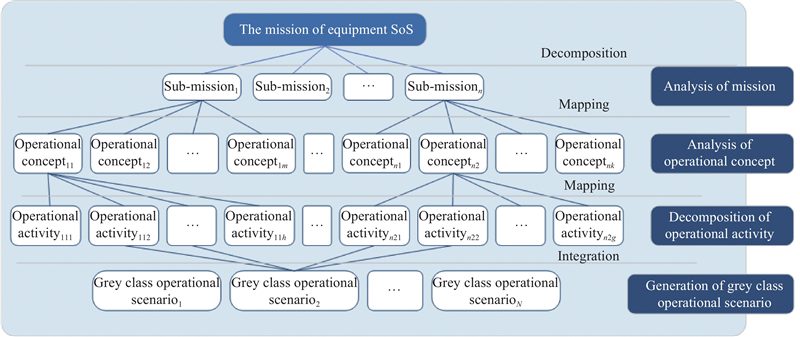

Table 1
Grey class and characteristic features of operational scenarios"
| Grey class level | Name | Grey class characteristic feature | |||
| Physical domain | Informational domain | Cognitive domain | Social domain | ||
| 1 | Highly suitable level | The SoS adapts to the task scenarios of any physical domains, obtaining sufficient data on operational effectiveness, task efficiency, and operational time outcomes. | No barriers to the exchange, sharing, recognition, collaboration and utilization of information. | The situation quality, the understanding of operational intent, and the synchronization of operational activities adapt to any task scenario. | No barriers to the information interaction, the formation of situational awareness, the cognitive sharing, and the collaborative decision-making. |
| 2 | Relatively suitable level | The SoS adapts to the task scenarios of multiple physical domains, obtaining big amount of data on operational effectiveness, task efficiency, and operational time outcomes. | The exchange, sharing, cognition, collaboration, and utilization of information adapt to multi-domain task scenarios. | The situation quality, the understanding of operational intent, and the synchronization of operational activities are achieved in multiple task scenarios. | The information interaction, the formation of situational awareness, the cognitive sharing, and the collaborative decision-making adapt to multiple task scenarios. |
| 3 | Generally suitable level | The SoS adapts to the task scenarios of a few physical domains, obtaining basic data on operational effectiveness, task efficiency, and operational time outcomes. | The exchange, sharing, cognition, collaboration, and utilization of information adapt to a few task scenarios. | The situation quality, the understanding of operational intent, and the synchronization of operational activities are achieved in a few task scenarios. | The information interaction, the formation of situational awareness, the cognitive sharing, and the collaborative decision-making adapt to a few task scenarios. |
| 4 | Barely suitable level | The SoS adapts to individual operational activities, obtaining minimal data on operational effectiveness, task efficiency, and operational time outcomes. | The exchange, sharing, cognition, collaboration, and utilization of information adapt to individual activity scenarios. | The situation quality, the understanding of operational intent, and synchronization of operational activities are achieved in individual operational activities. | The information interaction, the formation of situational awareness, the cognitive sharing, and the collaborative decision-making adapt to individual operational scenarios. |
| 5 | Unsuitable level | The SoS fails to adapt to any task’s scenarios or operational activities, making it challenging to obtain data on operational effectiveness, task efficiency, or operational time outcomes. | Incapable of the exchange, sharing, cognition, collaboration, or utilization of information in any scenario. | Unable to achieve the understanding of operational intent, the synchronization of operational activities, or related quality in any task or activity. | Incapable of achieving the information interaction, the formation of situational awareness, the cognitive sharing, and the collaborative decision-making in any task or activity. |
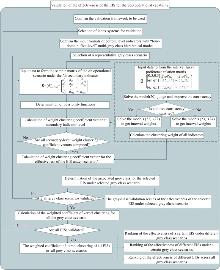
Fig 6
Grey validation process for the effectiveness of the EIS"
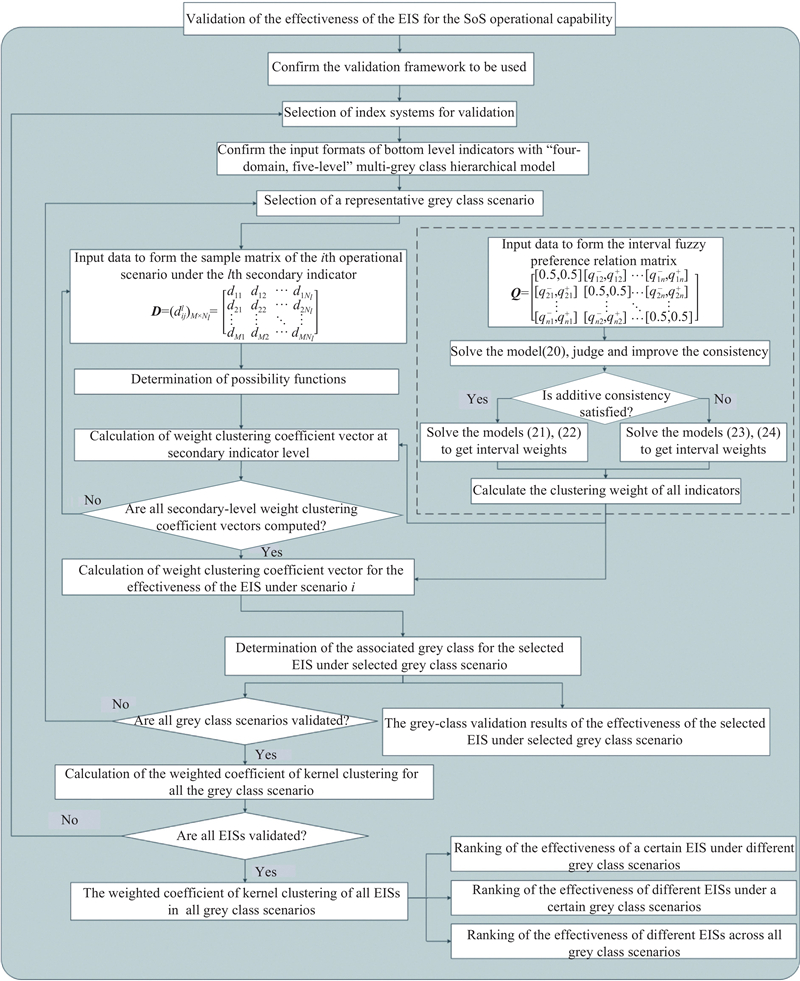
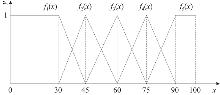
Fig 7
Illustration of the center-point mix possibility functions"
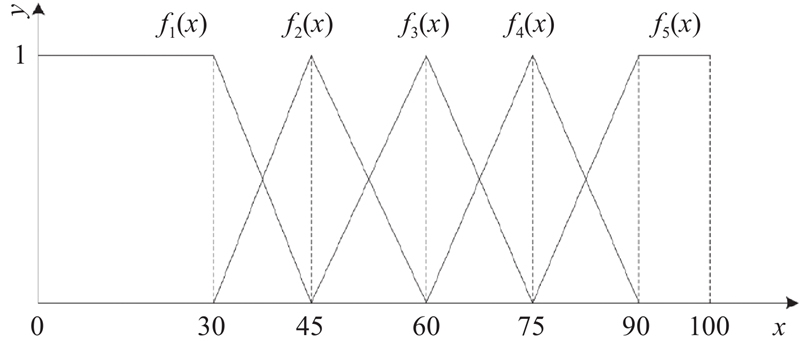
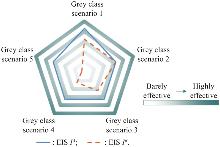
Fig 8
Comparison of the effectiveness of the two EISs in five grey-class scenarios"
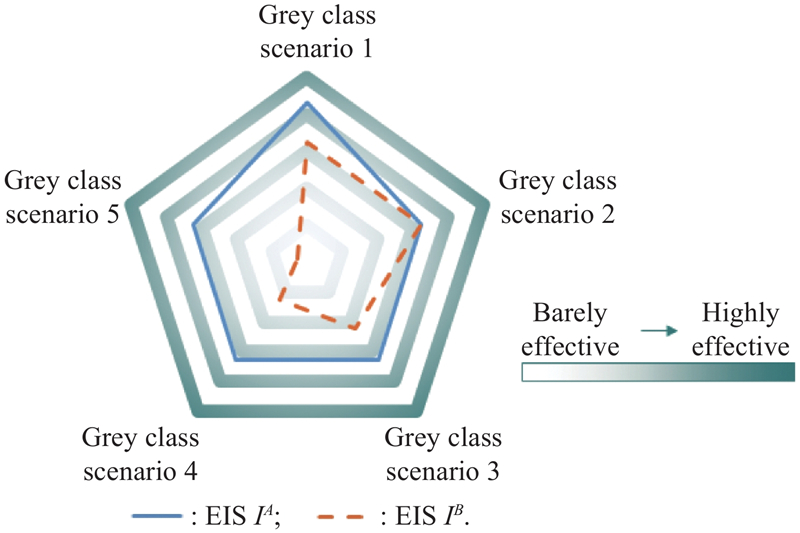
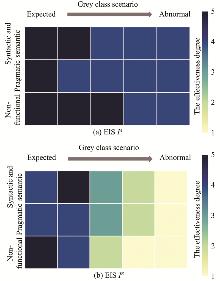
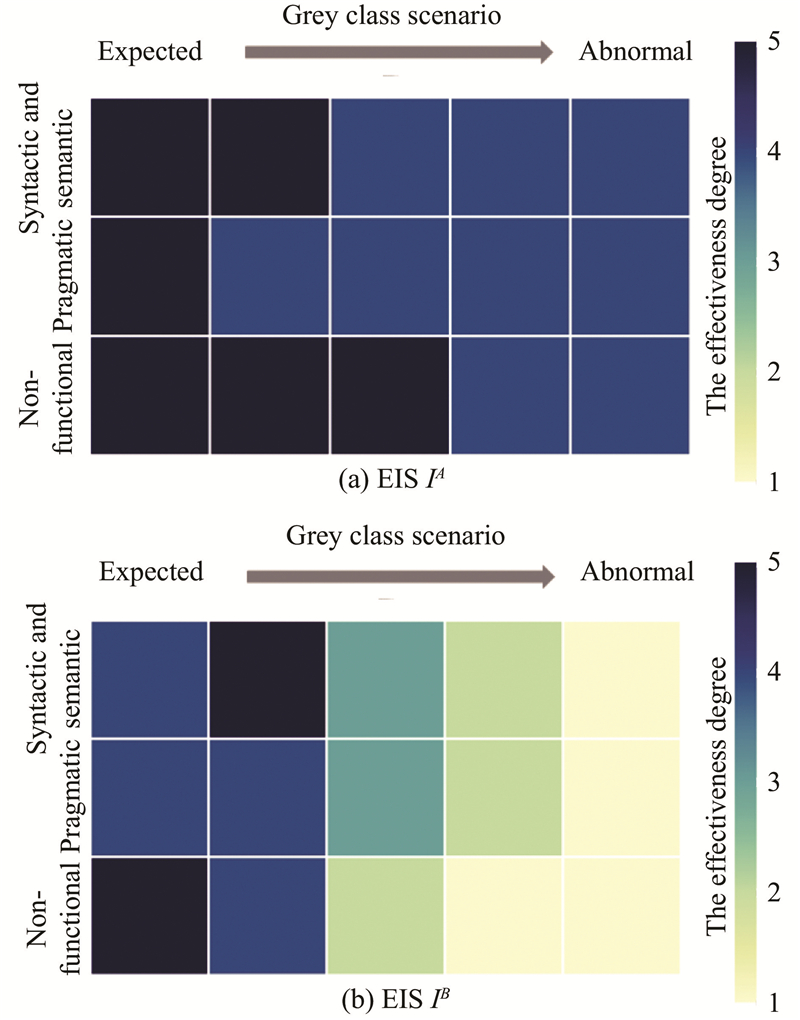
Fig 9
Effectiveness of the two EISs in five grey-class scenarios at the syntactic and semantic, pragmatic, and non-functional levels"
| 1 |
Wang X Y, Yang Z, Chai S Y, et al Integrated threat assessment method of beyond-visual-range air combat. Journal of Systems Engineering and Electronics, 2025, 36 (1): 176.
doi: 10.23919/JSEE.2025.000011 |
| 2 |
Hu J W, Wang Z H, Gao Y, et al Uncertainty entropy-based exploratory evaluation method and its applications on missile effectiveness evaluation. Journal of Systems Engineering and Electronics, 2023, 34 (6): 1602.
doi: 10.23919/JSEE.2023.000063 |
| 3 | Yang K W, Yang Z W, Tan Y J, et al A review of equipment system evaluation methods focused on system contribution rate. Systems Engineering and Electronics, 2019, 41 (2): 311. |
| 4 |
Wang X H, Zhang Y, Wang L Z, et al Robustness evaluation method for unmanned aerial vehicle swarms based on complex network theory. Chinese Journal of Aeronautics, 2020, 33 (1): 352.
doi: 10.1016/j.cja.2019.04.025 |
| 5 |
Gao Y, Liu H, Tian Y L Inverse design of mission success space for combat aircraft contribution evaluation. Chinese Journal of Aeronautics, 2020, 33 (8): 2189.
doi: 10.1016/j.cja.2020.03.039 |
| 6 | Dind J F, Si G Y, Yang J Y, et al Research and analysis on the method for building the indicator system for system combat effectiveness assessment. Journal of Command and Control, 2016, 2 (3): 239. |
| 7 | Ha J X, Wang J S Method for constructing the indicator system for cyber combat command effectiveness evaluation based on social network analysis. Journal of Academy of Force Engineering, 2016, 30 (6): 1. |
| 8 | Zhao Z Q. Research on the method for constructing the indicator system for equipment combat test effectiveness evaluation[C]// 20th China Conference on System Simulation Technology and its Application, 2019: 345. (in Chinese) |
| 9 | Cao Z M, Zhou Y F Method for constructing the intelligent combat effectiveness evaluation indicator system. Command Control & Simulation, 2024, 46 (6): 137. |
| 10 |
Ning X Y, Wang Y, Wang Z D, et al Link-16 anti-jamming performance evaluation based on grey relational analysis and cloud model. Journal of Systems Engineering and Electronics, 2025, 36 (1): 62.
doi: 10.23919/JSEE.2023.000120 |
| 11 |
Han C, Xiong W, Xiong M H, et al Support vector regression-based operational effectiveness evaluation approach to reconnaissance satellite system. Journal of Systems Engineering and Electronics, 2023, 34 (6): 1626.
doi: 10.23919/JSEE.2023.000020 |
| 12 | Zhao D L, Tan Y J, Li J C, et al Weapon equipment system contribution evaluation based on combat circumstances. Systems Engineering and Electronics, 2017, 39 (10): 2239. |
| 13 | Ma J, Ge Y, Pu H Y A review of attribute reduction methods. Data Analysis and Knowledge Discovery, 2020, 4 (1): 40. |
| 14 | Yu L W, Guo W Y, Huang J N, et al A review of algorithms for comprehensive evaluation index reduction. Mechanical Engineer, 2023, 9, 12. |
| 15 | Fu Y, Liu Y J RST evaluation method and application of the effectiveness of indicator systems. Management Review, 2009, 21 (7): 91. |
| 16 | Li C, Zhang W D Research on the copyright risk assessment indicator system and its effectiveness: based on the perspective of network content service providers. Information Theory and Practice, 2014, 37 (7): 48. |
| 17 | Xu M M, Zhang L J, Zhang X. Good standards and measurement methods of comprehensive evaluation index system[J]. Statistics and Decision, 2015(3): 18. (in Chinese) |
| 18 | Ma Z Q, Hong T. The study on reliability and validity of index system of risk evaluation on technological [C]. 1st International Workshop on Database Technology and Applications, 2009: 662. |
| 19 | Wang F, Zhang Q H, Jin J Q Research on reliability and validity of indicator system for community health services performance[J]. Chinese General Practice, 2008, 11 (1): 77. |
| 20 | Fan W Y, Zhao X H, Wu J C, et al Study on monitoring and early warning index system for schistosomiasis in Poyang Lake eco-economic region. Chinese Journal of Disease Control & Prevention, 2019, 23 (4): 421. |
| 21 | Yu Y, Tao L J, Yang T F Empirical study on the equalization of basic public health services index system. Journal of Central South University (Medical Edition), 2015, 40 (4): 421. |
| 22 | Zhao S D, Li S H Research on system evaluation of top management-team based on the method of analytical hierarchy process and rough set. Applied Mechanics and Materials, 2011, 63164, 322. |
| 23 | Liu S F. Grey clustering evaluation models. Liu S, ed. Grey systems analysis: methods, models and applications[M]. Singapore: Springer Nature Singapore, 2025: 155. |
| 24 | Wang J H, Wang L, Zhang L, et al Supplier selection VIKOR multi-attribute decision making of grey group clustering and improved CRITIC weighting. Systems Engineering and Electronics, 2023, 45 (1): 155. |
| 25 |
Xie N M, Su B T, Chen N L Construction mechanism of whitenization weight function and its application in grey clustering evaluation. Journal of Systems Engineering and Electronics, 2019, 30 (1): 121.
doi: 10.21629/JSEE.2019.01.12 |
| 26 |
Dai J, Yan Y, He Y H Grey incidence clustering method based on multidimensional dynamic time warping distance. Journal of Systems Engineering and Electronics, 2017, 28 (5): 946.
doi: 10.21629/JSEE.2017.05.12 |
| 27 | Deng J L. Grey control systems[M]. Wuhan: Press of Huazhong University of Science and Technology, 1985. (in Chinese) |
| 28 | Liu S F, Zhu Y D Models based on criteria’s triangular membership functions for the evaluation of regional economics. Transactions of the Chinese Agricultural Engineering, 1993, 9 (2): 8. |
| 29 | Liu S F, Xie N M A new grey evaluation method based on reformative triangular whitenization weight function. Journal of Systems Engineering, 2011, 26 (2): 244. |
| 30 |
Liu S F, Yang Y J, Fang Z G, et al Grey cluster evaluation models based on mixed triangular whitenization weight functions. Grey Systems: Theory and Application, 2015, 5 (3): 410.
doi: 10.1108/GS-11-2014-0050 |
| 31 | Liu S F, Zhang S G, Jian L R, et al Performance evaluation of large commercial aircraft vendors. Journal of Grey System, 2015, 27, 1. |
| 32 | Chen S J, Hwang C L. Fuzzy multiple attribute decision making: methods and applications[M]. Berlin: Springer Berlin Heidelberg, 1992. |
| 33 |
Ishibuchi H, Tanaka H Multiobjective programming in optimization of the interval objective function. European Journal of Operational Research, 1990, 48 (2): 219.
doi: 10.1016/0377-2217(90)90375-L |
| 34 |
Li C C, Dong Y C, Xu Y J, et al An overview on managing additive consistency of reciprocal preference relations for consistency-driven decision making and fusion: taxonomy and future directions. Information Fusion, 2019, 52, 143.
doi: 10.1016/j.inffus.2018.12.004 |
| 35 |
Tanino T Fuzzy preference orderings in group decision making. Fuzzy Sets and Systems, 1984, 12 (2): 117.
doi: 10.1016/0165-0114(84)90032-0 |
| 36 | Morris C H. Foundation of the theory of signs[M]. Chicago: The University of Chicago Press, 1938. |
| 37 | Zhang H J, Wei Z X, Ju H S, et al. Principles and engineering methods of weapon equipment system[M]. Beijing: Publishing House of Electronics Industry, 2019. (in Chinese) |
| 38 |
Xu Z Consistency of interval fuzzy preference relations in group decision making. Applied Soft Computing, 2011, 11 (5): 3898.
doi: 10.1016/j.asoc.2011.01.019 |
| 39 |
Wang Y M, Yang J B, Xu D L Interval weight generation approaches based on consistency test and interval comparison matrices. Applied Mathematics and Computation, 2005, 167 (1): 252.
doi: 10.1016/j.amc.2004.06.080 |
| 40 |
Xu Y, Li K W, Wang H Consistency test and weight generation for additive interval fuzzy preference relations. Soft Computing, 2014, 18 (8): 1499.
doi: 10.1007/s00500-013-1156-x |
| 41 | Lv S, Lin J, Xu Z, et al The consistency discretization adjustment method of interval fuzzy preference relationship based on individual agreement and group consensus. Computers & Industrial Engineering, 2024, 194, 110392. |
| 42 |
Xu Z, Chen J Some models for deriving the priority weights from interval fuzzy preference relations. European Journal of Operational Research, 2008, 184 (1): 266.
doi: 10.1016/j.ejor.2006.11.011 |
| [1] | Xichao SU, Fang GUO, Jingyu CONG, Yang ZHANG, Zhongzheng ZHAO, Wei HAN, Xinwei WANG. An evaluation method for contribution rate of UAVs to amphibious joint landing system of systems [J]. Journal of Systems Engineering and Electronics, 2025, 36(6): 1613-1628. |
| [2] | Ruiwen ZHANG, Bifeng SONG, Yang PEI, Qijia YUN. Improved method for subsystems performance trade-off in system-of-systems oriented design of UAV swarms [J]. Journal of Systems Engineering and Electronics, 2019, 30(4): 720-737. |
| Viewed | ||||||
|
Full text |
|
|||||
|
Abstract |
|
|||||
