
Journal of Systems Engineering and Electronics ›› 2025, Vol. 36 ›› Issue (6): 1613-1628.doi: 10.23919/JSEE.2025.000179
• SYSTEMS ENGINEERING • Previous Articles
Xichao SU1( ), Fang GUO2(), Jingyu CONG2(), Yang ZHANG3(), Zhongzheng ZHAO4(), Wei HAN2(), Xinwei WANG5,*()
Received:2024-11-19
Online:2025-12-18
Published:2026-01-07
Contact:
Xinwei WANG
E-mail:suxich@126.com;guofang575856@163.com;1837733589@qq.com;2906517@163.com;158732549@qq.com;Hanwei70cnau@163.com;wangxinwei@dlut.edu.cn
About author:Xichao SU, Fang GUO, Jingyu CONG, Yang ZHANG, Zhongzheng ZHAO, Wei HAN, Xinwei WANG. An evaluation method for contribution rate of UAVs to amphibious joint landing system of systems[J]. Journal of Systems Engineering and Electronics, 2025, 36(6): 1613-1628.
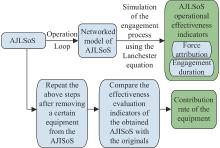
Fig 1
Flowchart of the design methodology"
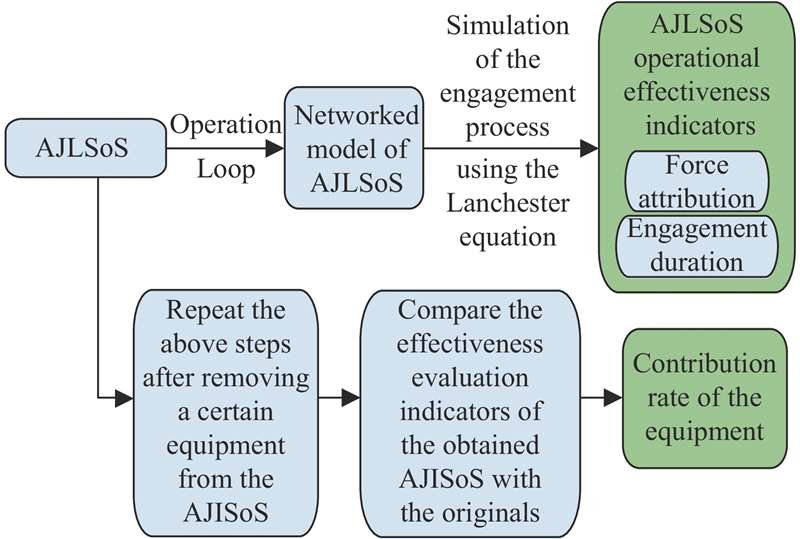
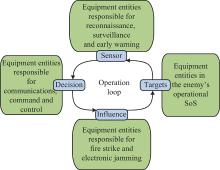
Fig 2
Operational loop diagram"

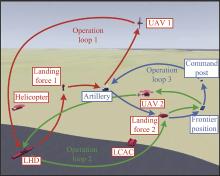
Fig 3
Operational loop cases in landing campaigns"


Table 1
Functional entity assignments of units within both red and blue strike chains"
| Opposing force | Serial number of equipment | Name of combat units | Functional entities in strike chains | ||
| Sensor | decision | influence | |||
| Red’s perspective | 1 | Landing force 1 | √ | √ | √ |
| 2 | Landing force 2 | √ | √ | √ | |
| 3 | LHD | √ | |||
| 4 | UAV 1 | √ | √ | ||
| 5 | UAV 2 | √ | √ | ||
| Blue’s perspective | 1 | Artillery’s garrison | √ | √ | √ |
| 2 | Command post’s garrison | √ | √ | √ | |
| 3 | Frontier position | √ | √ | √ | |
| 4 | Artillery | √ | |||
| 5 | Command post | √ | |||
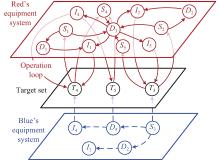
Fig 4
Abstracted operation loops on the red side"
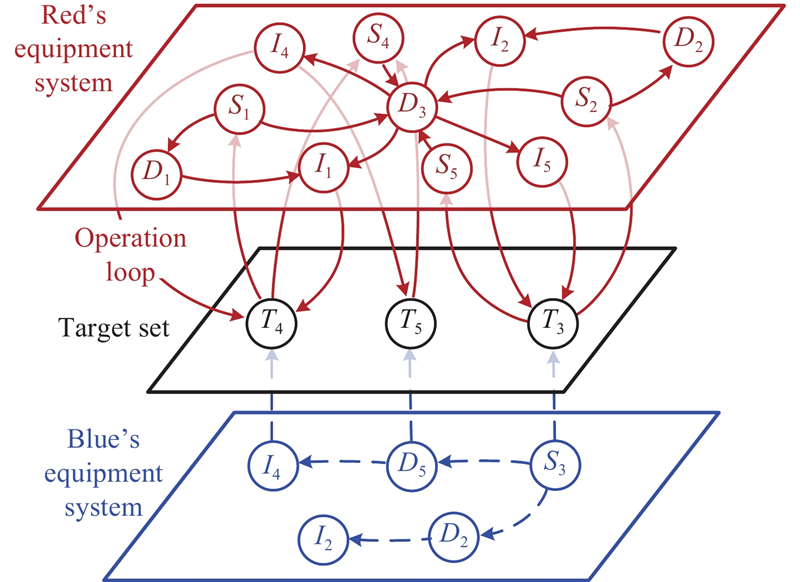
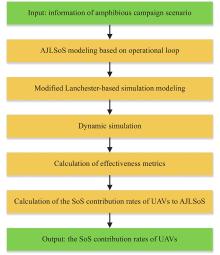
Fig 5
Procedure of calculating the contribution rates of UAVs"
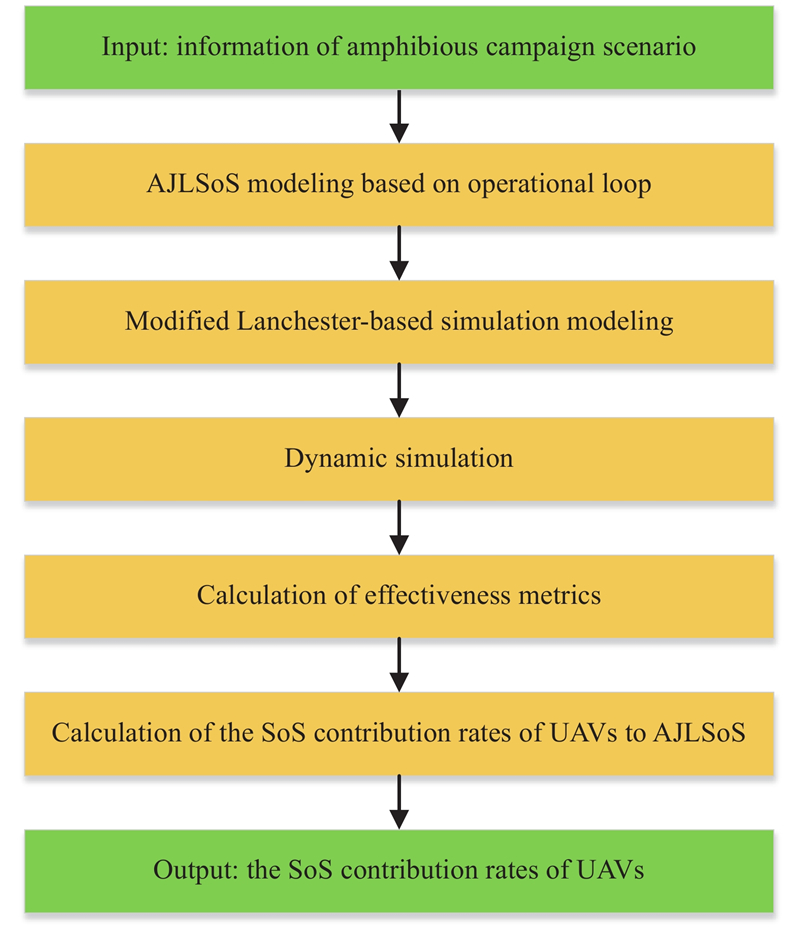
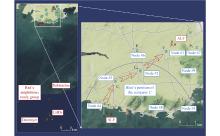
Fig 6
A case of landing campaign scenario"
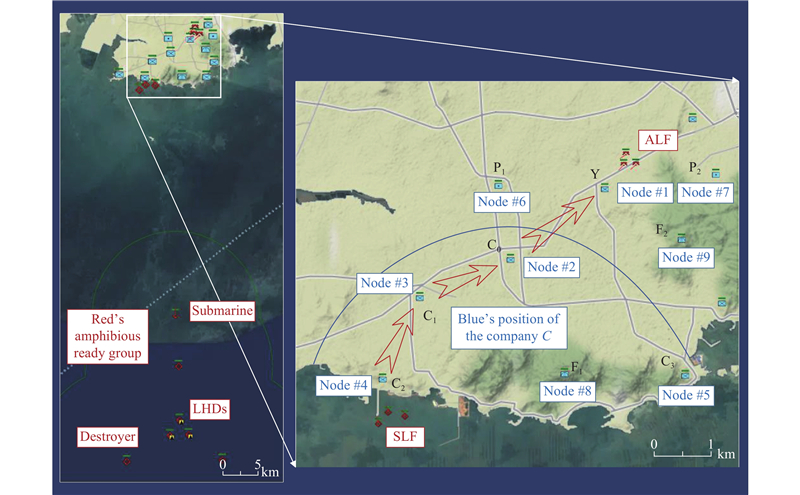
Table 2
Weapon deployment of blue force"
| Node type | Forces and equipment deployment (number of combat units) | |||
| Self-propelled howitzer | 80 mm mortar | Individual artillery | Light infantry | |
| Frontier position | 9 | 36 | ||
| Company command post | 12 | 35 | ||
| Brigade artillery | 8 | 12 | 48 | |
| Battalion artillery | 8 | 4 | 25 | |
| Battalion command post | 18 | 48 | ||
Table 3
Weapon deployment of red force"
| Type of landing forces | Total person | Forces and equipment deployment (number of combat units) | ||
| Vehicle-mounted artillery | Individual artillery | Light infantry | ||
| Surface landing force | 350 | 30 | 28 | 150 |
| Airborne landing force | 400 | − | 46 | 324 |
| Infantry unit | 90 | − | 9 | 78 |
| Fire support unit | 60 | − | 15 | 35 |
| Reconnaissance unit | 60 | − | 4 | 55 |
Table 4
Red’s expected number of ALUs assigned to each node on the blue side"
| Node number | Node designator | ALU number assigned by red force | ||
| Infantry unit | Fire support unit | Reconnaissance unit | ||
| 1 | Battalion command post | 1 | 1 | 1 |
| 2 | Company command post | − | 1 | 1 |
| 6 | Brigade artillery | 1 | 1 | − |
| 7 | Battalion artillery | 1 | − | − |
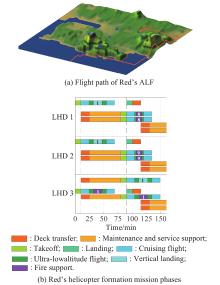
Fig 7
Estimated departure time and route of ALF in Red’s battle plan"
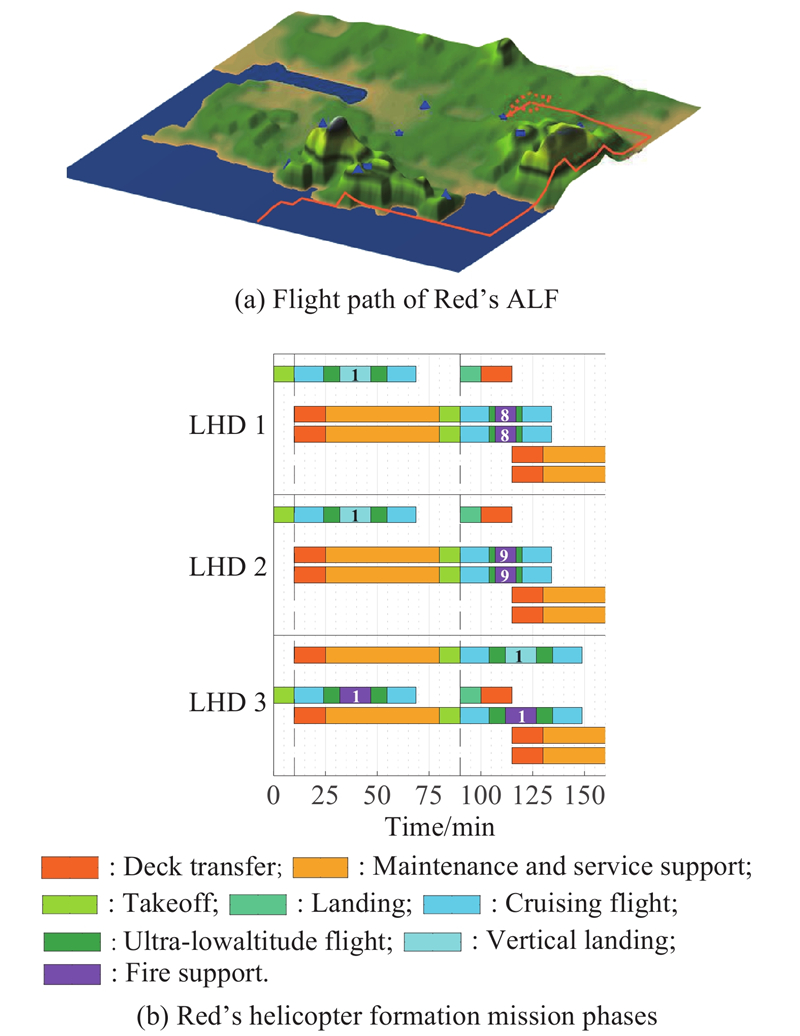
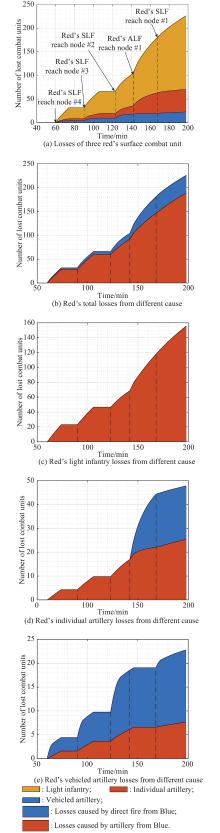
Fig 8
Combat unit attrition of red’s joint landing force over time"
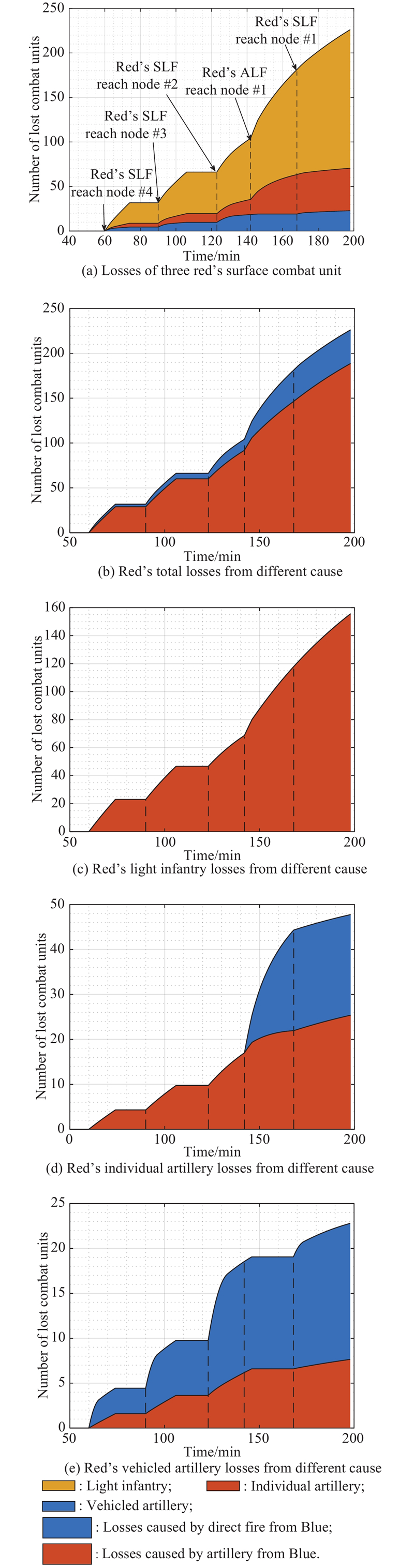
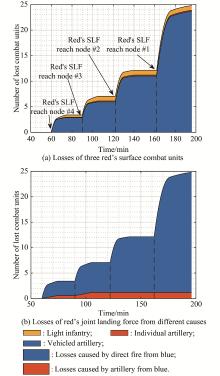
Fig 9
Combat unit attrition of red’s joint landing force over time"
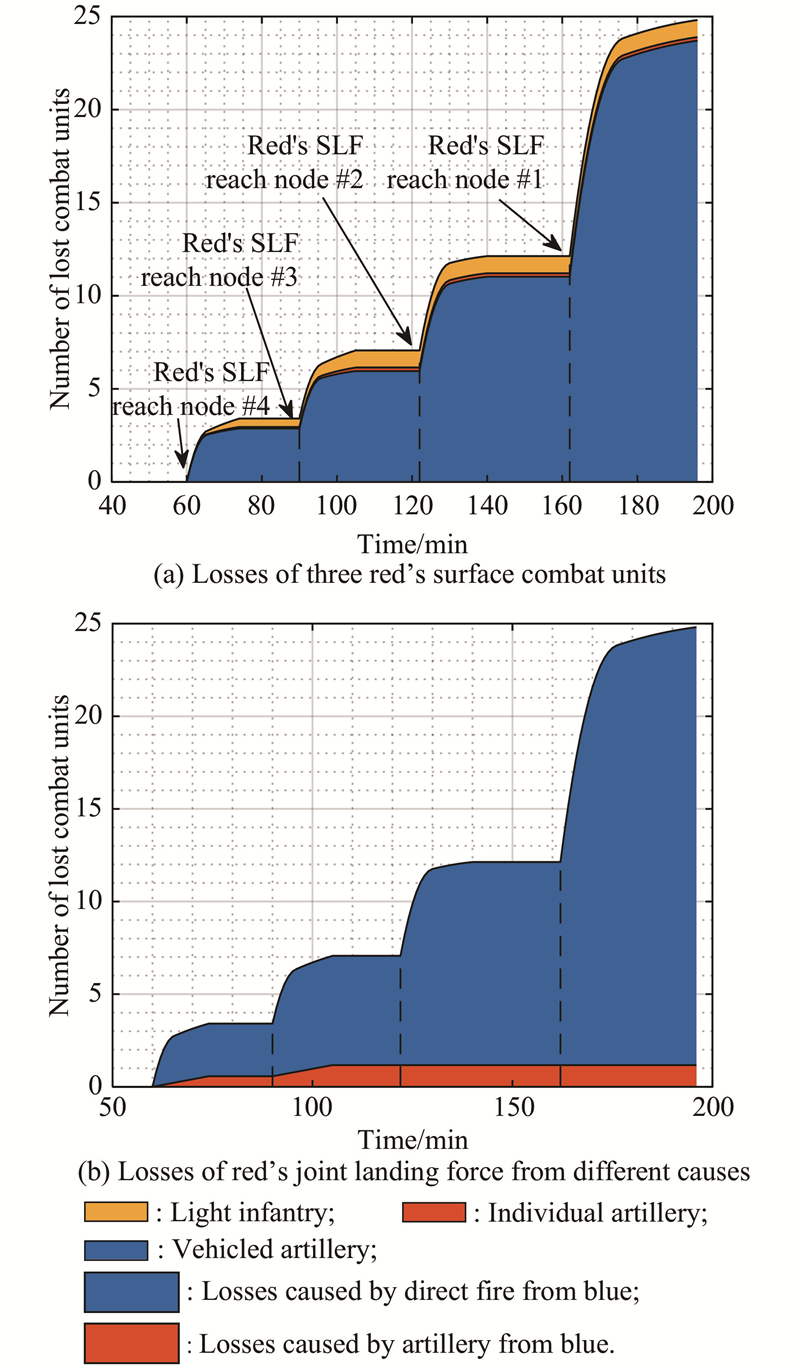
Fig 10
Combat unit attrition of Red and Blue in each local engagement"
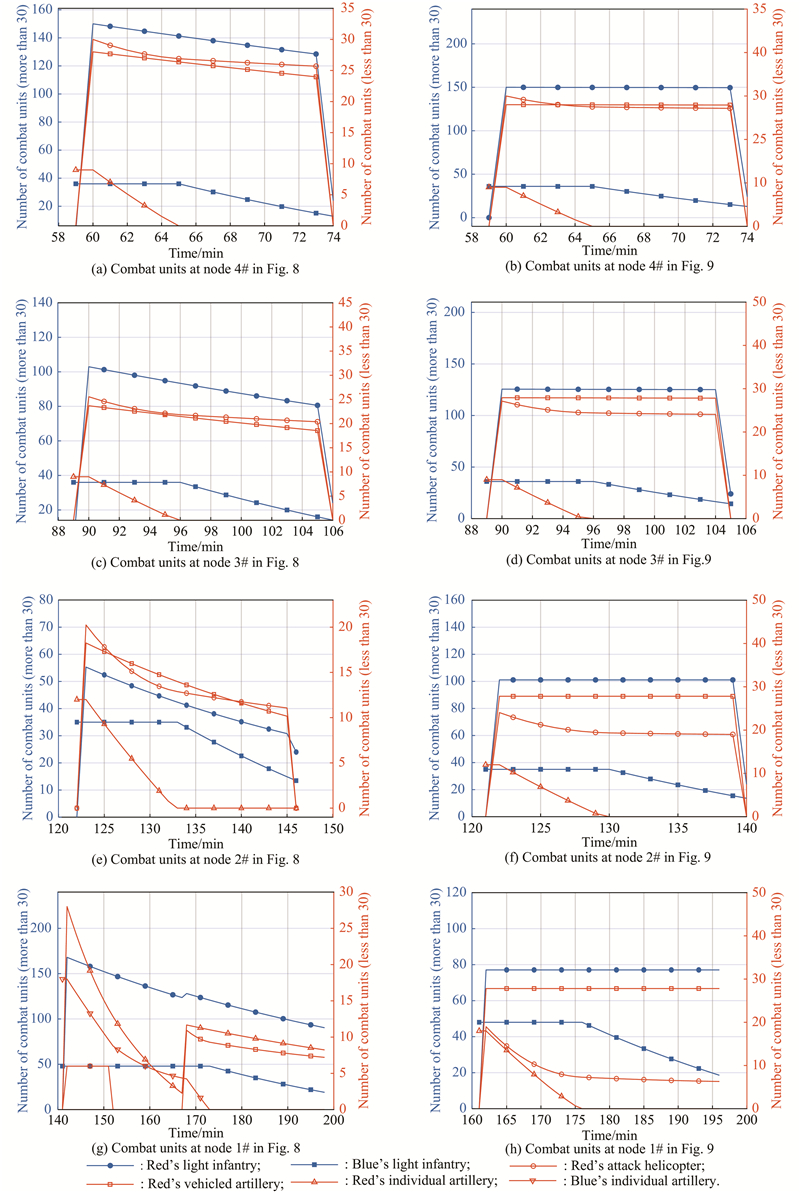
Fig 11
Operational effectiveness of red’s AJLSoS under different cases"
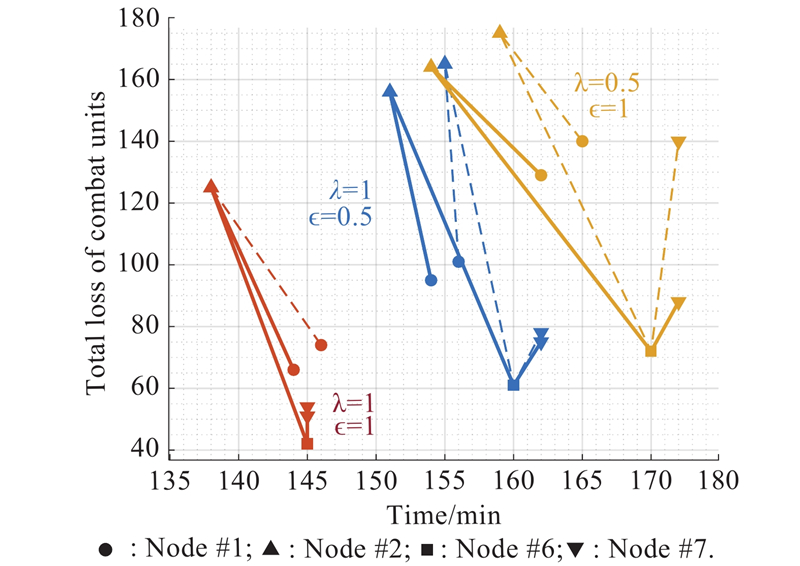
Table 5
Calculation results of effectiveness-based system contribution rate"
| Node attacked by ALF | SoS operational effectiveness | SoS contribution rate | ||||||
| Ideal reference group | without SUARH | with SUARH | with SUARH | SUARH (influence) | SUARH (sensor) | UFWA (sensor) | ||
| Node #1 | (144,66) | (146,74) | (154,95) | (162,129) | (0.013, 0.108) | (0.065, 0.305) | (0.111, 0.488) | |
| Node #2 | (138,125) | (138,125) | (151,156) | (154,164) | (0.000, 0.000) | (0.086, 0.199) | (0.104, 0.238) | |
| Node #6 | (145,42) | (145,42) | (160,61) | (170,72) | (0.000, 0.000) | (0.094, 0.311) | (0.147, 0.417) | |
| Node #7 | (145,51) | (145,54) | (162,75) | (172,88) | (0.000, 0.056) | (0.105, 0.320) | (0.157, 0.420) | |
| 1 |
WANG Z, LIU S F, FANG Z G Research on SoS-GERT network model for equipment system of systems contribution evaluation based on joint operation. IEEE Systems Journal, 2020, 14 (3): 4188- 96.
doi: 10.1109/JSYST.2019.2956549 |
| 2 | YANG K W, YANG Z W, TAN Y J, et al Review of the evaluation methods of equipment system of systems facing the contribution rate. Systems Engineering and Electronics, 2019, 41 (2): 311- 21. |
| 3 |
SHANG H L, ZHANG X K, YE Z Q, et al Operation loop-based network design model for defense resource allocation with uncertainty. IEEE Systems Journal, 2019, 13 (1): 477- 88.
doi: 10.1109/JSYST.2018.2827206 |
| 4 | SERESHT N G, FAYEK A R Neuro-fuzzy system dynamics technique for modeling construction systems. Applied Soft Computing, 2020, 93, 106400. |
| 5 | LIU A H, CHEN K, HUANG X F, et al Dynamic risk assessment model of buried gas pipelines based on system dynamics. Reliability Engineering & System Safety, 2021, 208, 107326. |
| 6 | LI Q, LIANG B H, FANG Z X. Mapping and integration of architecture and modelling frameworks. Proc. of the 2nd International Conference on Innovative Intelligent Industrial Production and Logistics , 2021: 216−226. |
| 7 |
LIU P, LI J C, XIA B Y, et al Weapons equipment portfolios selection based on equipment system contribution rates. Journal of Systems Engineering and Electronics, 2021, 32 (3): 584- 95.
doi: 10.23919/JSEE.2021.000050 |
| 8 |
DOU Y J, ZHOU Z X, ZHAO D L, et al Weapons system portfolio selection based on the contribution rate evaluation of system of systems. Journal of Systems Engineering and Electronics, 2019, 30 (5): 905- 919.
doi: 10.21629/JSEE.2019.05.09 |
| 9 | ZHANG T P, LIU T L, YANG J Concept and evaluation method of equipment system of systems contribution rate. Journal of Southeast University (English Edition), 2021, 37 (3): 317- 24. |
| 10 |
DU Y W, WANG S S, WANG Y M Group fuzzy comprehensive evaluation method under ignorance. Expert Systems With Applications, 2019, 126, 92- 111.
doi: 10.1016/j.eswa.2019.02.006 |
| 11 | LIU Y, ECKERT C M, EARL C A review of fuzzy AHP methods for decision-making with subjective judgements. Expert Systems with Applications, 2020, 161, 113738. |
| 12 |
WANG Y M, LIU P D, YAO Y Y BMW-TOPSIS: a generalized TOPSIS model based on three-way decision. Information Sciences, 2022, 607, 799- 818.
doi: 10.1016/j.ins.2022.06.018 |
| 13 |
CHEN S Q, WANG Y M, SHI H L, et al Evidential reasoning with discrete belief structures. Information Fusion, 2018, 41, 91- 104.
doi: 10.1016/j.inffus.2017.08.009 |
| 14 | BONGERS A, TORRES J L Revisiting the battle of midway: a counterfactual analysis. Military Operations Research, 2020, 25 (2): 49- 68. |
| 15 | PENG B, LIU S, XU L, et al Combat process simulation and attrition forecasting based on system dynamics and multi-agent modeling. Expert Systems with Applications, 2022, 187, 115976. |
| 16 |
KALLONIATIS A C, HOEK K, ZUPARIC M, et al Optimising structure in a networked Lanchester model for fires and manoeuvre in warfare. Journal of the Operational Research Society, 2021, 72 (8): 1863- 78.
doi: 10.1080/01605682.2020.1745701 |
| 17 |
KRESS M Lanchester models for irregular warfare. Mathematics, 2020, 8 (5): 737.
doi: 10.3390/math8050737 |
| 18 |
KRESS M, LIN K Y, MACKAY N J The attrition dynamics of multilateral war. Operations Research, 2018, 66 (4): 950- 6.
doi: 10.1287/opre.2018.1718 |
| 19 |
COULSON S G Lanchester modelling of intelligence in combat. Mathematics, 2019, 30 (2): 149- 64.
doi: 10.1093/imaman/dpx014 |
| 20 | MINGUELA-CASTRO G, HERADIO R, CERRADA C. Automated support for battle operational-strategic decision-making [J]. Mathematics, 2021, 9(13): 1534. |
| 21 | MCCARTNEY M. The solution of Lanchester’s equations with inter-battle reinforcement strategies. Physica A: Statistical Mechanics and its Applications, 2022, 568: 126477. |
| 22 | LANGRECK J, WONG H, HERNANDEZ A, et al Modeling and simulation of future capabilities with an automated computer-aided wargame. The Journal of Defense Modeling and Simulation Applications Methodology Technology, 2021, 18 (4): 407- 416. |
| 23 | FOSTER K L, PETTY M D, ASSOC C M. A case study of the use of design of experiments methods to calibrate a semi-automated forces system. Proc. of the Annual ACM Southeast Conference, 2019: 133−140. |
| 24 |
ZHANG Y, MOU Z Y, GAO F F, et al UAV-enabled secure communications by multi-agent deep reinforcement learning. IEEE Trans. on Vehicular Technology, 2020, 69 (10): 11599–11611.
doi: 10.1109/TVT.2020.3014788 |
| 25 | GANG J X, GUO X. A methods of operational effectiveness for C4ISR system based on system dynamics analysis. Proc. of the International Conference on Information Systems and Computer Aided Education, 2018: 81−86. |
| 26 |
JIA N P, YANG Z W, YANG K W Operational effectiveness evaluation of the swarming uavs combat system based on a system dynamics model. IEEE Access, 2019, 7, 25209- 25224.
doi: 10.1109/ACCESS.2019.2898728 |
| 27 | CARES J. Distributed networked operations: the foundations of network centric warfare. Bloomington: IUniverse, 2006. |
| 28 |
WU W L, ZHOU X S, SHEN B Comprehensive evaluation of the intelligence levels for unmanned swarms based on the collective OODA loop and group extension cloud model. Connection Science, 2022, 34 (1): 630- 651.
doi: 10.1080/09540091.2022.2026293 |
| 29 | ZHANG X K. Modeling and optimization of armament system of systems development based on operation loop. Changsha: National University of Defense Technology, 2016. (in Chinese) |
| 30 |
LIN K Y New results on a stochastic duel game with each force consisting of heterogeneous units. Naval Research Logistics, 2014, 61 (1): 56- 65.
doi: 10.1002/nav.21566 |
| 31 |
ATKINSON M P, KRESS M, MACKAY N J Targeting, deployment, and loss-tolerance in lanchester engagements. Operations Research, 2021, 69 (1): 71- 81.
doi: 10.1287/opre.2020.2022 |
| 32 | PAN X, ZUO D J, ZHANG Y D. Contribution rate evaluation method of equipment system-of-systems based on system dynamics. Systems Engineering and Electronics, 2021, 43(1): 112−120. (in Chinese) |
| 33 | WU H H. Planning and evaluation of amphibious landing operations. Nanjing: Nanjing University of Science and Technology, 2017. (in Chinese) |
| [1] | Jiacheng TANG, Zixiao YANG, Lei ZHANG, Tianjiang HU, Bo ZHU. Regular virtual tube for cooperative transportation of a payload by multiple quadrotors [J]. Journal of Systems Engineering and Electronics, 2025, 36(4): 1068-1076. |
| [2] | Chi HAN, Wei XIONG, Minghui XIONG, Zhen LIU. Support vector regression-based operational effectiveness evaluation approach to reconnaissance satellite system [J]. Journal of Systems Engineering and Electronics, 2023, 34(6): 1626-1644. |
| [3] | Yaozhong ZHANG, Zhuoran WU, Zhenkai XIONG, Long CHEN. A UAV collaborative defense scheme driven by DDPG algorithm [J]. Journal of Systems Engineering and Electronics, 2023, 34(5): 1211-1224. |
| [4] | Zhiwei CHEN, Ziming ZHOU, Luogeng ZHANG, Chaowei CUI, Jilong ZHONG. Mission reliability modeling and evaluation for reconfigurable unmanned weapon system-of-systems based on effective operation loop [J]. Journal of Systems Engineering and Electronics, 2023, 34(3): 588-597. |
| [5] | Renjie XU, Xin LIU, Donghao CUI, Jian XIE, Lin GONG. An evaluation method of contribution rate based on fuzzy Bayesian networks for equipment system-of-systems architecture [J]. Journal of Systems Engineering and Electronics, 2023, 34(3): 574-587. |
| [6] | Ziwei ZHANG, Qisheng GUO, Zhiming DONG, Hongxiang LIU, Ang GAO, Pengcheng QI. Operational effectiveness evaluation based on the reduced conjunctive belief rule base [J]. Journal of Systems Engineering and Electronics, 2022, 33(5): 1161-1172. |
| [7] | Kewei YANG, Boyuan XIA, Gang CHEN, Zhiwei YANG, Minghao LI. Multi-objective optimization of operation loop recommendation for kill web [J]. Journal of Systems Engineering and Electronics, 2022, 33(4): 969-985. |
| [8] | Qi HAN, Weimin LI, Qiling XU, Minrui ZHAO, Runze HUO, Tao ZHANG. Lanchester equation for cognitive domain using hesitant fuzzy linguistic terms sets [J]. Journal of Systems Engineering and Electronics, 2022, 33(3): 674-682. |
| [9] | Peng LIU, Jichao LI, Boyuan XIA, Danling ZHAO, Yuejin TAN. Weapons equipment portfolios selection based on equipment system contribution rates [J]. Journal of Systems Engineering and Electronics, 2021, 32(3): 584-595. |
| [10] | Xing PAN, Huixiong WANG, Yanjing YANG, Guozhong ZHANG. Resilience based importance measure analysis for SoS [J]. Journal of Systems Engineering and Electronics, 2019, 30(5): 920-930. |
| [11] | Yajie DOU, Zhexuan ZHOU, Danling ZHAO, Yong WEI. Weapons system portfolio selection based on the contribution rate evaluation of system of systems [J]. Journal of Systems Engineering and Electronics, 2019, 30(5): 905-919. |
| [12] | Ruiwen ZHANG, Bifeng SONG, Yang PEI, Qijia YUN. Improved method for subsystems performance trade-off in system-of-systems oriented design of UAV swarms [J]. Journal of Systems Engineering and Electronics, 2019, 30(4): 720-737. |
| [13] | Yani Cui, Jia Ren, Wencai Du, and Jingguo Dai. UAV target tracking algorithm based on task allocation consensus [J]. Journal of Systems Engineering and Electronics, 2016, 27(6): 1207-1218. |
| [14] | Zilong Cheng, Li Fan, and Yulin Zhang. A framework for equipment systems-of-systems effectiveness evaluation using parallel experiments approach [J]. Journal of Systems Engineering and Electronics, 2015, 26(2): 292-300. |
| [15] | Gu Hui & Song Bifeng. Study on effectiveness evaluation of weapon systems based on grey relational analysis and TOPSIS [J]. Journal of Systems Engineering and Electronics, 2009, 20(1): 106-111. |
| Viewed | ||||||
|
Full text |
|
|||||
|
Abstract |
|
|||||
