
Journal of Systems Engineering and Electronics ›› 2026, Vol. 37 ›› Issue (2): 567-578.doi: 10.23919/JSEE.2024.000006
• SYSTEMS ENGINEERING • Previous Articles
Weilin YUAN1( ), Shaofei CHEN2,*(), Lina LU2(), Zhenzhen HU2(), Yu XIE2(), Jing CHEN2()
Received:2023-07-06
Online:2026-04-18
Published:2026-04-30
Contact:
Shaofei CHEN
E-mail:yuanweilin12@nudt.edu.cn;chensf005@163.com;lulina16@nudt.edu.cn;hzzmail@163.com;xieyu_nudt@139.com;Chenjing001@vip.sina.com
About author:Supported by:Weilin YUAN, Shaofei CHEN, Lina LU, Zhenzhen HU, Yu XIE, Jing CHEN. Equilibrium learning for multi-stage cyber-physical multi-domain security game in island air defense[J]. Journal of Systems Engineering and Electronics, 2026, 37(2): 567-578.
Add to citation manager EndNote|Reference Manager|ProCite|BibTeX|RefWorks
Fig 1
Illustration of adversarial scenarios in island air defense"
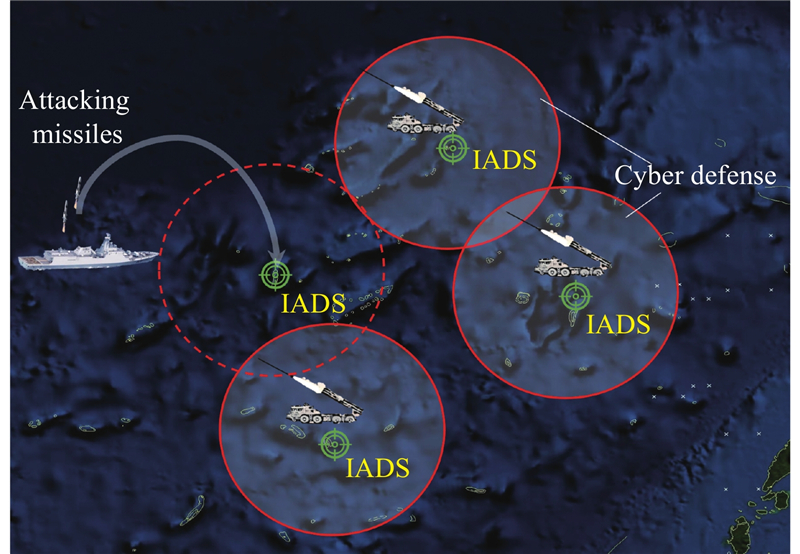
Fig 2
Progress of CI-IADS scenario"
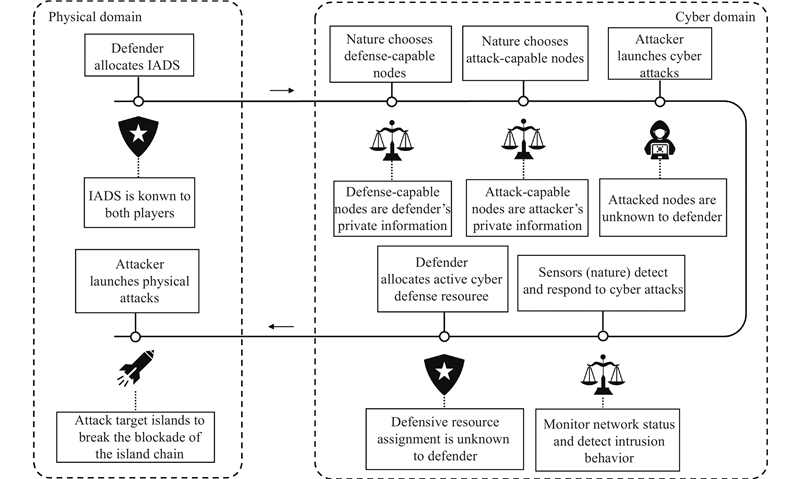
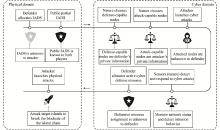
Fig 3
Progress of II-IADS scenario"
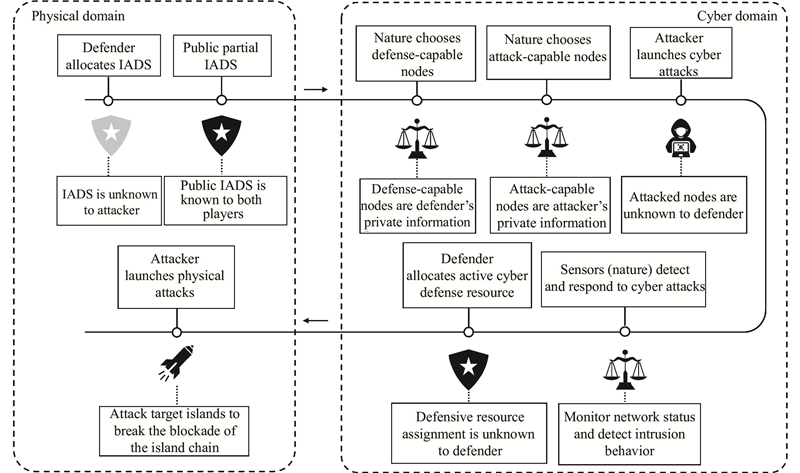
Table 1
Multi-domain and multi-stage island air defense game structure (CI-IADS scenario)"
| Stage | Player | Domain | ||
| 1 | Defender | Physical | − | |
| 2 | Nature | Cyber | − | |
| 3 | Nature | Cyber | − | |
| 4 | Attacker | Cyber | ||
| 5 | Nature | Cyber | − | |
| 6 | Defender | Cyber | ||
| 7 | Attacker | Physical |
Table 2
Multi-domain and multi-stage island air defense game structure (II-IADS scenario)"
| Stage | Player | Domain | ||
| 1 | Defender | Physical | − | |
| 2 | Defender | Physical | − | |
| 3 | Nature | Cyber | − | |
| 4 | Nature | Cyber | − | |
| 5 | Attacker | Cyber | ||
| 6 | Nature | Cyber | − | |
| 7 | Defender | Cyber | ||
| 8 | Attacker | Physical |
Table 3
Default parameters in island air defense"
| Parameter | Base value | Description | Constrain |
| − | Set of islands | − | |
| 6 | Number of IADs | ||
| 5 | Number of public IADS | ||
| 3 | Number of AMS | ||
| 4 | Number of defense-capable cyber nodes | ||
| 4 | Number of attack-capable cyber nodes | ||
| 2 | Number of cyber defense source | ||
| 2 | Number of cyber attack source | ||
| 0.3 | Coverage radius of each IADS | − | |
| 0.9 | Physical defense effectiveness | − | |
| 0.8 | Cyber defense effectiveness | − | |
| 0.7 | Cyber attack effectiveness | − | |
| 0.8 | Cyber sensor detection effectiveness | − |
Table 4
Optimal defensive strategies (default parameters in island air defense)"
| ID | Island information | Physical domain | Cyber domain | ||||||
| X | Y | Value | Defense | Attack | Defense | Attack | |||
| 1 | IADS | − | √ | √ | |||||
| 2 | − | AM | − | − | |||||
| 3 | IADS | AM | − | − | |||||
| 4 | IADS | − | √ | √ | |||||
| 5 | IADS | − | − | − | |||||
| 6 | IADS | − | − | − | |||||
| 7 | IADS | AM | − | − | |||||
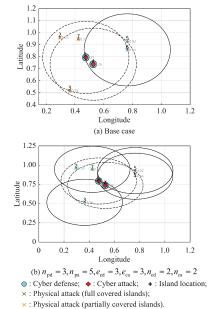
Fig 4
Illustrations of two island air defense scenarios"
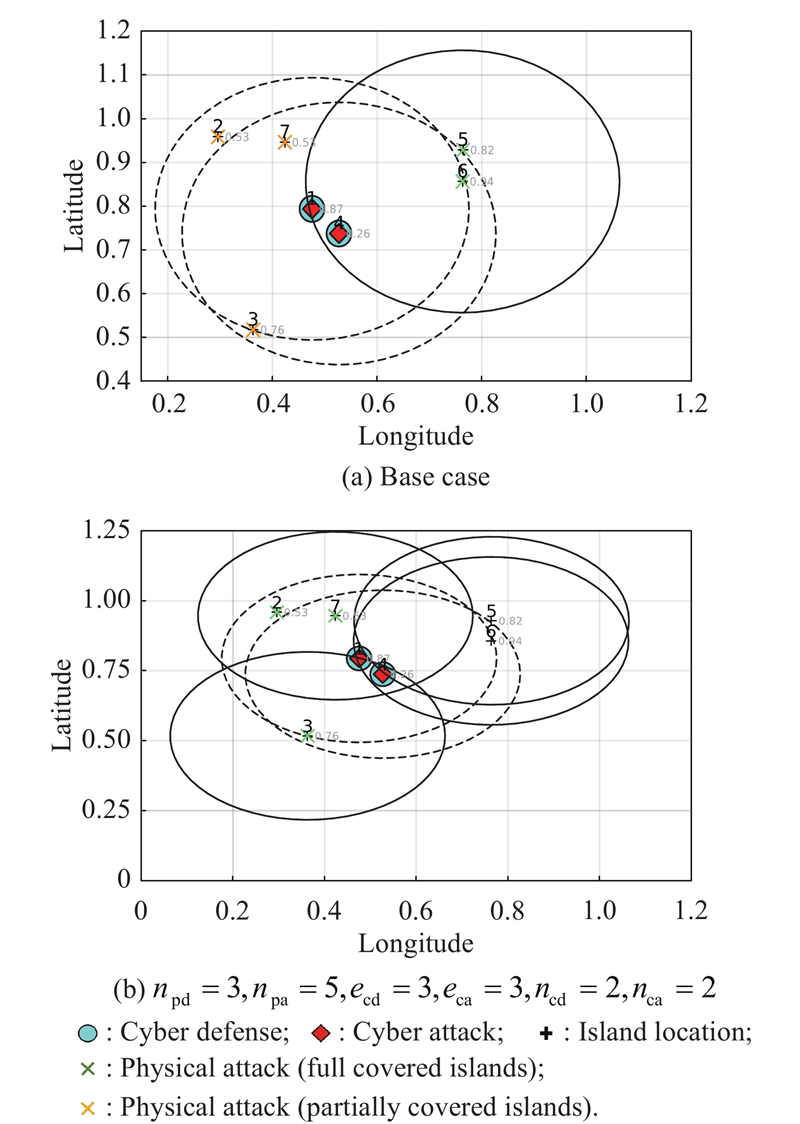
Table 5
Optimal defensive strategies ($ {{\boldsymbol{n}}_{{\boldsymbol{pd}}}} = {\boldsymbol{3}},{{\boldsymbol{n}}_{{\boldsymbol{pa}}}} = {\boldsymbol{5}},{{\boldsymbol{e}}_{{\boldsymbol{cd}}}} = {\boldsymbol{3}}, $$ {{\boldsymbol{e}}_{{\boldsymbol{ca}}}} = {\boldsymbol{3}},{{\boldsymbol{n}}_{{\boldsymbol{cd}}}} = {\boldsymbol{2}}, {{\boldsymbol{n}}_{{\boldsymbol{ca}}}} {\boldsymbol{=}} {\boldsymbol{2}} $)"
| ID | Island information | Physical domain | Cyber domain | ||||||
| X | Y | Value | Defense | Attack | Defense | Attack | |||
| 1 | IADS | − | √ | √ | |||||
| 2 | − | AM | − | − | |||||
| 3 | − | AM | − | − | |||||
| 4 | IADS | − | √ | √ | |||||
| 5 | − | AM | − | − | |||||
| 6 | IADS | AM | − | − | |||||
| 7 | − | AM | − | − | |||||
Fig 5
Utility of deceptive defensive strategies in different settings"
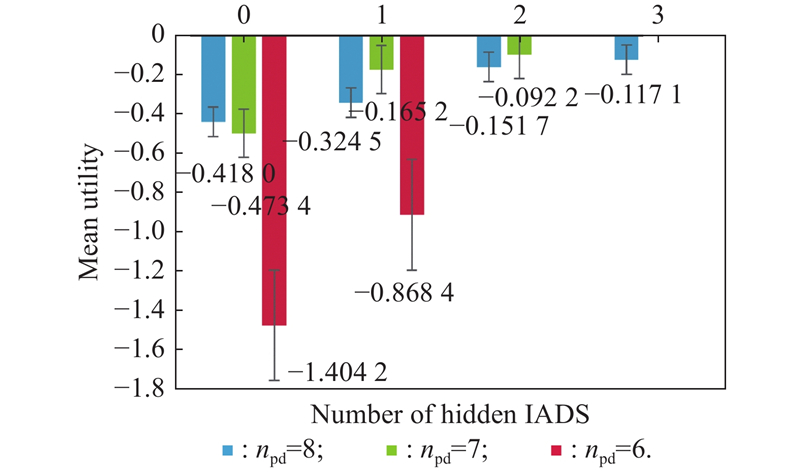
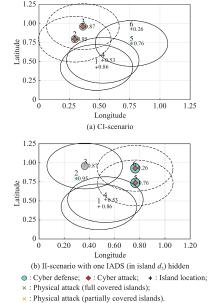
Fig 6
Comparison on defensive allocation"
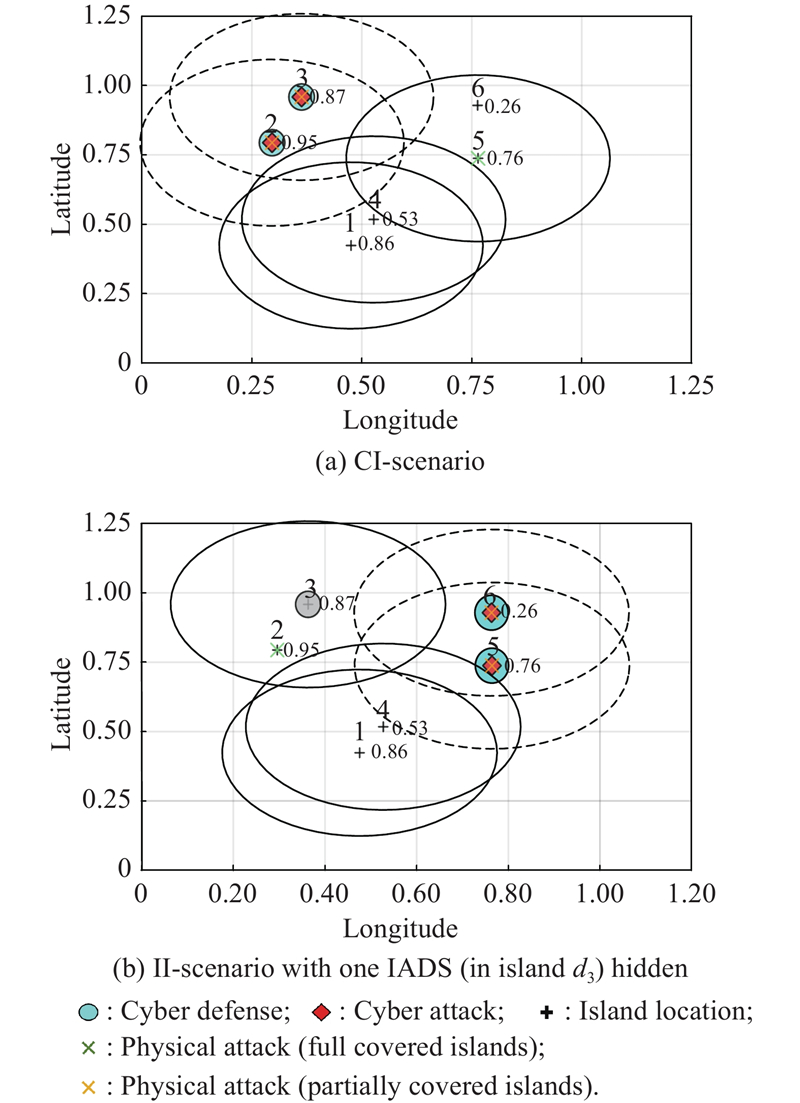
Fig 7
Convergence results"
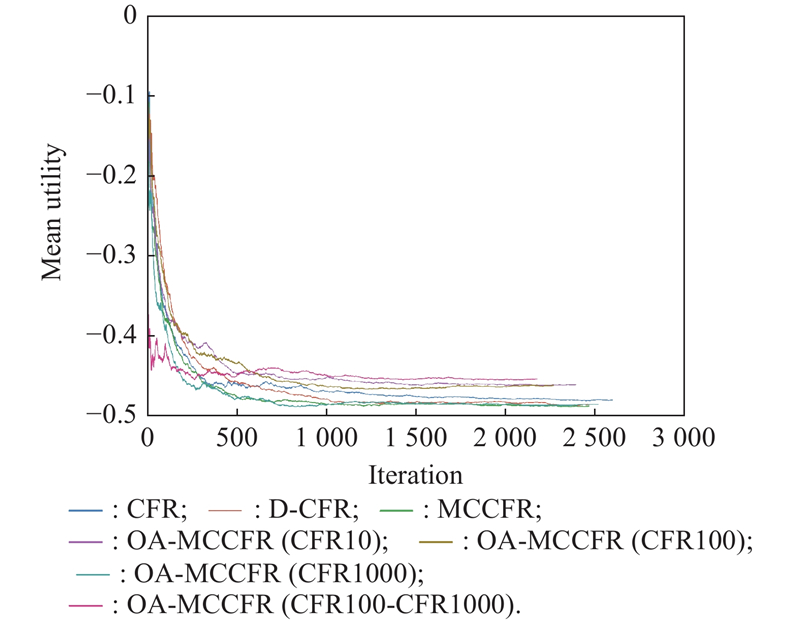
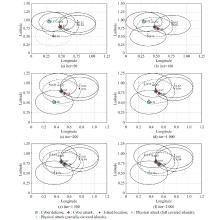
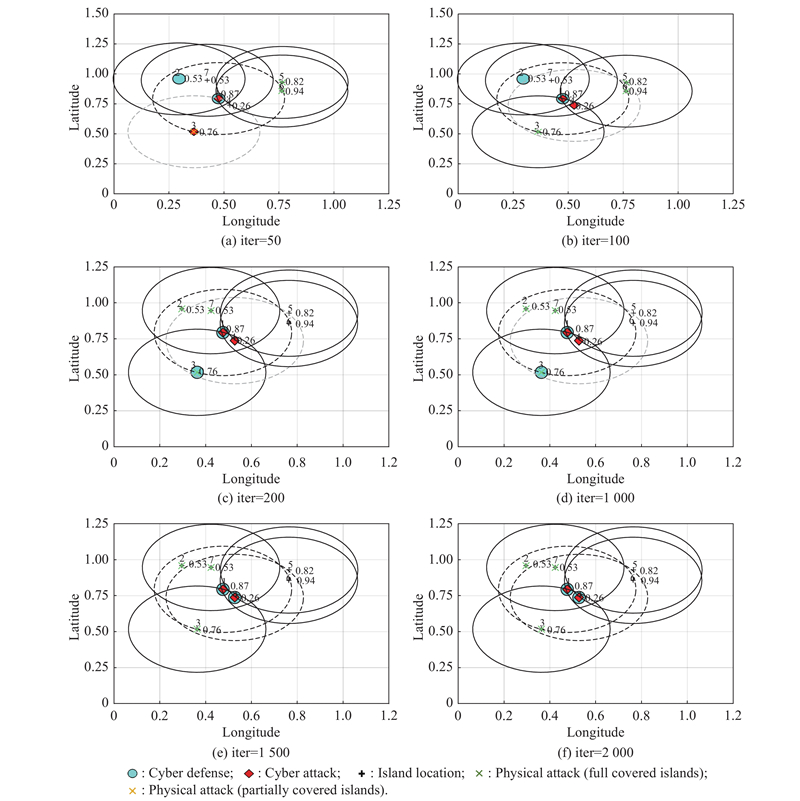
Fig 8
Visualization of defensive strategy learning process"
| 1 | U.S. ARMY. The U.S. army in multi-domain operations 2028. https://publicintelligence.net/usarmy-multidomain-ops-2028/. |
| 2 | Singapore Government Agency. Fact sheet: see more, shoot further, smarter – RSAF’s island air defence system. https://www.mindef.gov.sg/web/portal/mindef/news-and-events/latest-releases/article-detail/2020/December/17dec20_fs. |
| 3 | TAKAKO F G. Non-cooperative game theory. Japan: Springer Japan eBooks, 2015. |
| 4 | KORZHYK D, YIN Z , KIEKINTVELD C, et al. Stackelberg vs. Nash in security games: an extended investigation of interchangeability, equivalence, and uniqueness. Journal of Artificial Intelligence Research, 2011, 41: 297−327. |
| 5 | YUAN W L, LUO J R, LU L N, et. al. Methods in adversarial intelligent game: a holistic comparative analysis from perspective of game theory and reinforcement learning. Computer Science, 2022, 49 (8): 191−204. |
| 6 | PITA J, JAIN M, MARECKI J, et al. Deployed armor protection: the application of a game theoretic model for security at the Los Angeles international airport. Proc. of the 7th International Joint Conference on Autonomous Agents and Multiagent Systems: Industrial Track, 2008: 125−132. |
| 7 | TSAI J, RATHI S, KIEKINTVELD C, et al. IRIS: a tool for strategic security allocation in transportation networks. Cambridge: Cambridge University Press, 2011. |
| 8 | PITA J, BELLAMANE H, JAIN M, et al Security applications: lessons of real-world deployment. ACM SIGecom Exchanges, 2009, 8 (2): 1- 4. |
| 9 |
HAN C Y, LUNDAY B J, ROBBINS M J A game theoretic model for the optimal location of integrated air defense system missile batteries. Informs Journal on Computing, 2016, 28 (3): 405- 416.
doi: 10.1287/ijoc.2016.0690 |
| 10 | KEITH A, AHNER D. Counterfactual regret minimization for integrated cyber and air defense resource allocation. European Journal of Operational Research 2021, 292(1): 95−107. |
| 11 |
ROBERSON B The Colonel Blotto game. Economic Theory, 2006, 29 (1): 1- 24.
doi: 10.1007/s00199-005-0071-5 |
| 12 |
KOVENOCK D, ROBERSON B Coalitional Colonel Blotto games with application to the economics of alliances. Journal of Public Economic Theory, 2012, 14 (4): 653- 676.
doi: 10.1111/j.1467-9779.2012.01556.x |
| 13 | ZOU M W, CHEN S F, LUO J R, et al. An evolutionary learning approach for anti-jamming game in cognitive radio confrontation. Proc. of the IEEE International Conference on Systems, Man, and Cybernetics, 2022: 3210−3215. |
| 14 | HASAN K, SHETTY S, SOKOLOWSKI J A, et al. Security game for cyber physical systems. Proc. of the Communications and Networking Symposium, 2018: 1−12. |
| 15 |
CLEMPNER J, POZNYAK A Stackelberg security games. Expert Systems with Applications, 2015, 42 (8): 3967- 3979.
doi: 10.1016/j.eswa.2014.12.034 |
| 16 | SINHA A, FANG F, AN B, et al. Stackelberg security games: looking beyond a decade of success. Proc. of the International Joint Conference on Artificial Intelligence, 2018: 5494−5501. |
| 17 | CONITZER V, SANDHOLM T. Computing the optimal strategy to commit to. Proc. of the 7th ACM Conference on Electronic Commerce, 2006: 82−90. |
| 18 | MUTZARI D, AUMANN Y, KRAUS S. Robust solutions for multi-defender Stackelberg security games. https://arxiv.org/pdf/2204.14000.pdf. |
| 19 | NGUYEN T, JIAN A, TAMB M. Stop the compartmentalization: unified robust algorithms for handling uncertainties in security games. Proc. of the Autonomous Agents and Multi-Agents Systems, 2014: 317−324. |
| 20 | GUILLERMO A J, JULIO B C . Repeated Stackelberg security games: learning with incomplete state information. https://www-sciencedirect-com-s.libyc.nudt.edu.cn/science/article/pii/S0951832019304478. |
| 21 | GUO Q, AN B, BOVSANSKY B, et al. Comparing strategic secrecy and Stackelberg commitment in security games. Proc. of the International Joint Conference on Artificial Intelligence, 2017: 3691−3699. |
| 22 |
VINYALS O, BABUSCHKIN I, CZARNECKI W M, et al Grandmaster level in StarCraft II using multi-agent reinforcement learning. Nature, 2019, 575 (7782): 350- 354.
doi: 10.1038/s41586-019-1724-z |
| 23 | SANDHOLM T, GILPIN A, CONITZER V. Mixed-integer programming methods for finding Nash equilibria. Proc. of the National Conference on Artificial Intelligence, 2005: 495−501. |
| 24 | LIU W T, LEI J L, YI P, et al. No-regret learning for repeated non-cooperative games with lossy bandits. https://www.sciencedirect.com/science/article/abs/pii/S0005109823006222. |
| 25 | ZINKEVICH M, JOHANSON M, BOWLING M, et al Regret minimization in games with incomplete information. Advances in Neural Information Processing Systems, 2007, 20, 905- 912. |
| 26 | BROWN N, SANDHOLM T. Solving imperfect-information games via discounted regret minimization. https://doi.org/10.48550/arXiv.1809.04040. |
| 27 | LANCTOT M. Monte Carlo sampling and regret minimization for equilibrium computation and decision-making in large extensive form games. Edmonton: University of Albert, 2013. |
| 28 |
BOWLING M, BURCH N, JOHANSON M, et al Heads-up limit hold’em poker is solved. Science, 2015, 347 (6218): 145- 149.
doi: 10.1126/science.1259433 |
| 29 |
BLAIR A, SAFFIDINE A AI surpasses humans at six-player poker. Science, 2019, 365 (6456): 864- 865.
doi: 10.1126/science.aay7774 |
| 30 |
MORAVCIK M, SCHMID M, BURCH N, et al Deepstack: expert-level artificial intelligence in heads-up no-limit poker. Science, 2017, 356 (6337): 508- 513.
doi: 10.1126/science.aam6960 |
| 31 | SHOHAM Y, LEYTON-BROWN K. Multiagent systems: algorithmic, game-theoretic, and logical foundations. London: Cambridge University Press, 2008. |
| 32 | BROWN N. Equilibrium finding for large adversarial imperfect-information games. London: Carnegie Mellon University, 2020. |
| 33 | FRITH C, FRITH U. Theory of mind. https://www.researchgate.net/publication/232296544_Theory_of_mind. |
| [1] | Ruhao JIANG, He LUO, Yingying MA, Guoqiang WANG. Multicriteria game approach to air-to-air combat tactical decisions for multiple UAVs [J]. Journal of Systems Engineering and Electronics, 2023, 34(6): 1447-1464. |
| [2] | Qiuni LI, Rennong YANG, Haoliang LI, Huan ZHANG, Chao FENG. Modeling and game strategy analysis of suppressing IADS for multiple fighters' cooperation [J]. Journal of Systems Engineering and Electronics, 2018, 29(2): 296-304. |
| [3] | Guopeng Zhang, Peng Liu, and Enjie Ding. Energy efficient resource allocation in non-cooperative multi-cell OFDMA systems [J]. Journal of Systems Engineering and Electronics, 2011, 22(1): 175-182. |
| [4] | Xiaohui Yu and Qiang Zhang. Fuzzy Nash equilibrium of fuzzy n-person non-cooperative game [J]. Journal of Systems Engineering and Electronics, 2010, 21(1): 47-56. |
| Viewed | ||||||
|
Full text |
|
|||||
|
Abstract |
|
|||||
