
Journal of Systems Engineering and Electronics ›› 2026, Vol. 37 ›› Issue (2): 485-503.doi: 10.23919/JSEE.2026.000063
• SYSTEMS ENGINEERING • Previous Articles
Tao CHAO1,2,*( ), Xiaonan LI1,2(), Xiaobing SHANG3(), Ping MA1,2(), Ming YANG1,2()
Received:2024-08-26
Accepted:2026-03-19
Online:2026-04-18
Published:2026-04-30
Contact:
Tao CHAO
E-mail:chaotao2000@163.com;hfutlxn@163.com;shangxiaobing@163.com;pingma@hit.edu.cn;myang@hit.edu.cn
About author:Supported by:Tao CHAO, Xiaonan LI, Xiaobing SHANG, Ping MA, Ming YANG. Uncertainty quantification for the ascent phase of launch vehicles using Bayesian inference[J]. Journal of Systems Engineering and Electronics, 2026, 37(2): 485-503.
Add to citation manager EndNote|Reference Manager|ProCite|BibTeX|RefWorks
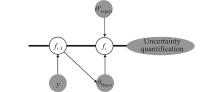
Fig 1
Schematic diagram of the proposed algorithm"
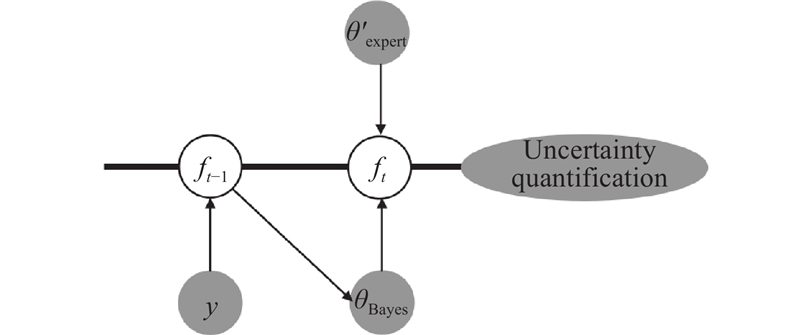

Table 1
Parameters of launch vehicle"
| Parameter | Value |
| Initial position | 0 |
| Initial position | 0 |
| Initial velocity | 0 |
| Initial velocity | 30 |
| Initial mass/kg | 4e+04 |
| Initial thrust/N | 5.5e+05 |
Table 2
Posterior of uncertainty parameters by Bayesian inference"
| Uncertainty parameter | Mean/% | 16th−84th quantiles/% | 2.5th−97.5th quantiles/% |
| 1.00 | [0.972, 1.031] | [0.953,1.052] | |
| 3.02 | [2.60, 3.39] | [2.14, 3.90] | |
| −1.96 | [−3.89, −0.04] | [−5.43,1.51] |
Table 3
Prior distributions by expert knowledge"
| Index | Uncertainty parameter | Distribution | Value |
| Uniform | |||
| Uniform | |||
| Uniform | |||
| Random wind | Uniform | ||
| Random wind | Uniform |
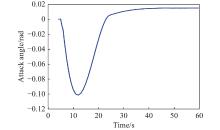
Fig 2
Attack Angle"
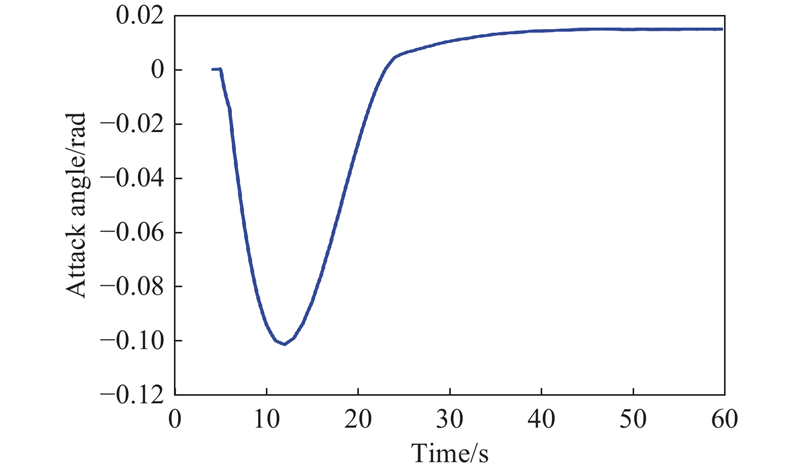
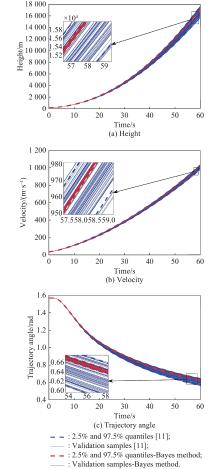
Fig 3
2.5% and 97.5% quantiles estimations based on [11] and the Bayes method"
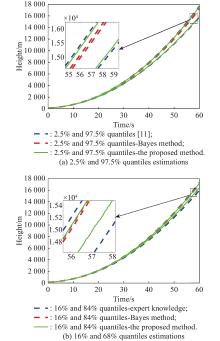
Fig 4
Output statistics of height using different methods in [11]"
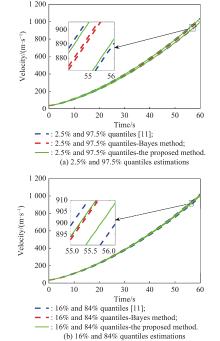
Fig 5
Output statistics of velocity using different methods in [11]"
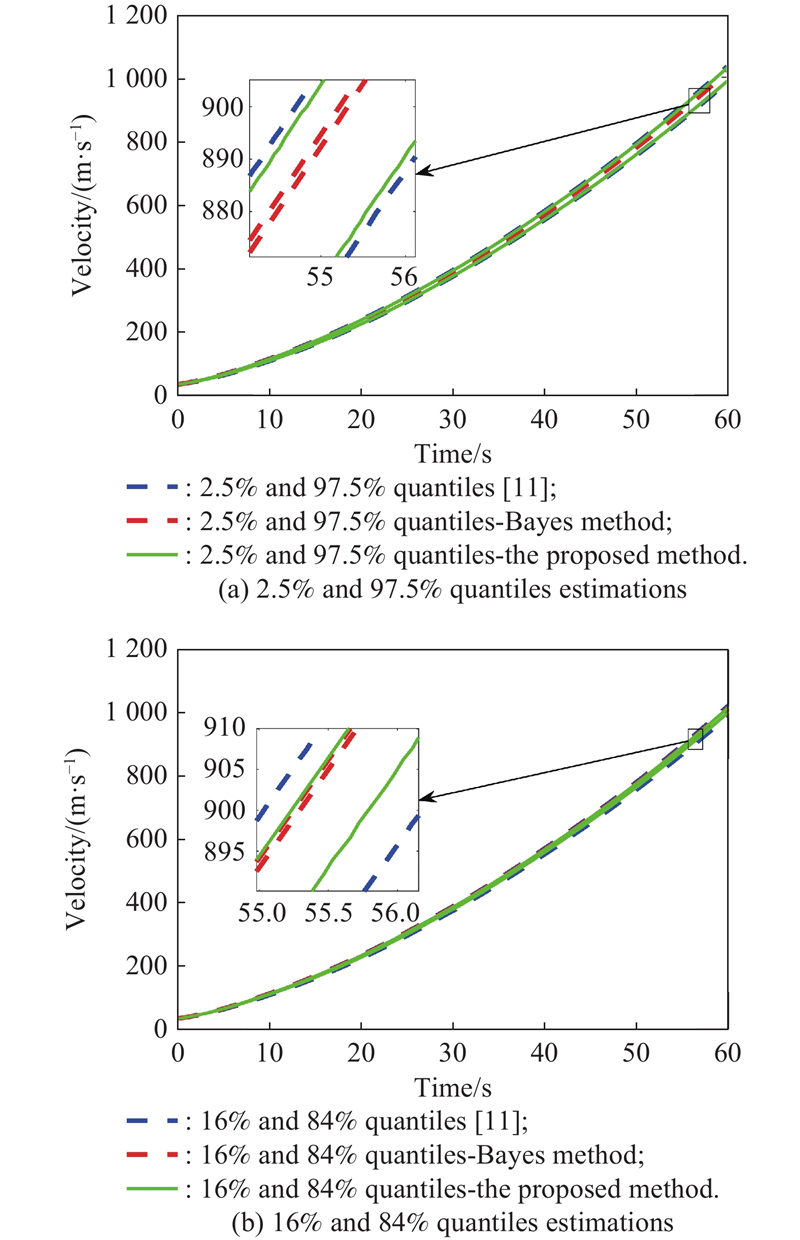
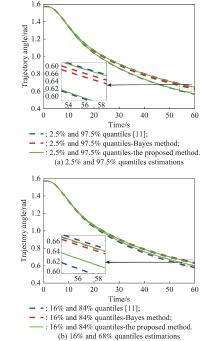
Fig 6
Output statistics of trajectory angle using different methods in [11]"
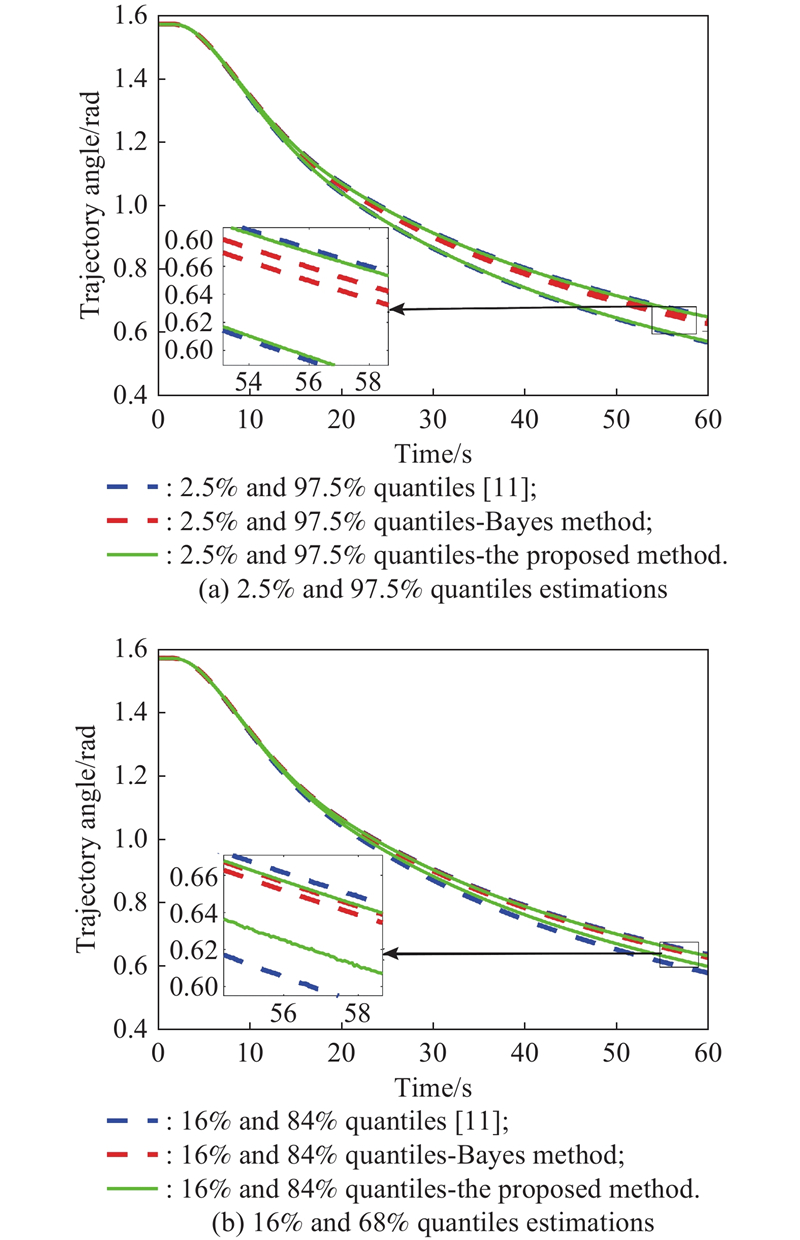
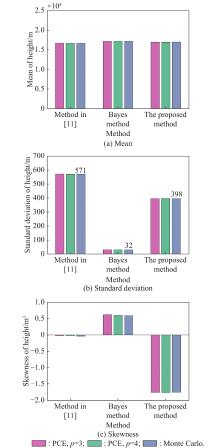
Fig 7
Mean, standard deviation, and skewness of height at the 60th second"
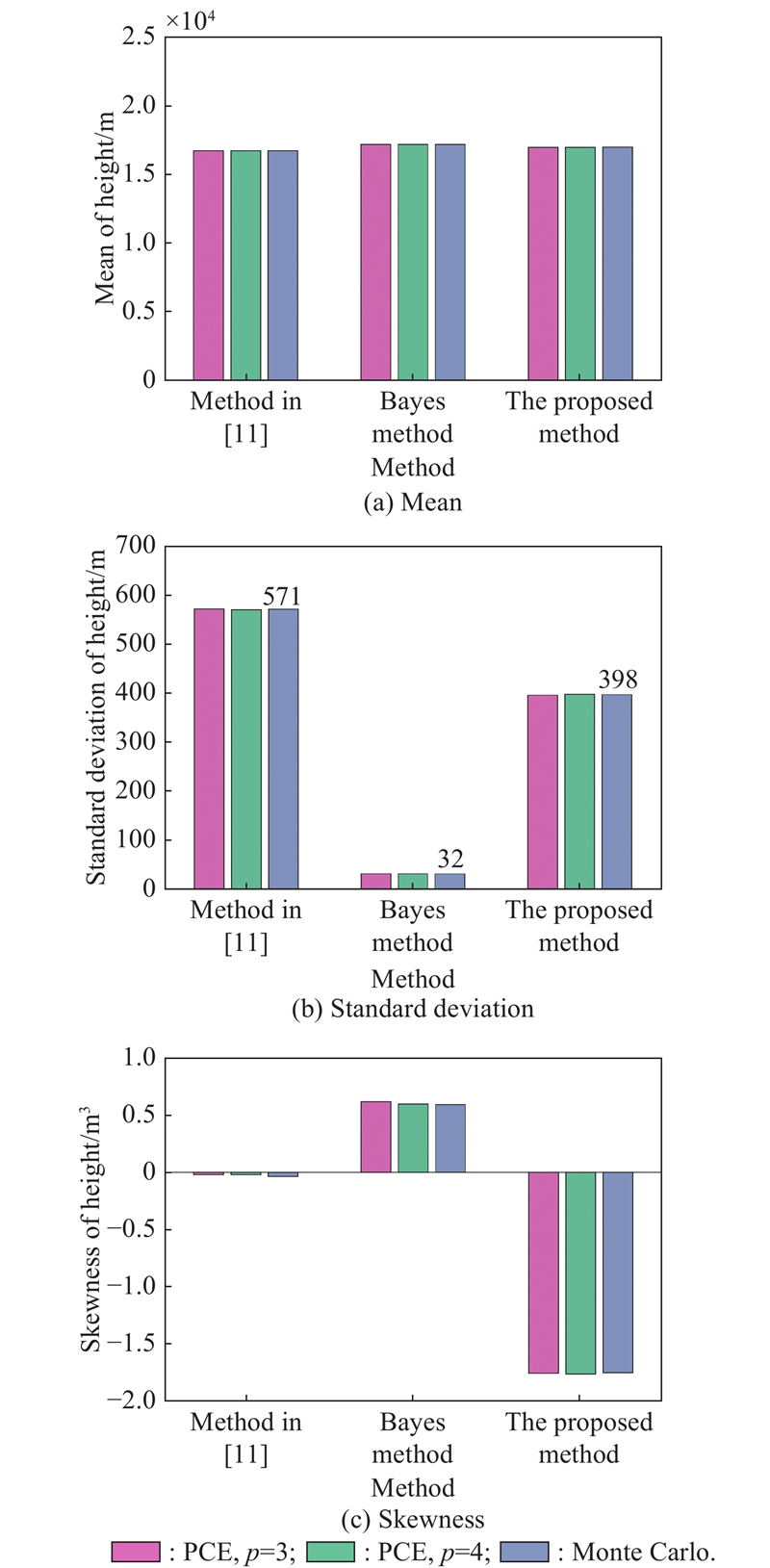
Table 4
Standard deviation of different method"
| Parameter | Traditional method | The proposed method |
| 570.65 | 397.23 | |
| 25.84 | 14.57 | |
| 0.48 | 0.29 | |
| 933.3 | 485.9 | |
| 21.7 | 11.1 | |
| 0.04 | 0.022 |
Table 5
Computing time of different algorithm combinations"
| Number | Bayesian inference | Uncertainty propagation | Total time |
| 1 | GPR-based | PCE | |
| 2 | GPR-based | MC | |
| 3 | PMCMC | PCE | |
| 4 | PMCMC | MC |
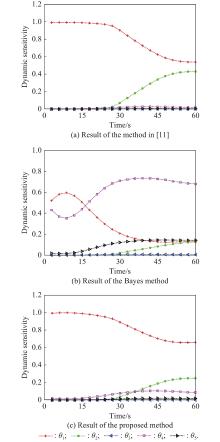
Fig 8
Total sensitivity indices for the velocity of the launch vehicle during the first stage flight"
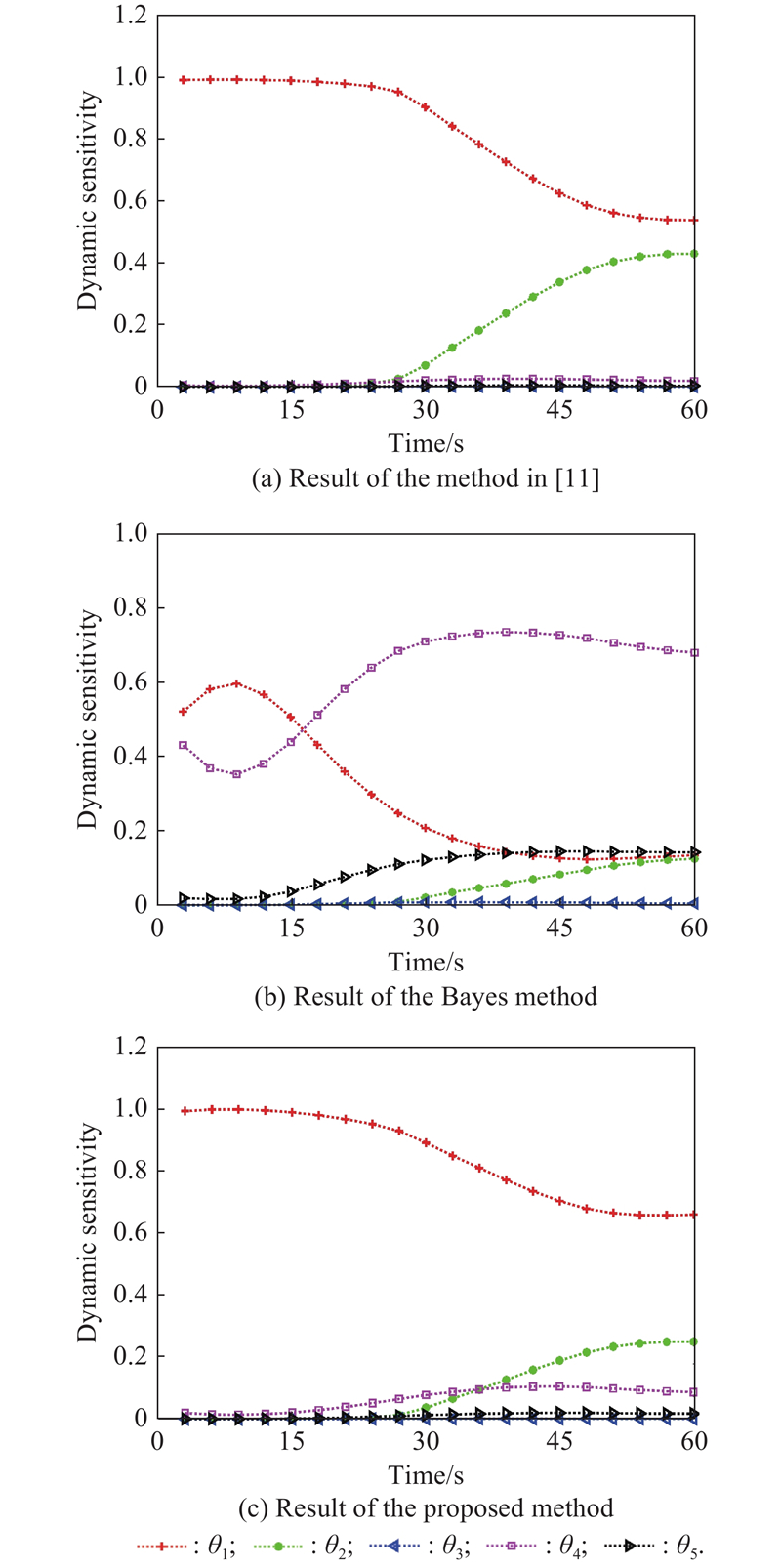
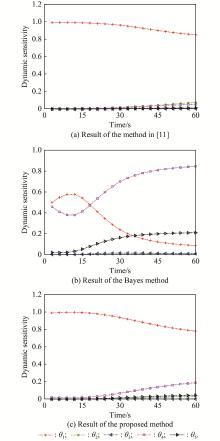
Fig 9
Total Sobol’ indices for the flight height of the launch vehicle during the first stage flight"
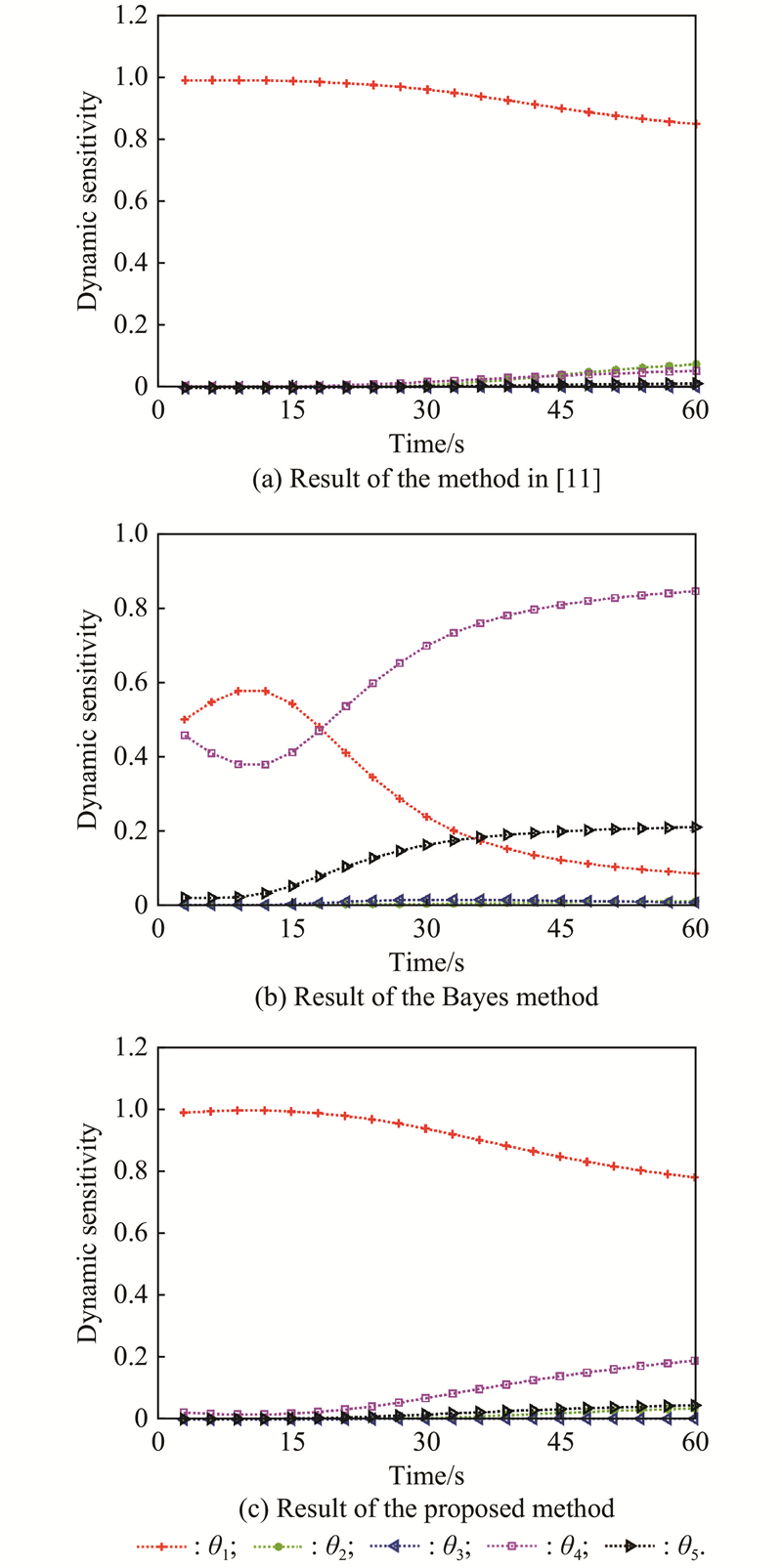
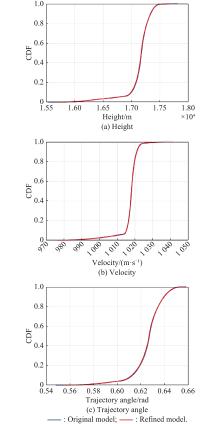
Fig 10
CDF of the original model and the refined model"
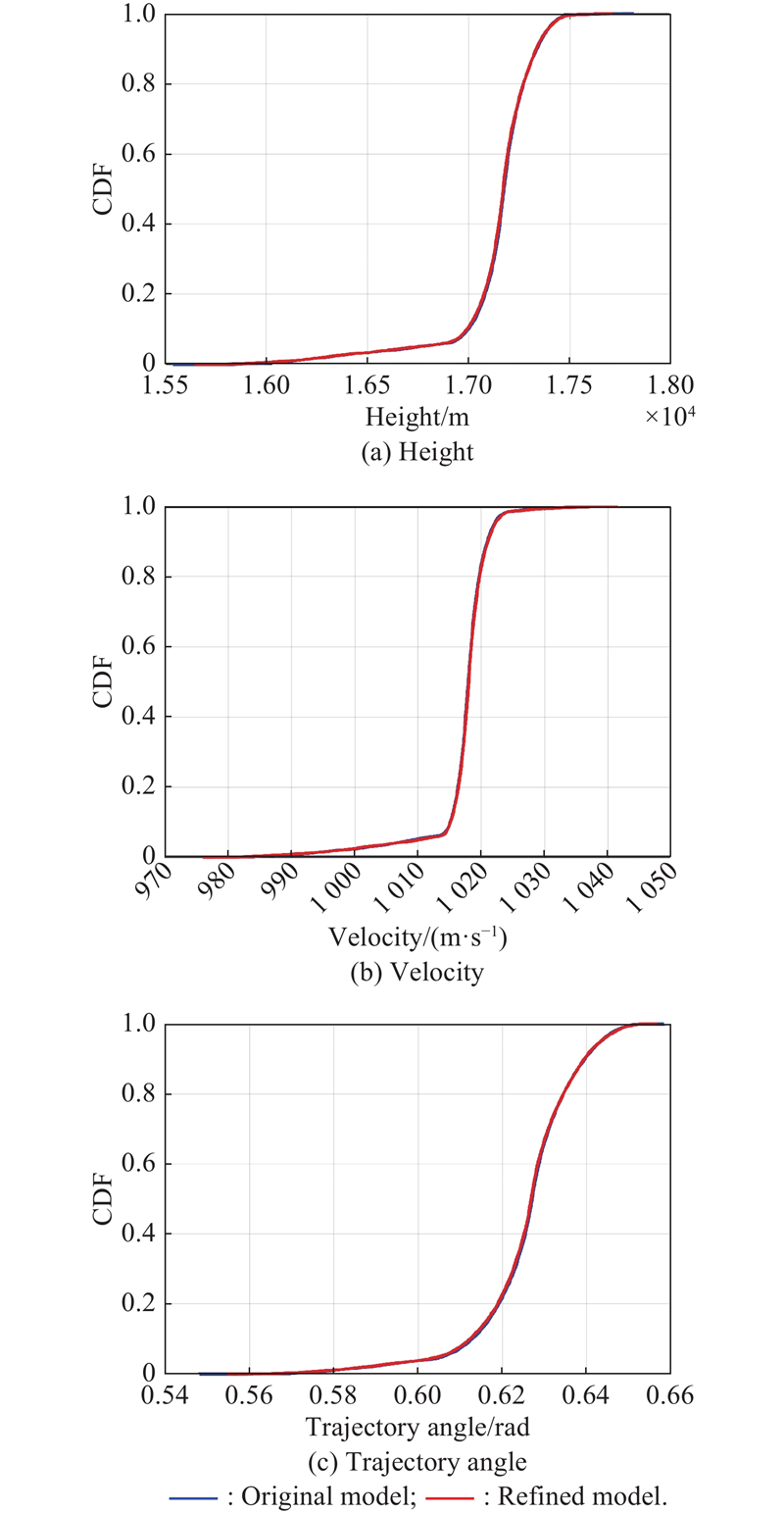
Table 6
Efficiency of sensitivity analysis using different methods"
| Method | Number of samples | Total time |
| PCE | 200 | |
| MCS |
Table 7
Parameters of launch vehicle"
| Parameter | Value |
| Initial mass/kg | 4.1e+04 |
| Initial thrust/N | 5.3e+05 |
Table 8
Prior distributions of uncertainty parameters"
| Uncertainty parameter | Distribution | Interval |
| Norm | ||
| Norm | ||
| Norm | ||
| Norm | ||
| Norm |
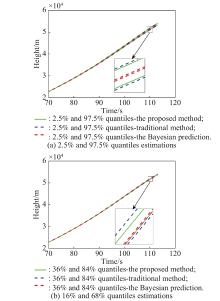
Fig 11
Predictive height using different methods"
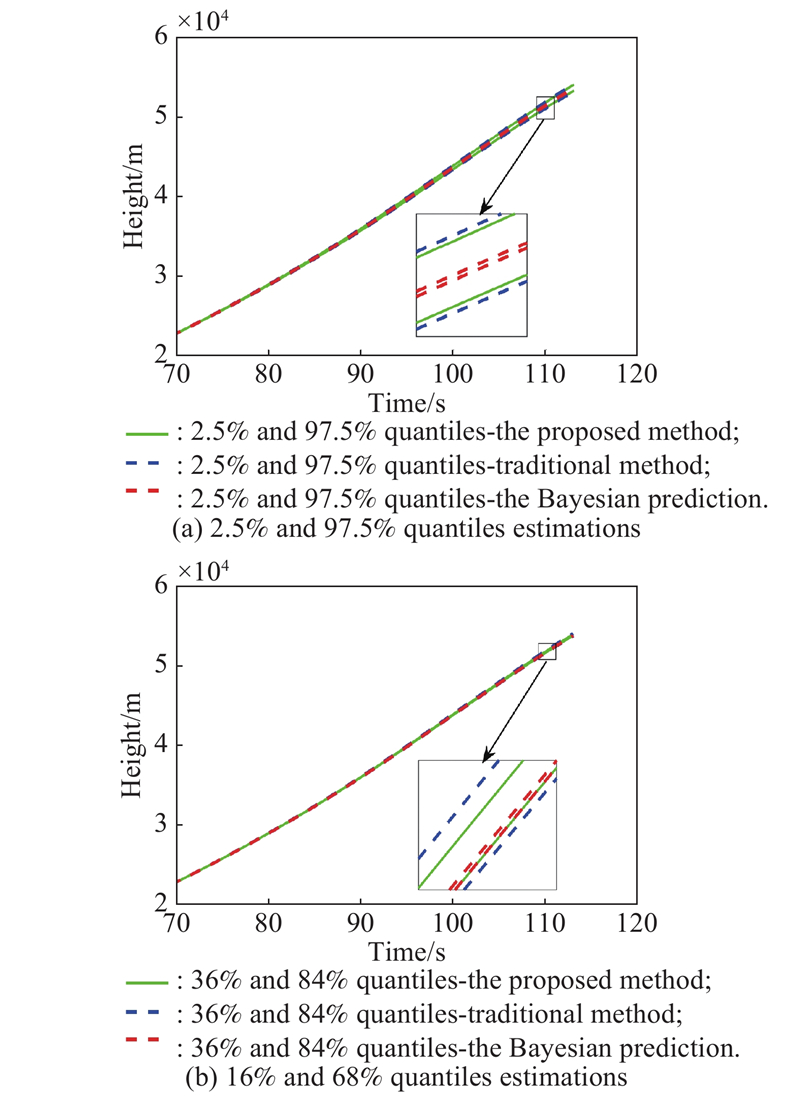
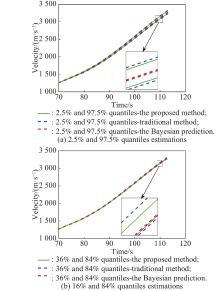
Fig 12
Predictive velocity using different methods"
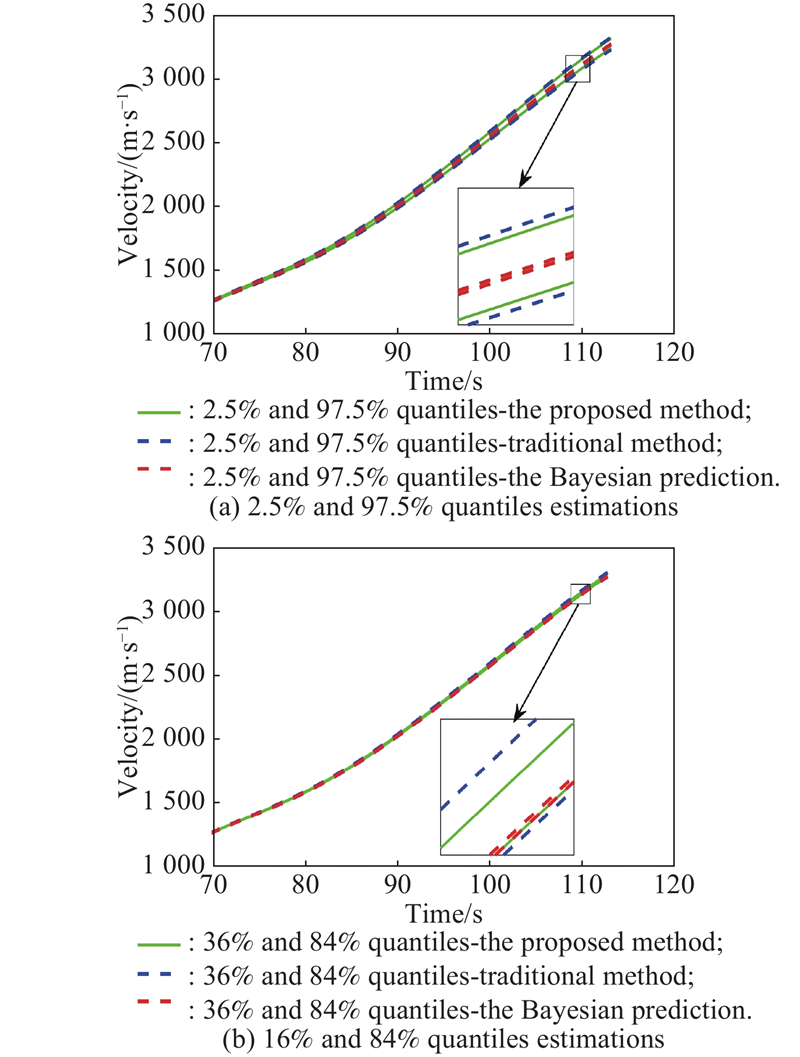
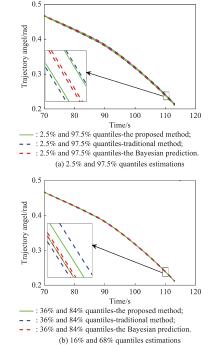
Fig 13
Predictive trajectory angle using different methods"
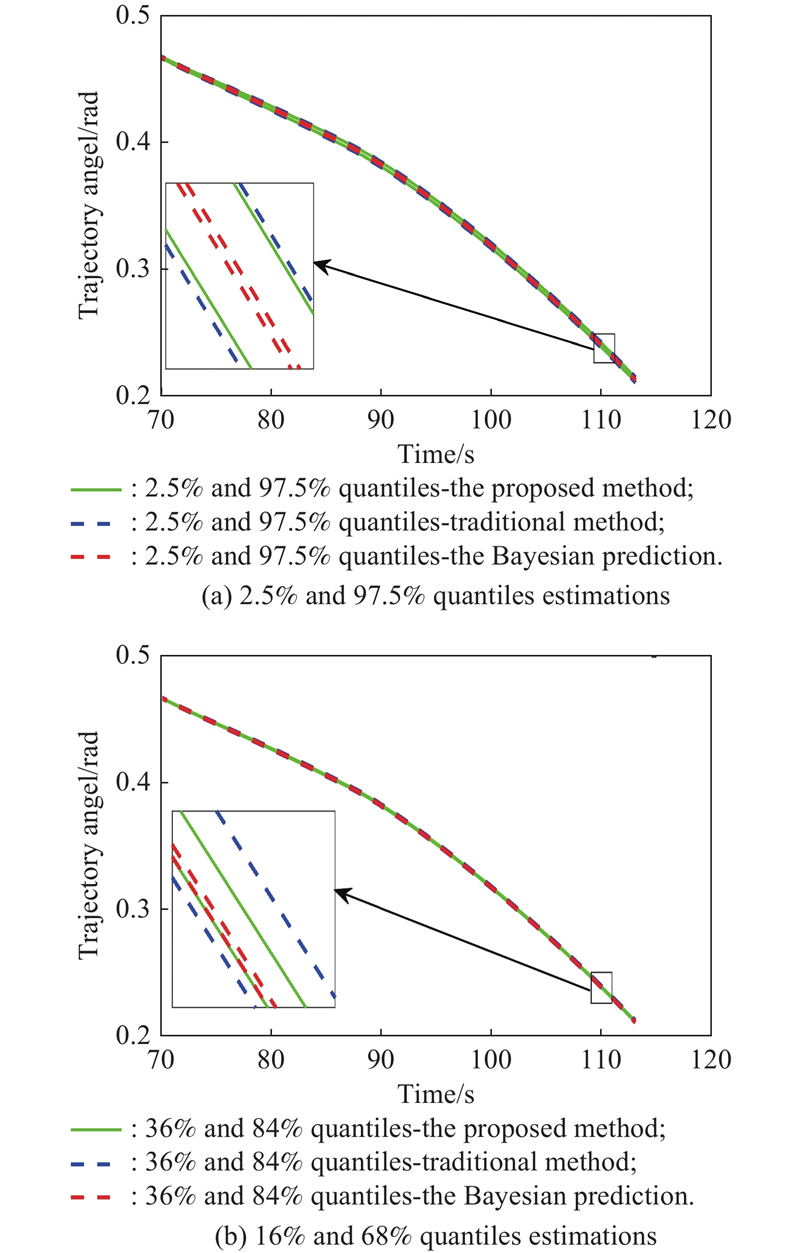
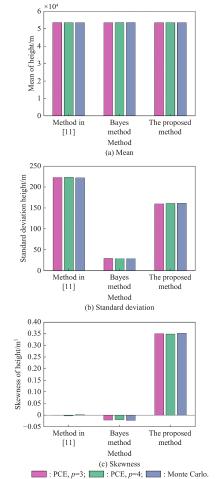
Fig 14
Mean, standard deviation, and skewness of height at the 113th second"
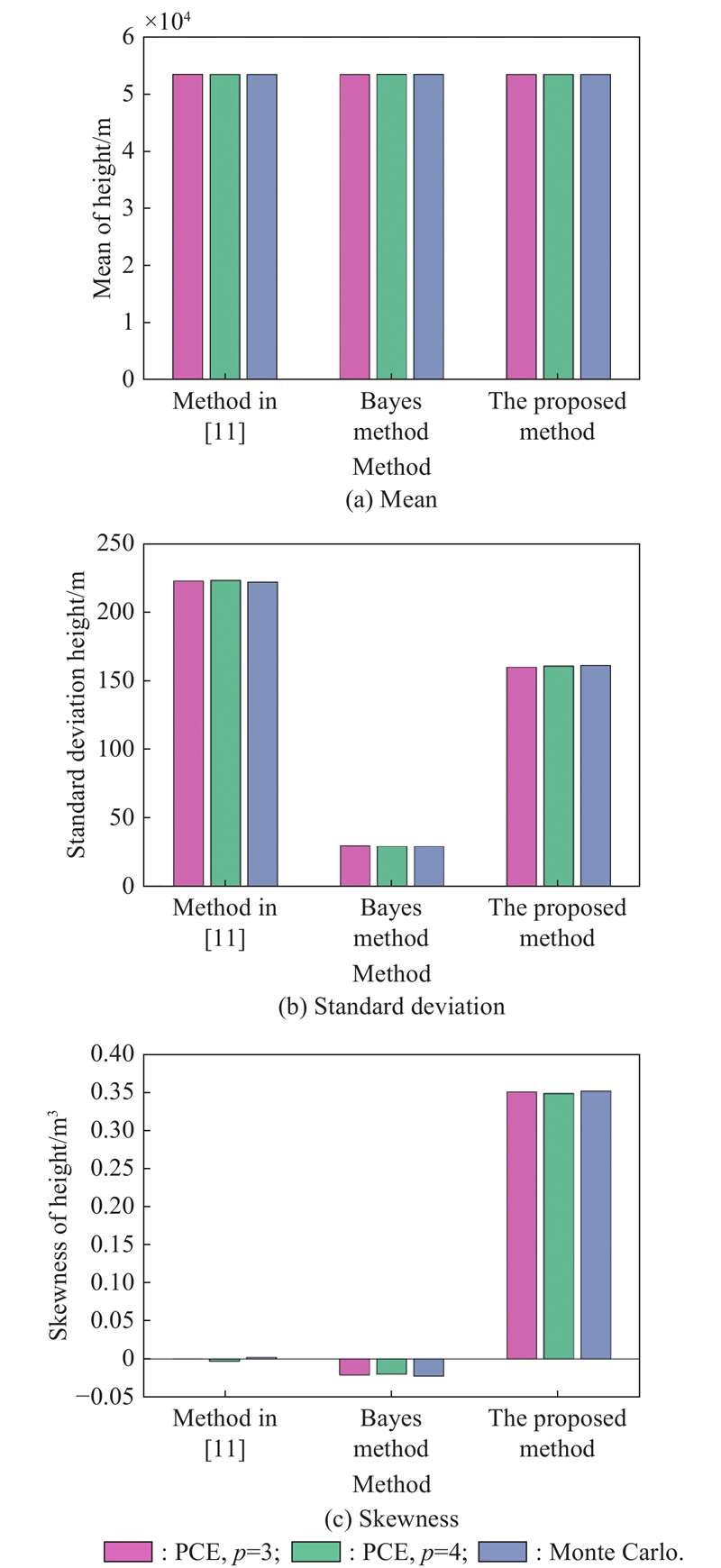
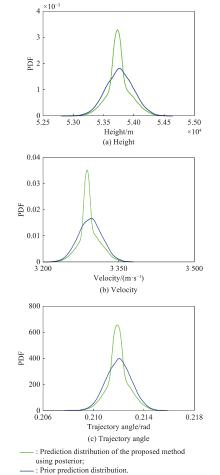
Fig 15
Comparision of the predictive distribution"
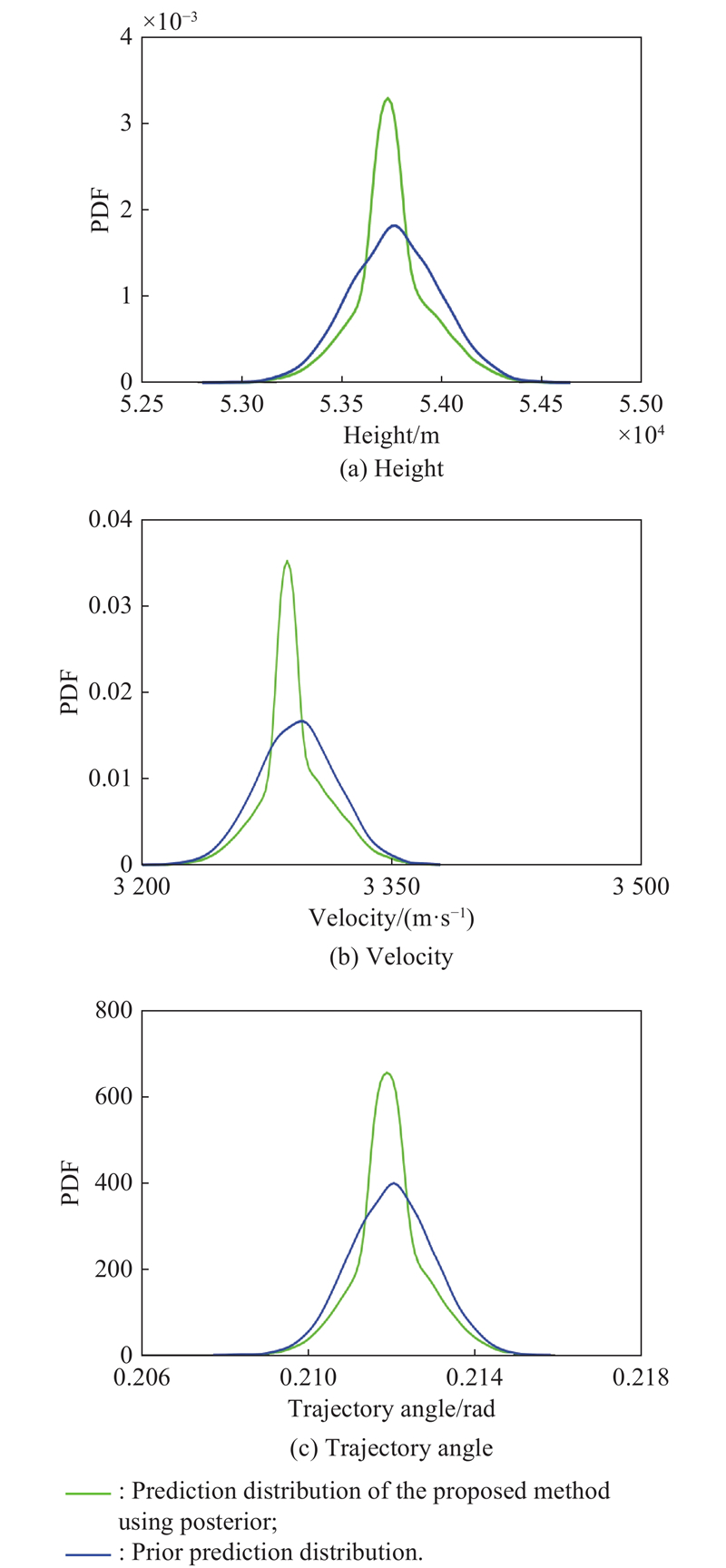
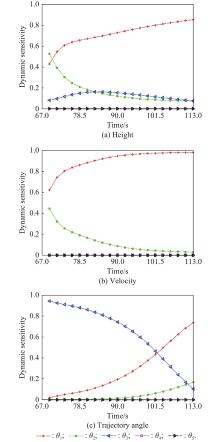
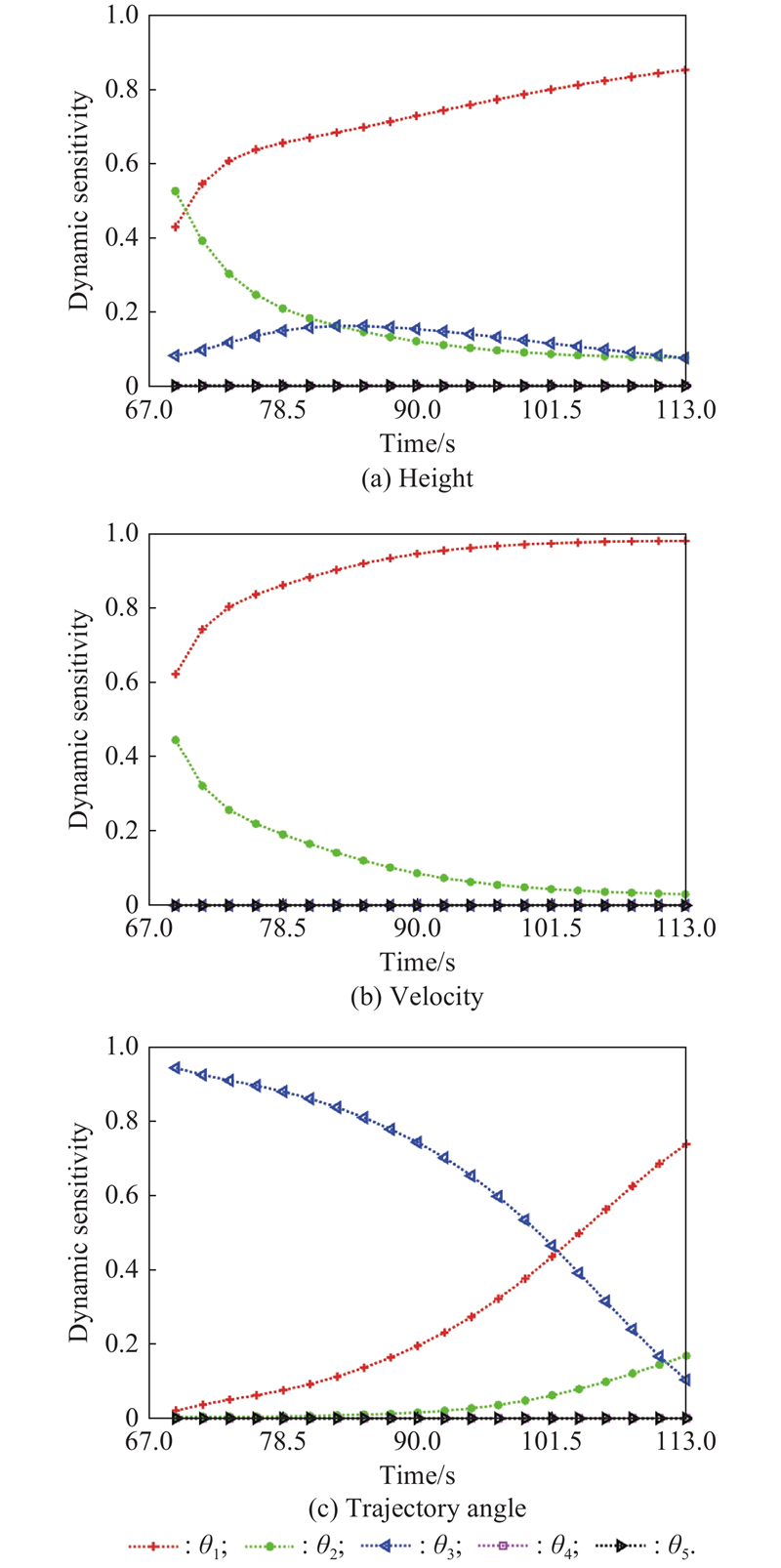
Fig 16
Total sensitivity of the different outputs"
| 1 |
MENG Y, ZHU Y K, CUI Y Y, et al Predefined-time enhanced antidisturbance attitude control for rigid-liquid coupled launch vehicles. Journal of Guidance, Control and Dynamics, 2025, 48 (4): 870- 884.
doi: 10.2514/1.G008397 |
| 2 |
XING X J, WANG R, GONG Q C, et al Terminal trajectory planning for the first-stage booster of rocket recovery by parafoil system in complex obstacle environments. IEEE Trans. on Aerospace and Electronic Systems, 2024, 60 (4): 4979- 4993.
doi: 10.1109/TAES.2024.3383815 |
| 3 | FU W Z, WANG B, SU J Y, et. al. Three-dimensional ascent guidance method for two-stage solid rocket launch vehicles under multiple constraints and uncertainties. Journal of Aerospace Engineering, 2024, 37(1): 04023088. |
| 4 |
ZHANG M M, JIANG Y, DENG Y G Research on convective cooling and thermal protection characteristics of integrated dual-sided deflector system. Aerospace, 2024, 11 (7): 501.
doi: 10.20944/preprints202404.1760.v1 |
| 5 |
SU Y, LIU Y Reentry trajectory optimization for reusable launch vehicle using marine predator whale optimizer and smoothing technique. Aerospace Science and Technology, 2025, 158, 109839.
doi: 10.1016/j.ast.2024.109839 |
| 6 |
XUE S, WANG Z L, BAI H Y, et al Research on self-learning control method of reusable launch vehicle based on neural network architecture search. Aerospace, 2024, 11 (9): 774.
doi: 10.3390/aerospace11090774 |
| 7 |
SUN Z X, CHAO T, WANG S Y, et al PCE-based robust trajectory optimization of launch vehicles via adaptive sample and truncation. Journal of Aerospace Engineering, 2022, 35 (5): 04022069.
doi: 10.1061/(asce)as.1943-5525.0001459 |
| 8 | ZHAO J, LI H Y, HE X Y, et al. Uncertainty analysis for return trajectory of vertical takeoff and vertical landing reusable launch vehicle. Mathematical Problems in Engineering, 2020, 2020: 4313758. |
| 9 |
SHANG X B, CHAO T, MA P, et al Simulation and robust optimization design for electromagnetic railgun performance. IEEE Trans. on Plasma Science, 2019, 47 (6): 2964- 2970.
doi: 10.1109/TPS.2019.2915803 |
| 10 |
MA P, SHANG X B, CHAO T, et al Simulation-based firing accuracy analysis for electromagnetic railgun with uncertainty. IEEE Trans. on Plasma Science, 2019, 47 (7): 3358- 3365.
doi: 10.1109/TPS.2019.2919193 |
| 11 |
BREVAULT L, BALESDENT M Uncertainty quantification for multidisciplinary launch vehicle design using model order reduction and spectral methods. Acta Astronautica, 2021, 187, 295- 314.
doi: 10.1016/j.actaastro.2021.06.040 |
| 12 |
BALESDENT M, BREVAULT L, VALDERRAMA-ZAPATA J L All-at-once formulation integrating pseudo-spectral optimal control for launch vehicle design and uncertainty quantification. Acta Astronautica, 2022, 200, 462- 477.
doi: 10.1016/j.actaastro.2022.08.032 |
| 13 | BRIESE L E, KIER T M, PETKOV I, et al. Advanced modeling and dynamic stability analysis of the aerodynamic control surfaces of callisto. Proc. of the AIAA Scitech Forum, 2022: 2023−2405. |
| 14 | KRUMMEN S, TUMMALA P, WILKEN J, et al. Applying Bayesian inference to estimate uncertainties in the aerodynamic database of CALLISTO. Proc. of the IEEE Aerospace Conference, 2023. DOI: 10.1109/AERO55745.2023.10115932. |
| 15 | DANG K D, MAESTRINI L Fitting structural equation models via variational approximations. Structural Equation Modeling-A Multidisciplinary Journal, 2023, 29 (6): 839- 853. |
| 16 |
YAMAGUCHI K, MARTINEZ A J Variational Bayes inference for hidden Markov diagnostic classification models. British Journal of Mathematical & Statistical Psychology, 2023, 29 (6): 839- 853.
doi: 10.1080/10705511.2022.2053857 |
| 17 |
LI R L, WANG X, ZHA H Y, et al Improving sampling accuracy of stochastic gradient MCMC methods via non-uniform subsampling of gradients. Discrete and Continuous Dynamical Systems-Series S, 2023, 16 (2): 329- 360.
doi: 10.3934/dcdss.2021157 |
| 18 |
CARPIO A, CEBRIAN E, GUTIERREZ A Object based Bayesian full-waveform inversion for shear elastography. Inverse Problems, 2023, 39 (7): 075007.
doi: 10.1088/1361-6420/acd5f8 |
| 19 | VONO M, PAULIN D, DOUCET A Efficient MCMC sampling with dimension-free convergence rate using ADMM-type splitting. Journal of Machine Learning Research, 2022, 23 (25): 1- 69. |
| 20 | SILVERMAN J D, ROCHE K, HOLMES Z C, et al Bayesian multinomial logistic normal models through marginally latent matrix-T processes. Journal of Machine Learning Research, 2022, 23 (1): 255- 296. |
| 21 | HALDEMANN J, KSOLL V, WALTER D, et al Exoplanet characterization using conditional invertible neural networks. Astronomy & Astrophysics, 2023, 672, A1- 80. |
| 22 |
WANG J X, ZHOU Z J, LIN K L, et al Facilitating Bayesian analysis of combustion kinetic models with artificial neural network. Combustion and Flame, 2020, 213, 87- 97.
doi: 10.1016/j.combustflame.2019.11.035 |
| 23 |
ZHANG W, LIU J, CHO C, et al A fast Bayesian approach using adaptive densifying approximation technique accelerated MCMC. Inverse Problems in Science and Engineering, 2016, 24 (2): 247- 264.
doi: 10.1080/17415977.2015.1017488 |
| 24 |
WANG H Q, LI J L Adaptive Gaussian process approximation for Bayesian inference with expensive likelihood functions. Neural Computation, 2018, 30 (11): 3072- 3094.
doi: 10.1162/neco_a_01127 |
| 25 |
ZHANG Y C, LU Z Z, CHENG K A Bayesian Monte-Carlo-based method for efficient computation of global sensitivity indices. Mechanical Systems and Signal Processing, 2019, 117, 498- 516.
doi: 10.1016/j.ymssp.2018.08.015 |
| 26 |
SUDRET B Global sensitivity analysis using polynomial chaos expansions. Reliability Engineering & System Safety, 2008, 93 (7): 964- 979.
doi: 10.1016/j.ress.2007.04.002 |
| 27 |
JIANG X Q, LI S, FURFARO R, et al High-dimensional uncertainty quantification for Mars atmospheric entry using adaptive generalized polynomial chaos. Aerospace Science and Technology, 2020, 107, 106240.
doi: 10.1016/j.ast.2020.106240 |
| 28 |
ZHAO J, LI H Y, LIU J H Uncertainty analysis for return trajectory of vertical takeoff and vertical landing reusable launch vehicle. Mathematical Problems in Engineering, 2020, 2020, 4313758.
doi: 10.1155/2020/4313758 |
| 29 |
ZHU H, XIAO M Y, ZHANG J H, et al Uncertainty design and optimization of a hybrid rocket motor with mixed random-interval uncertainties. Aerospace Science and Technology, 2022, 128, 107791.
doi: 10.1016/j.ast.2022.107791 |
| 30 |
HAARIO H, SAKSMAN E, TAMMINEN J An adaptive metropolis algorithm. Bernoulli, 2001, 7 (2): 223- 242.
doi: 10.32614/cran.package.metropolis |
| 31 |
WITTEVEEN J, LOEVEN A, BIJL H An adaptive stochastic finite elements approach based on newton-cotes quadrature in simplex elements. Computers & Fluids, 2009, 38 (6): 1270- 1288.
doi: 10.1016/j.compfluid.2008.12.002 |
| 32 |
XU Z X, XIA D Q, YONG N, et al Hybrid particle swarm optimization for high-dimensional Latin hypercube design problem. Applied Sciences, 2023, 13 (12): 7066.
doi: 10.3390/app13127066 |
| 33 |
WANG Y, WANG D P, YUE X W Sequential Latin hypercube design for two-layer computer simulators. Journal of Quality Technology, 2024, 56 (1): 71- 85.
doi: 10.1080/00224065.2023.2251178 |
| 34 |
YIN Y H, WANG L, XU H Q Construction of maximin L1-distance Latin hypercube designs. Electronic Journal of Statistics, 2023, 17 (2): 3942- 3968.
doi: 10.1214/23-ejs2194 |
| 35 |
WANG Q, LI H Y, LU L, et al Global sensitivity analysis of Earth-Moon transfer orbit parameters based on sOBOL Method. International Journal of Aerospace Engineering, 2022, 2022, 6587890.
doi: 10.1155/2022/6587890 |
| 36 |
KROEKER I, OLADYSHKIN S, RYBAK I Global sensitivity analysis using multi-resolution polynomial chaos expansion for coupled Stokes-Darcy flow problems. Computational Geosciences, 2023, 27 (5): 805- 827.
doi: 10.1007/s10596-023-10236-z |
| 37 |
ANDRIEU C, DOUCET A, HOLENSTEIN R Particle Markov chain Monte Carlo methods. Journal of the Royal Statistical Society: Series B (Statistical Methodology), 2010, 72 (3): 269- 342.
doi: 10.1111/j.1467-9868.2009.00736.x |
| [1] | Xu LYU, Baiqing HU, Yongbin DAI, Mingfang SUN, Yi LIU, Duanyang GAO. Gaussian process regression-based quaternion unscented Kalman robust filter for integrated SINS/GNSS [J]. Journal of Systems Engineering and Electronics, 2022, 33(5): 1079-1088. |
| [2] | Junming HU, Hongzhong HUANG, Yanfeng LI. Bayesian estimation of a power law process with incomplete data [J]. Journal of Systems Engineering and Electronics, 2021, 32(1): 243-251. |
| [3] | Rudong ZHAO, Xianming SHI, Qian WANG, Xiaobo SU, Xing SONG. Bayesian inference for ammunition demand based on Gompertz distribution [J]. Journal of Systems Engineering and Electronics, 2020, 31(3): 567-577. |
| [4] | Liang WANG, Huanyu LI, Jin'ge MA. Inference for dependence competing risks from bivariate exponential model under generalized progressive hybrid censoring with partially observed failure causes [J]. Journal of Systems Engineering and Electronics, 2019, 30(1): 201-208. |
| [5] | Changqiang HUANG, Kangsheng DONG, Hanqiao HUANG, Shangqin TANG, Zhuoran ZHANG. Autonomous air combat maneuver decision using Bayesian inference and moving horizon optimization [J]. Journal of Systems Engineering and Electronics, 2018, 29(1): 86-97. |
| [6] | Zhen Wang and Zhong Wu. Six-DOF trajectory optimization for reusable launch vehicles via Gauss pseudospectral method [J]. Journal of Systems Engineering and Electronics, 2016, 27(2): 434-441. |
| [7] | Guangxue Yu and Huifeng Li. Hierarchical structured robust adaptive attitude controller design for reusable launch vehicles [J]. Journal of Systems Engineering and Electronics, 2015, 26(4): 813-. |
| [8] | Bin Suo, Yongsheng Cheng, Chao Zeng, and Jun Li. Computational intelligence approach for uncertainty quantification using evidence theory [J]. Journal of Systems Engineering and Electronics, 2013, 24(2): 250-260. |
| Viewed | ||||||
|
Full text |
|
|||||
|
Abstract |
|
|||||
