
Journal of Systems Engineering and Electronics ›› 2025, Vol. 36 ›› Issue (6): 1453-1464.doi: 10.23919/JSEE.2025.000114
• ELECTRONICS TECHNOLOGY • Previous Articles
Jianmin JI( ), Wei WANG(), Kai YIN(), Kaibin WANG(), Bo CHEN(), Huilong YU()
Received:2024-10-30
Accepted:2025-06-25
Online:2025-12-18
Published:2026-01-07
Contact:
Huilong YU
E-mail:huaian.jijianmin@163.com;wang1961@vip.sina.com;yinkai1972@163.com;18510118516@wo.cn;cb199021@126.com;YHL23@sina.com
About author:JI Jianmin was born in 1987. He received his M.E. degree from Tianjin University in 2013 and he is a senior engineer in Beijing Institute of Remote Sensing Equipment. From 2019 until now, he has been studying control science and engineering for his Ph.D. degree. His current research area is radome technology. E-mail: huaian.jijianmin@163.comJianmin JI, Wei WANG, Kai YIN, Kaibin WANG, Bo CHEN, Huilong YU. Electromagnetic equivalent physical model for high-speed aircraft radomes considering high-temperature effects[J]. Journal of Systems Engineering and Electronics, 2025, 36(6): 1453-1464.
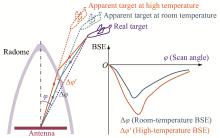
Fig 1
Schematic description of the impact of dielectric temperature drift on the BSEs of a radome"
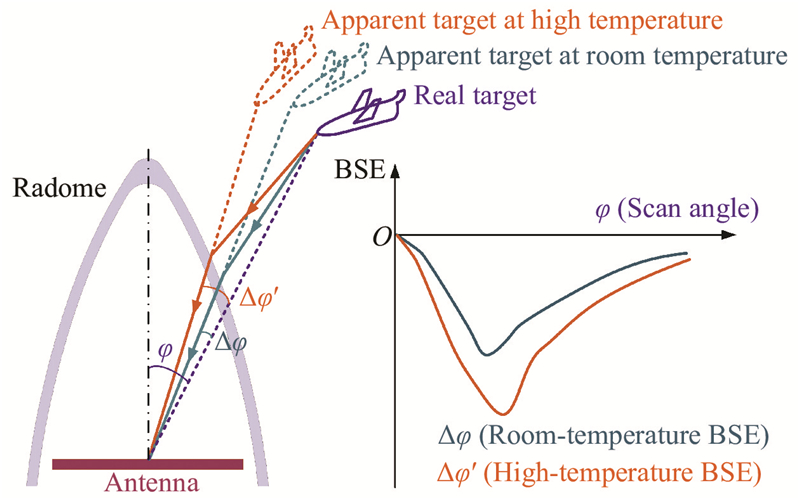
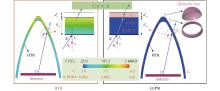
Fig 2
Schematic description of the construction of the EEPM of an HTR"
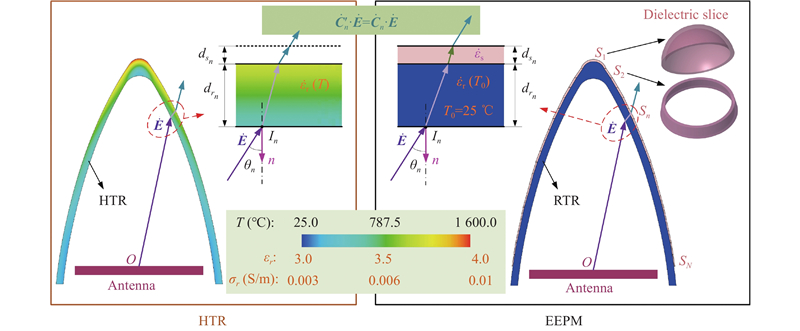
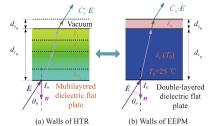
Fig 3
Schematic description of the localized flat plate equivalents of the HTR and its EEPM in subzone Sn"
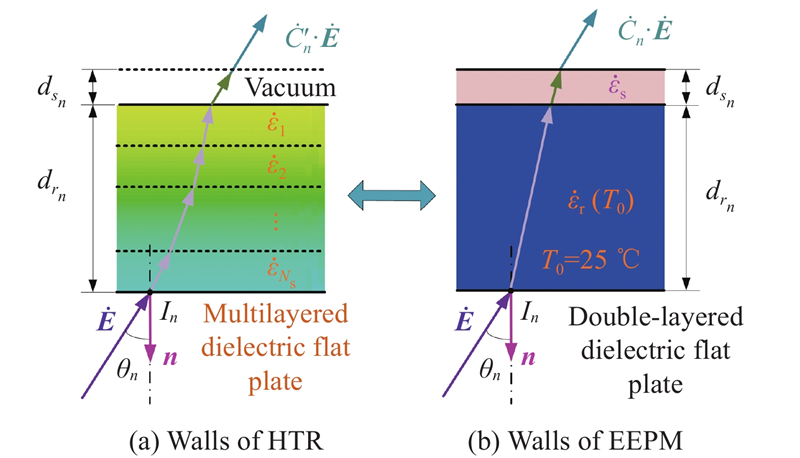
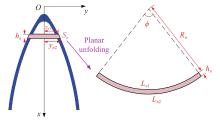
Fig 4
Planar unfolding of the ring-shaped dielectric slice"
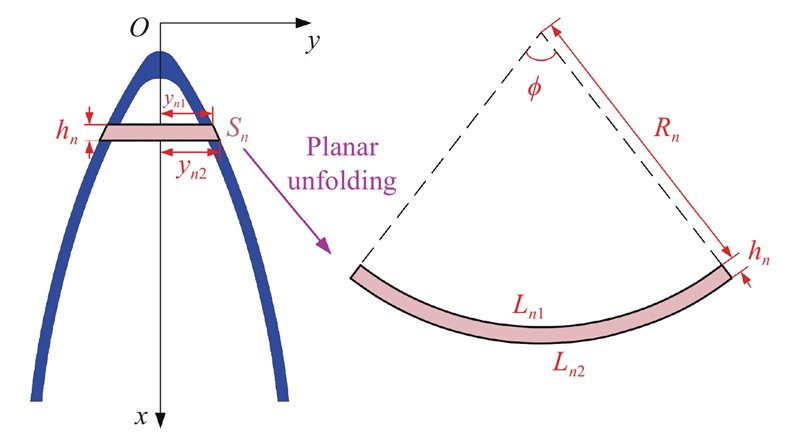
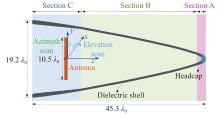
Fig 5
High-speed aircraft antenna-radome system"

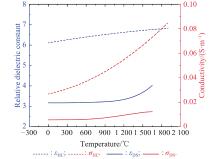
Fig 6
Dielectric temperature drift curves of the radome materials"
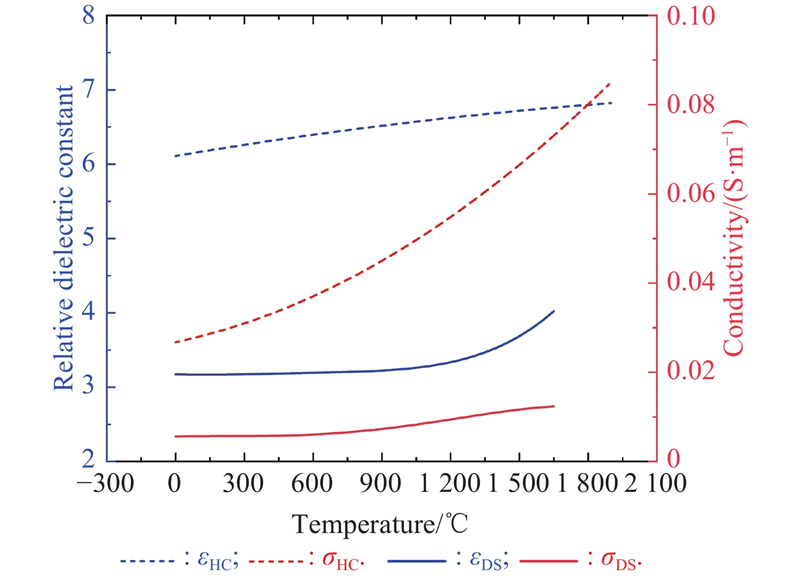
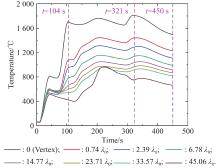
Fig 7
Temperature response curves at points along outer surface of the radome positioned at varying axial distances from the vertex"
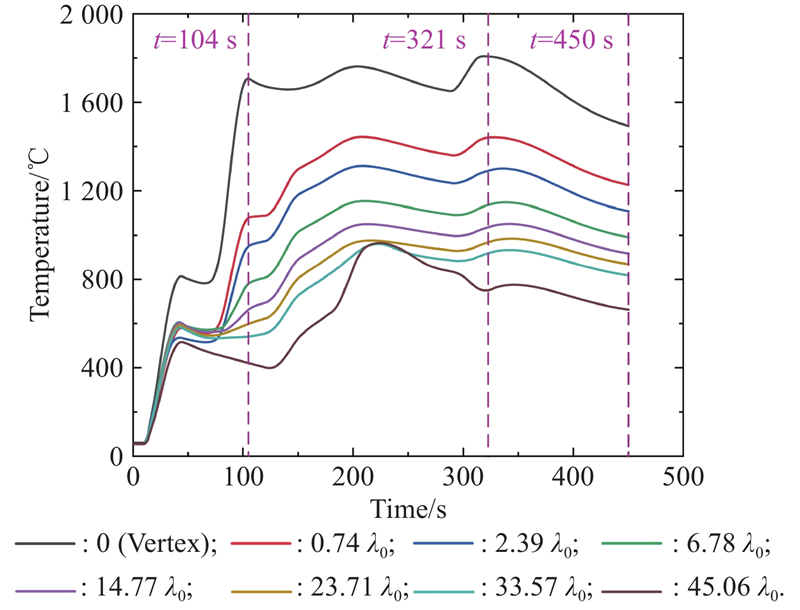
Fig 8
Temperature fields of the radome at typical time points"
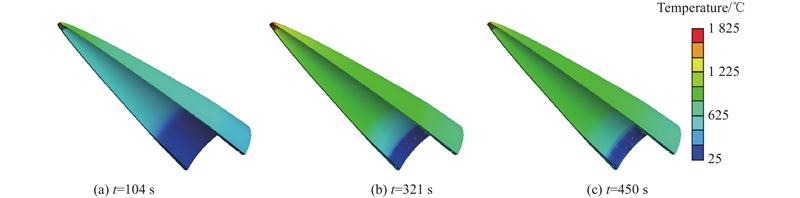
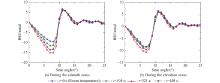
Fig 9
Radome’s BSEs at typical time points"
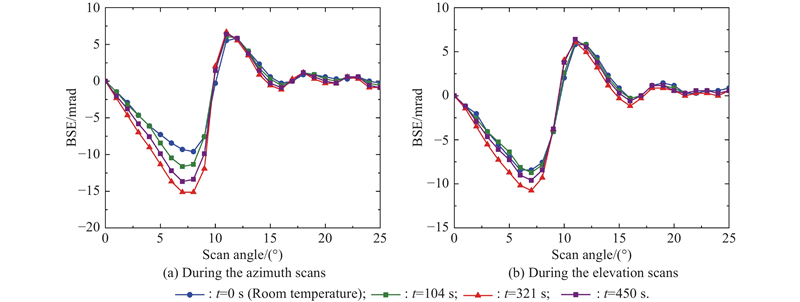
Fig 10
Influence of the dielectric temperature drift in different sections on the radome of BSEs at t = 321 s"
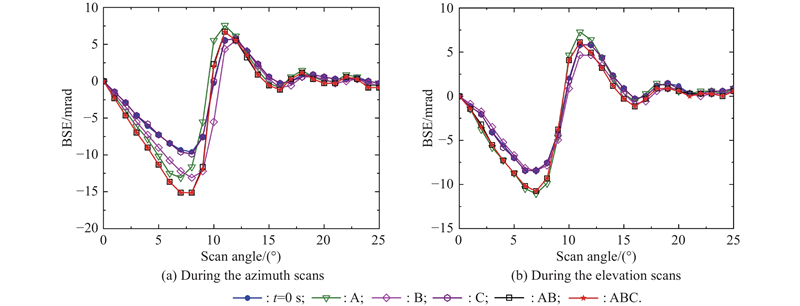
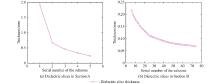
Fig 11
Dielectric slice thicknesses for the EEPM of the HTR (t = 321 s)"
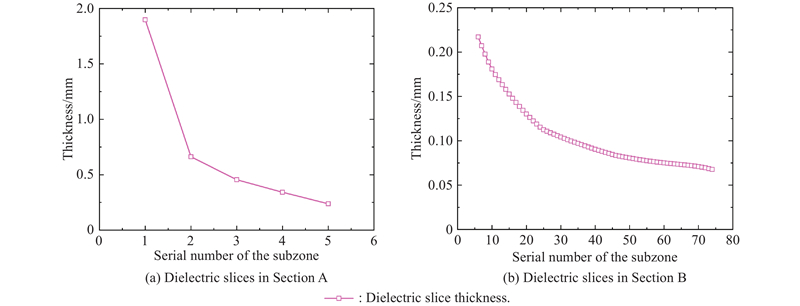
Fig 12
PTCs and IPDs in the subzones of Section A"
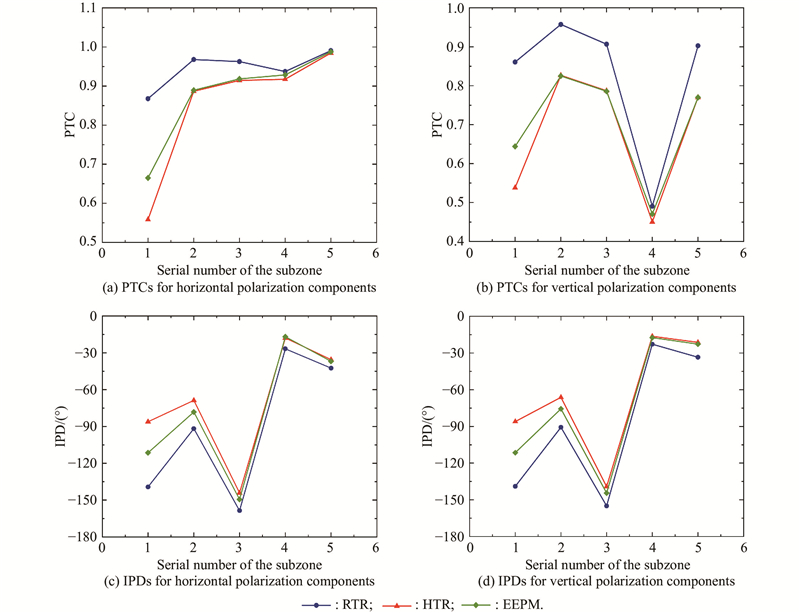
Fig 13
PTCs and IPDs in the subzones of Section B"
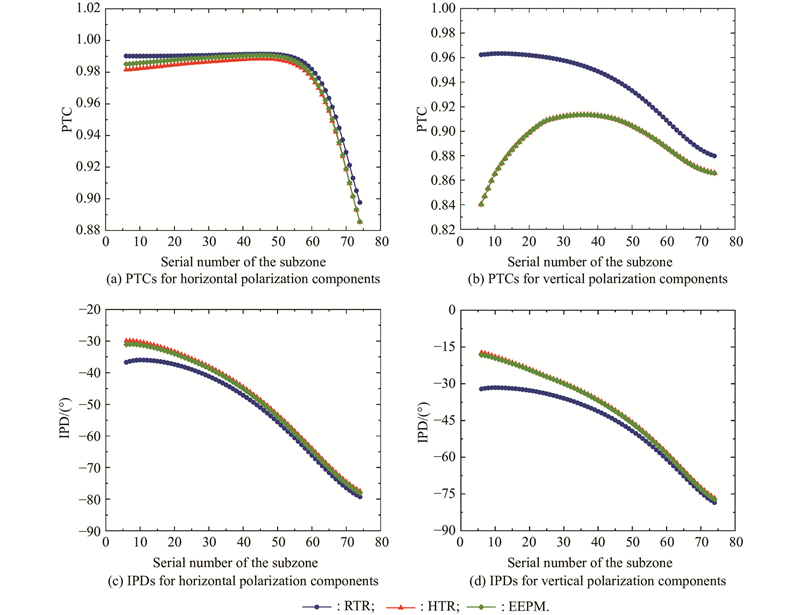
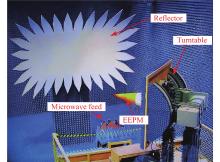
Fig 14
Electrical performance test scene"
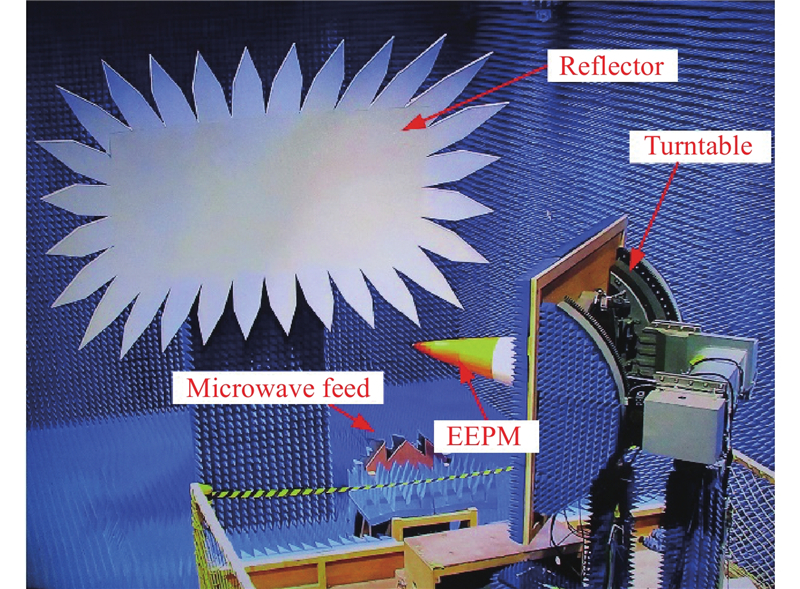
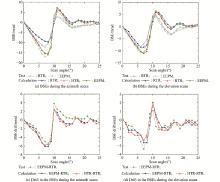
Fig 15
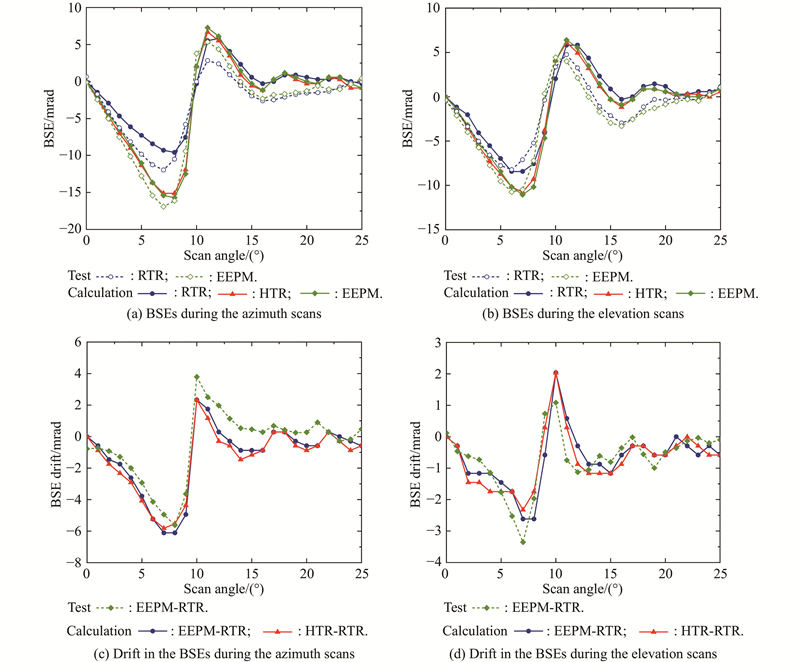
Comparison between the calculated and tested BSEs of the RTR, HTR, and EEPM"
| 1 | PALUMBO N F, BLAUWKAMP R A, LLOYD J M. Basic principles of homing guidance. Johns Hopkins APL Technical Digest, 2010, 29(1): 25−41. |
| 2 | CRONE G A E, RUDGE A W, TAYLOR G N. Design and performance of airborne radomes: a review. IEE Proceedings F (Communications, Radar and Signal Processing), 1981, 128(7): 451−464. |
| 3 | KOZAKOFF D J. Analysis of radome-enclosed antennas. London: Artech House, 2010. |
| 4 | SHAVIT R. Radome electromagnetic theory and design. Hoboken: John Wiley & Sons, 2018. |
| 5 | HONG N M. Improvement of quality of missile guidance through compensation for errors of nose cone. Journal of Physics: Conference Series, 2019, 1172: 012049. |
| 6 | XIAO Y, CHEN X, YANG L Y, et al. Analysis of radome error on guidance loop stability. Journal of Beijing University of Aeronautics and Astronautics, 2022, 49(11): 3066−3074. (in Chinese) |
| 7 | GUO J G, HU G J, GUO Z Y, et al. ADP based guidance strategy for maneuvering target interception under radome errors. Journal of Astronautics, 2022, 43(7): 911−920. (in Chinese) |
| 8 | SEO M G, TAHK M J. Observability analysis and enhancement of radome aberration estimation with line-of-sight angle-only measurement. IEEE Trans. on Aerospace and Electronic Systems, 2015, 51(4): 3321−3331. |
| 9 |
KLEIN I, RUSNAK I Loop-shaping approach to mitigate radome effects in homing missiles. Journal of Guidance, Control, and Dynamics, 2017, 40 (7): 1789- 1795.
doi: 10.2514/1.G000850 |
| 10 |
LIN S Y, WANG W, LIN W, et al The research of loop-shaping method to mitigate the total error effect in air-to-air missiles. Optik, 2019, 181, 923- 932.
doi: 10.1016/j.ijleo.2018.12.162 |
| 11 | GUO J G, ZHOU Y H, ZHOU M. Adaptive control law based integrated guidance and control design for missile with the radome error compensation. Proceedings of the Institution of Mechanical Engineers, Part G: Journal of Aerospace Engineering, 2024, 238(4): 361−371. |
| 12 | AN F Z, WU Z X, WANG H F, et al. Radar type air-to-air missile semi-physical simulation system scheme. Aero Weaponry, 2004, 3: 38−40. (in Chinese) |
| 13 | TANG H N, TANG Z G, GUO J F, et al. A distributed cooperative interception and guidance method and hardware-in-the-loop simulation verification. Journal of Astronautics, 2024, 45(4): 580−589. (in Chinese) |
| 14 | WANG Y X, CHAO T, WANG C L, et al. Research on credibility evaluation for radio frequency guided hardware-in-the-loop simulation system. Proc. of the 36th Chinese Control Conference , 2017: 10435−10439. |
| 15 | BUFORD JR J A, JOLLY A C, MOBLEY S B. Advancements in HWIL simulation at the US army aviation and missile command. Technologies for Synthetic Environments: Hardware-in-the-Loop Testing IV, 1999, 3697: 23−30. |
| 16 | BUFORD J J A, JOLLY A C, LETSON K R, et al HWIL weapon system simulations in the US army aviation and missile command (USAAMCOM). Technologies for Synthetic Environments: Hardware-in-the-Loop Testing VI, 2001, 4366, 82- 89. |
| 17 | REN S H, WU X Y, ZHANG Q B. A distributed cooperative interception and guidance method and hardware-in-the-loop simulation verification. Aerodynamic Missile Journal, 2006, 5: 3. (in Chinese) |
| 18 | WANG C S, WANG Y, CHEN Y K, et al. Coupling model and electronic compensation of antenna-radome system for hypersonic vehicle with effect of high-temperature ablation. IEEE Trans. on Antennas and Propagation, 2019, 68(3): 2340−2355. |
| 19 |
NAIR R, VANDANA S, SANDHYA S, et al Temperature-dependent electromagnetic performance predictions of a hypersonic streamlined radome. Progress in Electromagnetics Research, 2015, 154, 65- 78.
doi: 10.2528/PIER15052602 |
| 20 |
PARAMESWARAN A, SONALIKAR H Design of airborne radome using novel temperature dependent electromagnetic modeling. Progress in Electromagnetics Research C, 2020, 104, 37- 52.
doi: 10.2528/PIERC20041704 |
| 21 |
PARAMESWARAN A, SONALIKAR H S, KUNDU D Temperature-dependent electromagnetic design of inhomogeneous planar layer variable thickness radome for power transmission enhancement. IEEE Antennas and Wireless Propagation Letters, 2021, 20 (8): 1572- 1576.
doi: 10.1109/LAWP.2021.3091516 |
| 22 |
JI J M, REN J H, JIANG X Y, et al A novel method for calculating broadband electrical performance of high-speed aircraft radome under thermo-mechanical-electrical coupling. Chinese Journal of Aeronautics, 2024, 37 (9): 463- 474.
doi: 10.1016/j.cja.2024.06.008 |
| 23 | LI Y B, CHEN Q, LIU J Force thermal electricity integration analysis of large scared thin walled structures. Journal of Astronautics, 2021, 42 (1): 74- 82. |
| 24 | ZOHURI B, MCDANIEL P, LEE J, et al New weapon of tomorrow’s battlefield driven by hypersonic velocity. Journal of Energy and Power Engineering, 2019, 13 (5): 177- 196. |
| 25 | JI J M, WANG W, YU H L, et al Investigation of the electrical performance of high-speed aircraft radomes using a thermo-mechanical-electrical coupling model. Journal of Systems Engineering and Electronics, 2024, 35 (6): 1397- 1410. |
| 26 | LI Z, WANG Y D, ZHENG W, et al Accurately tracking hypersonic gliding vehicles via an LEO mega-constellation in relay tracking mode. Journal of Systems Engineering and Electronics, 2024, 35 (1): 211- 221. |
| 27 |
NAN Y, YI G X, HU L, et al Influencing factor analysis of interception probability and classification-regression neural network based estimation. Journal of Systems Engineering and Electronics, 2023, 34 (4): 992- 1006.
doi: 10.23919/JSEE.2023.000092 |
| 28 |
SAEEDI H M, GHEZAVATI J, ABBASGHOLIPOUR M, et al Various types of ceramics used in radome: a review. Scientia Iranica, 2017, 24 (3): 1136- 1147.
doi: 10.24200/sci.2017.4095 |
| 29 | ZHANG Y. Matlab optimization algorithms. Beijing: Tsinghua University Press, 2023. (in Chinese) |
| 30 | WANG Z H, JIANG C, NI B Y, et al. An interval finite element method for electromagnetic problems with spatially uncertain parameters. Science China Technological Sciences, 2020, 63(1): 25−43. |
| [1] | Jianmin JI, Wei WANG, Huilong YU, Juan LIU, Bo CHEN. Investigation of the electrical performance of high-speed aircraft radomes using a thermo-mechanical-electrical coupling model [J]. Journal of Systems Engineering and Electronics, 2024, 35(6): 1397-1410. |
| [2] | Zong Xianzheng, Nie Zaiping & Wang Jun. Co-aperture arrangement of dual antennas for orientation and telemetry in a conformal cavity [J]. Journal of Systems Engineering and Electronics, 2008, 19(6): 1133-1138. |
| [3] | Que Xiaofeng, Nie Zaiping & Hu Jun. Efficient analysis of dielectric radomes using multilevel fast multipole algorithm with CRWG basis [J]. Journal of Systems Engineering and Electronics, 2008, 19(1): 81-87. |
| Viewed | ||||||
|
Full text |
|
|||||
|
Abstract |
|
|||||
