
Journal of Systems Engineering and Electronics ›› 2025, Vol. 36 ›› Issue (6): 1428-1442.doi: 10.23919/JSEE.2025.000055
• ELECTRONICS TECHNOLOGY • Previous Articles
Wangjie CHEN1,2( ), Weiqiang ZHU2,*(), Zhenhong FAN1(), Qin MA2(), Jian YANG2(), Li WU1()
Received:2024-11-11
Online:2025-12-18
Published:2026-01-07
Contact:
Weiqiang ZHU
E-mail:tiandizhongzi@126.com;zhuweq8511@sina.com;zhfan@mail.njust.edu.cn;maqin8511@sina.com;james200586@163.com;li_wu@njust.edu.cn
About author:Wangjie CHEN, Weiqiang ZHU, Zhenhong FAN, Qin MA, Jian YANG, Li WU. Realization of 3D coordinate estimation for spaceborne interferometric antenna[J]. Journal of Systems Engineering and Electronics, 2025, 36(6): 1428-1442.
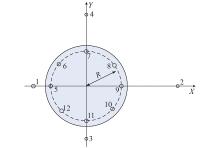
Fig 1
Hybrid interferometer configuration"
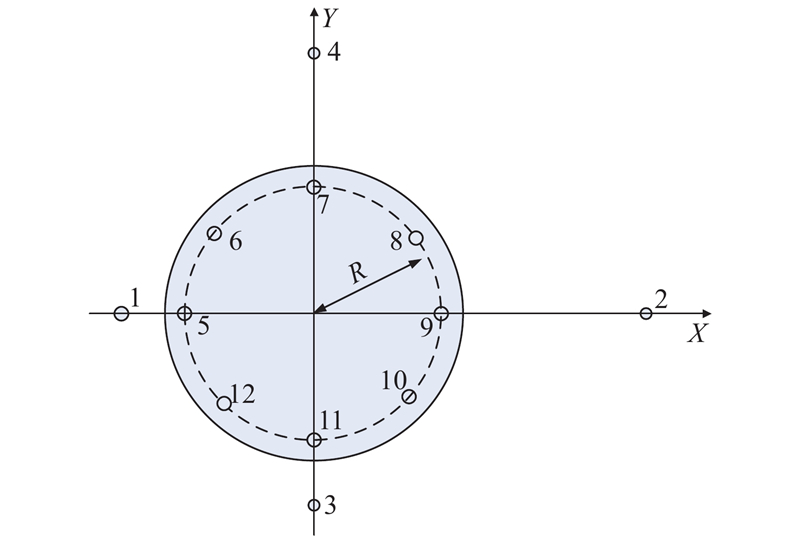
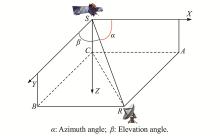
Fig 2
Principle diagram of DF and positioning"
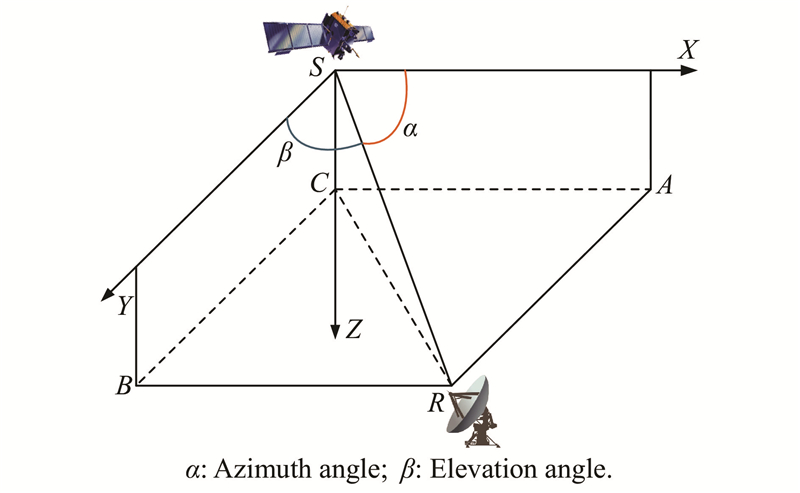
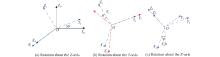
Fig 3
Schematic diagram of systematic errors in the rotation matrix from antenna mounting coordinate system to observation platform coordinate system"
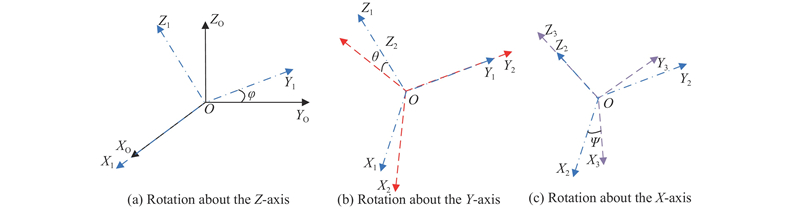
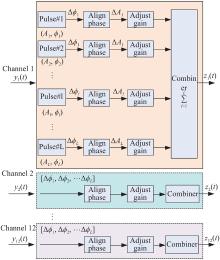
Fig 4
MRC scheme block diagram"
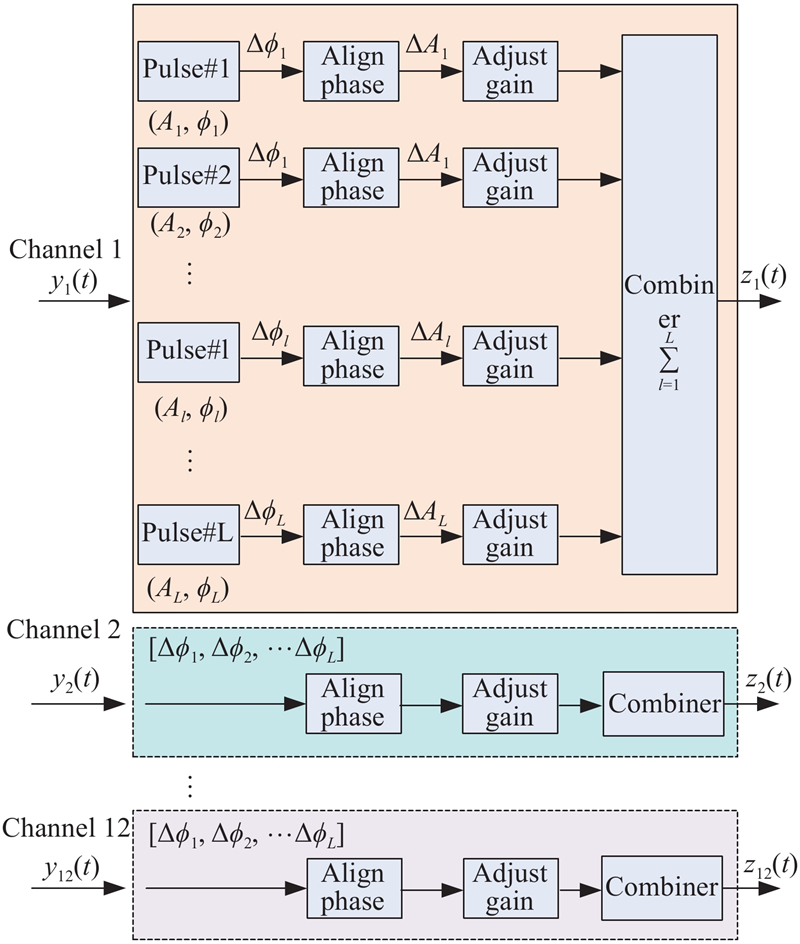
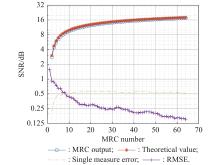
Fig 5
Relationship between MRC accumulated points and SNR"
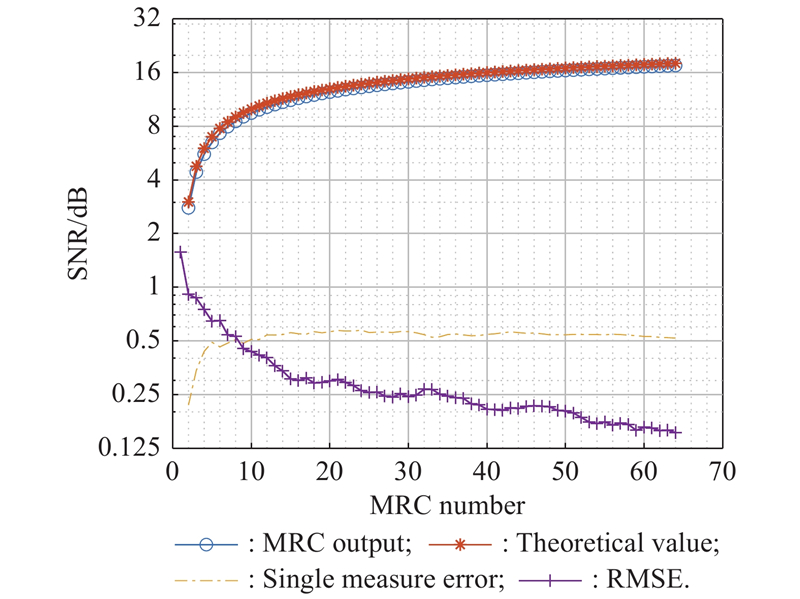

Table 1
Standard deviation of phase difference estimated in different SNRs"
| SNR/dB | ||
| Single pulse | MRC pulse | |
| −10 | 110.392 | 32.654 |
| 0 | 35.263 | 9.822 |
| 10 | 11.52 | 3.408 |
| 20 | 3.745 | 0.982 |
| 30 | 1.148 | 0.278 |
| 40 | 0.361 | 0.095 |
| 50 | 0.111 | 0.029 |
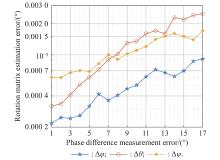
Fig 6
Rotation matrix estimation error"
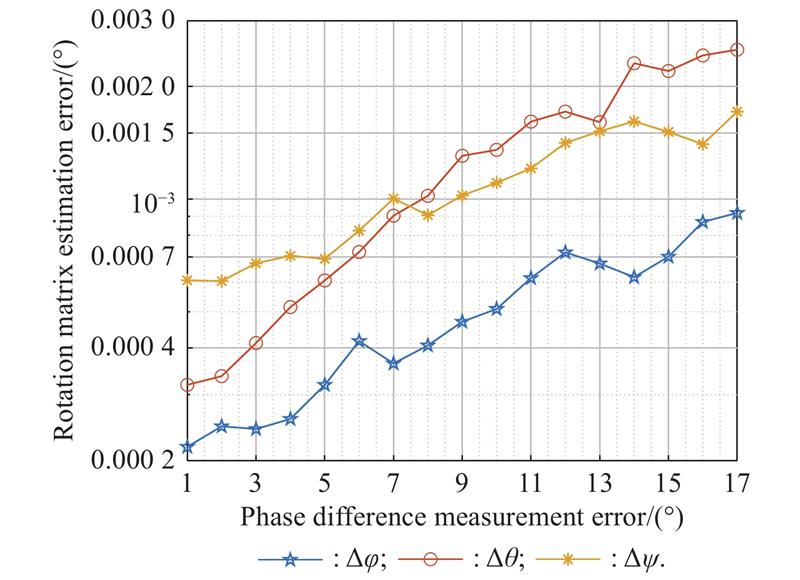
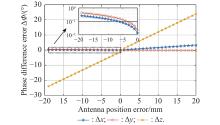
Fig 7
Relation diagram of 3D position error and phase difference"
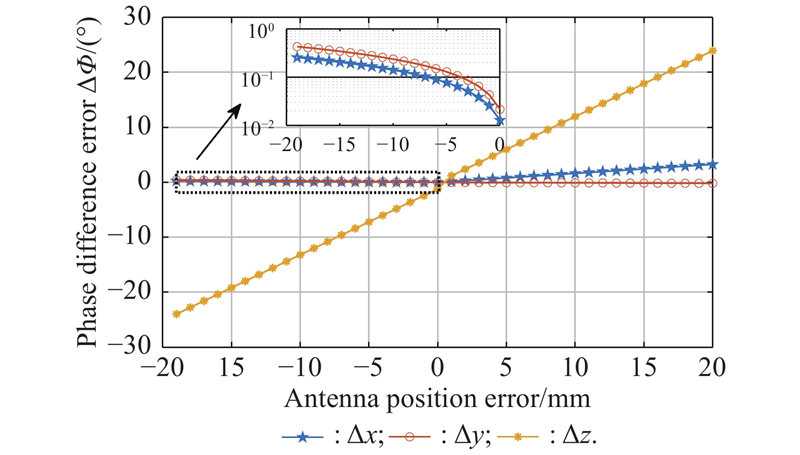
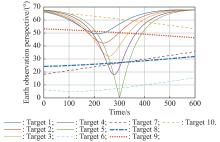
Fig 8
Schematic diagram of earth observation perspective"
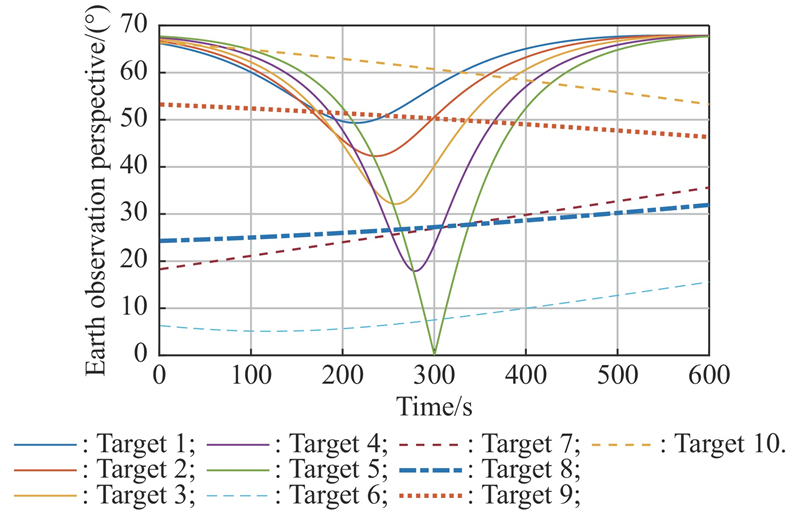
Fig 9
3D position estimation diagram"
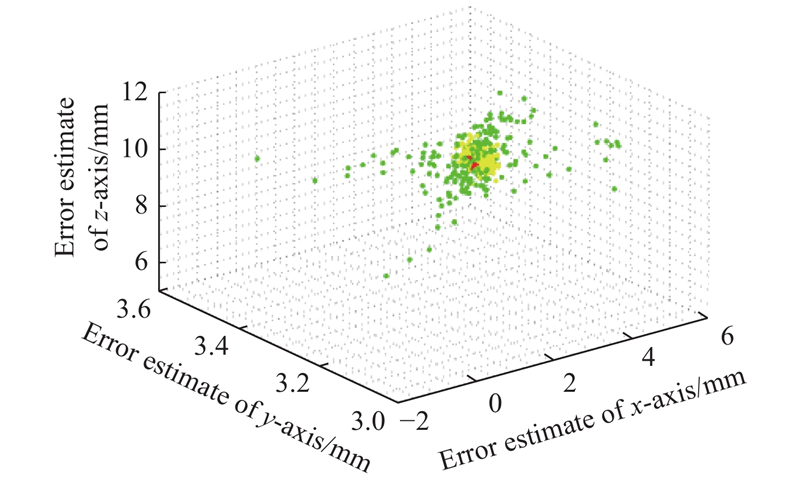
Table 2
Estimation error of 3D position using LS μm"
| Number | RMSE | |||
| X | Y | Z | Position | |
| 1 | 139 675 | 199 923 | 88 142 | 259 321 |
| 2 | 3 974.21 | 10 785.90 | 7 419.95 | 13 681.60 |
| 3 | 312.21 | 1,517.17 | 2 995.07 | 3 372.88 |
| 4 | 379.02 | 181.14 | 5 614.98 | 5 630.67 |
| 5 | 125.72 | 60.95 | 972.52 | 982.50 |
| 6 | 81.97 | 47.80 | 704.82 | 711.18 |
| 7 | 77.48 | 47.38 | 537.33 | 544.95 |
| 8 | 76.11 | 39.61 | 534.24 | 541.09 |
| 9 | 74.99 | 36.18 | 484.05 | 491.16 |
| 10 | 76.40 | 37.39 | 472.63 | 480.23 |
Table 3
Estimation error of 3D position using SIR-PF-KF μm"
| Iteration | RMSE | |||
| x | y | z | Position | |
| 1 | 11.93 | 6.74 | 86.08 | 87.16 |
| 2 | 7.68 | 4.35 | 52.46 | 53.20 |
| 3 | 9.03 | 2.58 | 65.54 | 66.21 |
| 4 | 6.71 | 2.88 | 47.65 | 48.20 |
| 5 | 5.33 | 3.10 | 49.87 | 50.25 |
| 6 | 4.07 | 2.10 | 46.50 | 46.72 |
| 7 | 3.12 | 1.80 | 34.31 | 34.50 |
| 8 | 3.80 | 1.64 | 20.88 | 21.29 |
| 9 | 6.01 | 2.38 | 27.07 | 27.83 |
| 10 | 3.68 | 1.63 | 30.63 | 30.89 |
Table 4
Estimation error of 3D position using MRC-SIR-PF-KF μm"
| Number | RMSE | |||
| X | Y | Z | Position | |
| 1 | 9.31 | 3.76 | 66.96 | 67.71 |
| 2 | 7.36 | 3.50 | 27.55 | 28.72 |
| 3 | 9.31 | 3.67 | 27.76 | 29.51 |
| 4 | 3.29 | 2.42 | 19.72 | 20.13 |
| 5 | 2.26 | 0.81 | 14.46 | 14.65 |
| 6 | 1.35 | 0.70 | 10.11 | 10.22 |
| 7 | 0.86 | 0.52 | 10.29 | 10.34 |
| 8 | 1.35 | 0.50 | 8.03 | 8.16 |
| 9 | 1.43 | 0.58 | 6.59 | 6.77 |
| 10 | 0.98 | 0.58 | 7.48 | 7.57 |
Fig 10
Estimation error of 3D position for different earth observation perspectives"
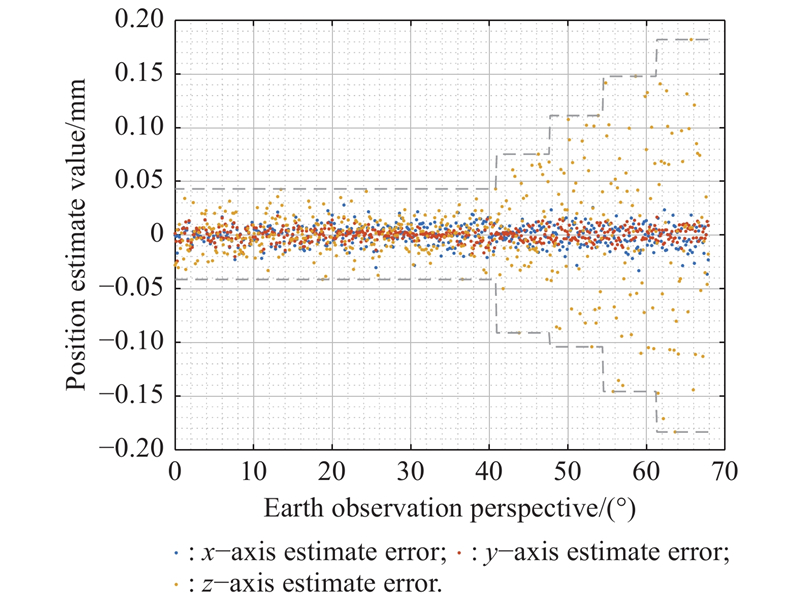
Table 5
Estimation error of 3D position at different frequencies μm"
| Frequency/GHz | RMSE | |||
| X | Y | Z | Position | |
| 1.5 | 5.29 | 3.85 | 22.39 | 23.32 |
| 2.5 | 4.43 | 2.51 | 10.23 | 11.43 |
| 3.5 | 3.62 | 1.53 | 7.24 | 8.24 |
| 4.5 | 2.75 | 1.41 | 4.08 | 5.12 |
| 5.5 | 2.08 | 1.08 | 5.66 | 6.13 |
| 6.5 | 1.59 | 1.02 | 4.43 | 4.82 |
| 7.5 | 1.28 | 0.73 | 4.70 | 4.92 |
| 8.5 | 1.13 | 0.71 | 3.97 | 4.19 |
| 9.5 | 0.88 | 0.67 | 2.90 | 3.10 |
| 10.5 | 0.81 | 0.54 | 2.94 | 3.09 |
Table 6
Measuring accuracy comparison μm"
| Method | Technology | RMSE |
| Method in [ | Levenberg marquardt method | 5.35 |
| Method in [ | Modular kinematic error model | 18.97 |
| Method in [ | Laser displacement sensors | 41.23 |
| Method in [ | Point cloud data based on airborne LiDAR scanner and terrestrial LiDAR scanner | |
| Method in [ | Digital image grating method | 3.10 |
| Proposed method | MRC-SIR-PF-KF method | 3.09 |
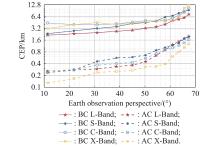
Fig 11
Positioning accuracy before and after correction"
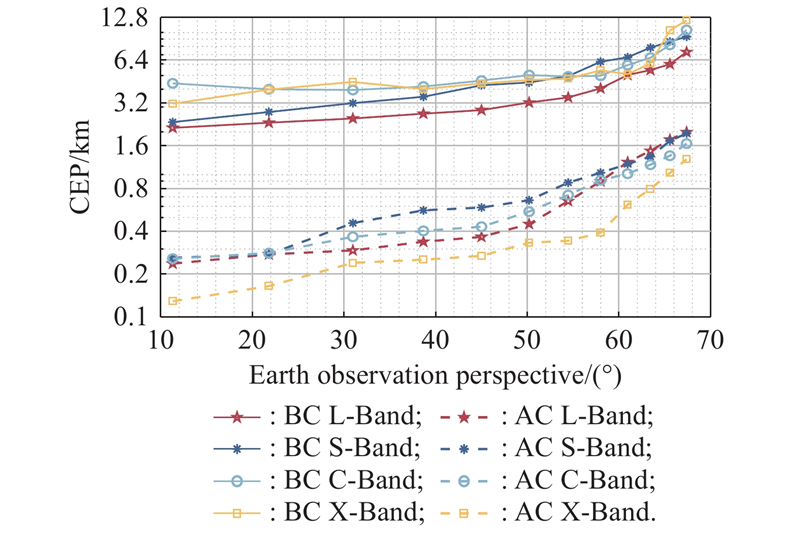
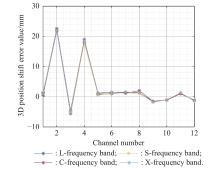
Fig 12
3D Position error of each frequency band"
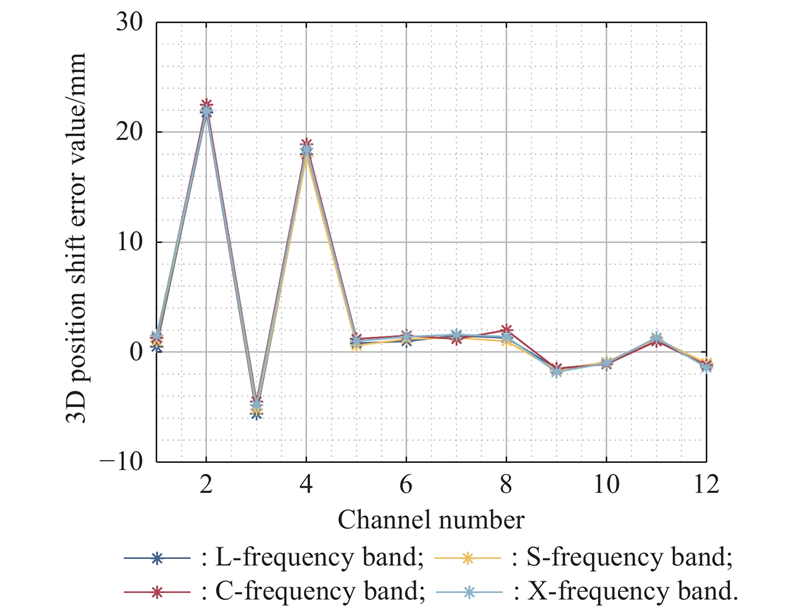
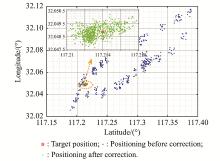
Fig 13
Positioning results before and after correction"
| 1 |
ZHANG L L, TANG C K, ZHANG Y, et al Inertial-navigation-aided single-satellite highly dynamic positioning algorithm. Sensors, 2019, 19 (19): 4196- 4196.
doi: 10.3390/s19194196 |
| 2 | WANG C N, WANG W H, CHEN W H. Single-satellite positioning algorithm based on direction-finding. Proc. of the in Electromagnetics Research Symposium-Spring, 2017: 2533−2538. |
| 3 |
MUHAMMAD F I, ZUBAIR K, MUHAMMAD Z, et al Accuracy improvement in amplitude comparison-based passive direction finding systems by adaptive squint selection. IET Radar, Sonar and Navigation, 2020, 14 (5): 662- 668.
doi: 10.1049/iet-rsn.2019.0465 |
| 4 |
CHEN J F, LIANG X L, HE C, et al Direction finding of linear frequency modulation signal with time-modulated array. IEEE Trans. on Antennas and Propagation, 2019, 67 (4): 2841- 2846.
doi: 10.1109/TAP.2018.2863252 |
| 5 |
YAN E Q, GUO X Y, YANG J, et al Improving accuracy of an amplitude comparison-based direction-finding system by neural network optimization. IEEE Access, 2020, 8, 169688- 169700.
doi: 10.1109/ACCESS.2020.3024031 |
| 6 |
LI X, MA X C Direction-of-arrival estimation by asymmetric amplitude interpolation. Applied Acoustics, 2022, 195, 108821.
doi: 10.1016/j.apacoust.2022.108821 |
| 7 |
HANNA B, PASCAL C D, MARTIN H Higher order direction finding from rectangular cumulant matrices: the rectangular 2q-MUSIC algorithms. Signal Processing, 2017, 133, 240- 249.
doi: 10.1016/j.sigpro.2016.10.020 |
| 8 | MENG F X, LI Z T, YU X T, et al Quantum algorithm for MUSIC-based DOA estimation in hybrid MIMO systems. Quantum Science & Technology, 2022, 7 (2): 025002. |
| 9 |
HU Y G, ABHAYAPALA T D, SAMARASINGHE P N Multiple source direction of arrival estimations using relative sound pressure based MUSIC. IEEE/ACM Trans. on Audio Speech and Language Processing, 2021, 29, 253- 264.
doi: 10.1109/TASLP.2020.3039569 |
| 10 | KUNDU D. Modified MUSIC algorithm for estimating DOA of signals. Signal Processing. 1996, 48(1): 85−90. |
| 11 | LEE J H, WOO J M Interferometer direction-finding system with improved DF accuracy using two different array configurations. IEEE Trans. on Antennas and Propagation, 2015, 14, 719- 722. |
| 12 |
BAI J, GE Z Q, LU M Phase center calibration for UWB phase interferometer direction finding by virtual baseline. IEICE Trans. on Fundamentals of Electronics, Communications and Computer Sciences, 2019, E102.A (10): 1383- 1386.
doi: 10.1587/transfun.E102.A.1383 |
| 13 | ZHOU W H, ZHOU YX, DAO Q H et al. Research on interferometer direction finding technology based on digital beam forming. Proc. of the 7th International Conference on Signal and Image Processing, 2022: 54−58. |
| 14 |
ZHANG J B, FENG W Q, XU Y Interferometer direction-finding system with time‐division multiplexing of spread spectrum signals. Microwave and Optical Technology Letters, 2022, 64 (6): 983- 991.
doi: 10.1002/mop.33217 |
| 15 |
SHEININ G M, BOBKOV M N, BOCHKOVA D E Basing errors in machining and monitoring. Russian Engineering Research, 2019, 39 (6): 523- 529.
doi: 10.3103/S1068798X19060169 |
| 16 | ZHANG F J, SONG A L, HE K D Study on vibration characteristics of robot-arm joint with clearance coupling effect. Machinery Design & Manufacture, 2023, 1 (1): 287- 294. |
| 17 |
BAO B, LALLART M, WANG Q Bandgap coupling effects between hybrid nonlinear synchronized switch damping and linear two-order resonant bandgaps in piezoelectric meta-structure. Proceedings of the Institution of Mechanical Engineers, Part L: Journal of Materials: Design and Applications, 2022, 236 (11): 2211- 2220.
doi: 10.1177/14644207211001891 |
| 18 |
LI Y T, XU Z C, YANG X H, et al Identification and high-precision trajectory tracking control for space robotic manipulator. Acta Astronautica, 2024, 214, 484- 495.
doi: 10.1016/j.actaastro.2023.11.001 |
| 19 |
LAI Y P, ZHOU H, ZENG Y M, et al Relationship between DOA estimation error and antenna pattern distortion in direction-finding high-frequency radar. IEEE Geoscience and Remote Sensing letters, 2019, 16 (8): 1235- 1239.
doi: 10.1109/LGRS.2019.2895922 |
| 20 | GAO L, SUN H W, QI J F, et al Effect of random phase error and baseline roll angle error on eddy identification by interferometric imaging altimeter. Journal of Oceanology and Limnology, 2021, 40, 1881- 1888. |
| 21 |
MA Y T, WANG B B, GAO X, et al The gray analysis and machine learning for device-free multi-target localization in passive UHF RFID environments. IEEE Trans. on Industrial Informatics, 2020, 16 (2): 802- 813.
doi: 10.1109/TII.2019.2921529 |
| 22 |
XIE Y Q, GU T Y, ZHENG D, et al A high-precision 3D target perception algorithm based on a mobile RFID reader and double tags. Remote Sensing, 2023, 15 (15): 3914.
doi: 10.3390/rs15153914 |
| 23 |
MOELLER C, SCHMIDT H, KOCH P, et al Real time pose control of an industrial robotic system for machining of large scale components in aerospace industry using laser tracker system. SAE International Journal of Aerospace, 2017, 10 (2): 100- 108.
doi: 10.4271/2017-01-2165 |
| 24 |
HU C A, LV F, XUE L, et al Full-range static method of calibration for laser tracker. Electronics, 2023, 12 (22): 4709.
doi: 10.3390/electronics12224709 |
| 25 |
JEONG S, KO M, KIM J LiDAR localization by removing moveable objects. Electronics, 2023, 12 (22): 4659.
doi: 10.3390/electronics12224659 |
| 26 |
ZHANG Y, HAN Y, YU R N, et al Pose measurement and motion estimation of space on-orbit cube-sats based on micro-doppler effect using laser coherent radar. Applied Sciences, 2022, 12 (8): 4021- 4021.
doi: 10.3390/app12084021 |
| 27 |
FU Q, ZHAO F, ZHU R, et al Research on the intersection angle measurement and positioning accuracy of a photoelectric theodolite. Frontiers in Physics, 2023, 10, 1121050.
doi: 10.3389/fphy.2022.1121050 |
| 28 |
XING Y B, DONG L, WANG T, et al High-precision and high-efficiency measurement method of accelerator tunnel control network based on total station angle observation. Measurement Science and Technology, 2024, 35 (2): 025902.
doi: 10.1088/1361-6501/ad080d |
| 29 | WANG J S, TAO B, GONG Z Y, et al A mobile robotic 3D measurement method based on point clouds alignment for large-scale complex surfaces. IEEE Trans. on Instrumentation and Measurement, 2021, 70, 7503011. |
| 30 | WANG Z X, LI S J, ZHAO L S, et al. Datum detection of mobile robot milling and drilling system. Journal of Nanjing University of Aeronautics & Astronautics, 2019, 51(3): 281−287. |
| 31 |
LIU H Q, ZHAO L M, LI Y, et al A sparse-based approach for DOA estimation and array calibration in uniform linear array. IEEE Sensors Journal, 2016, 16 (15): 6018- 6027.
doi: 10.1109/JSEN.2016.2577712 |
| 32 | AHMET M E. L-shaped coprime array structures for DOA estimation, Multidimensional Systems and Signal Processing, 2020, 31(1): 205−219. |
| 33 | LIU S Y, ZHANG Z, GUO Y. 2-D DOA Estimation with imperfect L-shaped array using active calibration. IEEE Communications Letters, 2021, 2(4): 1178−1182. |
| 34 | CHEN L P, MOU W H, LV Z C, et al. Performance analysis of two-dimensional DOA estimation for uniform circular array. Information Communications Technology Express, 2023, 9(5): 854−859. |
| 35 | CLAUDIO E, PARISI R Waves: weighted average of signal subspaces for robust wideband direction finding. IEEE Trans. on Signal Processing, 2001, 49 (10): 2179- 2191. |
| 36 |
LIU S, GUO H R, QIAN Z W, et al A study on a novel inverted ultra-short baseline positioning system and phase difference estimation. Journal of Marine Science and Engineering, 2023, 11 (5): 952.
doi: 10.3390/jmse11050952 |
| 37 | TAIMOOR Z, TARIQ M, ANZAR A, et al. Hybrid resampling scheme for particle filter-based inversion. IET Science, Measurement & Technology, 2020, 14(4): 396−406. |
| 38 | CHEN W J, ZHU W Q, FAN Z H, et al. A combined antenna array deployment with high positioning accuracy and low angular measurement error. Journal of Beijing Institute of Technology, 2024, 2: 141−154. (in Chinese) |
| 39 |
ZHANG J H, WANG T N, CHEN S M, et al 3D reconstruction method of carbon fiber reinforced plastics components based on pre-calibration measurement pose. Journal of Physics: Conference Series, 2023, 2493, 012018.
doi: 10.1088/1742-6596/2493/1/012018 |
| 40 |
DU H Q, WAND G L, WANG L N, et al A closed-loop calibration method for serial robots based on position constraints and local area measurement. Precision Engineering, 2024, 89, 121- 134.
doi: 10.1016/j.precisioneng.2024.06.006 |
| 41 |
HE J H, GU L F, YANG G L, et al A local POE-based self-calibration method using position and distance constraints for collaborative robots. Robotics and Computer-Integrated Manufacturing, 2024, 86, 102685.
doi: 10.1016/j.rcim.2023.102685 |
| 42 |
HAN L Y, YU L, ZHU X S A novel method for pose and position calibration of laser displacement sensors. Sensors, 2023, 23 (4): 1762- 1762.
doi: 10.3390/s23041762 |
| 43 |
FAN S Y, JING S S, XU W B, et al Extraction of moso bamboo parameters based on the combination of ALS and TLS point cloud data. Sensors, 2024, 24 (13): 4036.
doi: 10.3390/s24134036 |
| 44 | YANG X, MAI J T, WANG W Wide-range vision-based position measurement for linear servo-motor mover. Optics and Laser Technology, 2024, 180, 111541. |
| [1] | Weiming TIAN, Lin DU, Yunkai DENG, Xichao DONG. Partition of GB-InSAR deformation map based on dynamic time warping and k-means [J]. Journal of Systems Engineering and Electronics, 2022, 33(4): 907-915. |
| [2] | Bingren JI, Yong WANG, Bin ZHAO, Rongqing XU. Multi-static InISAR imaging for ships under sparse aperture [J]. Journal of Systems Engineering and Electronics, 2022, 33(3): 575-584. |
| [3] | Fengming HU, Jicang WU. Detecting spatio-temporal urban surface changes using identified temporary coherent scatterers [J]. Journal of Systems Engineering and Electronics, 2021, 32(6): 1304-1317. |
| [4] | Rui ZHANG, Wei XIANG, Guoxiang LIU, Xiaowen WANG, Wenfei MAO, Yin FU, Jialun CAI, Bo ZHANG. Interferometric coherence and seasonal deformation characteristics analysis of saline soil based on Sentinel-1A time series imagery [J]. Journal of Systems Engineering and Electronics, 2021, 32(6): 1270-1283. |
| [5] | Xianming XIE, Qingning ZENG. Multi-baseline extended particle filtering phase unwrapping algorithm based on amended matrix pencil model and quantized path-following strategy [J]. Journal of Systems Engineering and Electronics, 2019, 30(1): 78-84. |
| [6] | Xianming Xie. Multi-baseline phase unwrapping algorithm for INSAR [J]. Journal of Systems Engineering and Electronics, 2013, 24(3): 417-. |
| [7] | Leilei Kou, Xiaoqing Wang, Maosheng Xiang, and Minhui Zhu. High sidelobe effects on interferometric coherence for circular SAR imaging geometry [J]. Journal of Systems Engineering and Electronics, 2013, 24(1): 76-83. |
| [8] | Chenglan Liu, Feng He, Xunzhang Gao, Xiang Li, and Rongjun Shen. Novel reference range selection method in InISAR imaging [J]. Journal of Systems Engineering and Electronics, 2012, 23(4): 512-521. |
| [9] | Liu Congfeng & Liao Guisheng. Canonical framework for multi-channel SAR-GMTI [J]. Journal of Systems Engineering and Electronics, 2008, 19(5): 923-928. |
| Viewed | ||||||
|
Full text |
|
|||||
|
Abstract |
|
|||||
