
Journal of Systems Engineering and Electronics ›› 2026, Vol. 37 ›› Issue (5): 1547-1562.doi: 10.23919/JSEE.2026.000107
• SYSTEMS ENGINEERING • Previous Articles
Kaiqiang Tang1, Huiqiao Fu2( ), Jiasheng Liu2(), Guizhou Deng2(), Yuanyang Lu2(), Yiming Qi2(), Chunlin Chen2,*()
Received:2025-01-22
Online:2026-10-18
Published:2026-11-09
Contact:
Chunlin Chen
E-mail:hqfu@smail.nju.edu.cn;jiasheng@mail.ustc.edu.cn;guizhoudeng@gmail.com;yylu@smail.nju.edu.cn;qiyiming@smail.nju.edu.cn;clchen@nju.edu.cn
Supported by:Kaiqiang Tang, Huiqiao Fu, Jiasheng Liu, Guizhou Deng, Yuanyang Lu, Yiming Qi, Chunlin Chen. Augmented benchmarks for deep reinforcement learning in solving vehicle routing problems[J]. Journal of Systems Engineering and Electronics, 2026, 37(5): 1547-1562.
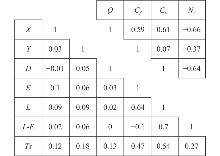
Fig 1
Correlation between variables"
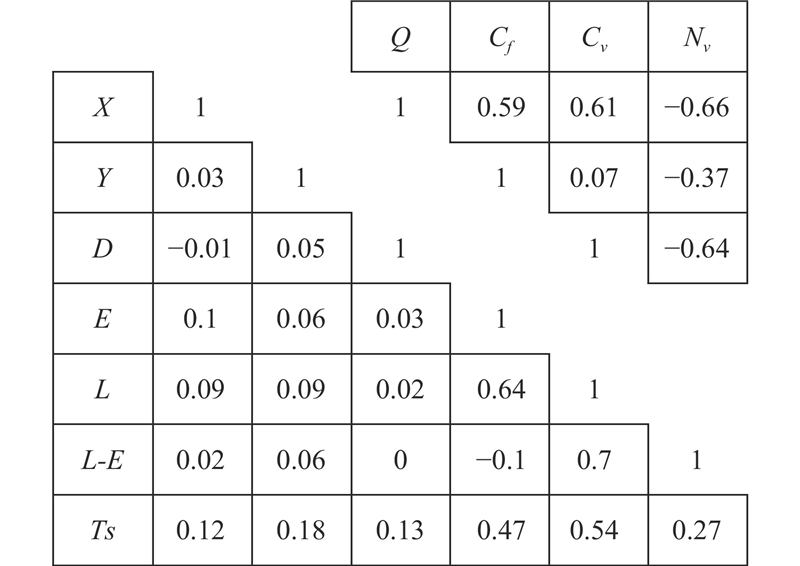

Table 1
Generation strategies of variables"
| Variable | Description | Strategy | |
| VRPTW | HFVRP | ||
| X0, Y0 | Depot | Fixed | Sample |
| X, Y | Coordinates | Fixed | Derivation |
| D | Demands | Fixed | Derivation |
| E, L | Time windows | Derivation | × |
| Ts | Service time | Fixed | × |
| Nv, Cf, Cv | Vehicle features | × | Sampled |
| Q | Capacity | Fixed | Sampled |
Fig 2
Comparison of original and augmented VRPTW distributions"
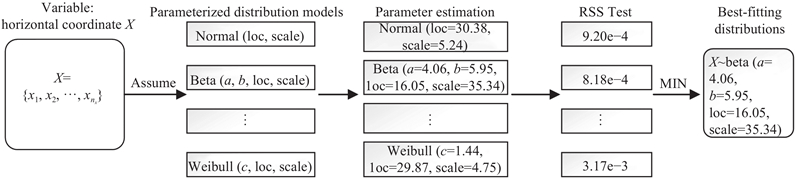
Fig 3
Convergence trajectories for distribution parameters (a, b, loc, scale) and RSS"
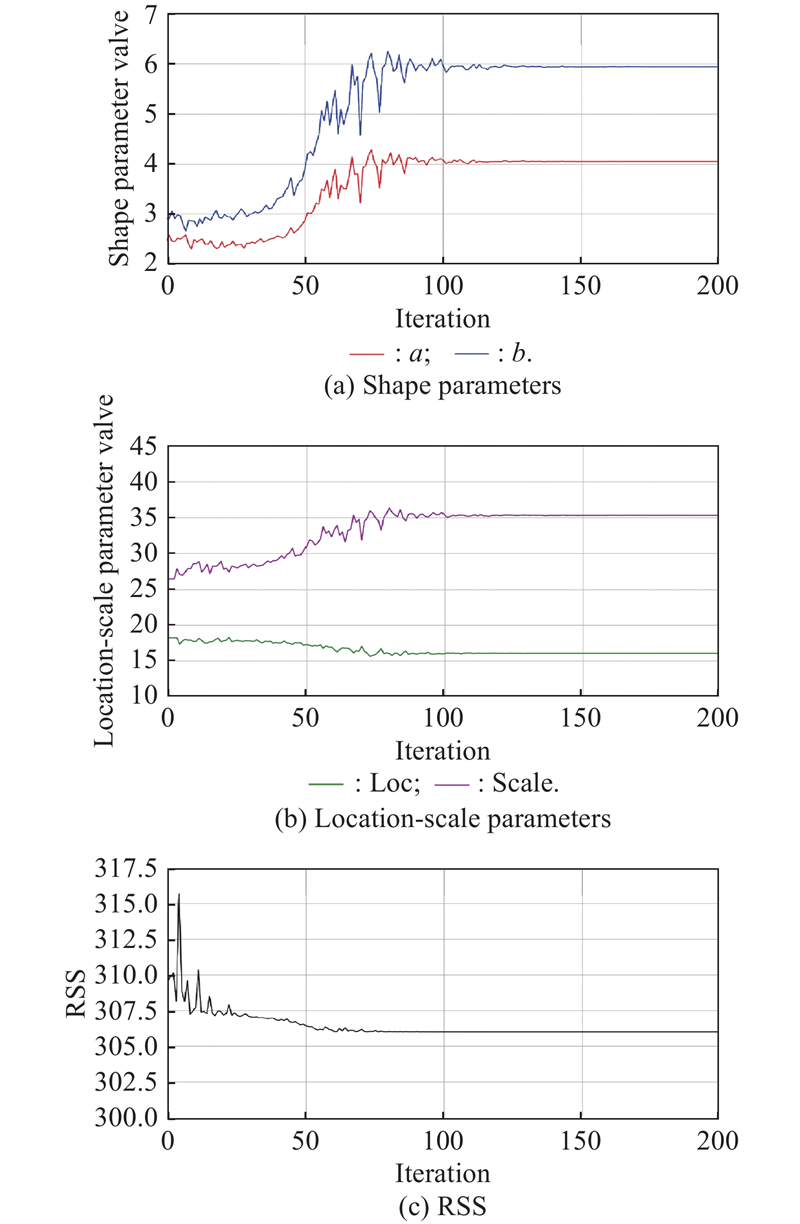
Table 2
Generation strategies of VRPTW benchmarks"
| Variable | Strategy |
| X0, Y0 | Fixed during instances |
| X, Y | Fixed during instances |
| D | Fixed during instances |
| Q | Fixed during instances |
| Tc | Fixed in series C but uniformly in R and RC |
| Tw | Distribution derivation (see |
| Ts | Fixed during instances |
Table 3
Distribution of half-widths for generation of augmented Solomon benchmark"
| Serie | Distribution function | Proportion |
| C 1 | B(4.059 4, 5.947, 16.05, 35.335) | 3/8* |
| B(3.663 4, 5.327 7, 33.509, 67.025) | 1/8 | |
| Gamma(1.524 2, 12.487, 43.031) | 1/8 | |
| B(3.725 7, 5.232 6, 66.196, 133.38) | 1/8 | |
| Constant 90 and 180 | 1/4 | |
| C 2 | Constant 80 | 1/2* |
| Constant 160 and 320 | 1/4 | |
| B(3.670 4, 5.2, 133.29, 266.05) | 1/8 | |
| B(0.855 84, 1.411 6, 88.5, 547.94) | 1/8 | |
| RC1 | Constant 15 | 1/2* |
| Generated proportionally: | ||
| 1/4constant 5, | ||
| 1/4constant 60, | 1/8 | |
| 1/2B(1.94, 87.21, 8.89, 663.77) | ||
| Constant 30 | 1/8 | |
| Generated proportionally: | ||
| 1/2B(2.88, 8.24, 19.28, 40.81), | 1/8 | |
| 1/2B(12.26, 10.26, 16.42, 78.39) | ||
| B(9.903, 5.492 5, −27.183, 29.574) | 1/8 | |
| RC2 | Constant 60 | 1/2* |
| Generated proportionally: | 1/8 | |
| 1/4constant 30, | ||
| 1/4constant 240, | ||
| Weibull(2.05, 92.65, 31.63) | ||
| Constant 120 | 1/8 | |
| B(1.296 2, 2.265 2, 44.515, 359.15) | 1/8 | |
| GE(0.224 91, 222.48, 34.735) | 1/8 | |
| R1 | Constant 5 | 1/4* |
| Constant 15 | 1/4* | |
| GE(0.230 95, 27.774, 4.345 4) | 1/8 | |
| B(1.232 5, 1.82, 11.318, 79.54) | 1/8 | |
| B(0.768 64, 1.248 5, 9.5, 88.049) | 1/8 | |
| GE(0.244 72, 55.605, 8.569 1) | 1/8 | |
| R2 | GE(0.224 02, 51.24, 17.331) | 3/8* |
| Constant 120 | 1/4* | |
| B(1.296 2, 2.265 2, 44.515, 359.15) | 1/8 | |
| B(0.895 57, 1.762 9, 36.5, 457.83) | 1/8 | |
| GE(0.225, 222.49, 34.737) | 1/8 |
Table 4
Distribution of half-widths for generation of augmented Gehring & Homberger benchmark"
| Serie | Distribution function | Proportion |
| C1 | Weibull( | 2/5* |
| Logn( | 1/10 | |
| B(2.698, | 1/10 | |
| Constant 90 | 1/10 | |
| Loggamma(823.03, −3 770.5, 579.59) | 1/10 | |
| Constant 180 | 1/10 | |
| Logn( | 1/10 | |
| C2 | Constant 80 | 2/5* |
| Constant 160 | 1/10 | |
| t(80.569, 248.69, 44.064) | 1/10 | |
| Loggamma(1 500.3, −39 813, 5 486.5) | 1/10 | |
| Constant 320 | 1/10 | |
| B( | 1/10 | |
| Constant 440 | 1/10 | |
| R1 | Constant 5 | 2/5* |
| Constant 15 | 2/5* | |
| B(19.967, 21.871, −31.535, 129.45) | 1/10 | |
| B(43.76, 63.152, −68.136, 314.14) | 1/10 | |
| R2 | B(17.91, 23.268, −50.954, 255.94) | 2/5* |
| Constant 120 | 2/5* | |
| B( | 1/10 | |
| Gamma(7 620.6, −2 395.3, | 1/10 | |
| RC1 | Constant 15 | 2/5* |
| B( | 1/10 | |
| Constant 30 | 1/10 | |
| GE( | 1/10 | |
| t(8 580.8, 59.812, 14.947) | 1/10 | |
| Constant 60 | 1/10 | |
| Constant 75 | 1/10 | |
| RC2 | Constant 60 | 2/5* |
| B( | 1/10 | |
| Constant 120 | 1/10 | |
| t(21377, 184.78, 85.286) | 1/10 | |
| N(238.07, 88.745) | 1/10 | |
| Constant 240 | 1/10 | |
| Constant 300 | 1/10 |
Fig 4
Comparison of original and augmented VRPTW distributions"
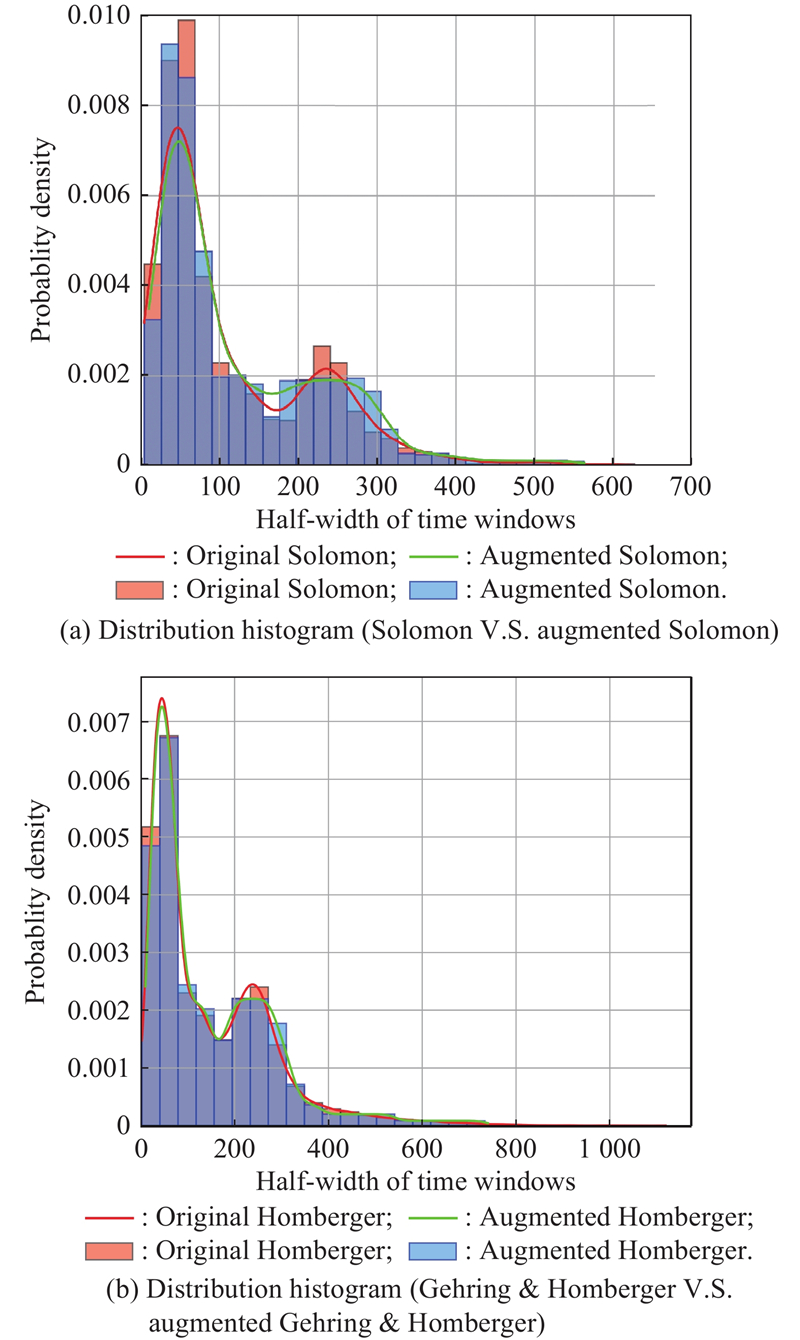
Table 5
Generation strategies of HFVRP benchmarks"
| Variable | Strategy |
| X0, Y0 | Randomly sample |
| X, Y, D | Distribution derivation (see |
| Q, Nv, Cf, Cv | Randomly sample as a group |
Table 6
Distribution of variables for generation of augmented Golden and augmented Choi & Tcha benchmark"
| Number | Customer size | Coordinate (X or Y) | Demand (D) |
| 3−6 | 20 | B( | B( |
| 13, 14 | 50 | B( | B( |
| 15, 16 | 50 | Uniform(5,64) | Weibull( |
| 17, 18 | 75 | B( | Weibull( |
| 19, 20 | 100 | B( | B( |
Fig 5
Comparison of original and augmented HFVRP distributions"
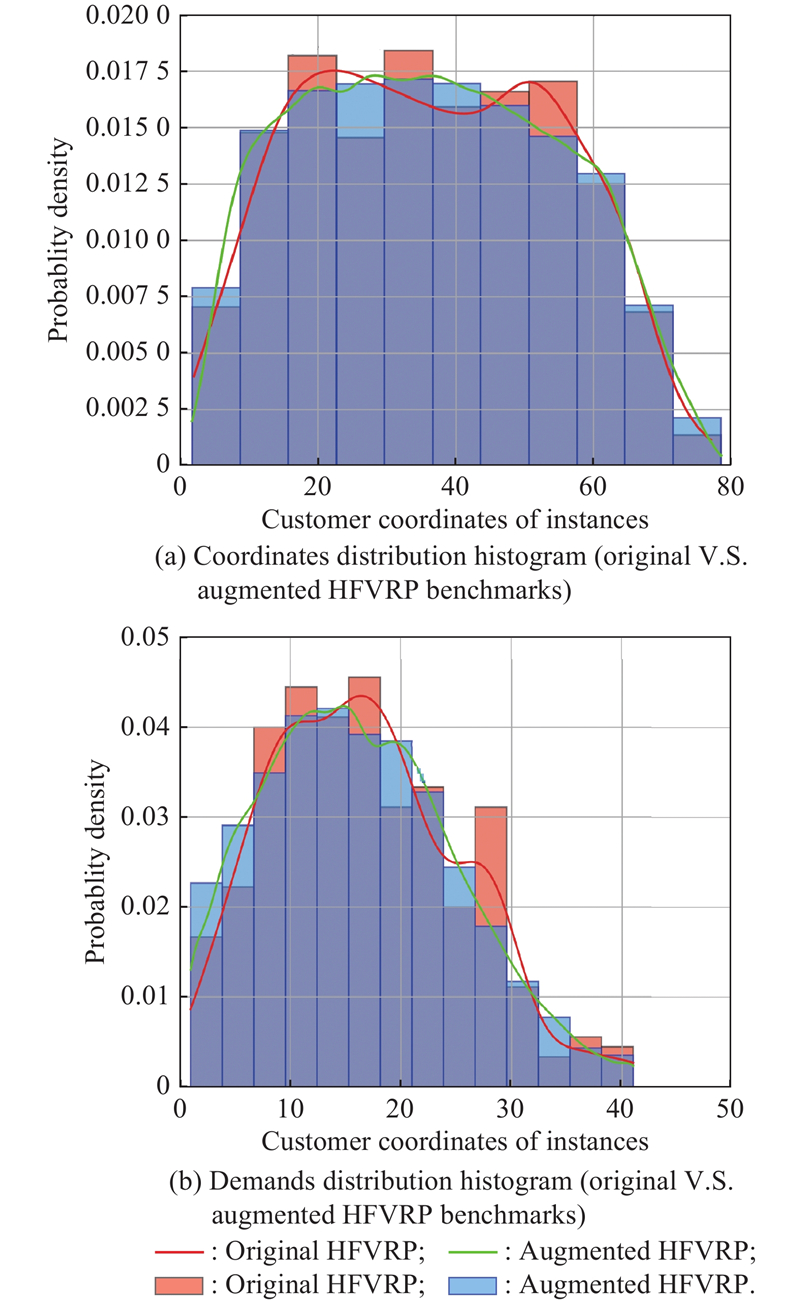
Fig 6
Effect of training with different data"
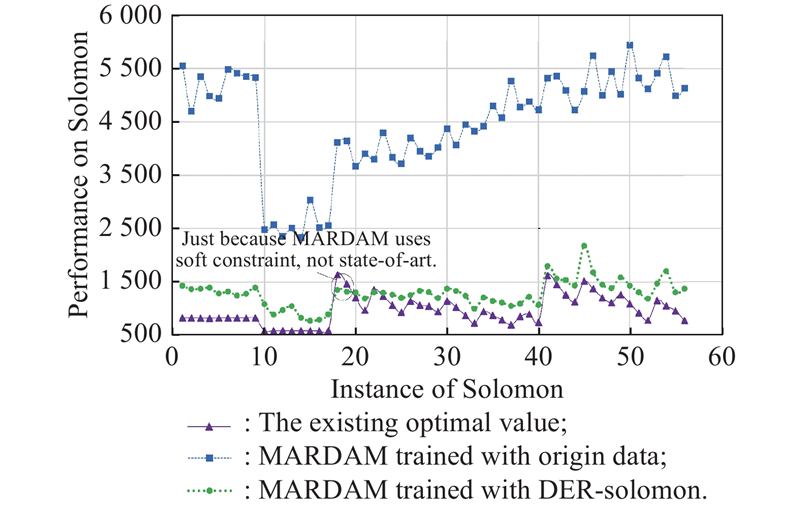
Fig 7
Performance comparison of algorithms on the Solomon benchmark"
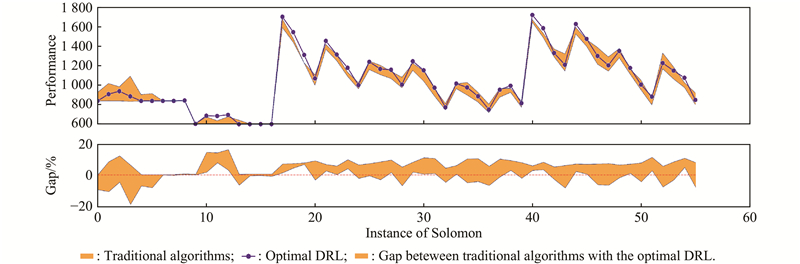
Table 7
Performance of DRL algorithms and traditional algorithms on Solomon benchmark"
| Solomon instance | Optimal | DRL | Tradition | ||||||
| AM | MDAM | POMO | GA | LKH | OR-Tools | HGS | |||
| C101 | 827.3 | 828.9 | 828.9 | 829.7 | 827.3 | 828.9 | 917.6 | 827.3 | |
| C102 | 827.3 | 942.5 | 958.9 | 898.5 | 858.4 | 828.9 | 827.3 | ||
| C103 | 826.3 | 987.4 | 987.0 | 928.6 | 857.4 | 828.1 | 974.6 | 826.3 | |
| C104 | 822.9 | 993.0 | 959.5 | 875.4 | 822.9 | 824.8 | 822.9 | ||
| C105 | 827.3 | 828.9 | 828.9 | 829.7 | 827.3 | 828.9 | 893.4 | 827.3 | |
| C106 | 827.3 | 828.9 | 828.9 | 829.7 | 827.3 | 829.4 | 904.8 | 827.3 | |
| C107 | 827.3 | 828.9 | 830.5 | 831.2 | 827.3 | 828.9 | 829.7 | 827.3 | |
| C108 | 827.3 | 828.9 | 876.7 | 832.7 | 827.3 | 829.4 | 831.7 | 827.3 | |
| C109 | 827.3 | 833.2 | 871.4 | 835.2 | 828.4 | 828.9 | 830.9 | 827.3 | |
| C201 | 589.1 | 744.2 | 753.4 | 591.6 | 589.1 | 591.6 | 591.6 | 589.1 | |
| C202 | 589.1 | 810.5 | 838.3 | 675.6 | 589.1 | 591.6 | 664.2 | 589.1 | |
| C203 | 588.7 | 817.4 | 874.3 | 673.5 | 588.7 | 591.6 | 624.5 | 588.7 | |
| C204 | 588.1 | 814.2 | 823.7 | 684.8 | 621.4 | 591.2 | 664.3 | 588.1 | |
| C205 | 586.4 | 728.8 | 764.9 | 588.9 | 586.4 | 588.9 | 631.1 | 586.4 | |
| C206 | 586 | 730.5 | 760.1 | 588.9 | 586.0 | 588.5 | 592.3 | 586 | |
| C207 | 585.8 | 697.3 | 750.5 | 588.9 | 585.8 | 588.5 | 591.4 | 585.8 | |
| C208 | 585.8 | 719.8 | 768.5 | 588.9 | 585.8 | 588.3 | 594.3 | 585.8 | |
| R101 | |||||||||
| R102 | |||||||||
| R103 | |||||||||
| R104 | 971.5 | 989.2 | 971.5 | ||||||
| R105 | |||||||||
| R106 | |||||||||
| R107 | |||||||||
| R108 | 932.1 | 992.6 | 970.0 | 952.5 | 932.1 | ||||
| R109 | |||||||||
| R110 | |||||||||
| R111 | |||||||||
| R112 | 948.6 | 997.1 | 963.8 | 971.0 | 948.6 | ||||
| R201 | |||||||||
| R202 | |||||||||
| R203 | 870.8 | 998.0 | 964.2 | 913.3 | 877.5 | 955.3 | 870.8 | ||
| R204 | 731.3 | 824.4 | 881.4 | 763.4 | 765.3 | 735.9 | 802.3 | 731.3 | |
| R205 | 949.8 | 981.4 | 955.0 | 949.8 | |||||
| R206 | 875.9 | 967.4 | 915.6 | 888.4 | 875.9 | ||||
| R207 | 794 | 891.2 | 982.2 | 877.5 | 825.4 | 816.9 | 917.4 | 794 | |
| R208 | 701 | 769.0 | 778.0 | 740.4 | 754.9 | 707.5 | 795.2 | 701 | |
| R209 | 854.8 | 951.9 | 943.3 | 872.3 | 866.3 | 955.9 | 854.8 | ||
| R210 | 900.5 | 984.7 | 923.8 | 916.1 | 956.8 | 900.5 | |||
| R211 | 746.7 | 837.6 | 845.4 | 806.3 | 782.7 | 763.2 | 824.3 | 746.7 | |
| RC101 | |||||||||
| RC102 | |||||||||
| RC103 | |||||||||
| RC104 | |||||||||
| RC105 | |||||||||
| RC106 | |||||||||
| RC107 | |||||||||
| RC108 | |||||||||
| RC201 | |||||||||
| RC202 | |||||||||
| RC203 | 923.7 | 996.1 | 961.3 | 942.6 | 923.7 | ||||
| RC204 | 783.5 | 925.5 | 920.0 | 873.2 | 803.2 | 787.5 | 850.0 | 783.5 | |
| RC205 | |||||||||
| RC206 | |||||||||
| RC207 | 962.9 | 966.6 | 968.9 | 962.9 | |||||
| RC208 | 776.1 | 838.6 | 916.8 | 866.9 | 791.6 | 790.7 | 912.3 | 776.1 | |
Table 8
Performance of DRL algorithms and traditional algorithms on Gehring & Homberger benchmark"
| Homberger instance | Optimal | DRL | Tradition | Gap from DRL/% | ||||||
| POMO | GA | LKH | OR-Tools | HGS | Optimal tradition | Worst tradition | ||||
| C1_2_1 | 0.3 | −37 | ||||||||
| C1_2_2 | 3.72 | −34.17 | ||||||||
| C1_2_3 | 5.37 | −33.14 | ||||||||
| C1_2_4 | 58.07 | 0.12 | ||||||||
| C1_2_5 | 0.64 | −35.38 | ||||||||
| C1_2_6 | 0.48 | −35.3 | ||||||||
| C1_2_7 | 0.32 | −36.3 | ||||||||
| C1_2_8 | 1.43 | −39.58 | ||||||||
| C1_2_9 | 3.13 | −36.42 | ||||||||
| C1_2_10 | 3.01 | −37.16 | ||||||||
| C1_4_1 | 0.54 | −26.19 | ||||||||
| C1_4_2 | 6.12 | −21.96 | ||||||||
| C1_4_3 | 8.28 | −23.46 | ||||||||
| C1_4_4 | 7.06 | −22.54 | ||||||||
| C1_4_5 | 0.23 | −24.55 | ||||||||
| C1_4_6 | 0.3 | −27.34 | ||||||||
| C1_4_7 | 0.51 | −29.13 | ||||||||
| C1_4_8 | 1.34 | −29.98 | ||||||||
| C1_4_9 | 3.28 | −26.98 | ||||||||
| C1_4_10 | 4.45 | −26.91 | ||||||||
| C1_6_1 | 6.74 | −15.13 | ||||||||
| C1_6_2 | 8.41 | −12.29 | ||||||||
| C1_6_3 | 7.9 | −14.01 | ||||||||
| C1_6_4 | 6.15 | −17.76 | ||||||||
| C1_6_5 | 7.66 | −13.76 | ||||||||
| C1_6_6 | infeasible | 12.06 | −12.54 | |||||||
| C1_6_7 | infeasible | 5.61 | −18.29 | |||||||
| C1_6_8 | 2.43 | −20.82 | ||||||||
| C1_6_9 | 4.25 | −19.49 | ||||||||
| C1_6_10 | 5.42 | −21.1 | ||||||||
| C1_10_1 | − | − | 11.43 | 8.02 | ||||||
| C1_10_2 | − | − | 11.42 | 5.83 | ||||||
| C1_10_3 | − | − | 11.05 | 8.84 | ||||||
| C1_10_4 | − | − | 8.66 | 7.38 | ||||||
| C1_10_5 | − | − | 12.94 | 5.21 | ||||||
| C1_10_6 | − | − | 18.21 | 5.72 | ||||||
| C1_10_7 | − | − | 10.2 | 3.59 | ||||||
| C1_10_8 | − | − | 5.65 | −6.66 | ||||||
| C1_10_9 | − | − | 6.87 | −0.68 | ||||||
| C1_10_10 | − | − | 8.37 | −0.52 | ||||||
Fig 8
DRL model generalization gaps across 56 Solomon instances: the impact of training data distribution"
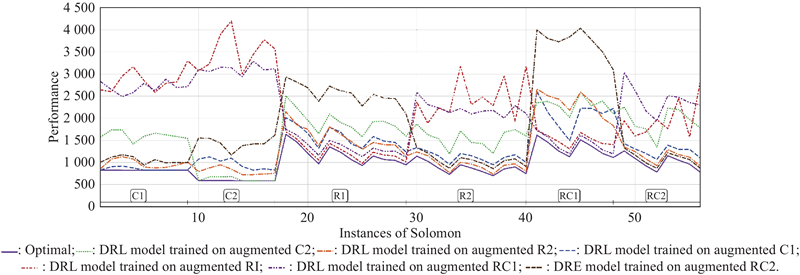
Table 9
Performance of DRL algorithms and traditional algorithms on Golden benchmark"
| Size | No. | HILS-RVRP | CG | DRL | Gap to optimal |
| 20 | 3 | 943.12 | 961.03 | 982.66 | 4.19 |
| 4 | 0.6 | ||||
| 5 | 970.77 | 4.01 | |||
| 6 | 0.9 | ||||
| 50 | 13 | 14.03 | |||
| 14 | 9.23 | ||||
| 15 | 4.04 | ||||
| 16 | 2.57 | ||||
| 75 | 17 | 10.35 | |||
| 18 | 12.69 | ||||
| 100 | 19 | 1.16 | |||
| 20 | 7.99 |
Table 10
Performance of DRL algorithms and traditional algorithms on Choia & Tcha benchmark"
| Size | No. | TS | CG | DRL | Gap to optimal |
| 20 | 3 | 4.64 | |||
| 4 | 0.18 | ||||
| 5 | 2.58 | ||||
| 6 | 0.06 | ||||
| 50 | 13 | 3.91 | |||
| 14 | 6.71 | ||||
| 15 | 1.03 | ||||
| 16 | 6.27 | ||||
| 75 | 17 | 3.86 | |||
| 18 | 7.71 | ||||
| 100 | 19 | 1.87 | |||
| 20 | 2.55 |
Table 11
Computation effciency (time) 1024 augmented Solomon instances"
| Type | Algorithm | Time on C1 | Time on C2 | Time on R1 | Time on R2 | Time on RC1 | Time on RC2 |
| Tradition | LKH | 25 min 36s | 47 min 36s | 46 min 41s | 1 h 47 min 6 s | 2 h 15 min 40 s | 1 h 44 min 15 s |
| OR-Tools | 2 h 44 min 36 s | 4 h 1 min 48 s | 3 h 43 min 2 s | 4 h 16 min 12 s | 3 h 4 min 47 s | 4 h 16 min 27 s | |
| GA | 4 h 59 min 46 s | 1 h 42 min 29 s | 1 h 9 min 54 s | 5 h 11 min 34 s | 55 min 15 s | 4 h 38 min 52 s | |
| DRL | AM | 1.3 s | 1.2 s | 1.3 s | 1.2 s | 1.2 s | 1.6 s |
| MDAM | 13.3 s | 11.8 s | 12.8 s | 12.3 s | 12.3 s | 11.6 s | |
| POMO | 4.4 s | 4.6 s | 4.4 s | 4.3 s | 4.6 s | 4.4 s |
| 1 |
Li B J, Wu G H, He Y M, et al An overview and experimental study of learning-based optimization algorithms for the vehicle routing problem[J]. IEEE/CAA Journal of Automatica Sinica, 2022, 9 (7): 1115.
doi: 10.1109/JAS.2022.105677 |
| 2 | Lyu W J, Wang H T, Song Y W, et al. A prediction-and-scheduling framework for efficient order transfer in logistics[C]// Thirty-Second International Joint Conference on Artificial Intelligence, 2023: 6130. |
| 3 | Braekers K, Ramaekers K, Van Nieuwenhuyse I The vehicle routing problem: state of the art classification and review. Computers & Industrial Engineering, 2016, 99 (1): 300. |
| 4 |
Konstantakopoulos G D, Gayialis S P, Kechagias E P Vehicle routing problem and related algorithms for logistics distribution: a literature review and classification. Operational Research, 2022, 22 (1): 2033.
doi: 10.1007/s12351-020-00600-7 |
| 5 |
Bräysy O, Gendreau M Vehicle routing problem with time windows, part II: metaheuristics. Transportation Science, 2005, 39 (1): 119.
doi: 10.1287/trsc.1030.0057 |
| 6 |
Schneider M, Stenger A, Goeke D The electric vehicle-routing problem with time windows and recharging stations. Transportation Science, 2014, 48 (4): 500.
doi: 10.1287/trsc.2013.0490 |
| 7 | Wang Y, Gurney N, Zhou J, et al. Route optimization in service of a search and rescue artificial social intelligence agent[C]// AAAI Fall Symposium, 2021: 220. |
| 8 |
Taillard E D A heuristic column generation method for the heterogeneous fleet VRP. RAIRO-Operations Research, 1999, 33 (1): 1.
doi: 10.1051/ro:1999101 |
| 9 |
Golden B, Assad A, Levy L, et al The fleet size and mix vehicle routing problem. Computers & Operations Research, 1984, 11 (1): 49.
doi: 10.1016/0305-0548(84)90007-8 |
| 10 | Koc C, Bektas T, Jabali O, et al Thirty years of heterogeneous vehicle routing. European Journal of Operational Research, 2016, 249 (1): 1. |
| 11 |
Brandao J A tabu search algorithm for the heterogeneous fixed fleet vehicle routing problem. Computers & Operations Research, 2011, 38 (1): 140.
doi: 10.1016/j.cor.2010.04.008 |
| 12 |
Tan S Y, Yeh W C The vehicle routing problem: state-of-the-art classification and review. Applied Sciences, 2021, 11 (21): 10295.
doi: 10.3390/app112110295 |
| 13 | Zhang R, Zhang C, Cao Z, et al. Learning to solve multiple-TSP with time window and rejections via deep reinforcement learning[EB/OL]. [2025-01-10]. http://arxiv.org/abs/2209.06094. |
| 14 | Bello I, Pham H, Le Q V, et al. Neural combinatorial optimization with reinforcement learning[C]// 5th International Conference on Learning Representations, 2017. https://openreview.net/forum?id=Bk9mxlSFx. |
| 15 | Jacobs T, Alesiani F, Ermis G. Reinforcement learning for route optimization with robustness guarantees[C]// 13th International Joint Conference on Artificial Intelligence, 2021: 2592. |
| 16 | Kool W, Van Hoof H, Welling M. Attention, learn to solve routing problems![C]// 7th International Conference on Learning Representations, 2019. https://openreview.net/forum?id=ByxBFsRqYm. |
| 17 | Zong Z F, Wang H S, Wang J W, et al. RBG: hierarchically solving large-scale routing problems in logistic systems via reinforcement learning[C]// 28th ACM SIGKDD Conference on Knowledge Discovery and Data Mining, 2022: 4648. |
| 18 | Tang K Q, Fu H Q, Liu J S, et al Hierarchical optimization research of constrained vehicle routing based on deep reinforcement learning. Systems Engineering and Electronics, 2025, 47 (3): 827. |
| 19 | Liang H, Ma Y, Cao Z, et al. SplitNet: a reinforcement learning based sequence splitting method for the minmax multiple travelling salesman problem[C]// AAAI Conference on Artificial Intelligence, 2023: 8720. |
| 20 |
Lin B, Ghaddar B, Nathwani J Deep reinforcement learning for the electric vehicle routing problem with time windows. IEEE Trans. on Intelligent Transportation Systems, 2021, 23 (8): 11528.
doi: 10.1109/iccia59741.2023.00012 |
| 21 |
Solomon M M Algorithms for the vehicle routing and scheduling problems with time window constraints. Operations Research, 1987, 35 (2): 254.
doi: 10.1287/opre.35.2.254 |
| 22 |
Gunawan A, Kendall G, Mccollum B, et al Vehicle routing: review of benchmark datasets. Journal of the Operational Research Society, 2021, 72 (8): 1794.
doi: 10.1080/01605682.2021.1884505 |
| 23 | More J J, Garbow B S, Hillstrom K E. User guide for MINPACK-1: ANL-80−74[D]. Argonne, Ill.: Argonne National Laboratory, 1980. |
| 24 |
Gao F C, Han L X Implementing the Nelder-Mead simplex algorithm with adaptive parameters. Computational Optimization and Applications, 2012, 51 (1): 259.
doi: 10.1007/s10589-010-9329-3 |
| 25 | Gehring H, Homberger J. A parallel hybrid evolutionary metaheuristic for the vehicle routing problem with time windows[C]// Eurogen99, 1999: 57. |
| 26 |
Yanik S, Bozkaya B, Dekervenoael R A new VRPPD model and a hybrid heuristic solution approach for e-tailing. European Journal of Operational Research, 2014, 236 (3): 879.
doi: 10.1016/j.ejor.2013.05.023 |
| 27 |
Christofides N, Eilon S An algorithm for the vehicle-dispatching problem. Journal of the Operational Research Society, 1969, 20 (1): 309.
doi: 10.2307/3008733 |
| 28 |
Clarke G, Wright J W Scheduling of vehicles from a central depot to a number of delivery points. Operations Research, 1964, 12 (4): 568.
doi: 10.1007/978-3-642-27922-5_18 |
| 29 |
Bono G, Dibangoye J S, Simonin O, et al Solving multi-agent routing problems using deep attention mechanisms. IEEE Trans. on Intelligent Transportation Systems, 2021, 22 (12): 7804.
doi: 10.1109/TITS.2020.3009289 |
| 30 | Xin L, Song W, Cao Z G, et al. Multi-decoder attention model with embedding glimpse for solving vehicle routing problems[C]// AAAI Conference on Artificial Intelligence, 2021: 12042. |
| 31 | Kwon Y D, Choo J, Kim B, et al. POMO: policy optimization with multiple optima for reinforcement learning[EB/OL]. [2025-01-10]. http://arxiv.org/abs/2010.16011. POMO. |
| 32 |
Ombuki B, Ross B J, Hanshar F Multi-objective genetic algorithms for vehicle routing problem with time windows. Applied Intelligence, 2006, 24 (1): 17.
doi: 10.1007/s10489-006-6926-z |
| 33 | Helsgaun K An extension of the Lin-Kernighan-Helsgaun TSP solver for constrained traveling salesman and vehicle routing problems. Roskilde: Roskilde University, 2017, 12 (1): 1. |
| 34 | Perron L, Furnon V. Or-tools[EB/OL]. [2026-01-10]. https://developers. google. com/optimization. |
| 35 |
Vidal T Hybrid genetic search for the CVRP: open-source implementation and SWAP* neighborhood. Computers & Operations Research, 2022, 140 (1): 105643.
doi: 10.1016/j.cor.2021.105643 |
| 36 |
Li J, Ma Y, Gao R, et al Deep reinforcement learning for solving the heterogeneous capacitated vehicle routing problem. IEEE Trans. on Cybernetics, 2022, 52 (12): 13572.
doi: 10.1109/TCYB.2021.3111082 |
| 37 | Penna P H V, Subramanian A, Ochi L S, et al A hybrid heuristic for a broad class of vehicle routing problems with heterogeneous fleet. Annals of Operations Research, 2019, 273 (2): 5. |
| 38 |
Choi E, Tcha D W A column generation approach to the heterogeneous fleet vehicle routing problem. Computers & Operations Research, 2007, 34 (7): 2080.
doi: 10.1016/j.cor.2005.08.002 |
| 39 |
Meliani Y, Hani Y, Elhaq S L, et al A tabu search based approach for the heterogeneous fleet vehicle routing problem with three-dimensional loading constraints. Applied Soft Computing, 2022, 126 (1): 109239.
doi: 10.1016/j.asoc.2022.109239 |
| [1] | Jiawei XIA, Xufang ZHU, Zhong LIU, Qingtao XIA. LSTM-DPPO based deep reinforcement learning controller for path following optimization of unmanned surface vehicle [J]. Journal of Systems Engineering and Electronics, 2023, 34(5): 1343-1358. |
| [2] | Yaozhong ZHANG, Yike LI, Zhuoran WU, Jialin XU. Deep reinforcement learning for UAV swarm rendezvous behavior [J]. Journal of Systems Engineering and Electronics, 2023, 34(2): 360-373. |
| [3] | Bohao LI, Yunjie WU, Guofei LI. Hierarchical reinforcement learning guidance with threat avoidance [J]. Journal of Systems Engineering and Electronics, 2022, 33(5): 1173-1185. |
| [4] | Kaifang WAN, Bo LI, Xiaoguang GAO, Zijian HU, Zhipeng YANG. A learning-based flexible autonomous motion control method for UAV in dynamic unknown environments [J]. Journal of Systems Engineering and Electronics, 2021, 32(6): 1490-1508. |
| Viewed | ||||||
|
Full text |
|
|||||
|
Abstract |
|
|||||
