
Journal of Systems Engineering and Electronics ›› 2026, Vol. 37 ›› Issue (2): 697-711.doi: 10.23919/JSEE.2025.000123
• CONTROL THEORY AND APPLICATION • Previous Articles
Weikang LI1( ), Ju JIANG1(), Yue BIAN2(), Yanhua HAN3,*()
Received:2025-03-18
Online:2026-04-18
Published:2026-04-30
Contact:
Yanhua HAN
E-mail:liweikang@nuaa.edu.cn;jiangju@nuaa.edu.cn;bianyue@nuaa.edu.cn;hanyanhua@nuaa.edu.cn
About author:Supported by:Weikang LI, Ju JIANG, Yue BIAN, Yanhua HAN. On-orbit servicing launch dynamics and multi-objective optimization of impulsive rendezvous[J]. Journal of Systems Engineering and Electronics, 2026, 37(2): 697-711.
Add to citation manager EndNote|Reference Manager|ProCite|BibTeX|RefWorks
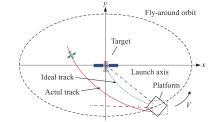
Fig 1
Sketch of platform flying around and aiming at the target"
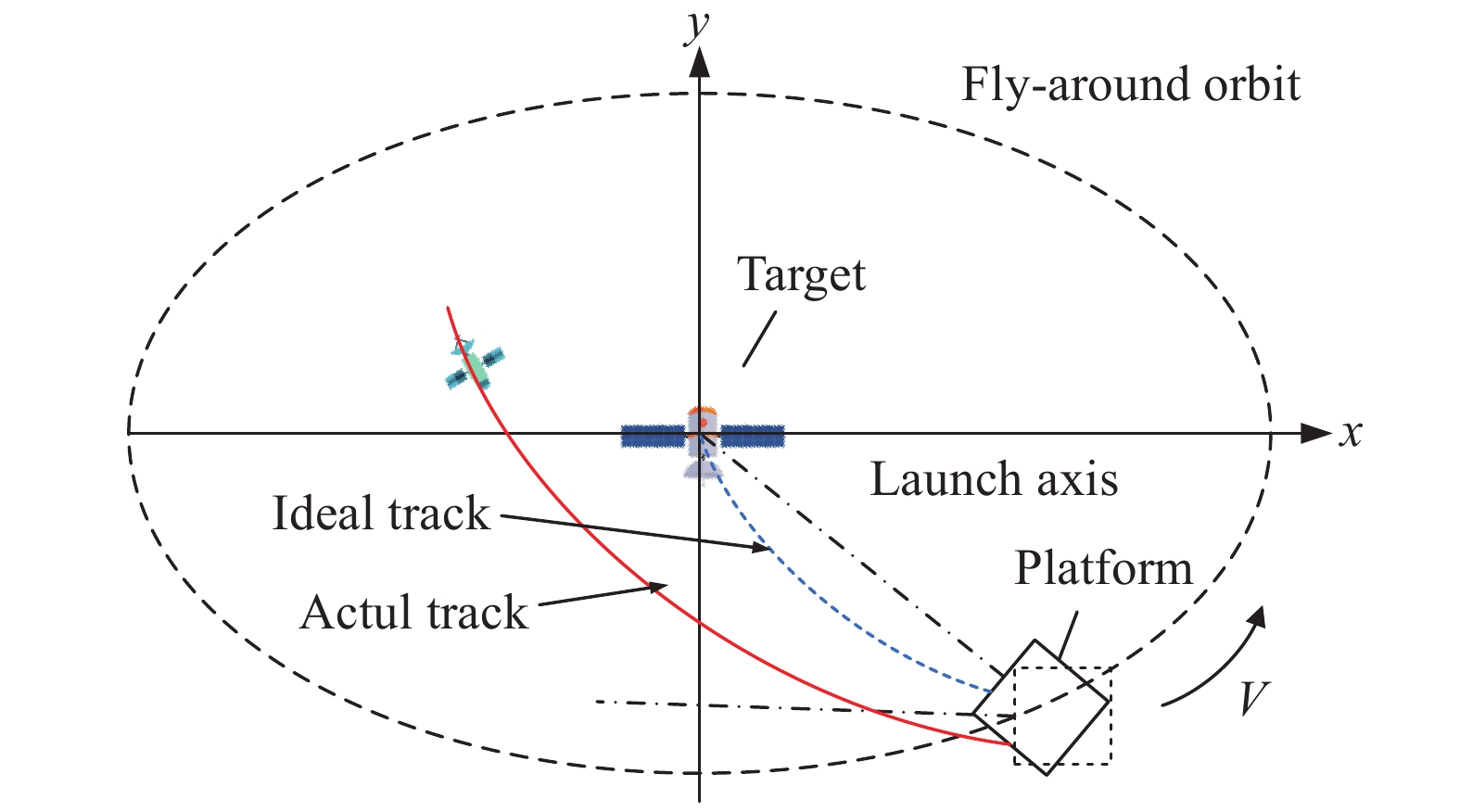
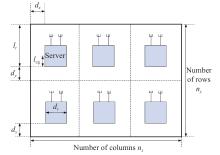
Fig 2
Schematic of the platform-server system structure"
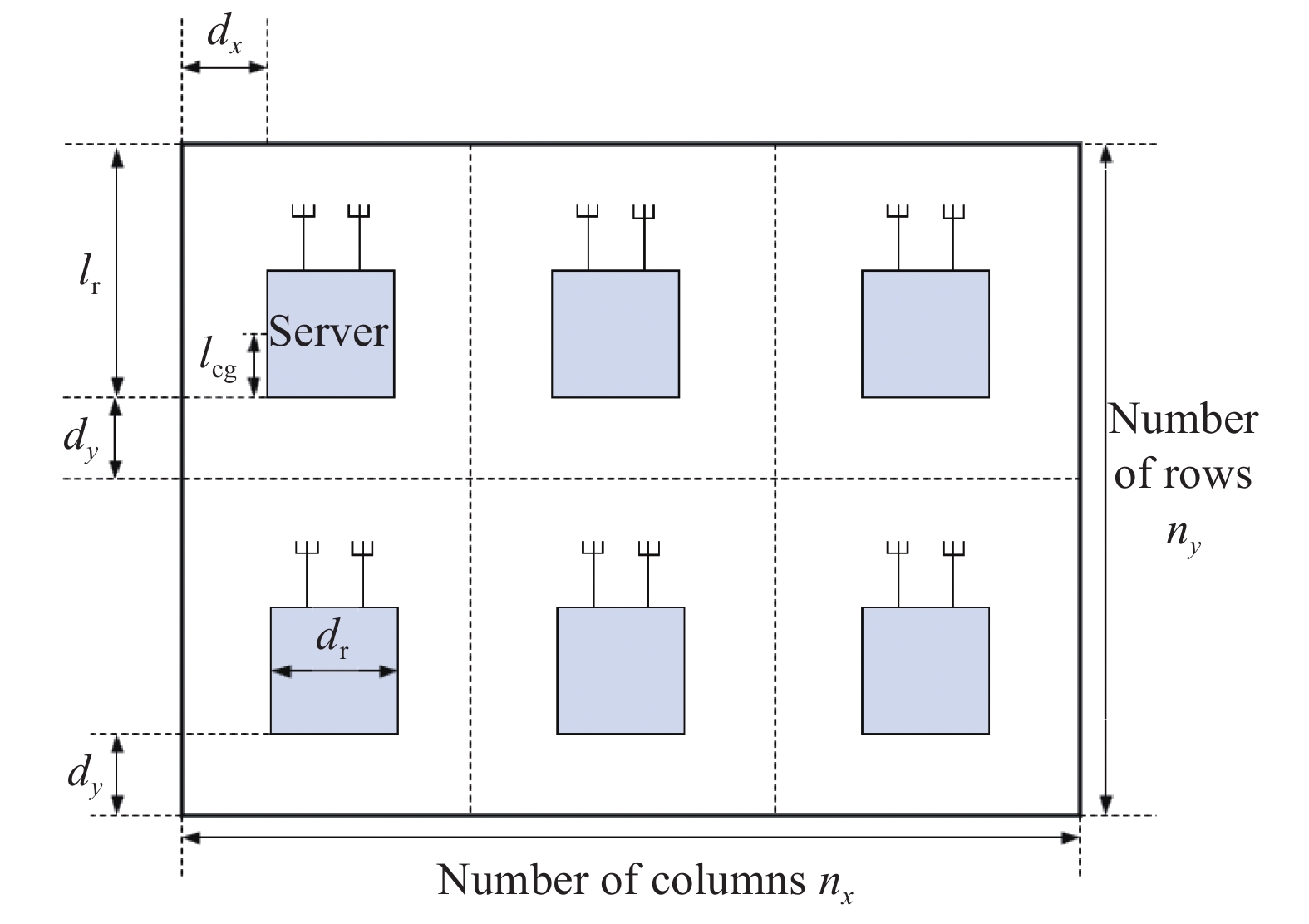
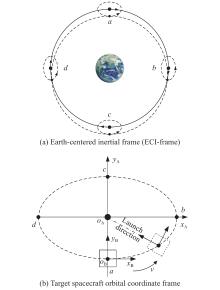
Fig 3
Schematic of coordinate system for relative motion in space"
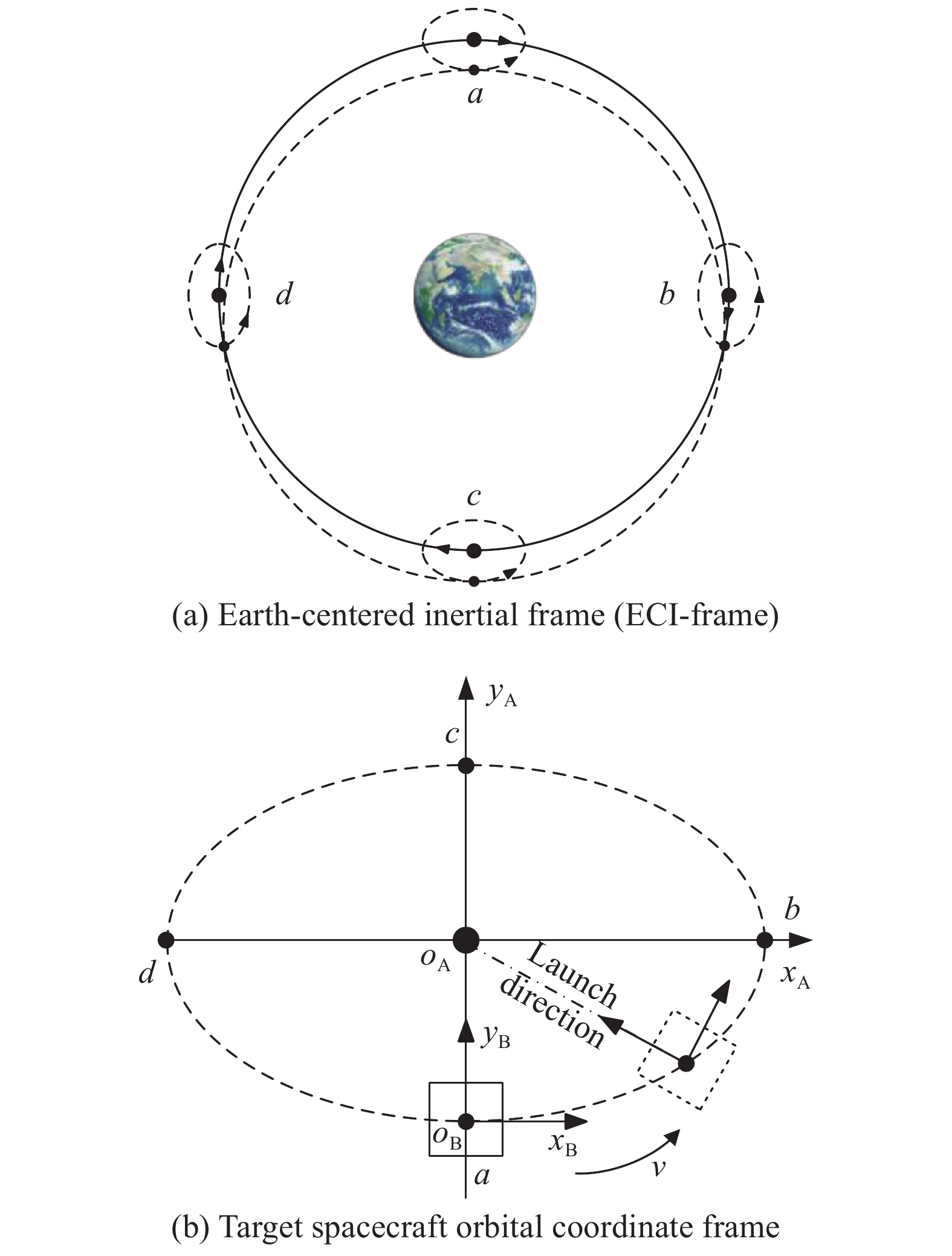
Fig 4
Virtual prototype base on ADAMS"
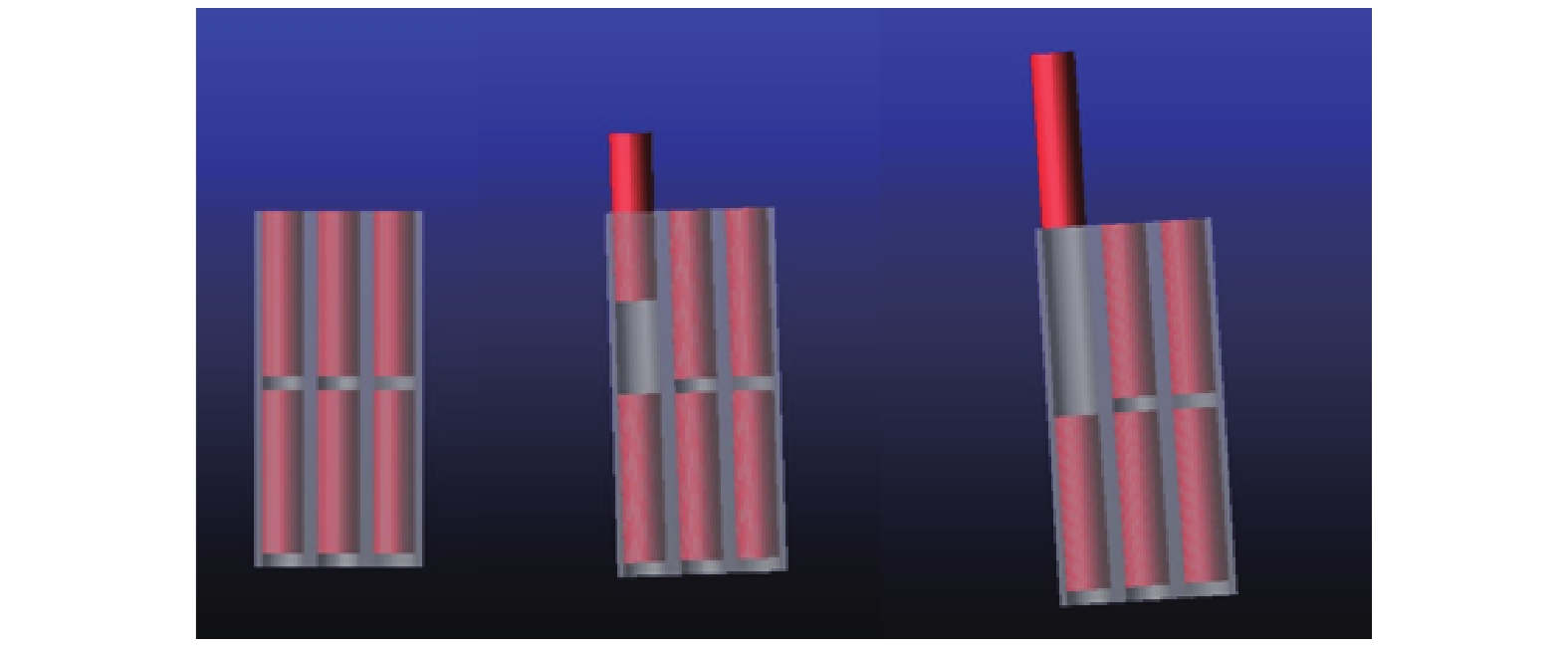
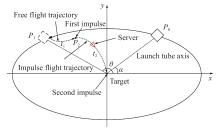
Fig 5
Double impulse rendezvous process"
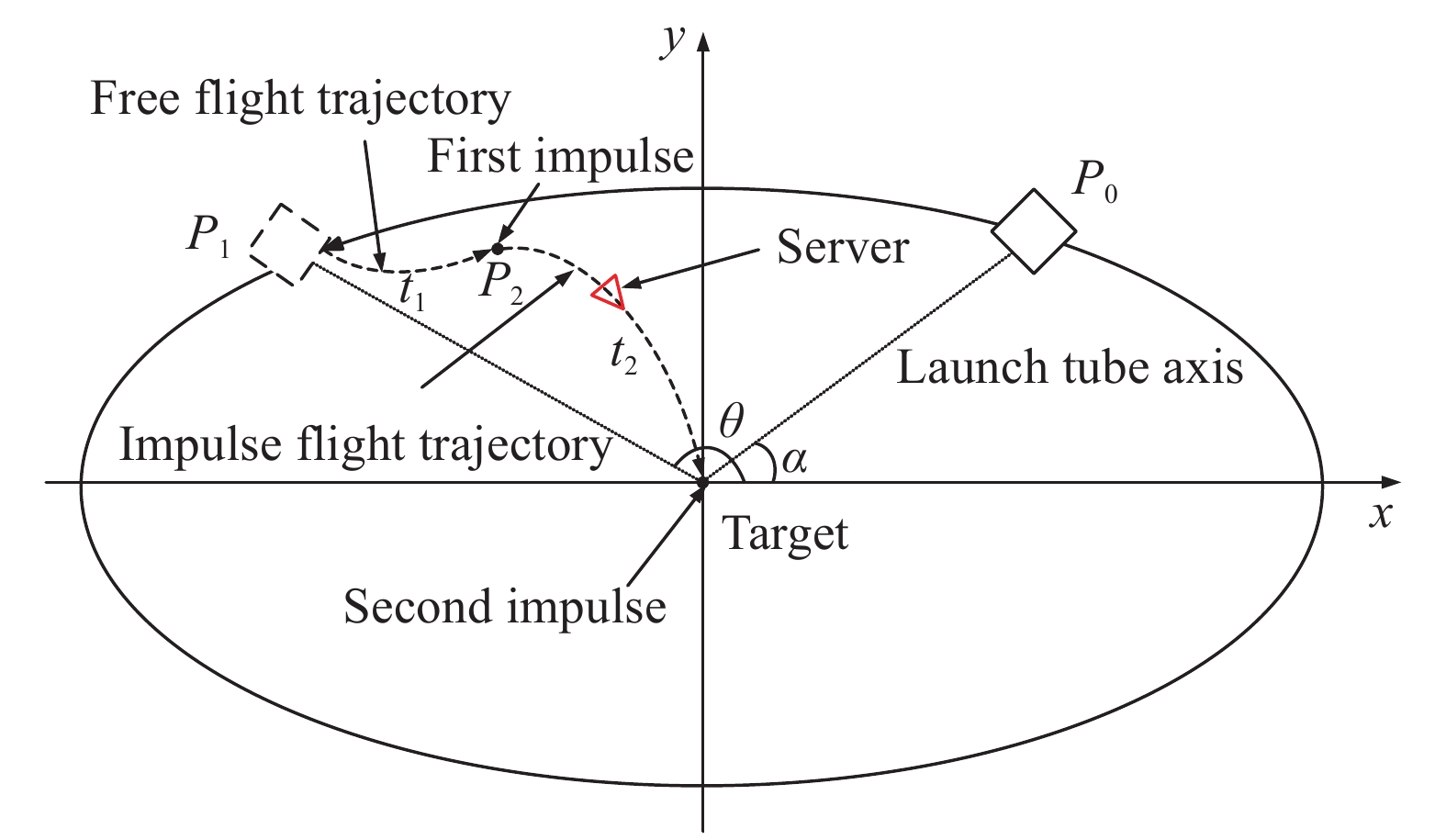

Table 1
Simulation entry parameters"
| Input parameter | Value |
Table 2
Motion state changes of the platform-server system"
| Parameter | Value |
| x/m | +0.01 |
| y/m | −0.13 |
| Vx/(m/s) | +0.03 |
| Vy/(m/s) | −0.19 |
| η/(°) | +3.91 |
| ω/(°/s) | +4.29 |
| +1.67 |
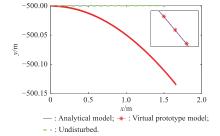
Fig 6
Platform motion trajectory during launch"
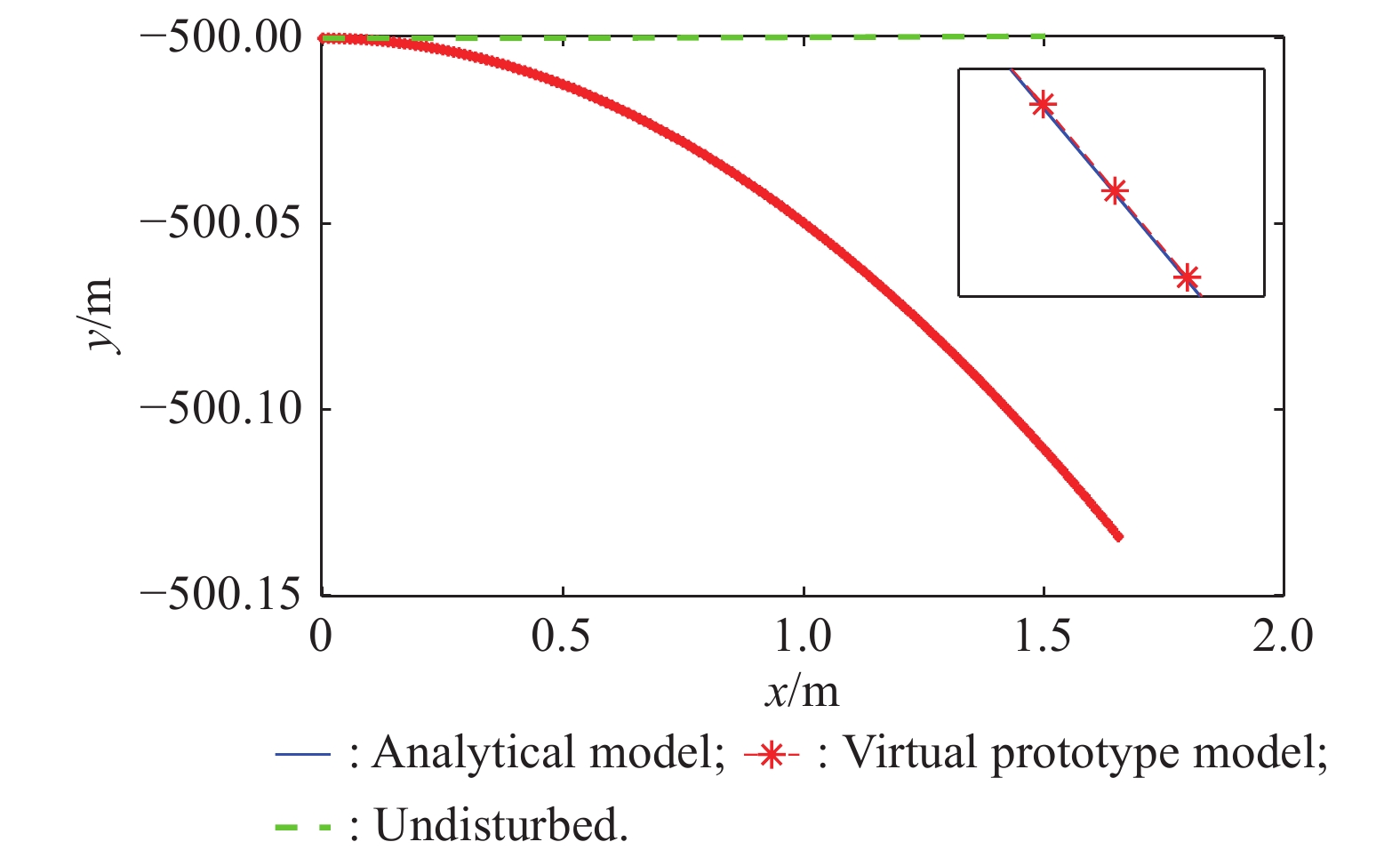
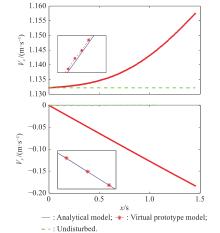
Fig 7
Velocity of the platform during launch"
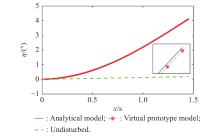
Fig 8
Platform attitude yaw angle during launch"
Fig 9
Platform attitude yaw rate during launch"
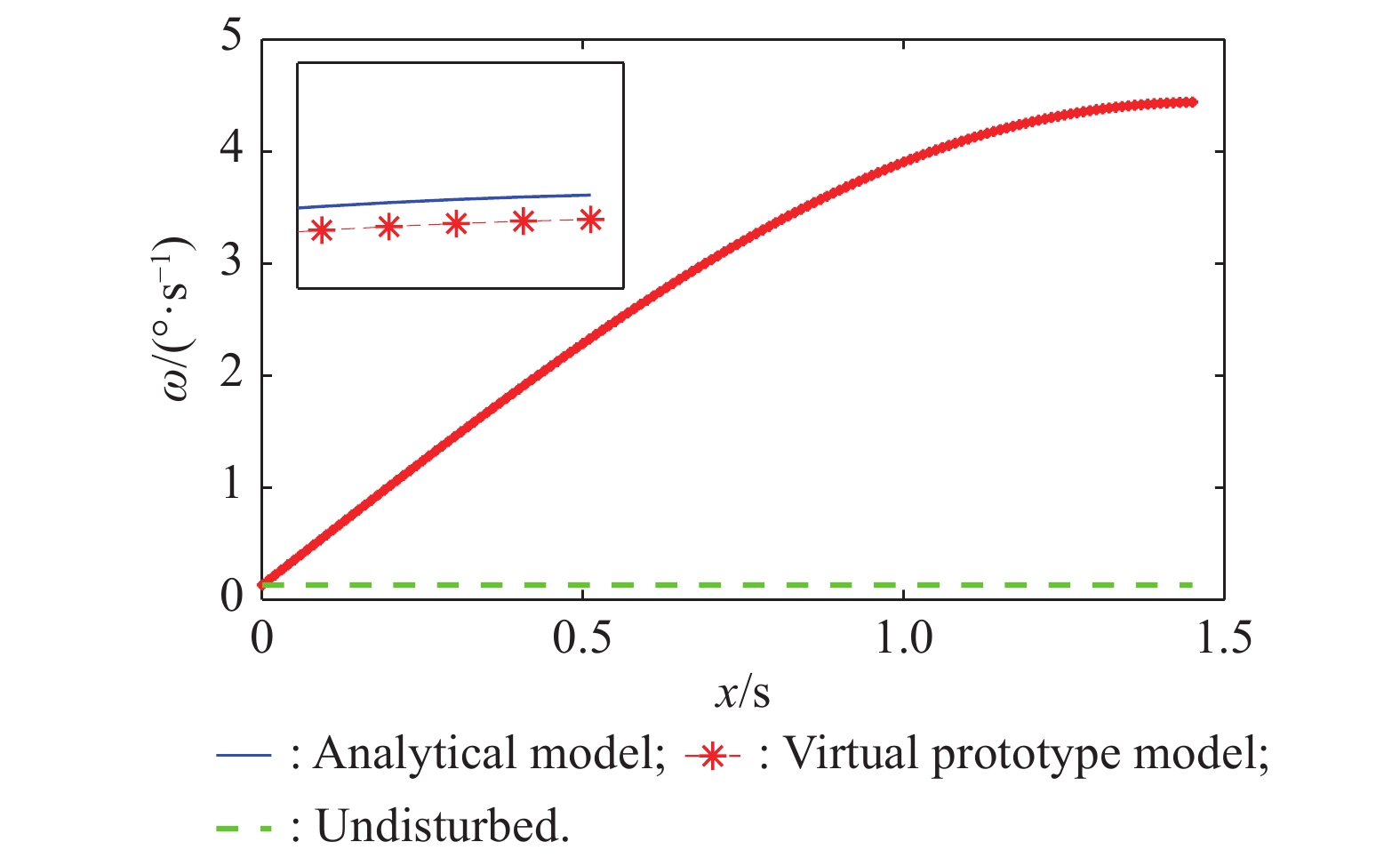
Fig 10
Sliding displacement of server in platform launch tube"
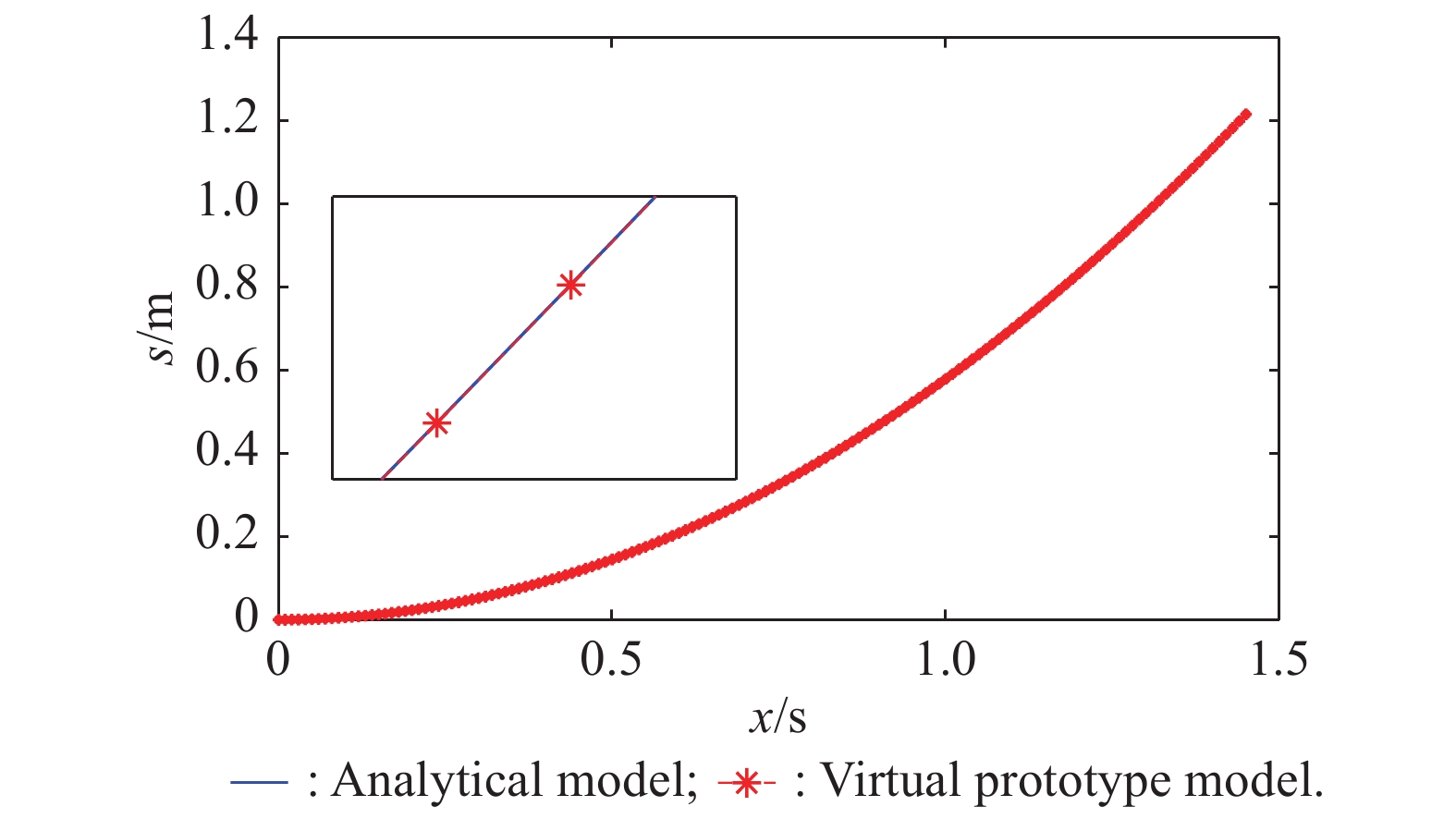
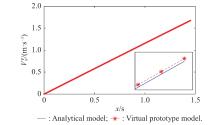
Fig 11
Sliding rate of server in launch tube"
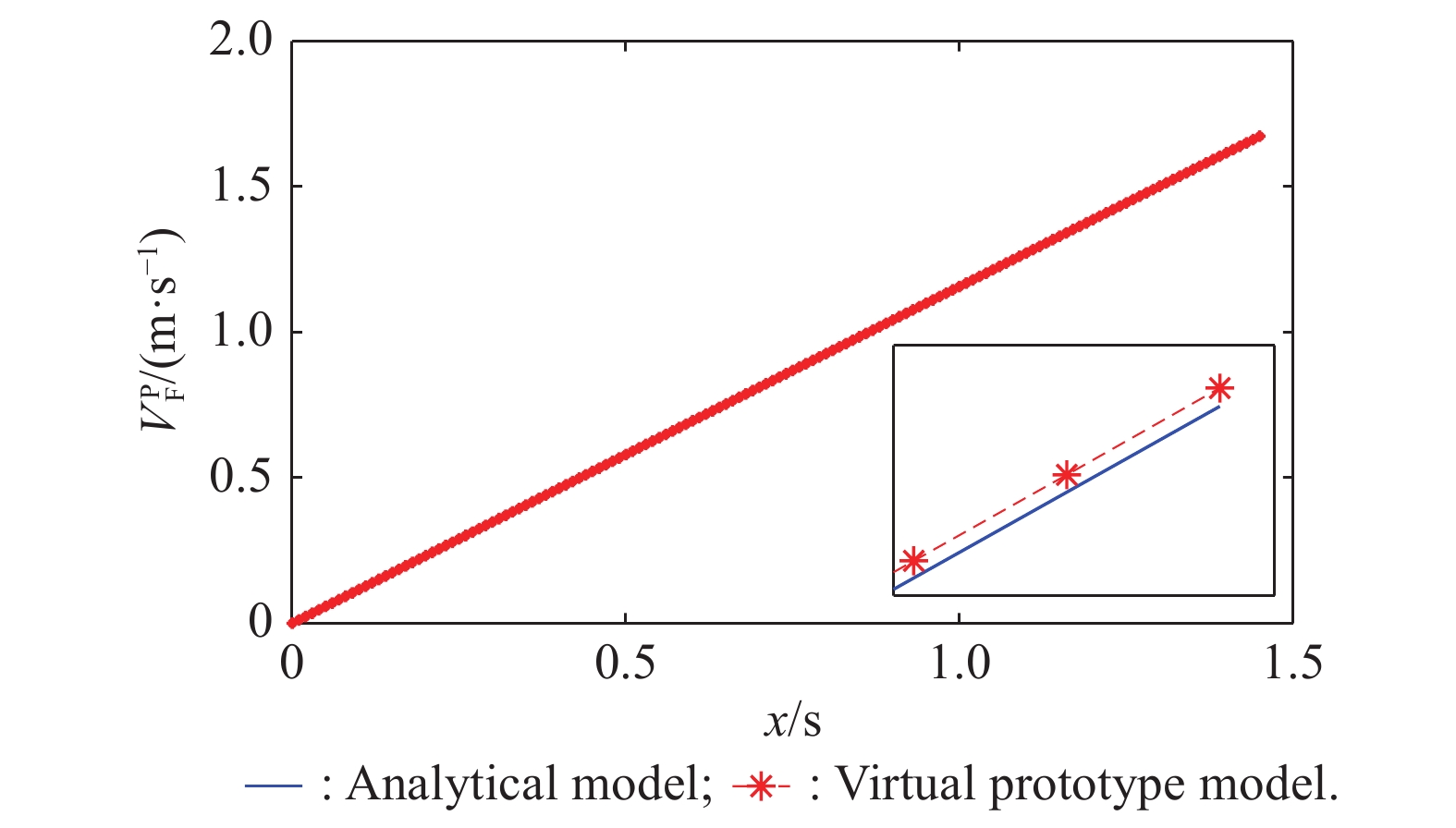
Table 3
Initial orbital parameters"
| Object | a/m | e | i/(°) | Ω/(°) | w/(°) | f/(°) |
| Target | 0 | 45 | 115 | 60 | 0 | |
| Chaser | 45 | 115 | 60 | 0 |
Table 4
Statistical results of HV and IGD metric values"
| Type | IGD | HV | t/s |
| MOEA/D | 1.25 | 2.48 | 0.8 |
| NSGA-II | 1.05 | 2.87 | 1.3 |
| Improved NSGA-II | 0.57 | 3.64 | 1.5 |
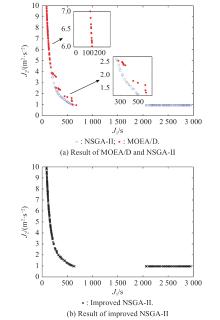
Fig 12
Pareto fronts of impulse rendezvous guidance law"
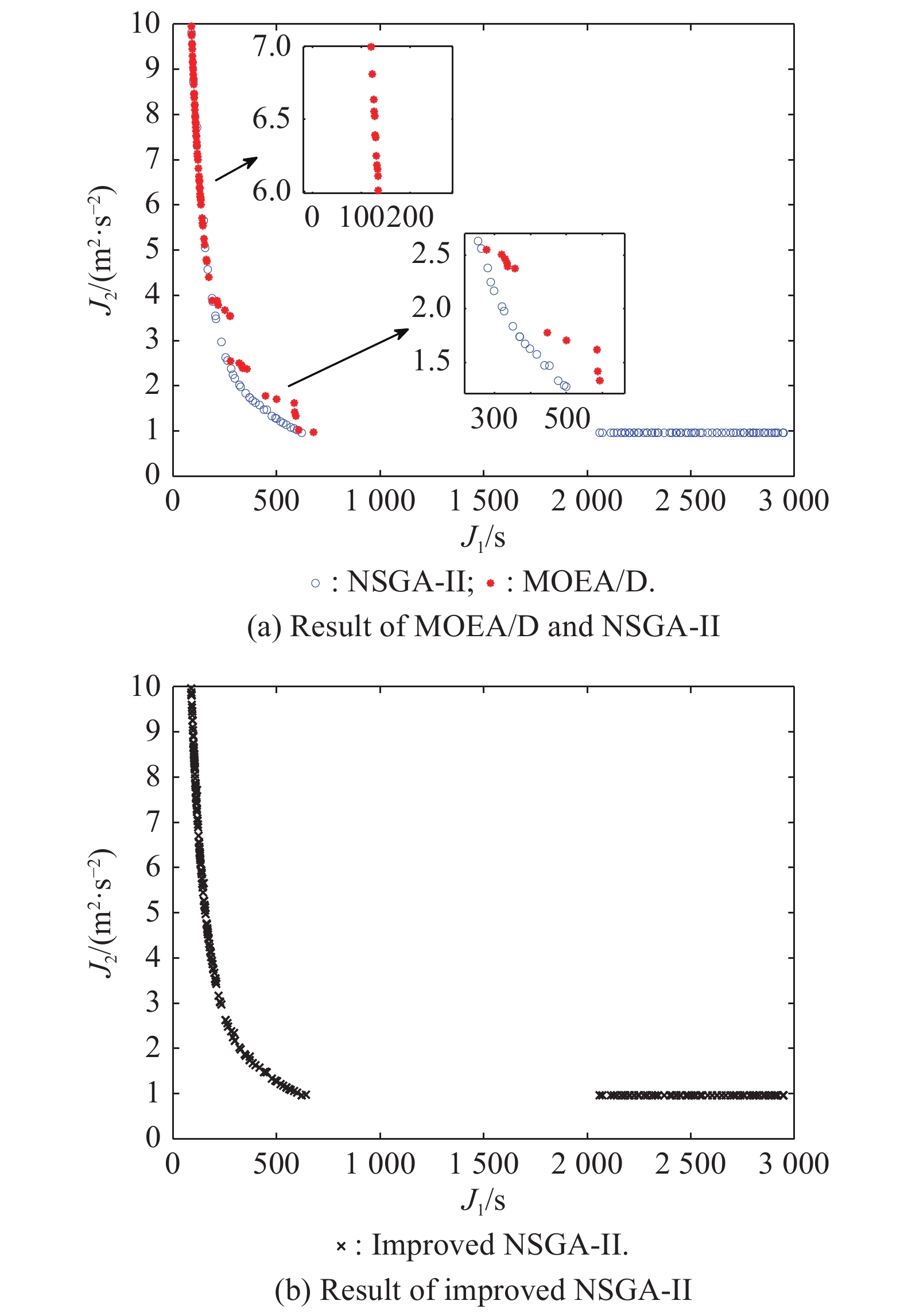
Table 5
Guidance parameters for different rendezvous strategies"
| Results | J1/s | J2/(m/s)2 | θ/(°) | t1/s | t2/s | Δvx1/(m/s) | Δvy1/(m/s) | Δvx2/(m/s) | Δvy2/(m/s) |
| Energy-optimal | 126.33 | 606 | |||||||
| Integrated optimal | 511 | 116.915 | 10 | 501 |
Table 6
Transfer orbit parameters of the server in different rendezvous strategies"
| Result | Orbits of different transfer phases | a/m | e | i/(°) | Ω/(°) | w/(°) | f/(°) |
| Energy-optimal | Free-flying orbit | 45 | 115 | 4.51 | 166.09 | ||
| Impulsive flight orbit | 45 | 115 | 58.12 | 151.93 | |||
| Integrated optimal | Free-flying orbit | 45 | 115 | 357.20 | 167.42 | ||
| Impulsive flight orbit | 45 | 115 | 1.79 | 163.47 |
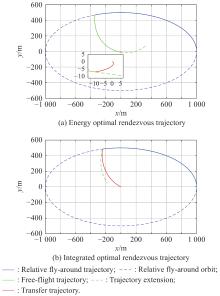
Fig 13
Different types of impulse rendezvous trajectories (coordinate system A)"
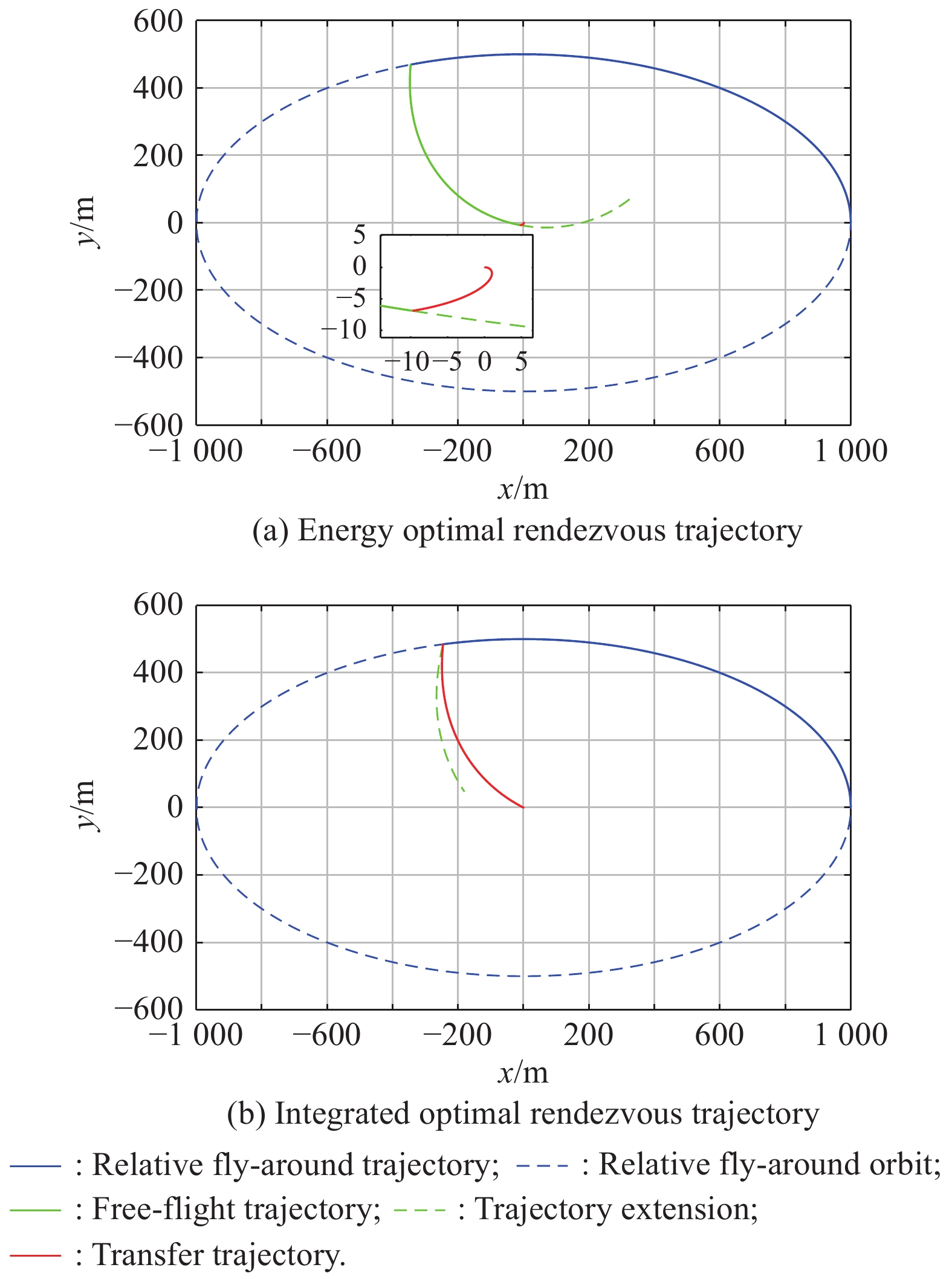
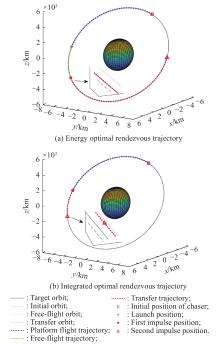
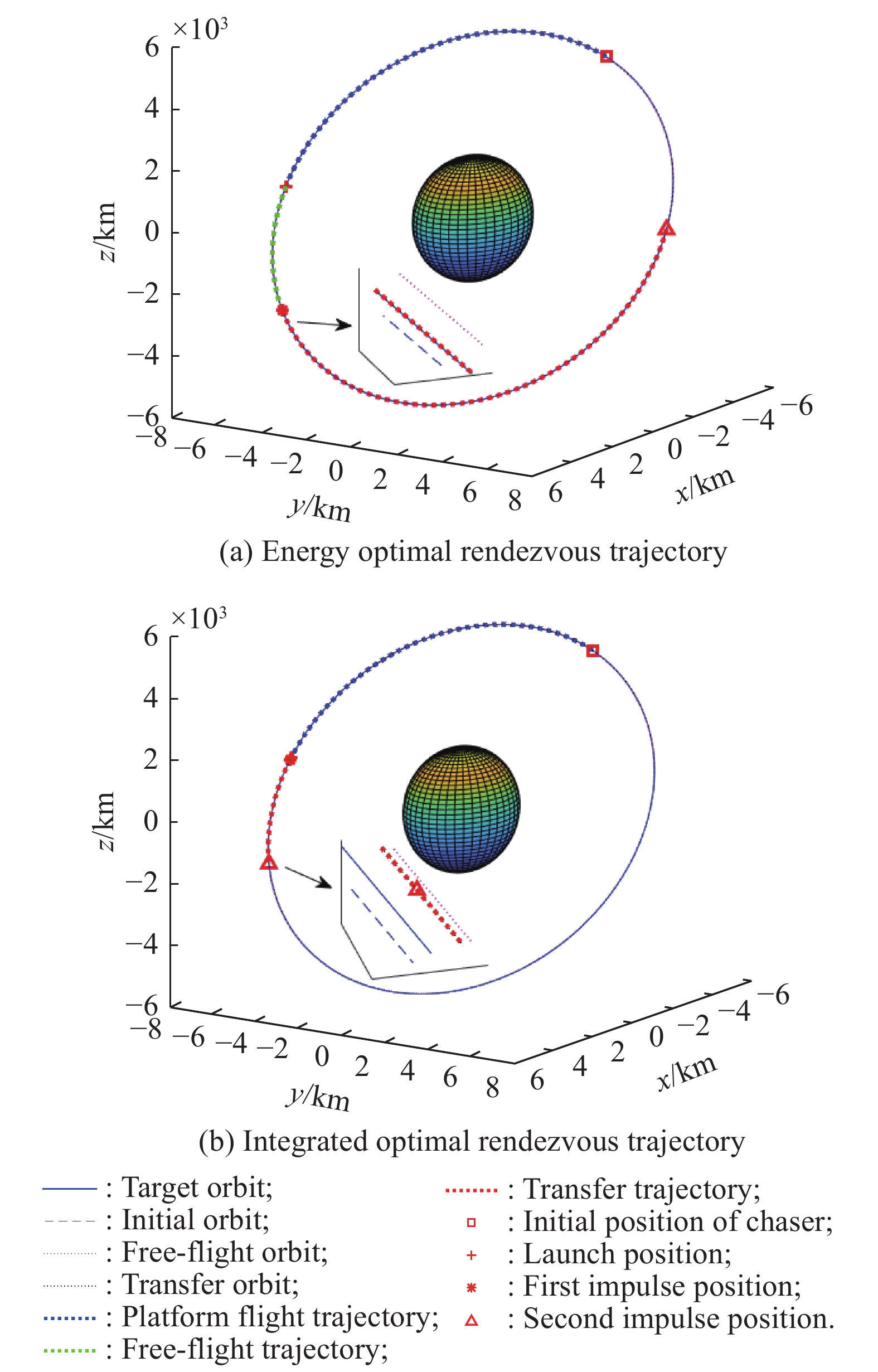
Fig 14
Different types of impulse rendezvous trajectories (ECI-frame)"
| 1 | HAN Y H, YING W B, ZHANG Y Dynamics for heavy equipment airdrop and control design. Flight Dynamics, 2022, 54 (2): 311- 320. |
| 2 | HAN Y H, YING W B, ZHANG Y Aircraft-rocket coupling dynamics for internally carried gravity air-launch method. Journal of Nanjing University of Aeronautics and Astronautics, 2020, 52 (6): 963- 971. |
| 3 | HAN Y H, LI W K, ZHANG Y Dynamics of space platform launching server and optimal double pulse rendezvous. Journal of Dynamics and Control, 2022, 20 (4): 63- 73. |
| 4 | HAN Y H Dynamics and homing guidance for space manipulator capturing on-orbit target. Journal of Astronautics, 2016, 37 (9): 1098- 1106. |
| 5 |
WANG G, CHEN X, XING Y, et al Multi-body separation simulation with an improved general mesh deformation method. Aerospace Science and Technology, 2017, 71, 763- 771.
doi: 10.1016/j.ast.2017.10.027 |
| 6 |
ERIC M Q, JILL L P, PRASUN N D Multibody modeling and simulation for mars phoenix entry, descent, and landing. Journal of Spacecraft and Rockets, 2011, 48 (5): 765- 771.
doi: 10.2514/1.46918 |
| 7 |
ZHAO Z J, REN G X Multibody dynamic approach of flight dynamics and nonlinear aeroelasticity of flexible aircraft. AIAA Journal, 2011, 49 (1): 41- 54.
doi: 10.2514/1.45334 |
| 8 |
WANG W W, WU Z G, LIU J F Dynamic analysis of cislunar suspension tether swings. Acta Astronautica, 2024, 216, 350- 369.
doi: 10.1016/j.actaastro.2024.01.010 |
| 9 | GERADIN M C J G, NIELSEN, ANDRE P. Numerical simulation of the folding and deployment of a polymer reflector. https://doi.org/10.1007/s11044-025-10080-2. |
| 10 |
BAGHERI, AMIE K, VALENTIN S, et al Nonlinear normal modes of highly flexible beam structures modelled under the SE(3) Lie group framework. Nonlinear Dynamics, 2024, 112 (3): 1641- 1659.
doi: 10.1007/s11071-023-09106-1 |
| 11 |
ZHANG G, ZHOU D, MORTARI D Optimal two-impulse rendezvous using constrained multiple-revolution Lambert solutions. Celestial Mechanics and Dynamical Astronomy, 2011, 110 (4): 305- 317.
doi: 10.1007/s10569-011-9349-z |
| 12 |
PRUSSING J E, CHIU J H Optimal multiple-impulse time-fixed rendezvous between circular orbits. Journal of Guidance, Control, and Dynamics, 1986, 9 (1): 17- 22.
doi: 10.2514/3.20060 |
| 13 |
LUO Y Z, TANG G J, LI Y J, et al Optimization of multiple-impulse, multiple-revolution, rendezvous-phasing maneuvers. Journal of Guidance, Control, and Dynamics, 2007, 30 (4): 946- 952.
doi: 10.2514/1.25620 |
| 14 | ZINAGE V, BAKOLAS E. Minimum-fuel spacecraft rendezvous based on sparsity promoting optimization. Proc. of the AIAA Scitech Forum, 2022. DOI: 10.2514/6.2022-0760. |
| 15 |
KIM Y, PARK S Y Nonsingular dual–primal algorithm for fuel-optimal impulsive rendezvous. Journal of Guidance, Control, and Dynamics, 2019, 42 (4): 737- 751.
doi: 10.2514/1.G003828 |
| 16 |
BANG J, AHN J Two-phase framework for near-optimal multi-target Lambert rendezvous. Advances in Space Research, 2018, 61 (5): 1273- 1285.
doi: 10.1016/j.asr.2017.12.025 |
| 17 |
ZHANG J, PARKS G Multi-objective optimization for multiphase orbital rendezvous missions. Journal of Guidance, Control, and Dynamics, 2013, 36 (2): 622- 629.
doi: 10.2514/1.57786 |
| 18 |
ZHANG Y Q, ZHU B L, CHENG M, et al Trajectory optimization for spacecraft autonomous rendezvous and docking with compound state-triggered constraints. Aerospace Science and Technology, 2022, 127, 107733.
doi: 10.1016/j.ast.2022.107733 |
| 19 | ZHANG D W, SONG S M, DUAN G R. Fuel and time optimal transfer of spacecrafts rendezvous using Lambert’s theorem and improved genetic algorithm. Proc. of the 2nd International Symposium on Systems and Control in Aerospace and Astronautics, 2008. DOI: 10.1109/ISSCAA.2008.4776390. |
| 20 | GAO X B, DONG Y F, SU J M Lambert transfer based on ant colony algorithm and Powell’s method. Journal of Beijing University of Aeronautics and Astronautics, 2009, 35 (5): 596- 599. |
| 21 |
PONTANI M, CONWAY B A Particle swarm optimization applied to impulsive orbital transfers. Acta Astronautica, 2012, 74, 141- 155.
doi: 10.1016/j.actaastro.2011.09.007 |
| 22 |
LUO Y Z, TANG G J, LEI Y J Optimal multi-objective linearized impulsive rendezvous. Journal of Guidance, Control, and Dynamics, 2007, 30 (2): 383- 389.
doi: 10.2514/1.21433 |
| 23 |
LUO Y Z, LEI Y J, TANG G J Optimal multi-objective nonlinear impulsive rendezvous. Journal of Guidance, Control, and Dynamics, 2007, 30 (4): 994- 1002.
doi: 10.2514/1.27910 |
| 24 |
WU G Q, TAN L G, LI X, et al Multi-objective optimization for time-open lambert rendezvous between non-coplanar orbits. International Journal of Aeronautical and Space Sciences, 2020, 21 (2): 560- 575.
doi: 10.1007/s42405-019-00231-z |
| 25 |
LUO Y Z, TANG G J, PARKS G Multi-objective optimization of perturbed impulsive rendezvous trajectories using physical programming. Journal of Guidance, Control, and Dynamics, 2008, 31 (6): 1829- 1832.
doi: 10.2514/1.35409 |
| 26 | ZHANG Y Q, CHENG M, NAN B, LI S. Stochastic trajectory optimization for 6-DOF spacecraft autonomous rendezvous and docking with nonlinear chance constraints. Acta Astronautica, 2023, 208: 62−73. |
| 27 | LIU S, QIAN Y, SHI W H, et al Research on control and guide methods of short-distance guidance based on C-W equation. Aerospace Shanghai, 2014, 31 (1): 1- 6. |
| 28 | MGEOFRION A Proper efficiency and the theory of vector optimization. Journal of Mathematical Analysis and Application, 1998, 41, 491- 502. |
| 29 |
CHARNES A, COOPER W W Management models and industrial applications of linear programming. Management Science, 1957, 4 (1): 38- 91.
doi: 10.1287/mnsc.4.1.38 |
| 30 | HAIMES Y On a bicriterion formulation of the problems of integrated system identification and system optimization. IEEE Trans. on Systems, Man, and Cybernetics, 1971, 1 (3): 296- 297. |
| 31 |
ZHANG Q F, LI H MOEA/D: a multiobjective evolutionary algorithm based on decomposition. IEEE Trans. on Evolutionary Computation, 2007, 11 (6): 712- 731.
doi: 10.1109/TEVC.2007.892759 |
| 32 |
SRINIUAS N, DEB K Muiltiobjective optimization using nondominated sorting in genetic algorithms. Evolutionary Computation, 1994, 2 (3): 221- 248.
doi: 10.1162/evco.1994.2.3.221 |
| 33 |
DEB K, PRATAP A, AGARWAL S, et al A fast and elitist multiobjective genetic algorithm: NSGA-Ⅱ. IEEE Trans. on Evolutionary Computation, 2002, 6 (2): 182- 197.
doi: 10.1109/4235.996017 |
| 34 | ZITZLER E, THIELE L, LAUMANNS M et al Performance assessment of multi-objective optimizers: an analysis and review. IEEE Trans. on Evolutionary Computation, 2003, 7(2): 117–132. |
| 35 | ZITZLER E, THIELE L Multi-objective evolutionary algorithms: a comparative case study and the strength Pareto approach. IEEE Trans. on Evolutionary Computation, 2002, 3 (4): 257- 271. |
| [1] | Hang GAO, Song ZHA, Jijun HUANG, Haiyang XIA, Jibin LIU. Multi-objective frequency planning: concept, modeling, and solution [J]. Journal of Systems Engineering and Electronics, 2026, 37(2): 337-356. |
| [2] | Yunong WANG, Wenhao BI, Qiucen FAN, Shuangfei XU, An ZHANG. Multi-objective optimization of top-level arrangement for flight test [J]. Journal of Systems Engineering and Electronics, 2025, 36(3): 714-724. |
| [3] | Yaqian YOU, Jianbin SUN, Yuejin TAN, Jiang JIANG. Multi-objective optimization framework in the modeling of belief rule-based systems with interpretability-accuracy trade-off [J]. Journal of Systems Engineering and Electronics, 2025, 36(2): 423-435. |
| [4] | Sixing LIU, Changbao PEI, Xiaodong YE, Hao WANG, Fan WU, Shifei TAO. Efficient sampling strategy driven surrogate-based multi-objective optimization for broadband microwave metamaterial absorbers [J]. Journal of Systems Engineering and Electronics, 2024, 35(6): 1388-1396. |
| [5] | Licong ZHANG, Chunlin GONG, Hua SU, Da Ronch ANDREA. Design methodology of a mini-missile considering flight performance and guidance precision [J]. Journal of Systems Engineering and Electronics, 2024, 35(1): 195-210. |
| [6] | Jiaxin HU, Leping YANG, Huan HUANG, Yanwei ZHU. Optimal reconfiguration of constellation using adaptive innovation driven multiobjective evolutionary algorithm [J]. Journal of Systems Engineering and Electronics, 2021, 32(6): 1527-1538. |
| [7] | Zining WANG, Min LIN, Xiaogang TANG, Kefeng GUO, Shuo HUANG, Ming CHENG. Multi-objective robust secure beamforming for cognitive satellite and UAV networks [J]. Journal of Systems Engineering and Electronics, 2021, 32(4): 789-798. |
| [8] | Shiyun LI, Sheng ZHONG, Zhi PEI, Wenchao YI, Yong CHEN, Cheng WANG, Wenzhu ZHANG. Multi-objective reconfigurable production line scheduling for smart home appliances [J]. Journal of Systems Engineering and Electronics, 2021, 32(2): 297-317. |
| [9] | Jianjiang WANG, Xuejun HU, Chuan HE. Reactive scheduling of multiple EOSs under cloud uncertainties: model and algorithms [J]. Journal of Systems Engineering and Electronics, 2021, 32(1): 163-177. |
| [10] | Zhen XU, Enze ZHANG, Qingwei CHEN. Rotary unmanned aerial vehicles path planning in rough terrain based on multi-objective particle swarm optimization [J]. Journal of Systems Engineering and Electronics, 2020, 31(1): 130-141. |
| [11] | Yan'gang LIANG, Zheng QIN. A decision support system for satellite layout integrating multi-objective optimization and multi-attribute decision making [J]. Journal of Systems Engineering and Electronics, 2019, 30(3): 535-544. |
| [12] | Jiale GAO, Qinghua XING, Chengli FAN, Zhibing LIANG. Double adaptive selection strategy for MOEA/D [J]. Journal of Systems Engineering and Electronics, 2019, 30(1): 132-143. |
| [13] | Jiting Li, Sheng Zhang, Xiaolu Liu, and Renjie He. Multi-objective evolutionary optimization for geostationary orbit satellite mission planning [J]. Systems Engineering and Electronics, 2017, 28(5): 934-945. |
| [14] | Hongliang Xu and Hai Huang. Thruster direction controlling of assembled spacecraft based on gimbal suspension [J]. Journal of Systems Engineering and Electronics, 2016, 27(2): 442-448. |
| [15] | Ying Zhang, Rennong Yang, Jialiang Zuo, and Xiaoning Jing. Enhancing MOEA/D with uniform population initialization, weight vector design and adjustment using uniform design [J]. Journal of Systems Engineering and Electronics, 2015, 26(5): 1010-1022. |
| Viewed | ||||||
|
Full text |
|
|||||
|
Abstract |
|
|||||
