
Journal of Systems Engineering and Electronics ›› 2026, Vol. 37 ›› Issue (1): 225-241.doi: 10.23919/JSEE.2026.000017
• SYSTEMS ENGINEERING • Previous Articles Next Articles
Minghao LI( ), An ZHANG(), Wenhao BI(), Qiucen FAN(), Pan YANG()
Received:2023-08-04
Online:2026-02-18
Published:2026-03-09
Contact:
An ZHANG
E-mail:liminghao@mail.nwpu.edu.cn;zhangan@nwpu.edu.cn;biwenhao@nwpu.edu.cn;fanqc1006@mail.nwpu.edu.cn;xyyangpan@mail.nwpu.edu.cn
About author:Supported by:Minghao LI, An ZHANG, Wenhao BI, Qiucen FAN, Pan YANG. Mission capability assessment of UAV swarms based on UAF and interval-valued spherical fuzzy ANP[J]. Journal of Systems Engineering and Electronics, 2026, 37(1): 225-241.
Add to citation manager EndNote|Reference Manager|ProCite|BibTeX|RefWorks
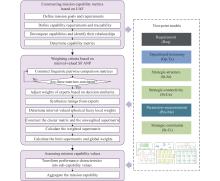
Fig 1
Overview of the proposed method"
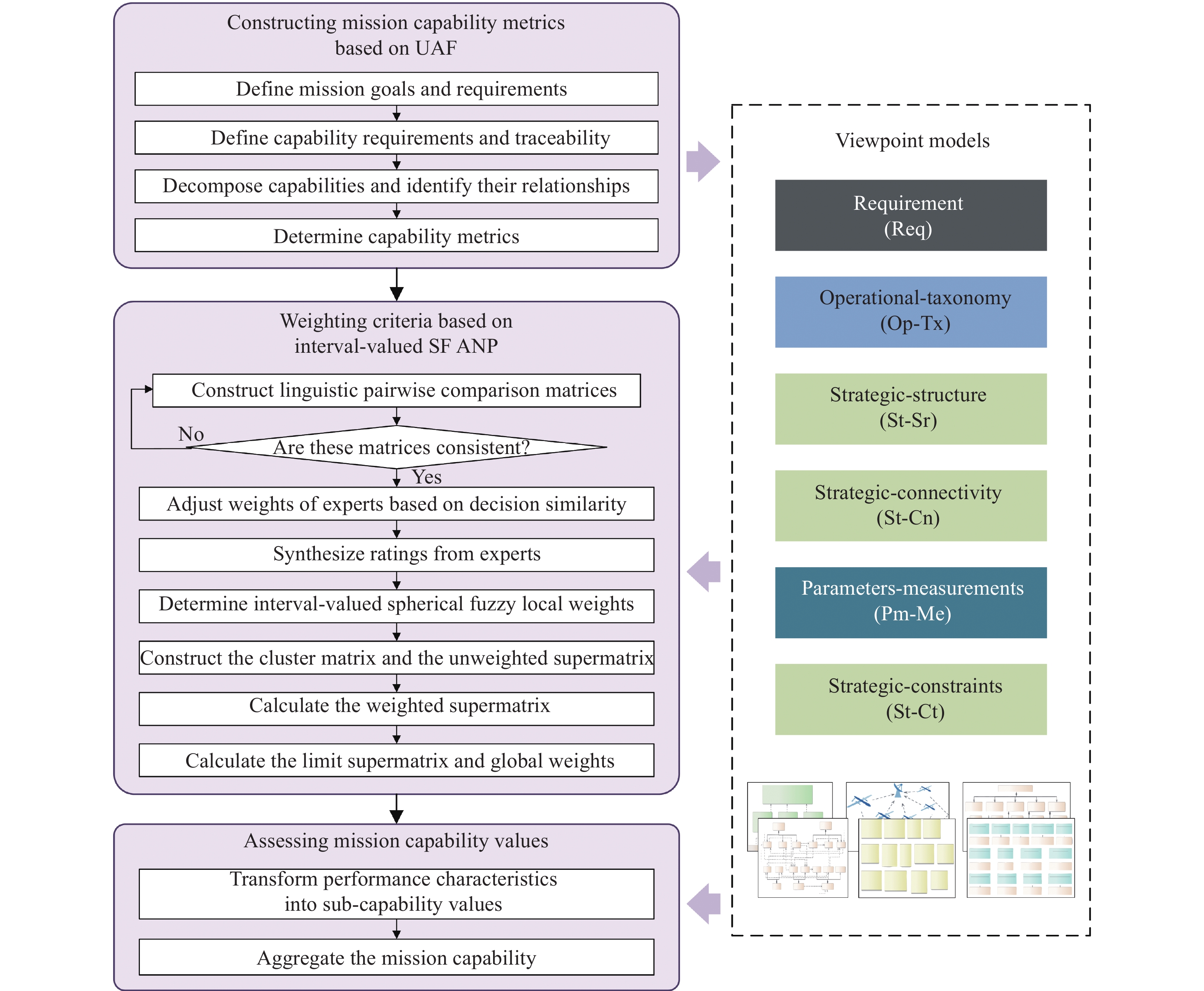
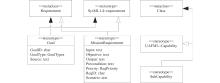
Fig 2
Meta-model of extension on the goal, mission requirement, and sub-capability based on SysML and UAFML"
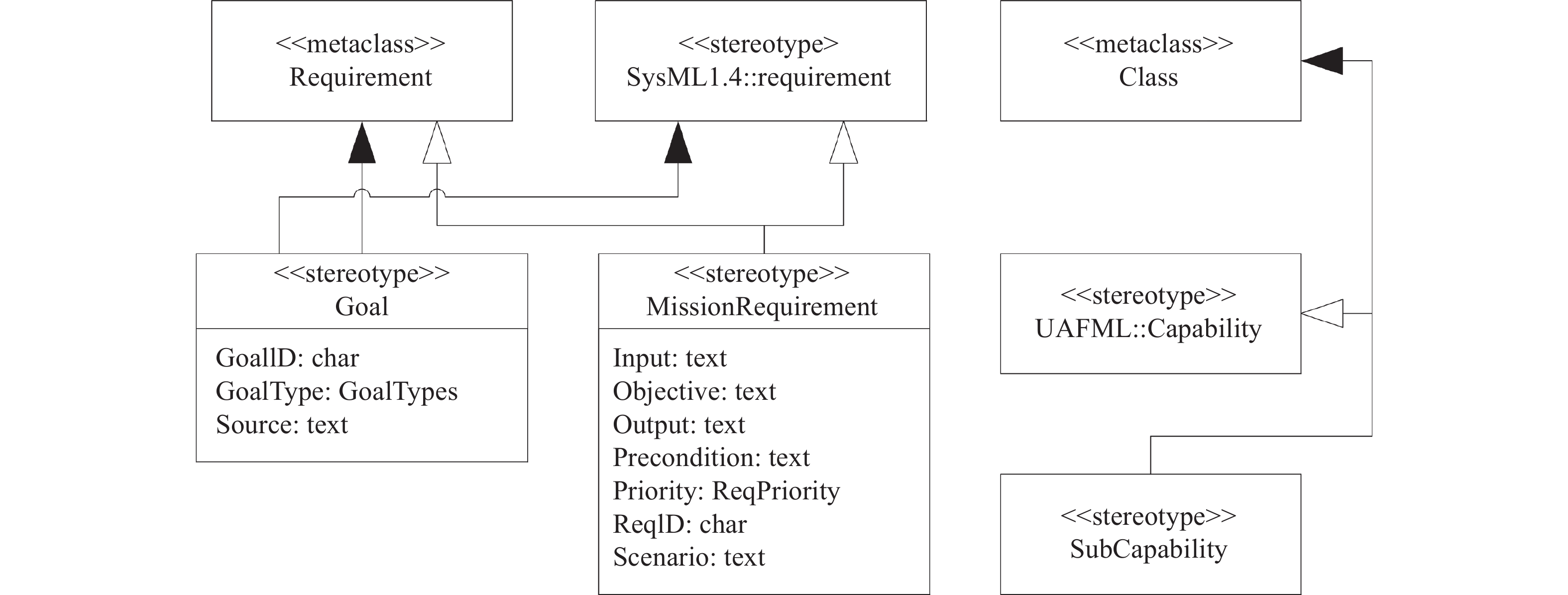

Table 1
Linguistic terms in IVSF-ANP"
| Linguistic term | IVSFN | Consistency scale |
| Equally important (EI) | ([0.45, 0.55], [0.45, 0.55], [0.30, 0.40]) | 1 |
| Moderately more important (MMI) | ([0.55, 0.65], [0.35, 0.45], [0.25, 0.30]) | 3 |
| Strongly more important (SMI) | ([0.65, 0.75], [0.25, 0.35], [0.20, 0.25]) | 5 |
| Very strongly more important (VSMI) | ([0.75, 0.85], [0.15, 0.25], [0.15, 0.20]) | 7 |
| Absolutely more important (AMI) | ([0.85, 0.95], [0.05, 0.15], [0.05, 0.15]) | 9 |
| Moderately less important (MLI) | ([0.35, 0.45], [0.55, 0.65], [0.25, 0.30]) | 1/3 |
| Strongly less important (SLI) | ([0.25, 0.35], [0.65, 0.75], [0.20, 0.25]) | 1/5 |
| Very Strongly less important (VSLI) | ([0.15, 0.25], [0.75, 0.85], [0.15, 0.20]) | 1/7 |
| Absolutely less important (ALI) | ([0.05, 0.15], [0.85, 0.95], [0.05, 0.15]) | 1/9 |
Fig 3
Nonlinear transformation functions for different measurements"
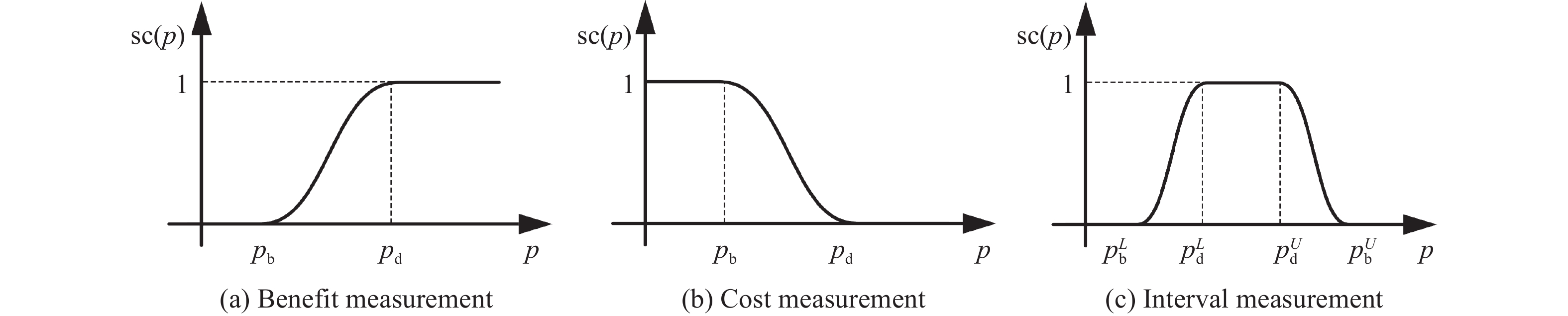
Fig 4
Req viewpoint with links to capability requirements"
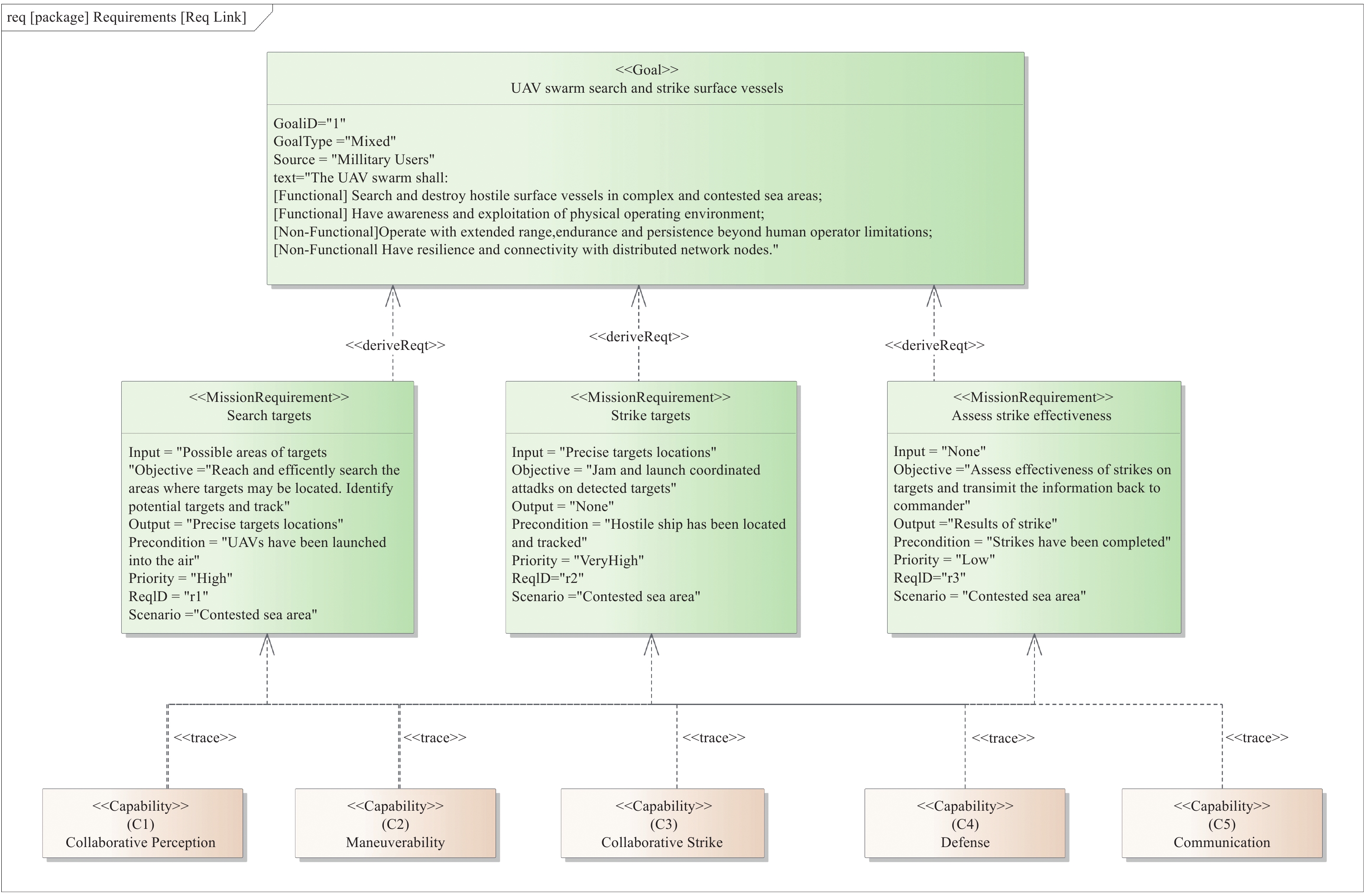
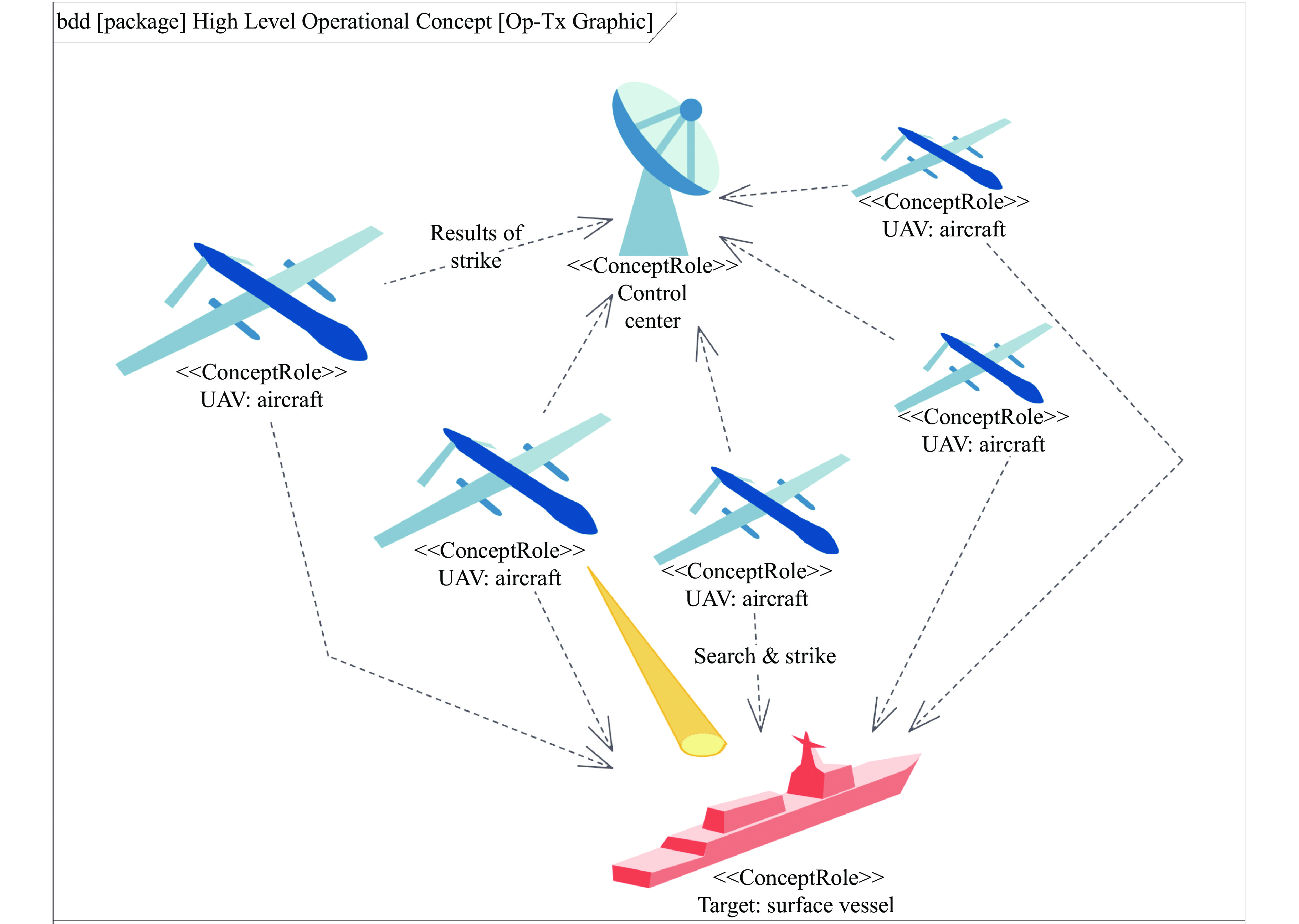
Fig 5
Op-Tx viewpoint with graphics"
Fig 6
St-Sr viewpoint"
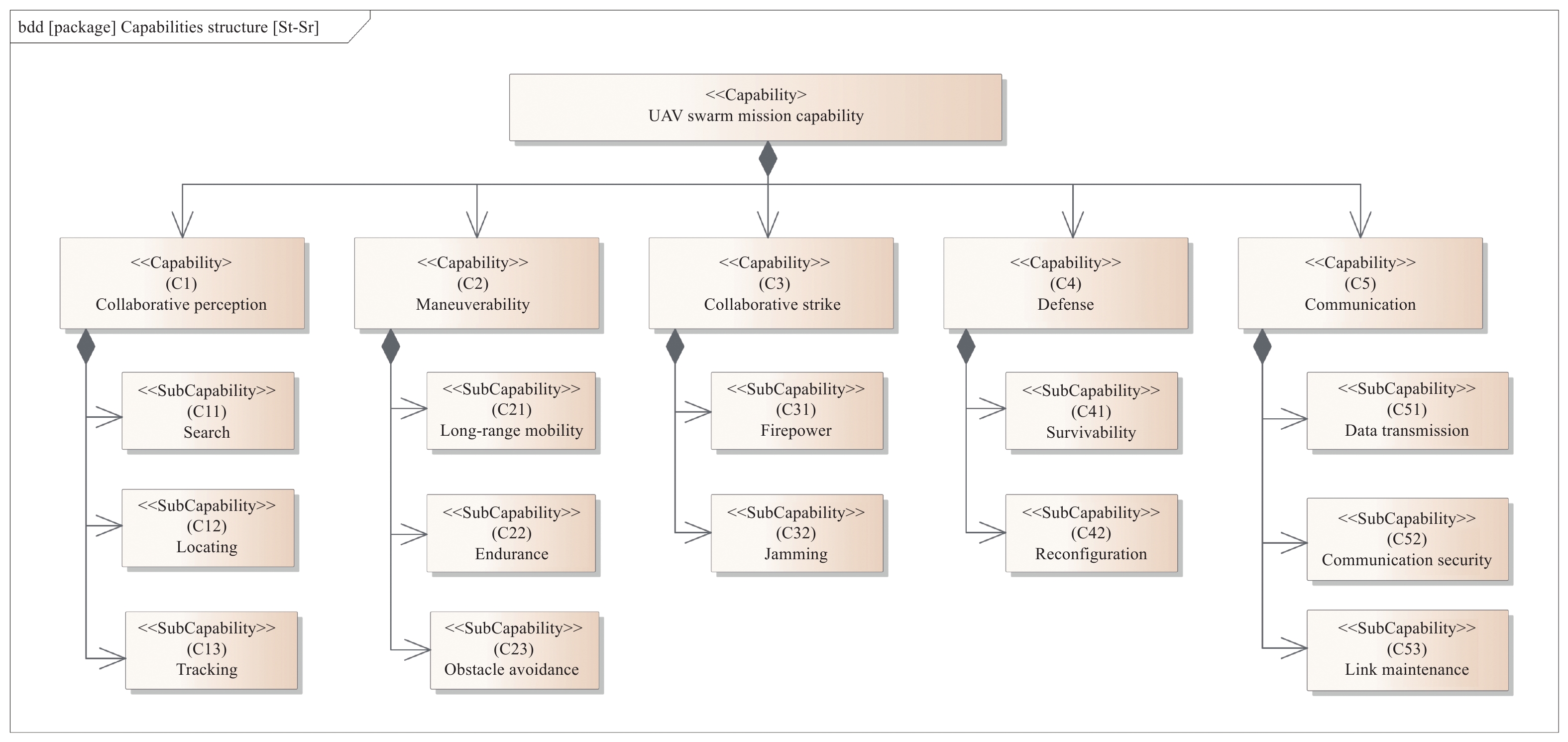
Fig 7
St-Cn viewpoint"
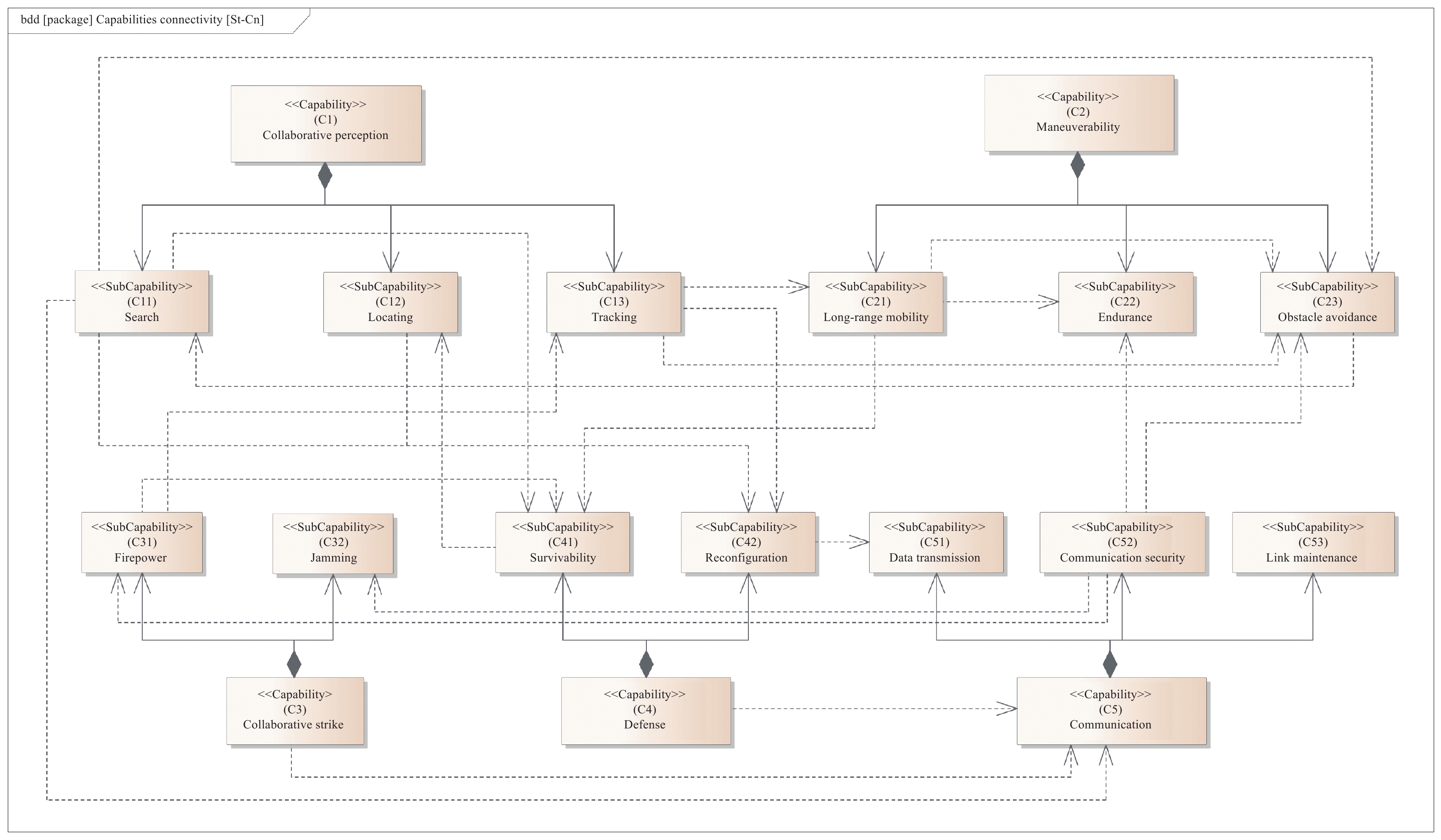
Fig 8
Pm-Me viewpoint"
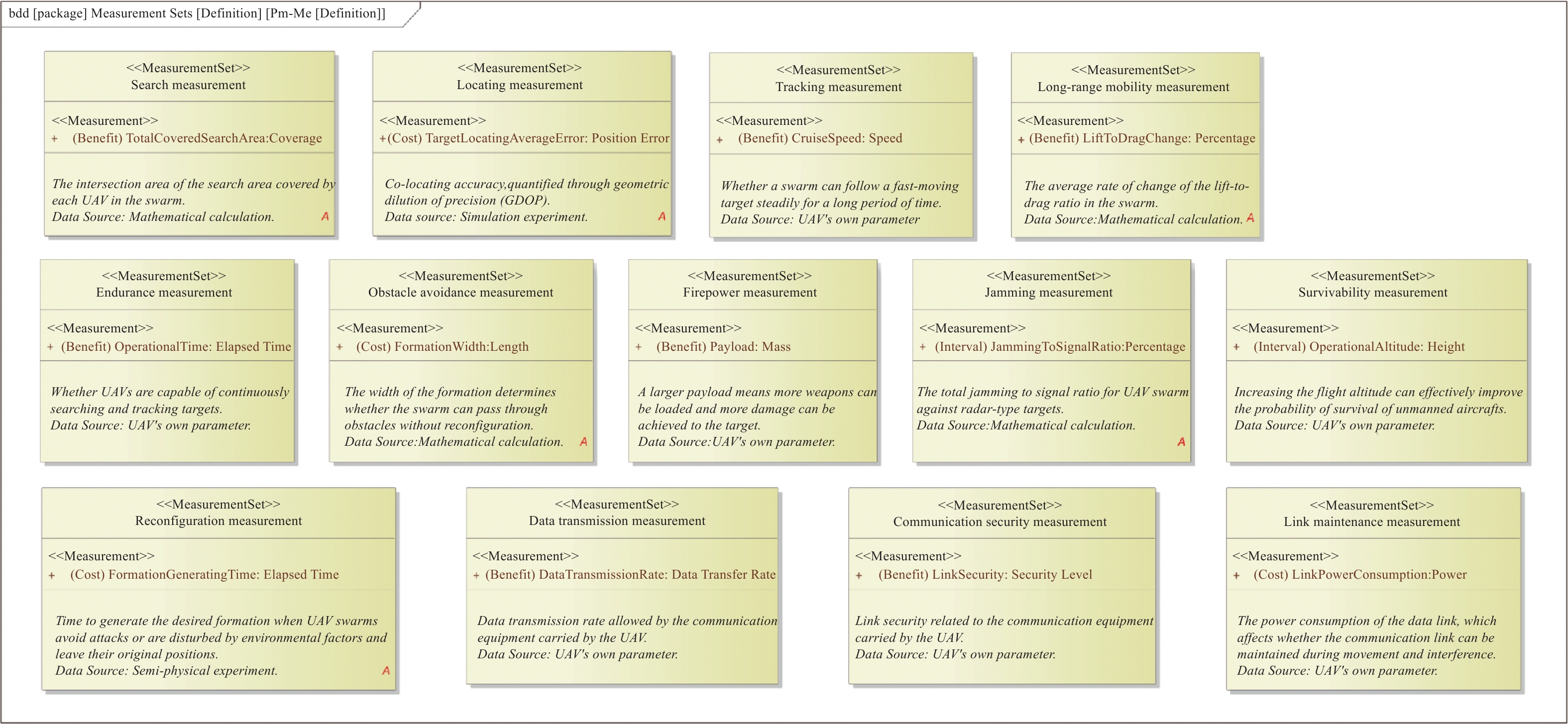
Fig 9
St-Ct viewpoint"
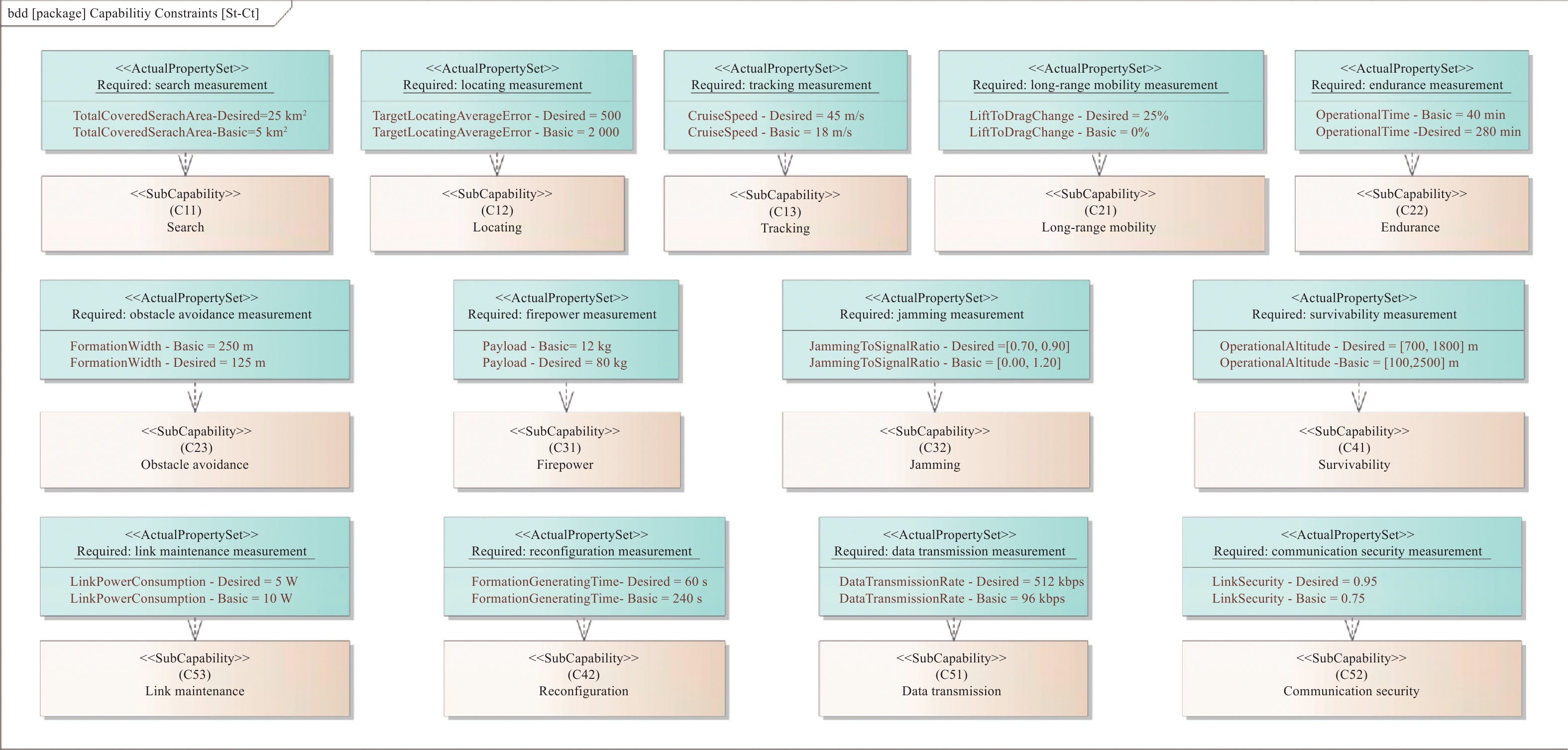
Table 2
Parameters of the UAVs comprising each swarm"
| UAV parameter | UAV1 | UAV2 | UAV3 | UAV4 | UAV5 |
| Search radius/m | 2000 | ||||
| Direction locating error | 1 | 0.8 | 1.3 | 1.5 | 0.7 |
| Cruise speed/(m/s) | 20 | 25 | 40 | 50 | 30 |
| Wingspan/m | 3.5 | 3.4 | 4.2 | 4 | 2 |
| Wing area/m2 | 1.6 | 1.22 | 1.5 | 1.2 | 0.4 |
| Lift coefficient | 0.50 | 0.98 | 0.26 | 0.60 | 1.02 |
| Drag coefficient | 0.035 | 0.016 | 0.035 | 0.038 | 0.040 |
| Lift curve slope | 0.089 | 0.092 | 0.041 | 0.089 | 0.150 |
| Operational time/min | 180 | 120 | 240 | 520 | 60 |
| Payload/kg | 40 | 30 | 60 | 120 | 15 |
| Jamming coefficient | 1 | 1.2 | 0.9 | 0.8 | 0.7 |
| Operational altitude/m | 2000 | 500 | |||
| Data transmission rate/kbps | 640 | 115 | 128 | 276 | 212 |
| Link security | 0.85 | 0.93 | 0.81 | 0.78 | 0.8 |
| Link power consumption/W | 13.5 | 6.7 | 5 | 3.2 | 7.8 |
Table 3
UAV swarms performance characteristics"
| Performance characteristic | S1 | S2 | S3 | S4 | S5 |
| Total covered search area/km2 | 29.69 | 13.51 | 20.81 | 11.03 | 7.78 |
| Target locating average error | 909.1 | ||||
| Cruise speed/(m/s) | 20 | 25 | 40 | 50 | 30 |
| Lift to drag change | 0.25 | 0.16 | 0.12 | 0.08 | 0.14 |
| Operational time/min | 180 | 120 | 240 | 520 | 60 |
| Formation width/m | 182.68 | 213.45 | 178.06 | 243.62 | 169.66 |
| Payload of single UAV/kg | 40 | 30 | 60 | 120 | 15 |
| Jamming to signal ratio | 0.74 | 0.89 | 0.66 | 0.59 | 0.52 |
| Operational altitude/m | 2000 | 500 | |||
| Formation generating time/s | 99.62 | 87.24 | 278.55 | 153.56 | 213.23 |
| Data transmission rate/kbps | 640 | 115 | 128 | 276 | 212 |
| Link security | 0.85 | 0.93 | 0.81 | 0.78 | 0.8 |
| Link power consumption/W | 13.5 | 6.7 | 5 | 3.2 | 7.8 |
Table 4
Linguistic comparison matrices and consistency ratios for sub-capabilities in C5 with respect to C42"
| Expert | Sub-capability | C51 | C52 | C53 | CR |
| Expert 1 | C51 | EI | VSMI | SMI | 0.012 |
| C52 | VSLI | EI | EI | ||
| C53 | SLI | EI | EI | ||
| Expert 2 | C51 | EI | SMI | MMI | 0.037 |
| C52 | SLI | EI | MLI | ||
| C53 | MLI | MMI | EI | ||
| Expert 3 | C51 | EI | VSMI | MMI | 0.062 |
| C52 | VSLI | EI | SLI | ||
| C53 | MLI | SMI | EI |
Table 5
Decision similarity matrix for sub-capabilities in C5 with respect to C42"
| Expert | Expert 1 | Expert 2 | Expert 3 |
| Expert 1 | 1 | 0.930 | 0.911 |
| Expert 2 | 0.930 | 1 | 0.976 |
| Expert 3 | 0.911 | 0.976 | 1 |
Table 6
Synthesized ratings and corresponding local weights in IVSFN forms for sub-capabilities in C5 with respect to C42"
| With respect to C42 | C51 | C52 | C53 | Local weight |
| C51 | ([0.45, 0.55], [0.45, 0.55], [0.30, 0.40]) | ([0.68, 0.79], [0.24, 0.33], [0.18, 0.24]) | ([0.48, 0.58], [0.42, 0.52], [0.28, 0.37]) | ([0.56, 0.66], [0.36, 0.46], [0.25, 0.35]) |
| C52 | ([0.15, 0.28], [0.73, 0.85], [0.16, 0.22]) | ([0.45, 0.55], [0.45, 0.55], [0.30, 0.40]) | ([0.35, 0.45], [0.55, 0.65], [0.25, 0.30]) | ([0.35, 0.45], [0.57, 0.67], [0.25, 0.34]) |
| C53 | ([0.41, 0.51], [0.49, 0.59], [0.28, 0.36]) | ([0.55, 0.65], [0.35, 0.45], [0.25, 0.30]) | ([0.45, 0.55], [0.45, 0.55], [0.30, 0.40]) | ([0.48, 0.58], [0.43, 0.53], [0.28, 0.37]) |
Table 7
Unweighted supermatrix"
| Criterion | C1 | C2 | C3 | C4 | C5 | |||||||||||||
| C11 | C12 | C13 | C21 | C22 | C23 | C31 | C32 | C41 | C42 | C51 | C52 | C53 | ||||||
| C1 | C11 | 0 | 0 | 0 | 0 | 0 | 1 | 0 | 0 | 0 | 0 | 0 | 0 | 0 | ||||
| C12 | 0 | 0 | 0 | 0 | 0 | 0 | 0 | 0 | 1 | 0 | 0 | 0 | 0 | |||||
| C13 | 0 | 0 | 0 | 0 | 0 | 0 | 1 | 0 | 0 | 0 | 0 | 0 | 0 | |||||
| C2 | C21 | 0 | 0 | 0 | 0 | 0 | 0 | 0 | 0 | 0 | 0 | 0 | 0 | |||||
| C22 | 0 | 0 | 0 | 0 | 0 | 0 | 0 | 0 | 0 | 0 | 0 | |||||||
| C23 | 1 | 0 | 0 | 0 | 0 | 0 | 0 | 0 | 0 | 0 | ||||||||
| C3 | C31 | 0 | 0 | 0 | 0 | 0 | 0 | 0 | 0 | 0 | 0 | 0 | 0 | |||||
| C32 | 0 | 0 | 0 | 0 | 0 | 0 | 0 | 0 | 0 | 0 | 0 | 0 | ||||||
| C4 | C41 | 0 | 0 | 1 | 0 | 0 | 1 | 0 | 0 | 0 | 0 | 0 | 0 | |||||
| C42 | 1 | 1 | 0 | 0 | 0 | 0 | 0 | 0 | 0 | 0 | 0 | 0 | ||||||
| C5 | C51 | 0 | 0 | 0 | 0 | 0 | 0 | 0 | 0 | |||||||||
| C52 | 0 | 0 | 0 | 0 | 0 | 0 | 0 | 0 | ||||||||||
| C53 | 0 | 0 | 0 | 0 | 0 | 0 | 0 | 0 | ||||||||||
Table 8
Cluster matrix"
| Capability | C1 | C2 | C3 | C4 | C5 |
| C1 | 0 | 0 | |||
| C2 | 0 | 0 | |||
| C3 | 0 | 0 | 0 | 0 | |
| C4 | 0 | 0 | |||
| C5 | 0 | 0 |
Table 9
Global weights of sub-capabilities"
| Capability | Sub-capability | Global weight |
| C1 | C11 | |
| C12 | ||
| C13 | ||
| C2 | C21 | |
| C22 | ||
| C23 | ||
| C3 | C31 | |
| C32 | ||
| C4 | C41 | |
| C42 | ||
| C5 | C51 | |
| C52 | ||
| C53 |
Table 10
Sub-capability values of each UAV swarm"
| Sub-capability | S1 | S2 | S3 | S4 | S5 |
| C11 | |||||
| C12 | |||||
| C13 | |||||
| C21 | |||||
| C22 | |||||
| C23 | |||||
| C31 | |||||
| C32 | |||||
| C41 | |||||
| C42 | |||||
| C51 | |||||
| C52 | |||||
| C53 |
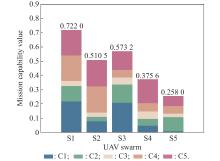
Fig 10
Mission capability values of the alternative UAV swarms"
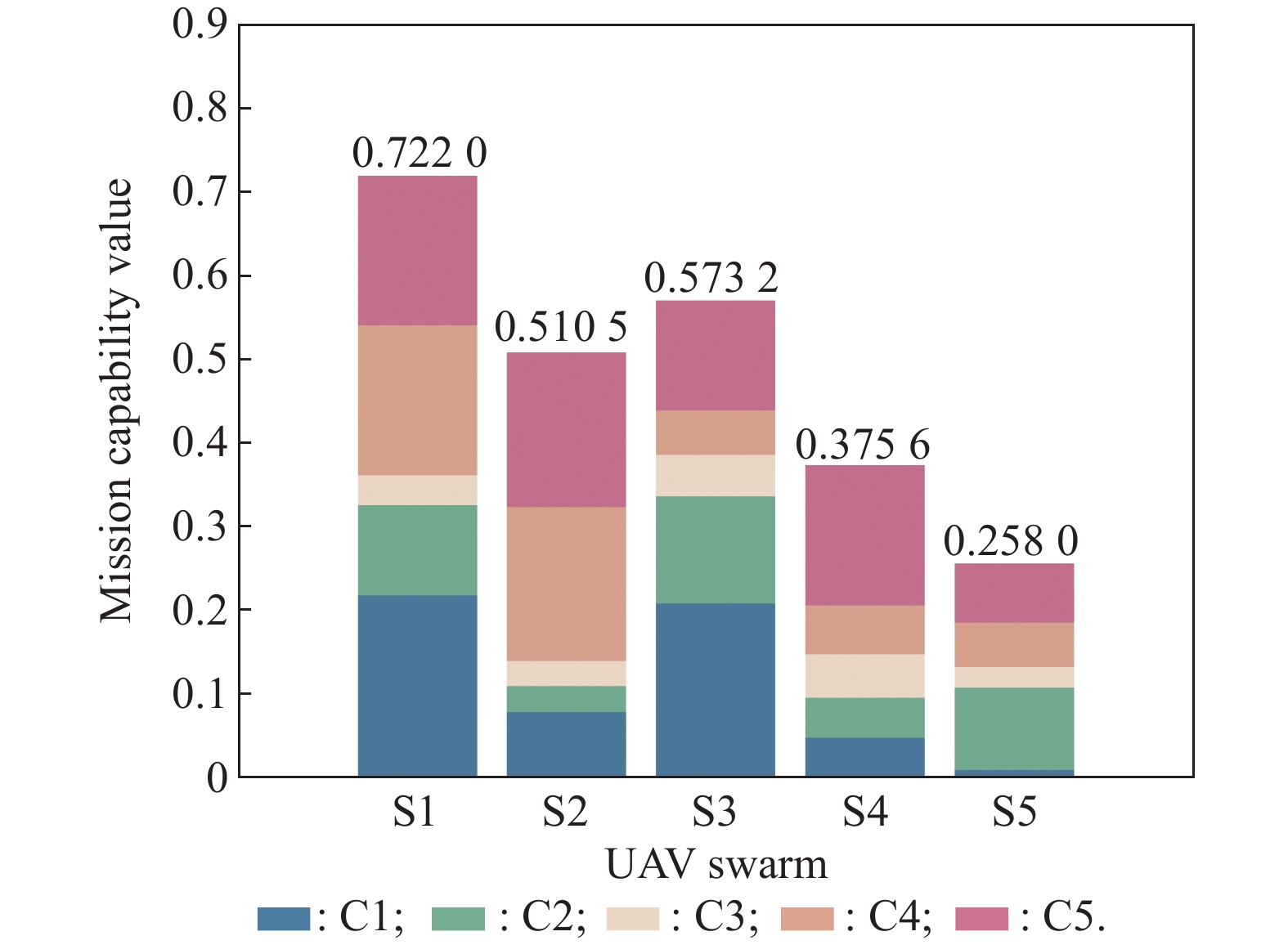
Table 11
Mission capability values obtained by ANP, FANP, SF-ANP, and IVSF-ANP"
| Method | S1 | S2 | S3 | S4 | S5 |
| ANP | |||||
| FANP | |||||
| SF-ANP | |||||
| IVSF-ANP |
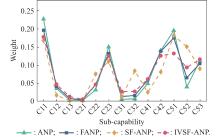
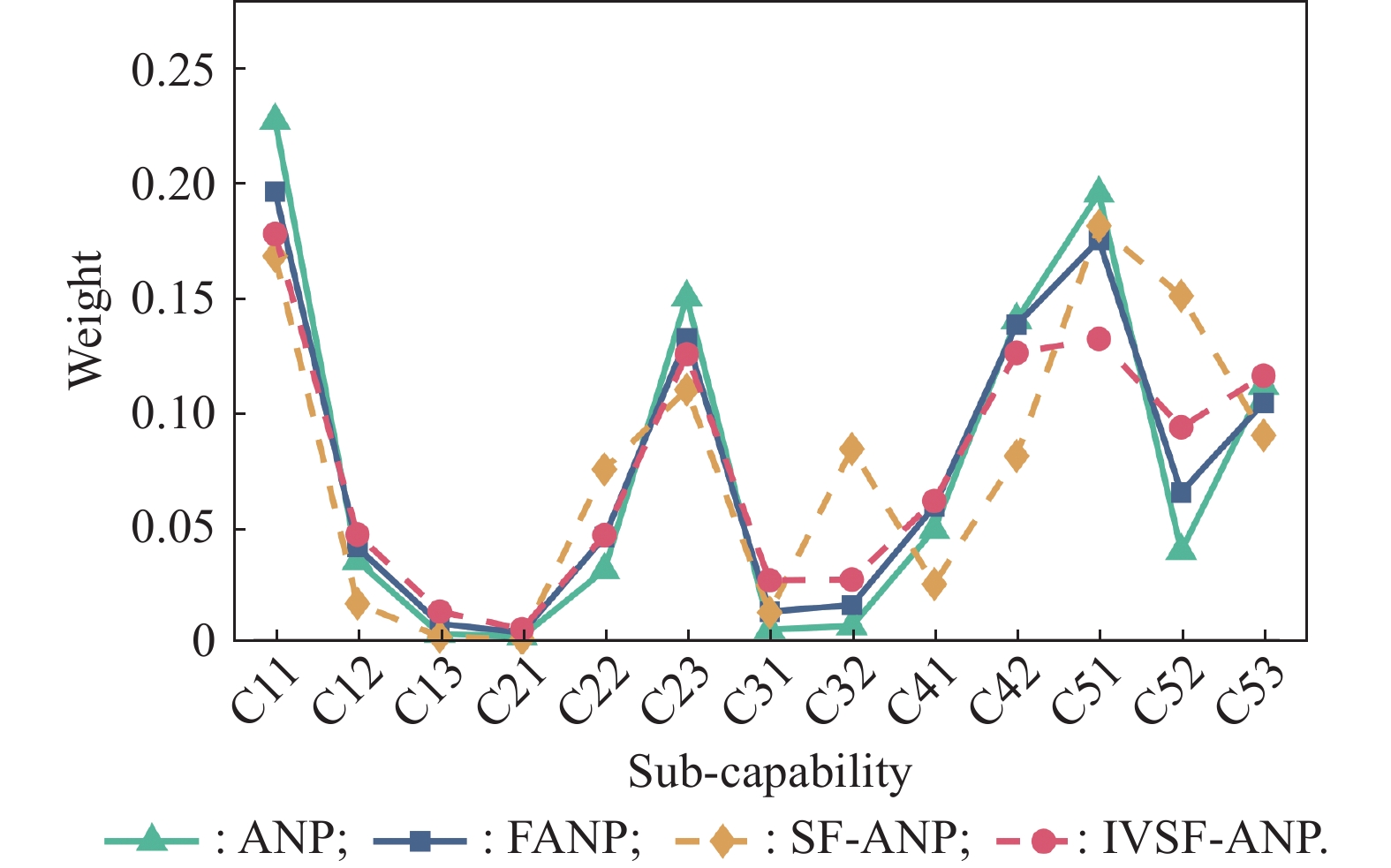
Fig 11
Comparison of the weights of sub-capabilities obtained by ANP, FANP, SF-ANP, and IVSF-ANP"
| 1 |
ZHEN Z Y, CHEN Y, WEN L D, et al An intelligent cooperative mission planning scheme of UAV swarm in uncertain dynamic environment. Aerospace Science and Technology, 2020, 100, 105826.
doi: 10.1016/j.ast.2020.105826 |
| 2 |
GAO N, LIANG L, CAI D H, et al Coverage control for UAV swarm communication networks: a distributed learning approach. IEEE Internet of Things Journal, 2022, 9 (20): 19854- 19867.
doi: 10.1109/JIOT.2022.3170123 |
| 3 |
, LIU R, SUN L, et al UAV swarm based radar signal sorting via multi-source data fusion: a deep transfer learning framework. Information Fusion, 2022, 78, 90- 101.
doi: 10.1016/j.inffus.2021.09.007 |
| 4 | DUAN X B, FAN Q C, BI W H, et al Belief Exponential Divergence for D-S Evidence Theory and its Application in Multi-Source Information Fusion. Journal of Systems Engineering and Electronics, 2024, 35 (6): 1454- 1468. |
| 5 | XIAO Z W, FU X W A Cooperative Detection Game: UAV Swarm vs. One Fast Intruder. Journal of Systems Engineering and Electronics, 2023, 34 (6): 1565- 1575. |
| 6 | HONG L, GUO H Z, LIU J J, et al Toward swarm coordination: topology-aware inter-UAV routing optimization. IEEE Trans. on Vehicular Technology, 2020, 69 (9): 10177- 10187. |
| 7 | LIU C, AKBAR A, WU H B, et al Mission capability estimation of multicopter UAV for low-altitude remote sensing. Journal of Intelligent & Robotic Systems, 2020, 100 (2): 667- 688. |
| 8 |
, et al A baseline-resilience assessment method for UAV swarms under heterogeneous communication networks. IEEE Systems Journal, 2022, 16 (4): 6107- 6118.
doi: 10.1109/JSYST.2022.3197324 |
| 9 | , et al Mission reliability modeling of UAV swarm and its structure optimization based on importance measure. Reliability Engineering & System Safety, 2021, 215, 107879. |
| 10 |
FEI L G D-ANP: a multiple criteria decision making method for supplier selection. Applied Intelligence, 2020, 50 (8): 2537- 2554.
doi: 10.1007/s10489-020-01639-x |
| 11 |
SANCHEZ-LOZANO J M, RODRIGUEZ O N Application of fuzzy reference ideal method (FRIM) to the military advanced training aircraft selection. Applied Soft Computing, 2020, 88, 106061.
doi: 10.1016/j.asoc.2020.106061 |
| 12 | SUN Y K, FANG Z G Research on projection gray target model based on FANP-QFD for weapon system of systems capability evaluation. IEEE Systems Journal, 2021, 15 (3): 4126- 4136. |
| 13 |
COLAK M, KAYA I, KARASAN A, et al Two-phase multi-expert knowledge approach by using fuzzy clustering and rule-based system for technology evaluation of unmanned aerial vehicles. Neural Computing and Applications, 2022, 34 (7): 5479- 5495.
doi: 10.1007/s00521-021-06694-0 |
| 14 |
ORJI I J, KUSI-SARPONG S, HUANG S F, et al Evaluating the factors that influence blockchain adoption in the freight logistics industry. Transportation Research Part E: Logistics and Transportation Review, 2020, 141, 102025.
doi: 10.1016/j.tre.2020.102025 |
| 15 | MUNIM Z H, SORNN-FRIESE H, DUSHENKO M Identifying the appropriate governance model for green port management: applying analytic network process and best-worst methods to ports in the Indian Ocean rim. Journal of Cleaner Production, 2020, 268, 122156. |
| 16 |
SUN X, LIU H, WU G H, et al Training effectiveness evaluation of helicopter emergency relief based on virtual simulation. Chinese Journal of Aeronautics, 2018, 31 (10): 2000- 2012.
doi: 10.1016/j.cja.2018.08.011 |
| 17 |
MISTARIHI M Z, OKOUR R A, MUMANI A A An integration of a QFD model with Fuzzy-ANP approach for determining the importance weights for engineering characteristics of the proposed wheelchair design. Applied Soft Computing, 2020, 90, 106136.
doi: 10.1016/j.asoc.2020.106136 |
| 18 | DEV N K, SHANKAR R, GUPTA R, et al Multi-criteria evaluation of real-time key performance indicators of supply chain with consideration of big data architecture. Computers & Industrial Engineering, 2019, 128, 1076- 1087. |
| 19 |
GUO J, CHEN Y Y, HAO D P, et al A multi-criteria decision-making approach to help resource-exhausted areas choose suitable transformation templates-The example of Wansheng in Chongqing, China. Ain Shams Engineering Journal, 2022, 13 (5): 101709.
doi: 10.1016/j.asej.2022.101709 |
| 20 |
SAHIN B, SOYLU A Intuitionistic fuzzy analytical network process models for maritime supply chain. Applied Soft Computing, 2020, 96, 106614.
doi: 10.1016/j.asoc.2020.106614 |
| 21 |
, et al Intuitionistic fuzzy analytic network process. IEEE Trans. on Fuzzy Systems, 2018, 26 (5): 2578- 2590.
doi: 10.1109/TFUZZ.2017.2788881 |
| 22 |
GAO J W, GUO F J, MA Z Y, et al Multi-criteria decision-making framework for large-scale rooftop photovoltaic project site selection based on intuitionistic fuzzy sets. Applied Soft Computing, 2021, 102, 107098.
doi: 10.1016/j.asoc.2021.107098 |
| 23 | PENG Z X, HE L N, XIE Y S, et al A Pythagorean fuzzy ANP-QFD-Grey relational analysis approach to prioritize design requirements of sustainable supply chain. Journal of Intelligent & Fuzzy Systems, 2022, 42 (4): 3893- 3907. |
| 24 |
MAHMOOD T, ULLAH K, KHAN Q, et al An approach toward decision-making and medical diagnosis problems using the concept of spherical fuzzy sets. Neural Computing and Applications, 2019, 31 (11): 7041- 7053.
doi: 10.1007/s00521-018-3521-2 |
| 25 |
BROOKS M, HAUSE M Making the puzzle pieces fit—utilizing UAF to model a cybersecurity SoS. Insight, 2022, 25 (2): 51- 55.
doi: 10.1002/inst.12387 |
| 26 |
HAUSE M, BLEAKLEY G, MORKEVICIUS A Technology update on the unified architecture framework (UAF). Insight, 2017, 20 (2): 71- 78.
doi: 10.1002/inst.12153 |
| 27 | Object Management Group. Unified architecture framework modeling language (UAFML). https://www.omg.org/spec/UAF/1.2/UAFML/PDF. |
| 28 | ZHANG Y C, XING C G, WANG Q, et al. A UAF based method for next generation air traffic management system development. Proc. of the International Conference on Guidance, Navigation and Control, 2020: 4053−4063. |
| 29 | EICHMANN O C, MELZER S, GOD R. Model-based development of a system of systems using unified architecture framework (UAF): a case study. Proc. of the 13th IEEE International Systems Conference, 2019. DOI: 10.1109/SYSCON.2019.8836749. |
| 30 | KUTLU GUNDOGDU F, KAHRAMAN C Spherical fuzzy sets and spherical fuzzy TOPSIS method. Journal of Intelligent & Fuzzy Systems, 2019, 36 (1): 337- 352. |
| 31 |
ERDOGAN M, KAYA I, KARASAN A, et al Evaluation of autonomous vehicle driving systems for risk assessment based on three-dimensional uncertain linguistic variables. Applied Soft Computing, 2021, 113, 107934.
doi: 10.1016/j.asoc.2021.107934 |
| 32 |
KUTLU GUNDOGDU F, KAHRAMAN C A novel fuzzy TOPSIS method using emerging interval-valued spherical fuzzy sets. Engineering Applications of Artificial Intelligence, 2019, 85, 307- 323.
doi: 10.1016/j.engappai.2019.06.003 |
| 33 |
MENEKSE A, CAMGOZ-AKDAG H Internal audit planning using spherical fuzzy ELECTRE. Applied Soft Computing, 2022, 114, 108155.
doi: 10.1016/j.asoc.2021.108155 |
| 34 |
JIN C X, RAN Y, WANG Z C, et al Prioritization of key quality characteristics with the three-dimensional HoQ model-based interval-valued spherical fuzzy-ORESTE method. Engineering Applications of Artificial Intelligence, 2021, 104, 104271.
doi: 10.1016/j.engappai.2021.104271 |
| 35 |
AYDOGDU A, GUL S New entropy propositions for interval-valued spherical fuzzy sets and their usage in an extension of ARAS (ARAS-IVSFS). Expert Systems, 2022, 39 (4): e12898.
doi: 10.1111/exsy.12898 |
| 36 | ERDOGAN M Assessing farmers’ perception to Agriculture 4. 0 technologies: a new interval-valued spherical fuzzy sets based approach. International Journal of Intelligent Systems, 2022, 37 (2): 1751- 1801. |
| 37 | BOGGERO L, CIAMPA P D, NAGEL B. An MBSE architectural framework for the agile definition of system stakeholders, needs and requirements. Proc. of the 15th Annual Conference on Systems Engineering Research, 2021. DOI: 10.5281/2enodo.5735150. |
| 38 | Chief of Naval Operations. Navy aviation vision 2030-2035. https://media.defense.gov/2021/Oct/27/2002881262/-1/-1/0/NAVY%20AVIATION%20VISION%202030-2035_FNL.PDF. |
| 39 | LIN X H, CHENG Z F, YU Y, et al Optimal configuration method for maritime UAVs cooperative DOA localization. Fire Control & Command Control, 2021, 46 (12): 9- 14. |
| 40 |
PACHTER M, D'AZZO J J, PROUD A W Tight formation flight control. Journal of Guidance, Control, and Dynamics, 2001, 24 (2): 246- 254.
doi: 10.2514/2.4735 |
| 41 | KIM J, HESPANHA J P. Cooperative radar jamming for groups of unmanned air vehicles. Proc. of the 43rd IEEE Conference on Decision and Control, 2004: 632−637. |
| 42 |
YANG P, ZHANG A, ZHOU D Event-triggered finite-time formation control for multiple unmanned aerial vehicles with input saturation. International Journal of Control, Automation and Systems, 2021, 19 (5): 1760- 1773.
doi: 10.1007/s12555-019-0833-7 |
| [1] | Meigen HUANG, Tao WANG, Tian JING, Song YANG, Xin ZHOU, Hua HE. Case-based reasoning of operation strategies recommendation for UAV swarm [J]. Journal of Systems Engineering and Electronics, 2025, 36(6): 1548-1561. |
| [2] | Yuelong LUO, Xiuqiang JIANG, Suchuan ZHONG, Yuandong JI. Air-to-ground reconnaissance-attack task allocation for heterogeneous UAV swarm [J]. Journal of Systems Engineering and Electronics, 2025, 36(1): 155-175. |
| [3] | Yimin FENG, Ping GE, Yanli SHAO, Qiang ZOU, Yusheng LIU. UAF-based integration of design and simulation model for system-of-systems [J]. Journal of Systems Engineering and Electronics, 2025, 36(1): 108-126. |
| [4] | Zhiwen XIAO, Xiaowei FU. A cooperative detection game: UAV swarm vs. one fast intruder [J]. Journal of Systems Engineering and Electronics, 2023, 34(6): 1565-1575. |
| [5] | Boyu QIN, Dong ZHANG, Shuo TANG, Yang XU. Two-layer formation-containment fault-tolerant control of fixed-wing UAV swarm for dynamic target tracking [J]. Journal of Systems Engineering and Electronics, 2023, 34(6): 1375-1396. |
| [6] | Yaozhong ZHANG, Yike LI, Zhuoran WU, Jialin XU. Deep reinforcement learning for UAV swarm rendezvous behavior [J]. Journal of Systems Engineering and Electronics, 2023, 34(2): 360-373. |
| [7] | Jie LI, Xiaoyu DANG, Sai LI. DQN-based decentralized multi-agent JSAP resource allocation for UAV swarm communication [J]. Journal of Systems Engineering and Electronics, 2023, 34(2): 289-298. |
| [8] | Hao LI, Hemin SUN, Ronghua ZHOU, Huainian ZHANG. Hybrid TDOA/FDOA and track optimization of UAV swarm based on A-optimality [J]. Journal of Systems Engineering and Electronics, 2023, 34(1): 149-159. |
| [9] | Yangyang JIANG, Yan GAO, Wenqi SONG, Yue LI, Quan QUAN. Bibliometric analysis of UAV swarms [J]. Journal of Systems Engineering and Electronics, 2022, 33(2): 406-425. |
| [10] | Jinqiang HU, Husheng WU, Renjun ZHAN, Rafik MENASSEL, Xuanwu ZHOU. Self-organized search-attack mission planning for UAV swarm based on wolf pack hunting behavior [J]. Journal of Systems Engineering and Electronics, 2021, 32(6): 1463-1476. |
| Viewed | ||||||
|
Full text |
|
|||||
|
Abstract |
|
|||||
