
Journal of Systems Engineering and Electronics ›› 2026, Vol. 37 ›› Issue (3): 767-778.doi: 10.23919/JSEE.2026.000066
• CROSS-DOMAIN ELECTROMAGNETIC PERCEPTION AND COMMUNICATION & NETWORKING TECHNOLOGY (PART I) • Previous Articles Next Articles
Yongsheng DUAN( ), Junning ZHANG(), Lei XUE(), Ying XU()
Received:2025-12-25
Accepted:2026-03-22
Online:2026-06-18
Published:2026-06-29
Contact:
Junning ZHANG
E-mail:406810103@qq.com;zjn20101796@sina.cn;eeixuelei@163.com;eeixuying@163.com
Supported by:Yongsheng DUAN, Junning ZHANG, Lei XUE, Ying XU. RF-IRSynNet: cross-modal radio frequency-infrared fusion for robust UAV recognition[J]. Journal of Systems Engineering and Electronics, 2026, 37(3): 767-778.
Add to citation manager EndNote|Reference Manager|ProCite|BibTeX|RefWorks
Fig 1
Overview of the proposed RF-IRSynNet"
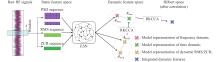
Fig 2
Dynamic feature extraction and association mapping within the model space"
Fig 3
Temporal transmission patterns of RF signal I/Q components"
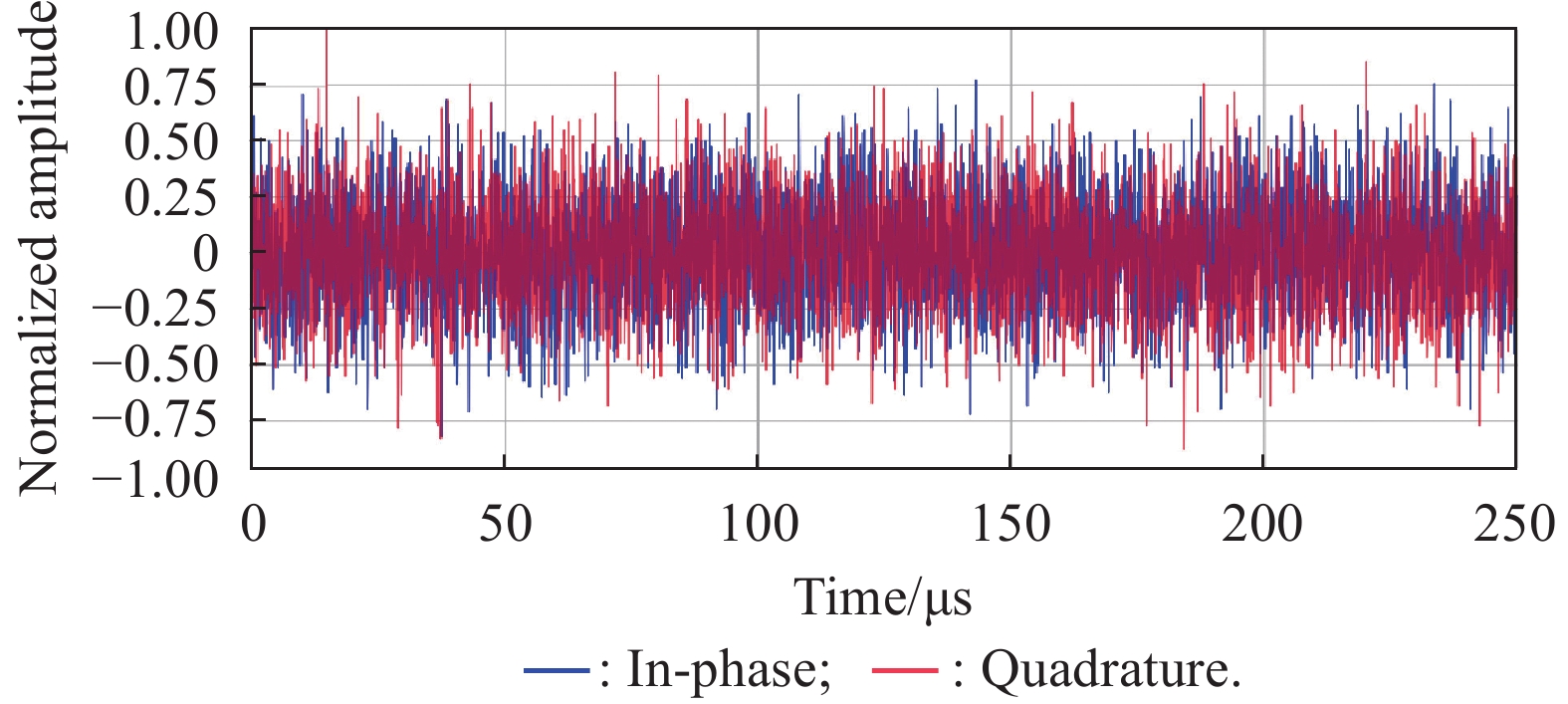
Fig 4
Sliding-window extracted PSD features of UAV RF signals"
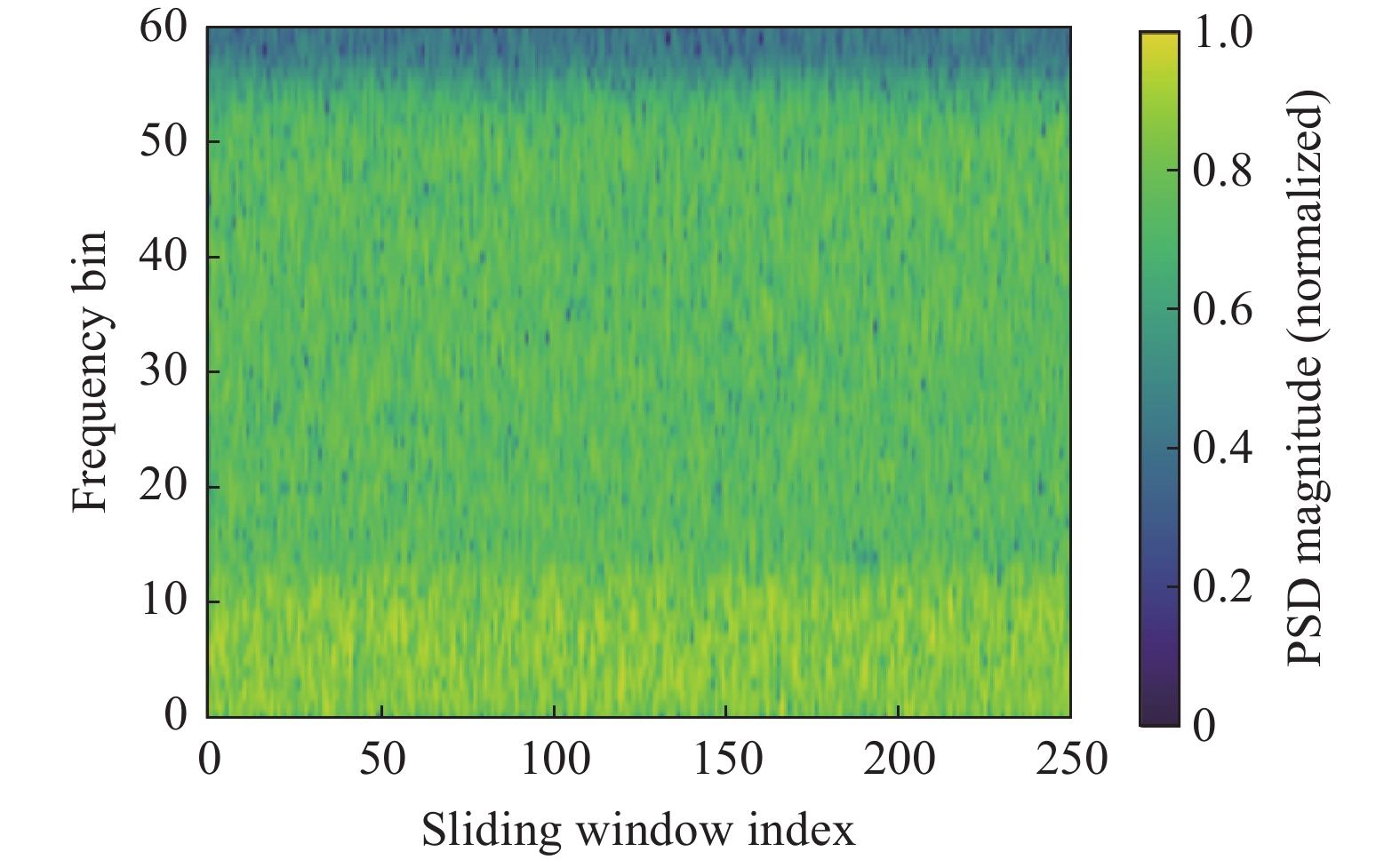
Fig 5
UAV image dataset showing visual degradation at 50 m and 200 m"
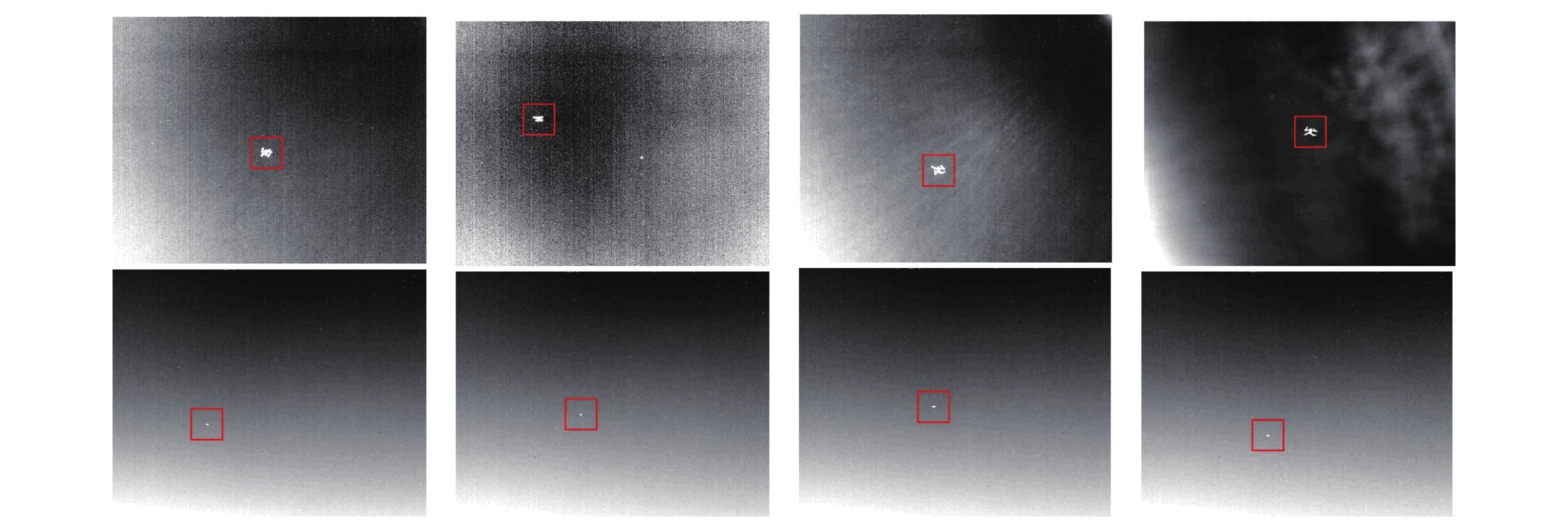

Table 1
Detection accuracy of different methods under various conditions"
| Algorithm | Modality | Distance/m | Train: Test Split/% | |||
| 50:50 | 60:40 | 70:30 | 80:20 | |||
| Faster R-CNN [ | Visual | 50 200 | 89.9 47.5 | 90.2 63.8 | 91.7 69.1 | 92.5 71.3 |
| YOLOv11 [ | Visual | 50 200 | 89.3 62.6 | 91.8 66.7 | 93.3 73.3 | 94.5 79.5 |
| RT-DETR [ | Visual | 50 200 | 88.9 60.4 | 86.1 68.5 | 92.7 74.8 | 95.3 81.7 |
| PSD+SVM [ | RF | 50 200 | 55.7 51.6 | 56.1 52.4 | 58.5 53.7 | 59.7 55.2 |
| ResNet50 [ | RF | 50 200 | 61.6 58.9 | 67.8 61.1 | 73.9 72.8 | 76.0 75.4 |
| RF-ESN | RF | 50 200 | 81.1 79.3 | 83.6 81.9 | 86.9 84.8 | 89.5 88.5 |
| 2DCNN+1DCNN [ | Visual+RF | 50 200 | 84.5 49.5 | 86.3 55.0 | 88.3 58.3 | 92.7 64.1 |
| Proposed method | Visual+RF | 50 200 | 92.6±1.3 90.4±1.6 | 93.8±1.1 92.0±1.3 | 96.7±0.8 93.6±1.0 | 98.0±0.5 94.5±0.9 |
| p-value (Proposed method vs. RT-DETR) | 50 | 3.15e-3 | 5.33e-4 | 1.72e-3 | 5.32e-3 | |
| p-value (Proposed method vs. RF-ESN) | 200 | 6.64e-6 | 1.51e-5 | 3.97e-5 | 1.19e-4 | |
Fig 6
UMAP visualization of feature representations"
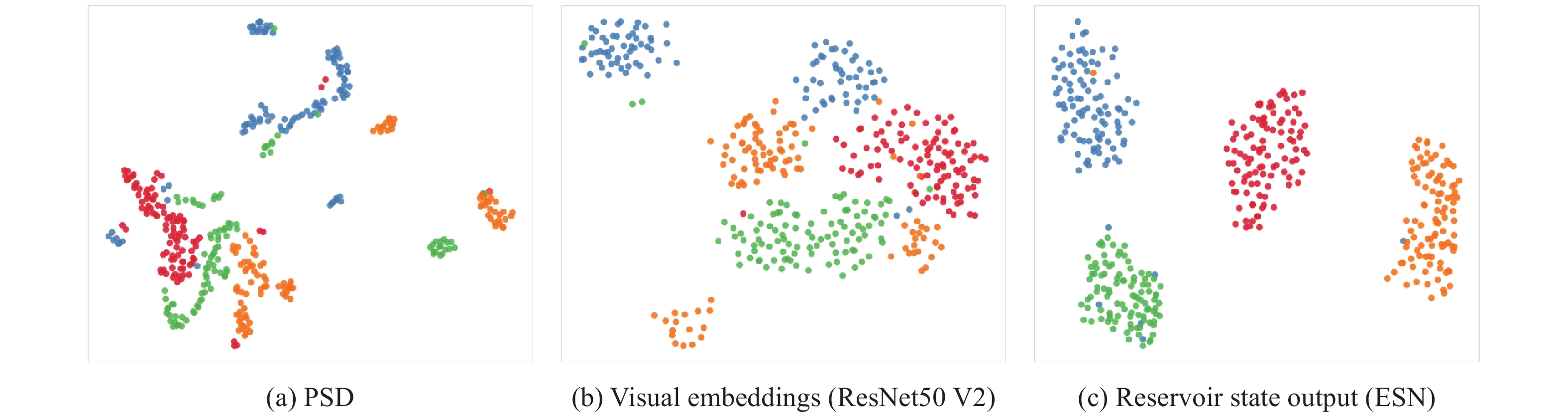
Table 2
Classification performance across modalities"
| Model | Accuracy | Precision | Recall | F1-score |
| Vision only | ||||
| RF only | ||||
| RF-IRSynNet |
Table 3
Detection accuracy of different methods under various conditions"
| Fold | Vision only | RF only | RF-IRSynNet |
| Fold 1 | |||
| Fold 2 | |||
| Fold 3 | |||
| Fold 4 | |||
| Fold 5 | |||
| Average (Std.) |
Fig 7
Multimodal fusion resolves visual-only model failures in challenging cases"
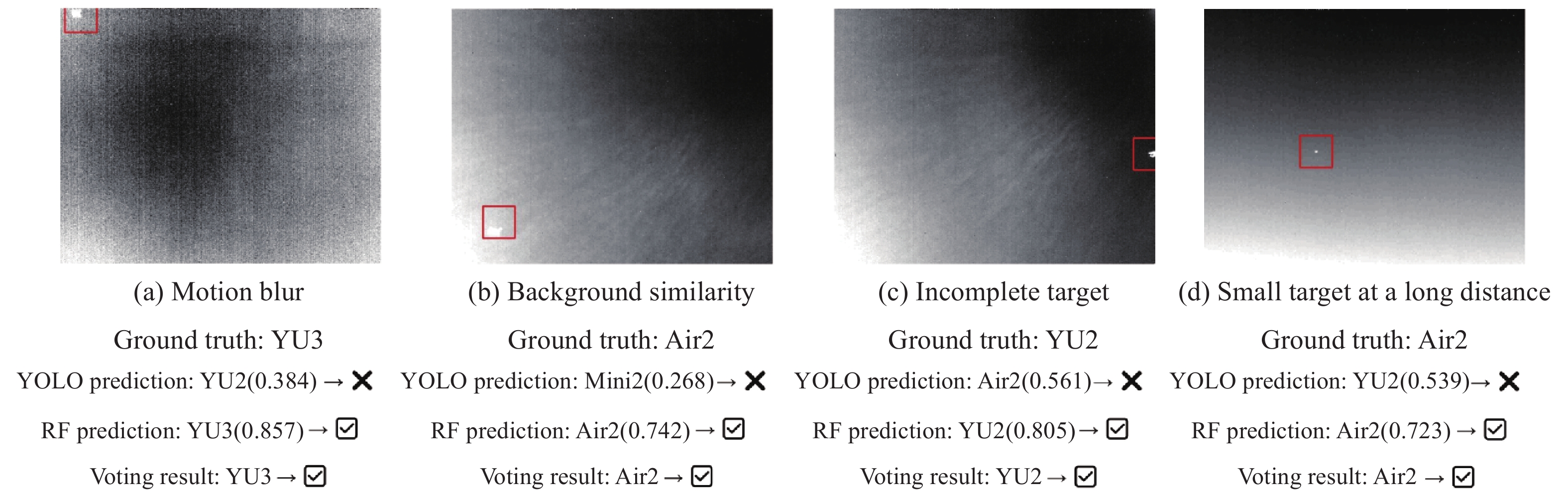
Table 4
Classification performance across modalities"
| Decision-making strategy | Accuracy | Precision | Recall | F1-score |
| Max confidence | ||||
| Soft confidence | ||||
| Weighted sum |
| 1 |
ZHANG H, GAO Y, WANG X, et al UAV swarm path planning for sensor data collection via double prepartitioned deep Q-network. IEEE Sensors Journal, 2025, 25 (17): 34091- 34103.
doi: 10.1109/JSEN.2025.3555602 |
| 2 | DUAN Y S, ZHANG J N, XUE L, et al. Embedded RF fingerprint interpretation: multi-channel complex residual networks with adaptive sphere space decision boundaries. Journal of Systems Engineering and Electronics, 2026, 37(1): 137−147. |
| 3 |
LIU J, XIANG J J, JIN Y J, et al Boost precision agriculture with unmanned aerial vehicle remote sensing and edge intelligence: a survey. Remote Sensing, 2021, 13 (21): 4387.
doi: 10.3390/rs13214387 |
| 4 |
SUN F K, NA Z Y, PEI J F A hybrid multitask learning approach for efficient UAV signal identification. IEEE Sensors Journal, 2025, 25 (17): 33064- 33073.
doi: 10.1109/JSEN.2025.3588616 |
| 5 |
WANG B S, LI Q, MAO Q C, et al A survey on vision-based anti-unmanned aerial vehicles methods. Drones, 2024, 8 (9): 518.
doi: 10.3390/drones8090518 |
| 6 |
HUANG M G, WANG T, JING T, et al Case-based reasoning of operation strategies recommendation for UAV swarm. Journal of Systems Engineering and Electronics, 2025, 36 (6): 1548- 1561.
doi: 10.23919/JSEE.2025.000178 |
| 7 |
WANG P F, HU J F, HU W, et al Anti-swarm UAV radar system based on detection data fusion. Journal of Systems Engineering and Electronics, 2024, 35 (5): 1167- 1176.
doi: 10.23919/JSEE.2023.000077 |
| 8 | ZHANG J, NA X, XI R, et al. mmHawkeye: passive UAV detection with a COTS mmWave radar. Proc. of the 20th Annual IEEE International Conference on Sensing, Communication, and Networking, 2023: 267−275. |
| 9 |
LAI Y C, HUANG Z Y Detection of a moving UAV based on deep learning-based distance estimation. Remote Sensing, 2020, 12 (18): 3035.
doi: 10.3390/rs12183035 |
| 10 | PODDER P, ZAMWODNIOK M, MADRIA S. Deep learning for UAV detection and classification via radio frequency signal analysis. Proc. of the 25th IEEE International Conference on Mobile Data Manage, 2024: 165−174. |
| 11 |
ZHOU W Q, SONG C, LIU C L, et al A prediction model of maize field yield based on the fusion of multitemporal and multimodal UAV data: a case study in Northeast China. Remote Sensing, 2023, 15 (14): 3483.
doi: 10.3390/rs15143483 |
| 12 |
LIU J, XU Q Y, SU M UAV swarm target identification and quantification based on radar signal independency characterization. Remote Sensing, 2024, 16 (18): 3512.
doi: 10.3390/rs16183512 |
| 13 | DONG Y F, WU F Y, ZHANG S J, et al. Securing the skies: a comprehensive survey on anti-UAV methods, benchmarking, and future directions. https://arxiv.org/abs/2504.11967. |
| 14 |
SEMENYUK V, KURMASHEV I, LUPIDI A, et al Advances in UAV detection: integrating multisensor systems and AI for enhanced accuracy and efficiency. International Journal of Critical Infrastructure Protection, 2025, 49, 100744.
doi: 10.1016/j.ijcip.2025.100744 |
| 15 |
WANG H Y, SHEN Q, DENG Z L A diverse knowledge perception and fusion network for detecting targets and key parts in UAV images. Neurocomputing, 2025, 612, 128748.
doi: 10.1016/j.neucom.2024.128748 |
| 16 | DENG T C, ZHOU Y, WU W H, et al. Multi-modal UAV detection, classification, and tracking algorithm-technical report for CVPR 2024 UG2 challenge. https://arxiv.org/abs/2405.16464. |
| 17 | JOVANOSKA S, BROTJE M, KOCH W. Multisensor data fusion for UAV detection and tracking. Proc. of the 19th International Radar Symposium, 2018. DOI: 10.23919/IRS.2018.8447971. |
| 18 |
AASEN H, HONKAVAARA E, LUCIEER A, et al Quantitative remote sensing at ultra-high resolution with UAV spectroscopy: a review of sensor technology, measurement procedures, and data correction workflows. Remote Sensing, 2018, 10 (7): 1091.
doi: 10.3390/rs10071091 |
| 19 |
JIANG W, LIU Z, WANG Y P, et al Realizing small UAV targets recognition via multi-dimensional feature fusion of high-resolution radar. Remote Sensing, 2024, 16 (15): 2710.
doi: 10.3390/rs16152710 |
| 20 |
GUI S X, SONG S, QIN R J, et al Remote sensing object detection in the deep learning era−a review. Remote Sensing, 2024, 16 (2): 327.
doi: 10.3390/rs16020327 |
| 21 | MUELLER M, SMITH N, GHANEM B. A benchmark and simulator for UAV tracking. Proc. of the 14th European Conference on Computer Vision, 2016: 445–461. |
| 22 | KHAN M U, DIL M, MISBAH M, et al. Translearn-YOLOX: improved-YOLO with transfer learning for fast and accurate multiclass UAV detection. Proc of the International Conference on Communication, Computing and Digital Systems, 2023. DOI: 10.1109/C-CODE58145.2023.10139896. |
| 23 | HE Z C, HUANG J J, QIAN G B. UAV detection and identification based on radio frequency using transfer learning. Proc. of the 8th International Conference on Computer and Communications, 2022: 1812–1817. |
| 24 |
ZHANG D L, DING G R, ZHANG J N, et al Enhancing data augmentation diversity: a diffusion model-based approach for few-shot specific emitter identification. IEEE Trans. on Information Forensics and Security, 2025, 21, 2769- 2784.
doi: 10.1109/TIFS.2026.3671056 |
| 25 |
DUMITRESCU C, MINEA M, COSTEA I M, et al Development of an acoustic system for UAV detection. Sensors, 2020, 20 (17): 4870.
doi: 10.3390/s20174870 |
| 26 | DIAMANTIDOU E, LALAS A, VOTIS K, et al. Multimodal deep learning framework for enhanced accuracy of UAV detection. Proc. of the Computer Vision Systems: 12th International Conference, 2019: 768–777. |
| 27 |
NEVES F S, CLARO R M, PINTO A M End-to-end detection of a landing platform for offshore UAVs based on a multimodal early fusion approach. Sensors, 2023, 23 (5): 2434.
doi: 10.3390/s23052434 |
| 28 | YANB T, LU Y, DENG H L, et al. A hybrid multimodal neural network-based anomaly detection model for UAVs. IEEE Trans. on Aerospace and Electronic Systems, 2025, 61(4): 10273−10291. |
| 29 | LIU J Q, PLOTEGHER L, ROURA E, et al Real-time detection for small UAVs: combining YOLO and multi-frame motion analysis. IEEE Trans. on Aerospace and Electronic Systems, 2025, 60 (5): 13419- 13433. |
| 30 |
MSCOY J, RAWAL A, RAWAT D B, et al Ensemble deep learning for sustainable multimodal UAV classification. IEEE Trans. on Intelligent Transportation Systems, 2022, 24 (12): 15425- 15434.
doi: 10.1109/tits.2022.3170643 |
| 31 | MCCOY J, RAWAT D B. Optimized machine learning based multimodal UAV detection using ensemble stacking. Proc. of the IEEE 6th International Conference on Cognitive Machine Intelligence, 2024: 40–49. |
| 32 | DU G C, ZHOU P Y, YADIKAR N, et al. Toward a dynamic tree-Mamba encoder for UAV tracking with vision-language. Knowledge-Based Systems, 2025, 323: 113731. |
| 33 |
XU Q, XU Z M, WANG H B, et al Online learning discriminative sparse convolution networks for robust UAV object tracking. Knowledge-Based Systems, 2025, 308, 112742.
doi: 10.1016/j.knosys.2024.112742 |
| 34 | CHEN H H, TINO P, RODAN A, et al Learning in the model space for cognitive fault diagnosis. IEEE Trans. on Neural Networks and Learning Systems, 2013, 25 (1): 124- 136. |
| 35 | XIONG Y M, YEUNG D Y. Mixtures of ARMA models for model-based time series clustering. Proc. of the IEEE International Conference on Data Mining, 2002: 717–720. |
| 36 | SRIVASTAVA P K, DESAI D K, NANDI S, et al HMMModE−improved classification using profile hidden Markov models by optimising the discrimination threshold and modifying emission probabilities with negative training sequences. BMC Bioinformatics, 2007, 8 (1): 1- 17. |
| 37 |
QUEVEDO J, CHEN H H, CUGUEROM A, et al Combining learning in model space fault diagnosis with data validation/reconstruction: application to the Barcelona water network. Engineering Applications of Artificial Intelligence, 2014, 30, 18- 29.
doi: 10.1016/j.engappai.2014.01.008 |
| 38 | CHEN A, ZHOU X R, FAN Y, et al Underground diagnosis based on GPR and learning in the model space. IEEE Trans. on Pattern Analysis and Machine Intelligence, 2023, 46 (5): 3832- 3844. |
| 39 | ZHOU X R, LIU S, CHEN A, et al. Learning in CubeRes model space for anomaly detection in 3D GPR data. Proc. of the 33rd International Joint Conference on Artificial Intelligence, 2024: 5662–5670. |
| 40 |
LIU S K, ZHOU X R, CHEN H H Multiscale temporal dynamic learning for time series classification. IEEE Trans. on Knowledge and Data Engineering, 2025, 37 (6): 3543- 3555.
doi: 10.1109/TKDE.2025.3542799 |
| 41 | CHEN L, ZHOU X R, CHEN H H. Audio scanning network: bridging time and frequency domains for audio classification. Proc. of the AAAI Conference on Artificial Intelligence, 2024: 11355–11363. |
| 42 | MA Q L, LI S, ZHUANG W Q, et al Self-supervised time series clustering with model-based dynamics. IEEE Trans. on Neural Networks and Learning Systems, 2020, 32 (9): 3942- 3955. |
| 43 | KHANAM R, HUSSAIN M. Yolov11: an overview of the key architectural enhancements. https://www.arxiv.org/abs/2410.17725. |
| 44 |
HAN J M, SHANG Z H, DONG Y, et al Research on YOLO-DBO object detection method based on 1064-nm laser irradiation locking. IEEE Sensors Journal, 2025, 25 (17): 32793- 32803.
doi: 10.1109/JSEN.2025.3590354 |
| 45 | JAEGER H. The ‘echo state’ approach to analysing and training recurrent neural networks-with an erratum note. Bonn: German National Research Center for Information Technology GMD Technical Report, 2001: 148. |
| 46 |
REN S, HE K, GIRSHICK R, et al Faster R-CNN: towards realtime object detection with region proposal networks. IEEE Trans. on Pattern Analysis and Machine Intelligence, 2017, 39 (6): 1137- 1149.
doi: 10.1109/TPAMI.2016.2577031 |
| 47 | ZHAO Y A, LV W Y, XU S L, et al. DETRs beat YOLOs on real-time object detection. Proc. of the IEEE/CVF Conference on Computer Vision and Pattern Recognition, 2024: 16965–16974. |
| 48 |
KI R, KUMBASAR N, ORAL E A, et al Drone classification using RF signal-based spectral features. Engineering Science and Technology, an International Journal, 2022, 28, 101028.
doi: 10.1016/j.jestch.2021.06.008 |
| [1] | Chang CUI, Guiyan WEI, Xichao DONG, Cheng HU, Jianping WANG. MMF-SLR: a sign language recognition method based on multi-modal feature using millimeter-wave radar [J]. Journal of Systems Engineering and Electronics, 2026, 37(2): 357-366. |
| [2] | Bingdong LIU, Ruihang YU, Zhiming XIONG, Meiping WU. A lightweight pure visual BEV perception method based on dual distillation of spatial-temporal knowledge [J]. Journal of Systems Engineering and Electronics, 2026, 37(1): 36-44. |
| [3] | Zhicheng WANG, Weilin LI, Xiaoyi SUN, Hanxi ZHAO, Wentong CHEN, Jing WU. Improved YOLOv5-based radar object detection [J]. Journal of Systems Engineering and Electronics, 2025, 36(4): 932-939. |
| [4] | Jun TANG, Wanting QIN, Qingtao PAN, Songyang LAO. A deep multimodal fusion and multitasking trajectory prediction model for typhoon trajectory prediction to reduce flight scheduling cancellation [J]. Journal of Systems Engineering and Electronics, 2024, 35(3): 666-678. |
| [5] | Pengcheng WANG, Weisong LIU, Zheng LIU. Recognition of dynamically varying PRI modulation via deep learning and recurrence plot [J]. Journal of Systems Engineering and Electronics, 2023, 34(4): 815-826. |
| [6] | Yasong LUO, Jianghu XU, Chengxu FENG, Kun ZHANG. An accurate detection algorithm for time backtracked projectile-induced water columns based on the improved YOLO network [J]. Journal of Systems Engineering and Electronics, 2023, 34(4): 981-991. |
| [7] | Long ZHOU, SuyuanX WEI, Zhongma CUI, Jiaqi FANG, Xiaoting YANG, Wei DING. Lira-YOLO: a lightweight model for ship detection in radar images [J]. Journal of Systems Engineering and Electronics, 2020, 31(5): 950-956. |
| [8] | Yan Wu, Yuping Wang, Xiaoxiong Liu, and Jimin Ye. Multi-population and diffusion UMDA for dynamic multimodal problems [J]. Journal of Systems Engineering and Electronics, 2010, 21(5): 777-783. |
| Viewed | ||||||
|
Full text |
|
|||||
|
Abstract |
|
|||||
