
Journal of Systems Engineering and Electronics ›› 2026, Vol. 37 ›› Issue (3): 755-766.doi: 10.23919/JSEE.2026.000056
• CROSS-DOMAIN ELECTROMAGNETIC PERCEPTION AND COMMUNICATION & NETWORKING TECHNOLOGY (PART I) • Previous Articles Next Articles
Shichao CHEN1,*( ), Mengke DING1(), Feng LUO2()
Received:2025-10-09
Accepted:2025-11-17
Online:2026-06-18
Published:2026-06-29
Contact:
Shichao CHEN
E-mail:scchen0115@163.com;dmk0924@163.com;luofeng@xidian.edu.cn
Supported by:Shichao CHEN, Mengke DING, Feng LUO. Cross-domain feature fusion and classification for weak target in sea clutter based on metric learning[J]. Journal of Systems Engineering and Electronics, 2026, 37(3): 755-766.
Add to citation manager EndNote|Reference Manager|ProCite|BibTeX|RefWorks
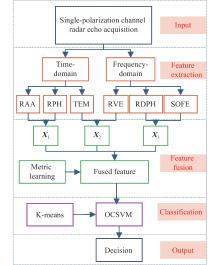
Fig 1
Flowchart of the DML-EOCSVM"
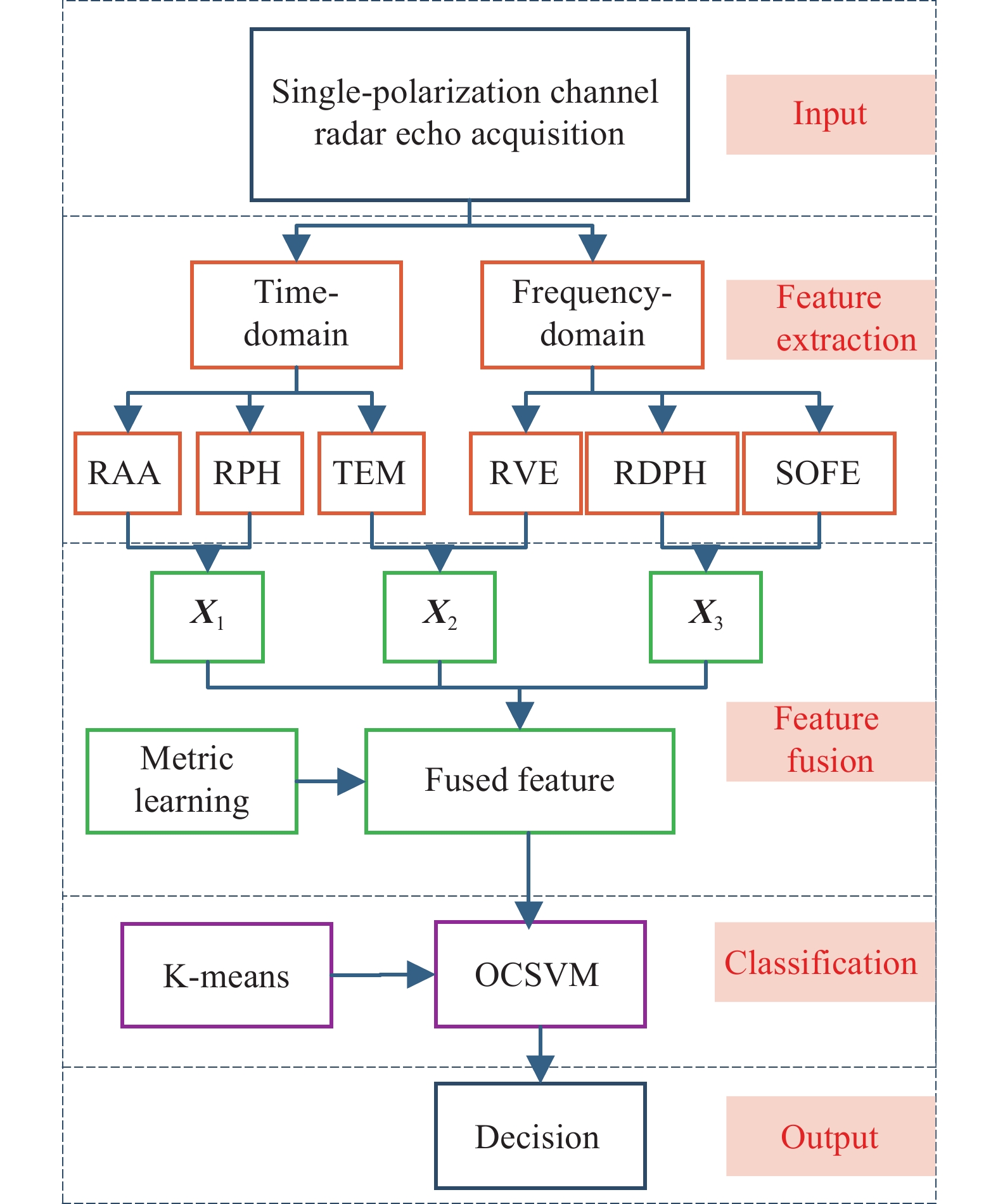
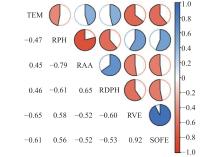
Fig 2
Pearson correlation coefficient on Dataset 26"
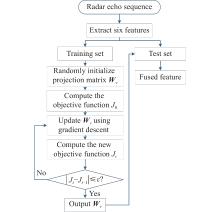
Fig 3
Feature fusion algorithm based on metric learning"
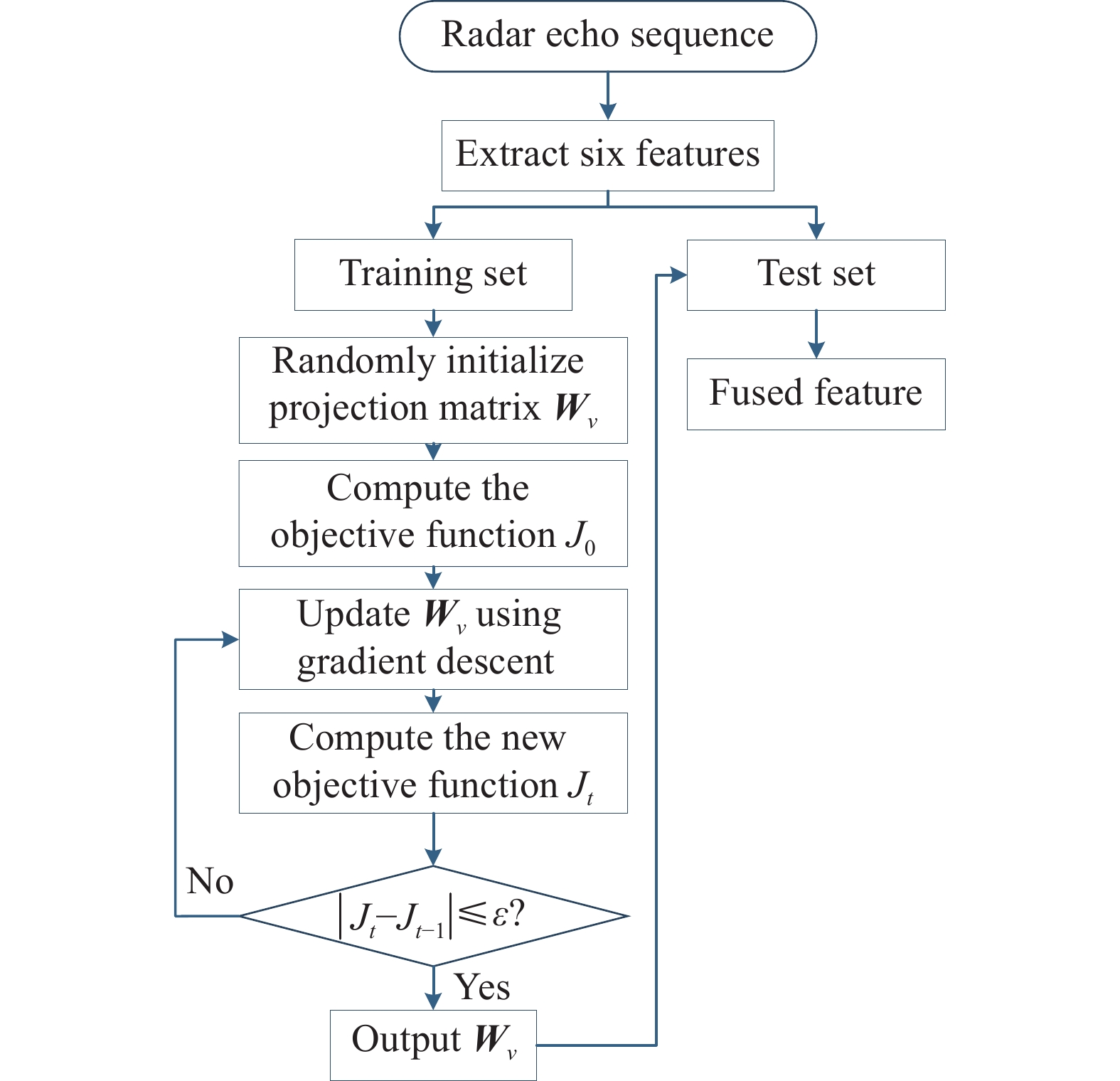
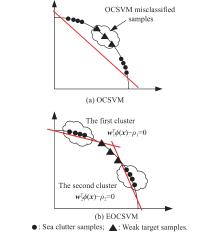
Fig 4
Two-dimension illustration of the EOCSVM and OCSVM classification hyperplanes"
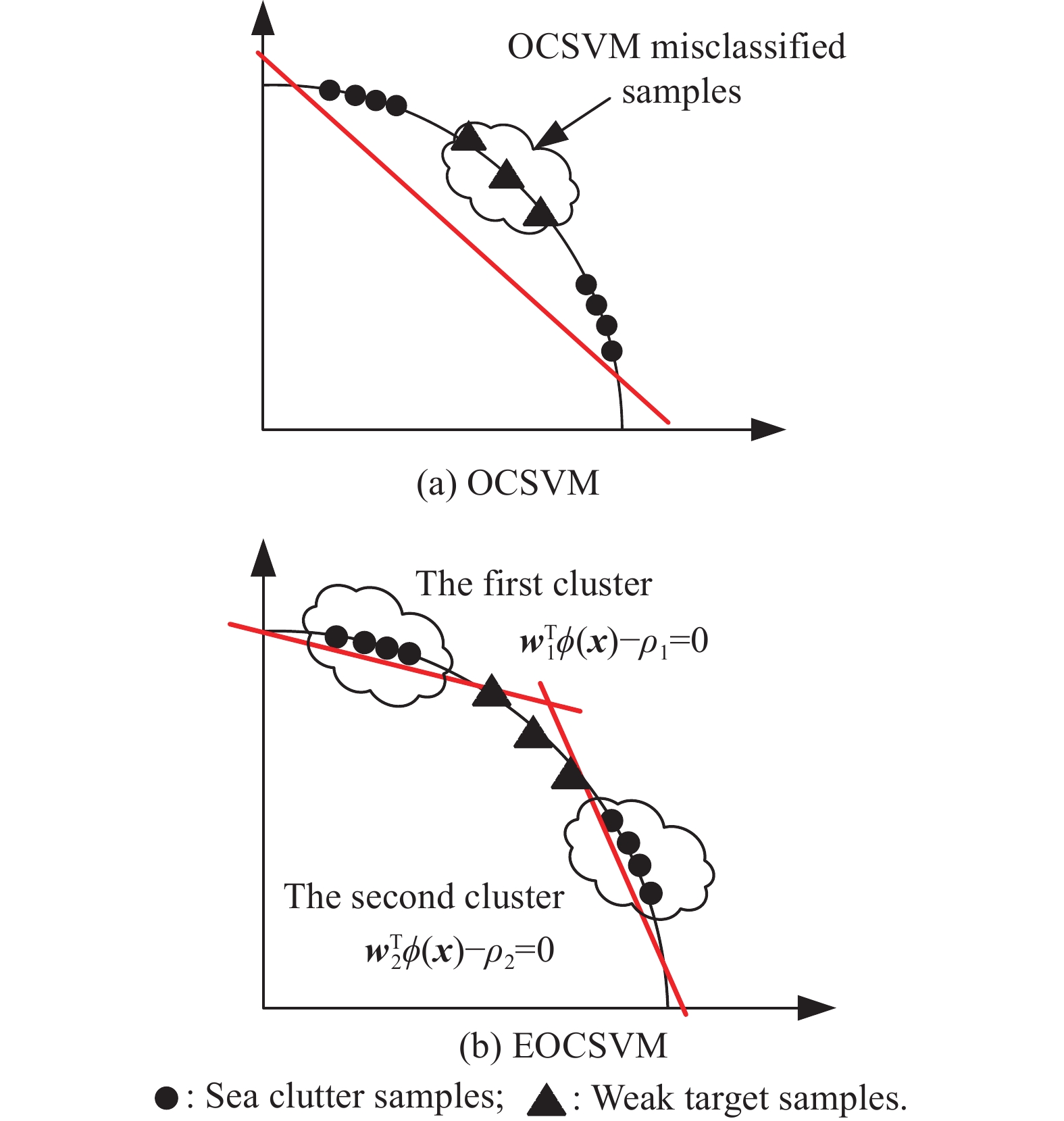

Table 1
IPIX radar data description"
| Dataset | Number of target cell | Number of affected cell | Average SCR/dB |
| 17 | 9 | 8:11 | 11.95 |
| 26 | 7 | 6:8 | 6.43 |
| 30 | 7 | 6:8 | 2.96 |
| 31 | 7 | 6:9 | 8.03 |
| 40 | 7 | 5:8 | 11.39 |
| 54 | 8 | 7:10 | 13.88 |
| 280 | 8 | 7:10 | 6.20 |
| 310 | 7 | 6:9 | 2.52 |
Table 2
Number of experimental samples"
| Sample length | Clutter | Target | Training | Test |
| 128 | ||||
| 512 |
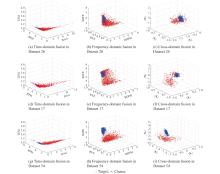
Fig 5
Scatter Plot of Features Before Fusion"
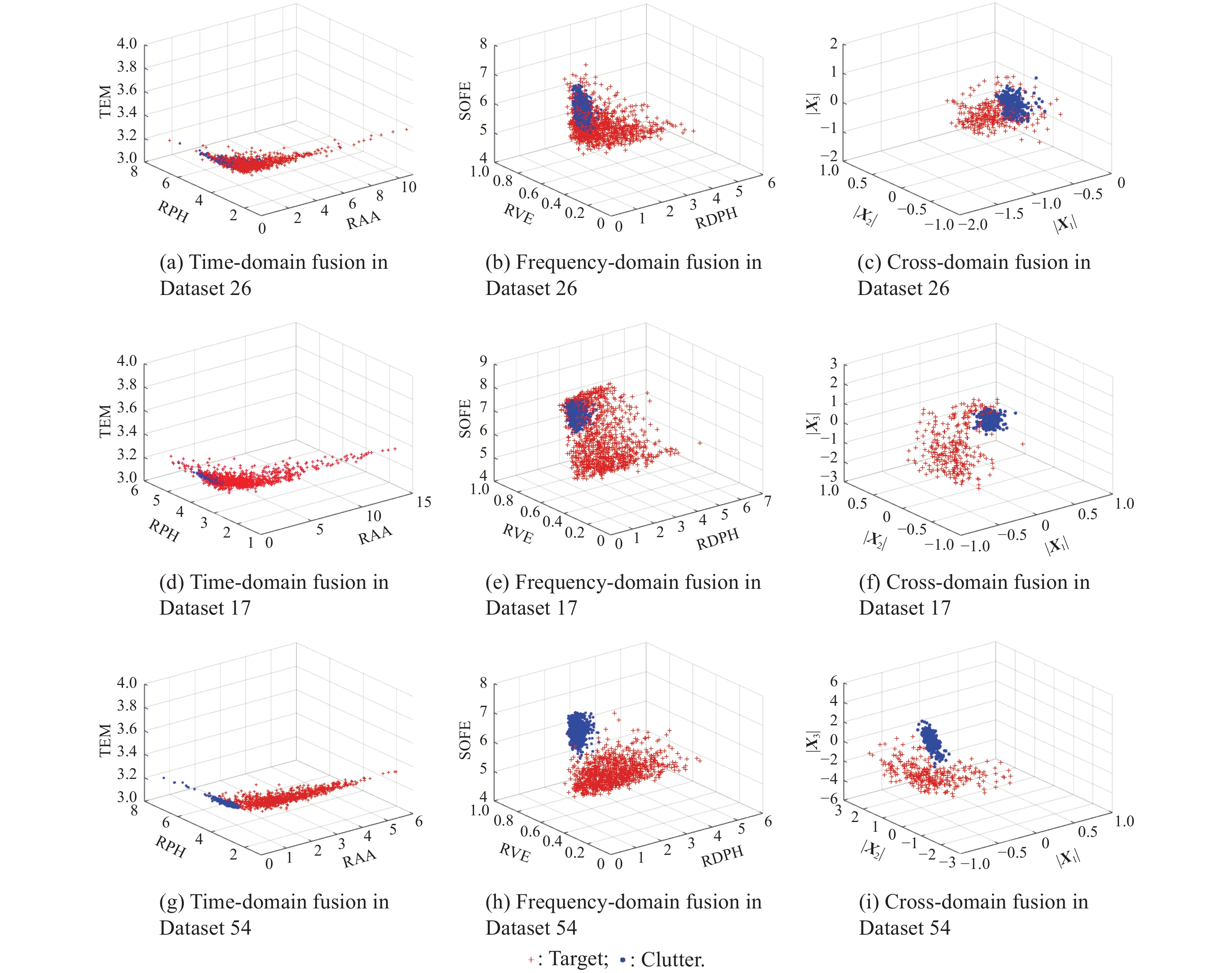
Table 3
Feature separability measure at an observation time of 128 ms"
| Dataset | G-value of pre-fusion | G-value of after-fusion | |||
| |X1| | |X2| | |X3| | |H| | ||
| 17 | 0.863 | 1.602 | 0.906 | 1.609 | |
| 26 | 0.315 | 0.321 | 0.318 | 0.411 | |
| 30 | 0.192 | 0.152 | 0.234 | 0.290 | |
| 31 | 0.279 | 0.319 | 0.830 | 0.852 | |
| 40 | 0.510 | 0.564 | 0.517 | 0.610 | |
| 54 | 2.095 | 4.999 | 4.561 | 6.296 | |
| 280 | 0.227 | 0.308 | 0.283 | 0.346 | |
| 310 | 0.185 | 0.536 | 0.125 | 0.559 | |
Table 4
Feature separability measure at an observation time of 512 ms"
| Dataset | G-value of pre-fusion | G-value of after-fusion | |||
| |X1| | |X2| | |X3| | |H| | ||
| 17 | 1.066 | 1.405 | 0.900 | 1.749 | |
| 26 | 0.397 | 0.561 | 0.374 | 0.693 | |
| 30 | 0.248 | 0.267 | 0.247 | 0.412 | |
| 31 | 0.383 | 0.388 | 1.110 | 1.143 | |
| 40 | 0.577 | 0.679 | 0.674 | 1.141 | |
| 54 | 1.929 | 2.267 | 6.459 | 6.896 | |
| 280 | 0.331 | 0.474 | 0.394 | 0.596 | |
| 310 | 0.278 | 0.351 | 0.242 | 0.449 | |
Table 5
Detection performance on IPIX datasets"
| Feature domain | Time/ms | ||||
| Time-domain features (RAA, RPH, TEM) | 128 | ||||
| 512 | |||||
| Frequency-domain features (RDPH, RVE, SOFE) | 128 | ||||
| 512 | |||||
| Cross-domain features (RAA, RPH, TEM, RDPH, RVE, SOFE) | 128 | ||||
| 512 |
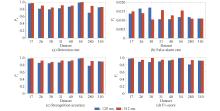
Fig 6
Performance on IPIX datasets"
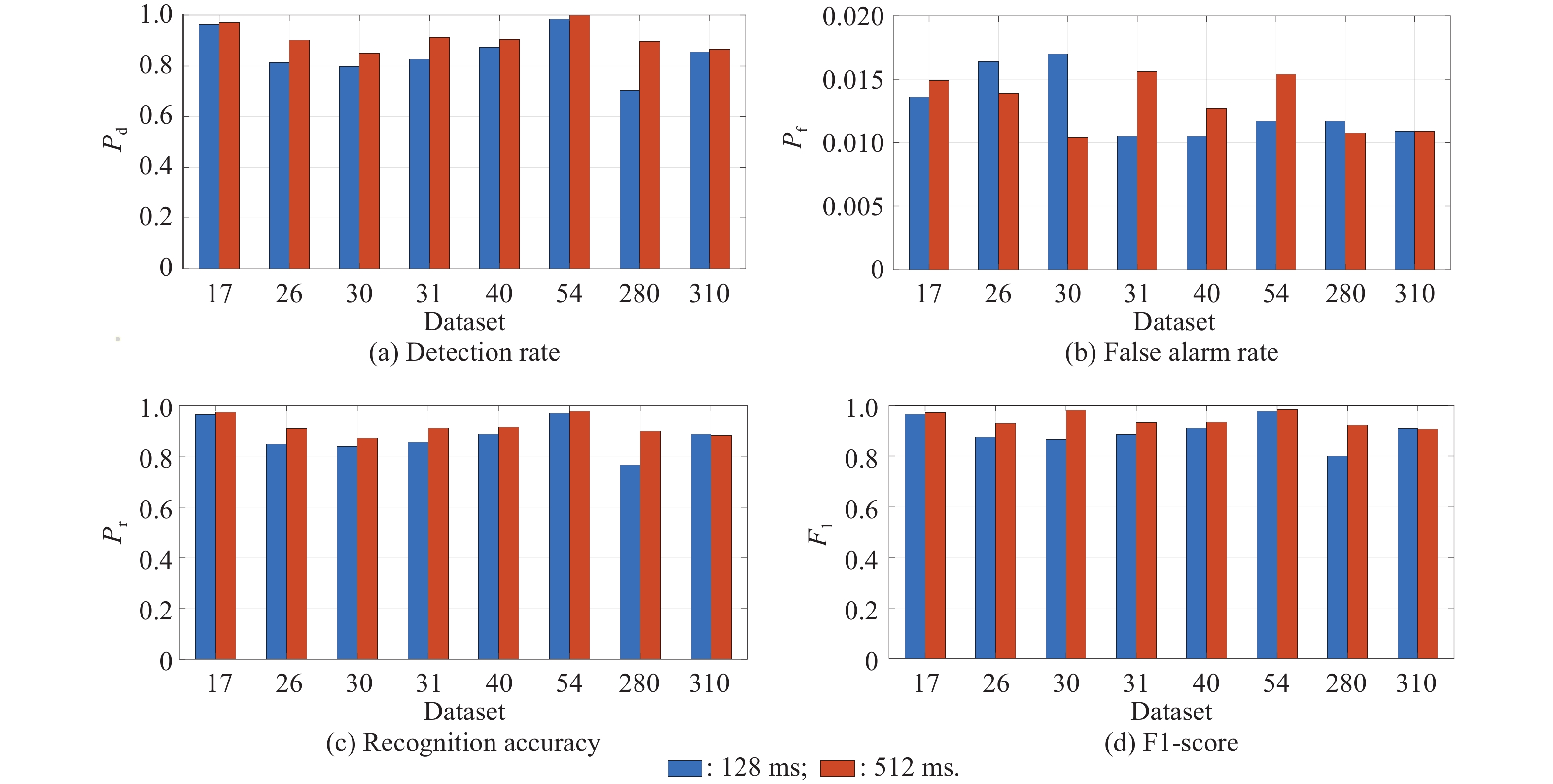
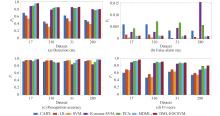
Fig 7
Performance on IPIX datasets with different methods"
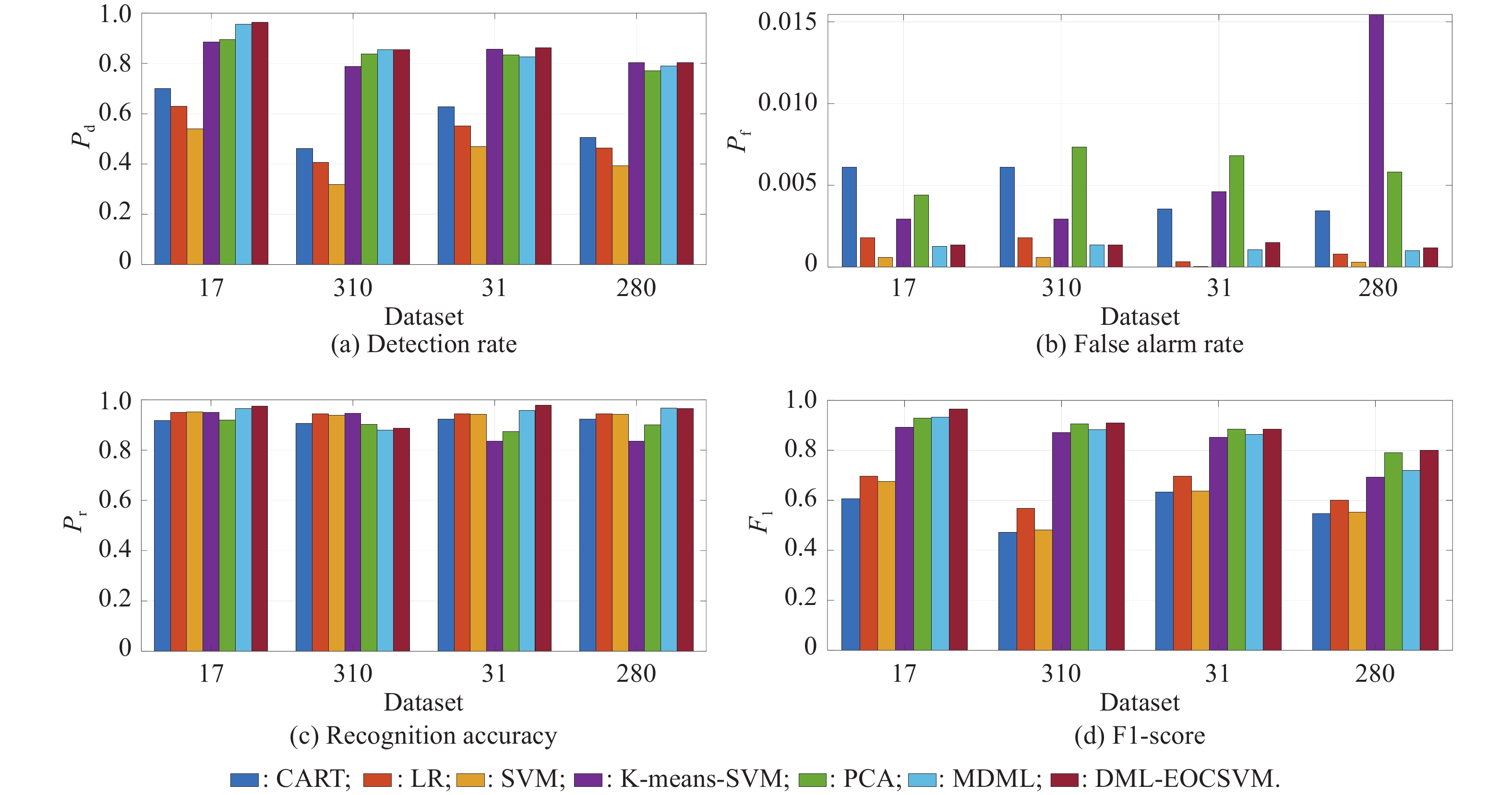
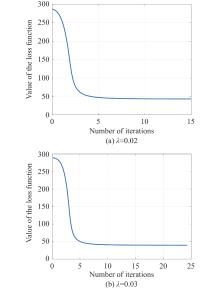
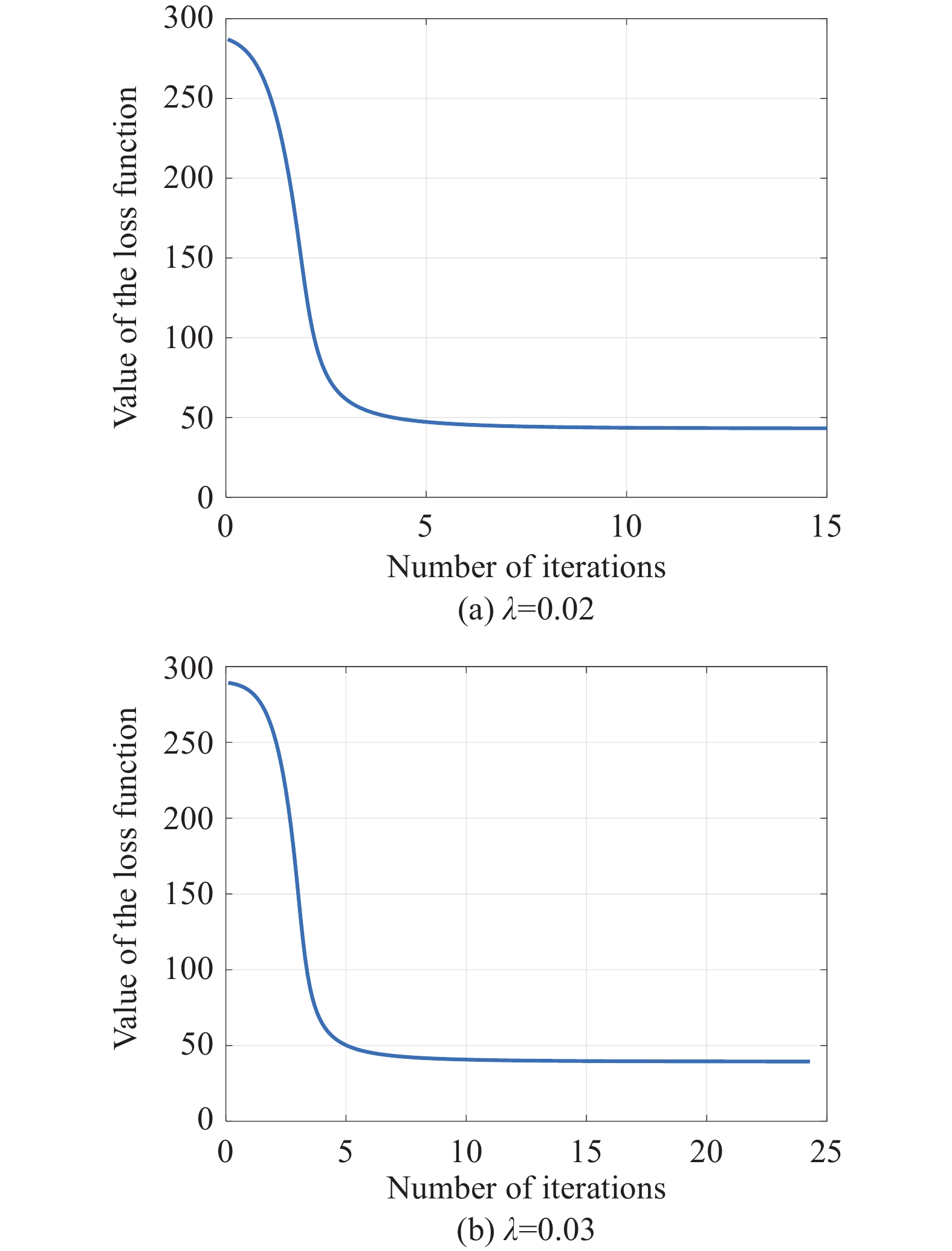
Fig 8
Change in the loss function over iterations"
| 1 |
YANG Y, YANG B Y Overview of radar detection methods for low altitude targets in marine environments. Journal of Systems Engineering and Electronics, 2024, 35 (1): 1- 13.
doi: 10.23919/JSEE.2024.000026 |
| 2 | HE Y, HUANG Y, GUAN J, et al Research progress in radar maritime target detection technology. Journal of Signal Processing, 2025, 41 (6): 969- 992. |
| 3 | RICHTER Y, BALAL N, PINHASI Y Neural-network-based target classification and range detection by CW MMW radar. Remote Sensing, 2023, 15 (18): 22. |
| 4 | FAN Y F, WANG X B, CHEN S C, et al Sea-surface weak target detection based on weighted difference visibility graph. IEEE Geoscience and Remote Sensing Letters, 2025, 22, 3503605. |
| 5 |
BAI X H, XU S W, GUO Z X, et al Graph-based maximum connected-component learning algorithm for small target detection in maritime radars. IEEE Trans. on Aerospace and Electronic Systems, 2025, 61 (1): 250- 265.
doi: 10.1109/TAES.2024.3443786 |
| 6 | CHEN S C, OUYANG X, LUO F. Ensemble one-class support vector machine for sea surface target detection based on K-means clustering. Remote Sensing, 2024, 16(13): 2401. |
| 7 | XU S W, BAI X H, GUO Z X, et al Status and prospects of feature-based detection methods for floating targets on the sea surface. Journal of Radars, 2020, 9 (4): 684- 714. |
| 8 | SHUI P L, LI D C, XU S W Tri-feature-based detection of floating small targets in sea clutter. IEEE Trans. on Aerospace and Electronic Systems, 2014, 50 (2): 1418- 1430. |
| 9 | FAN Y F, TAO M L, PU J Multifractal correlation analysis of autoregressive spectrum-based feature learning for target detection within sea clutter. IEEE Trans. on Geoscience Remote Sensing, 2022, 60, 5108811. |
| 10 |
SHI S N, SHUI P L Detection of low-velocity and floating small targets in sea clutter via income-reference particle filters. Signal Processing, 2018, 148, 78- 90.
doi: 10.1016/j.sigpro.2018.02.005 |
| 11 | SHI Y L, LIU Z P, JIA B L The unbalanced classification of weak target in sea clutter. Journal of Signal Processing, 2021, 37 (9): 1781- 1789. |
| 12 |
SONG Z Y, XU Y T Long time hybrid integration of radar rotating target. Journal of Systems Engineering and Electronics, 2025, 36 (6): 1477- 1487.
doi: 10.23919/JSEE.2024.000123 |
| 13 | QU Q Z, WANG Y L, LIU W J, et al A false alarm controllable detection method based on CNN for sea-surface small targets. IEEE Geoscience and Remote Sensing Letters, 2022, 19, 4029705. |
| 14 |
GUO Z X, BAI X H, SHUI P L, et al Fast dual trifeature-based detection of small targets in sea clutter by using median normalized Doppler amplitude spectra. IEEE Journal of Selected Topics in Applied Earth Observations and Remote Sensing, 2023, 16, 4050- 4063.
doi: 10.1109/JSTARS.2023.3268181 |
| 15 |
GUAN J, JIANG X Y, LIU N B, et al Target detection in sea clutter based on feature re-expression using Spearman’s correlation. IEEE Sensors Journal, 2024, 24 (19): 30435- 30450.
doi: 10.1109/JSEN.2024.3440065 |
| 16 |
ZHANG W, DU L, LI L L, et al Infinite Bayesian one-class support vector machine based on Dirichlet process mixture clustering. Pattern Recognition, 2018, 78, 56- 78.
doi: 10.1016/j.patcog.2018.01.006 |
| 17 |
CHEN S C, LUO F, LUO X X Multi-view feature-based sea surface small target detection in short observation time. IEEE Geoscience Remote Sensing Letters, 2021, 18 (7): 1189- 1193.
doi: 10.1109/LGRS.2020.2994341 |
| 18 | HAYKIN S. The McMaster IPIX radar sea clutter database. http://soma.ece.mcmaster.ca/ipix/2001. |
| 19 | CUI M. The research on feature extraction and fusion recognition for radar target. Xi’an: Xidian University, 2020. |
| 20 |
FAN Y F, TAO M L, SU J, et al Weak target detection based on joint fractal characteristics of autoregressive spectrum in sea clutter background. IEEE Geoscience Remote Sensing Letters, 2019, 16 (12): 1824- 1828.
doi: 10.1109/LGRS.2019.2912329 |
| 21 |
JOHANNES L, ANTHONY P D, WOLFGANG D An optimal decision-tree design strategy and its application to sea ice classification from SAR imagery. Remote Sensing, 2019, 11 (13): 1574.
doi: 10.3390/rs11131574 |
| 22 |
WU Z H, PAN S R, CHEN F W A comprehensive survey on graph neural networks. IEEE Trans. on Neural Networks and Learning Systems, 2021, 32 (1): 4- 24.
doi: 10.1109/TNNLS.2020.2978386 |
| 23 |
LI Y Z, XIE P C, TANG Z S, et al SVM-based sea-surface small target detection: a false-alarm-rate-controllable approach. IEEE Geoscience and Remote Sensing Letters, 2019, 16 (8): 1225- 1229.
doi: 10.1109/LGRS.2019.2894385 |
| 24 | LI L L, DU L, ZHANG W, et al. Enhancing information discriminant analysis: feature extraction with linear statistical model and informationtheoretic criteria. Pattern Recognition, 2024, 60: 554−570. |
| 25 |
GUO Z X, BAI X H, LI J Y, et al Small target detection in sea clutter using dominant clutter tree based on anomaly detection framework. Signal Processing, 2024, 219, 109399.
doi: 10.1016/j.sigpro.2024.109399 |
| [1] | Tao HAN, Gongjian ZHOU. Pseudo-spectrum based track-before-detect for bistatic radar network [J]. Journal of Systems Engineering and Electronics, 2026, 37(1): 127-136. |
| [2] | Zhicheng WANG, Huiming JIANG, Hui XU, Gao SUN, Jialian SHENG. Multi-affinity clustering analysis based graph learning for multichannel signal utilization [J]. Journal of Systems Engineering and Electronics, 2026, 37(1): 171-183. |
| [3] | Zhen LI, Huafeng HE, Tao ZHOU, Qi ZHANG, Xiaofei HAN, Yongquan YOU. Dual CG-IG distribution model for sea clutter and its parameter correction method [J]. Journal of Systems Engineering and Electronics, 2025, 36(5): 1177-1187. |
| [4] | Siji CHEN, Bo JIANG, Hong XU, Tao PANG, Mingke GAO. High dynamic mobile topology-based clustering algorithm for UAV swarm networks [J]. Journal of Systems Engineering and Electronics, 2025, 36(4): 1103-1112. |
| [5] | Yin CAO, Lijing LI, Sheng LIANG. Temperature error compensation method for fiber optic gyroscope based on a composite model of k-means, support vector regression and particle swarm optimization [J]. Journal of Systems Engineering and Electronics, 2025, 36(2): 510-522. |
| [6] | Zihang FENG, Liping YAN, Jinglan BAI, Yuanqing XIA, Bo XIAO. A content-aware correlation filter with multi-feature fusion for RGB-T tracking [J]. Journal of Systems Engineering and Electronics, 2024, 35(6): 1357-1371. |
| [7] | Chuanfei ZANG, Yumiao WANG, Xiang WANG, Congan XU, Guolong CUI. Sea clutter suppression via cuttable encoder-decoder-augmentation network [J]. Journal of Systems Engineering and Electronics, 2024, 35(6): 1428-1440. |
| [8] | Jian WANG, Jingyi ZHU, Hua SHI, Huchen LIU. New density clustering-based approach for failure mode and effect analysis considering opinion evolution and bounded confidence [J]. Journal of Systems Engineering and Electronics, 2024, 35(6): 1491-1506. |
| [9] | Yu LU, Jiongqi WANG, Zhangming HE, Haiyin ZHOU, Yao XING, Xuanying ZHOU. System error iterative identification for underwater positioning based on spectral clustering [J]. Journal of Systems Engineering and Electronics, 2024, 35(4): 1028-1041. |
| [10] | Yong YANG, Boyu YANG. Overview of radar detection methods for low altitude targets in marine environments [J]. Journal of Systems Engineering and Electronics, 2024, 35(1): 1-13. |
| [11] | Shuwen XU, Yifan HAO, Zhuo WANG, Jian XUE. Persymmetric adaptive polarimetric detection of subspace range-spread targets in compound Gaussian sea clutter [J]. Journal of Systems Engineering and Electronics, 2024, 35(1): 31-42. |
| [12] | Shichao CHEN, Feng LUO, Min TIAN, Wanghan LYU. Short-time maritime target detection based on polarization scattering characteristics [J]. Journal of Systems Engineering and Electronics, 2024, 35(1): 55-64. |
| [13] | Youliang LIN, Wu LI, Gang LIU, Dong HUANG. Method for triangular fuzzy multiple attribute decision making based on two-dimensional density operator method [J]. Journal of Systems Engineering and Electronics, 2024, 35(1): 178-185. |
| [14] | Sheng TONG, Hong QU, Junjie XUE. K-DSA for the multiple traveling salesman problem [J]. Journal of Systems Engineering and Electronics, 2023, 34(6): 1614-1625. |
| [15] | Xiaolong CHEN, Jian GUAN, Jibin ZHENG, Yue ZHANG, Xiaohan YU. Radar fast long-time coherent integration via TR-SKT and robust sparse FRFT [J]. Journal of Systems Engineering and Electronics, 2023, 34(5): 1116-1129. |
| Viewed | ||||||
|
Full text |
|
|||||
|
Abstract |
|
|||||
