
Journal of Systems Engineering and Electronics ›› 2026, Vol. 37 ›› Issue (2): 337-356.doi: 10.23919/JSEE.2026.000058
• ELECTRONICS TECHNOLOGY • Previous Articles
Hang GAO( ), Song ZHA(), Jijun HUANG(), Haiyang XIA(), Jibin LIU()
Received:2024-05-09
Accepted:2026-03-30
Online:2026-04-18
Published:2026-04-30
Contact:
Song ZHA
E-mail:836418930@qq.com;zhasong0551@163.com;huangjijun1989@nudt.edu.cn;easonhsia@sina.com;liujibin@gfkd.edu.com
About author:Supported by:Hang GAO, Song ZHA, Jijun HUANG, Haiyang XIA, Jibin LIU. Multi-objective frequency planning: concept, modeling, and solution[J]. Journal of Systems Engineering and Electronics, 2026, 37(2): 337-356.
Add to citation manager EndNote|Reference Manager|ProCite|BibTeX|RefWorks
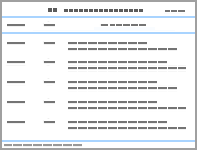
Table 1
Relevant notations for radio equipment in SFPP"
| Notion | Definition |
| The working frequency band of radio equipment respectively represents the lower and upper limits of the frequency | |
| The channel bandwidth of radio equipment | |
| The antenna main lobe gain of radio equipment | |
| The interference threshold of the receiver of radio equipment | |
| The frequency priority of radio equipment | |
| The platform serial number of radio equipment | |
| The frequency demand quantity of radio equipment | |
| The pre-assigned frequency for radio equipment | |
| The pre-assigned power for radio equipment | |
| The pre-assigned geographic coordinates for radio equipment | |
| The set of frequencies assigned to radio equipment | |
| The power assigned to radio equipment | |
| The geographic coordinates assigned to radio equipment | |
| The maximum number of equipment frequency requirements | |
| The maximum number of key points involved in power operation for each radio equipment | |
| The maximum number of key points involved in geographic location operation for each radio equipment | |
| The set of selectable frequencies for radio equipment | |
| The set of selectable power for radio equipment | |
| The set of selectable geographic coordinates for radio equipment where |
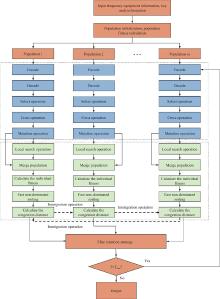
Fig 1
Flowchart of the MPMA"
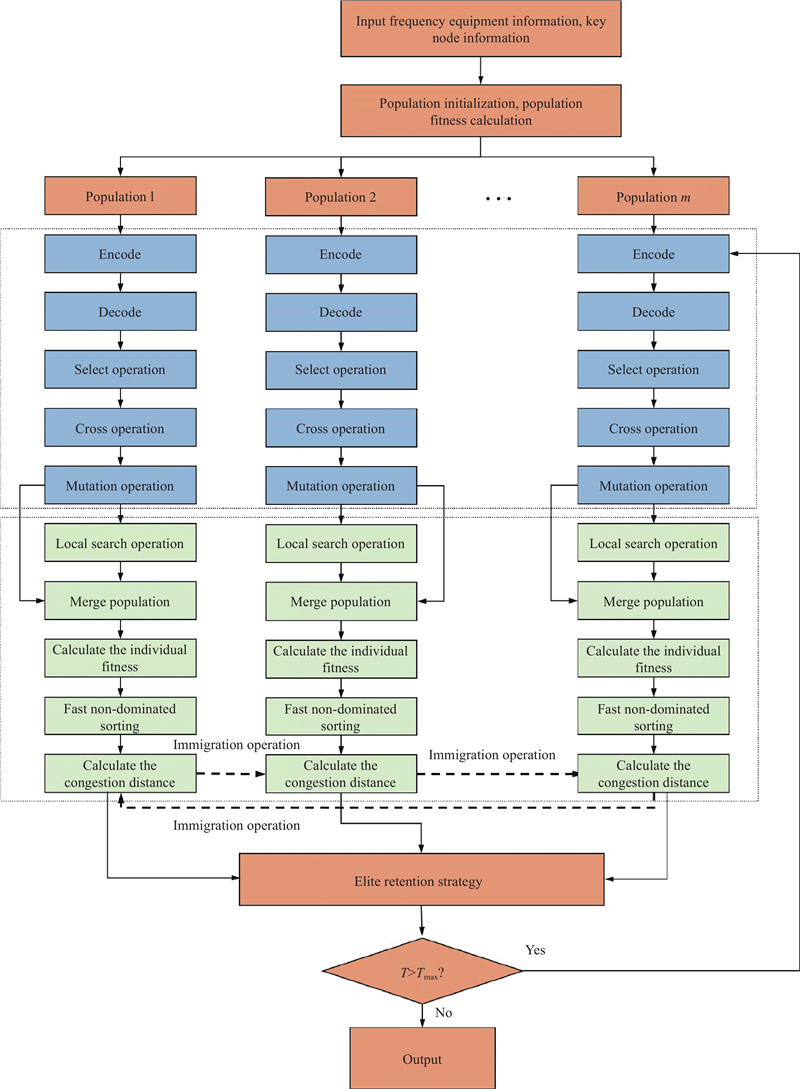
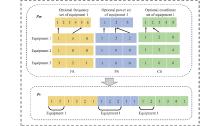
Fig 2
An example of segmentation coding"
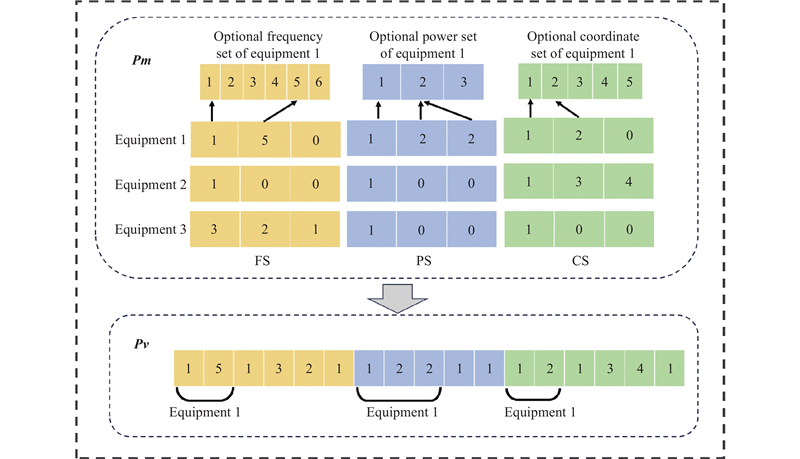
Fig 3
An example of frequency crossover operator 1"
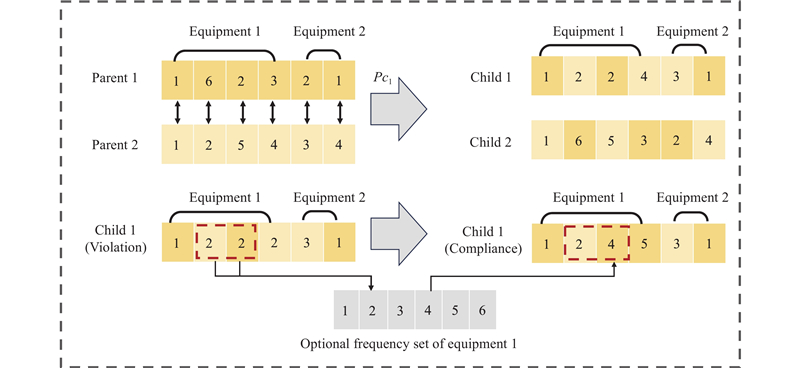
Fig 4
Example of frequency crossover operator 2"
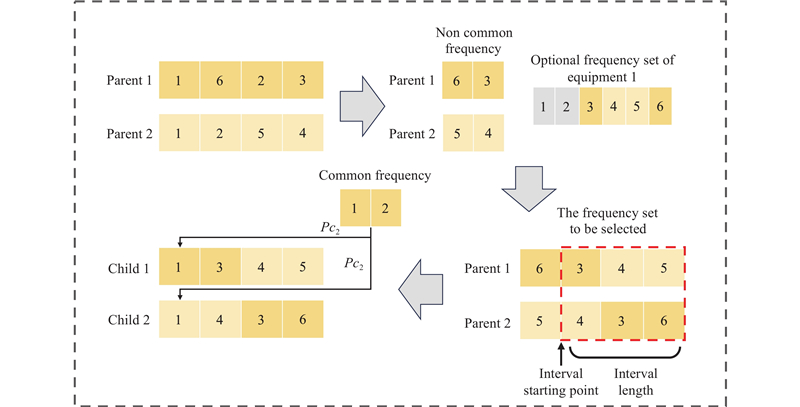
Fig 5
Example of power/geographic operator"
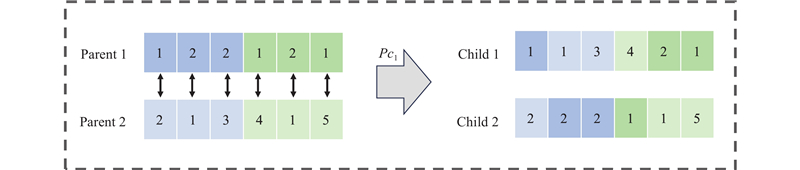
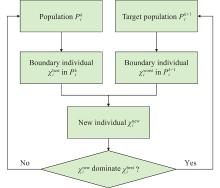
Fig 6
Flow chart of immigration operation"
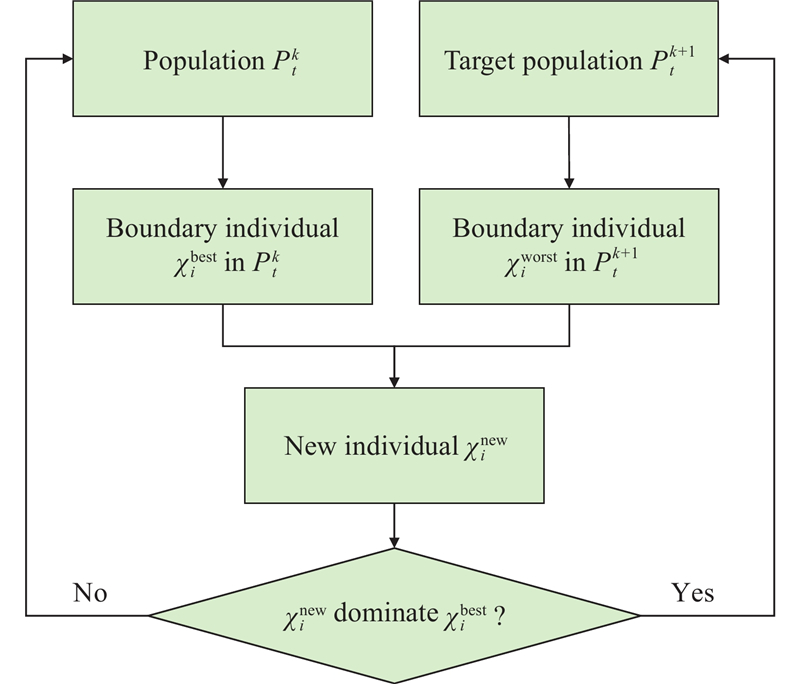
Table 2
Radio equipment parameters"
| Parameter | Value | |
| Category 1 | Category 1 | |
| Equipment serial number | 1−15 | 16−30 |
| Function | Radar | Radio station |
| Frequency band/MHz | [ | [30,88] |
| Optional frequency interval /MHz | 50 | 2.5 |
| Channel bandwidth/MHz | 100 | 2.5 |
| Antenna main lobe gain/dBi | 5 | 5 |
| Receiver interference threshold/dBm | −115 | −120 |
| Optional transmit power/kW | 10,20,30,40 | 0.01,0.02,0.03 |
| Number of frequency requirements | 2 | 1 |
Table 3
Radio equipment involved in different cases"
| Case | Radio equipment | ||||||||||||||
| Case 1 | 1 | 2 | 3 | 4 | 5 | 6 | 7 | 8 | 9 | 10 | 11 | 12 | 13 | 14 | 15 |
| ● | ● | ● | ● | ● | ○ | ○ | ○ | ○ | ○ | ○ | ○ | ○ | ○ | ○ | |
| 16 | 17 | 18 | 19 | 20 | 21 | 22 | 23 | 24 | 25 | 26 | 27 | 28 | 29 | 30 | |
| ○ | ○ | ○ | ○ | ○ | ○ | ○ | ○ | ○ | ○ | ○ | ○ | ○ | ○ | ○ | |
| Case 2 | 1 | 2 | 3 | 4 | 5 | 6 | 7 | 8 | 9 | 10 | 11 | 12 | 13 | 14 | 15 |
| ● | ● | ● | ● | ● | ● | ● | ● | ● | ● | ● | ● | ● | ● | ● | |
| 16 | 17 | 18 | 19 | 20 | 21 | 22 | 23 | 24 | 25 | 26 | 27 | 28 | 29 | 30 | |
| ○ | ○ | ○ | ○ | ○ | ○ | ○ | ○ | ○ | ○ | ○ | ○ | ○ | ○ | ○ | |
| Case 3 | 1 | 2 | 3 | 4 | 5 | 6 | 7 | 8 | 9 | 10 | 11 | 12 | 13 | 14 | 15 |
| ● | ● | ● | ● | ● | ● | ● | ● | ● | ● | ● | ● | ● | ● | ● | |
| 16 | 17 | 18 | 19 | 20 | 21 | 22 | 23 | 24 | 25 | 26 | 27 | 28 | 29 | 30 | |
| ● | ● | ● | ● | ● | ● | ● | ● | ● | ● | ● | ● | ● | ● | ● | |
Table 4
Key point information in Case 1"
| Equipment | Key point | Start time | Operation | Priority |
| 1 | Point 1 | 0 | 1 | 5 |
| Point 2 | 2 | 3 | 2 | |
| 2 | Point 1 | 0 | 1 | 4 |
| Point 2 | 1 | 4 | 2 | |
| 3 | Point 1 | 1 | 1 | 3 |
| Point 2 | 2 | 5 | 2 | |
| 4 | Point 1 | 1 | 1 | 1 |
| Point 2 | 2 | 2 | 1 | |
| 5 | Point 1 | 1 | 1 | 2 |
| Point 2 | 2 | 3,5 | 2 |
Table 5
Key point information in Case 2"
| Equipment | Key point | Start time | Operation | Priority | Equipment | Key point | Start time | Operation | Priority | |
| 1 | Point 1 | 0 | 1 | 5 | 9 | Point 1 | 0 | 1 | 2 | |
| Point2 | 1 | 3 | 2 | Point 2 | 1 | 3 | 4 | |||
| 2 | Point 1 | 0 | 1 | 4 | 10 | Point 1 | 1 | 1 | 2 | |
| Point 2 | 1 | 2 | 2 | Point 2 | 2 | 4 | 3 | |||
| 3 | Point 1 | 0 | 1 | 3 | 11 | Point 1 | 1 | 1 | 2 | |
| Point 2 | 1 | 2 | 2 | Point 2 | 2 | 5 | 1 | |||
| 4 | Point 1 | 1 | 1 | 1 | 12 | Point 1 | 0 | 1 | 3 | |
| Point 2 | 2 | 3 | 3 | Point 2 | 1 | 5 | 5 | |||
| 5 | Point 1 | 1 | 1 | 5 | 13 | Point 1 | 0 | 1 | 2 | |
| Point 2 | 2 | 2 | 2 | Point 2 | 1 | 5 | 1 | |||
| 6 | Point 1 | 2 | 1 | 1 | 14 | Point 1 | 0 | 1 | 4 | |
| Point 2 | 3 | 3,5 | 4 | Point 2 | 1 | 3 | 5 | |||
| 7 | Point 1 | 2 | 1 | 5 | 15 | Point 1 | 0 | 1 | 2 | |
| Point 2 | 3 | 4,5 | 2 | Point 2 | 1 | 2 | 2 | |||
| 8 | Point 1 | 0 | 1 | 2 | ||||||
| Point 2 | 1 | 2 | 5 |
Table 6
Key point information in Case 3"
| Equipment | Key point | Start time | Operation | Priority | Equipment | Key point | Start time | Operation | Priority | |
| 1 | Point 1 | 0 | 1 | 5 | 16 | Point 1 | 0 | 1 | 2 | |
| 2 | Point 1 | 0 | 1 | 2 | 17 | Point 1 | 0 | 1 | 2 | |
| 3 | Point 1 | 0 | 1 | 4 | 18 | Point 1 | 0 | 1 | 3 | |
| 4 | Point 1 | 0 | 1 | 2 | 19 | Point 1 | 1 | 1 | 3 | |
| 5 | Point 1 | 0 | 1 | 3 | 20 | Point 1 | 1 | 1 | 2 | |
| 6 | Point 1 | 1 | 1 | 2 | 21 | Point 1 | 1 | 1 | 2 | |
| 7 | Point 1 | 1 | 1 | 1 | 22 | Point 1 | 1 | 1 | 2 | |
| 8 | Point 1 | 1 | 1 | 3 | 23 | Point 1 | 2 | 1 | 3 | |
| 9 | Point 1 | 1 | 1 | 5 | 24 | Point 1 | 2 | 1 | 3 | |
| 10 | Point 1 | 2 | 1 | 2 | 25 | Point 1 | 2 | 1 | 3 | |
| 11 | Point 1 | 2 | 1 | 1 | 26 | Point 1 | 2 | 1 | 3 | |
| 12 | Point 1 | 2 | 1 | 4 | 27 | Point 1 | 1 | 1 | 4 | |
| 13 | Point 1 | 2 | 1 | 5 | 28 | Point 1 | 1 | 1 | 5 | |
| 14 | Point 1 | 0 | 1 | 2 | 29 | Point 1 | 1 | 1 | 5 | |
| 15 | Point 1 | 0 | 1 | 2 | 30 | Point 1 | 1 | 1 | 1 |
Table 7
Operating parameters"
| Parameter | Value |
| Operating system | Win11 |
| CPU | AMD Ryzen 7 6800HS @ 3.20 GHz |
| RAM/G | 16 |
| Programming platform | Matlab2021b |
Table 8
Algorithm parameters"
| Parameter | Value |
| N | 50 |
| M | 3 |
| T | 100 |
| Pc1 | [0.4,0.6] |
| Pc2 | [0.4,0.6] |
| Pr | [0.05,0.15] |
| step | [ |
Fig 7
Performance comparison under different population initialization methods"
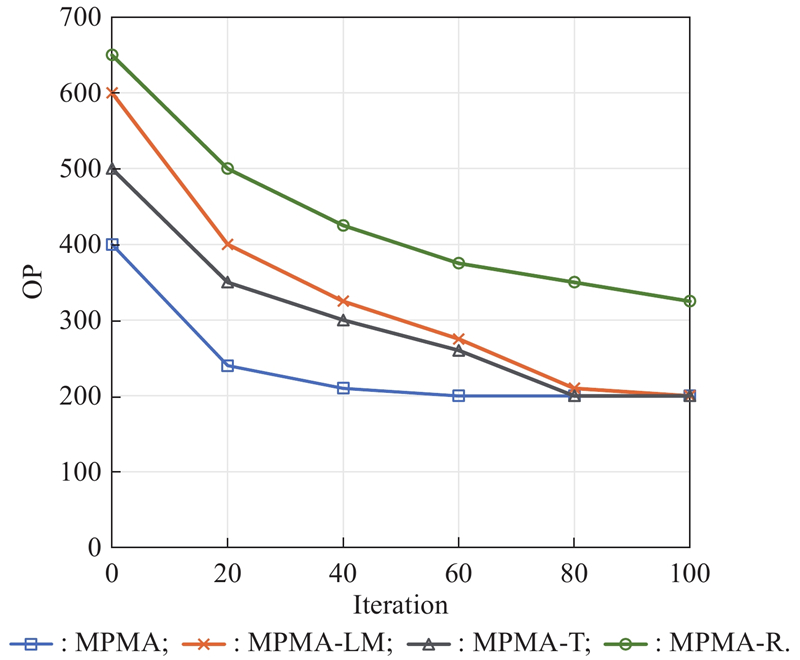
Fig 8
Performance comparison under different algorithms"
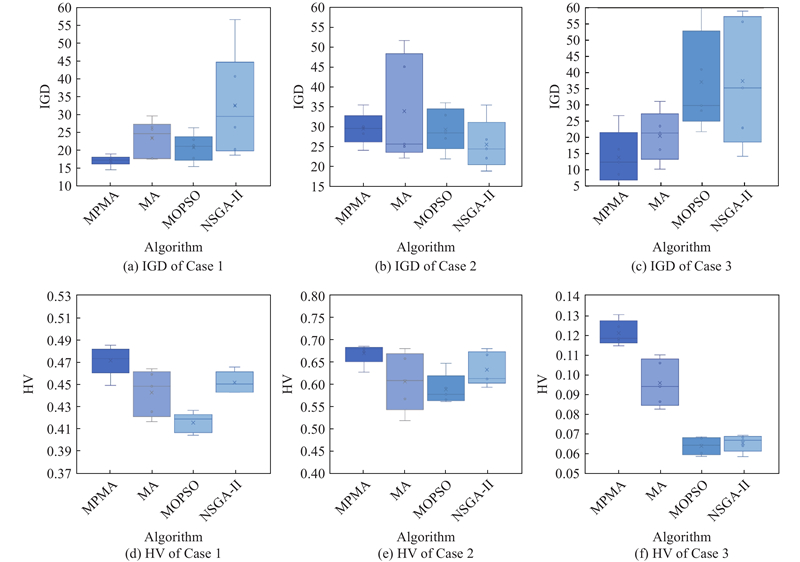
Fig 9
Pareto distribution of different algorithms"
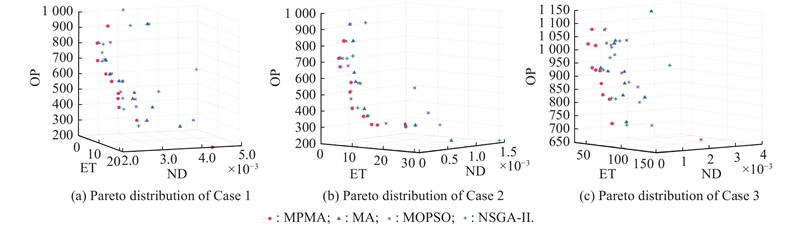
Table 9
Comparison different algorithms in extreme solutions"
| Case | Method | Min ET | Min ND | Min OP | ||||||||
| ET | ND | OP | ET | ND | OP | ET | ND | OP | ||||
| Case 1 | MPMA | 0.010 | 900 | 3.603 | 700 | 21.606 | 200 | |||||
| MA | 0.014 | 900 | 1.209 | 800 | 13.223 | 300 | ||||||
| MOPSO | 0.019 | 1.829 | 600 | 15.657 | 350 | |||||||
| NSGA-II | 0.621 | 900 | 7.818 | 400 | 10.203 | 300 | ||||||
| Case 2 | MPMA | 0.607 | 712.5 | 1.460 | 662.5 | 17.500 | 312.5 | |||||
| MA | 0.750 | 715 | 0.750 | 715 | 24.241 | 220 | ||||||
| MOPSO | 1.738 | 817.5 | 2.213 | 715 | 16.965 | 312.5 | ||||||
| NSGA-II | 1.437 | 720 | 2.286 | 712.5 | 31.646 | 215 | ||||||
| Case 3 | MPMA | 33.399 | 927.5 | 39.872 | 61.978 | 725 | ||||||
| MA | 37.490 | 52.606 | 920 | 59.010 | 725 | |||||||
| MOPSO | 44.562 | 53.074 | 130.528 | 675 | ||||||||
| NSGA-II | 40.193 | 68.076 | 825 | 79.560 | 725 | |||||||
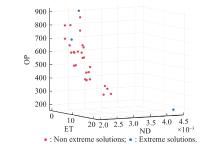
Fig 10
Pareto frontier obtained by MPMA in Case 1"
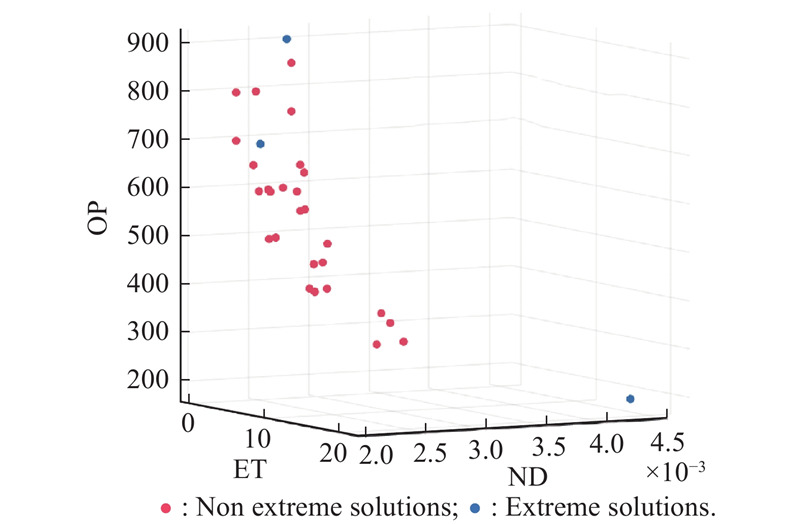
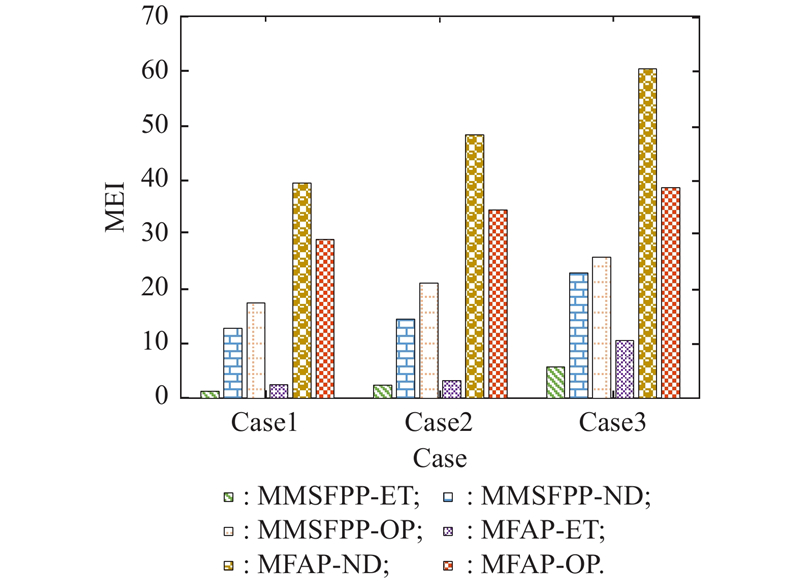
Fig 11
Performance comparison of MEI"
| 1 |
LU D J, WANG X, WU X T, et al Adaptive allocation strategy for cooperatively jamming netted radar system based on improved cuckoo search algorithm. Defense Technology, 2023, 24 (6): 285- 297.
doi: 10.1016/j.dt.2022.04.013 |
| 2 |
KIOUCHE A E, BESSEDIK M, BENBOUZID F, et al An efficient hybrid multi-objective memetic algorithm for the frequency assignment problem. Engineering Applications of Artificial Intelligence, 2020, 87, 103265.
doi: 10.1016/j.engappai.2019.103265 |
| 3 |
SARA C, LUCA D G, ROBERTO M R, et al Multi-neighborhood simulated annealing for the minimum interference frequency assignment problem. EURO Journal on Computational Optimization, 2022, 10, 100024.
doi: 10.1016/j.ejco.2021.100024 |
| 4 | WEISE T, WU Z Z, LI X L, et al Frequency fitness assignment: optimization without a bias for good solutions can be efficient. IEEE Trans. on Evolutionary Computation, 2021, 27, 980- 992. |
| 5 | FAN Q R, WANG X Y, LI J, et al Spectrum requirements matching degree-based frequency assignment algorithm. Radio Communication Technology, 2023, 49 (3): 583- 588. |
| 6 | HALE W K Frequency assignment: Theory and applications. Proceedings of the IEEE, 1980, 68 (12): 1497- 1514. |
| 7 | KOLEN A, VAN C. A constraint satisfaction approach to the radio link frequency assignment problem. Caparica: Relatório técnico da Universidade, 1994. |
| 8 | AARDAL K I, HIPOLITO A, VAN HOESEL C P M. A branch-and-cut algorithm for the frequency assignment problem. Maastricht: METEOR, Maastricht Research School of Economics of Technology and Organization, 1996. |
| 9 | ALRAJHI K, THOMPSON J, PADUNGWECH W. A heuristic approach for the dynamic frequency assignment problem. Proc. of the UK Workshop on Computational Intelligence, 2017: 91–103. |
| 10 | HAO J K, DORNE R, GALINIER P. Tabu search for frequency assignment in mobile radio networks. Heuristics, 1998, 4 (1): 47–62. |
| 11 |
WANG F, DONG J, LU D M, et al Frequency assignment algorithm based on hybrid intelligent optimization method. Chinese Journal of Radio Science, 2013, 28 (5): 947- 952.
doi: 10.1109/cvidl51233.2020.00-50 |
| 12 | SIDDIQI U F , SAIT S M. An optimization heuristic based on non-dominated sorting and tabu search for the fixed spectrum frequency assignment problem. IEEE Access, 2018, 6: 72635−72648. |
| 13 | WANG G H Frequency assignment algorithm optimization based on simulated annealing algorithm. Radio Communications Technology, 2017, 43 (5): 57- 61. |
| 14 | XU Q, XIONG H, LI Z, et al An improved ANTS algorithm for frequency assignment problem. Radio Engineering, 2010, 40 (1): 58- 61. |
| 15 |
LAU T L, TSANG E P K Guided genetic algorithm and its application to radio link frequency assignment problems. Constraints, 2001, 6 (4): 373- 398.
doi: 10.1023/A:1011406425471 |
| 16 | LI X C, HE Q H Multi-areas outstanding covering optimization method of HF network based on preference ranking elimination NSGAII algorithm. Journal of Electronics & Information Technology, 2017, 39 (8): 1779- 1787. |
| 17 | LIU M, ZHA S HUANG J J, et al. Frequency planning method for joint operations based on multi-objective optimization. Chinese Journal of Radio Science, 2022, 37 (3): 434- 442. |
| 18 | ZHUMA E, PURIS A Allocation of frequencies in GSM mobile networks using meta heuristics ACO. Revista Publicando, 2015, 2 (5): 47- 64. |
| 19 | NIU K, LI B, FU Q. Method of battlefield frequency allocation based on chaotic perturbation mechanism particle swarm optimization algorithm. Journal of System Simulation, 2021, 33(8): 1905−1913.(in Chinese) |
| 20 | OSMAN, ZEIN E, EMAM A M, et al Minimizing interference in frequency assignment problem based on guided particle swarm optimization algorithm. International Journal of Scientific & Technology Research, 2017, 27 (4): 980- 992. |
| 21 |
HADJI E, BABES M Integrating tabu search in particle swarm optimization for the frequency assignment problem. China Communications, 2016, 13 (3): 137- 155.
doi: 10.1109/cc.2016.7445509 |
| 22 |
SALCEDO S, BOUSOÑO C A hybrid neural-genetic algorithm for the frequency assignment problem in satellite communications. Applied Intelligence, 2005, 22 (3): 207- 217.
doi: 10.1007/s10791-005-6619-y |
| 23 |
WANG Y Y, ZHAO W J Multi-objective optimization of tasks scheduling problem for overlapping multiple tower cranes. Buildings, 2024, 14 (4): 867.
doi: 10.3390/buildings14040867 |
| 24 | YAN L, GUO W, XU D, et al. Dynamic frequency assignment method on the battlefield with complex interference constraints. Proc. of the International Conference on Information Science and Control Engineering, 2020: 1850−1855. |
| 25 | XU Z, LIU Y N, ZHANG Z B, et al Adaptive planning technology for strategy based battlefield frequency. Command Information System and Technology, 2023, 14 (1): 35- 41. |
| 26 | GRELLA F M Genetic algorithms in the multi-objective optimization. African Journal of Oral Health Sciences, 2011, 11, 81. |
| 27 | MOSCATO P. On evolution, search, genetic algorithms and martial arts-towards memetic algorithms. Caltech Concurrent Computation Program, Evolution, Search, Optimization, 1989: 1−68. |
| 28 |
REN H, LIU, K, YAN G Z, et al A memetic algorithm for cooperative complex task offloading in heterogeneous vehicular networks. IEEE Trans. on Network Science and Engineering, 2023, 10 (1): 189- 204.
doi: 10.1109/TNSE.2022.3206228 |
| 29 |
DU Y H, WANG T, XIN B, et al A data-driven parallel scheduling approach for multiple agile earth observation satellites. IEEE Trans. on Evolutionary Computation, 2020, 24 (4): 679- 693.
doi: 10.1109/TEVC.2019.2934148 |
| 30 |
PARK J, PARK M W, KIM D W, et al Multi-population genetic algorithm for multilabel feature selection based on label complementary communication. Entropy, 2020, 22 (8): 876.
doi: 10.3390/e22080876 |
| 31 | XUE S, CHEN X, WANG Y T, et al Research on multi-objective resource constrained project scheduling problem based on improved multi population genetic algorithm. Journal of Industrial Engineering/Engineering Management, 2023, 37 (5): 167- 175. |
| 32 |
LI Y, LI X Y, GAO L, et al An efficient critical path based method for permutation flow shop scheduling problem. Journal of Manufacturing Systems, 2022, 63, 344- 353.
doi: 10.1016/j.jmsy.2022.04.005 |
| 33 | LI S Y, WANG Y F, QIAO J F, et al A regional local search strategy for NSGA II algorithm. Acta Automatica Sinica, 2020, 46 (12): 2617- 2627. |
| [1] | Yunong WANG, Wenhao BI, Qiucen FAN, Shuangfei XU, An ZHANG. Multi-objective optimization of top-level arrangement for flight test [J]. Journal of Systems Engineering and Electronics, 2025, 36(3): 714-724. |
| [2] | Yaqian YOU, Jianbin SUN, Yuejin TAN, Jiang JIANG. Multi-objective optimization framework in the modeling of belief rule-based systems with interpretability-accuracy trade-off [J]. Journal of Systems Engineering and Electronics, 2025, 36(2): 423-435. |
| [3] | Sixing LIU, Changbao PEI, Xiaodong YE, Hao WANG, Fan WU, Shifei TAO. Efficient sampling strategy driven surrogate-based multi-objective optimization for broadband microwave metamaterial absorbers [J]. Journal of Systems Engineering and Electronics, 2024, 35(6): 1388-1396. |
| [4] | Licong ZHANG, Chunlin GONG, Hua SU, Da Ronch ANDREA. Design methodology of a mini-missile considering flight performance and guidance precision [J]. Journal of Systems Engineering and Electronics, 2024, 35(1): 195-210. |
| [5] | Xi LONG, Weiwei CAI, Leping YANG, Tianyu WANG. Mission scheduling of multi-sensor collaborative observation for space surveillance network [J]. Journal of Systems Engineering and Electronics, 2023, 34(4): 906-923. |
| [6] | Lin ZHU, Junjiang LI, Zijie LIU, Dengyin ZHANG. A multi-resource scheduling scheme of Kubernetes for IIoT [J]. Journal of Systems Engineering and Electronics, 2022, 33(3): 683-692. |
| [7] | Jiaxin HU, Leping YANG, Huan HUANG, Yanwei ZHU. Optimal reconfiguration of constellation using adaptive innovation driven multiobjective evolutionary algorithm [J]. Journal of Systems Engineering and Electronics, 2021, 32(6): 1527-1538. |
| [8] | Zining WANG, Min LIN, Xiaogang TANG, Kefeng GUO, Shuo HUANG, Ming CHENG. Multi-objective robust secure beamforming for cognitive satellite and UAV networks [J]. Journal of Systems Engineering and Electronics, 2021, 32(4): 789-798. |
| [9] | Shiyun LI, Sheng ZHONG, Zhi PEI, Wenchao YI, Yong CHEN, Cheng WANG, Wenzhu ZHANG. Multi-objective reconfigurable production line scheduling for smart home appliances [J]. Journal of Systems Engineering and Electronics, 2021, 32(2): 297-317. |
| [10] | Jianjiang WANG, Xuejun HU, Chuan HE. Reactive scheduling of multiple EOSs under cloud uncertainties: model and algorithms [J]. Journal of Systems Engineering and Electronics, 2021, 32(1): 163-177. |
| [11] | Bo LI, Linyu TIAN, Daqing CHEN, Shiyang LIANG. An adaptive dwell time scheduling model for phased array radar based on three-way decision [J]. Journal of Systems Engineering and Electronics, 2020, 31(3): 500-509. |
| [12] | Zhen XU, Enze ZHANG, Qingwei CHEN. Rotary unmanned aerial vehicles path planning in rough terrain based on multi-objective particle swarm optimization [J]. Journal of Systems Engineering and Electronics, 2020, 31(1): 130-141. |
| [13] | Yan'gang LIANG, Zheng QIN. A decision support system for satellite layout integrating multi-objective optimization and multi-attribute decision making [J]. Journal of Systems Engineering and Electronics, 2019, 30(3): 535-544. |
| [14] | Jiale GAO, Qinghua XING, Chengli FAN, Zhibing LIANG. Double adaptive selection strategy for MOEA/D [J]. Journal of Systems Engineering and Electronics, 2019, 30(1): 132-143. |
| [15] | Jiting Li, Sheng Zhang, Xiaolu Liu, and Renjie He. Multi-objective evolutionary optimization for geostationary orbit satellite mission planning [J]. Systems Engineering and Electronics, 2017, 28(5): 934-945. |
| Viewed | ||||||
|
Full text |
|
|||||
|
Abstract |
|
|||||
