
Journal of Systems Engineering and Electronics ›› 2026, Vol. 37 ›› Issue (2): 636-651.doi: 10.23919/JSEE.2025.000152
• CONTROL THEORY AND APPLICATION • Previous Articles
Yuqi WANG1,2( ), Yun ZHANG1,2(), Yunze CAI1,2,3,4,*()
Received:2025-05-19
Online:2026-04-18
Published:2026-04-30
Contact:
Yunze CAI
E-mail:wangyuqi@sjtu.edu.cn;zhang_yun@sjtu.edu.cn;yzcai@sjtu.edu.cn
About author:Supported by:Yuqi WANG, Yun ZHANG, Yunze CAI. Hierarchical random networks for optimizing communication complexity of consensus-based networks[J]. Journal of Systems Engineering and Electronics, 2026, 37(2): 636-651.
Add to citation manager EndNote|Reference Manager|ProCite|BibTeX|RefWorks
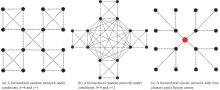
Fig 1
Network topology comparisons (three network topologies under identical conditions, network size $ |{\cal{N}}|=16 $ and connection probability $ \bar{\eta} = 100\% $)"
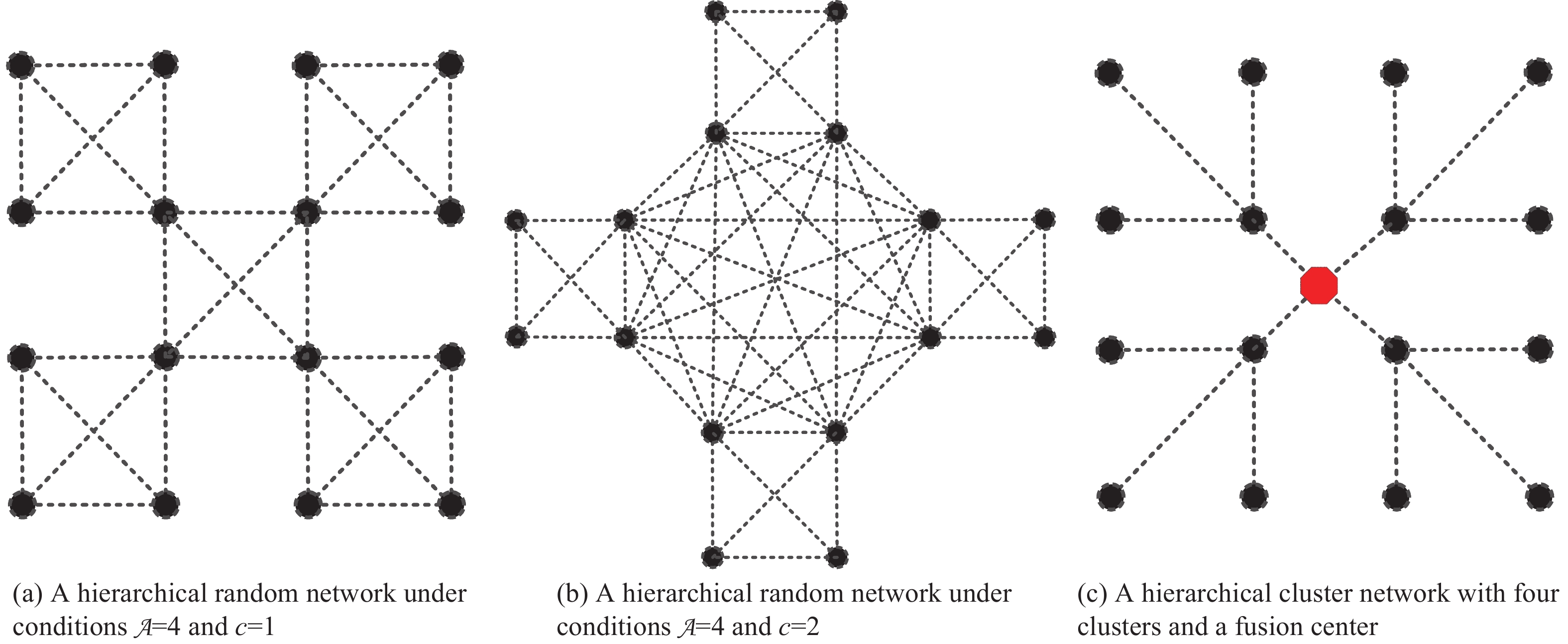
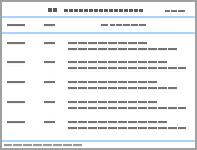
Table 1
Comparison of related studies for reducing the communication complexity in single time-scale systems"
| Method | Conectivity condition | Network architecture | Scalability | Communication complexity |
| Event-triggered [ | Unexplored | Peer-to-peer | No | Unpredictable |
| Hierarchical clustering [ | Only if | Leader-follower | No | |
| ER random network [ | Details in Remark 3 | Peer-to-peer | Yes | |
| Multi-class hierarchical [ | Details in [ | Peer-to-peer | Yes | Details in [ |
| This paper | Details in Corollary 1 | Peer-to-peer | Yes |
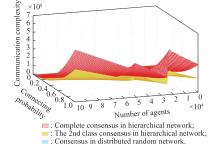
Fig 3
Comparisons of the communication complexity based on Theorem 3 and Corollary 3"
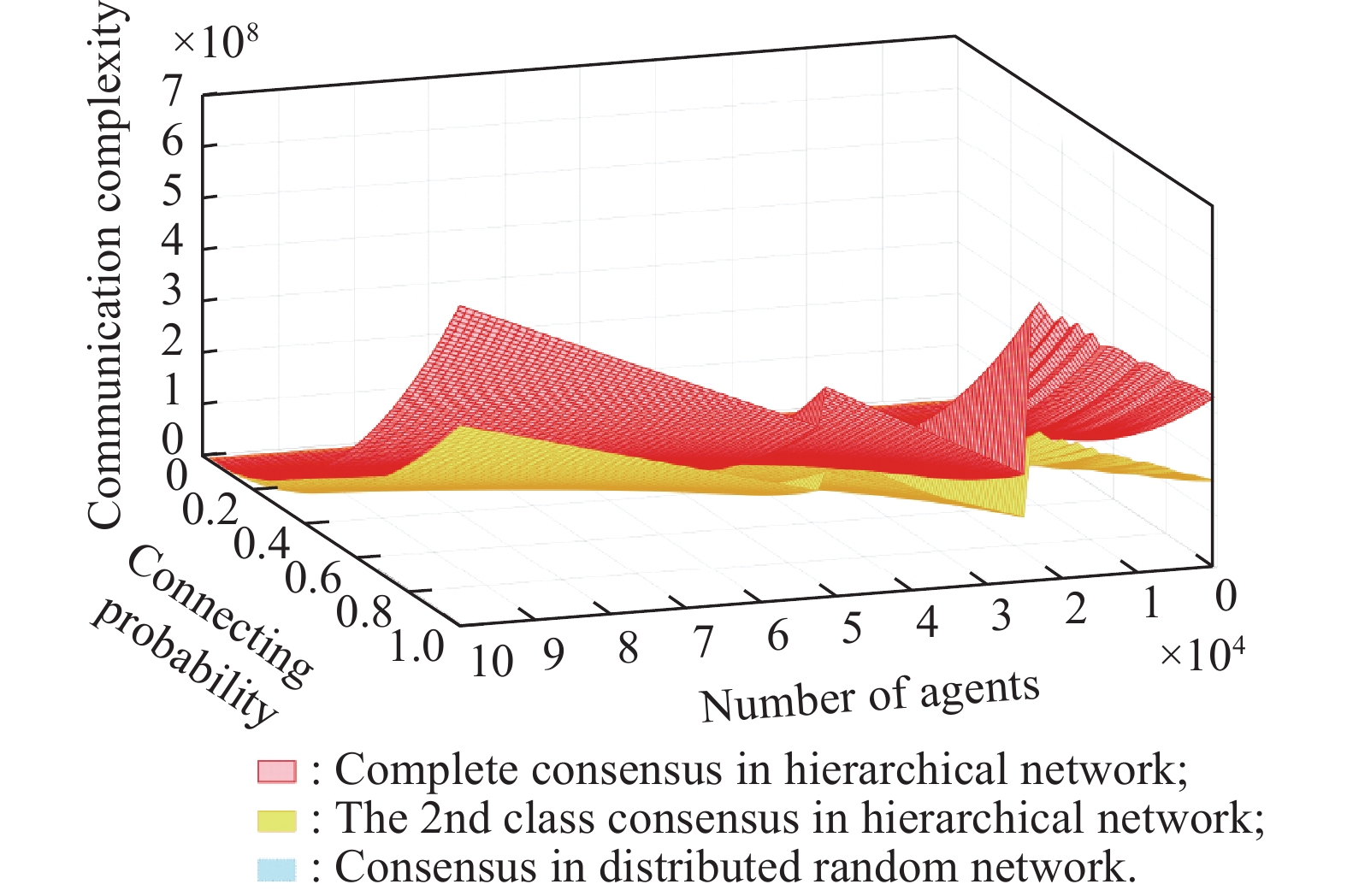
Fig 4
Comparisons of the communication complexity between hierarchical networks and distributed networks"
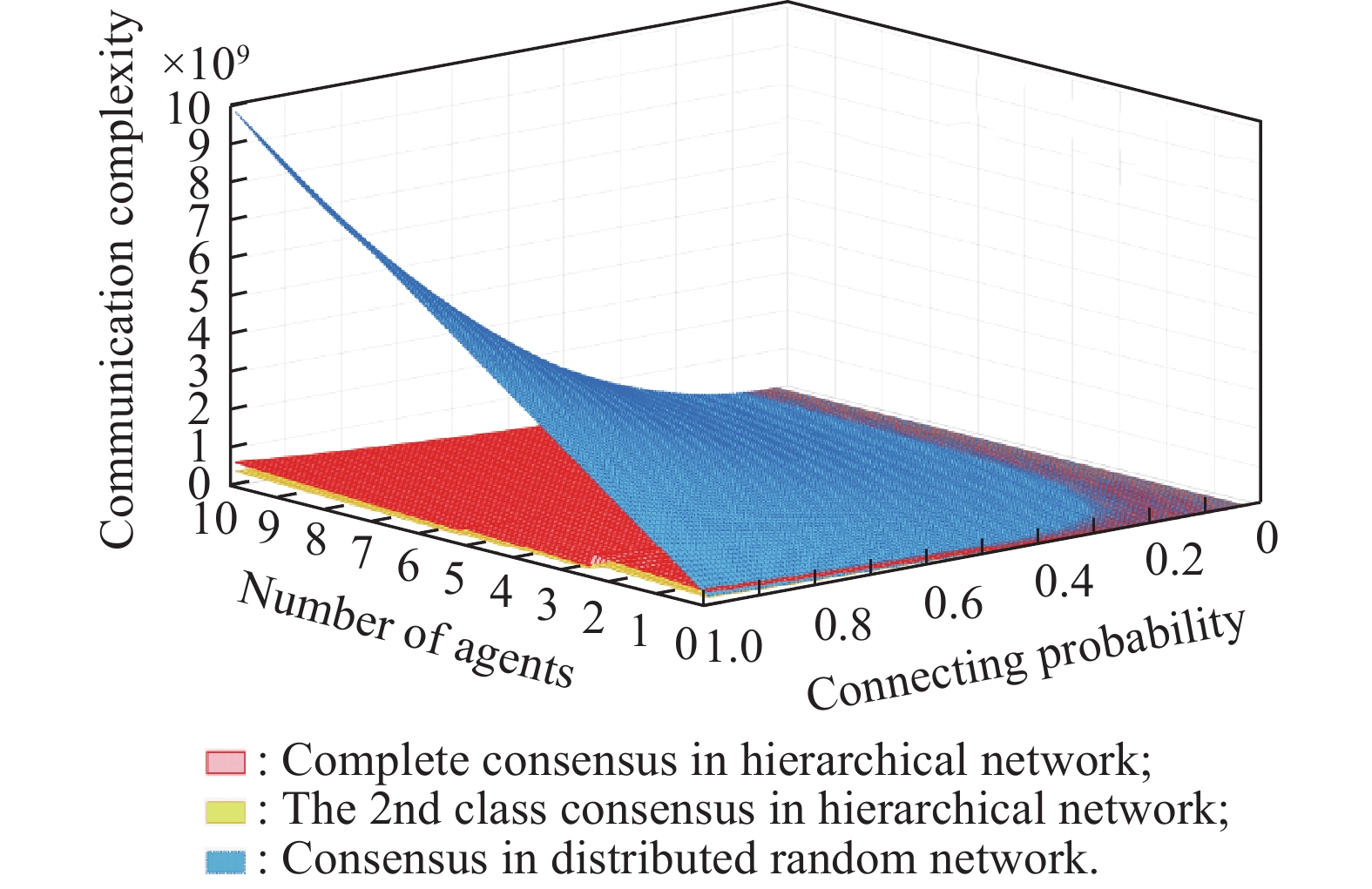
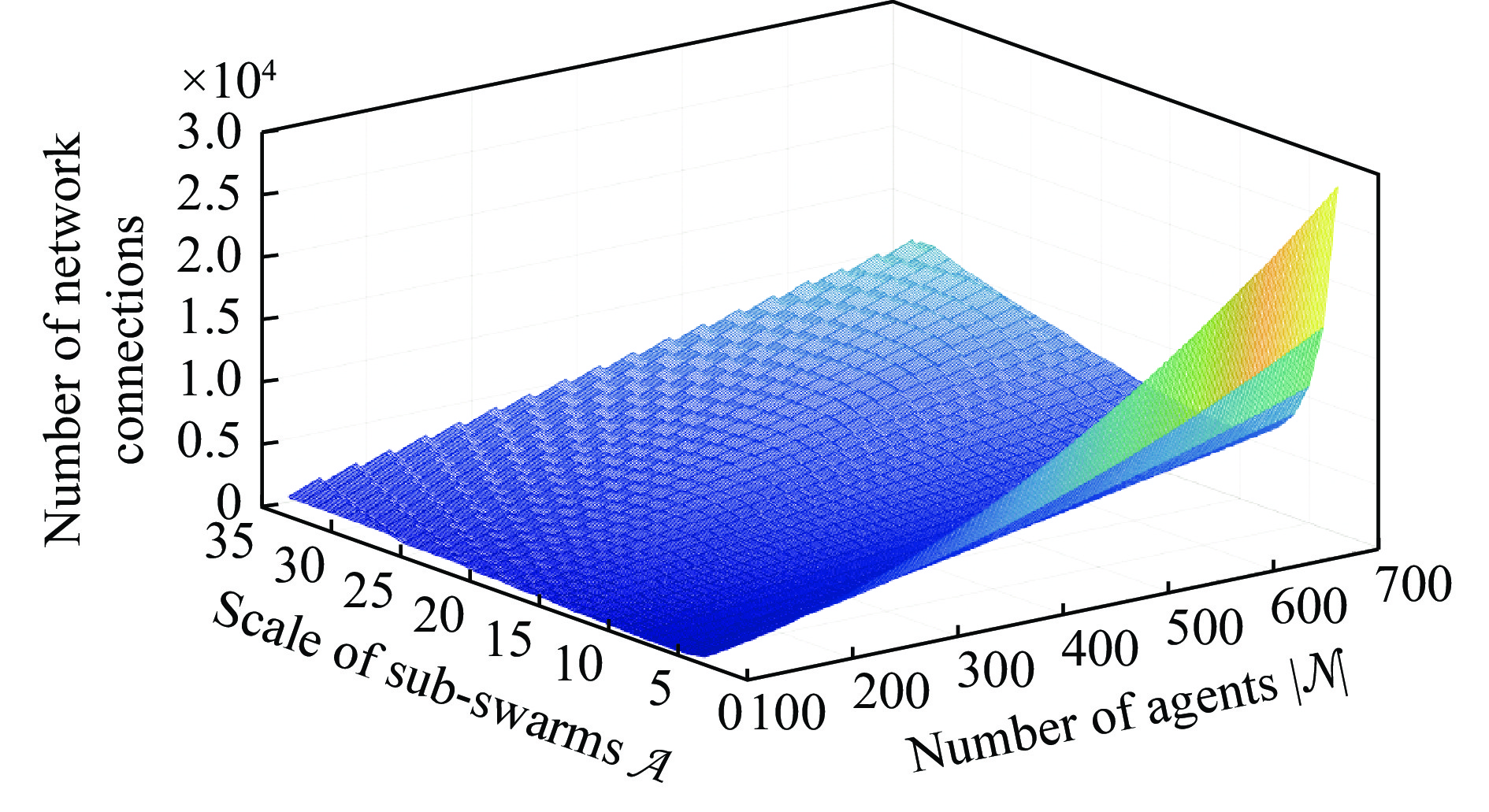
Fig 2
Expected number of network connections based on Theorem 2"
Table 2
Time-varying inputs of target"
| Time/s | 0−25 | 25−50 | 50−100 | 100−125 | 125−150 | 150−160 |
| 5 | 5 | 10 | 0 | −10 | 10 | |
| 5 | −5 | −5 | 0 | 0 | 5 | |
| Time/s | 160−170 | 170−180 | 180−200 | 200−250 | 250−300 | − |
| −5 | −10 | 0 | −10cos | 0 | − | |
| 5 | 0 | −10 | −10 | 0 | − | |
Fig 5
Diagram of distributed random network topology"
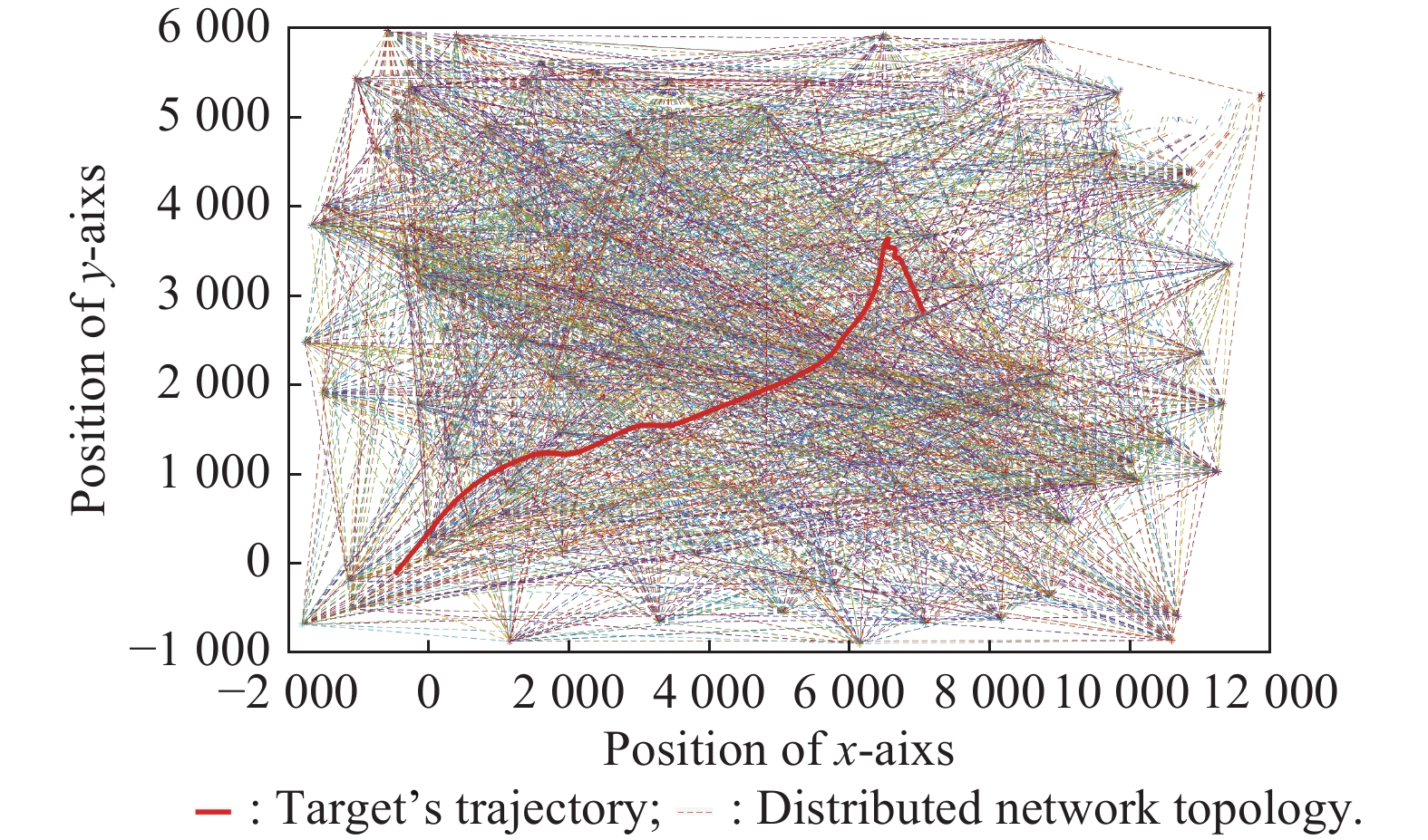
Fig 6
Diagram of hierarchical random network topology"
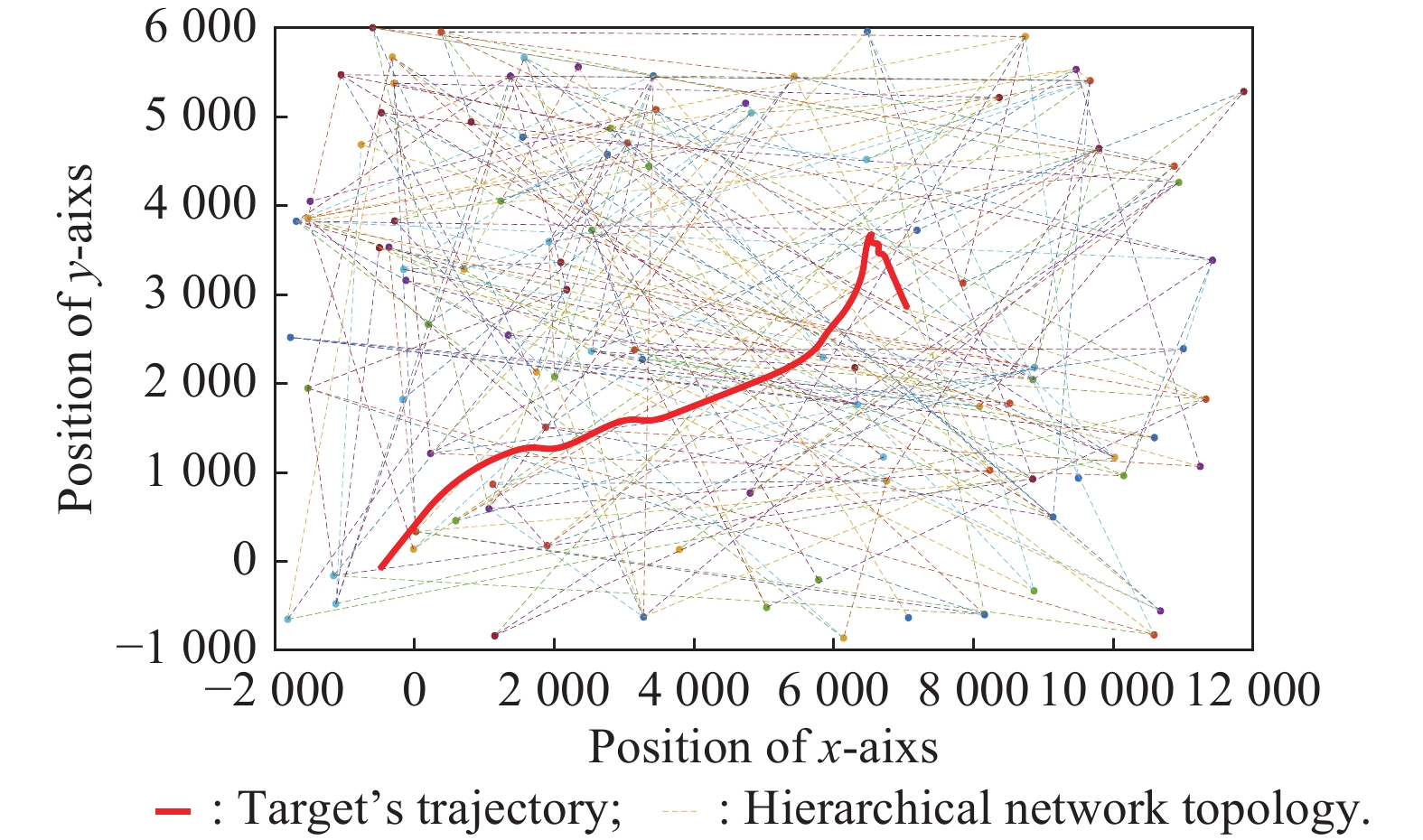
Fig 7
Positions estimation RMSEs of two single time-scale filters"
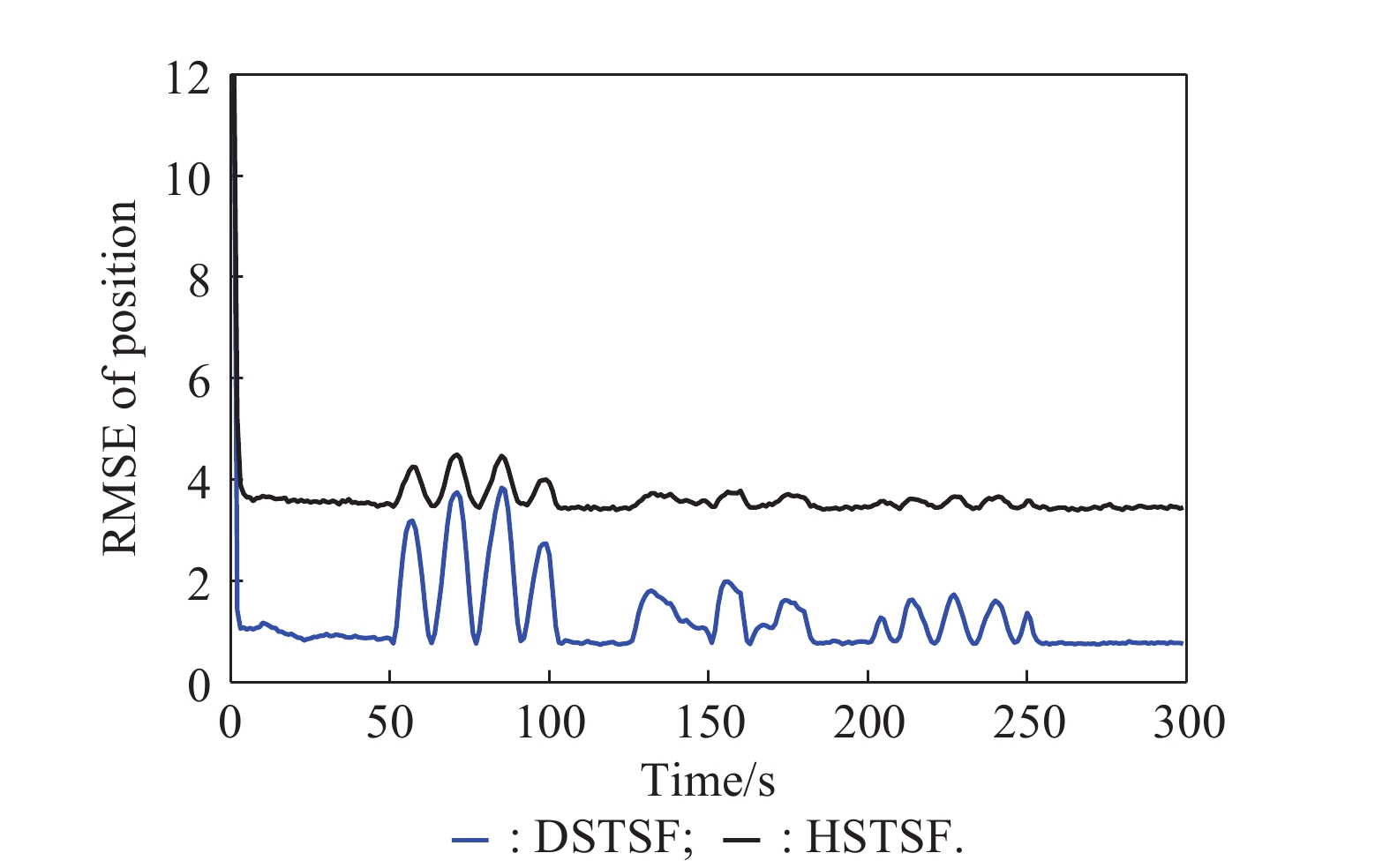
Fig 8
Positions estimation CRMSEs of two single time-scale filters"
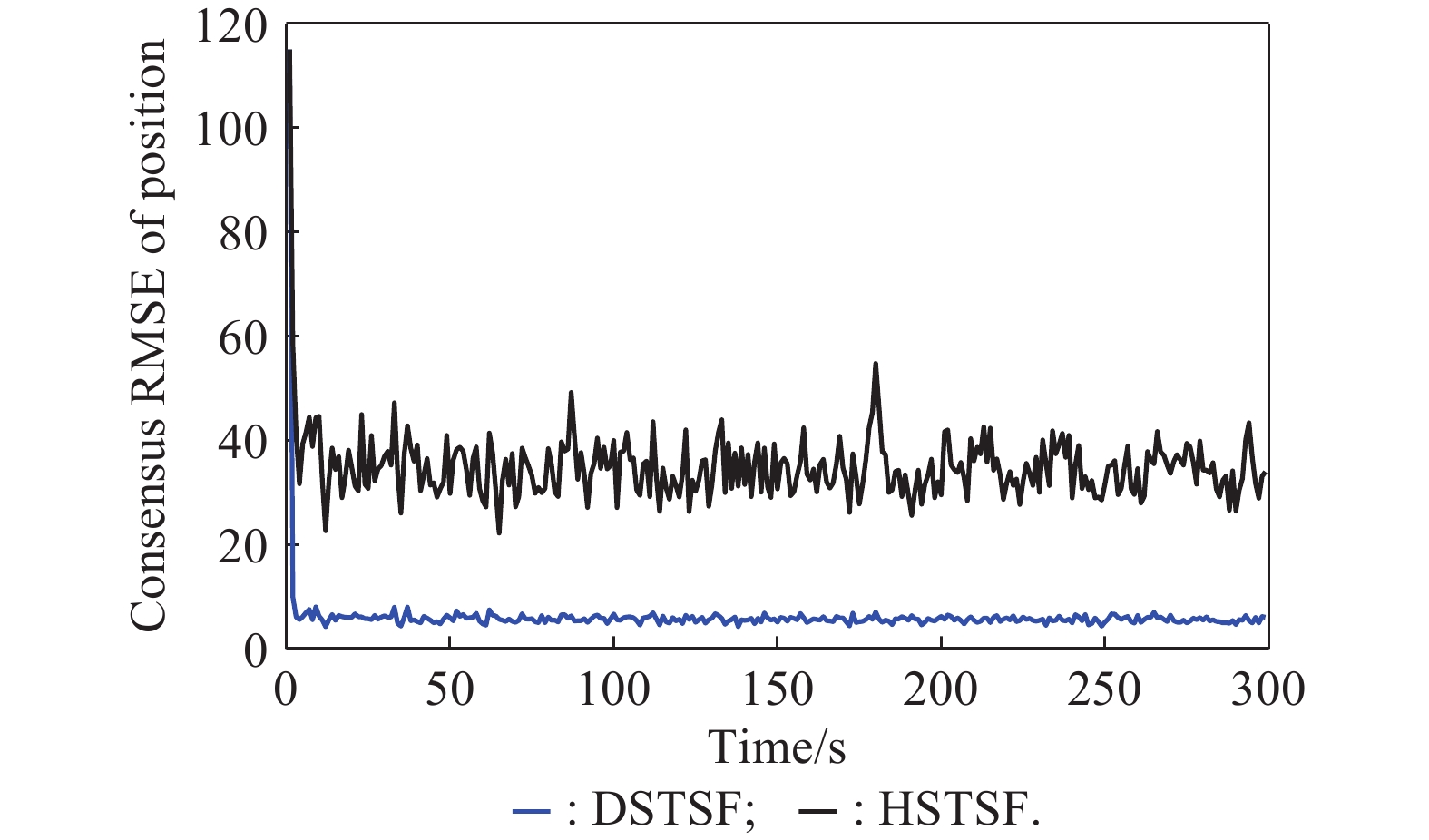
Table 3
Constant acceleration inputs of basic multiple models"
| Model index | 1 | 2 | 3 | 4 | 5 | 6 | 7 | 8 | 9 |
| 0 | 5 | −5 | 5 | −5 | 10 | 0 | −10 | 0 | |
| 0 | 5 | 5 | −5 | −5 | 0 | 10 | 0 | −10 |
Fig 9
Position estimation RMSEs of three double time-scale filters"
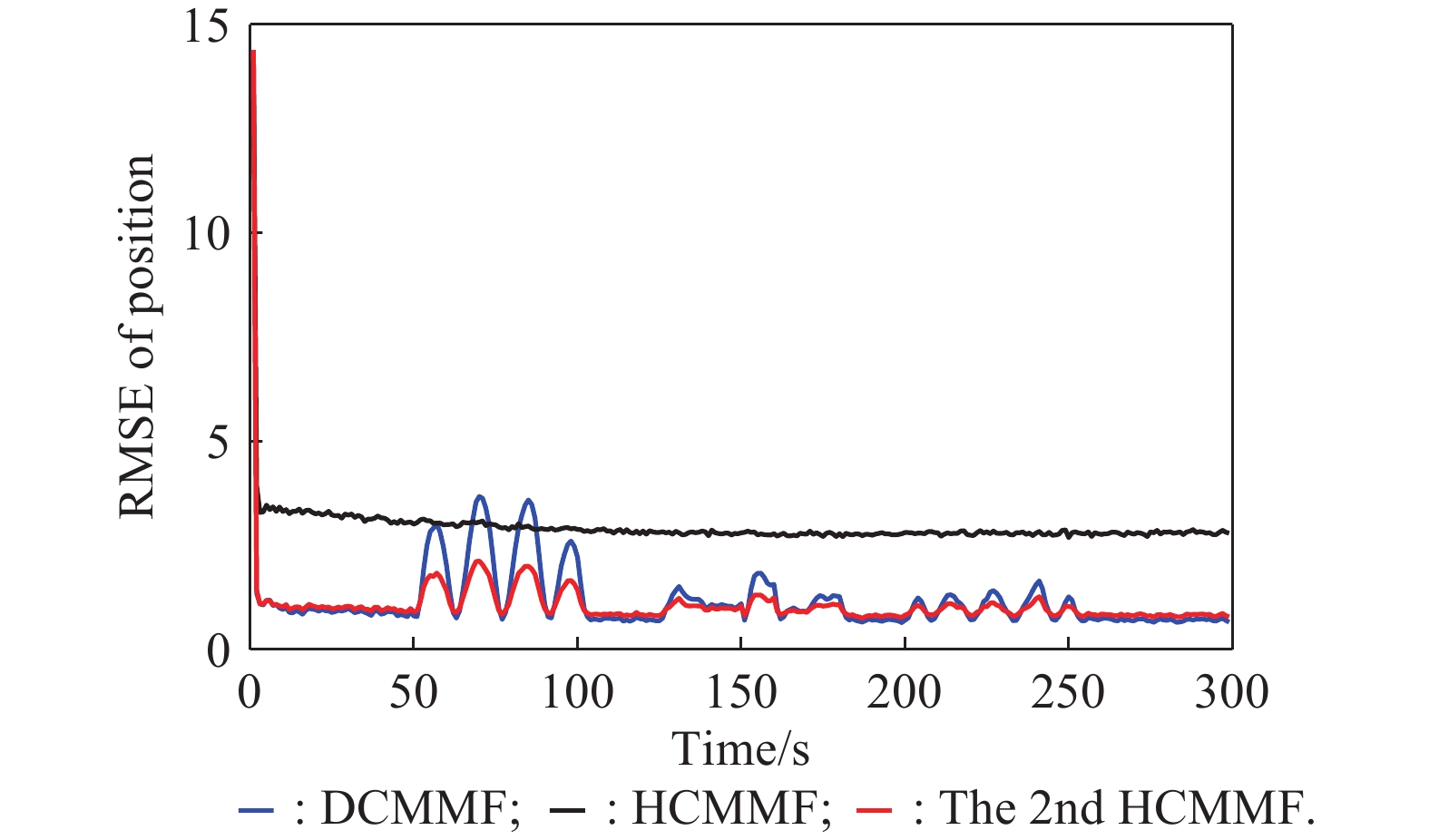
Fig 10
Position estimation CRMSEs of three double time-scale filters"
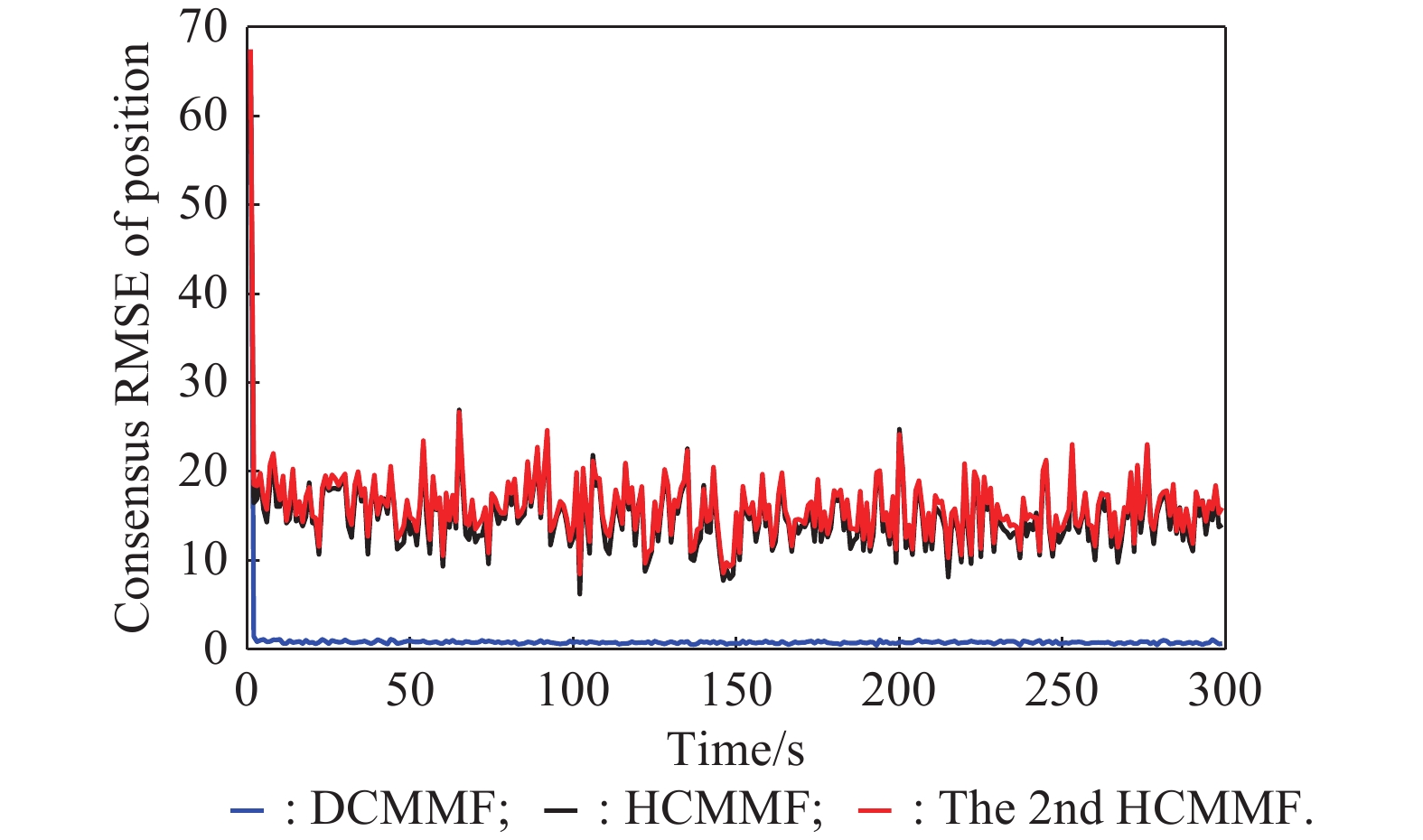
Table 4
RMSEs and communication complexities of three method in the above simulation case studies"
| Metric | DSTSF | HSTSF | − |
| Average RMSE in case 1 | 1.278 | 3.626 | − |
| Max RMSE in case 1 | 3.839 | 4.494 | − |
| Average CRMSE in case 1 | 6.093 | 34.92 | − |
| Consensus loop times | 1 | 1 | − |
| Communication complexity | 495 | − | |
| Metric | DCMMF | HCMMF | The 2nd HCMMF |
| Average RMSE in case 2 | 1.187 | 2.935 | 1.075 |
| Max RMSE in case 2 | 3.763 | 3.464 | 2.112 |
| Average CRMSE in case 2 | 1.018 | 15.12 | 16.04 |
| Consensus loop times | 3 | 7 | 5 |
| Communication complexity | |||
| 1 |
OLFATI-SABER R, FAX J A, MURRAY R M Consensus and cooperation in networked multi-agent systems. Proceedings of the IEEE, 2007, 95 (1): 215- 233.
doi: 10.1109/JPROC.2006.887293 |
| 2 |
OLFATI-SABER R, MURRAY R M Consensus problems in networks of agents with switching topology and time-delays. IEEE Trans. on Automatic Control, 2004, 49 (9): 1520- 1533.
doi: 10.1109/TAC.2004.834113 |
| 3 | OROSTICA B, NUNEZ F. A multi-cast algorithm for robust average consensus over internet of things environments. Computer Communications, 2019, 140−141: 15–22. |
| 4 |
LI T C, FAN H Q, GARCIA J, et al Second-order statistics analysis and comparison between arithmetic and geometric average fusion: application to multi-sensor target tracking. Information Fusion, 2019, 51, 233- 243.
doi: 10.1016/j.inffus.2019.02.009 |
| 5 |
ZHENG L T, BATTISTELLI G, CHISCI L, et al Distributed state estimation for heterogeneous sensor networks. Automatica, 2024, 169, 111839.
doi: 10.1016/j.automatica.2024.111839 |
| 6 |
BATTISTELLI G, CHISCI L Kullback–Leibler average, consensus on probability densities, and distributed state estimation with guaranteed stability. Automatica, 2014, 50 (3): 707- 718.
doi: 10.1016/j.automatica.2013.11.042 |
| 7 | BATTISTELLI G, CHISCI L, FANTACCI C, et al. Consensus-based multiple-model Bayesian filtering for distributed tracking. IET Radar, Sonar & Navigation, 2015, 9(4): 401−410. |
| 8 | WANG Y Q, LU Z, CAI Y Z Consensus-based distributed variable structure multiple model. Acta Automatica Sinica, 2021, 47 (7): 1548- 1557. |
| 9 |
HATANO Y, MESBAHI M Agreement over random networks. IEEE Trans. on Automatic Control, 2005, 50 (11): 1867- 1872.
doi: 10.1109/TAC.2005.858670 |
| 10 |
LIN X, ZHENG Y S, WANG L Consensus of switched multi-agent systems with random networks. International Journal of Control, 2017, 90 (5): 1113- 1122.
doi: 10.1080/00207179.2016.1201865 |
| 11 |
FU W M, QIN J H, WU J F, et al Interval consensus over random networks. Automatica, 2020, 111, 108603.
doi: 10.1016/j.automatica.2019.108603 |
| 12 | SHANG Y L Median-based resilient consensus over time-varying random networks. IEEE Trans. on Circuits and Systems II: Express Briefs, 2022, 69 (3): 1203- 1207. |
| 13 |
YANG J N, ZHOU L Q, LIU J, et al Min–max group consensus of discrete-time multi-agent systems under directed random networks. Systems Control Letters, 2024, 193, 105938.
doi: 10.1016/j.sysconle.2024.105938 |
| 14 |
WANG Y, CAI M, JIAN X L Consensus model of social network group decision-making based on trust relationship among experts and expert reliability. Journal of Systems Engineering and Electronics, 2023, 34 (6): 1576- 1588.
doi: 10.23919/JSEE.2023.000021 |
| 15 |
DIAO W X, LIU Y Two-level consensus modeling with utility and cost constraints. Journal of Systems Engineering and Electronics, 2022, 33 (3): 716- 726.
doi: 10.23919/JSEE.2022.000066 |
| 16 |
ZHOU J L, YAND J Y Distributed guidance law design for cooperative simultaneous attacks with multiple missiles. Journal of Guidance Control, and Dynamics, 2016, 39 (10): 2439- 2447.
doi: 10.2514/1.G001609 |
| 17 |
ZHOU J L, LV Y Z, WEN G H, et al Terminal-time synchronization of multivehicle systems under sampled-data communications. IEEE Trans. on Systems, Man, and Cybernetics: Systems, 2022, 52 (4): 2625- 2636.
doi: 10.1109/TSMC.2021.3049545 |
| 18 |
ZHAO E J, DING X, ZHANG K, et al Fixed-time cooperative interception guidance law with angle constraints for multiple flight vehicles. Journal of Systems Engineering and Electronics, 2025, 36 (2): 569- 579.
doi: 10.23919/JSEE.2025.000036 |
| 19 |
DOOSTMOHAMMADIAN M, TAGHIEH A, ZARRABI H Distributed estimation approach for tracking a mobile target via formation of uavs. IEEE Trans. on Automation Science and Engineering, 2022, 19 (4): 3765- 3776.
doi: 10.1109/TASE.2021.3135834 |
| 20 |
WANG Y Q, ZHENG L T, CAI Y Z Multi-class hierarchical random networks for consensus-based information filter. IEEE Trans. on Circuits and Systems I: Regular Papers, 2025, 72 (9): 4981- 4993.
doi: 10.1109/TCSI.2024.3516371 |
| 21 |
DING L, HAN Q L, GE X H, et al An overview of recent advances in event-triggered consensus of multiagent systems. IEEE Trans. on Cybernetics, 2018, 48 (4): 1110- 1123.
doi: 10.1109/TCYB.2017.2771560 |
| 22 |
ZHANG W A, CHEN B, CHEN M Z Q Hierarchical fusion estimation for clustered asynchronous sensor networks. IEEE Trans. on Automatic Control, 2016, 61 (10): 3064- 3069.
doi: 10.1109/TAC.2015.2498701 |
| 23 |
DONG X X, BATTISTELLI G, CHISCI L, et al An event-triggered hybrid consensus filter for distributed sensor network. IEEE Signal Processing Letters, 2022, 29, 1472- 1476.
doi: 10.1109/LSP.2022.3183494 |
| 24 | ERDOS P, RENYI A. On the evolution of random graphs. The structure and dynamics of networks. Princeton: Princeton University Press, 2006. |
| 25 |
LOPES C G, SAYED A H Diffusion least-mean squares over adaptive networks: Formulation and performance analysis. IEEE Trans. on Signal Processing, 2008, 56 (7): 3122- 3136.
doi: 10.1109/TSP.2008.917383 |
| 26 |
DOOSTMOHAMMADIAN M, KHAN U A On the complexity of minimum-cost networked estimation of self-damped dynamical systems. IEEE Trans. on Network Science and Engineering, 2020, 7 (3): 1891- 1900.
doi: 10.1109/TNSE.2019.2956546 |
| 27 |
CALAFIORE G C, ABRATE F Distributed linear estimation over sensor networks. International Journal of Control, 2009, 82 (5): 868- 882.
doi: 10.1080/00207170802350662 |
| 28 |
YUAN Y, STAN G B, SHI L, et al Decentralised minimum-time consensus. Automatica, 2013, 49 (5): 1227- 1235.
doi: 10.1016/j.automatica.2013.02.015 |
| 29 |
SHANG Y L Estimation of the shortest average distance in bipartite networks with given density. Journal of the Physical Society of Japan, 2011, 80 (5): 055001.
doi: 10.1143/JPSJ.80.055001 |
| 30 |
HENDRICKX J M, JUNGERS R M, OLSHEVSKY A, et al Graph diameter, eigenvalues, and minimum-time consensus. Automatica, 2014, 50 (2): 635- 640.
doi: 10.1016/j.automatica.2013.11.034 |
| 31 |
CHUNG F, LU L Y The diameter of sparse random graphs. Advances in Applied Mathematics, 2001, 26 (4): 257- 279.
doi: 10.1006/aama.2001.0720 |
| 32 |
SHANG Y L Inhomogeneous long-range percolation on the hierarchical lattice. Reports on Mathematical Physics, 2015, 76 (1): 53- 61.
doi: 10.1016/S0034-4877(15)30018-5 |
| 33 |
SHANG Y L Percolation in a hierarchical lattice. Zeitschrift fur Naturforschung A, 2012, 67 (5): 225- 229.
doi: 10.5560/zna.2012-0012 |
| 34 |
SHANG Y L Characterization of expansion-related properties of modular graphs. Discrete Applied Mathematics, 2023, 338, 135- 144.
doi: 10.1016/j.dam.2023.06.002 |
| [1] | Xiaoyu XING, Haoxiang XIA. A formation pursuit method integrated coordinated reciprocity for enhanced capture [J]. Journal of Systems Engineering and Electronics, 2026, 37(1): 211-224. |
| [2] | Xueqiang GU, Lina LU, Fengtao XIANG, Wanpeng ZHANG. Formation-containment control for nonholonomic multi-agent systems with a desired trajectory constraint [J]. Journal of Systems Engineering and Electronics, 2025, 36(1): 256-268. |
| [3] | Donghao QIN, Le WANG, Jiuan GAO, Jianxiang XI. Minimum-energy leader-following formation of distributed multi-agent systems with communication constraints [J]. Journal of Systems Engineering and Electronics, 2023, 34(6): 1419-1431. |
| [4] | Zhengyu YE, Bin JIANG, Yuehua CHENG, Ziquan YU, Yang YANG. Distributed fault diagnosis observer for multi-agent system against actuator and sensor faults [J]. Journal of Systems Engineering and Electronics, 2023, 34(3): 766-774. |
| [5] | Pu YANG, Xukai HU, Zixin WANG, Zhiqing ZHANG. Sliding mode fault tolerant consensus control for multi-agent systems based on super-twisting observer [J]. Journal of Systems Engineering and Electronics, 2022, 33(6): 1309-1319. |
| [6] | Sader MALIKA, Fuyong WANG, Zhongxin LIU, Zengqiang CHEN. Distributed fuzzy fault-tolerant consensus of leader-follower multi-agent systems with mismatched uncertainties [J]. Journal of Systems Engineering and Electronics, 2021, 32(5): 1031-1040. |
| [7] | Duo QI, Junhua HU, Xiaolong LIANG, Jiaqiang ZHANG, Zhihao ZHANG. Research on consensus of multi-agent systems with and without input saturation constraints [J]. Journal of Systems Engineering and Electronics, 2021, 32(4): 947-955. |
| [8] |
Bingqiang LI, Tianyi LAN, Yiyun ZHAO, Shuaishuai LYU.
Open-loop and closed-loop |
| [9] | Xia WU, Yan LI, Yongjian SUN, Alei CHEN, Jianwen CHEN, Jianchao MA, Hao CHEN. Investigation of MAS structure and intelligent+ information processing mechanism of hypersonic target detection and recognition system [J]. Journal of Systems Engineering and Electronics, 2020, 31(6): 1105-1115. |
| [10] | Jie ZHANG, Gang WANG, Shaohua YUE, Yafei SONG, Jiayi LIU, Xiaoqiang YAO. Multi-agent system application in accordance with game theory in bi-directional coordination network model [J]. Journal of Systems Engineering and Electronics, 2020, 31(2): 279-289. |
| [11] | Weiwei WU, Qian MA, Yexin LIU, Yongjun KIM. A model for knowledge transfer in a multi-agent organization based on lattice kinetic model [J]. Journal of Systems Engineering and Electronics, 2020, 31(1): 156-167. |
| [12] | Dariush TAVAKOLIFAR, Hamid KHALOOZADEH, Roya AMJADIFARD. Stabilization of switched systems with all unstable modes: application to the aircraft team problem [J]. Journal of Systems Engineering and Electronics, 2019, 30(4): 792-798. |
| [13] | Xiaolei Li, Xiaoyuan Luo, Shaobao Li, Jianjin Li, and Xinping Guan. Consensus of second-order nonlinear multi-agent systems via sliding mode observer and controller [J]. Systems Engineering and Electronics, 2017, 28(4): 756-. |
| [14] | Yanchao Sun, Wenjia Wang, Guangfu Ma, Zhuo Li, and Chuanjiang Li. Backstepping-based distributed coordinated tracking for multiple uncertain Euler-Lagrange systems [J]. Journal of Systems Engineering and Electronics, 2016, 27(5): 1083-1095. |
| [15] | Jia Wei and Huajing Fang. Multi-agent consensus with time-varying delays and switching topologies [J]. Journal of Systems Engineering and Electronics, 2014, 25(3): 489-495. |
| Viewed | ||||||
|
Full text |
|
|||||
|
Abstract |
|
|||||
