
Journal of Systems Engineering and Electronics ›› 2026, Vol. 37 ›› Issue (3): 897-903.doi: 10.23919/JSEE.2026.000042
• SYSTEMS ENGINEERING • Previous Articles Next Articles
Guoliang ZHU1( ), Jinjian ZHANG2(), Xuan LIU2(), Guojun WANG2(), Xiaodong ZHANG2(), Kaiyu CHEN3(), Yu WANG3,*()
Received:2025-10-23
Online:2026-06-18
Published:2026-06-29
Contact:
Yu WANG
E-mail:zhujunren@126.com;zhangjinjian1221@163.com;1298604075@qq.com;2111979554@qq.com;zxd0352@qq.com;kaiyu_chen@mail.nwpu.edu.cn;wyyyyy@mail.nwpu.edu.cn
Guoliang ZHU, Jinjian ZHANG, Xuan LIU, Guojun WANG, Xiaodong ZHANG, Kaiyu CHEN, Yu WANG. Heterogeneous multi-core task scheduling based on adaptive simulated annealing[J]. Journal of Systems Engineering and Electronics, 2026, 37(3): 897-903.
Add to citation manager EndNote|Reference Manager|ProCite|BibTeX|RefWorks
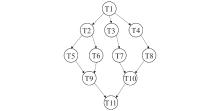
Fig 1
Application model representation by DAG"
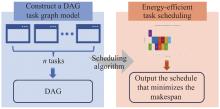
Fig 2
Energy-efficient task scheduling process schematic"
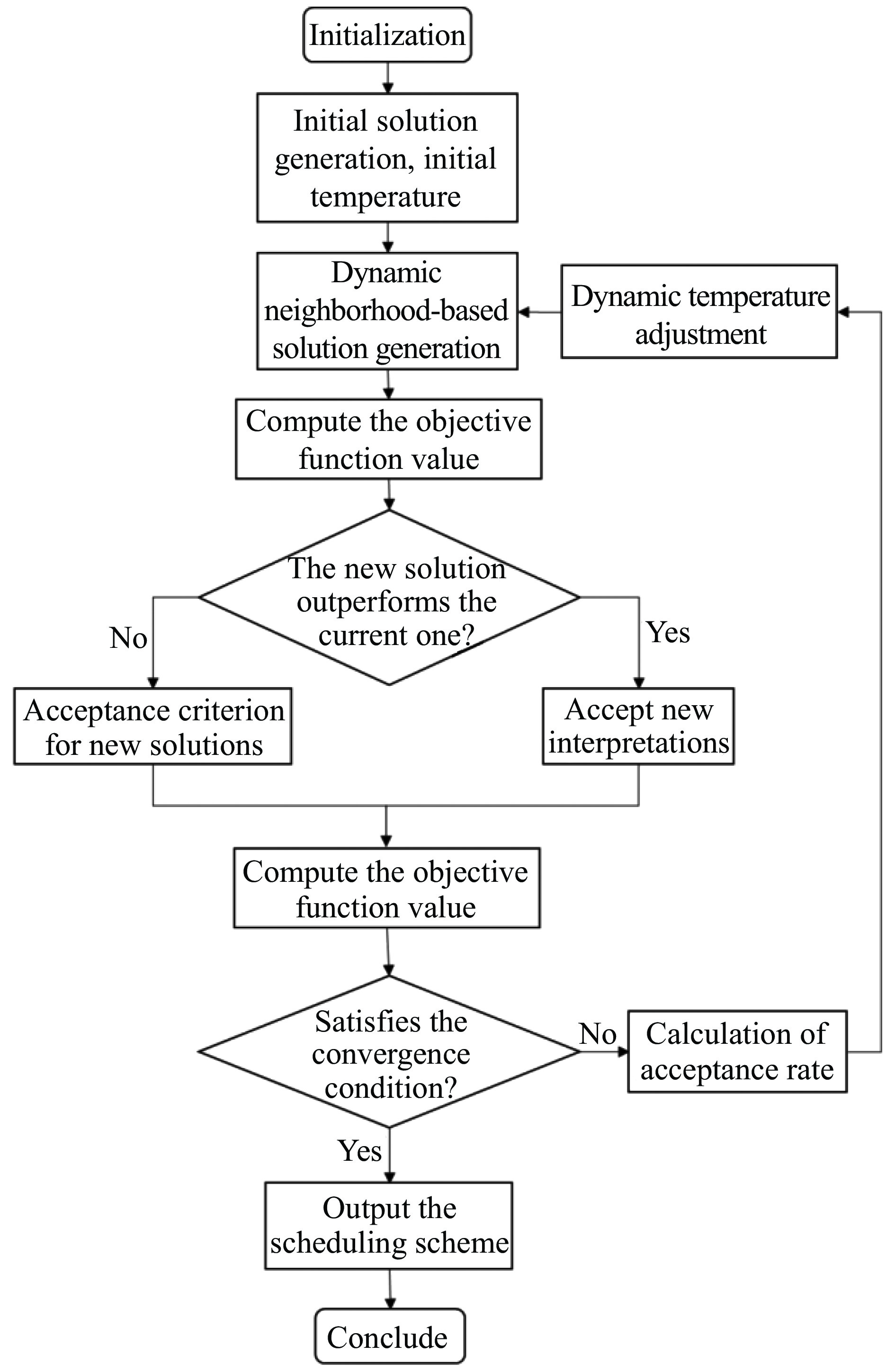
Fig 3
ASA scheduling algorithm flowchart"
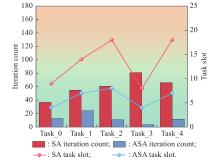
Fig 4
Convergence generation and task slots comparison"
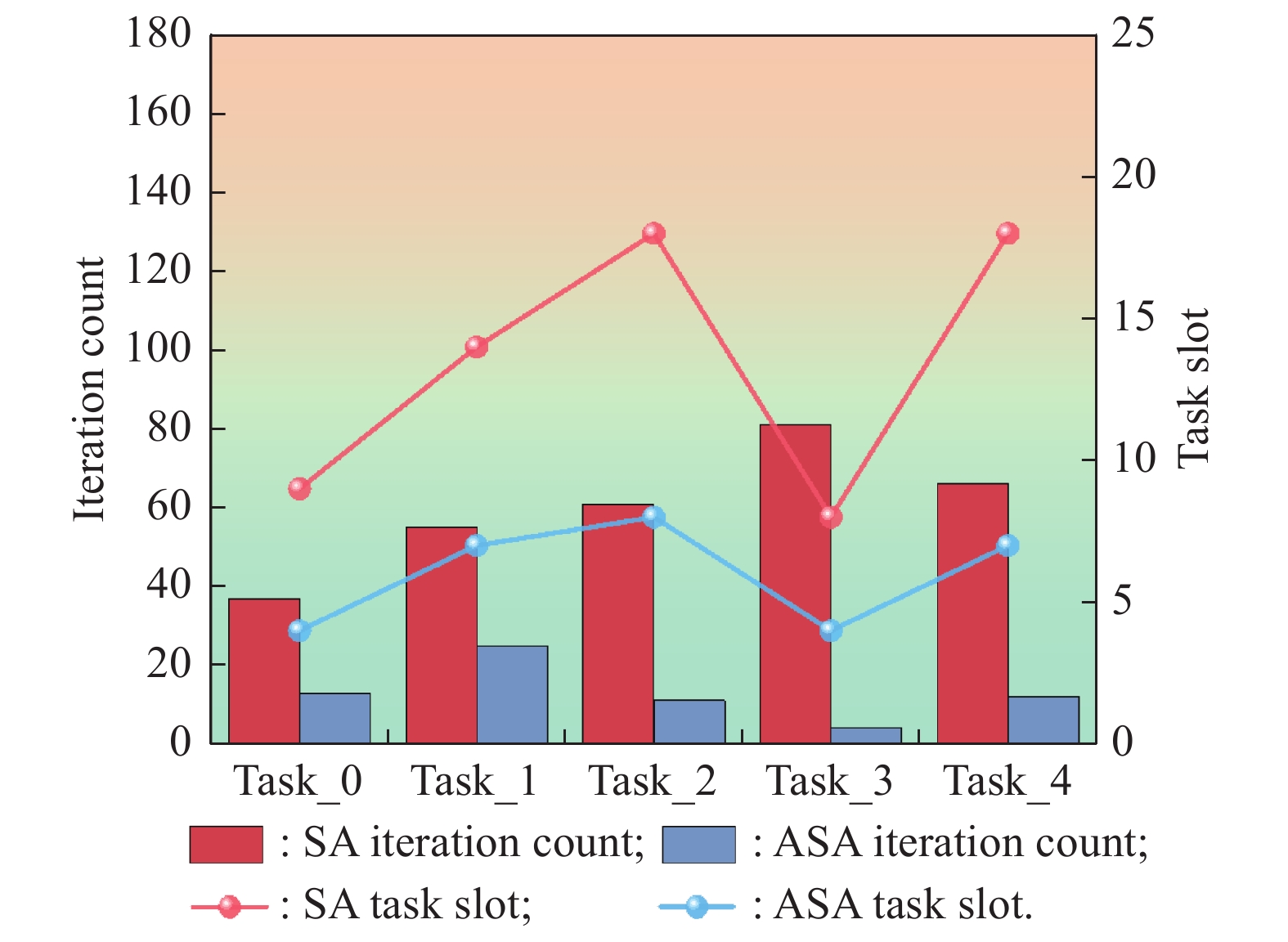
Table 1
Convergence generation comparison"
| Algorithm | 0 | 1 | 2 | 3 | 4 |
| SA | 37 | 55 | 61 | 81 | 66 |
| ASA | 13 | 25 | 11 | 4 | 12 |
Table 2
Task slots comparison"
| Algorithm | 0 | 1 | 2 | 3 | 4 |
| SA | 9 | 14 | 18 | 8 | 18 |
| ASA | 4 | 7 | 8 | 4 | 7 |
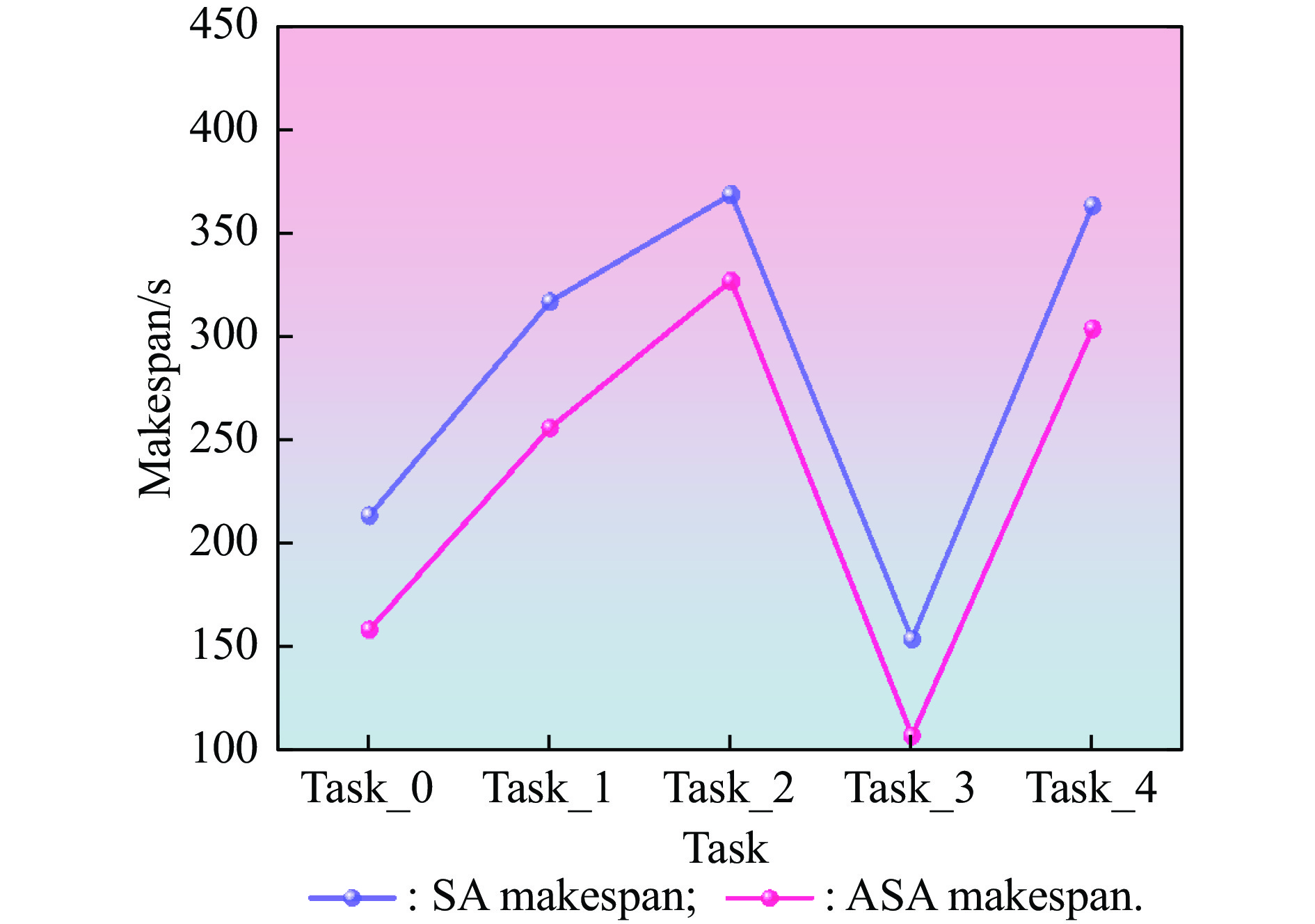
Fig 5
Scheduling time comparison"
Table 3
Makespan comparison s"
| Algorithm | 0 | 1 | 2 | 3 | 4 |
| SA | 213.5 | 317.3 | 369.2 | 153.4 | 363.8 |
| ASA | 158.1 | 255.9 | 327.3 | 106.6 | 304.1 |
| 28 | ZHOU S E, LEI H. An improved genetic-annealing algorithm for task scheduling based on precedence task duplication. Microelectronics & Computer, 2006, 23(10): 62–64. |
| 29 | CHENG X H, LIU T C Heterogeneous multi-core task scheduling based on crazy adaptive bottle ascidians group algorithm. Computer & Digital Engineering, 2024, 52 (10): 2886- 2889, 2919. |
| 30 | FENG S, JIANG B, XU H Task Scheduling for heterogeneous multi-core processors based on evolutionary adaptive bat algorithm. Computer Engineering, 2025, 51 (5): 249- 256. |
| 31 | YAN T, LI W, LI Y C. QoS guided task scheduling heuristic in computational grid environments. Microelectronics & Computer, 2006, 23(10): 107–110. (in Chinese) |
| 1 | XIE X Y, REN X, ZHU Y, et al A resource-adaptive tensor decomposition method for convolutional neural networks. High Technology Letters, 2025, 31 (4): 355- 364. |
| 2 |
FANG J, LIN S, YANG H J, et al A perceptual and predictive batch-processing memory scheduling strategy for a CPU-GPU heterogeneous system. Frontiers of Information Technology & Electronic Engineering, 2023, 24 (7): 994- 1007.
doi: 10.1631/FITEE.2200449 |
| 3 | SONG Y, DAI H, JIANG J, et al. Multikernel: operating system solution to generalized functional safety. Security and Safety, 2023, 2(2): 30−43. |
| 4 |
YAN J, TANG F F, ZHANG Z G, et al Low-power design for heterogeneous multi-core AI SoC chip. Aerospace Control, 2020, 38 (2): 6268.
doi: 10.16804/j.cnki.issn1006-3242.2020.02.013 |
| 5 |
LI B, ZHOU Q L, SI X M, et al Design method of big data high-efficiency platform based on mimic computing. Application Research of Computers, 2019, 36 (7): 2059- 2064.
doi: 10.19734/j.issn.1001-3695.2018.02.0084 |
| 6 |
JIA G Y, HAN G J, JIANG J F, et al Dynamic resource partitioning for heterogeneous multi-core-based cloud computing in smart cities. IEEE Access, 2016, 4, 108- 118.
doi: 10.1109/ACCESS.2015.2507576 |
| 7 |
QIU T, ZHAO A Y, MA R X, et al A task-efficient sink node based on embedded multi-core SoC for Internet of Things. Future Generation Computer Systems, 2018, 82, 656- 666.
doi: 10.1016/j.future.2016.12.024 |
| 8 | NING J H, YANG T T, ZHENG C, et al. DeAOff: dependence-aware offloading of decoder-based generative models for edge computing. China Communications, 2025, 22(7): 14−29. |
| 9 |
KIM Y G, KIM M, CHUNG S W Enhancing energy efficiency of multimedia applications in heterogeneous mobile multi-core processors. IEEE Trans. on Computers, 2017, 66 (11): 1878- 1889.
doi: 10.1109/TC.2017.2710317 |
| 10 |
ZHANG S B, GAO H Y, SU Y M, et al Physical-layer secure hybrid task scheduling and resource management for fog computing IoT networks. Journal of Systems Engineering and Electronics, 2025, 36 (5): 1146- 1160.
doi: 10.1007/s11390-010-9318-0 |
| 11 |
ZHOU Z, LI F M, ZHU H X, et al An improved genetic algorithm using greedy strategy toward task scheduling optimization in cloud environments. Neural Computing and Applications, 2020, 32, 1531- 1541.
doi: 10.1007/s00521-019-04119-7 |
| 12 | ZHOU Y H, ZENG W, ZHENG Q F, et al. A survey on task scheduling of CPU-GPU heterogeneous cluster. ZTE Communications, 2024, 22(3): 83−90. (in Chinese) |
| 13 |
MADNI S H H, ABD LATIFF M S, ABDULLAHI M, et al Performance comparison of heuristic algorithms for task scheduling in IaaS cloud computing environment. PloS One, 2017, 12 (5): e0176321.
doi: 10.1371/journal.pone.0176321 |
| 14 | XIE G Q, XIAO X R, PENG H, et al A survey of low-energy parallel scheduling algorithms. IEEE Trans. on Sustainable Computing, 2021, 7 (1): 27- 46. |
| 15 | WU J, CHEN Y N, HE Y M, et al. Survey on autonomous task scheduling technology for Earth observation satellites. Journal of Systems Engineering and Electronics, 2022, 33(6): 1176–1189. |
| 16 | YANG T T, ZHANG Y Q, YUE F L, et al. D-scheduler: a scheduler in time-triggered distributed system through decoupling dependencies between tasks and messages. Science China (Technological Sciences), 2024, 67(1): 183−196. (in Chinese) |
| 17 | LIU W, JIN Y F, ZHANG L, et al. Dynamic access task scheduling of LEO constellation based on space-based distributed computing. Journal of Systems Engineering and Electronics, 2024, 35(4): 842–854. |
| 18 | YANG M, WANG Y, WANG J, et al. Optimal scheduling of integrated energy systems in low-carbon communities considering flexibility of resources and segmental control of solid oxide fuel cells. Journal of Modern Power Systems and Clean Energy, 2025, 13(3): 915−927. |
| 19 |
LI K L, TANG X Y, LI K Q Energy-efficient stochastic task scheduling on heterogeneous computing systems. IEEE Trans. on Parallel and Distributed Systems, 2013, 25 (11): 2867- 2876.
doi: 10.1109/TPDS.2013.270 |
| 20 |
HAO P T, XIAO F, HUANG S J, et al The multi-type DAG task scheduling method based on communication overhead. Microelectronics & Computer, 2024, 41 (5): 67- 75.
doi: 10.19304/J.ISSN1000-7180.2023.0135 |
| 21 |
QUAN Z, WANG Z J, YE T, et al Task scheduling for energy consumption constrained parallel applications on heterogeneous computing systems. IEEE Trans. on Parallel and Distributed Systems, 2019, 31 (5): 1165- 1182.
doi: 10.1109/TPDS.2019.2959533 |
| 22 | YANG P, HOU J W, YU L, et al. Edge-coordinated energy-efficient video analytics for digital twin in 6G. China Communications, 2023, 20(2): 14−25. |
| 23 | LONG T Y, MA Y, WU L, et al. A novel fault-tolerant scheduling approach for collaborative workflows in an edge-IoT environment. Digital Communications and Networks, 2022, 8(6): 911−922. |
| 24 | LI W M, HAN D, GAO L, et al. Integrated production and transportation scheduling method in hybrid flow shop. Chinese Journal of Mechanical Engineering, 2022, 35(1): 123−142. (in Chinese) |
| 25 |
XIE G Q, XIAO X R, LI R F, et al Schedule length minimization of parallel applications with energy consumption constraints using heuristics on heterogeneous distributed systems. Concurrency and Computation: Practice and Experience, 2017, 29 (16): e4024.
doi: 10.1002/cpe.4024 |
| 26 |
ZHANG L X, LI K L, LI C Y, et al Bi-objective workflow scheduling of the energy consumption and reliability in heterogeneous computing systems. Information Sciences, 2017, 379, 241- 256.
doi: 10.1016/j.ins.2016.08.003 |
| 27 |
FAN X M, LI X H, DING Y M, et al Demand response scheduling algorithm for smart residential communities considering heterogeneous energy consumption. Energy and Buildings, 2023, 279, 112691.
doi: 10.1016/j.enbuild.2022.112691 |
| [1] | Kaisheng WANG, Yanyan HUANG, Jinxi TAN, Wenjie ZHAI. Research on unmanned swarm scheduling strategies for mountain obstacle-breaching missions [J]. Journal of Systems Engineering and Electronics, 2026, 37(1): 26-35. |
| [2] | Xiaoduo LI, He LUO, Guoqiang WANG, Youlong YIN. Improved simulated annealing algorithm for UAV path planning with uncertain flight time [J]. Journal of Systems Engineering and Electronics, 2026, 37(1): 272-286. |
| [3] | Haiquan SUN, Zhilong WANG, Xiaoxuan HU, Wei XIA. Hybrid genetic simulated annealing algorithm for agile Earth observation satellite scheduling considering cloud cover distribution [J]. Journal of Systems Engineering and Electronics, 2025, 36(6): 1595-1612. |
| [4] | Shibo ZHANG, Hongyuan GAO, Yumeng SU, Rongchen SUN. Physical-layer secure hybrid task scheduling and resource management for fog computing IoT networks [J]. Journal of Systems Engineering and Electronics, 2025, 36(5): 1146-1160. |
| [5] | Wei LIU, Yifeng JIN, Lei ZHANG, Zihe GAO, Ying TAO. Dynamic access task scheduling of LEO constellation based on space-based distributed computing [J]. Journal of Systems Engineering and Electronics, 2024, 35(4): 842-854. |
| [6] | Jian WU, Yuning CHEN, Yongming HE, Lining XING, Yangrui HU. Survey on autonomous task scheduling technology for Earth observation satellites [J]. Journal of Systems Engineering and Electronics, 2022, 33(6): 1176-1189. |
| [7] | Bing WANG, Pengfei ZHANG, Yufeng HE, Xiaozhi WANG, Xianxia ZHANG. Scenario-oriented hybrid particle swarm optimization algorithm for robust economic dispatch of power system with wind power [J]. Journal of Systems Engineering and Electronics, 2022, 33(5): 1143-1150. |
| [8] | Haowei ZHANG, Junwei XIE, Zhaojian ZHANG, Lei SHAO, Tangjun CHEN. Variable scheduling interval task scheduling for phased array radar [J]. Journal of Systems Engineering and Electronics, 2018, 29(5): 937-946. |
| [9] | Haowei ZHANG, Junwei XIE, Zhaojian ZHANG, Binfeng ZONG, Chuan SHENG. Pulse interleaving scheduling algorithm for digital array radar [J]. Journal of Systems Engineering and Electronics, 2018, 29(1): 67-73. |
| [10] | Chong Wang, Jinhui Tang, Xiaohang Cheng, Yingchen Liu, and Changchun Wang. Distributed cooperative task planning algorithm for multiple satellites in delayed communication environment [J]. Systems Engineering and Electronics, 2016, 27(3): 619-633. |
| [11] | Xionghou Liu, Chao Sun, Yixin Yang, Jie Zhuo, and Yina Han. Low complexity MIMO sonar imaging using a virtual sparse linear array [J]. Journal of Systems Engineering and Electronics, 2016, 27(2): 370-378. |
| [12] | Aijun Liu, Michele Pfund, and John Fowler. Scheduling optimization of task allocation in integrated manufacturing system based on task decomposition [J]. Journal of Systems Engineering and Electronics, 2016, 27(2): 422-433. |
| [13] | Xiaolong Xu, Lingling Cao, and Xinheng Wang. Resource pre-allocation algorithms for low-energy task scheduling of cloud computing [J]. Journal of Systems Engineering and Electronics, 2016, 27(2): 457-469. |
| [14] | Xiong Fu and Yeliang Cang. Task scheduling and virtual machine allocation policy in cloud computing environment [J]. Journal of Systems Engineering and Electronics, 2015, 26(4): 847-. |
| [15] | Weidong Jiang, Haowen Chen, and Xiang Li. Antenna geometry strategy with prior information for direction-finding MIMO radars [J]. Systems Engineering and Electronics, 2015, 26(3): 468-475. |
| Viewed | ||||||
|
Full text |
|
|||||
|
Abstract |
|
|||||
