
Journal of Systems Engineering and Electronics ›› 2026, Vol. 37 ›› Issue (2): 367-376.doi: 10.23919/JSEE.2026.000091
• ELECTRONICS TECHNOLOGY • Previous Articles
Xiao LING1( ), Zhiqi CHEN1(), Guangyang DU2(), Qinghong SHENG1,*()
Received:2024-05-26
Accepted:2026-03-22
Online:2026-04-18
Published:2026-04-30
Contact:
Qinghong SHENG
E-mail:xlingsky@nuaa.edu.cn;1826944388@qq.com;zhanglin821129@163.com;qhsheng@nuaa.edu.cn
About author:Supported by:Xiao LING, Zhiqi CHEN, Guangyang DU, Qinghong SHENG. A multi-source clustered targets track association method based on dual-channel TCN-GRU[J]. Journal of Systems Engineering and Electronics, 2026, 37(2): 367-376.
Add to citation manager EndNote|Reference Manager|ProCite|BibTeX|RefWorks
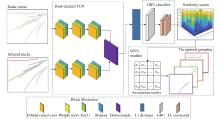
Fig 1
Dual-channel TCN-GRU neural network"
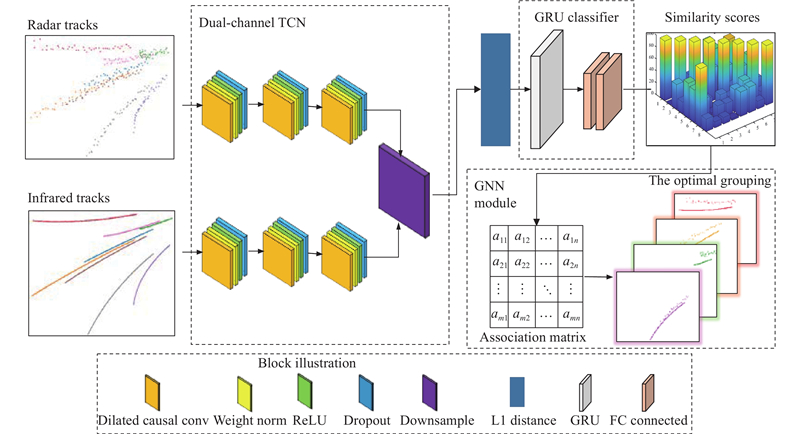
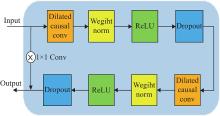
Fig 2
TCN network submodule structure"
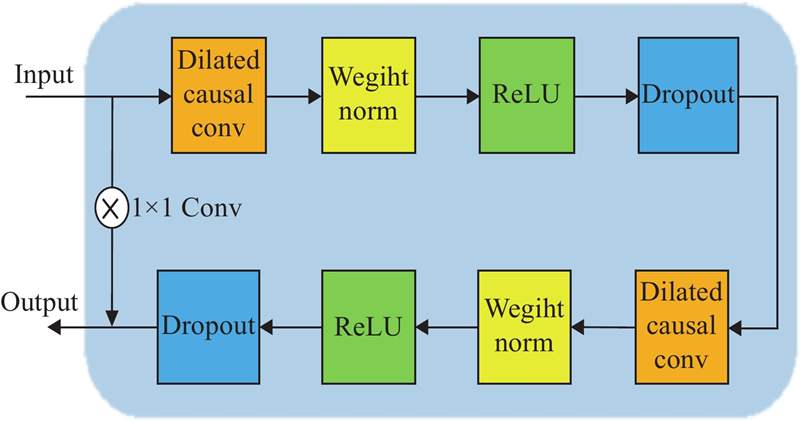
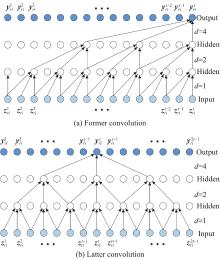
Fig 3
Former and the latter convolution"
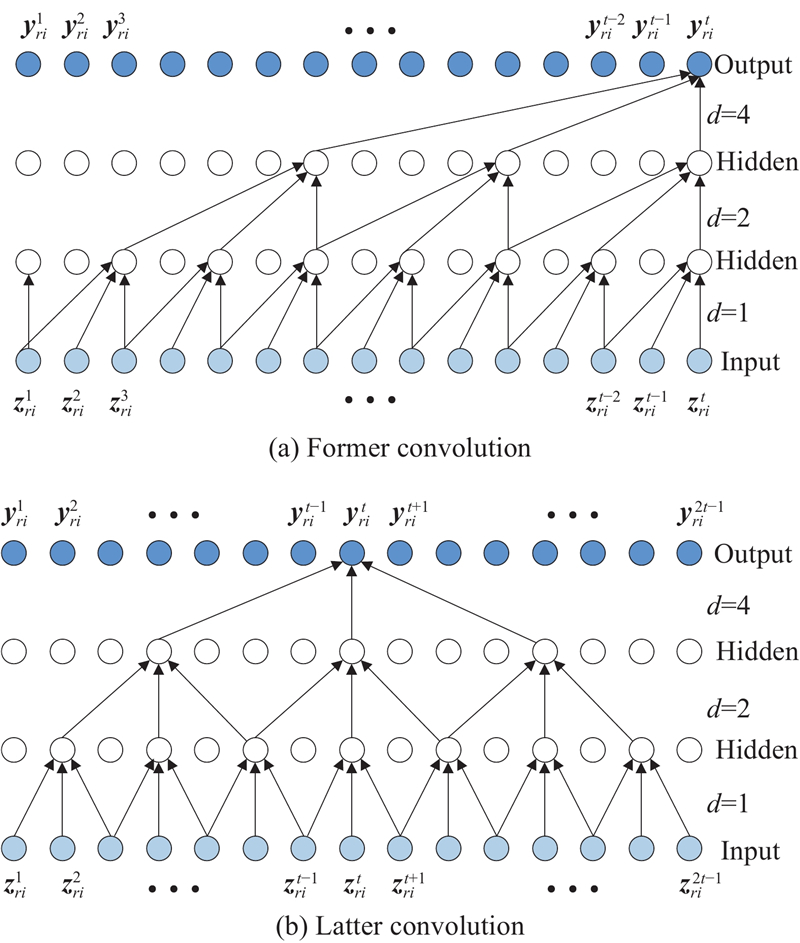
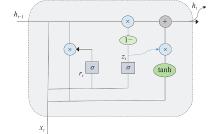
Fig 4
GRU structure"
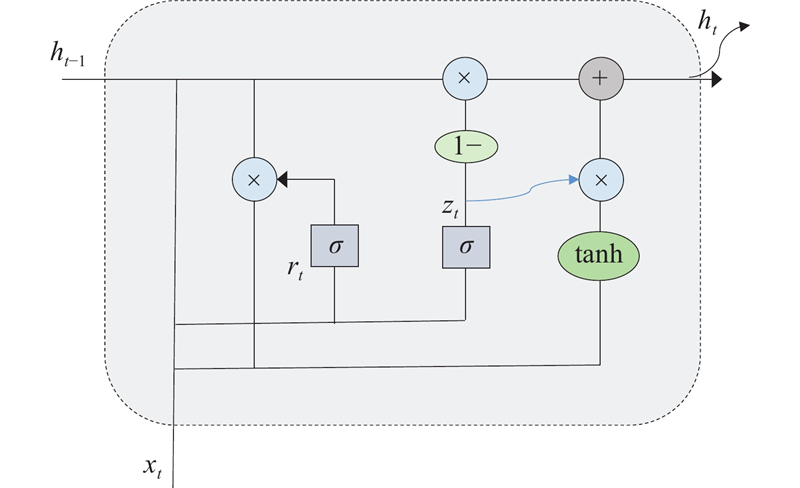
Table 1
Improvement of parameters %"
| Network | Accuracy | Precision | Recall | F1 |
| One-channel TCN | 87.53 | 85.20 | 86.91 | 85.53 |
| Dual-channel TCN | 94.14 | 92.32 | 91.96 | 91.68 |
| TCN-GRU | 92.72 | 88.68 | 89.28 | 88.98 |
| Improved conv | 89.64 | 88.85 | 90.36 | 89.60 |
| Final network | 96.67 | 96.12 | 95.52 | 95.81 |
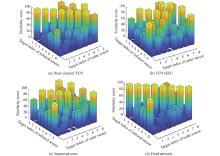
Fig 5
Improved network’s abilities"
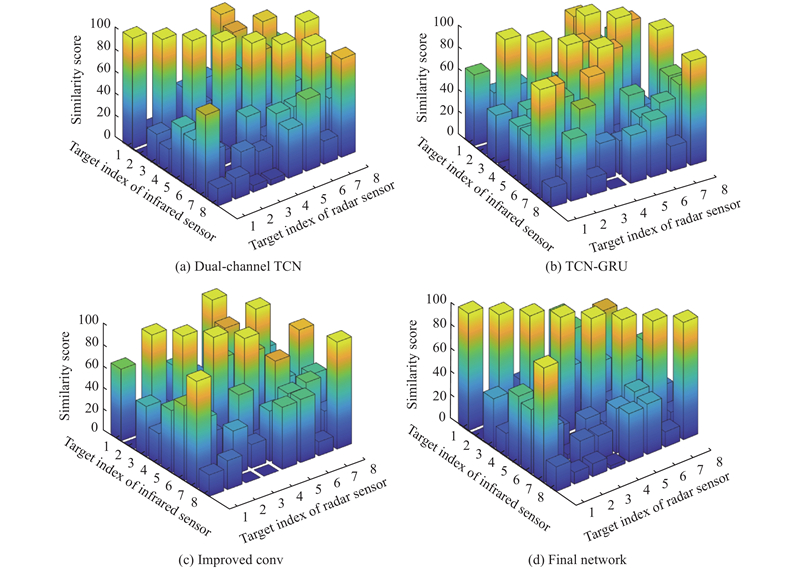
Table 2
Association accuracy of each algorithm %"
| Algorithm | Scenario 1 | Scenario 2 |
| Murty | 73.45 | 64.09 |
| GNN | 83.26 | 71.72 |
| LSTM | 82.85 | 73.72 |
| CNN-LSTM | 84.67 | 75.91 |
| TCN-GRU | 91.53 | 80.87 |
| Proposed algorithm | 96.38 | 87.16 |
Table 3
Association error rate of each algorithm %"
| Algorithm | Scenario 1 | Scenario 2 |
| Murty | 17.38 | 26.63 |
| GNN | 12.20 | 20.01 |
| LSTM | 11.51 | 18.72 |
| CNN-LSTM | 10.32 | 15.22 |
| TCN-GRU | 6.47 | 13.93 |
| Proposed algorithm | 2.73 | 9.79 |
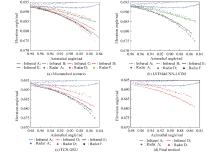
Fig 6
Mismatched scenario and methods results"
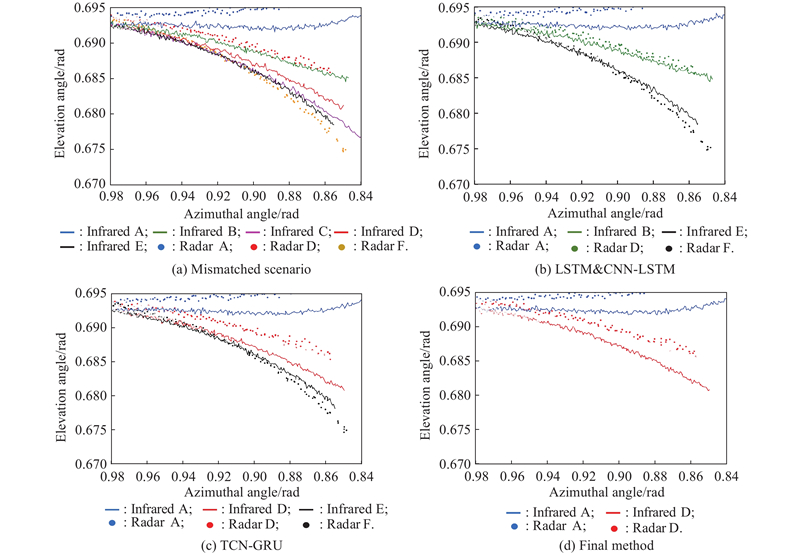
Table 4
Complexity and timeliness"
| Algorithm | Parameter number/MB | Computational cost/GFLOPs | Processing time/s |
| Murty | − | − | 6.26 |
| GNN | − | − | 4.68 |
| LSTM | 12.83 | 5.34 | 10.21 |
| CNN-LSTM | 29.4 | 11.13 | 12.75 |
| TCN-GRU | 7.31 | 3.89 | 6.18 |
| Final method | 7.31 | 3.90 | 6.87 |
| 36 | YAO Y Q, ZHANG J, DU P, et al. A galaxy image augmentation method based on few-shot learning and generative adversarial networks. Research in Astronomy and Astrophysics, 2024, 24(3): 035015. |
| 37 |
SUN J Domain knowledge enhanced deep learning for electrocardiogram arrhythmia classification. Frontiers of Information Technology & Electronic Engineering, 2023, 24 (1): 59- 72.
doi: 10.1631/FITEE.2100519 |
| 1 | LI Y L, ZHANG T S Summary of multi-sensor track association algorithms. Ship Electronic Engineering, 2021, 41 (8): 44- 45. |
| 2 | LIGGINS M E, HALL D L, LLINAS J. Handbook of multisensor data fusion: theory and practice. Boca Raton: CRC Press, 2009. |
| 3 | TIAN W, WANG Y, SHAN X M, et al Analytic performance prediction of track-to-track association with biased data in multi-sensor multi-target tracking scenarios. Sensors, 2013, 13 (9): 12444- 12465. |
| 4 |
SUN G, PEI S S, LONG Q, et al Disparity estimation for multi-scale multi-sensor fusion. Journal of Systems Engineering and Electronics, 2024, 35 (2): 259- 274.
doi: 10.23919/JSEE.2023.000101 |
| 5 | BREKKE E F, TOKLE L C N. Hypothesis exploration in multiple hypothesis tracking with multiple clusters. Proc. of the IEEE 25th International Conference on Information Fusion, 2022. |
| 6 |
SINHA A, DING Z, KIRUBARAJAN T, et al Track quality based multitarget tracking approach for global nearest-neighbor association. IEEE Trans. on Aerospace and Electronic Systems, 2012, 48 (2): 1179- 1191.
doi: 10.1109/TAES.2012.6178056 |
| 7 |
SUN K, CHEN Y H, WU W H, et al A multi-target tracking algorithm based on Gaussian mixture model. Journal of Systems Engineering and Electronics, 2020, 31 (3): 482- 487.
doi: 10.23919/JSEE.2020.000020 |
| 8 |
BLOM H A P, BLOEM E A Modified joint probabilistic data association avoiding track coalescence. IEEE Trans. on Automatic Control, 2000, 45 (2): 247- 259.
doi: 10.1109/9.839947 |
| 9 |
GUAN X, HE Y, XIAO Y Gray track-to-track correlation algorithm for distributed multi-target tracking system. Systems Engineering and Electronics, 2006, 26 (11): 3448- 3455.
doi: 10.1016/j.sigpro.2006.03.001 |
| 10 | BERNDT R J. Aircraft micro-Doppler feature extraction from high range resolution profiles. Proc. of the IEEE Radar Conference, 2016: 457−462. |
| 11 | HU R H, SAMIR B, HICHEM S, et al. Multiple cues association for multiple object tracking based on convolutional neural network. Proc. of the IEEE Second International Conference on Artificial Intelligence and Knowledge Engineering, 2019: 117−122. |
| 12 | LIU H J, ZHANG H, MERTZ C. DeepDA: LSTM-based deep data association network for multi-targets tracking in clutter. Proc. of the 22th International Conference on Information Fusion, 2019. DOI: 10.23919/FUSION43075.2019.9011217. |
| 13 | LU Z H. Establishment and simulation verification of a universal ballistic model for missiles. Changsha: National University of Defense Technology, 2009. (in Chinese) |
| 14 |
YE F, MAO Y, LI Y B, et al Target threat estimation based on discrete dynamic Bayesian networks with small samples. Journal of Systems Engineering and Electronics, 2022, 33 (5): 1135- 1142.
doi: 10.23919/JSEE.2022.000076 |
| 15 |
WANG J, ZENG Y J, WEI S M, et al Multi-sensor track-to-track association and spatial registration algorithm under incomplete measurements. IEEE Trans. on Signal Processing, 2021, 69 (3): 337- 350.
doi: 10.1109/tsp.2021.3084533 |
| 16 | KROPFREITER T, MEYER F, CORALUPPI S, et al Track coalescence and repulsion in multi-target tracking: an analysis of MHT, JPDA, and belief propagation methods. IEEE Open Journal of Signal Processing, 2024, 5, 1- 17. |
| 17 | TOKAT A, KOKSAL H A. A fast track-to-track association algorithm by sequence processing of target states. Proc. of the IEEE 21st International Conference on Information Fusion, 2018: 1280−1284. |
| 18 | LI L F, CHENG T Debiased conversion measurements based target tracking with direction cosine measurements. Journal of Systems Engineering and Electronics, 2022, 33 (6): 1140- 1150. |
| 19 | ZENG Y J, WANG J, WEI S M, et al Review of the method for distributed multi-sensor multi-target tracking. Journal of Radars, 2023, 12 (1): 197- 213. |
| 20 | ZHANG X L, XUE S B, DU G Y, et al Identity recognition method of cluster targets for heterogeneous sensors. Modern Defence Technology, 2021, 49 (5): 51- 55. |
| 21 | CUI Y Q, HE Y, TANG T, et al A deep learning track correlation method. Acta Electronica Sinica, 2022, 50 (3): 759- 763. |
| 22 | LV J F, YU Z L, LIU Y F, et al GTAN: graph-based tracklet association network for multi-object tracking. Neural Computing and Applications, 2023, 36 (8): 3889- 3902. |
| 23 | YANG Y T, LIANG Y, YANG Y B, et al. Asynchronous track-to-track association algorithm based on dynamic time warping distance. Proc. of the 34th Chinese Control Conference, 2015: 4772−4777. |
| 24 | WEI B, FAN Y Q A track correlation algorithm based on Siamese network. Journal of Terahertz Science and Electronic Information Technology, 2022, 20 (12): 1292- 1297. |
| 25 |
LU W X, JIN J, WANG B Y, et al Intelligence in tourist destinations management: Improved attention-based gated recurrent unit model for accurate tourist flow forecasting. Sustainability, 2020, 12 (4): 1390- 1401.
doi: 10.3390/su12041390 |
| 26 |
DI F Q, YU H L, ZHONG Z H, et al Counting of alpha particle tracks on imaging plate based on a convolutional neural network. Nuclear Science and Techniques, 2023, 34 (3): 596- 603.
doi: 10.1007/s41365-023-01190-7 |
| 27 | HEWAGE P, BEHERA A, TORVATI M, et al. Temporal convolutional network for an effective weather forecasting using time-series data from the local weather station. Soft Computing, 2020, 24(21): 16453−16482. |
| 28 |
ZHANG C J, LIU Y C, SI W J PRI modulation recognition and sequence search under small sample prerequisite. Journal of Systems Engineering and Electronics, 2023, 34 (3): 706- 713.
doi: 10.23919/JSEE.2023.000007 |
| 29 |
YE J H, XUE S J, JIANG A W Attention based spatio-temporal graph convolutional network considering external factors for multi-step traffic flow prediction. Digital Communications and Networks, 2022, 8 (3): 343- 350.
doi: 10.1016/j.dcan.2021.09.007 |
| 30 | CHUNG J, GULCEHRE C, CHO K H, et al. Empirical evaluation of gated recurrent neural networks on sequence modeling. arXiv: 1412.3555, 2014. |
| 31 | GAO G L, LI Y, ZHOU X Y, et al Deep learning-based subseasonal to seasonal precipitation prediction in southwest China: algorithm comparison and sensitivity to input features. Earth and Planetary Physics, 2023, 7 (4): 471- 486. |
| 32 |
LIU J, LIU J C Integrating deep learning and logging data analytics for lithofacies classification and 3D modeling of tight sandstone reservoirs. Geoscience Frontiers, 2022, 13 (1): 350- 363.
doi: 10.1016/j.gsf.2021.101311 |
| 33 |
WEI T, WANG Y, SHAN X M, et al Track-to-track association for biased data based on the reference topology feature. IEEE Signal Process. Letters, 2014, 21 (4): 449- 453.
doi: 10.1109/LSP.2014.2305305 |
| 34 | XU Y S, DING C B, REN W J, et al Multi-feature combination track-to-track association based on histogram statistics feature. Journal of Radars, 2019, 8 (1): 25- 35. |
| 35 |
SINGER R A, SEA R G, HOUSEWRIGHT K B Derivation and evaluation of improved tracking filter for use in clustered multi-target environments. IEEE Trans. on Information Theory, 1974, 20 (4): 423- 432.
doi: 10.1109/TIT.1974.1055256 |
| [1] | Jie YAN, Yingmei WEI, Yuxiang XIE, Quanzhi GONG, Shiwei ZOU, Xidao LUAN. The brief self-attention module for lightweight convolution neural networks [J]. Journal of Systems Engineering and Electronics, 2025, 36(6): 1389-1397. |
| [2] | Shichang WAN, Hao LI, Yahui HU, Xuhua WANG, Siyuan CUI. A multi target intention recognition model of drones based on transfer learning [J]. Journal of Systems Engineering and Electronics, 2025, 36(5): 1247-1258. |
| [3] | Hong WANG, Delanyo Kwame Bensah KULEVOME, Zi’an ZHAO. An integrated PHM framework for radar systems through system structural decomposition [J]. Journal of Systems Engineering and Electronics, 2025, 36(1): 95-107. |
| [4] | Chuanfei ZANG, Yumiao WANG, Xiang WANG, Congan XU, Guolong CUI. Sea clutter suppression via cuttable encoder-decoder-augmentation network [J]. Journal of Systems Engineering and Electronics, 2024, 35(6): 1428-1440. |
| [5] | Yuxiang XIE, Quanzhi GONG, Xidao LUAN, Jie YAN, Jiahui ZHANG. A survey of fine-grained visual categorization based on deep learning [J]. Journal of Systems Engineering and Electronics, 2024, 35(6): 1337-1356. |
| [6] | Ai GAO, Shengnan XU, Zichen ZHAO, Haibin SHANG, Rui XU. Fault diagnosis method of link control system for gravitational wave detection [J]. Journal of Systems Engineering and Electronics, 2024, 35(4): 922-931. |
| [7] | Rong FAN, Chengke SI, Yi HAN, Qun WAN. RFFsNet-SEI: a multidimensional balanced-RFFs deep neural network framework for specific emitter identification [J]. Journal of Systems Engineering and Electronics, 2024, 35(3): 558-574. |
| [8] | Xinwei OU, Zhangxin CHEN, Ce ZHU, Yipeng LIU. Low rank optimization for efficient deep learning: making a balance between compact architecture and fast training [J]. Journal of Systems Engineering and Electronics, 2024, 35(3): 509-531. |
| [9] | Guoliang SUN, Shanshan PEI, Qian LONG, Sifa ZHENG, Rui YANG. Disparity estimation for multi-scale multi-sensor fusion [J]. Journal of Systems Engineering and Electronics, 2024, 35(2): 259-274. |
| [10] | Dada ZHAO, Kai DING, Xiaogang QI, Yu CHEN, Hailin FENG. Sound event localization and detection based on deep learning [J]. Journal of Systems Engineering and Electronics, 2024, 35(2): 294-301. |
| [11] | Xiaolong XU, Shuai JIANG, Jinbo ZHAO, Xinheng WANG. DCEL: classifier fusion model for Android malware detection [J]. Journal of Systems Engineering and Electronics, 2024, 35(1): 163-177. |
| [12] | Luyang BAI, Jun WANG, Xiaoling CHEN. Ambiguity function analysis and side peaks suppression of Link16 signal based passive radar [J]. Journal of Systems Engineering and Electronics, 2023, 34(6): 1526-1536. |
| [13] | Xi LONG, Weiwei CAI, Leping YANG, Tianyu WANG. Mission scheduling of multi-sensor collaborative observation for space surveillance network [J]. Journal of Systems Engineering and Electronics, 2023, 34(4): 906-923. |
| [14] | Yufeng CUI, Yongliang WANG, Weijian LIU, Qinglei DU, Xichuan ZHANG, Xuhui LI. A tunable adaptive detector for distributed targets when signal mismatch occurs [J]. Journal of Systems Engineering and Electronics, 2023, 34(4): 873-878. |
| [15] | Yuyuan ZHANG, Wenjun YAN, Limin ZHANG, Qing LING. FOLMS-AMDCNet: an automatic recognition scheme for multiple-antenna OFDM systems [J]. Journal of Systems Engineering and Electronics, 2023, 34(2): 307-323. |
| Viewed | ||||||
|
Full text |
|
|||||
|
Abstract |
|
|||||
